絵でわかる日本語
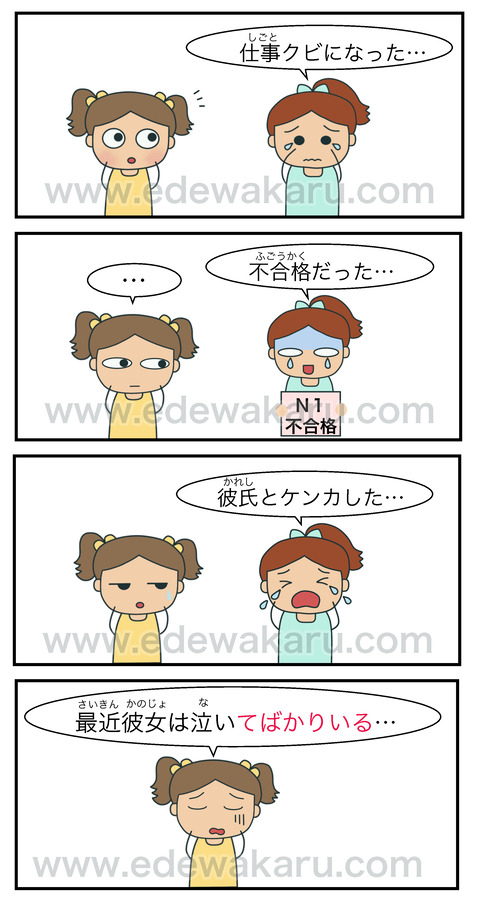
Meaning
Do 〜 repeatedly
Always be doing 〜
How to use it
Verb [て-form] + ばかりいる
Verb [て-form] + ばかりだ
Explanation
“〜てばかりいる” means “do 〜 repeatedly” or “always be doing 〜,” and is used when someone does the same thing over and over or always does the same thing. 😊 “〜ばかり” is similar to “だけ” and “のみ,” which express limitation, but the “ばかり” in “〜てばかりいる” cannot be changed to “だけ” or “のみ,” so be careful. 😨
[Examples]
⭕️ She does nothing but cry.
❌ She only cries.
❌ She cries only.
Also, this pattern is used with negative feelings, such as criticism or reproach. (Review: 〜を込めて・〜を込めた)
[Examples]
She is always studying.
[Positive meaning: She’s always studying; how diligent! 😮]
[Negative meaning: She’s always studying; what a boring person. 😒]
She does nothing but study.
[Positive meaning: None]
[Negative meaning: She’s always studying; what a boring person. 😒]
[Additional explanation]
Besides “〜てばかりいる” and “〜てばかりだ,” there is also the form “〜ばかり〜する・している.” 😊
I do nothing but drink juice.
I do nothing but drink juice.
I drink nothing but juice.
I do nothing but play games.
I do nothing but play games.
I only play games / I’m always playing games.
The three examples above are used with the same meaning. 😀
[For those who want to learn more]
“〜てばかりいる” can be changed to “ばっかり” or “ばっか,” the colloquial forms of “ばかり.” 😉 If you have forgotten these, review them. 😀 (Review: Colloquial forms 〜ばっかり・〜ばっか)
[“ばかり” patterns]
〜たばかり
〜てばかりいる・〜てばかりだ
〜てばかりはいられない・〜てばかりもいられない
〜と言わんばかりに・〜とばかりに
〜とばかり思っていた
〜とばかりは言えない
〜ばかり (quantity word + ばかり)
〜ばかりだ
〜ばかりだ (preparations completed)
〜ばかりで
〜ばかりでなく〜も
〜ばかりに
〜ばかりの (figurative use)
〜ばかりは
〜んばかり
In context 3 examples
最近彼女は泣いてばかりいる
→最近彼女はいつも泣いているRecently, she does nothing but cry. → Recently, she is always crying.
お母さんは怒ってばかりだ
→お母さんはいつも怒っているMom does nothing but get angry. → Mom is always angry.
お父さんは休みの日は寝てばかりいる
→お父さんは休みの日はいつも寝ているOn his days off, Dad does nothing but sleep. → On his days off, Dad is always sleeping.
Read the original source text
Meaning
何度も〜する
いつも〜している
How to use it
動詞[て形]+ばかりいる
動詞[て形]+ばかりだ
Explanation
「〜てばかりいる」は「何度も〜する」「いつも〜している」というように、同じことを何度もする時や、いつも同じことをする時に使います😊「〜ばかり」は限定の「だけ」「のみ」に似ていますが、
「〜てばかりいる」の「ばかり」は「だけ」や「のみ」にチェンジすることはできませんので気を付けてください
😨
[例]
⭕️彼女は泣い
てばかりいる
❌彼女は泣い
てだけいる
❌彼女は泣い
てのみいる
また、
この文型は批判や非難など、マイナスの気持ちを込めて(復習:〜を込めて・〜を込めた)使われます。
[例]
彼女は
いつも
勉強し
ている
【いい意味:いつも勉強していてえらいな〜😮】
【悪い意味:いつも勉強していてつまらない人だ😒】
彼女は勉強し
てばかりいる
【いい意味:
なし】
【悪い意味:いつも勉強していてつまらない人だ😒】
【補足説明】
「〜てばかりいる」「〜てばかりだ」以外に「〜ばかり〜する・している」という形もあります
😊
ジュースを飲ん
でばかりいる
ジュースを飲ん
でばかりだ
ジュース
ばかり
飲ん
でいる
ゲームをし
てばかりいる
ゲームをし
てばかりだ
ゲーム
ばかりする
・ゲーム
ばかりしている
上の3つの例文は同じ意味で使用されます😀
【余裕がある人へ】
「〜てばかりいる」は「ばかり」の口語形「ばっかり」「ばっか」にチェンジすることができます
😉忘れてしまった人は復習しておいてください😀(復習:「口語形」〜ばっかり・〜ばっか)
【「ばかり」シリーズ】
〜たばかり
〜てばかりいる・〜てばかりだ
〜てばかりはいられない・〜てばかりもいられない
〜と言わんばかりに・〜とばかりに
〜とばかり思っていた
〜とばかりは言えない
〜ばかり(数量詞+ばかり)
〜ばかりだ
〜ばかりだ(準備完了)
〜ばかりで
〜ばかりでなく〜も
〜ばかりに
〜ばかりの(比喩)
〜ばかりは
〜んばかり