AIUEO JLPT Grammar
Meaning
「〜め」 connects to the stem of adjectives to emphasize their degree or characteristic.
How to use it
Adjective stem + め
In context 5 examples
彼女は辛めの料理が好きだ。
She likes food that’s a bit on the spicy side.
この服は少し暗めだから、もっと明るい色にしたい。
This outfit is a little dark, so I'd like to change it to a lighter color.
この絵は青めの色を多く使っている。
This painting uses a lot of blue tones.
このシャツは大きめだから、もう少し小さいサイズが欲しい。
This shirt is a bit large, so I’d like a smaller size.
今日のスープは塩味が強めだね。
Today’s soup is a bit salty.
Read the original source text
Meaning
「〜め」 connects to the stem of adjectives to emphasize their degree or characteristic.
How to use it
形容詞語幹+め
Explanation · 日本語
「〜め」は、形容詞の語幹に接続して使われ、その形容詞が表す性質や特徴が強調される時に使われる表現です。
絵でわかる日本語
Usage 1
Read this source entry ↗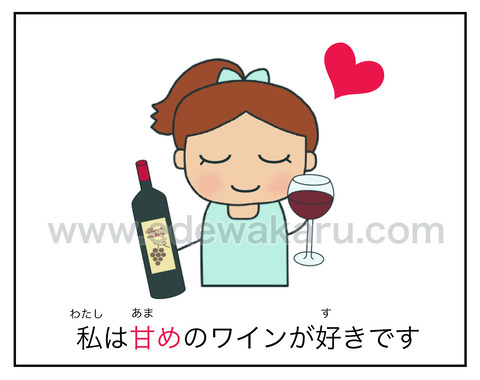
Meaning
Slightly ~ (degree/state)
How to use it
Verb [ます-form] + め
い-adjective [remove い] + め
な-adjective [remove な] + め
Explanation
When “〜め” is used with an adjective or verb that expresses degree, it means “slightly ~” or “in a somewhat ~ state” 😮 This “〜め” is written with the kanji “目,” but in most cases it is written in hiragana as “め.” Also, it is rarely used with な-adjectives; with adjectives, it is mostly used with い-adjectives 😀
In context 4 examples
私は甘めのワインが好きです
→私は少し甘いワインが好きですI like slightly sweet wine. →I like wine that is a little sweet.
今日のカレーはいつもより辛めだ
→今日のカレーはいつもより少し辛いToday’s curry is a little spicier than usual. →Today’s curry is slightly spicy compared to usual.
赤やピンクなどの派手めな色の服は着たことがありません
→赤やピンクなどの少し派手な色の服は着たことがありませんI’ve never worn clothes in somewhat flashy colors such as red or pink. →I’ve never worn clothes in colors that are a little flashy, such as red or pink.
健康のことを考えて、最近は塩分控えめの食事にしています
→健康のことを考えて、最近は塩分を少し控えた食事にしています(*控える:少なくするという意味)For the sake of my health, I’ve recently been eating meals with slightly reduced salt. →For the sake of my health, I’ve recently been eating meals with a little less salt (*控える means “to reduce”).
Read the original source text
Meaning
少し〜(程度・状態)
How to use it
動詞[ます形]+ め
い形容詞[ーい]+め
な形容詞[ーな]+め
Explanation
「〜め」は程度を表す形容詞や動詞と一緒に使うと「少し〜の状態」という意味になります
😮この「〜め」は漢字で書くと「目」ですが、ほとんどの場合は「め」とひらがなで書かれます。また「な形容詞」に使われることが少なく、形容詞の場合はほとんどが「い形容詞」に使われます😀
Usage 2
Read this source entry ↗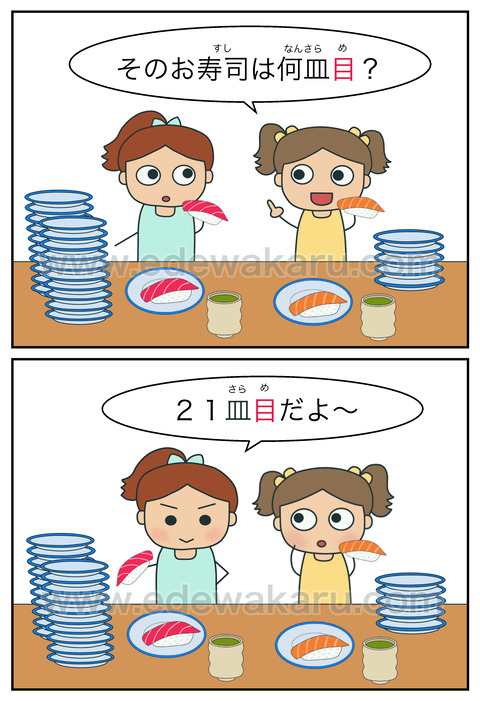
Meaning
Expresses order
How to use it
Numeral + 目
Explanation
“〜目” is attached to a counter to express order or sequence. It is generally written in kanji, as “〜目” 😊
“〜目” can also mean “a little〜” 😮 In that case, it is written in hiragana as “〜め.” The meaning is different too, so be sure to distinguish and learn the two uses 😉
(Review: 〜め)
In context 4 examples
A:そのお寿司は何皿目?B:21皿目だよ〜
A: Which plate of sushi is that? B: The 21st plate!
3つ目の信号を左に曲がってください
Please turn left at the third traffic light.
彼が遅刻したのは、これで4回目だ
This is the fourth time he’s been late.
ダイエットをすることにした。今日で10日目だ…今のところ続いている(復習:〜ことにする)(復習:〜ところ(Nのところ))
I decided to go on a diet. Today is day 10… I’ve kept it up so far (Review: 〜ことにする) (Review: 〜ところ (Nのところ)).
Read the original source text
Meaning
順番を表す
How to use it
数量詞+目
Explanation
「〜目」は、数量詞について順序や順番を表します。 「〜目」というように、漢字で書くのが一般的です😊
「〜目」には、他にも「少し〜」という意味もあります
😮この場合は「〜め」というように、ひらがなで書かれます。意味も違いますので、しっかりと区別をして覚えておきましょう😉
(復習:〜め)
IMABI
The Affix ~め
Read this IMABI lesson ↗Explanation
The Affix ~め
In this lesson, we will learn about the various usages of the affix ~め, which we have already seen used to stand for the “-th” in Japanese ordinal numbers. What may come as a surprise is that the usages discussed in this lesson are all etymologically tied to the word 目 with the primary meaning of “eye,” which also explains why it is an appropriate spelling for all its usages.
秤の目 → Unit of Measure → Sequence
The ability of ~め to denote ordinal numbers ultimately derives from the phrase 秤の目 meaning “mark” on a device to measure length/weight. Just how “eyeing” it can be used as a means of indicating measure in English, this is precisely how 目 has found itself in many “weight” related words such as 量目 (weight from a scale), 目方 (quantity that has been “weighed out”), etc. This even produced the weight measure word 匁(=文目1), which was equivalent to 3.75 grams. When referring to 匁 in increments of perfect multiples of ten, it was customary to simply say 目.
1. 銀一貫五百目寄付す。
Donated 1,500 momme of silver.
With its ability to indicate measurements established, some quantities are naturally sequential. For instance, when demarcating a quantity of years, 3年目 would be an “amount of three years accounted for,” which we understand to mean “third year.” This is the basis for how and why ~め denotes cardinal numbers with all counters.
2. 色違いポケモンをゲットできました。スタートしてから30匹目です!!
I was able to catch a shiny Pokémon! It’s the 30th I’ve caught since starting!!
3. あなたの社会人一日目は、どんな一日でしたか?
What was your first day like as a working adult?
4. 東京を出てから何年目になるだろう。
How many years has it been since I left Tokyo?
Point of Change/Contact
Similarly to demarcating measurements with ruler/scale marks, the affix ~め may also denote a point of change or the “point” where said situation is evident. In these contexts, ~め can constitute a boundary where physical objects come in contact (when following a noun) or the boundary where an action has not occurred and is now occurring (when following the 連用形 of verbs).
5. 縫い目が解れたら、接着剤や補修剤で縫い目を固めるか縫いなおすこと。
If a stich comes undone, you will need to fix it with glue or a repair agent, or sew it back together.
6.「夏至」と「冬至」で二至、「春分」と「秋分」で二分、合わせて二至二分と呼び、季節の変わり目として非常に重要なものです。
The “summer solstice” and the “winter solstice” make up the two solstices, and the “vernal equinox” and the “autumnal equinox” make up the two equinoxes, and they are very important as the turning points between the seasons.
7. 惣体が茶色がかって既に多少の時代を帯びている上に、古風なかんじん2撚で丁寧な結び目がしてあった。
The whole thing was brownish and had already shown signs of age, and on top of that, it was neatly knotted with old-fashioned twisted-paper string.
From 『道草』by 夏目漱石.
8. 彼は親の死目にさえ会わなかった。
He didn’t even see the death of his own parents.
From 『道草』by 夏目漱石.
9. その本の読んでもらいたい部分に折り目をつけておきました。
I made creases in the parts of the book that I wanted (them) to read.
10. 知能指数は高かったが、学業成績は及落の境目だった。
Although (their) IQ was high, (their) academic performance was on the borderline between poor and good.
To a lesser degree, ~め may indicate the “point” at which a possibility becomes evident, which is the case in the phrase 勝ち目, meaning “chance of winning.” This, though, does logically fall in line with the aforementioned examples, as when one begins to go down the path to victory, victory has not been one yet, and it is the temporal trajectory of the verb 勝つ itself that helps us understand the “boundary” that is being denoted by ~め.
11. 遺産がほしい元夫には、孤立無援で勝ち目はあるのか?
Is there any chance of the ex-husband, who wants his inheritance, can win by himself without support?
“Somewhat”
The affix ~め may also appear after the stems of select adjectives, adjectival nouns, as well as some adverbs and the 連用形 of some verbs to indicate a degree that is “somewhat” so. The resultant expressions made by this affix are ナ・ノ-type adjectival nouns, and they may even be used as standalone nouns, in which case ~め may be viewed as a nominalizing affix.
The largest subset of words used with this meaning of ~め is constituted by adjectives which describe basic attributes (属性形容詞) such as age, quantity, color, dimensions, etc.
~め cannot be attached to all adjectives, adjectival nouns, and verbs. In fact, it is almost as restricted in number as the affix ~み. However, ~め is arguably more frequently used in the spoken language given its meaning of “somewhat.”
Though not exhaustive, the lists of words below constitute most instances of this grammar point. Note that while all instances of ~め may be spelled in kanji as 目, this is especially common with Sino-Japanese vocabulary and when it attaches to the 連用形 of verbs, and this is reflected in the spellings below.
+~めApproximation+~めApproximation
短めshortish長めlongish
細めthinnish太めplump
近めfairly close遠めfairly distant
丸めroundish四角めsquarish
薄めrather light/pale;
on the weak side厚めon the thick side
浅めon the shallow side深めon the deep side
小さめsmallish大きめlargish
濃いめ※on the strong/thick side少なめeasy (amount) on
多めquite a lot白めsomewhat white
黒めblackish青めbluish
赤めreddish黄色めyellowish
辛め3hottish; kind of salty硬めsomewhat hard/firm
柔らかめon the soft side明るめon the bright side
暗めrather dim軽めrather light
重めrather heavy早めon the early side
遅めon the late side易しめon the easy side
粗めsomewhat coarse荒めsomewhat rough
若めyoungish古めsomewhat old
難しめon the difficult sideデカめrather huge
綺麗目rather pretty無理目pretty unfeasible
控え目mild-mannered抑え目reserved
落ち目on the waneゆっくりめon the slow side
熱め (△)on the hotter side
※The affix ~め is irregular with the adjective 濃い, forming 濃いめ as opposed to 濃め.
12. 冬は土を深めに掘り返す『天地返し』を行います。
During winter, we “turn the soil” by digging up the soil fairly deep.
13. 確かに武士には肌が黒めの方が多かったのは事実ですが、それは黒人だからということはなく、純血の日本人でも日焼けしまくった結果そうなったと言うだけのことなんです。
While it is a fact that many samurai had darker skin, this was not because they were “black”; it was simply because even full-blooded Japanese ended up with darker skin as a result of excessive tanning.
14. 歌詞に英語が多めの日本のバンドがたくさんあります。
There are lots of bands in Japan whose lyrics contain quite a lot of English.
15. 血色メイクとは違い、色素薄めのメイクです!
Unlike complexion makeup, this makeup is on the light side with pigmentation!
16. 厚めの豚バラ肉のサムギョプサルのレシピをご紹介したいと思います!
I’d like to introduce you to a recipe for samgyeopsal that uses thick pork belly!
17. 少し明かるめの色を使ってハイライトを入れる方法があります。
There is a method for adding highlights by using slightly lighter colors.
18. いつもよりやや辛めだわ。
It’s a tad spicier than usual.
19. やや大きめな寿司を、グワ~ッと大きな口を開けてひとくちで頂いてみると、うん、組み合わされた食材が口の中でちゃんとお好み焼きの味になってる。
When opened my mouth wide and took a bit of the rather large piece of sushi, yeah, the combined ingredients really did taste like okonomiyaki in my mouth.
20. 誕生日プレゼントに小さめな物はダメですか?
Is it not okay to give a smallish birthday present?
21. 麺は{柔らかめ・硬めで}お願いします。
I’d like for my noodles to be {soft/hard}, please.
22. デカめのイオンが見えてる。
I’m able to see a fairly large AEON (from here).
23. 濃いめのコーヒードリンクが好きな方は、エスプレッソのショットを追加してみてください。逆にあまり濃くないのが好きな方は、「エスプレッソ少なめ」という風に注文してみてください。
If you like your coffee stronger, try adding an extra shot of espresso. If you like your coffee not so strong, try ordering yours by asking for “less espresso.”
As briefly mentioned above, these ~め forms can be even be utilized as standalone nouns, especially with the pattern ~がいい.
24. 枕は硬め4がいいの?
Are firmer pillows best?
25. おしゃれは派手めがちょうどいい。
When it comes to being trendy, being a tad flashy is just right.
粗目 read as ざらめ meaning “granulated sugar” also derives from this grammar point.
26. 「白砂糖の大さじ1」をザラメで代用する場合は、大さじではどれくらいの量になりますか。
If you were to substitute granulated sugar for “1 tablespoon of white sugar,” how many tablespoons would that be?
27. 湯加減はどう?ちょっと熱めにしてやったよ。
How’s the bathwater? I made sure it was on the even hotter side.
Miscellaneous め
In conclusion, we will look at other morphemes in Japanese that also happen to be /me/, just so that you do not incidentally relate them to ~目.
■ め【海藻・海布】= Seaweed
28. ワカメならではの雰囲気を楽しめます!
You can enjoy the unique feel unique to wakame seaweed!
■ め【芽】= Sprout
29. 種から芽が出ているかどうかは農林水産省の試験官が確認します。
Inspectors from the Ministry of Agriculture, Forestry and Fisheries will confirm whether the seeds have sprouted.
■ め【女】= Female
30. 自由の女神の頂上部である「王冠」に登るためのチケットの確保は争奪戦になっています。
A fierce competition is underway to secure tickets to climb to to the top of the Statue of Liberty, her “Crown.”
There is also a suffix ~め, which when it is applied to the first-person pronoun わたくし is used to humble oneself, but when it is applied to other people, it is highly insulting and used to make swears worse.
31. 私めの報告は道すがらお話しするとしましょう。
I shall give you my report along the way.
32. この大馬鹿野郎めが!
Why, you big stupid-ass bastard!!
One momme is equivalent to 3.75 grams. When referring to 匁 in increments of perfect multiples of ten, it was customary to simply say ~目. ↩︎
かんじん{撚・縒} derives from 観世{撚・縒}, and it exhibits various other dialectal variants. The word itself refers to twisting thinly cut pieces of paper into a string, which translates into English as a “twisted-paper string.” ↩︎
辛め may also idiomatically refer to grading “rather harshly.” ↩︎
This is an example of a ~め phrase being used as a noun. ↩︎
In context 32 examples
銀一貫五百目寄付す。
Donated 1,500 momme of silver.
色違いポケモンをゲットできました。スタートしてから30匹目です!!
I was able to catch a shiny Pokémon! It’s the 30th I’ve caught since starting!!
あなたの社会人一日目は、どんな一日でしたか?
What was your first day like as a working adult?
東京を出てから何年目になるだろう。
How many years has it been since I left Tokyo?
縫い目が解れたら、接着剤や補修剤で縫い目を固めるか縫いなおすこと。
If a stich comes undone, you will need to fix it with glue or a repair agent, or sew it back together.
「夏至」と「冬至」で二至、「春分」と「秋分」で二分、合わせて二至二分と呼び、季節の変わり目として非常に重要なものです。
The “summer solstice” and the “winter solstice” make up the two solstices, and the “vernal equinox” and the “autumnal equinox” make up the two equinoxes, and they are very important as the turning points between the seasons.
惣体が茶色がかって既に多少の時代を帯びている上に、古風なかんじん2撚で丁寧な結び目がしてあった。
The whole thing was brownish and had already shown signs of age, and on top of that, it was neatly knotted with old-fashioned twisted-paper string.
彼は親の死目にさえ会わなかった。
He didn’t even see the death of his own parents.
その本の読んでもらいたい部分に折り目をつけておきました。
I made creases in the parts of the book that I wanted (them) to read.
知能指数は高かったが、学業成績は及落の境目だった。
Although (their) IQ was high, (their) academic performance was on the borderline between poor and good.
遺産がほしい元夫には、孤立無援で勝ち目はあるのか?
Is there any chance of the ex-husband, who wants his inheritance, can win by himself without support?
冬は土を深めに掘り返す『天地返し』を行います。
During winter, we “turn the soil” by digging up the soil fairly deep.
確かに武士には肌が黒めの方が多かったのは事実ですが、それは黒人だからということはなく、純血の日本人でも日焼けしまくった結果そうなったと言うだけのことなんです。
While it is a fact that many samurai had darker skin, this was not because they were “black”; it was simply because even full-blooded Japanese ended up with darker skin as a result of excessive tanning.
歌詞に英語が多めの日本のバンドがたくさんあります。
There are lots of bands in Japan whose lyrics contain quite a lot of English.
血色メイクとは違い、色素薄めのメイクです!
Unlike complexion makeup, this makeup is on the light side with pigmentation!
厚めの豚バラ肉のサムギョプサルのレシピをご紹介したいと思います!
I’d like to introduce you to a recipe for samgyeopsal that uses thick pork belly!
少し明かるめの色を使ってハイライトを入れる方法があります。
There is a method for adding highlights by using slightly lighter colors.
いつもよりやや辛めだわ。
It’s a tad spicier than usual.
やや大きめな寿司を、グワ~ッと大きな口を開けてひとくちで頂いてみると、うん、組み合わされた食材が口の中でちゃんとお好み焼きの味になってる。
When opened my mouth wide and took a bit of the rather large piece of sushi, yeah, the combined ingredients really did taste like okonomiyaki in my mouth.
誕生日プレゼントに小さめな物はダメですか?
Is it not okay to give a smallish birthday present?
麺は{柔らかめ・硬めで}お願いします。
I’d like for my noodles to be {soft/hard}, please.
デカめのイオンが見えてる。
I’m able to see a fairly large AEON (from here).
濃いめのコーヒードリンクが好きな方は、エスプレッソのショットを追加してみてください。逆にあまり濃くないのが好きな方は、「エスプレッソ少なめ」という風に注文してみてください。
If you like your coffee stronger, try adding an extra shot of espresso. If you like your coffee not so strong, try ordering yours by asking for “less espresso.”
枕は硬め4がいいの?
Are firmer pillows best?
おしゃれは派手めがちょうどいい。
When it comes to being trendy, being a tad flashy is just right.
「白砂糖の大さじ1」をザラメで代用する場合は、大さじではどれくらいの量になりますか。
If you were to substitute granulated sugar for “1 tablespoon of white sugar,” how many tablespoons would that be?
湯加減はどう?ちょっと熱めにしてやったよ。
How’s the bathwater? I made sure it was on the even hotter side.
ワカメならではの雰囲気を楽しめます!
You can enjoy the unique feel unique to wakame seaweed!
種から芽が出ているかどうかは農林水産省の試験官が確認します。
Inspectors from the Ministry of Agriculture, Forestry and Fisheries will confirm whether the seeds have sprouted.
自由の女神の頂上部である「王冠」に登るためのチケットの確保は争奪戦になっています。
A fierce competition is underway to secure tickets to climb to to the top of the Statue of Liberty, her “Crown.”
私めの報告は道すがらお話しするとしましょう。
I shall give you my report along the way.
この大馬鹿野郎めが!
Why, you big stupid-ass bastard!!
DoJG 日本語文法辞典(全集)
Meaning
-th; -th one
How to use it
Number+Counter | 目 | |
| 四人目 | The fourth (person) |
Explanation
A suffix which represents an ordinal number.
In context 8 examples
私の車は右から二台目です。
My car is the second one from the right.
それは上から三つ目の引き出しに入っています。
It is in the third drawer from the top.
山本先生は前から二列目、左から三人目の人だ。
Mr. Yamamoto is the person third from the left in the second row.
一回目は失敗した。
I failed the first time.
この日本語プログラムは今年で五年目になる。
This Japanese program is in its fifth year (this year).
五周目からは林先生がこのクラスをお教えになります。
From the fifth week on Mr. Hayashi will teach this class.
上野さんは一番目に演奏する。
Miss Ueno will perform first.
A: 今のバイオリンは何台目ですか。 B: 六台目です。
A: How many violins have you used so far? B: The present one is my sixth.