DoJG 日本語文法辞典(全集)
Meaning
Even though (it is/was the case that); even if (it is true that); although (it is/was the case that); whatever/whoever/etc.; no matter what/who/how/etc.; whether X or Y
How to use it
(i) Vinformal | に{しろ/せよ} | |
| {行く/行った}に{しろ/せよ} | Even though someone goes/went |
(ii) Adjectiveいinformal | に{しろ/せよ} | |
| {高い/高かった}に{しろ/せよ} | Even though something is/was expensive |
(iii) Adjectiveなstem | {∅/である/だった/であった}に{しろ/せよ} | |
| 不十分{∅/である/だった/であった}に{しろ/せよ} | Even though something is/was insufficient |
(iv) Noun | {∅/である/だった/であった}に{しろ/せよ} | |
| 子供{∅/である/だった/であった}に{しろ/せよ} | Even though it is/was a child |
| 誰{∅/である/だった/であった}に{しろ/せよ} | Whoever it may be/have been |
| いずれに{しろ/せよ} | Whichever it may be; at any rate |
(v) Adverb | に{しろ/せよ} | |
| ゆっくりに{しろ/せよ} | Even though something happens slowly |
Explanation
にしろ・せよ A conjunctive phrase that carries the meaning of concession.
In context 16 examples
時間があまりなかったに{しろ/せよ}、この仕事はひどすぎる。
Even though he didn't have much time, this work is too sloppy.
誰が書くに{しろ/せよ}、絶対間違いがあってはいけない。
No matter who writes it, there can be absolutely no mistakes.
行くに{しろ/せよ}、行かないに{しろ/せよ}、後で電話を下さい。
Whether you go or not, please give me a call later.
何に{しろ/せよ}、このままでは問題は解決しない。
At any rate (literally: whatever it is), leaving the situation as it is won't solve the problem.
たとえ練習に{しろ/せよ}、真面目にやらなければならない。
Even though it is just practice, you have to take it seriously.
程度の差はあるにせよ、性差別のない国はないだろう。
Although the degree may differ from country to country (literally: there may be differences in degree), there is no country without gender discrimination.
薬を飲むことですべての問題が解決はしないにしろ、あなたの場合は薬で症状を軽減させることが先決です。
Even if (it's true that) taking the drug will not solve all your problems, in your case, you have to alleviate the symptoms first (by taking it).
誰かに書いてもらうにしろ、内容は我々が考えなければならない。
Even if we ask someone to write it for us, we will have to think of what to say (literally: the content) ourselves.
どのソフトを使うにしろ、早く使い方に慣れてもらわないといけない。
Whichever software application you use, you must quickly get comfortable using it (literally: get used to how to use it).
誰がそれを説明するにせよ、相手の気持ちを傷つけないように細心の注意が必要だ。
Whoever explains it (to him) must be very careful not to hurt his feelings.
どんな事情があったにせよ、何も言わずに仕事を辞めるのは無責任すぎる。
No matter what the circumstances were, quitting the job without saying anything is just (too) irresponsible.
ホームページの制作に関する書籍は書店の棚にあふれている状態で、自分が読むにせよ、他人に勧めるにせよ、大いに迷う。
Books on Web page design are spilling off of bookstore shelves, and whether we want to read them ourselves or recommend them to someone else, it is hard to know what to choose.
現政権を支持するにせよ批判するにせよ、まずはじめに問題に対する正確な理解と冷静な分析が不可欠である。
First of all, whether you support the current administration or criticize it, an accurate understanding and a cool analysis of the problems are indispensable.
野球にせよサッカーにせよ、プロでやっていくには並の努力では続かない。
Whether it be baseball or soccer, you cannot stay as a professional player just with an ordinary effort.
普通の人は、意識的にせよ無意識的にせよ、不快なことを避けようとする。
Whether they do it consciously or unconsciously, ordinary people try to avoid unpleasant things.
一旦ネットに発信してしまった情報は、それが真実にせよそうでないにせよ、取り消しができない。
Whether it is true or not, once you send out information on the Internet, you can't take it back.
日本語文型辞典
Meaning
A formal written-language form of 「…にしても」. 「…にしろ」 is also used.
Examples:
1. Even if his subordinates bear direct responsibility, he will likely also be condemned for failing to supervise them properly.
2. Whether you come or not, I’d like you to at least get in touch.
3. In any case, we must conduct another examination.
See also: にしても
Read the original source text
Meaning
基本情報説明「…にしても」の改まった書きことばの言い方。「…にしろ」とも言う。例文① 直接の責任は部下にあるにせよ、彼の監督不行届きも糾弾されるだろう。② 来るにせよ来ないにせよ、連絡ぐらいはしてほしい。③ いずれにせよもう一度検査をしなければならない。参照⇾にしても
絵でわかる日本語
Meaning
Whether it is case A or case B…
Both A and B, in either case…
How to use it
Verb, adjective, or noun [plain form] + にしても〜にしても
Explanation
“AにしてもBにしても” is a sentence pattern meaning “whether it is case A or case B, either way.” Sometimes it takes the form “AにしてもAないにしても,” and sometimes “A” and “B” are things from the same group. 😮
[Learn these together]
“〜にしても〜にしても” can be changed to “〜にしろ〜にしろ” or “〜にせよ〜にせよ.” 😊 Remember that “〜にしろ” and “〜にせよ” are slightly more formal than “〜にしても.” 😀
[Examples]
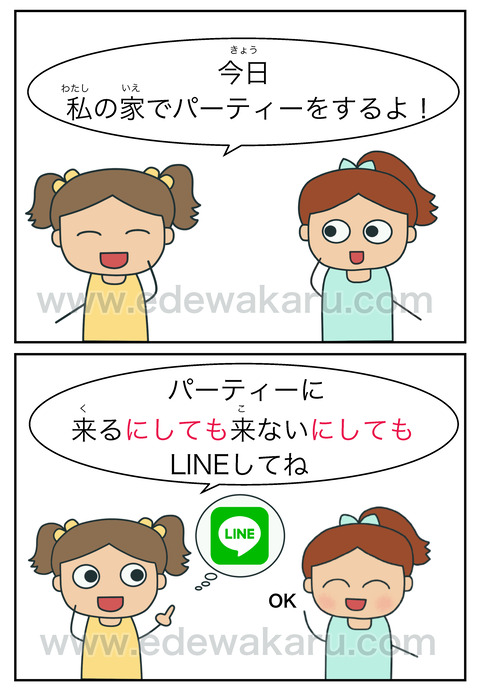
Whether or not you come to the party, send me a LINE message.
= Whether or not you come to the party, send me a LINE message.
= Whether or not you come to the party, send me a LINE message.
Whether it’s a dog or a cat, keeping a pet is hard.
= Whether it’s a dog or a cat, keeping a pet is hard.
= Whether it’s a dog or a cat, keeping a pet is hard.
There are many expressions and words used with “〜にしても,” “〜にしろ,” and “〜にせよ,” so I think it’s useful to learn them as a set. 😉
In context 4 examples
パーティーに来るにしても来ないにしてもLINE(ライン)してね
→パーティーに来る場合も来ない場合もどちらの場合でもLINEしてね(復習:「Google」や「Twitter」は日本語でどう読むの?)Whether you come to the party or not, send me a LINE message. (Review: How do you pronounce “Google” and “Twitter” in Japanese?)
N1を受けるにしても受けないにしても、毎日しっかり勉強しなくちゃ
→N1を受ける場合も受けない場合も、毎日しっかり勉強しなくちゃ(復習:〜なくちゃ)Whether you take N1 or not, you have to study hard every day. (Review: 〜なくちゃ)
犬にしても猫にしてもペットを飼うのは大変だ
→犬でも猫でもどちらの場合でも、ペットを飼うのは大変だWhether it’s a dog or a cat, keeping a pet is hard. → Either way, whether it’s a dog or a cat, keeping a pet is hard.
高いにしても安いにしても、教科書は買わざるを得ない
→高くても安くてもどちらの場合でも、教科書は買わざるを得ない(復習:〜ざるを得ない)Whether they’re expensive or cheap, I have no choice but to buy the textbook. (Review: 〜ざるを得ない)
Read the original source text
Meaning
〜の場合も〜の場合も〜
〜も〜もどちらの場合でも〜
How to use it
動詞・形容詞・名詞[普通形]+にしても〜にしても
Explanation
「AにしてもBにしても」は「Aの場合もBの場合も、どちらの場合でも」という意味を表す文型です。「AにしてもAないにしても」になる場合と、「A」と「B」に同じグループのものがくる場合があります😮
【一緒に覚えましょう】
「〜にしても〜にしても」は「〜にしろ〜にしろ」「〜にせよ〜にせよ」にチェンジすることができます
😊「〜にしろ」「〜にせよ」は「〜にしても」より少しかたい言い方だと覚えておきましょう😀
[例]
パーティーに来る
にしても
来ない
にしても
LINEしてね
=パーティーに来る
にしろ
こない
にしろ
LINEしてね
=パーティーに来る
にせよ
来ない
にせよ
LINEしてね
犬
にしても
猫
にしても
ペットを飼うのは大変だ
=犬
にしろ
猫
にしろ
ペットを飼うのは大変だ
=犬
にせよ
猫
にせよ
ペットを飼うのは大変だ
「〜にしても」「〜にしろ」「〜にせよ」を使う表現や単語はたくさんありますので、セットで覚えておくといいと思います😉
どんなときどう使う 日本語表現文型辞典
Usage 1
Meaning
no matter how; no matter where
How to use it
N / [plain form] (な-adjective + である / N + である) + にせよW
Explanation
と仮定しても
1)「~にせよ、…」の形で、「もし~となっても、~であっても」と言い、「…」で、話者の主張・判断・評判・納得できない気持ち・非難などを述べる。
2)「たとえ・仮に・疑問詞」などの言葉とともに使うことが多い。
3)「としても・にしても・にしろ」より硬い言葉で、意味は同じである。
2)Often used with たとえ, 仮に, or interrogatives.
3)More formal than としても, にしても, or にしろ, but has same meaning.
1)"Even if." Speaker's assertion, judgment, evaluation, feeling of inability to agree, or criticism follows.
In context 3 examples
どんなことをするにせよ、十分な計画と準備が必要だ。
Whatever you do, you need to plan and prepare thoroughly.
どんなにわずかな予算であるにせよ、委員会の承認を得なければならない。
No matter how small the budget is, you must get the committee’s approval.
母の病気が重いので、どこへ行くにせよ、携帯電話をいつも持っている。
Because my mother is seriously ill, I always carry my mobile phone wherever I go.
Read the original source text
Meaning
no matter how; no matter where
How to use it
N/〔普通形〕(ナAである/Nである)+にせよW
Explanation
と仮定しても
1)「~にせよ、…」の形で、「もし~となっても、~であっても」と言い、「…」で、話者の主張・判断・評判・納得できない気持ち・非難などを述べる。
2)「たとえ・仮に・疑問詞」などの言葉とともに使うことが多い。
3)「としても・にしても・にしろ」より硬い言葉で、意味は同じである。
2)Often used with たとえ, 仮に, or interrogatives.
3)More formal than としても, にしても, or にしろ, but has same meaning.
1)"Even if." Speaker's assertion, judgment, evaluation, feeling of inability to agree, or criticism follows.
Usage 2
Meaning
whether…or…
How to use it
V-dictionary form / N + にせよ + V-dictionary form / N + にせよW
Explanation
にせよ~にせよ
~でも~でも
1)「~でも~でも」と例をいくつかあげて「その全部に当てはまる」と言いたいときに使う。
2) ❹ のように、対立的なものを並べて「そのどちらの場合でも」という意味で使うこともある。
3)同類の用法「にしても~にしても・にしろ~にしろ」より硬い言い方。
3)Pattern にせよ~にせよhas same usage as にしても~にしても, and にしろ~にしろ, but more formal.
1)Lists multiple examples and shows that something is true in every case.
2)Also describes contrasts, as in sentence ❹ ; shows something is true in either case.
In context 4 examples
動物にせよ植物にせよ、生物はみんな水がなければ生きられない。
Whether animals or plants, all living things need water to survive.
学生にせよ教師にせよ事務職員にせよ、この学校の関係者は創立者のことぐらいは知っているべきだ。
Whether students, teachers, or administrative staff, everyone connected with this school should at least know about its founder.
夏休みに山に行くにせよ海に行くにせよ、十分な準備をして行った方がよい。
Whether you go to the mountains or the sea during summer vacation, it’s best to prepare thoroughly before you go.
男にせよ女にせよ、自己実現のチャンスは平等に与えられるべきだ。
Whether male or female, everyone should be given equal opportunities for self-fulfillment.
Read the original source text
Meaning
whether…or…
How to use it
Vる/N+にせよ+Vる/N+にせよW
Explanation
にせよ~にせよ
~でも~でも
1)「~でも~でも」と例をいくつかあげて「その全部に当てはまる」と言いたいときに使う。
2) ❹ のように、対立的なものを並べて「そのどちらの場合でも」という意味で使うこともある。
3)同類の用法「にしても~にしても・にしろ~にしろ」より硬い言い方。
3)Pattern にせよ~にせよhas same usage as にしても~にしても, and にしろ~にしろ, but more formal.
1)Lists multiple examples and shows that something is true in every case.
2)Also describes contrasts, as in sentence ❹ ; shows something is true in either case.
日本語文型辞典 英語版
Meaning
A formal, written expression of にせよ. Can be rephrased as ...にしろ.
→
In context 3 examples
直接の責任は部下にあるにせよ、彼の監督不行届きも糾弾されるだろう。
Even though his subordinate was directly responsible, his lack of supervision will probably be criticized.
来るにせよ来ないにせよ、連絡ぐらいはしてほしい。
Whether you come or not, I want you to at least contact me.
いずれにせよもう一度検査をしなければならない。
At any rate, we have to do another inspection.
Bunpro Grammar Reference
Meaning
Even if, Even though, No matter, Whether… or
How to use it
Verb + にしろ(1) + Phrase
[い]Adjective + にしろ(1) + Phrase
[な]Adjective + (である)+ にしろ(1) + Phrase
Noun + (である)+ にしろ(1) + Phrase
(1) にせよ
Nuance
A strong, imperative phrase, highlighting that regardless of (A), (B) is still true.
Explanation
にせよ, and にしろ are two phrases that are often translated as 'even if (A)', or 'no matter if (A)'. This structure is a combination of に, and either of the imperative forms of する; せよ, or しろ. せよ tends to be more common in written material, while しろ is more common in speech. Despite the English translations, this particular use of the imperative form of する translates more accurately to 'so it's (A), who cares!', as the speaker is just strongly stating that the actual condition of (A) is unimportant in relation to what they actually want to say.
にせよ and にしろ can appear following verbs, い-Adjectives, な-Adjectives or nouns in any of their standard forms.
飲み会に参加しないにせよ、参加費は明日までに持ってきてください。
Even if you are not going to attend the drinking party, please bring your entrance fee by tomorrow.
怖いにしろ、私の仕事なのでやらなくてはならない。
Even though it scares me, I have to do it because it's my job.
どんなに不便であるにせよ、私は自然が豊かな田舎に住みたいです。
Even if it would be very inconvenient, I would prefer to live in the countryside where nature is abundant.
あの人は相手が子供にしろ、一切手加減はしない。
That person does not take it easy at all, even if the opponent is a child.
As this structure is fairly direct, in most cases it will be used as a way to emphasize that regardless of what the case is for (A), (B) is still true, or is the more important matter to consider.
In context 16 examples
- 違いがあるにせよ、わずかな差だ。
Even if there is a difference, it is minimal.
- 飲み会に参加しないにせよ、参加費は明日までに持ってきてください。
Even if you are not going to attend the drinking party, please bring your entrance fee by tomorrow.
- 怖いにしろ、私の仕事なのでやらなくてはならない。
Even though it scares me, I have to do it because it's my job.
- どんなに不便であるにせよ、私は自然が豊かな田舎に住みたいです。
Even if it would be very inconvenient, I would prefer to live in the countryside where nature is abundant.
- あの人は相手が子供にしろ、一切手加減はしない。
That person does not take it easy at all, even if the opponent is a child.
- それは難しいにしろ、するしかない。
Even if it is hard, I have no choice but to do it.
- 飲まないにしろ、居酒屋に行こう。
Even if we don't drink, let's go to an Izakaya.
- いずれにせよ、この決定は変わりません。
At any rate, this decision will stand.
- それが上司の命令にせよ、わたしは従えません。
Even if that is an order from the boss, I will not follow it.
- この状態では何にせよ、誰かに助けてもらうしかないよ。
In this situation, no matter what we do we need to get someone to help us.
- 悪い結果にしろ、いつかハードワークが報われる時が来るでしょう。
Even if the results are bad, eventually hard work will pay off.
- 社長に頼まれたにせよ、今回は断るしかない。
Even if the company chief asked me, I would have to refuse.
- たとえこちらが正当であるにせよ、いま抗議するのはタイミングが悪い。
Even if we are right, this is not the time to protest.
- わが社の提案は一目見てお分りいただけるにしろ、そちらに納得いただけるかどうかは保証できません。
Even if they can understand our offer instantly, I cannot guarantee that they will be satisfied with it. (even though)
- どんな事情があったにしろ、締め切りは先週だった。もう少し締め切りよりも早く書類を提出してもよかった。
No matter the circumstances, the deadline was a week ago. It would have been better to have submitted the documents before the deadline.
- 詩人:「私が死亡するにせよ青銅の記念碑より詩で永続する記憶が存在するだろう。」
Poet: 'Even if I die, with my poems, I have created a legacy that will last longer than any bronze monument.'
NINJAL 日本語文型データベース
Usage 1
Meaning
[1] Used to express the speaker’s judgment that even if something is assumed to be the case, it will not have the kind of effect one might expect as a result.
[2] Used to express the speaker’s judgment that even if something is a fact, it will not have the kind of effect one might expect as a result.
How to use it
V plain form + にせよ
i-A plain form + にせよ
na-A plain form + にせよ (however, “na-Aだ” → “na-Aである + にせよ”)
N plain form + にせよ (however, “Nだ” → “N + にせよ・Nである + にせよ”)
na-A plain form + にせよ (however, “na-Aだ” → “na-A + にせよ・na-Aである + にせよ”)
Other
Notes
[1] “~” is followed by a clause expressing a supposition. After “~にせよ,” there is usually a clause expressing the speaker’s judgment, evaluation, or intention.
When “~” includes an interrogative such as “何・どこ・だれ,” it expresses that the result is the same under any conditions.
[2] “~” is followed by a clause expressing a fact. After “~にせよ,” there is usually a clause expressing the speaker’s judgment, evaluation, or intention.
In context 39 examples
これから先どんな問題が起きるにせよ、リーダーの白井さんがうまく処理してくれるだろう。
Whatever problems arise from here on, Shirai, the leader, will probably handle them well.
部長は私の退職届をもう読んだだろうか。まだ読んでいないにせよ、今さら取り戻せない。
I wonder if the department head has read my resignation letter yet. Even if they haven’t read it, it’s too late to take it back now.
もしもこの事業の存続について何か情報が流れたにせよ、本当のことを知っている人は多くないと思う。
Even if some information about the continuation of this business has leaked, I don’t think many people know the truth.
この家をこのまま売るか、解体して土地を売るか。どちらに決めたにせよ、私たちはこの地を去ることになる。
Whether we sell this house as it is or tear it down and sell the land, whatever we decide, we will end up leaving this place.
選手たちは今日の試合でベストを尽くすことができただろうか。たとえできなかったにせよ、得たものはあったはずだ。
I wonder whether the players were able to do their best in today’s game. Even if they couldn’t, they must have gained something.
ある文学賞に短編を応募してみた。入賞は難しいにせよ、候補作には残ってほしい。
I submitted a short story to a literary award. Winning a prize may be difficult, but I hope it at least makes the shortlist.
祖父の遺産について親族と話し合いをすることになっている。たとえ和解はたやすくないにせよ、なんとか妥協点を見つけたいものだ。
We’re supposed to discuss my grandfather’s estate with our relatives. Even if reconciliation isn’t easy, I’d like us somehow to find a compromise.
自由に意見をと言われたのでひとこと発言してみたが、部長はひどく怒った。仮に私の言い方が悪かったにせよ、部長の対応には失望した。
I was told to speak freely, so I tried saying a few words, but the department head got very angry. Even if I expressed myself badly, I was disappointed by the department head’s response.
今度の台風でうちの別荘もきっと被害を受けたはずだ。たとえそれほどひどくはなかったにせよ、ある程度の修繕費は覚悟しないといけないだろう。
Our vacation home must have been damaged by this typhoon. Even if it wasn’t too badly damaged, we’ll probably have to be prepared for some repair costs.
社内の服装規定がいくら緩やかであるにせよ、従業員の服装が周囲の人に不快感を与えないという最低限のラインはあるのではないだろうか。
However relaxed the company dress code may be, surely there is still a minimum standard that employees’ clothing should not make people around them uncomfortable.
たとえもう必要ではないにせよ、気に入っていた服をごみとして捨てるのには抵抗がある。
Even if I don’t need them anymore, I’m reluctant to throw away clothes I liked as garbage.
仮に相手が親切だったにせよ、初めて会った人に我が家の情報を何もかも話してしまうとは、兄は警戒心がなさすぎる。
Even if the other person was kind, my older brother was far too wary to tell someone he had just met absolutely everything about our family.
たとえ意識的ではなかったにせよ、母は僕が小さいときから台所仕事をよく手伝わせた。おかげで僕は料理が大好きになった。
Even if it wasn’t intentional, my mother often had me help with kitchen chores from when I was little. Thanks to that, I came to love cooking.
どのような理由にせよ、暴力はいけません。まずは話し合ってみようではありませんか。
Whatever the reason, violence is unacceptable. Why don’t we try talking it out first?
明日は「平和を考える会」の記念集会がある。たとえどのような立場の発言であるにせよ、しっかり耳を傾けるべきだろう。
Tomorrow there will be a commemorative meeting of the “Group for Thinking about Peace.” Whatever position the speakers’ remarks come from, we should listen carefully.
これは非常に珍しい蝶だ。恐らく、絶滅危惧種ではないにせよ、本州では見られない種類だと思う。
This is an extremely rare butterfly. It is probably not an endangered species, but I think it is a kind that cannot be found on Honshu.
理解者がどれほどの数だったにせよ、当時、性差別に対してしっかり反対意見を言える女性達がいたのだ。
However many people supported them, there were women at the time who could firmly speak out against gender discrimination.
今、新製品の売れ行きを集計中だが、仮に予想通りでなかったにせよ、生産個数は現状維持でいいと思う。
We’re currently tallying sales of the new product, but even if they don’t meet expectations, I think we should keep production at its current level.
地区の夏祭り準備会に参加するかしないか迷っている。いずれにせよ協力金は払うつもりだ。
I’m wondering whether to take part in the district summer festival planning meeting. In any case, I intend to pay the contribution.
リサイクルショップで中古の本棚を買った。多少の傷はあるにせよ、十分使える。
I bought a used bookshelf at a secondhand shop. It has a few scratches, but it’s perfectly usable.
海外に住んでいる親友が結婚する。結婚式には出席できないにせよ、せめてお祝いは贈りたい。
My close friend who lives overseas is getting married. Even if I can’t attend the wedding, I’d at least like to send a gift.
どんな間違いを犯したにせよ、反省しているなら許すべきだ。
No matter what mistake you made, if you regret it, you should be forgiven.
あの頃、家庭の問題で精神的な余裕がなかったにせよ、仕事をいい加減にするべきではなかった。
Even if I had no emotional capacity because of family problems back then, I shouldn’t have done my job carelessly.
誤解していた私の方が悪いにせよ、あんなに責めるなんてひどい。
Even if I was the one at fault for misunderstanding, it was cruel of them to blame me so much.
いくら安いにせよ、使わない物は買う必要はない。
No matter how cheap it is, there’s no need to buy things you won’t use.
海外旅行中に病気になる確率は高くないにせよ、万が一のことを考えて保険に入っておいたほうがいい。
Even if the chance of getting sick while traveling abroad isn’t high, you should take out insurance in case something happens.
あの時の彼の態度は確かにひどかったにせよ、彼には彼の言い分があるのだ。
His behavior at the time was certainly awful, but he has his reasons.
どんなにおいしくなかったにせよ、人からもらったお菓子をあからさまに「まずい」とはふつう言わない。
No matter how bad it tasted, people generally don’t bluntly say “That’s gross” about sweets someone gave them.
祖父は今は元気にせよ、いつ体調を崩してもおかしくない年齢だ。
My grandfather is healthy now, but he is at an age where it would not be surprising if his health deteriorated at any time.
いかに給料が魅力的であるにせよ、責任を持ってやり遂げられる仕事かどうかを見極めることが大切だ。
No matter how attractive the salary is, it is important to determine whether it is a job you can take responsibility for and see through to completion.
たとえ多くの人員がすぐに必要ではないにせよ、安易に人員を減らしてはいけないと思う。
Even if we don’t need a large workforce right away, I don’t think we should reduce staffing casually.
一時的であったにせよ、このおもちゃはかつて大人気だったのです。
Even if it was only temporary, this toy was once hugely popular.
豪華ではなかったにせよ、彼らは念願かなって結婚式を挙げることができた。
Even if it wasn’t lavish, they were able to hold the wedding they had long hoped for.
彼にスマホを見られたので、怒った。たとえ親しい間柄にせよ、勝手にスマホの中を見られるのは嫌だ。
I got angry because he looked at my smartphone. Even if we are close, I don’t like someone looking through my phone without permission.
確かに古くてぼろぼろの家ではあるが、どのような状態の家であるにせよ、住む人が幸せならばそれでいい。
It is certainly an old, dilapidated house, but whatever condition a house is in, if the people living there are happy, that is enough.
友人の活躍は、自分の手柄ではないにせようれしいものだ。
Even if a friend’s success isn’t my own achievement, it still makes me happy.
インフルエンザによる欠席だったにせよ、追試験を受けるためには医師の診断書が必要だ。
Even if the absence was due to influenza, a doctor’s note is required in order to take the make-up exam.
母がけがをして大変だったという弟の話は、うそではなかったにせよ、だいぶ大げさだった。
My younger brother’s story that things were difficult because our mother was injured wasn’t false, but it was quite exaggerated.
松田さんほどではないにせよ、山田さんもよく遅刻をする。
Yamada often arrives late, though not as often as Matsuda.
Read the original source text
Meaning
[1] 〜と仮定した場合も、そのことから予想されるような影響は受けないという話し手の判断を述べるときに使います。
[2] ~は事実だがその場合も、そのことから予想されるような影響は受けないという話し手の判断を述べるときに使います。
How to use it
V普通形+にせよ
i-A普通形+にせよ
na-A普通形+にせよ(ただし、「na-Aだ」→「na-Aである+にせよ」)
N普通形+にせよ(ただし、「Nだ」→「N+にせよ・Nである+にせよ」)
na-A普通形+にせよ(ただし、「na-Aだ」→「na-A+にせよ・na-Aである+にせよ」)
その他
Notes
[1] 「〜」には仮定したことを表す文がきます。「~にせよ」の後には、ふつう話し手の判断・評価・意志を表す文がきます。
「~」が疑問詞(「何・どこ・だれ」など)を含むときは、どのような条件の場合にも同じ結果になることを表します。
[2] 「〜」には事実を表す文がきます。「〜にせよ」の後には、ふつう話し手の判断・評価・意志を表す文がきます。
Usage 2
Meaning
Used to give two examples with “~” and say that the same thing applies in either case.
The form “~にせよ[interrogative]+にせよ” is also used to express that the same thing can be said of all similar things.
How to use it
V1 plain form + にせよ V2 plain form + にせよ
i-A1 plain form + にせよ i-A2 plain form + にせよ
na-A1 plain form + にせよ na-A2 plain form + にせよ (however, “Nだ” → “na-A + にせよ・na-Aである + にせよ”)
N1 plain form + にせよ N2 plain form + にせよ (however, “Nだ” → “N + にせよ・Nである + にせよ”)
Notes
The two “~” expressions may sometimes be different parts of speech.
“~” is followed by words that are semantically related or have opposite meanings.
In context 20 examples
ミーティングを欠席するにせよ飲み会を欠席するにせよ、山本さんには連絡しておいたほうがいいだろう。
Whether Yamamoto is absent from the meeting or the drinking party, we should probably let him know.
留学するにせよしないにせよ、スペイン語の勉強は一生続けていくつもりだ。
Whether I study abroad or not, I intend to keep studying Spanish throughout my life.
復習しないにせよ予習しないにせよ、それは本人の問題だ。
Whether they review or prepare in advance, that is the person’s own concern.
あの時、親が賛成したにせよ反対したにせよ、どちらにしても、あの子は早々と親元から離れたでしょう。
Whether their parents approved or opposed it at the time, either way, that child would have left home early.
希望の職に就職できたにせよできなかったにせよ、お世話になった方には一言お礼を言うべきだ。
Whether or not you got the job you wanted, you should at least thank the people who helped you.
交通ルールを知らなかったにせよ知っていて守らなかったにせよ、事故を起こせばだれもが犯罪者になるのだ。
Whether someone caused an accident because they didn’t know the traffic rules or knew them but didn’t follow them, anyone who causes an accident becomes a criminal.
AIを導入する企業は増えている。導入経費が高いにせよ安いにせよ、一度試してみる価値はある。
More and more companies are adopting AI. Whether the implementation costs are high or low, it is worth trying once.
学校が楽しくないにせよ勉強が面白くないにせよ、私には何でも相談できる両親がいるのでくじけないで頑張れる。
Whether school isn’t fun or studying isn’t interesting, I can keep going without losing heart because I have parents I can talk to about anything.
成績がよかったにせよ悪かったにせよ、息子が努力していたことは認めよう。
Whether my son’s grades were good or bad, let’s acknowledge that he made an effort.
食べたくなかったにせよおいしくなかったにせよ、食べ物を粗末にすることはよくないよ。
Whether you didn’t want to eat it or it wasn’t tasty, it’s not good to waste food.
字が上手であるにせよ下手であるにせよ、丁寧にわかりやすく書くことが大切だと思います。
Whether your handwriting is good or bad, I think it is important to write carefully and clearly.
今必要でないにせよ子どもが興味を示していないにせよ、将来のことを考えて子どもに英語を習わせる親は多い。
Many parents have their children learn English with the future in mind, whether they don’t need it now or their children aren’t showing interest.
田中さんのことが好きだったにせよ嫌いだったにせよ、仕事中に個人的な感情を表に出すのはよくなかったと反省しています。
Whether I liked or disliked Tanaka, I regret showing my personal feelings at work.
キッチンや風呂場などの水回りが便利ではなかったにせよきれいじゃなかったにせよ、当時はお金がなかったのでリフォームできなかった。
Whether the plumbing areas, such as the kitchen and bathroom, were inconvenient or not clean, we couldn’t renovate because we didn’t have money at the time.
時計にせよ何にせよ、凝りだしたらきりがない。
Whether it’s watches or anything else, once you get deeply into it, there’s no end to it.
豚にせよ熊にせよ、動物の赤ちゃんはみんなかわいい。
Whether pigs or bears, all animal babies are cute.
セミにせよ蛍にせよ、命が短いからこそ懸命に生きる姿が美しいのだ。
Whether cicadas or fireflies, their way of living so earnestly is beautiful precisely because their lives are short.
俳優であるにせよ芸術家であるにせよ、一流の人は研鑽を惜しまない。
Whether they are actors or artists, first-rate people never spare effort in honing their skills.
得意科目にせよ得意科目ではないにせよ、試験は早く終わってほしい。
Whether it’s a subject I’m good at or one I’m not good at, I want the exam to be over soon.
2位だったにせよ3位だったにせよ、優勝できなかったことには変わりはない。
Whether we came in second or third, the fact remains that we didn’t win.
Read the original source text
Meaning
〜で2つの例を挙げて、どちらの場合でも同じことが言えると言いたいときに使います。
「〜にせよ[疑問詞]+にせよ」の形も使い、同じようなものなら全部同じことが言えることを表します。
How to use it
V1普通形+にせよV2普通形+にせよ
i-A1普通形+にせよi-A2普通形+にせよ
na-A1普通形+にせよna-A2普通形+にせよ(ただし、「Nだ」→「na-A+にせよ・na-Aである+にせよ」)
N1普通形+にせよN2普通形+にせよ(ただし、「Nだ」→「N+にせよ・Nである+にせよ」)
Notes
2つの「〜」には異なる品詞がくる場合もあります。
「〜」には、意味的に関連のある言葉、または対立する意味の言葉がきます。
AIUEO JLPT Grammar
Meaning
This sentence pattern is used in more formal writing or speech to express that the same result or situation will apply regardless of the contrasting examples.
How to use it
Verb に + せよ + verb に + せよ; adjective に + せよ + adjective に + せよ; な-adjective に + せよ + な-adjective に + せよ; noun に + せよ + noun に + せよ
In context 5 examples
試合に参加するにせよしないにせよ、とりあえず来てください。
Whether you're going to play in the game or not, please come along.
美しいにせよ醜いにせよ、人を見た目で判断してはいけない。
Whether someone is beautiful or not, you shouldn’t judge people by their appearance.
雨が降るにせよ降らないにせよ、運動会は開催されます。
Whether it rains or not, the sports day will be held.
重要であるにせよそうでないにせよ、全てのメールに返信する必要があります。
Whether it’s important or not, you need to reply to all the emails.
子供にせよ大人にせよ、読書は大切な習慣です。
Whether you’re a child or an adult, reading is an important habit.
Read the original source text
Meaning
This sentence pattern is used in more formal writing or speech to express that the same result or situation will apply regardless of the contrasting examples.
How to use it
動詞に+せよ+動詞に+せよ形容詞に+せよ+形容詞に+せよ形容動詞に+せよ+形容動詞に+せよ名詞に+せよ+名詞に+せよ
Explanation · 日本語
この文型は、対照的な例を挙げながら、そのどちらの場合でも同じ結果や状況が成り立つことをを表す表現です。「〜にしても〜にしても」と同様、少し硬い表現で、書面語や正式な場面で使われることが多いです。