日本語文型辞典
Meaning
Basic information: Nをよぎなくさせる. Attached to an action-denoting noun, means “to put someone in a situation where they have no choice but to do that.” Used to indicate that an undesirable situation is brought about. Examples: ① The typhoon’s approach forced a change in the climbing plans. ② The guerrillas’ unexpected counterattack forced the government forces to retreat.
Read the original source text
Meaning
基本情報Nをよぎなくさせる説明動作を表す名詞に付いて、「そうせざるを得ない状態にする」という意味を表す。好ましくない事態を引き起こすことを表す場合に用いる。例文① 台風の襲来が登山計画の変吏を余儀なくさせた。② 思いがけないゲリラの反撃が政府軍の撤退を余儀なくさせた。
日本語文型辞典 英語版
Meaning
【をよぎなくさせる】[Nをよぎなくさせる]
Attached to a noun which demonstrates an act, means “to be made to do so forcibly” or “to have no choice but to do so.” Used in cases where an undesirable situation is caused.
In context 2 examples
台風の襲来が登山計画の変更を余儀なくさせた。
We were forced to change our mountain climbing plans because the typhoon came.
思いがけないゲリラの反撃が政府軍の撤退を余儀なくさせた。
An unexpected guerrilla counteroffensive forced the government troops to withdraw.
IMABI
Can’t Help III
Read this IMABI lesson ↗Explanation
Can’t Help III: ~ないではすまない, ~ないではおかない, ~を余儀なく[される・させる], & ~を禁じ得ない
These are even more difficult phrases dealing with not being able to help one’s emotions, etc. Not only do you need to try to separate these in your mind from the phrases found in the two previous lessons about this topic, but you’re going to have to pay even more attention to the differences among these patterns.
~{ないで・ずに}はすまない
Also seen as ~ずにはすまない, which is more formal but can still be found used in the spoken language, is used to show that if one thinks from a societal point of view with a given circumstance, doing something is simply and certainly unavoidable. It is difficult to use, however, when you think that you have to do something from personal emotion. Given that the phrase is stiff, this should be understandable.
1. 人の心を傷つけてしまったなら、謝らずにはすまない。
If you are to hurt someone’s heart, you can’t avoid apologizing.
2. 借金をせずにはすむまい。(古風で、硬い言い方)
You can’t get by without borrowing money.
3. 親に知られたら叱られないではすまないよ。
If your parents found out, you won’t be able to avoid getting scolded.
The non-double negative form above result in ~ないで済すむ, which means “to get by without…”. Just as in English, this implies a good thing because you got away without doing something. 済む itself may show that something is done.
4. 済んだことだ。
It’s finished.
5. 済んだのですか。
Is it over?
6. 金を払わないで済みました。
I got by without paying for it.
7. 気づかれずに済む。
To escape attention.
8. 彼が怪我けがをせずに済んでよかった。
I’m glad that he got by without injury.
9. 冗談じょうだんですまない。
To go beyond a joke. (Shows guilt)
10. 済んだことは元もとに戻もどらない。
What’s done cannot be undone.
11. 蜂を見つけたら、ゆっくり離れたほうがいい。体に止まっても振り払わずにじっとしていれば刺されずに済むよ。
If you are to find a bee, it’s best to separate oneself from it slowly. Even if it lands on you, you can leave without being stung if you stay still.
12. もう一つは、犯行後、同じように夜を待ち、普通の道を河内長野方面に向かって歩いたかもしれないことだ。これは車道以外に近道の旧道もあるので、ここを歩けば夜間は誰にも見られずに済む。
Another possibility is that (the criminal) waited just like that for night after the crime and walked down a regular road toward Kawachi-Nagano. This could go without being seen by anyone at night walking through here because there are also old shortcuts aside from the roadway.
From 二重葉脈 by 松本清張.
~{ないで・ずに}はおかない
Also seen as ~ずにはおかない, this pattern is used to show that one will certainly happen naturally or that you won’t allow something to stay not being done. It shows strong resolution. The situation where one won’t allow for something deals with first person. However, the first situation deals with subjects outside of first person, which includes inanimate things.
13. あの話はやはり嘘だったと、絶対に白状はくじょうさせないではおかないぞ。
If that was indeed a lie, I will absolutely not stand without making (that person) confess.
14. 彼女が歌ったのは聞く人の心を揺ゆさぶらずにはおかない。
What she had sung will surely move the hearts of those who hear.
~を余儀なく[される・させる]
余儀 よぎ means “another way/problem” and 余儀ない expresses “out of one’s control”. So, ~を余儀なくされる, shows that one had to do something that was not of one’s will and there was no other choice to get around it. You are essentially driven into a corner in a certain situation. This can also be seen in the causative as ~を余儀なくさせる. Usually the subject of sentences with ~を余儀なくされる is usually human, but the subject of sentences with ~を余儀なくさせる is usually not human but a something.
15. 悪天候のため試合の中止を余儀なくされました。
Bad weather made us postpone the match.
16. アメリカの圧力が貿易ぼうえき自由化を余儀なくさせた。
American pressure made free trade unavoidable.
17. 暴風雨で遠足は延期を余儀なくされた。
We had to put off the field trip due to fierce rain.
18. {余儀ない・やむを得ない}事情で欠席しました。
I was absent due to an uncontrollable situation.
19. 辞任を余儀なくされる。
To become out of one’s control to resign.
~を禁じ得ない
Although most dictionaries will just tell you this is the same as ~ないではいられない, this is not enough information to help you get a question right about it on the JLPT. Like all the other phrases in this series, this phrase describes not being able to withhold emotions, but this portrays an image of not being able to restrain emotions that have sprung up due to the circumstances. This phrase attaches to nouns that imply emotion. Sentences with it are usually first person.
20. 涙を禁じえなかった。
I couldn’t hold back the tears.
21. 犯人の供述を聞き、犯行動機はんこうどうきの身勝手みがってさに怒いかりを禁じ得なかった。
I couldn’t withhold my anger at the selfishness of the motive from listening to the criminal’s affidavit.
22. 同情の念を禁じえない。
I can’t hold back sympathy
23. 残された子犬を見て、涙を禁じ得なかった。
I couldn’t hold back the tears from looking at the puppy that was left.
In context 23 examples
人の心を傷つけてしまったなら、謝らずにはすまない。
If you are to hurt someone’s heart, you can’t avoid apologizing.
借金をせずにはすむまい。(古風で、硬い言い方)
You can’t get by without borrowing money.
親に知られたら叱られないではすまないよ。
If your parents found out, you won’t be able to avoid getting scolded.
済んだことだ。
It’s finished.
済んだのですか。
Is it over?
金を払わないで済みました。
I got by without paying for it.
気づかれずに済む。
To escape attention.
彼が怪我けがをせずに済んでよかった。
I’m glad that he got by without injury.
冗談じょうだんですまない。
To go beyond a joke. (Shows guilt)
済んだことは元もとに戻もどらない。
What’s done cannot be undone.
蜂を見つけたら、ゆっくり離れたほうがいい。体に止まっても振り払わずにじっとしていれば刺されずに済むよ。
If you are to find a bee, it’s best to separate oneself from it slowly. Even if it lands on you, you can leave without being stung if you stay still.
もう一つは、犯行後、同じように夜を待ち、普通の道を河内長野方面に向かって歩いたかもしれないことだ。これは車道以外に近道の旧道もあるので、ここを歩けば夜間は誰にも見られずに済む。
Another possibility is that (the criminal) waited just like that for night after the crime and walked down a regular road toward Kawachi-Nagano. This could go without being seen by anyone at night walking through here because there are also old shortcuts aside from the roadway.
あの話はやはり嘘だったと、絶対に白状はくじょうさせないではおかないぞ。
If that was indeed a lie, I will absolutely not stand without making (that person) confess.
彼女が歌ったのは聞く人の心を揺ゆさぶらずにはおかない。
What she had sung will surely move the hearts of those who hear.
悪天候のため試合の中止を余儀なくされました。
Bad weather made us postpone the match.
アメリカの圧力が貿易ぼうえき自由化を余儀なくさせた。
American pressure made free trade unavoidable.
暴風雨で遠足は延期を余儀なくされた。
We had to put off the field trip due to fierce rain.
{余儀ない・やむを得ない}事情で欠席しました。
I was absent due to an uncontrollable situation.
辞任を余儀なくされる。
To become out of one’s control to resign.
涙を禁じえなかった。
I couldn’t hold back the tears.
犯人の供述を聞き、犯行動機はんこうどうきの身勝手みがってさに怒いかりを禁じ得なかった。
I couldn’t withhold my anger at the selfishness of the motive from listening to the criminal’s affidavit.
同情の念を禁じえない。
I can’t hold back sympathy
残された子犬を見て、涙を禁じ得なかった。
I couldn’t hold back the tears from looking at the puppy that was left.
どんなときどう使う 日本語表現文型辞典
Meaning
compel
How to use it
N + を余儀なくさせる W
Explanation
しかたなく~させる
1)自然や環境など本人の力では及ばない強い力で「~させる」という表現。行為を表す名詞につく。
2)「余儀なくされる」とは立場が反対になる。
2)Opposite emphasis: よぎなくされる (be compelled to).
1)Nature, environment, or other powers beyond those of party in question compel him to do something. Appends to nouns of action.
In context 2 examples
太郎は役者志望だったが、家庭の事情は彼に家業を継ぐことを余儀なくさせた。
Taro wanted to become an actor, but family circumstances forced him to take over the family business.
人件費の高騰が新しい支店開設の中止を余儀なくさせた。
The rise in labor costs forced the cancellation of plans to open a new branch.
Read the original source text
Meaning
compel
How to use it
N+を余儀なくさせるW
Explanation
しかたなく~させる
1)自然や環境など本人の力では及ばない強い力で「~させる」という表現。行為を表す名詞につく。
2)「余儀なくされる」とは立場が反対になる。
2)Opposite emphasis: よぎなくされる (be compelled to).
1)Nature, environment, or other powers beyond those of party in question compel him to do something. Appends to nouns of action.
絵でわかる日本語
Meaning
Cause someone to be in a situation where they have no choice but to...
How to use it
Noun [dictionary form] + を余儀なくさせる
Explanation
“Aを余儀なくさせる” is a sentence pattern meaning “cause someone to be in a situation where they have to do A.” It is used when you want to say that “because of a cause, someone is made to do A.” “〜を余儀なくさせる” is a causative form, and [the cause] is the subject. Both forms are written language and are rarely used in conversation, but learn to distinguish them as N1 grammar patterns.
[Related grammar patterns]
In context 4 examples
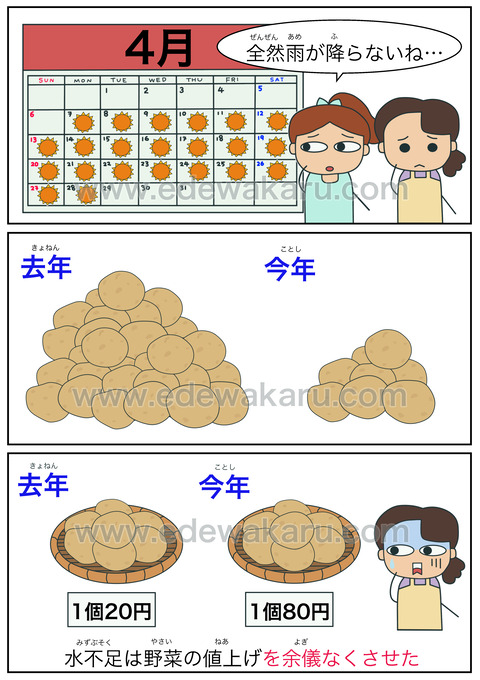
水不足は野菜の値上げを余儀なくさせた
→水不足が野菜の値上げをしなければいけない状態にさせたThe water shortage forced vegetable prices to rise. → The water shortage put things in a situation where vegetable prices had to rise.
大雨はイベントの中止を余儀なくさせた
→大雨がイベントを中止しなければいけない状態にさせたThe heavy rain forced the event to be canceled. → The heavy rain put things in a situation where the event had to be canceled.
事故のケガは彼に入院生活(にゅういんせいかつ)を余儀なくさせた
→事故のケガは、入院生活をしなければいけない状態にさせたHis injury from the accident forced him to be hospitalized. → His injury from the accident put him in a situation where he had to be hospitalized.
土砂崩れは住民に避難を余儀なくさせた
→土砂崩れが避難しなければいけない状態にさせたThe landslide forced residents to evacuate. → The landslide put residents in a situation where they had to evacuate.
Read the original source text
Meaning
〜しなければいけない状態にさせる
How to use it
名詞[辞書形]+を余儀なくさせる
Explanation
「Aを余儀なくさせる」は「Aしなければいけない状況にさせる」という意味の文型です。「原因があって、Aをしなければいけない状況にさせる」と言いたい時に使います。「〜を余儀なくさせる」は使役形で
【原因】が主語
になります。
どちらも書き言葉で、会話で使われることはほとんどありませんがN1の文型として区別して覚えておきましょう。
【関連文型】
毎日のんびり日本語教師
Meaning
To force (someone) to do something
How to use it
Noun + を余儀なくさせる
Explanation
Expresses that some phenomenon forces someone to take an action.
The person performing the action does not want to do it, conveying that they do it unwillingly.
In many cases, it is used for adverse circumstances.
The subject must be the cause.
This is a formal expression, of the kind used in the news. It is mainly used in writing.
「余儀ない」 is originally an adjective meaning that there is no other way, or that something is unavoidable.
A similar pattern is 「【N1文法】~を余儀なくされる」, but its subject is a person or group, not the cause.
Notes
Similar grammar: 「【N1文法】~を余儀なくされる」
In context 10 examples
両国関係の悪化が、プロジェクトの中止を余儀なくさせた。
The deterioration in relations between the two countries forced the project to be canceled.
台風の上陸が、フライトの延期を余儀なくさせた。
The typhoon’s landfall forced the flight to be postponed.
突然発生した雪崩が、登山計画の中止を余儀なくさせた。(突然发生的雪崩导致登山计划被迫停止。)
A sudden avalanche forced the mountaineering expedition to be called off. (A sudden avalanche forced the climbing plan to be stopped.)
貿易交渉の結果、A国はB国に関税の引き下げを余儀なくさせた。
As a result of the trade negotiations, Country A forced Country B to lower its tariffs.
たった一つのミスが、彼に辞職を余儀なくさせた。
A single mistake forced him to resign.
夫の不倫は、結婚生活の破綻を余儀なくさせた。(丈夫出轨使婚姻生活破裂了。)
Her husband’s affair forced their marriage to fall apart. (Her husband’s affair caused their married life to break down.)
敵の物資の補給路を遮断し撤退を余儀なくさせた。
They cut off the enemy’s supply route, forcing them to retreat.
軍による爆撃は数万人に避難を余儀なくさせています。
The military’s bombing is forcing tens of thousands of people to evacuate.
A被告はコンビニのレジ付近の床に大便をし、店員に清掃作業を余儀なくさせて業務を妨害した。
Defendant A defecated on the floor near the convenience store’s cash register, forcing an employee to clean it up and disrupting business.
A先輩は後輩に手を出し孕ませ、その子に退学を余儀なくさせた。
Senior A got a junior pregnant after having sex with her, forcing the girl to drop out of school.
Read the original source text
Meaning
(人に)~を強制する
How to use it
名詞+を余儀なくさせる
Explanation
何らかの現象が人に対して行動を強制することを表します。
動作主体はその行為をすることを望んでおらず、嫌々行うようなニュアンスがあります。
多くの場合は悪い事態に対して使います。
主語は必ず原因です。
ニュースなどに用いられるような硬い表現です。主に書き言葉として使います。
「余儀ない」はもともと、他に方法がない状態、やむを得ない状態を表す形容詞です。
似ている文型に「【N1文法】~を余儀なくされる」がありますが、こちらの主語は原因ではなく人や集団です。
Notes
似ている文法「【N1文法】~を余儀なくされる」