AIUEO JLPT Grammar
Meaning
This sentence pattern expresses that, due to a situation or reason, there is absolutely no possibility of acting or responding, often used when there are other more pressing matters.
How to use it
Verb dictionary form + どころではない; verb te-form + いる + どころではない; noun + どころではない
In context 5 examples
お金が足りなくて、新しい車を買うどころではない。
I don’t have enough money, so buying a new car is out of the question.
時間がなくて、休憩どころではない。
I don’t have time; taking a break is out of the question.
彼は仕事のことで頭がいっぱいで、デートどころではない。
He is so preoccupied with work that dating is out of the question.
大雨が降っていて、ピクニックどころではない。
It’s raining heavily, so a picnic is out of the question.
試験が近くて、遊ぶどころではない。
The exam is approaching, so there’s no time to play around.
Read the original source text
Meaning
This sentence pattern expresses that, due to a situation or reason, there is absolutely no possibility of acting or responding, often used when there are other more pressing matters.
How to use it
動詞辞書形+どころではない動詞て形+いる+どころではない名詞+どころではない
Explanation · 日本語
この文型は、ある状況や理由によって、それを行う余裕や可能性が全くないことを表す表現で、他に優先すべき事柄がある場合に使用されます。
文法
Meaning
“There’s no way I can ~ / I don’t have time to ~”
An expression used to strongly deny that one has the leeway to do something, or to say that there is something more important to do.
How to use it
V (dictionary form) + どころではない
N + どころではない
In context 8 examples
アメリカに住み始めた頃は、英語の勉強に必死で、遊びどころではなかった。
When I first started living in America, I was so busy studying English that I didn’t have time to have fun.
テスト前なのに、母が入院してしまって、勉強どころではなかった。
Even though it was right before a test, my mother was hospitalized, so I couldn’t focus on studying.
せっかく海外に旅行に来たのに、財布を盗まれて、観光どころではなかった。
Even though I had gone all the way abroad on a trip, my wallet was stolen, so sightseeing was out of the question.
隣の部屋がうるさすぎて、寝るどころではない。
The room next door is so noisy that there’s no way I can sleep.
こんなに給料が安いと、結婚どころではないな。
With a salary this low, marriage is out of the question.
今日はお客さんが多すぎて、休憩どころではない。
There are too many customers today, so there’s no time for a break.
手伝ってあげたいんだけど、僕も仕事が全然終わって、それどころじゃないんだ。ごめんね。
I’d like to help you, but my work isn’t finished at all either, so I can’t do that right now. Sorry.
A:今晩、飲みに行かない?
B:ごめん、まだレポートが終わってなくて、それどころじゃないんだ。A: Do you want to go out for drinks tonight? B: Sorry, I still haven’t finished my report, so I can’t think about that right now.
Read the original source text
Meaning
"~はとてもできない / ~する時間がない"
「~する余裕がない」、「〜の他にもっと大切なことがある」と強く否定したいときに使う表現。
How to use it
V(辞書形)+ どころではない
N + どころではない
Bunpro Grammar Reference
Meaning
This is not the time for…, Far from, Out of the question
How to use it
Phrase + どころ + ではない
Phrase + どころ + じゃない
Phrase + どころ + ではありません
Phrase + どころ + じゃありません
Nuance
An expression emphasizing that it is hardly the place or situation for (A).
Explanation
When the voiced form of ところ 'place', どころ appears in Japanese, it will very often be part of a set phrase expressing some kind of negative situation or evaluation. どころではない is no different, and highlights that it is 'far from (A)', or that '(A) is out of the question'. These translations appear when the actual situation is considered to be even more remarkable than the phrase that どころではない is attached to.
This grammar pattern will be seen at the end of phrases indicating some situation which is not ideal. Additionally, ではない may be replaced with じゃない in more casual settings.
出産は痛いどころではないらしい。
They say childbirth is far from painful.
締め切りが迫って来てるから、休憩を取るどころじゃない。
The deadline is approaching, so taking a break is out of the question.
どころではない may also sometimes be translated as 'it is not the time for (A)'. In sentences that use this interpretation, (A) is considered to be something that there is no allowance for due to there being far more important matters. This use will reflect the personal opinion of the speaker.
お母さんからお父さんが倒れたと連絡があったので、仕事どころではない。
It is not the time for working, since I got a message from my mother telling me that my father collapsed.
今は仕事が忙しいし、お金も全然ないから、結婚どころじゃない。
Since I am busy with work and have no money, it is not the time to get married.
In context 16 examples
- 休みの日はたくさん寝たい。レジャーどころではない。
On my day off, I want to sleep a lot. Leisure activities are out of the question.
- 出産は痛いどころではないらしい。
They say childbirth is far from painful.
- 締め切りが迫って来てるから、休憩を取るどころじゃない。
The deadline is approaching, so taking a break is out of the question.
- お母さんからお父さんが倒れたと連絡があったので、仕事どころではない。
It is not the time for working, since I got a message from my mother telling me that my father collapsed.
- 今は仕事が忙しいし、お金も全然ないから、結婚どころじゃない。
Since I am busy with work and have no money, it is not the time to get married.
- 腰を痛めてしまったから、マラソンどころではありません。
I unfortunately injured my lower back, a marathon is out of the question.
- 熱があるというのに、遊園地どころではないよ。
When you have a fever, it is not the time to go to an amusement park.
- なんとか通じればいい。アクセントどころではありません。
It would be good if you could somehow communicate. This is not the time to worry about accent.
- 急用が入ったので、お出掛けどころではなくなった。
Urgent business came in, so going out became out of the question.
- 落し物をしたので、買い物どころではなくなった。
I lost something, so going shopping became out of the question.
- ゲリラ豪雨で、海水浴どころではない。
Going swimming in the ocean is out of the question when it is downpouring.
- 火山が噴火して、学校どころではない。
The volcano is erupting, it is not the time for school.
- 大病を患っているんだから、仕事どころではない。
Since I have become severely ill, this is not the time for work.
- 仕事が忙しすぎて、年休を取るどころではない。
I am so busy at work, taking time off is out of the question.
- 「早く美容室に行け」と言われても、今はそれどころではない。
Even if you were told, 'Go to a beauty parlor right away!', now is not the time for that.
- 今まで恋人も出来たことがないのに、結婚どころではない。
Since I haven't even had a lover yet, getting married is out of the question.
DoJG 日本語文法辞典(全集)
Meaning
Cannot; be simply impossible; simply don’t/doesn’t have time; be far from ~; anything but ~; no way; far from; be out of question
How to use it
(i) {V/Adjectiveい}informal nonpast | どころではない | |
| 映画を見るどころではない | Someone simply doesn’t have time to see a movie |
| 面白いどころではない | Someone is far from being interesting |
(ii) Noun (をする) | どころではない | Where Noun is typically an action noun |
| ゴルフ(をする) どころではない | I simply don’t have time to play golf |
| 散歩(をする) どころではない | I simply don’t have time to take a walk |
(iii) Adjective な stem | どころではない | |
| 自由どころではない | Something/someone is hardly free |
Explanation
A phrase indicating that an action/state is simply impossible due to an adverse situation.
In context 13 examples
自分のことで精一杯で、人のことなど考えるどころではない。
I'm so busy with my own things that I simply can't think of other people's matters (right now).
年末なのに多忙で、海外旅行(をする)どころではなかった。
I was so busy toward the end of the year that there was no way I could travel abroad.
津波で愛する娘を亡くしたので、悲しいどころではない。死にたい気持ちだ。
I lost my beloved daughter in the tsunami. I'm not just sad. I feel like killing myself.
定年になっても暇どころではない。毎日野菜作りに精を出している。
I have retired, but I can't say I have any free time. Every day I put all my energy into vegetable gardening.
毎日の生活に汲々としていて、株を買うどころではありません。
My everyday life is so tight financially that I simply can't consider buying stocks.
私はテニスが大好きだが、最近大怪我をしてテニスどころではない。
I love tennis, but I sustained a severe injury recently, and playing tennis is now out of the question.
A:おい、今晩、飲みに行こうか。B:それどころじゃないんだ。妻が入院したんだ.
A: Hey, why don't we go drinking tonight? B: No way. My wife has been hospitalized.
目下寝たきりの母の介護で、外出どころではないんです。
Right now I'm taking care of my bed-ridden mother, so I simply don't have time to leave the house.
このところ学生の修論指導で研究どころじゃないんだよ。
I've been advising MA students on their theses lately and I simply don't have time to do research.
A:妻:あなた、この週末に熱海の温泉にでも行かない? B:夫:それどころじゃないんだよ。原稿の締め切りが来週の月曜日なんだ。
Wife: Honey, why don't we go to the hot springs in Atami this weekend? Husband: No way! The deadline for the manuscript is next Monday.
スイカマラソンは、レース中やレース後にスイカが食べられる。でも、走り終わったら、へとへとで、とてもスイカを食べるどころではないそうだ。
In the watermelon marathon, runners can eat watermelon during or after the race, but I hear that when they're done running they're so tired that there's no way they can eat the watermelon.
今日は非常に暑かった。もう暖かいどころではない。
It was extremely hot today. You can't just call it warm anymore.
ものすごい排気ガスを吸っているから、健康どころではない.
I am breathing in all these awful exhaust fumes, so I am far from being healthy.
絵でわかる日本語
Meaning
It is not a situation in which one can …
This is no time to be …ing
How to use it
Noun [dictionary form] + どころではない
Verb [〜ている] + どころではない
Explanation
「〜どころではない」is an expression meaning “it is not a situation in which one can …” or “this is no time to be …ing” 😊 In many cases, it is used to mean that, because of some reason, one is not in a situation or position to do something 😀
【For those with time】
「〜どころではない」is generally used with nouns expressing actions or verbs in the 〜ている form, but it can also be used with 「それ」😮 This form is often used in conversation, so try using it in everyday conversation 😆
[Example]
A: Let’s go to the party!
B: I have to work overtime, so it’s
それどころではない
yo.
Here, 「それ」refers to “the party” 😊 So,
I have to work overtime, so I’m in no position to go to the
party (noun).
I have to work overtime, so this is no time to be
going to the party (verb).
I have to work overtime, so it’s
それどころではない
yo.
These three examples have the same meaning 😉
This expression is commonly used, so be sure to learn it as one of the patterns formed with 「ところ」😄
【The「ところ」series】
〜たところ〜た
〜たところで〜ない
〜ていたところだ
〜といったところだ・〜というところだ
〜ところ (Nのところ)
〜ところだ (V dictionary form + ところだ)
〜ところだ (ている + ところだ)
〜ところだ (Vた + ところだ)
〜ところまで来る
In context 4 examples
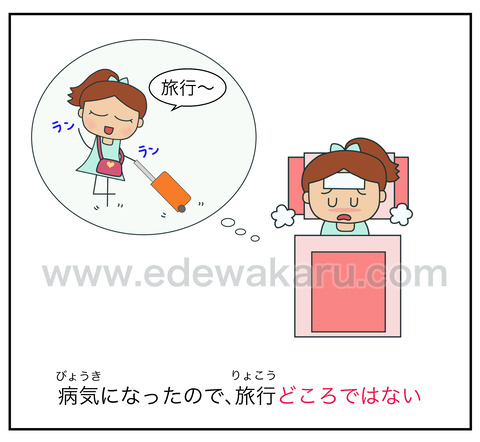
病気になったので、旅行どころではない
→病気になったので、旅行できる状況ではないI got sick, so this is no time for a trip. →I got sick, so I’m not in a situation where I can travel.
お母さんが入院したので、クリスマスどころではなかった
→お母さんが入院したので、クリスマスを楽しんでいる場合ではなかったMy mother was hospitalized, so I wasn’t in a position to celebrate Christmas. →My mother was hospitalized, so it wasn’t a time to be enjoying Christmas.
こんなに給料が少ないと、結婚どころじゃないよ…
→こんなに給料が少ないと、結婚なんてできる状況ではないよ…With a salary this low, marriage is out of the question… →With a salary this low, I’m not in a situation to get married…
A:パーティーに行こうよ!B:残業しなきゃ(口語形:〜なきゃ)だから、パーティーに行っているどころではないよ
→残業しなければだから、パーティーに行っている場合ではないよA: Let’s go to the party! B: I have to work overtime (colloquial form: 〜なきゃ), so this is no time to be going to the party. →I have to work overtime, so this is no time to be going to the party.
Read the original source text
Meaning
〜できる状況ではない
〜している場合ではない
How to use it
名詞[辞書形]+どころではない
動詞[ーている]+どころではない
Explanation
「〜どころではない」は「〜できる状況ではない」「〜している場合ではない」という表現です
😊多くの場合、何か理由があって〜できる状況や場合ではないという意味で 使用されます😀
【余裕のある人へ】
「〜どころではない」は動作を表す名詞や動詞の〜ている形に使われるのが一般的ですが、
「それ」を使って使用することもできます
😮会話の場合にはよく使われる形ですので、日常会話で使ってみるといいですね😆
[例]
A:パーティーに行こうよ!
B:残業しなきゃだから、
それどころではない
よ
この場合の「それ」は「パーティー」ですね😊ですから、
残業しなきゃだから、
パーティーどころではないよ
(名詞)
残業しなきゃだから、
パーティーに行っているどころではない
よ(動詞)
残業しなきゃだから、
それどころではない
よ
この3つの例文は同じ意味になります😉
よく使われる表現ですので、「ところ」が作る文型の1つとしてしっかりと覚えましょう😄
【「ところ」シリーズ】
〜たところ〜た
〜たところで〜ない
〜ていたところだ
〜といったところだ・〜というところだ
〜ところ(Nのところ)
〜ところだ(V辞書形+ところだ)
〜ところだ(ている+ところだ)
〜ところだ(Vた+ところだ)
〜ところまで来る
くらべてわかる日本語表現文型辞典
Meaning
Meaning 1: The actual situation is not merely A; it is even more extreme than A.
Meaning 2: There is no room to do A. The speaker thinks there is something else more important than A.
How to use it
Aどころではない (Aどころじゃない/Aどころの騒ぎではない)
Connection 1:
[Verb—る form/ている] どころではない
[i-adjective—い] どころではない
[Noun—∅] どころではない
Connection 2:
[Verb—る form] どころではない
[Noun—∅] どころではない
Explanation
[Comparison 1]
“AどころかBも (AどころかB)” (Meanings 1 and 2, p. 169)
When A in “Aどころではない” has a positive evaluation, it can be replaced with “AどころかB.” When A has a negative evaluation, however, the expression only means that the situation is far more extreme than A.
○ハワイは楽しい{どころか、/どころじゃなかったよ。}ずっと雨だったんだ。 — Hawaii wasn’t just fun—it rained the whole time.
○彼の部屋は汚い{どころか、/どころじゃない。}足の踏み場もないんだ。 — His room isn’t just dirty; there’s no place to set foot.
○彼の部屋は汚いどころか、ごみひとつ落ちていない。 — His room isn’t just dirty; there isn’t a single piece of trash on the floor.
×彼の部屋は汚いどころじゃない。ごみひとつ落ちていない。 — His room isn’t just dirty. There isn’t a single piece of trash on the floor.
“Aなんてものではない” (Meaning 1, p. 209)
[Comparison 2]
“A場合ではない” (Meaning 1, p. 272)
Notes
[Note 1]
・This is said with feelings such as anger, excitement, or exasperation because the other person’s perception is so far removed from reality. To intensify the degree, use “Aどころの騒ぎではない.”
○「朝の電車って、こんでるの?」 — “Are the morning trains crowded?”
“‘Crowded’ doesn’t begin to describe it. It’s so bad I feel like I might get crushed to death.”
In context 8 examples
被害総額は5億円どころではない。
The total amount of damage is far more than 500 million yen.
骨を折ったんだから、痛いどころの騒ぎじゃなかった。
Since I broke a bone, it wasn’t merely painful—it was excruciating.
「あの人、知ってる?」
「知ってるどころじゃないよ。子どものころからの幼なじみだよ。」“Do you know that person?” “Know them? We’ve been friends since we were children.”
「息子さん、スポーツしてるから、よく食べるでしょ。」
「食べるどころじゃないわよ。1日5食よ。」“Your son plays sports, so he must eat a lot, right?” “‘Eat a lot’ doesn’t begin to describe it. He eats five meals a day.”
ローンの返済に追われて貯金(する)どころではない。
I’m so busy paying off my loan that I can’t even think about saving money.
「ちょっと手伝ってよ。」「それどころじゃない。今、忙しいんだ。」
“Give me a hand for a minute.” “I can’t do that right now. I’m busy.”
近くで火事があったので、落ち着いて食事するどころじゃなかったよ。
There was a fire nearby, so it was no time to sit down and eat calmly.
あわてていて、人の話を聞くどころじゃなかった。
I was so flustered that I couldn’t even listen to what people were saying.
Read the original source text
Meaning
意味1:実状はAの程度ではなく、A以上にもっとすごい。
意味2:Aをする余裕がない。Aよりも大事・大切なことがほかにあると話し手は考えている。
How to use it
Aどころではない(Aどころじゃない/Aどころの騒ぎではない)
接続1:
[動詞-る形/ている]どころではない
[イ形-い]どころではない
[名詞-∅]どころではない
接続2:
[動詞-る形]どころではない
[名詞-∅]どころではない
Explanation
【対比1】
「AどころかBも(AどころかB)」(意味1,2 P.169)
「Aどころではない」のAがプラス評価の時は「AどころかB」と置き換え可能だが、マイナス評価の時は、Aより極端に程度が進んでいるという意味しかない。
○ハワイは楽しい{どころか、/どころじゃなかったよ。}ずっと雨だったんだ。
○彼の部屋は汚い{どころか、/どころじゃない。}足の踏み場もないんだ。
○彼の部屋は汚いどころか、ごみひとつ落ちていない。
×彼の部屋は汚いどころじゃない。ごみひとつ落ちていない。
「Aなんてものではない」(意味1 P.209)
【対比2】
「A場合ではない」(意味1 P.272)
Notes
【注意1】
・相手の認識の程度があまりに現実と離れているので怒り・興奮・たまらない気持ちなどを伴って発話される。程度を強めるときは「Aどころの騒ぎではない」という。
○「朝の電車って、こんでるの?」
「こんでるどころ(の騒ぎ)じゃないよ。殺されるかと思うほどだ。」
日本語NET JLPT文法解説まとめ
Meaning
“I absolutely can’t ~ / I don’t have time to ~”
An expression used to strongly deny that one has the leeway to do something, or to say that there is something more important to do besides ~.
How to use it
V (dictionary form) + どころではない
N + どころではない
Explanation
no way
A phrase used to strongly deny by saying, 'No time to 〜,' or 'There are more important things than 〜.'
In context 1 examples
アメリカに住み始めた頃は、英語の勉強に必死で、遊びどころではなかった。
When I first started living in America, I was so busy studying English that I didn’t have time to have fun.
Read the original source text
Meaning
"~はとてもできない / ~する時間がない"
「~する余裕がない」、「〜の他にもっと大切なことがある」と強く否定したいときに使う表現。
How to use it
V(辞書形)+ どころではない
N + どころではない
Explanation
no way
A phrase used to strongly deny by saying, 'No time to 〜,' or 'There are more important things than 〜.'
毎日のんびり日本語教師
Meaning
~している場合ではない
② More than; far from
How to use it
Action noun + どころではない
Verb dictionary form + どころではない
Verb ている form + どころではない
Explanation
There are two meanings.
① It is not the time to be doing that
Expresses that the situation is urgent for reasons such as time or money, and that there is no time to do that. Examples (1)–(4).
② The situation is even more extreme
「Aどころではない」 expresses that the situation is more extreme than A. It can describe both good and bad things, and this use can also carry a sense of urgency. Examples (5)–(8).
「それどころではない」 and 「それどころではなく~」 are idiomatic expressions.
「それどころではなく」 can be used on its own like a conjunction.
Notes
The 「どころ」 series
In context 8 examples
年末だが何かと忙しくて大掃除どころではない。
It’s the end of the year, but I’m busy with all sorts of things, so there’s no time for a thorough cleaning.
腹が減って寝るどころではない。(肚子饿得哪能睡得着。)
I’m so hungry I can’t sleep. (I’m too hungry to sleep.)
仕事に追われて、ゆっくりメシ食べてるどころの話ではない。
I’m swamped with work and don’t even have time to eat a proper meal.
この時期忙しすぎてクリスマスどころの話ではない。
I’m so busy this time of year that I can’t even think about Christmas.
寄せられた批判コメントは100件どころではない。(收到的批评评论不止100件。)
There were far more than 100 critical comments. (There were more than 100 critical comments.)
美しすぎて息を呑むどころではない。
It’s so beautiful it takes my breath away.
一石二鳥どころではない。一石三鳥だ。
It’s more than killing two birds with one stone—it’s three.
謝って済むどころではなく、それは犯罪だ。
It’s not a matter of simply apologizing; that’s a crime.
Read the original source text
Meaning
~している場合ではない
②不止
How to use it
動作性の名詞+どころではない
動辞形+どころではない
動ている形+どころではない
Explanation
意味が2つあります。
①それをしている場合ではない
時間的・金銭的等の理由で事態が切迫しており、それをしている場合ではないことを表します。例文(1)~(4)。
②事態はそれ以上である
「Aどころではない」で、事態の程度はA以上であることを表します。良い事でも悪い事でも表すことができ、この用法でも事態が切迫しているニュアンスを持つこともあります。 例文(5)~(8)。
「それどころではない」「それどころではなく~」は慣用的に用いられる表現です。
「それどころではなく」は単独で接続詞的な使い方ができます。
Notes
「どころ」シリーズ
どんなときどう使う 日本語表現文型辞典
Usage 1
Meaning
no way
How to use it
Vる/N・する
Explanation
~はとてもできない
動詞のN+どころではない「~どころではない」の形で、「~のようなことをする余裕はない」と強く否定する言い方。会話的表現で、公式の文や論文などの硬い文章には使われない。
Strongly emphasizes that speaker has no margin to do activity. Conversational. Not used in official speech, essays, or other formal written forms.
In context 3 examples
A:高橋さん、今度の休みに京都へ行くんだけど、いっしょに行きませんか。B:ごめんなさいね。わたし、今忙しくて、旅行どころじゃないんです。
A: Mr. Takahashi, I’m going to Kyoto during the next holiday. Would you like to come along? B: I’m sorry. I’m so busy right now; I’m in no position to travel.
当時はお金もなく、誕生日といっても祝うどころではなかった。
At the time, I had no money, and even though it was my birthday, I was in no position to celebrate.
桜の季節だというのに、お花見どころじゃなく、夜遅くまで仕事をしている。
Even though it’s cherry blossom season, I’m nowhere near enjoying hanami; I’m working until late at night.
Read the original source text
Meaning
no way
How to use it
Vる/N・する
Explanation
~はとてもできない
動詞のN+どころではない「~どころではない」の形で、「~のようなことをする余裕はない」と強く否定する言い方。会話的表現で、公式の文や論文などの硬い文章には使われない。
Strongly emphasizes that speaker has no margin to do activity. Conversational. Not used in official speech, essays, or other formal written forms.
Usage 2
Meaning
no way
How to use it
Vる/N・する
Explanation
どころではない
~はとてもできない
動詞のN+どころではない「~どころではない」の形で、「~のようなことをする余裕はない」と強く否定する言い方。会話的表現で、公式の文や論文などの硬い文章には使われない。
Strongly emphasizes that speaker has no margin to do activity. Conversational. Not used in official speech, essays, or other formal written forms.どころではない
In context 3 examples
A:高橋さん、今度の休みに京都へ行くんだけど、いっしょに行きませんか。B:ごめんなさいね。わたし、今忙しくて、旅行どころじゃないんです。
A: Mr. Takahashi, I’m going to Kyoto during the next holiday. Would you like to come along? B: I’m sorry. I’m so busy right now; I’m in no position to travel.
当時はお金もなく、誕生日といっても祝うどころではなかった。
At the time, I had no money, and even though it was my birthday, I was in no position to celebrate.
桜の季節だというのに、お花見どころじゃなく、夜遅くまで仕事をしている。
Even though it’s cherry blossom season, I’m nowhere near enjoying hanami; I’m working until late at night.
Read the original source text
Meaning
no way
How to use it
Vる/N・する
Explanation
どころではない
~はとてもできない
動詞のN+どころではない「~どころではない」の形で、「~のようなことをする余裕はない」と強く否定する言い方。会話的表現で、公式の文や論文などの硬い文章には使われない。
Strongly emphasizes that speaker has no margin to do activity. Conversational. Not used in official speech, essays, or other formal written forms.どころではない