絵でわかる日本語
Usage 1
Read this source entry ↗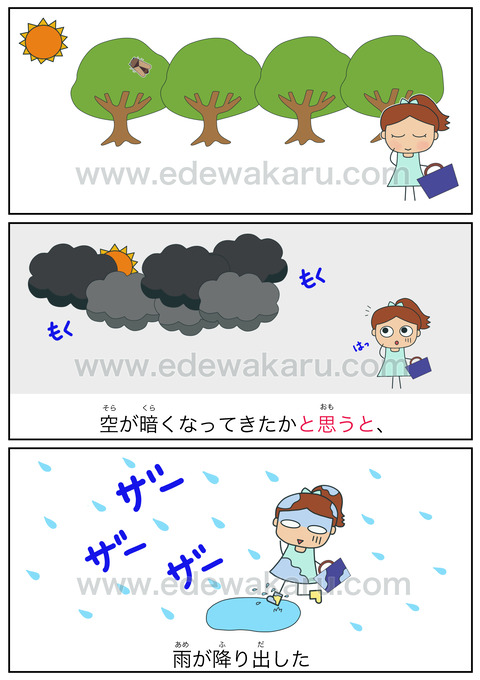
Meaning
When ~ happens, immediately ~
Almost at the same time as ~ happens
How to use it
Verb [dictionary form] + かと思うと
Verb [た-form] + かと思ったら
Explanation
“Aと思うとB・Aと思ったらB” is a sentence pattern meaning “when A happens, B happens immediately” or “B happens almost at the same time as A.” This pattern conveys the speaker’s [surprise] or [feeling that something is unexpected]. It is used when you want to say “something unexpected, B, happened immediately after A.” Also, “〜と思うと” can be changed to “〜かと思うと,” “〜と思ったら,” or “〜かと思ったら.”
[Example]
The sky started getting dark
と思うと, it began to rain
= The sky started getting dark
かと思うと, it began to rain
= The sky started getting dark
と思ったら, it began to rain
= The sky started getting dark
かと思ったら, it began to rain
Also, be careful: this cannot be used about oneself.
[Examples]
❌ I got home
と思うと, I went out again
⭕️ When I got home, I went out again right away
“〜と思うと・〜と思ったら” also has a usage that expresses [rapid change], so let’s learn that as well 😊
[Related patterns]
In context 5 examples
空が暗くなってきたと思うと、雨が降り出した
→空が暗くなってきたら、すぐに雨が降り出したJust as the sky started getting dark, it began to rain. →As soon as the sky got dark, it began to rain.
娘は学校から帰ってきたと思うと、またすぐに出かけていった
→学校から帰ってくると、またすぐに出かけていったJust when my daughter got home from school, she went out again right away. →When she got home from school, she went out again right away.
空が光ったと思うと、雷が鳴った
→空が光ったら、すぐに雷が鳴ったJust as the sky flashed, thunder rumbled. →As soon as the sky flashed, thunder rumbled.
彼女は、下を向いたかと思うと泣き始めた
→下を向くと、すぐに泣き始めたJust as she lowered her gaze, she began to cry. →As soon as she lowered her gaze, she began to cry.
兄は、ぼくの顔を見たかと思うと殴りかかってきた
→ぼくの顔を見ると、すぐに殴りかかってきたJust as my older brother saw my face, he lunged at me. →As soon as he saw my face, he lunged at me.
Read the original source text
Meaning
〜したら、すぐに〜
〜するのと、ほとんど同時に
How to use it
動詞[辞書形]+かと思うと
動詞[た形]+かと思ったら
Explanation
「Aと思うとB・Aと思ったらB」は「Aすると、すぐにB」「Aするのとほとんど同時にB」という意味の文型です。この文型は、話し手の【驚き】や【意外だと思う気持ち】が入ります。
「Aの後、すぐに続いてBという意外なことが起こった」
と言いたい時に使います。また、
「〜と思うと」は「〜かと思うと」「〜と思ったら」「〜かと思ったら」
にチェンジすることができます。
[例]
空が暗くなってきた
と思うと、雨が降り出した
=空が暗くなってきた
かと思うと、雨が降り出した
=空が暗くなってきた
と思ったら、雨が降り出した
=空が暗くなってきた
かと思ったら、雨が降り出した
また、自分のことには使えませんので注意しましょう。
[例]
❌私は家に帰った
と思うと、また出かけた
⭕️私は家に帰ると、またすぐに出かけた
「〜と思うと・〜と思ったら」には【速い変化】を表す用法もありますので、一緒に覚えておきましょう😊
【関連文型】
Usage 2
Read this source entry ↗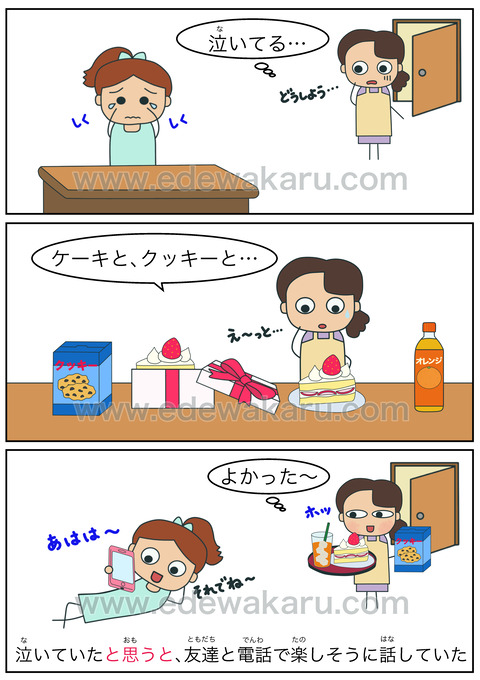
Meaning
A rapid change from ~ to ~
How to use it
Verb [dictionary form] + かと思うと
Verb [た-form] + かと思ったら
Explanation
“Aと思うとB” is a sentence pattern meaning “the change from A to B is rapid” or “it changes immediately from state A to state B.” It is used when you want to say that the shift from being in state “A” to being in state “B” happens very quickly. In most cases, “A” and “B” are actions or states that express opposites. Also, “〜と思うと” can be changed to “〜かと思うと,” “〜と思ったら,” or “〜かと思ったら.”
[Examples]
① Just when I thought she had been crying,
she was happily talking on the phone with her friend
→The change from a crying state to a happy state is rapid
② Just when I thought she had gotten angry,
she burst out laughing
→The change from an angry state to bursting out laughing is rapid
③ Just when I thought he had finally started studying,
he started playing a game
→He started playing a game soon after he began studying
④ Just when I thought the rain had stopped,
it started raining again…
→The change from having stopped to starting again is rapid
⑤ Just when I thought it was starting to feel like summer,
today was as cold as February
→It had felt hot like summer, but suddenly it got cold
“〜と思うと・〜と思ったら” have other usages too, so let’s review them 😊
In context 5 examples
泣いていたと思うと、友達と電話で楽しそうに話していた
Just when I thought she had been crying, she was happily talking on the phone with her friend.
彼女は怒ったと思うと、大声で笑い出した
Just when I thought she had gotten angry, she burst out laughing.
やっと勉強し出したと思うと、ゲームを始めた
Just when I thought he had finally started studying, he started playing a game.
雨がやんだと思うと、また降り出した…
Just when I thought the rain had stopped, it started raining again…
夏らしくなってきたと思うと、今日は2月のような寒さだった
Just when I thought it was starting to feel like summer, today was as cold as February.
Read the original source text
Meaning
〜から〜への変化が速い
How to use it
動詞[辞書形]+かと思うと
動詞[た形]+かと思ったら
Explanation
「Aと思うとB」は「AからBになる変化が速い」「AからBの状態にすぐに変わる」という意味の文型です。これは「A」していた状態から「B」の状態に切りかわるのが、とても速いと言いたい時に使います。ほとんどの場合には「A」と「B」には、反対を表す動作や状態が入ります。また、
「〜と思うと」は「〜かと思うと」「〜と思ったら」「〜かと思ったら」
にチェンジすることができます。
[例]
①泣いていた
と思うと、友達と電話で楽しそうに話していた
→泣いていた状態から、楽しそうにしている状態への変化が速い
②彼女は怒った
と思うと、大声で笑い出した
→怒っていた状態から、笑い出す状態への変化が速い
③やっと勉強し出した
と思うと、ゲームを始めた
→勉強しだしてから、すぐにゲームを始めた
④雨がやんだ
と思うと、また降り出した…
→やんだ状態から、降り出すまでの変化が速い
⑤夏らしくなってきた
と思うと、今日は2月のような寒さだった
→夏らしい暑さだったのに、急に寒くなった
「〜と思うと・〜と思ったら」には、他の用法もありますので復習をしておきましょう😊
どんなときどう使う 日本語表現文型辞典
Meaning
no sooner than
How to use it
Vた+(か)と思うと
Explanation
(か)とおもうと
~すると、すぐに
1)「~(か)と思うと…」の形で、「~」が起こったすぐ直後に「…」が起こる、と言いたいときに使う。
2)「(か)と思うと」は現実のできごとを描写するのであるから、意志的な行為を表す文や「よう・つもり」などの意志の文・命令文・否定文などが後に来ることはない。
◆ × 学校から帰ってきたかと思うと、すぐ勉強しよう。
3) ❷ の「と思ったら」も意味・用法は同じ。
4)同様の意味・用法を持つ表現には次のものがある。
2)Phrase ~(か)と思うと describes actual event. Clauses expressing volitional action or words of volition, such as よう or つもり, commands, or negatives cannot follow. Cannot be used for the speaker.
◆ × 学校から帰ってきたかと思うと、すぐ勉強しよう。
3)In sentence ❷ , と思ったら has the same meaning and usage.
1)One event directly follows another.
4) Patterns with similar meanings or usage are:
In context 3 examples
空でなにかピカッと光ったかと思うと、ドーンと大きな音がして地面が揺れた。
Just as something flashed in the sky, there was a loud boom and the ground shook.
あの子はやっと勉強を始めたと思ったら、もういねむりをしている。
That child had only just started studying, and now he's already dozing off.
うちの子どもは学校から帰ってきたかと思うと、いつもすぐ遊びに行ってしまう。
As soon as my child gets home from school, they always go straight out to play.
Read the original source text
Meaning
no sooner than
How to use it
Vた+(か)と思うと
Explanation
(か)とおもうと
~すると、すぐに
1)「~(か)と思うと…」の形で、「~」が起こったすぐ直後に「…」が起こる、と言いたいときに使う。
2)「(か)と思うと」は現実のできごとを描写するのであるから、意志的な行為を表す文や「よう・つもり」などの意志の文・命令文・否定文などが後に来ることはない。
◆ × 学校から帰ってきたかと思うと、すぐ勉強しよう。
3) ❷ の「と思ったら」も意味・用法は同じ。
4)同様の意味・用法を持つ表現には次のものがある。
2)Phrase ~(か)と思うと describes actual event. Clauses expressing volitional action or words of volition, such as よう or つもり, commands, or negatives cannot follow. Cannot be used for the speaker.
◆ × 学校から帰ってきたかと思うと、すぐ勉強しよう。
3)In sentence ❷ , と思ったら has the same meaning and usage.
1)One event directly follows another.
4) Patterns with similar meanings or usage are:
NINJAL 日本語文型データベース
Meaning
Used when you want to say that another event or major change occurs right after the speaker notices “〜.”
How to use it
Vたと思うと
Notes
It is not used to describe the speaker’s own actions.
An unexpected event often follows “〜と思うと.” A sentence expressing the speaker’s hope or intention, or a sentence urging the listener to do something, does not follow.
In context 5 examples
そのランナーは、走り出したと思うと、すぐ立ち止まってしまった。
The runner started running, and then immediately stopped.
その学生は授業中、急に立ち上がったと思うと、先生の前まで進んでいき、「先生、お願いがあります」と頭を下げた。
During class, the student suddenly stood up, then walked up to the teacher, bowed, and said, “Teacher, I have a favor to ask.”
黒い雲が一瞬にして広がったと思うと、急に大粒の雨が降り出した。
Black clouds spread across the sky in an instant, and then large raindrops suddenly began to fall.
聞いていた古いラジオから急にピーっと異音がしたと思うと、何も聞こえなくなった。壊れてしまったようだ。
A strange beep suddenly came from the old radio I was listening to, and then it went silent. It seems to have broken.
春は天気が変わりやすい。暖かい日が数日続いたと思うと、またすぐ寒くなることもある。
The weather changes easily in spring. It may be warm for several days, only to get cold again soon afterward.
Read the original source text
Meaning
話し手が~に気づいたすぐ後に、続けて次の出来事や大きな変化が起こると言いたいときに使います。
How to use it
Vたと思うと
Notes
話し手自身の行為の描写には使いません。
「〜と思うと」の後には、意外性のある出来事を表す文がくることが多いです。話し手の希望・意向を表す文や相手への働きかけの文はきません。