どんなときどう使う 日本語表現文型辞典
Meaning
matter of course; certain; definite
How to use it
〔Plain form〕(ナA・ナAである/N・Nである)+ に決まっている
Explanation
きっと~だ/必ず~だ
話者が断定したいほど確信を持っていると言いたいときに使う。
Speaker's conclusive conviction about something.
In context 4 examples
そんな暗いところで本を読んだら目に悪いに決まっている。
It’s bound to be bad for your eyes if you read in such a dark place.
今週中に30枚のレポートを書くなんて無理に決まっています。
It’s obviously impossible to write a 30-page report within this week.
デパートよりスーパーの方が品物が安いに決まっているよ。スーパーへ行こう。
Of course things are cheaper at a supermarket than at a department store. Let’s go to the supermarket.
選挙では林氏が当選するに決まっている。彼はこの土地の有力者なんだから。
Mr. Hayashi is bound to win the election. He’s an influential person in this area.
Read the original source text
Meaning
matter of course; certain; definite
How to use it
〔普通形〕(ナA・ナAである/N・Nである)+に決まっている
Explanation
きっと~だ/必ず~だ
話者が断定したいほど確信を持っていると言いたいときに使う。
Speaker's conclusive conviction about something.
日本語文型辞典
Meaning
N/A/V にきまっている
It expresses the speaker’s confident supposition that something must be so. When asserting something that differs from the listener’s supposition, the form 「に決まっているじゃない(か/の)」 is used. This is the spoken-language equivalent of 「にちがいない」.
Examples:
1. It must have been that guy who pulled this prank.
2. Surely he’ll want to take part too.
3. If you say something like that, she’s bound to be offended.
4. A: I wonder if Mr. Tanabe made it on time.
B: He left half an hour late, so he must have been late.
Read the original source text
Meaning
基本情報N/A/V にきまっている説明「必ずそうに違いない」という話し手の確信のこもった推測を表す。聞き手の推測と食い違っている内容を主張するときは「に決まっているじゃない(か/の)」となる。「にちがいない」の話しことば的な言い方。例文① こんないたずらをするのはあいつにきまっている。② きっと彼も参加したがるに決まっている。③ そんなことを言ったら彼女が気を悪くするに決まっているじゃないか。④ A:田辺さん、ちゃんと時間にまにあったかしら。
B:30分も遅く出ていったのだから、遅刻したに決まっているじゃないの。
日本語文型辞典 英語版
Meaning
【にきまっている】[N/A/V にきまっている]
B:30分も遅く出ていったのだから、遅刻したに決まっているじゃないの。
She left thirty minutes late, so she must have arrived late.
Expresses the speaker’s conviction that something must be the case. When the speaker asserts his/her conviction contradicting the listener’s, にきまっている becomes に決まっているじゃない(か/の). An expression in spoken Japanese.
In context 4 examples
こんないたずらをするのはあいつにきまっている。
I’m sure he’s the guy who would pull such a stunt.
きっと彼も参加したがるに決まっている。
I bet that he wants to join in.
そんなことを言ったら彼女が気を悪くするに決まっているじゃないか。
If you say such a thing, isn’t it likely she’ll get really upset?
A:田辺さん、ちゃんと時間にまにあったかしら。
I wonder if Tanabe-san arrived in time.
くらべてわかる日本語表現文型辞典
Meaning
Meaning 1: The speaker’s strong inference. The speaker is convinced that it is A.
Meaning 2: It is naturally A.
How to use it
Explanation
【Contrast 1】
“Aことにきまっている”
“Aことにきまっている” is an expression that strongly conveys objectivity: the decision is made beyond the speaker’s control. “Aにきまっている” expresses the speaker’s inference or judgment.
○今日、彼女は来るにきまっている。(確率が大である) — She is sure to come today. (It is highly likely.)
○今日、彼女は来ることにきまっている。(決定している) — It has been decided that she will come today. (It has been decided.)
In context 8 examples
頑張っても、どうせいい成績なんか取れないにきまっている。
No matter how hard I try, I’m bound not to get good grades anyway.
あの人のことだから、合格するにきまっているよ。
Knowing that person, he’s sure to pass.
この小説の犯人は彼女にきまっている。
The culprit in this novel is definitely her.
あの人の作る料理なんて、まずいにきまっている。
Any food that person makes is bound to taste bad.
金はないよりあるほうがいいにきまっている。
It’s obviously better to have money than not to.
雪の中で寝ると、死ぬにきまってるじゃないか。
If you sleep in the snow, you’re bound to die, aren’t you?
親ですもの子どもたちのことを心配しているにきまっているでしょ。
They’re parents, so of course they’re worried about their children.
「儲かってる?」「とんでもない。毎月赤字にきまっているじゃない。」
“Are you making a profit?” “Not at all. We’re definitely in the red every month.”
Read the original source text
Meaning
意味1:話し手の強い推量。話し手はAだと信じ込んでいる。
意味2:当然Aだ。
How to use it
Explanation
【対比1】
「Aことにきまっている」
「Aことにきまっている」は客観性を強く出す表現で話し手の意志の及ばないところでの決定。「Aにきまっている」は話し手の推量判断。
○今日、彼女は来るにきまっている。(確率が大である)
○今日、彼女は来ることにきまっている。(決定している)
NINJAL 日本語文型データベース
Meaning
Expresses the speaker’s subjective, emphatic inference that something is definitely so.
How to use it
V plain form + にきまっている
i-A plain form + にきまっている
na-A plain form + にきまっている (however, “na-Aだ” → “na-A + にきまっている”)
N plain form + にきまっている (however, “Nだ” → “N にきまっている”)
In context 18 examples
「山本さんは遅刻するにきまっているよ。あの人はいつも待ち合わせに遅れるんだから」
“Yamamoto is bound to be late. That person is always late for appointments.”
子ども「あ、またテストでこんな点、取っちゃった。お母さんに見せたら不機嫌になるにきまっているなあ」
Child: “Oh, I got a score like this on the test again. If I show Mom, she’s bound to get annoyed.”
先生に「ばか!」なんて言ってしまったのだから、私は先生によく思われていないにきまっている。
Since I went and said something like “You idiot!” to the teacher, the teacher is bound to think badly of me.
「田中さんと加藤さんの囲碁対決はどうなったでしょうね」「田中さんが勝ったにきまっているよ。彼は強いからね」
“How do you think the Go match between Tanaka and Kato turned out?” “Tanaka must have won. He’s strong.”
雄介は気弱だからなあ。結局、昨日も加代さんに自分の気持ちを伝えられなかったに決まっている。
Yusuke is so timid. He’s bound to have failed to tell Kayo how he feels yesterday, too.
仕事をするなら、もちろん給料が高い方がいいにきまっている。
If you’re going to work, of course a higher salary is bound to be better.
こんなに物価が高くては、生活が苦しいにきまっているではないか。
With prices this high, life is bound to be difficult, isn’t it?
「上司と飲みに行くことなんて、ある?」「ないない。うちの上司と飲みに行っても、楽しくないにきまっていますよ」
“Do you ever go drinking with your boss?” “No, never. It’s bound to be no fun going drinking with my boss.”
母「ジュン、マリちゃんに変なこと言ってからかったらだめでしょう。マリちゃん、恥ずかしかったにきまっているよ」
Mother: “Jun, you shouldn’t tease Mari by saying strange things to her. Mari must have been embarrassed.”
お酒を飲まないひとみさんがワインをもらっても、全然うれしくなかったに決まっている。
Hitomi doesn’t drink, so she’s bound not to have been happy at all to receive wine.
「税務署の職員なんて不親切にきまっているよ」「でも、この前の人はとても親切だったよ」
“Tax office employees are bound to be unhelpful.” “But the person I dealt with the other day was very helpful.”
めいちゃん、試験に落ちて相当落ち込んでいるみたい。大丈夫って言っていたけど、大丈夫じゃないにきまっている。心配だな。
Mei seems really down about failing the exam. She said she was okay, but she’s bound not to be okay. I’m worried.
「あの二人、有名タレント同士の結婚だから、結婚パーティーも豪華だったにきまっているね」
“Those two are both famous entertainers, so their wedding party must have been lavish.”
ライバルの田中選手が優勝で、自分は2回戦敗退だったのだから、加藤選手は内心穏やかじゃなかったに決まっています。
Since his rival, Tanaka, won the championship while he was eliminated in the second round, Kato must have been far from calm inside.
太郎は優秀だから、今日のテストも満点にきまっている。
Taro is outstanding, so he’s bound to get a perfect score on today’s test, too.
今は景気が悪いので、賃上げ交渉での会社側の返答は、こちらがすぐに受け入れられるようなものではないにきまっている。
The economy is bad now, so the company’s response to the wage increase negotiations is bound not to be something we can accept right away.
父「あいつ、中学生のときは医者になりたいとか言ってたけど、本気じゃなかったのかな」母「あの子は真面目だから、あの時は本気だったにきまっていますよ」
Father: “That guy used to say he wanted to be a doctor when he was in middle school, but I wonder if he was serious.” Mother: “He’s a serious person, so he must have meant it at the time.”
家業の寿司屋を継ぐことは太郎の本望ではなかったに決まっている。本当は画家になりたかったはずだ。
It must not have been Taro’s heartfelt wish to take over the family sushi restaurant. He must really have wanted to become a painter.
Read the original source text
Meaning
間違いなく〜だという話し手の主観的・断定的な推測を表します。
How to use it
V普通形+にきまっている
i-A普通形+にきまっている
na-A普通形+にきまっている (ただし「na-Aだ」→「na-A+にきまっている」)
N普通形+にきまっている(ただし、「Nだ」→「Nにきまっている」)
IMABI
No doubt that
Read this IMABI lesson ↗Explanation
No Doubt that: ~に違いない, ~に相違ない, & ~に決まっている
~に違いない and ~に相違ない are not necessarily difficult, but there are certain problems that students have. The unusual way it connects to adjective/verb expressions, not properly understanding what can follow them, and not understanding formality differences are the main sources of error. The lesson will be ended with the similar ~に決まっている.
~に違いない VS ~に相違ない
First and foremost, these expressions are both translated as “there is without a doubt that…”. This is the immediate source of confusion because you can add phrases like “I think that” or “probably” in English without causing ungrammaticality. However, with these Japanese expressions, doing so does. First, consider the following defining of these terms.
~に違いない: Not from objective proof or logical speculation, but rather from the speaker’s own experience, this phrase shows one’s intuitive speculation/confidence. With such a bold move, it is without surprise that this is quite strong. It is often used in situations where it’s as if one is talking to oneself in attempts to verify one’s own guess or deliberation.
~に相違ない: Like ~に違いない, it shows intuitive speculation/confidence, but it is more stiff and formal. This formality difference is very important to keep in mind. One reason is that speech modals more akin to the spoken language like the final particle から, which is commonly used with ~に違いない, are not typically used with ~相違ない. This also implies that there is no mistake in it; thus, it gives a more confident tone. Thus, although adverbs like きっと are common with ~に違いない, it is not with ~に相違ない due to the tone. Although perhaps of old logic, some speakers feel this is more so indicative of middle-aged/old men as they are more likely to use old-fashioned expressions, which would not be old-fashioned for them, and fits the traditional tone for masculine speech.
These patterns attach to phrases in the following manner.
Nouns N(である)+~に{違い・相違}ない
形容詞 形容詞 + ~に{違い・相違}ない
形容動詞 形容詞(である) + ~に{違い・相違}ない
Verbs Verb + ~に{違い・相違}ない
Notice that it does not say Adj/V + こと + に{違い・相違}ない. It is a set phrase, and like other phrases with に, the reason for why this is allowed stems from a Classical Japanese grammatical maneuver of using conjugational parts of speech as nominal phrases when in the 連体形. As this base has changed appearance for many items, it’s not surprising that in Modern Japanese this technique is limited.
Examples
1. 政府の報道官の応答はどんなに(か)悔しかったに違いない。
The response of the government spokesperson was in no doubt overly regrettable.
Grammar Note: In a more literary sense どんなに(か) may be replaced with いかばかりか. Also note that the use of か with this in the first place is hardly ever heard.
2. 違いない(その通り)、君の言う通りだ。
That’s right. It’s just as you say.
3. この計画の実行は困難に違いない。
It is without a doubt that this plan’s implementation is difficult.
4. 泥棒どろぼうが入ったに違いない。
There is no doubt that a robber came in.
5. 馬鹿者ばかものには違いないが、責任を取らざるをえないだろう。
Although it’s without a doubt that you’re an idiot, there’s no other way but to take responsibility.
By 大仏次郎おさらぎじろう
6. 明日は曇くもるに違いない。
It will definitely be cloudy tomorrow.
7. 社長は天才であることに相違ない。
There’s no doubt that the company president is a genius.
8. 「あの女の人は誰でしょうか」「ケンさんのガールフレンドに違いありません。手を繋つないで一緒に歩いていますから」
“Who is that woman?” “There’s no doubt that she’s Ken’s girlfriend because they’re holding hands walking together”.
9. 「あの人は何語なにごの学生でしょうか」「日本語の学生に違いありません。読んでいるものに「新しい」と書いてありますから」
“What language student is that person? “That person is no doubt a Japanese student because the thing (that person) is reading has “atarashii” written on it”
10. 「あの人は日本に住んでいたんでしょうか」「そうに違いありません。日本の新聞を読んでいますから」
“I wonder if that person lived in Japan” There’s no doubt about it because he’s reading a Japanese newspaper”
11. 「あの女の人は結婚しているんでしょうか」「そうに違いありません。指輪ゆびわを嵌はめていますから」
“I wonder if that woman is married” “There’s no doubt about it because she’s wearing a ring”
~に決まっている
~に決まっている means “it is certainly…” and follows nouns, adjectives, or verbs. This speech modal shows 100% certainty and is reflective of 話し言葉. It shows that the speaker is very confident in labeling something as so. It is also used in chastising.
12. 彼は嘘うそをついているに決まっている。
He’s certainly lying.
13. 夏は暑いに決まっている。
It is certainly hot in summer.
14. 負けるに決まってる。(Casual)
(They) will certainly lose.
In context 14 examples
政府の報道官の応答はどんなに(か)悔しかったに違いない。
The response of the government spokesperson was in no doubt overly regrettable.
違いない(その通り)、君の言う通りだ。
That’s right. It’s just as you say.
この計画の実行は困難に違いない。
It is without a doubt that this plan’s implementation is difficult.
泥棒どろぼうが入ったに違いない。
There is no doubt that a robber came in.
馬鹿者ばかものには違いないが、責任を取らざるをえないだろう。
Although it’s without a doubt that you’re an idiot, there’s no other way but to take responsibility.
明日は曇くもるに違いない。
It will definitely be cloudy tomorrow.
社長は天才であることに相違ない。
There’s no doubt that the company president is a genius.
「あの女の人は誰でしょうか」「ケンさんのガールフレンドに違いありません。手を繋つないで一緒に歩いていますから」
“Who is that woman?” “There’s no doubt that she’s Ken’s girlfriend because they’re holding hands walking together”.
「あの人は何語なにごの学生でしょうか」「日本語の学生に違いありません。読んでいるものに「新しい」と書いてありますから」
“What language student is that person? “That person is no doubt a Japanese student because the thing (that person) is reading has “atarashii” written on it”
「あの人は日本に住んでいたんでしょうか」「そうに違いありません。日本の新聞を読んでいますから」
“I wonder if that person lived in Japan” There’s no doubt about it because he’s reading a Japanese newspaper”
「あの女の人は結婚しているんでしょうか」「そうに違いありません。指輪ゆびわを嵌はめていますから」
“I wonder if that woman is married” “There’s no doubt about it because she’s wearing a ring”
彼は嘘うそをついているに決まっている。
He’s certainly lying.
夏は暑いに決まっている。
It is certainly hot in summer.
負けるに決まってる。(Casual)
(They) will certainly lose.
絵でわかる日本語
Meaning
Surely …
It must be …
How to use it
Verb・adjective・noun [dictionary form] + に決まっている
Explanation
「〜に決まっている」means “it must surely be …” and is a sentence pattern that expresses the speaker’s certainty. It is used to state one’s inference with a high degree of confidence, as in “surely ….” It is also commonly used in conversation 😊
In conversation, the colloquial form 「〜に決まってる」is often used, with colloquial 「〜てる・〜でる」, so learn these together 😄
【Related sentence patterns】
In context 4 examples
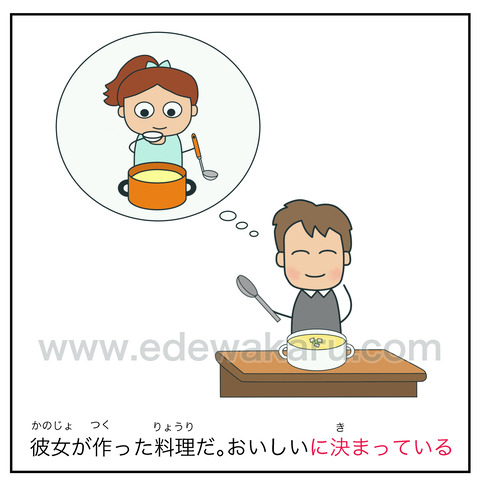
彼女が作った料理だ。おいしいに決まっている!
→彼女が作った料理だ。おいしいに違いないIt’s a dish she made. It must be delicious! →It’s a dish she made. It must be delicious.
1年間毎日しっかり勉強したんだ。合格するに決まっている
→1年間毎日しっかり勉強したんだ。きっと合格するに違いないYou studied hard every day for a year. You’re sure to pass. →You studied hard every day for a year. You must surely pass.
妹も新しいスマホを欲しがるに決まっている
→妹もきっと新しいスマホを欲しがるだろうMy younger sister is sure to want a new smartphone too. →My younger sister will surely want a new smartphone too.
山田くんの言うことなんて、うそに決まっているわ!
→山田くんの言うことなんて、うそに違いないWhatever Yamada says, it must be a lie! →Whatever Yamada says, it must be a lie.
Read the original source text
Meaning
きっと〜だ
〜に違いない
How to use it
動詞・形容詞・名詞[辞書形]+に決まっている
Explanation
「〜に決まっている」は「きっと〜に違いない」という意味で、話し手の確信を表す文型です。「きっと〜だ」というように、高い確信性を持って自分の推測を言う文型です。会話でもよく使われます😊
会話では「〜に決まってる」というように口語形の「〜てる・〜でる」がよく使われますので、一緒に覚えておきましょう😄
【関連文型】
毎日のんびり日本語教師
How to use it
Verb plain form + に決まっている
I-adjective plain form + に決まっている
Na-adjective stem + に決まっている
Noun + に決まっている
Explanation
Expresses the speaker’s confident and emphatic judgment or assertion.
Notes
Similar grammar: 「【N2 Grammar】~に違いない」
Similar grammar: 「【N2 Grammar】~に相違ない」
「~に決まっている」, 「~に違いない」, and 「~に相違ない」 all have the same meaning, but 「~に決まっている」 is the softest expression. 「~に相違ない」 is used mainly in written language.
In context 6 examples
何をするにも楽しいほうがいいに決まっている。
Whatever you do, it’s bound to be better if it’s fun.
夜の病院ではお化けが出るなんて嘘に決まってる。
It’s definitely a lie that ghosts appear in hospitals at night.
サービス業に休みなんかない。土日も仕事に決まっている。
There are no days off in the service industry. It’s a given that you work weekends too.
彼はどうせ来ないに決まっている。
He’s definitely not coming anyway.
理論は間違っていないから、成功するに決まっている。
The theory isn’t wrong, so it’s bound to succeed.
無理に痩せようとすると、身体に負担がかかるに決まっている。
If you try to lose weight too quickly, it’s bound to put a strain on your body.
Read the original source text
How to use it
動詞普通形+に決まっている
い形容詞普通形+に決まっている
な形容詞語幹+に決まっている
名詞+に決まっている
Explanation
話し手の自信に満ちた強めの判断・断定を表します。
Notes
似ている文法「【N2文法】~に違いない」
似ている文法「【N2文法】~に相違ない」
「~に決まっている」「~に違いない」「~に相違ない」はそれぞれ同じ意味ですが、最も柔らかい表現は「~に決まっている」です。「~に相違ない」は主に書き言葉として用いられます。