文法
Meaning
① 〜 had an effect / thanks to 〜
② 〜 was worthwhile
Used when you want to say that although something was difficult or painful, doing it brought an effect or achievement and led to a good result.
How to use it
V (dictionary form / た-form) + かいがあって
V (ます-stem) + がいがある
Nの + あげく ※N is the N of a する verb
Notes
① When speaking, the が in “〜かいがあって” is often omitted.
② The negative form can also be “〜かいがなく,” but “〜かいもなく” is more commonly used.
In context 12 examples
毎日シャドーイングをしたかいがあって、発音が上手になった。
Thanks to shadowing every day, my pronunciation improved.
毎日鏡の前で練習したかいがあって、プレゼンは大成功だった。
Thanks to practicing in front of the mirror every day, the presentation was a great success.
2時間も並んだかいがあって、日本一美味しいと評判の高いラーメンを食べることができた。
It was worth waiting in line for two whole hours: I was able to eat ramen reputed to be the best in Japan.
20kgもダイエットに成功したのだから、高いお金を払ったかいがあったと思う。
Since I successfully lost as much as 20 kg, I think it was worth paying so much money.
苦労したかいがあって、第一志望の大学に合格できた。
Thanks to all my hard work, I was able to get into my first-choice university.
彼はいつも面白い反応をしてくれるので、イジリがいがある。
He always gives funny reactions, so he’s fun to tease.
ジェシカさんは真面目だし、予習・復習をきちんとしてくるから教えがいがある。
Jessica is diligent and always comes prepared, having done her review and preview, so she’s rewarding to teach.
今の仕事は忙しいが、やりがいがある。
My current job is busy, but it’s rewarding.
努力のかいもなく、N1の試験に合格できなかった。
Despite all my efforts, I couldn’t pass the N1 exam.
遠くから時間とお金をかけて来たかいもなく、店は閉まっていて名物料理が食べられなかった。
Despite traveling from far away and spending time and money to get there, the shop was closed and I couldn’t eat its specialty dish.
父は手術のかいもなく、亡くなってしまった。
Despite the surgery, my father passed away.
夜11時まで残業したかいもなく、納期を守れず謝ることになった。
Despite working overtime until 11 p.m., I couldn’t meet the deadline and had to apologize.
Read the original source text
Meaning
①〜の効果があって / 〜のおかげで
②〜の価値があって
大変だった、辛かったが〜したことで効果や成果が得られて、いい結果になったと言いたい時に使う。
How to use it
V(辞書形 / タ形) + かいがあって
V(ます形)ます + がいがある
Nの + あげく ※Nはする動詞のN
Notes
①話す時は「〜かいがあって」の「が」が脱落することが多い。
②否定の形は「〜かいがなく」でもいいが「〜かいもなく」を使うことが多い。
絵でわかる日本語
Meaning
〜having had an effect from doing 〜
〜having achieved results from doing 〜
How to use it
Verb [た-form・ている-form] + かいあって
Noun [dictionary form] + のかいあって
Explanation
“〜かいあって” is a grammar pattern meaning “having had an effect from doing 〜” or “having achieved results from doing 〜.” It is used when you want to say that doing something difficult or painful produced a good effect or result 😊 When used with a noun, it becomes “〜のかいあって.”
[Examples]
Thanks to my efforts, I passed N1.
Thanks to my training, I was able to win.
The meaning is the same even when “が” is inserted, as in “〜かいがあって” 😀
[Examples]
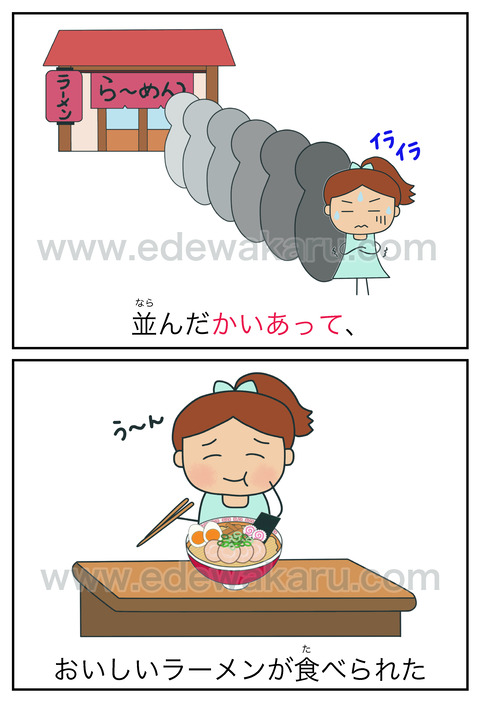
Thanks to having waited in line for two hours, I was able to eat delicious ramen.
Thanks to having waited in line for two hours, I was able to eat delicious ramen.
There is also the usage “〜かいがある” 😮
[Examples]
This ramen is delicious. It was worth waiting in line for two hours.
I passed N1! All my hard work paid off!!
“〜かいがある” is written with the kanji “〜甲斐がある,” so learners at an advanced level may want to remember it 😊
[Additional explanation]
Remember that the negative form of “〜かいあって” is “〜かいもなく.” Also, the negative form of “〜かいがある” is “〜かいがない” 😉
[Examples]
Despite my efforts, I didn’t pass N1.
I couldn’t pass N1… My efforts were in vain…
Remember that “〜かいあって” must always be followed by the た-form 😀
In context 3 examples
並んだかいあって、おいしいラーメンが食べられた
→並んだ効果があって、おいしいラーメンが食べられたThanks to having waited in line, I was able to eat delicious ramen. →As a result of waiting in line, I was able to eat delicious ramen.
努力したかいあって、N1に合格した
→努力した成果があって、N1に合格したThanks to my efforts, I passed N1. →As a result of my efforts, I passed N1.
毎日トレーニングしたかいあって、優勝することができた
→毎日トレーニングした効果があって、優勝することができたThanks to training every day, I was able to win. →As a result of training every day, I was able to win.
Read the original source text
Meaning
〜した効果があって〜
〜した成果があって〜
How to use it
動詞[た形・ている形]+かいあって
名詞[辞書形]+のかいあって
Explanation
「〜かいあって」は「〜した効果があって」「〜した成果があって」という意味で使われる文型です。
大変なことや、辛いことをしたら、いい効果や成果が出たと言いたい時に使います
😊名詞に使う場合は
「〜のかいあって」
になります。
[例]
努力
のかいあって、N1に合格した
トレーニング
のかいあって、優勝することができた
「〜かいがあって」というように「が」が入っていても意味は同じです
😀
[例]
2時間並んだ
かいあって、おいしいラーメンが食べられた
2時間並んだ
かいがあって、おいしいラーメンが食べられた
また、
「〜かいがある」
という使い方もあります😮
[例]
このラーメンはおいしい。2時間並んだ
かいがある
N1に合格できた!努力した
かいがあった!!
「〜かいがある」は漢字で書くと
「〜甲斐がある」
と書きますので、上級レベルの人は覚えておくといいと思います😊
【補足説明】
「〜かいあって」の否定形は「〜かいもなく」です。また、
「〜かいがある」の否定形は「〜かいがない」と覚えておきましょう
😉
[例]
努力した
かいもなく、N1に合格できなかった
N1に合格できなかった…努力した
かいがなかった
…
「〜かいあって」の後ろは必ず「た形」がくると覚えておきましょう
😀
日本語NET JLPT文法解説まとめ
Meaning
① The effect of ~ / thanks to ~
② Worthwhile
Used when you want to say that although something was difficult or painful, doing it produced an effect or achievement and led to a good result.
How to use it
V (dictionary form / ta-form) + かいがあって
V (ます-form)ます + がいがある
N from a する verb + かいがあって
Explanation
① "Thanks to / Due to the effects of"
② "It was worth"
It is used to say that although something was difficult and challenging, the efforts paid off and resulted in a good outcome.
① In speech, the が in 「〜かいがあって」 is often dropped.
② The negative form can be 「〜かいがなく」, but 「〜かいもなく」 is more commonly used.
In context 12 examples
毎日シャドーイングをしたかいがあって、発音が上手になった。
Thanks to shadowing every day, my pronunciation improved.
毎日鏡の前で練習したかいがあって、プレゼンは大成功だった。
Thanks to practicing in front of the mirror every day, the presentation was a great success.
2時間も並んだかいがあって、日本一美味しいと評判の高いラーメンを食べることができた。
It was worth waiting in line for two whole hours: I was able to eat ramen reputed to be the best in Japan.
20kgもダイエットに成功したのだから、高いお金を払ったかいがあったと思う。
Since I successfully lost as much as 20 kg, I think it was worth paying so much money.
苦労したかいがあって、第一志望の大学に合格できた。
Thanks to all my hard work, I was able to get into my first-choice university.
彼はいつも面白い反応をしてくれるので、イジリがいがある。
He always gives funny reactions, so he’s fun to tease.
ジェシカさんは真面目だし、予習・復習をきちんとしてくるから教えがいがある。
Jessica is diligent and always comes prepared, having done her review and preview, so she’s rewarding to teach.
今の仕事は忙しいが、やりがいがある。
My current job is busy, but it’s rewarding.
努力のかいもなく、N1の試験に合格できなかった。
Despite all my efforts, I couldn’t pass the N1 exam.
遠くから時間とお金をかけて来たかいもなく、店は閉まっていて名物料理が食べられなかった。
Despite traveling from far away and spending time and money to get there, the shop was closed and I couldn’t eat its specialty dish.
父は手術のかいもなく、亡くなってしまった。
Despite the surgery, my father passed away.
夜11時まで残業したかいもなく、納期を守れず謝ることになった。
Despite working overtime until 11 p.m., I couldn’t meet the deadline and had to apologize.
Read the original source text
Meaning
①〜の効果があって / 〜のおかげで
②〜の価値があって
大変だった、辛かったが〜したことで効果や成果が得られて、いい結果になったと言いたい時に使う。
How to use it
V(辞書形 / タ形) + かいがあって
V(ます形)ます + がいがある
する動詞のNの + かいがあって
Explanation
① "Thanks to / Due to the effects of"
② "It was worth"
It is used to say that although something was difficult and challenging, the efforts paid off and resulted in a good outcome.
①話す時は「〜かいがあって」の「が」が脱落することが多い。
②否定の形は「〜かいがなく」でもいいが「〜かいもなく」を使うことが多い。