絵でわかる日本語
Meaning
~ happened right after ~
~ happened just as one was about to ~
How to use it
Verb [た-form] + 矢先
Verb [volitional form] + とした矢先
Verb [volitional form] + と思った矢先
Explanation
「A矢先にB」 is a sentence pattern meaning “B happened right after A” or “B happened just as one was about to do A.” It is used when A and B happen at almost the same time. B is something unexpected or unanticipated. The 「に」 in 「〜矢先に」 can be omitted.
[Example]
Just as I’d hung out the laundry, it started to rain.
=Just as I’d hung out the laundry, it started to rain.
Let’s review patterns similar to 「〜矢先に」 😉
【Similar patterns】
In context 5 examples
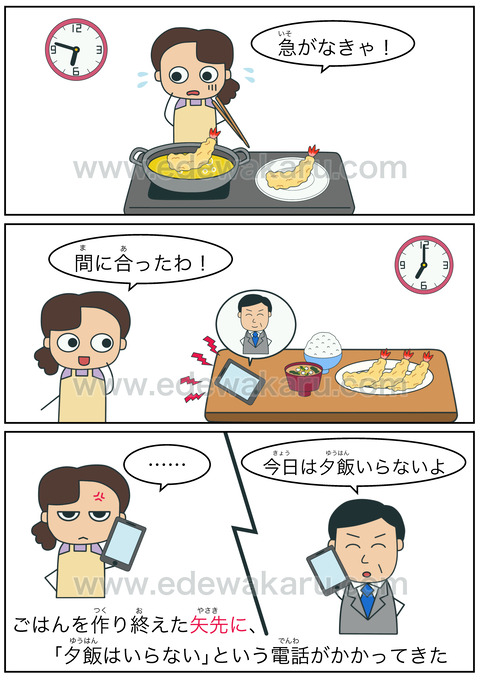
ごはんを作り終えた矢先に、「夕飯はいらない」という電話がかかってきた
→ごはんを作り終えたら、「夕飯はいらない」という電話がかかってきたJust as I’d finished making dinner, I got a call saying, “I won’t need dinner.” → As soon as I finished making dinner, I got a call saying, “I won’t need dinner.”
洗濯物を干した矢先に雨が降り出した
→洗濯物を干したら、すぐに雨が降り出したJust as I’d hung out the laundry, it started to rain. → It started raining right after I hung out the laundry.
帰ろうとした矢先に、社長に呼ばれた
→帰ろうとしていたら、社長に呼ばれたJust as I was about to leave, the president called me over. → I was about to leave when the president called me over.
休みなので映画を見に行こうと思っていた矢先、仕事の電話が入った
→映画を見に行こうと思っていたら、仕事の電話が入ったJust as I was thinking of going to see a movie since it was my day off, I got a work call. → I was thinking of going to see a movie when I got a work call.
家を出ようとした矢先に、大雨が降ってきた
→いえを出ようとしたら、大雨が降ってきたJust as I was about to leave the house, it started pouring. → It started pouring just as I was about to leave the house.
Read the original source text
Meaning
〜したら、すぐに〜した
〜しようとしたら、〜した
How to use it
動詞[た形]+矢先
動詞[意向形]+とした矢先
動詞[意向形]+と思った矢先
Explanation
「A矢先にB」は「Aしたら、すぐにBした」「Aようとしたら、Bした」という意味の文型です。「A」と「B」が、ほとんど同じ時に発生した時に使われます。「B」には意外なことや、予想しなかったことが入ります。「〜矢先に」の「に」は省略することができます。
[例]
洗濯物を干した
矢先に、雨が降り出した
=洗濯物を干した
矢先、雨が降り出した
「〜矢先に」に似ている文型を復習しておきましょう😉
【類似文型】
毎日のんびり日本語教師
How to use it
Verb た-form + 矢先(に)
Verb volitional form + とする矢先(に)
Verb volitional form + とした矢先(に)
Explanation
This grammar expresses that the first and latter events occur at the same time; the latter clause describes an unexpected event that the speaker did not anticipate.
It conveys more tension than「~とき」.
Notes
Nothing in particular.
In context 6 examples
風邪が治った矢先に今度はインフルにかかった。
Just when I’d recovered from a cold, I came down with the flu.
家でゆっくりしようと思った矢先、仕事が入った。
Just when I thought I’d relax at home, work came up.
ご飯作ろうと思った矢先に、猫が膝に乗ってきた。
Just as I was about to make dinner, the cat climbed onto my lap.
元気って言った矢先に風邪引いた。
I’d just said I was fine, and then I caught a cold.
洗濯物干そうとした矢先に雨。
Just as I was about to hang out the laundry, it started raining.
寝ようと思った矢先に電話が来た。
Just as I was about to go to sleep, I got a call.
Read the original source text
How to use it
動た形+矢先(に)
動意向形+とする矢先(に)
動意向形+とした矢先(に)
Explanation
前項と後項が同時発生していることを表す文法で、後項には話者の予想しなかった意外な出来事を述べます。
「~とき」よりもより緊迫感がある表現です。
Notes
特になし