AIUEO JLPT Grammar
Meaning
「〜たて」indicates that an action has just been completed or that a new state has emerged immediately after an action was carried out. This expression is mainly used in spoken language and emphasizes freshness or a new situation.
How to use it
Verb masu-stem + たて
In context 5 examples
焼きたてのパンはとても美味しい。
Freshly baked bread is very delicious.
入れたてのコーヒーをどうぞ。
Please have some freshly brewed coffee.
塗りたてのペンキに触らないでください。
Please don’t touch the freshly painted surface.
できたての料理をすぐに食べた。
I ate the freshly made food right away.
洗いたてのシャツは気持ちがいい。
A freshly washed shirt feels great.
Read the original source text
Meaning
「〜たて」indicates that an action has just been completed or that a new state has emerged immediately after an action was carried out. This expression is mainly used in spoken language and emphasizes freshness or a new situation.
How to use it
動詞ます形+たて
Explanation · 日本語
「〜たて」は、動作が終わったばかりであることや、行動が実施された直後の新しい状態を示す表現です。この表現は主に口語で使われ、新鮮さや新しい状況を強調したいときに使われます。
文法
Meaning
An expression that emphasizes freshness or newness. It is often used with a positive meaning.
How to use it
V (ます-form) ます + たて
In context 12 examples
さぁ、パンは焼きたてで美味しいですよ。おひとついかがでしょうか。
Now, the bread is freshly baked and delicious. Would you like one?
やっぱり料理はできたてが美味しいね。
As you'd expect, food tastes best freshly made.
その天ぷらは揚げたてですから、美味しいですよ。
That tempura is freshly fried, so it's delicious.
生まれたての子鹿が必死に立とうと頑張っている。
A newborn fawn is desperately trying to stand.
昨日、初めて生まれて初めて搾りたてのミルクを飲んだ。
Yesterday, for the first time, I drank freshly squeezed milk.
そこはペンキを塗りたてなので、注意してくださいね。
That area has just been painted, so please be careful.
彼はまだ入社したてで、とてもフレッシュだ。
He has only just joined the company, so he's very fresh.
付き合いたてのカップルにおすすめのデートスポット特集。
A feature on recommended date spots for couples who have just started dating.
干したての布団はふかふかして気持ちがいい。
A futon that's just been aired is fluffy and feels nice.
この市場ではとれたての魚を使った海鮮丼が食べられます。
At this market, you can eat seafood rice bowls made with freshly caught fish.
しぼりたてのミルクは濃厚で美味しい。
Freshly squeezed milk is rich and delicious.
ファブリーズであらいたてのお洗濯の香りを
The scent of laundry freshly washed with Febreze.
Read the original source text
Meaning
〜したばかりで
新しさ、新鮮さを強調する表現。プラスの意味で使われることが多い。
How to use it
V(ます形)ます + たて
Bunpro Grammar Reference
Meaning
Freshly ~ed, Just ~ed
How to use it
Verb[stem]+ たて
Verb[stem]+ たて + の + Noun
Nuance
A word which indicates that (A) was just done, or freshly done. The finished product has just been established.
Explanation
たて, coming from the verb 立てる 'to stand' is a suffix in Japanese that is often used after the conjunctive form of verbs. たて conveys that something has 'just been finished', or is 'freshly finished'.
As a suffix, たて transforms verbs into nouns. This means that they may be followed by a (B) phrase, or followed directly by the case marking particle の and a noun.
ここにあるのは全部揚げたてですよ。
Everything here is freshly fried.
釣りたてだから新鮮だよ!
It is just fished up, so it is fresh!
私は出来立てのパンを食べるのが大好きです。
I like to eat freshly baked bread.
生まれたての赤ちゃんっておさるさんみたいじゃない?
Don't newborn babies look like monkeys?
Fun Fact
たて is a suffix that is used to convey the moment in time directly after something has been finished, rather than the fact that it 'is' finished. Due to this, たて is most frequently used with verbs that indicate some sense of time based importance, where (A) will degrade in quality over time after completion.
取り立ての野菜で作るサラダは美味しい。
Making salad with freshly picked vegetables is delicious. (Natural Japanese, as the vegetables will slowly degrade in quality after picking)
この靴は濡れたてだから、乾かすのに少し時間がかかると思う。
These shoes got freshly wet, so it will take some time to dry. (Unnatural Japanese, as becoming wet has no time-based relevance to what happens next)
In context 18 examples
- 釣り立ての魚を食べるのは最高!
Eating freshly caught fish is the best!
- ここにあるのは全部揚げたてですよ。
Everything here is freshly fried.
- 釣りたてだから新鮮だよ!
It is just fished up, so it is fresh!
- 生まれたての赤ちゃんっておさるさんみたいじゃない?
Don't newborn babies look like monkeys?
- 私は出来立てのパンを食べるのが大好きです。
I like to eat freshly baked bread.
- この魚は焼き立てです。
This fish has been freshly cooked.
- 出来立てのお菓子を食べたのは初めてだ。
It's my first time eating freshly made sweets.
- このお店ではとり立ての野菜が買えます。
You can buy freshly picked vegetables at this shop.
- 淹れ立てのコーヒーの香りが好きだ。
I like the smell of freshly made coffee.
- 捥ぎ立ての果物はみずみずしい。
Freshly picked fruits are so juicy.
- 印刷し立ての雑誌を入手しました。
I got a magazine that was just printed.
- 蒸し立てのお芋を召し上がれ!
Please eat the freshly steamed sweet potatoes!
- このベンチはペンキ塗り立てのため、気を付けてください。
This bench has been freshly painted, so please be careful.
- 彼女は女優になり立てです。
She has just become an actress.
- 彼は小学校に入学し立てで張り切っています。
He is in high spirits, because he has just entered elementary school.
- この農場は毎日、産み立ての卵を出荷する。
This farm is shipping freshly laid eggs every day.
- 取り立ての野菜で作るサラダは美味しい。
Making salad with freshly picked vegetables is delicious. (Natural Japanese, as the vegetables will slowly degrade in quality after picking)
- この靴は濡れたてだから、乾かすのに少し時間がかかると思う。
These shoes got freshly wet, so it will take some time to dry. (Unnatural Japanese, as becoming wet has no time-based relevance to what happens next)
絵でわかる日本語
Meaning
Just did 〜; new and fresh
How to use it
Verb [ます-form] + たて
Verb [ます-form] + たての + noun
Explanation
“〜たて” is a sentence pattern meaning “just made/done 〜 and therefore new or fresh.” The major difference from “〜たばかり” is that “〜たて” always includes the meaning “new” or “fresh,” and is used with a positive meaning. 😊 Be careful: it cannot be used just to express the passage of time, as in “just after doing 〜” or “not much time has passed since doing 〜.” 😨
[Examples]
⭕️ I just ate.
❌ I’ve just eaten. → There is no sense of newness or freshness in “eating.”
⭕️ The baby just fell asleep.
❌ The baby just fell asleep. → There is no sense of newness or freshness in “sleeping.”
[Summary]
“〜たばかり” → expresses a state in which not much time has passed since doing 〜
“〜たて” → not much time has passed since doing 〜, and it is new or fresh
[Examples]
A dish that was just made → A dish made not long ago
A freshly made dish → Because it was just made, it is still warm and delicious
“〜たて” is often used in everyday conversation. You’ll also often see or hear it at shops such as bakeries, in expressions like “焼きたて” (freshly baked), “できたて” (freshly made), “しぼりたて” (freshly squeezed), and “採りたて” (freshly picked), so it is useful to learn. 😉
In context 5 examples
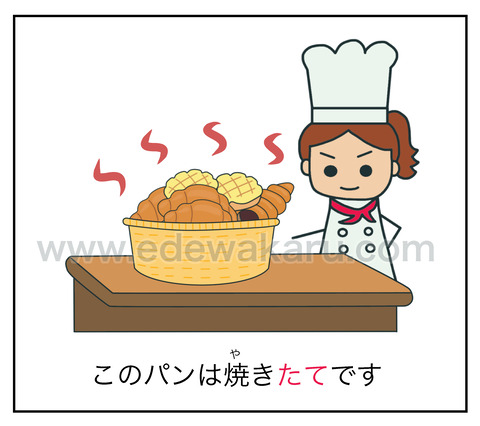
このパンは焼きたてです
→このパンは焼いたばかりです(まだあたたかくておいしいですよ)This bread is freshly baked. → This bread has just been baked (it’s still warm and delicious).
しぼりたてのミルクはおいしいね
→しぼったばかりのミルクはおいしいねFreshly squeezed milk is delicious, isn’t it? → Milk that has just been squeezed is delicious, isn’t it?
釣りたての魚は新鮮でおいしいね
→釣ったばかりの魚は新鮮でおいしいねFreshly caught fish is fresh and delicious, isn’t it? → Fish that has just been caught is fresh and delicious, isn’t it?
彼は入社したての社員だ
→彼は入社したばかりの社員だ(新しい社員だ)He is a newly hired employee. → He is an employee who has just joined the company (a new employee).
あの夫婦は結婚したてだからまだラブラブだね
→あの夫婦 は結婚したばかり(新婚)だからまだラブラブだねThat couple just got married, so they’re still so lovey-dovey. → That couple just got married (they’re newlyweds), so they’re still so lovey-dovey.
Read the original source text
Meaning
〜したばかりで新しい・新鮮だ
How to use it
動詞[ます形] +たて
動詞[ます形]+たての+名詞
Explanation
「〜たて」は「〜たばかりで新しい・新鮮だ」という意味を表す文型です。「〜たばかり」との大きな違いは
「〜たて」には必ず「新しい」「新鮮だ」という意味が入り、プラスの意味で使われることです
😊「〜した直後」「〜してからあまり時間が経っていない」というように、ただ時間の経過を表す場合には使うことができませんので注意してください😨
[例]
⭕️ご飯を食べ
たばかり
だ
❌ご飯を食べ
たて
だ→「ご飯を食べる」ことに新しさや新鮮だという意味はない
⭕️赤ちゃんはさっき寝
たばかり
よ
❌赤ちゃんはさっき寝
たて
よ→「寝る」ことに新しさや新鮮だという意味はない
【まとめ】
「〜たばかり」→
〜てからあまり時間が経っていない状態を表す
「〜たて」→
〜てからあまり時間が経っていなくて新しい・新鮮だ
[例]
作っ
たばかり
の料理→作ってからあまり時間が経っていない・少し前にできた料理
作り
たて
の料理→作ってからあまり時間が経っていないから
まだあたたかくておいしい
「〜たて」は日常会話でとてもよく使われます。また、パン屋さんなどのお店でも「焼きたて」「できたて」「しぼりたて」「採りたて」などよく見たり聞いたりすることがあると思いますので、覚えておくと便利ですよ😉
日本語文型辞典
Meaning
Basic information
R-たての N / R-たてだ
Explanation
Follows the continuative form of a verb and means “…has just been done.” The verbs that can be used are limited.
Examples
① Try speaking in a foreign language you’ve just learned.
② The bread here is freshly baked and delicious.
③ She has just become a teacher.
④ I bit into a freshly picked tomato from the rice paddy.
⑤ Would you like freshly squeezed orange juice?
⑥ [Notice] Freshly painted. Do not touch.
Example (incorrect): a just-read book.
Example (correct): a book that has just been read.
Read the original source text
Meaning
基本情報R-たてのNR-たてだ説明動詞の連用形を受けて「…したばかり」の意味を表す。使える動詞は限られている。例文① 覚えたての外国語で話してみる。② ここのパンは焼きたてで、おいしい。③ 彼女は先生になりたてだ。④ 水田でとれたてのトマトをかじった。⑤ しぼりたてのオレンジジュースはいかがですか。⑥ ≪貼祇≫ペンキぬりたて。さわるな。例文(誤) 読みたての本。例文(正) 読んだばかりの本。
日本語文型辞典 英語版
Meaning
【たて】[R-たてのN][R-たてだ]
Attaches to the stem of a verb and expresses the meaning “has just been V.” The range of verbs that can be used with this expression is limited.
(×)読みたての本。
A freshly read book.
(○)読んだばかりの本。
A book I’ve just read.
In context 6 examples
覚えたての外国語で話してみる。
I’ll try to speak in the foreign language I’ve just learned.
ここのパンは焼きたてで、おいしい。
This bread is freshly baked, and it’s delicious.
彼女は先生になりたてだ。
She’s just become a teacher.
畑でとれたてのトマトをかじった。
I bit into a tomato that I’d just picked in the garden.
しぼりたてのオレンジジュースはいかがですか。
Would you like some fresh-squeezed orange juice?
《貼紙》ペンキぬりたて。さわるな。
《written notice》Wet paint. Do not touch.
日本語NET JLPT文法解説まとめ
Meaning
“Just did ~”
An expression that emphasizes newness and freshness. It is often used with a positive meaning.
How to use it
V(ます-form)ます + たて
Explanation
"having just done 〜 / just after doing 〜".
An expression that emphasizes novelty and freshness. It is often used in a positive sense.
In context 12 examples
さぁ、パンは焼きたてで美味しいですよ。おひとついかがでしょうか。
Now, the bread is freshly baked and delicious. Would you like one?
やっぱり料理はできたてが美味しいね。
As you'd expect, food tastes best freshly made.
その天ぷらは揚げたてですから、美味しいですよ。
That tempura is freshly fried, so it's delicious.
生まれたての子鹿が必死に立とうと頑張っている。
A newborn fawn is desperately trying to stand.
昨日、初めて生まれて初めて搾りたてのミルクを飲んだ。
Yesterday, for the first time, I drank freshly squeezed milk.
そこはペンキを塗りたてなので、注意してくださいね。
That area has just been painted, so please be careful.
彼はまだ入社したてで、とてもフレッシュだ。
He has only just joined the company, so he's very fresh.
付き合いたてのカップルにおすすめのデートスポット特集。
A feature on recommended date spots for couples who have just started dating.
干したての布団はふかふかして気持ちがいい。
A futon that's just been aired is fluffy and feels nice.
この市場ではとれたての魚を使った海鮮丼が食べられます。
At this market, you can eat seafood rice bowls made with freshly caught fish.
しぼりたてのミルクは濃厚で美味しい。
Freshly squeezed milk is rich and delicious.
ファブリーズであらいたてのお洗濯の香りを
The scent of laundry freshly washed with Febreze.
Read the original source text
Meaning
”〜したばかりで”
新しさ、新鮮さを強調する表現。プラスの意味で使われることが多い。
How to use it
V(ます形)ます + たて
Explanation
"having just done 〜 / just after doing 〜".
An expression that emphasizes novelty and freshness. It is often used in a positive sense.
毎日のんびり日本語教師
How to use it
Verb masu-stem + たて
Explanation
Attached to the verb masu-stem, it has the same meaning as “~たばかり” (“just did”).
It indicates a particularly fresh or new state, so it can only be used in a positive sense.
Note that “~たて” is treated as a noun.
Notes
This grammar cannot be used when there is no sense of freshness. It also cannot be used with negative expressions such as “壊す” (“to break”).
✕
食べたてのピザ (pizza just eaten)
〇
食べたばかりのピザ (pizza just eaten)
✕
壊したてのビル (a building just demolished)
〇
壊したばかりのビル (a building just demolished)
In context 16 examples
できたての料理は一番おいしい。(刚出锅的食物最好吃了。)
Freshly made food tastes the best. (Freshly cooked food tastes the best.)
これは焼きたてだから食べられるよ。
This is freshly baked, so you can eat it.
生まれたての雛(刚出生的小鸡)
A newly hatched chick (a newly hatched chick)
先輩には高校に入りたての頃から仲良くしてもらっていた。
My senior had been kind to me ever since I had just started high school.
洗いたてのタオルを使うと気持ちいい。(用刚洗好的毛巾会很舒服。)
It feels nice to use a freshly washed towel. (It feels nice to use a freshly washed towel.)
付き合いたてのカップルはどこかぎこちない雰囲気が漂うものだ。(刚交往的情侣总会有种不自然的氛围。)
New couples always have a somewhat awkward air about them. (Couples who have just started dating always seem to have an awkward atmosphere.)
髭剃りたてのお肌はすべすべしている。(刚刮完胡子的皮肤很光滑。)
Skin just after shaving is smooth. (Skin just after shaving is smooth.)
干したての布団の匂いが好き。(喜欢刚晒好的被褥的味道。)
I like the smell of freshly aired-out futons. (I like the smell of freshly aired-out futons.)
付き合いたての彼女と夏祭りへ。
Off to the summer festival with my new girlfriend.
干したてのお布団って気持ちいい。
Freshly aired-out futons feel so nice.
朝は淹れたてのコーヒーを味わってから出発する。
In the morning, I set off after savoring freshly brewed coffee.
自動車学校卒業したての私にとって公道は怖すぎる。
As someone who has only just graduated from driving school, I find public roads far too scary.
彼女が剃りたての顎を触ってくる。
She touches my freshly shaved chin.
搾りたての牛乳と採れたて野菜を買ってきた。
I bought freshly squeezed milk and freshly harvested vegetables.
20歳になりたてなのでお酒を飲むのが最近のブームです。
I just turned 20, so drinking alcohol has recently become my thing.
オープンしたてのお店でパスタを食べた。
I ate pasta at a shop that had just opened.
Read the original source text
How to use it
動ます形+たて
Explanation
動ます形に接続して、「~たばかり」と同じ意味を表します。
特に新鮮な状態や新しい状態であることを表すので、良い意味だけに使えます。
なお、「~たて」は名詞として扱います。
Notes
この文法は新鮮さがなければ使えません。また「壊す」等のマイナス表現にも使えません。
✕
食べたてのピザ
〇
食べたばかりのピザ
✕
壊したてのビル
〇
壊したばかりのビル