AIUEO JLPT Grammar
Meaning
「にて」is a particle used to indicate location, means, method, reason, or time, and is used in more formal contexts or written language.
How to use it
Noun + にて
In context 5 examples
会議は東京にて行われます。
The meeting will be held in Tokyo.
展覧会は美術館にて開催されます。
The exhibition will be held at the art museum.
結果は後日、郵送にてお知らせします。
The results will be notified by mail later.
応募はウェブサイトにて受付けています。
Applications are accepted through the website.
お問い合わせはメールにてお願いします。
Please contact us via email.
Read the original source text
Meaning
「にて」is a particle used to indicate location, means, method, reason, or time, and is used in more formal contexts or written language.
How to use it
名詞+にて
Explanation · 日本語
「にて」は、「で」と同じように場所、手段、方法、理由、時間などを表すために使われる助詞です。フォーマルな場面や書き言葉でよく使用されます。
文法
Meaning
~で
① Place
② Means or method
③ Time
④ Cause or reason
How to use it
N + にて
Notes
A formal expression used in writing and formal situations.
In context 6 examples
本日のイベントは1階の広場にて行います。
Today’s event will be held in the first-floor plaza.
雨の場合、スポーツ大会は体育館にて行います。
In case of rain, the sports tournament will be held in the gymnasium.
最後のシーンは京都のお寺にて撮影されたそうです。
I hear the final scene was filmed at a temple in Kyoto.
当日欠席される方は、メールまたは電話にてご連絡ください。
If you will be absent on the day, please contact us by email or phone.
それでは会場にて皆様のご参加をお待ちしております。
We look forward to your participation at the venue.
部長は本日、出張にて会議を欠席されるそうです。
I hear the department head will be absent from the meeting today because of a business trip.
Read the original source text
Meaning
〜で
①場所
②手段・方法
③時間
④原因・理由
How to use it
N + にて
Notes
硬い表現。文章や改まった場面で使われる
Bunpro Grammar Reference
Meaning
In, At, With, Using, By
How to use it
Noun + にて
Nuance
A somewhat formal, short pattern used to show that something happens in, at, or by using (A).
Explanation
にて is often considered as its own stand-alone particle, despite originally being a mix of に, and the conjunction particle, て. When combined, にて becomes a formal case-marking particle that is used in the same way as で. This means that it can convey the meaning of 'with (A)', 'by (A)', 'at (A)', or 'using (A)'.
にて will primarily appear following nouns that illustrate a means, method, time, location, reason, or origin that the speaker wants to highlight.
明日は金時計にて集合しましょう。
Let's meet tomorrow at the Golden Clock.
当店は午前9時にて開店いたします。
This store will open at 9:00 a.m.
予約をされる場合は電話にてご連絡ください。
If you want to make a reservation, please make one by phone.
As this grammar structure is formal, it will primarily be seen in writing, or heard in announcements. で will be the far more natural choice in casual conversation.
In context 15 examples
- これにて一件落着。
With this, the case is closed.
- 明日は金時計にて集合しましょう。
Let's meet tomorrow at the Golden Clock.
- 当店は午前9時にて開店いたします。
This store will open at 9:00 a.m.
- 予約をされる場合は電話にてご連絡ください。
If you want to make a reservation, please make one by phone.
- 応接室にてお待ちしております。
I am waiting in the waiting room.
- 面接は本社にて行います。
The interview will take place at the company headquarters.
- メールにてご連絡いただけると助かります。
It would be helpful if you could contact me using email.
- 午後五時にて閉店いたします。
We will close (the shop) at five in the afternoon.
- 外部委員にて調査がなされます。
The investigation will be performed by an external committee.
- 在学中にて、アルコールは控えている。
I am refraining from alcohol while in active school enrollment.
- 明日、東京駅にてお会いしましょう。
Tomorrow, let's meet at Tokyo Station.
- 学会にて新たな見解が発表された。
A new opinion was announced at the academic conference.
- あれは、コンクールにて最優秀賞を受賞した絵画です。
That is the painting that was awarded the top award in the contest.
- 実習にて学んだことを、本番で活かしてください。
Please make use of what you learned in training.
- イベントは屋外にて行われますので、雨天時は中止となります。
Since the event will take place in the outdoors, when it is rainy weather, the event will be suspended.
Read the original source text
Meaning
In, At, With, Using, By
How to use it
Noun + にて
Nuance
A somewhat formal, short pattern used to show that something happens in, at, or by using (A).
Explanation
にて is often considered as its own stand-alone particle, despite originally being a mix of に, and the conjunction particle, て. When combined, にて becomes a formal case-marking particle that is used in the same way as で. This means that it can convey the meaning of 'with (A)', 'by (A)', 'at (A)', or 'using (A)'.
にて will primarily appear following nouns that illustrate a means, method, time, location, reason, or origin that the speaker wants to highlight.
明日は金時計にて集合しましょう。
Let's meet tomorrow at the Golden Clock.
当店は午前9時にて開店いたします。
This store will open at 9:00 a.m.
予約をされる場合は電話にてご連絡ください。
If you want to make a reservation, please make one by phone.
As this grammar structure is formal, it will primarily be seen in writing, or heard in announcements. で will be the far more natural choice in casual conversation.
Nuance · 日本語
(A)を使って何かがその中で、そこで、そのそばで起こるということを丁寧に表す短い表現。
Explanation · 日本語
「にて」は「に」と接続助詞「て」の組み合わせですが、よく独立した助詞として扱われます。「にて」は「で」と同じように「(A) の場所で」「(A) の方法で」「(A) の理由で」「(A) のときに」というような意味を表します。これは「で」よりも形式的な表現です。
「にて」は主に、話し手が強調したい手段や方法、時間、場所、理由、起点を示す名詞の後に置いて使われます。
明日は金時計にて集合しましょう。
Let's meet tomorrow at the Golden Clock.
当店は午前9時にて開店いたします。
This store will open at 9:00 a.m.
予約をされる場合は電話にてご連絡ください。
If you want to make a reservation, please make one by phone.
これはフォーマルな表現なので、主に文書やアナウンスなどでよく使われます。日常生活では「で」を使う方が自然です。
絵でわかる日本語
Meaning
by; at; with
How to use it
Noun [dictionary form] + にて
Explanation
“〜にて” means “by” or “at” and indicates things such as [place], [time], [means], or [reason]. It is a formal expression used in written language and in formal situations.
[Examples]
① The free service ended at 10:00.
[Time]
② The event will be held at the park.
[Place]
③ If you will be absent, please contact us by email.
[Means]
④ I will be waiting for you at the station at 9:00 tomorrow.
[Place]
⑤ We accept reservations online.
[Means]
⑥ Our store will be closing today.
[Time]
⑦ Today’s match was canceled due to the typhoon.
[Cause]
⑧ A: Is Mr. Tanaka here?
B: Mr. Tanaka is away from his desk in a meeting.
[Cause]
Remember that 〜にて is also used in conversation in formal situations 😊
In context 8 examples
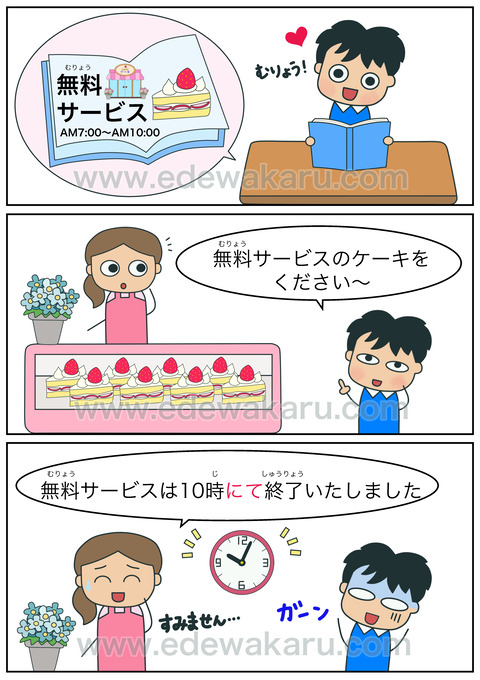
無料サービスは10時にて終了いたしました
→無料サービスは10時で終了いたしましたThe free service ended at 10:00. →The free service ended at 10:00.
イベントは公園にて行います
→イベントは公園で行いますThe event will be held at the park. →The event will be held at the park.
欠席される場合は、メールにてご連絡ください
→欠席される場合は、メールでご連絡くださいIf you will be absent, please contact us by email. →If you will be absent, please contact us by email.
明日9時に駅にてお待ちしております
→明日9時に駅でお待ちしておりますI will be waiting for you at the station at 9:00 tomorrow. →I will be waiting for you at the station at 9:00 tomorrow.
ご予約はインターネットにて受け付けております
→ご予約はインターネットで受け付けておりますWe accept reservations online. →We accept reservations online.
当店は本日にて閉店させていただきます
→当店は本日で閉店させていただきますOur store will be closing today. →Our store will be closing today.
本日の試合は台風にて中止となりました
→本日の試合は台風で中止となりましたToday’s match was canceled due to the typhoon. →Today’s match was canceled because of the typhoon.
A:田中さんいらっしゃいますか?B:田中は会議にて席を外しております
→田中は会議で席を外しております*「席を外す」とは「一時的にその場を離れる」という意味ですA: Is Mr. Tanaka here? B: Mr. Tanaka is away from his desk in a meeting. →Mr. Tanaka is away from his desk because of a meeting. *席を外す means “to leave one’s place temporarily.”
Read the original source text
Meaning
〜で
How to use it
名詞[辞書形]+にて
Explanation
「〜にて」は「〜で」という意味で[場所][時間][手段][理由]などを表します。かたい言い方ですので書き言葉として使われ、改まった場面で使用されます。
[例]
①無料サービスは10時
にて
終了いたしました
[時間]
②イベントは公園
にて
行います
[場所]
③欠席される場合は、メール
にて
ご連絡ください
[手段]
④明日9時に駅
にて
お待ちしております
[場所]
⑤ご予約はインターネット
にて
受け付けております
[手段]
⑥当店は本日
にて
閉店させていただきます
[時間]
⑦本日の試合は台風
にて
中止となりました
[原因]
⑧A:田中さんいらっしゃいますか?
B:田中は会議
にて
席を外しております
[原因]
「〜にて」は改まった場面では会話でも使われますので覚えておきましょう😊
日本語文型辞典
Meaning
Basic information
Nにて
Used to indicate the place where an event occurs, and in set expressions such as 「これにて」 and 「当方にて」. It is used in written language, such as formal letters. It can be replaced with 「で」.
Examples
① Photographs will be taken in front of the school gate.
② Well then, please excuse me here.
③ We will make the arrangements for the venue on our end.
Read the original source text
Meaning
基本情報Nにて説明出来事の場所を表したり、「これにて」「当方にて」などの慣用的表現に用いられる。改まった手紙などの書きことばに用いる。「で」に言いかえられる。例文① 校門前にて写真撮影を行います。② では、これにて失礼致します。③ 会場係は当方にて手配いたします。
日本語文型辞典 英語版
Meaning
【にて】[Nにて]
Expresses the place of an event, or is used for idiomatic expressions such as これにて(now) or 当方にて(ourselves). Used in written Japanese, such as in a formal letter. Can be rephrased as で.
In context 3 examples
校門前にて写真撮影を行います。
We will take photographs in front of the school gate.
では、これにて失礼致します。
Well, may I be excused now?
会場係は当方にて手配いたします。
As for staff in charge of the venue, we will arrange for them.
日本語NET JLPT文法解説まとめ
Meaning
at / by
① Location
② Means or method
③ Time
④ Cause or reason
How to use it
N + にて
Explanation
A formal expression used in writing and formal situations.
In context 6 examples
本日のイベントは1階の広場にて行います。
Today’s event will be held in the first-floor plaza.
雨の場合、スポーツ大会は体育館にて行います。
In case of rain, the sports tournament will be held in the gymnasium.
最後のシーンは京都のお寺にて撮影されたそうです。
I hear the final scene was filmed at a temple in Kyoto.
当日欠席される方は、メールまたは電話にてご連絡ください。
If you will be absent on the day, please contact us by email or phone.
それでは会場にて皆様のご参加をお待ちしております。
We look forward to your participation at the venue.
部長は本日、出張にて会議を欠席されるそうです。
I hear the department head will be absent from the meeting today because of a business trip.
Read the original source text
Meaning
〜で
①場所
②手段・方法
③時間
④原因・理由
How to use it
N + にて
Explanation
硬い表現。文章や改まった場面で使われる
毎日のんびり日本語教師
Meaning
By / at
How to use it
Noun + にて
Explanation
Broadly speaking, it has three meanings.
① The place where something occurs.
② Means, method, or material.
③ The end point of a time span.
In each case, it can be replaced with the case-marking particle 「で」.
It is often used in written language.
Notes
Nothing in particular.
In context 8 examples
予約は店頭にて承っております。
Reservations are accepted at the store.
イベントは駅前中央広場にて行います。
The event will be held at the Central Plaza in front of the station.
それでは明日会場にてお待ちしております。
We will be waiting for you at the venue tomorrow.
お電話もしくはインターネット予約にて受付しております。
We accept reservations by telephone or online.
席の状況は電話にて確認いただけると状況をお伝えできます。
We can tell you the seating availability if you check by phone.
ご予約は随時、先着順にて受け付けております。
Reservations are accepted on a rolling basis, in order of arrival.
これにて終了。
That concludes it.
申し込みは10月26日にて締め切らせていただきます。
We will accept applications until October 26.
Read the original source text
Meaning
~で
How to use it
名詞+にて
Explanation
大きく分けて3つの意味があります。
①物事が発生した場所。
②手段・方法・材料
③時間的な範囲の終わり
いずれも格助詞「で」に置き換えることができます。
書き言葉としてよく用いられます。
Notes
特になし
IMABI
Ni, Nite, & E
Read this IMABI lesson ↗Explanation
第023課: The Particles に, にて, & へ
You can’t just assume that particles are completely the same in Classical Japanese. Although all three of these particles are very similar to what they are in Modern Japanese, there are quite a few things that make a big difference. For example, where’s で? It evolves from にて. So, way back when, に showed all of the functions now allotted to just で!
に
Just as in Modern Japanese, に has a lot of usages! In Classical Japanese it has both case and conjunctive usages. Let’s start with what’s different.
1. It can be used like the particles で and にて to show the location of an action. It may also show method by which something is done as well as cause. All of these usages have been given to で in Modern Japanese. In Modern Japanese you would be counted wrong for this. However, for a very long time up until and even a whiles after the contraction of にて to で was made, に was still used in this way.
1. この皮衣かはぎぬは、火に焼かむに焼けずはこそ、真まことならめ。
When we try to burn this leather robe with fire and it doesn’t burn, then it’s probably the real thing.
From the 竹取物語.
Particle Note: Remember the 連体形の準体法? This examples why に is after 焼かむ. The implied noun is 時.
2. 在京荒有家尓 一宿者 益旅而 可辛苦 (原文)
都なる荒れたる家にひとり寝ば旅にまさりて苦しかるべし
Sleeping by myself in my ruined home in the capital is perhaps more trying than sleeping in travel.
From the 万葉集.
3. 烏玉之 夜之深去者 久木生留 清河原尓 知鳥數鳴 (原文)
ぬばたまの夜の更けゆけば久木生おふる清き川原かはらに千鳥しば鳴く
As the pitch black night grew late, the plovers constantly chirped at the pure riverbank where the hisaki grows.
From the 万葉集.
Word Note: It’s not exactly known what plant the 久木 was.
2. The conjunctive particle に is interchangeable with the conjunctive particle を. As we learned in that lesson, this に can be used to show causation, concession, as well as sequence. The usages in order in Modern Japanese are ので, のに, and が respectively.
4. 命のあるものを見るに、人ばかり久しきはなし。
When you look at things that have life, nothing (lives) as long as people.
From the 徒然草.
3. So, what are all of those usages in Modern Japanese that are in Classical Japanese? The most important usage still in this time is doing all of what we learned way back in Lesson 19. Although most of this is the same, some things have been expanded upon, so don’t just glance through it.
に compensates the establishment of an action or state. に shows deep establishment. In doing so, it plays this role in many crucial situations. It is for the most part equivalent to “at”. The following five points describe に very well.
Shows the place of where a state (of action) deep establishment. It may show the place of existence or occurrence or person of possession (彼には子どもがいる).
Shows destination/direction/target! It’s the indirect object marker as well.
Shows the effect, condition, state, or goal of an action. Verbs like “to become” come to mind. This may also show pretext. For example, “you make your hands as a pillow”. It is also the “as” of comparison and capacity.
Shows the standard of action, condition, or state. Ex. “to lack in creativity”.
Shows what brings about some sort of measure, feelings, situation, or work.
More specifically, other applications of all of this that you have to keep in mind are how it is used with the passive and causative to mean “by”. Of course, you can’t forget how it is used to show time of action.
Examples
5. 朝あしたに死に、夕べに生まるるならひ。
The pattern of dying in the morning and being born in the evening.
From the 方丈記.
6. 葦北乃 野坂乃浦従 船出為而 水嶋尓将去 浪立莫勤 (原文)
葦北の野坂の浦ゆ船出して水嶋に行かむ浪立つなゆめ
Let’s set sail from Ashikita’s Nozaka Inlet to Mizushima. Waves, never roll!
From the 万葉集.
7. 狩りに往にけり。
He went hunting (with falcons).
From the 伊勢物語.
8. 白波の上にただよひ
Since it floated on top of the white waves
From the 平家物語.
Historical Note: Remember that the copula verb なり comes from にあり.
9. まことかと聞きて見つれば、言の葉を飾れる玉の枝にぞありける。
He listened, wondering if it was real, and when he looked, he found that to his surprise that it was a jeweled branch decorated with words!
From the 竹取物語.
10. 妹之家毛 継而見麻思乎 山跡有 大嶋嶺尓 家母有猿尾 (原文)
妹が家も継ぎて見ましを大和なる大島おほしまの嶺ねに家いへもあらましを
(If we can’t meet), at least it would be nice to see your house. If only my house were on top of the peak of the great island of Yamato(, then I could always see your house).
From the 万葉集.
11. 京に入り立ちてうれし。
We were happy to enter the capital.
From the 土佐日記.
12. 淀よどみに浮かぶうたかたは
Bubbles floating in a pool (of water)
From the 方丈記.
にて
This particle can follow both nominals and the 連体形. It is the ancestor of で. It is the combination of the case particle に and the conjunctive particle て. Just like で can be used to indicate place of action, means of action, what something is made of, age, cause, and condition. In showing condition it is often like として. When used as a conjunctive particle, it is just like ので. Remember that there was no need to have something nominalize verbs because of 連体形の準体法. で first appears in the Late 平安時代. However, it was probably in local vernaculars much earlier. Whatever you do, don’t confuse it with the て form of なり.
13. 後生でだに悪道へおもむかんずる事のかなしさよ。
Ah, the sadness of heading toward hell even in the next life!
From the 平家物語.
14. 芝の上にて飲みたるもをかし。
Drinking on top of the grass is also charming.
From the 徒然草.
15. 應還 時者成来 京師尓而 誰手本乎可 吾将枕 (原文)
帰るべく時はなりけり都にて誰が手本をか我が枕かむ
I at last may go home, but whose sleeves of someone in the capital shall I sleep on for I no longer have a wife.
From the 万葉集.
16. いみじう寂しげなるに、
He seemed very lonesome, but
From the 源氏物語.
へ
There is nothing different about this particle. One thing that you should keep in mind, though, is that originally it was meant to indicate movement going (far) away. However, it has ever since the 平安時代 been used with any direction like it is used today. The particle most likely comes from the noun 辺.
17. 住む館より出でて、舟に乗るべき所へ渡る。
We left the fort where we had lived and crossed to the place where we were to board a boat.
From the 土佐日記.
In context 19 examples
It can be used like the particles で and にて to show the location of an action. It may also show method by which something is done as well as cause. All of these usages have been given to で in Modern Japanese. In Modern Japanese you would be counted wrong for this. However, for a very long time up until and even a whiles after the contraction of にて to で was made, に was still used in this way.
When we try to burn this leather robe with fire and it doesn’t burn, then it’s probably the real thing.
この皮衣かはぎぬは、火に焼かむに焼けずはこそ、真まことならめ。
When we try to burn this leather robe with fire and it doesn’t burn, then it’s probably the real thing.
在京荒有家尓 一宿者 益旅而 可辛苦 (原文)
在京荒有家尓 一宿者 益旅而 可辛苦 (Original text)
烏玉之 夜之深去者 久木生留 清河原尓 知鳥數鳴 (原文)
烏玉之 夜之深去者 久木生留 清河原尓 知鳥數鳴 (Original text)
The conjunctive particle に is interchangeable with the conjunctive particle を. As we learned in that lesson, this に can be used to show causation, concession, as well as sequence. The usages in order in Modern Japanese are ので, のに, and が respectively.
When you look at things that have life, nothing (lives) as long as people.
命のあるものを見るに、人ばかり久しきはなし。
When you look at things that have life, nothing (lives) as long as people.
朝あしたに死に、夕べに生まるるならひ。
The pattern of dying in the morning and being born in the evening.
葦北乃 野坂乃浦従 船出為而 水嶋尓将去 浪立莫勤 (原文)
葦北乃 野坂乃浦従 船出為而 水嶋尓将去 浪立莫勤 (Original text)
狩りに往にけり。
He went hunting (with falcons).
白波の上にただよひ
Since it floated on top of the white waves
まことかと聞きて見つれば、言の葉を飾れる玉の枝にぞありける。
He listened, wondering if it was real, and when he looked, he found that to his surprise that it was a jeweled branch decorated with words!
妹之家毛 継而見麻思乎 山跡有 大嶋嶺尓 家母有猿尾 (原文)
妹之家毛 継而見麻思乎 山跡有 大嶋嶺尓 家母有猿尾 (Original text)
京に入り立ちてうれし。
We were happy to enter the capital.
淀よどみに浮かぶうたかたは
Bubbles floating in a pool (of water)
後生でだに悪道へおもむかんずる事のかなしさよ。
Ah, the sadness of heading toward hell even in the next life!
芝の上にて飲みたるもをかし。
Drinking on top of the grass is also charming.
應還 時者成来 京師尓而 誰手本乎可 吾将枕 (原文)
應還 時者成来 京師尓而 誰手本乎可 吾将枕 (Original text)
いみじう寂しげなるに、
He seemed very lonesome, but
住む館より出でて、舟に乗るべき所へ渡る。
We left the fort where we had lived and crossed to the place where we were to board a boat.
Read the original source text
Explanation
第023課: The Particles に, にて, & へ
You can’t just assume that particles are completely the same in Classical Japanese. Although all three of these particles are very similar to what they are in Modern Japanese, there are quite a few things that make a big difference. For example, where’s で? It evolves from にて. So, way back when, に showed all of the functions now allotted to just で!
に
Just as in Modern Japanese, に has a lot of usages! In Classical Japanese it has both case and conjunctive usages. Let’s start with what’s different.
1. It can be used like the particles で and にて to show the location of an action. It may also show method by which something is done as well as cause. All of these usages have been given to で in Modern Japanese. In Modern Japanese you would be counted wrong for this. However, for a very long time up until and even a whiles after the contraction of にて to で was made, に was still used in this way.
1. この皮衣かはぎぬは、火に焼かむに焼けずはこそ、真まことならめ。
When we try to burn this leather robe with fire and it doesn’t burn, then it’s probably the real thing.
From the 竹取物語.
Particle Note: Remember the 連体形の準体法? This examples why に is after 焼かむ. The implied noun is 時.
2. 在京荒有家尓 一宿者 益旅而 可辛苦 (原文)
都なる荒れたる家にひとり寝ば旅にまさりて苦しかるべし
Sleeping by myself in my ruined home in the capital is perhaps more trying than sleeping in travel.
From the 万葉集.
3. 烏玉之 夜之深去者 久木生留 清河原尓 知鳥數鳴 (原文)
ぬばたまの夜の更けゆけば久木生おふる清き川原かはらに千鳥しば鳴く
As the pitch black night grew late, the plovers constantly chirped at the pure riverbank where the hisaki grows.
From the 万葉集.
Word Note: It’s not exactly known what plant the 久木 was.
2. The conjunctive particle に is interchangeable with the conjunctive particle を. As we learned in that lesson, this に can be used to show causation, concession, as well as sequence. The usages in order in Modern Japanese are ので, のに, and が respectively.
4. 命のあるものを見るに、人ばかり久しきはなし。
When you look at things that have life, nothing (lives) as long as people.
From the 徒然草.
3. So, what are all of those usages in Modern Japanese that are in Classical Japanese? The most important usage still in this time is doing all of what we learned way back in Lesson 19. Although most of this is the same, some things have been expanded upon, so don’t just glance through it.
に compensates the establishment of an action or state. に shows deep establishment. In doing so, it plays this role in many crucial situations. It is for the most part equivalent to “at”. The following five points describe に very well.
Shows the place of where a state (of action) deep establishment. It may show the place of existence or occurrence or person of possession (彼には子どもがいる).
Shows destination/direction/target! It’s the indirect object marker as well.
Shows the effect, condition, state, or goal of an action. Verbs like “to become” come to mind. This may also show pretext. For example, “you make your hands as a pillow”. It is also the “as” of comparison and capacity.
Shows the standard of action, condition, or state. Ex. “to lack in creativity”.
Shows what brings about some sort of measure, feelings, situation, or work.
More specifically, other applications of all of this that you have to keep in mind are how it is used with the passive and causative to mean “by”. Of course, you can’t forget how it is used to show time of action.
Examples
5. 朝あしたに死に、夕べに生まるるならひ。
The pattern of dying in the morning and being born in the evening.
From the 方丈記.
6. 葦北乃 野坂乃浦従 船出為而 水嶋尓将去 浪立莫勤 (原文)
葦北の野坂の浦ゆ船出して水嶋に行かむ浪立つなゆめ
Let’s set sail from Ashikita’s Nozaka Inlet to Mizushima. Waves, never roll!
From the 万葉集.
7. 狩りに往にけり。
He went hunting (with falcons).
From the 伊勢物語.
8. 白波の上にただよひ
Since it floated on top of the white waves
From the 平家物語.
Historical Note: Remember that the copula verb なり comes from にあり.
9. まことかと聞きて見つれば、言の葉を飾れる玉の枝にぞありける。
He listened, wondering if it was real, and when he looked, he found that to his surprise that it was a jeweled branch decorated with words!
From the 竹取物語.
10. 妹之家毛 継而見麻思乎 山跡有 大嶋嶺尓 家母有猿尾 (原文)
妹が家も継ぎて見ましを大和なる大島おほしまの嶺ねに家いへもあらましを
(If we can’t meet), at least it would be nice to see your house. If only my house were on top of the peak of the great island of Yamato(, then I could always see your house).
From the 万葉集.
11. 京に入り立ちてうれし。
We were happy to enter the capital.
From the 土佐日記.
12. 淀よどみに浮かぶうたかたは
Bubbles floating in a pool (of water)
From the 方丈記.
にて
This particle can follow both nominals and the 連体形. It is the ancestor of で. It is the combination of the case particle に and the conjunctive particle て. Just like で can be used to indicate place of action, means of action, what something is made of, age, cause, and condition. In showing condition it is often like として. When used as a conjunctive particle, it is just like ので. Remember that there was no need to have something nominalize verbs because of 連体形の準体法. で first appears in the Late 平安時代. However, it was probably in local vernaculars much earlier. Whatever you do, don’t confuse it with the て form of なり.
13. 後生でだに悪道へおもむかんずる事のかなしさよ。
Ah, the sadness of heading toward hell even in the next life!
From the 平家物語.
14. 芝の上にて飲みたるもをかし。
Drinking on top of the grass is also charming.
From the 徒然草.
15. 應還 時者成来 京師尓而 誰手本乎可 吾将枕 (原文)
帰るべく時はなりけり都にて誰が手本をか我が枕かむ
I at last may go home, but whose sleeves of someone in the capital shall I sleep on for I no longer have a wife.
From the 万葉集.
16. いみじう寂しげなるに、
He seemed very lonesome, but
From the 源氏物語.
へ
There is nothing different about this particle. One thing that you should keep in mind, though, is that originally it was meant to indicate movement going (far) away. However, it has ever since the 平安時代 been used with any direction like it is used today. The particle most likely comes from the noun 辺.
17. 住む館より出でて、舟に乗るべき所へ渡る。
We left the fort where we had lived and crossed to the place where we were to board a boat.
From the 土佐日記.