日本語文型辞典 英語版
Meaning
【かとおもうと】[V-たかとおもうと]
→
【とおもう】9
In context 2 examples
急に空が暗くなったかと思うと、はげしい雨がふってきた。
Just as the sky grew dark, it started raining heavily.
やっと帰ってきたかと思ったら、また出かけるの?
You’ve just come back, and now you’re leaving again?
Read the original source text
Meaning
【かとおもうと】[V-たかとおもうと]
→
【とおもう】9
IMABI
As soon as
Read this IMABI lesson ↗Explanation
As soon as: ~や(いなや), ~なり, ~途端(に), ~かと思うと, & ~次第
Though “as” itself is hard enough in Japanese, Japanese also has a lot of expressions that mean “as soon as”. This lesson will investigate how to use these expressions. Take close attention to what defines them as there are differences!
~や否や & ~や
Placed after the 終止形しゅうしけい of a verb in ~や or ~や否いなや, it means “as soon as”. With 否や, it is like the second action takes place before the first action can even be confirmed or done. The most used is や否や. In fact, や否や will be used 90% of the time.
1. 地震じしんが発生はっせいするやいなや、気象庁きしょうちょうは直ただちに津波警報つなみけいほうを出しました。
As soon as the earthquake happened, the Meteorological Agency issued a tsunami warning.
2. 姉の顔を見るやいなや、泣き出した。
I began weeping as soon as I saw my sister’s face.
3a. その選手はチャンスと見るや、一気に{攻め込んだ・攻撃をしかけた}。
3b. その選手はチャンスと見るやいなや、一気に{攻め込んだ・攻撃をしかけた}。 (あまり使わない言い方)
The player felt a chance open and attacked in one burst.
4. 出発しゅっぱつするやいなや雨が降ふり出した。
It started to rain as soon as I departed.
~やいなや cannot be used to show the speaker’s wants or intentions. Also, don’t use the past tense before ~やいなや. The action can be something that you can expect. It’s important to understand that the events of the second clause are actions/movements.
5. うちの猫は魚が大好きで、あげるやいなや、一気に全部食べてしまう。
My cat loves fish, and the instant you give it to it, it’s gone in an instant.
The Conjunctive Particle なり
After the 連体形 of a verb, ~なり shows that something is done as soon as something else is done. So right when someone does something, they do something next in sequence to the first action. The subject is normally third person, and the subject is the same in both clauses.
6a. 宿題を済ませるなり、彼らはインターネットを使った。
6b. 宿題を済ませるとすぐに、彼らはインターネットを使った。(More natural)
They used the Internet as soon as they finished their homework.
7. 彼は帰るなり、トイレに行った。
He went to the bathroom as soon as he got home.
8. 社長は入ってくるなり、大声で怒鳴りました。
As soon as the company president came in, he shouted in a big voice.
The word comes from the なり in words like 身なり (appearance). The event in the second clause is often one that describes an action/condition not wanted. Although it is used some in the spoken language, it is usually reserved to writing.
After the past tense, it shows a situation that is still in play as another action begins. It is unnatural when you move in any way to a different action.
9. 彼は靴を履いたなり、畳に上がってしまった。 △
彼は靴を履いたまま、畳に上がってしまった。 〇
He accidentally stepped onto the tatami mat with his shoes still.
10. 彼女は公園でベンチに座り込んだ{なり・まま}、眠ってしまった。
She fell asleep while sitting on a park bench.
~途端(に)
When students learn of 途端に, they immediately think of ~ときに, especially when they learn that this phrase is used after the past tense. Understandable, ~たとき(に)and ~たとたん(に) vaguely resemble each other, especially when not written in 漢字.
~た途端とたん(に) is, again, only used with the past tense. It marks the instant after one does something. This “something” that happens afterward is something that is unexpected and much of a surprise.
11. 彼がドアを開けた途端、車が爆発した。
The car exploded just as he opened the door.
12. 窓まどを開けた途端に、犬が飛び出していった。
As soon as I opened the window, the dog jumped out.
13. 立ち去さった途端に、その建物たてものが爆発ばくはつしたよ!
As soon as he left, the building exploded!
14. 動画どうがを観みた途端に、眠ねむくなってしまった。
I accidentally fell asleep as soon as I saw the video.
15. 余所見をした途端、転んだ。
I fell down as soon as I turned away.
16. 酒を飲むと、(その)途端に人が変わる。
Once a person drinks, that person changes instantly.
Grammar Note: 途端 may also be used in the sense of instantly and can be seen with such statements.
As seen in the example sentences, though, ~た途端(に)can’t be used when something volitional occurs. So, although a situation may be unexpected, you would need to use a phrase like ~たら、すぐに if you are using a verb of volition.
17. ベルが鳴ったら、すぐに外に出てください。
When the bell rings, immediately go outside.
~かと思うと
Perhaps because it is rarely treated separately in grammar discussions, students have a hard time knowing how to use this phrase. This describes something happening that causes a sense of surprise, similar to ~た途端(に), which follows after an event described in the first clause. Transitivity, though, is clearly different as ~た途端(に)is used with transitive expressions, but this phrase does not have that requirement.
You cannot use this phrase for yourself. At times it may be best to use ~かと思ったら instead. Sentences of command, negation, or will appear afterwards. For some people, when the event is not of the future or going back and forth in a way that means the first action may happen again in the “future”, then the use of ~かと思うと is somewhat unnatural and should be replaced with ~かと思ったら. So, for the sentences below regarding weather, you can paraphrase with the latter and have no problem.
Examples
18. 雨が降ってきたかと{思うと ?/〇・思ったら 〇}、もう止んだ。
Just when I thought it had started to rain, it stopped.
19. 空が曇ってきたと{思うと ?/〇・思ったら 〇}、突然大雨になった。
Just when I thought it got cloudy, it started to rain heavily.
20. 彼女はA君のことを好きだと言っていたかと思うと、次はB君が好きだと言い出し、何を考えているのかよく分からない。
Just as I had thought she said she liked A-kun, she then stated that she liked B-kun, and so I don’t know what she’s thinking.
22. うちの子供は帰ってきたかと{思うと ?/〇・思ったら 〇}、もう外に遊びに行った。
The kids had already gone to play outside just when I thought they had come home.
~次第
As a regular noun, 次第 means “course of events”. It is seen after nouns a lot, especially Sino-Japanese words, but also after the 連用形 of verbs.
When it attaches to other nouns, it often means “depending on”. As such, when after the 連用形 of a verb, it may show that something is dependent on an action in question.
23. 請求せいきゅうがあり次第だ。
It’s on demand.
24. 物事は状況次第。
Circumstances alter cases.
25. こういう次第だ。
This is how it stands.
26. 万事は君の(この)取り扱い方次第だ。
It depends on the way you handle it.
27. 天気の様子次第で行くかどうか決めるんだ。
I’m going to decide on whether to go or not depending on the weather condition.
28. 大統領が決心するかどうかはそれ次第だ。
The president’s resolution depends on this.
29. 豊作になるかどうかは天気次第です。
An abundant harvest is dependent on the weather.
30. 結果は君次第だ。
The results depend on you.
31. 昇進できるかどうかは能力次第だ。
Promotion is dependent on one’s ability.
連用形 + 次第
It may also be used with the 連用形 of a verb to show what happens “as soon as…”. This is in the sense that right after something realizes, one does the next action. Thus, the second clause following must be a verb of volition in regards to the speaker. This separates it quite well from the other “as soon as” phrases in this lesson.
32. 着き次第、被災地に援助します。
As soon as we arrive, we will aid in the disaster area.
33. 手当たり次第に食べ物を買い占しめる。
To buy up food as it is made available.
34. 満員になり次第締め切ろう。
Let’s close up as soon as we become a full house.
35. 我々は雪がやみ次第、作業を再び始めるつもりです。
We plan to resume operations as soon as it stops snowing.
Adverbial 次第に
Lastly, 次第に is an adverb meaning “gradually”, “finally”, or “in order”.
36. 機械は{次第にだんだんと}廃すたれていくだろう。
Machines will gradually go out of date.
37. 騒音そうおんが次第に消えてゆく。
Noise will gradually fade away.
In context 38 examples
地震じしんが発生はっせいするやいなや、気象庁きしょうちょうは直ただちに津波警報つなみけいほうを出しました。
As soon as the earthquake happened, the Meteorological Agency issued a tsunami warning.
姉の顔を見るやいなや、泣き出した。
I began weeping as soon as I saw my sister’s face.
その選手はチャンスと見るや、一気に{攻め込んだ・攻撃をしかけた}。
The player felt a chance open and attacked in one burst.
その選手はチャンスと見るやいなや、一気に{攻め込んだ・攻撃をしかけた}。 (あまり使わない言い方)
The player felt a chance open and attacked in one burst.
出発しゅっぱつするやいなや雨が降ふり出した。
It started to rain as soon as I departed.
うちの猫は魚が大好きで、あげるやいなや、一気に全部食べてしまう。
My cat loves fish, and the instant you give it to it, it’s gone in an instant.
宿題を済ませるなり、彼らはインターネットを使った。
They used the Internet as soon as they finished their homework.
宿題を済ませるとすぐに、彼らはインターネットを使った。(More natural)
They used the Internet as soon as they finished their homework.
彼は帰るなり、トイレに行った。
He went to the bathroom as soon as he got home.
社長は入ってくるなり、大声で怒鳴りました。
As soon as the company president came in, he shouted in a big voice.
彼は靴を履いたなり、畳に上がってしまった。 △
He went up onto the tatami with his shoes still on. △
彼女は公園でベンチに座り込んだ{なり・まま}、眠ってしまった。
She fell asleep while sitting on a park bench.
彼がドアを開けた途端、車が爆発した。
The car exploded just as he opened the door.
窓まどを開けた途端に、犬が飛び出していった。
As soon as I opened the window, the dog jumped out.
立ち去さった途端に、その建物たてものが爆発ばくはつしたよ!
As soon as he left, the building exploded!
動画どうがを観みた途端に、眠ねむくなってしまった。
I accidentally fell asleep as soon as I saw the video.
余所見をした途端、転んだ。
I fell down as soon as I turned away.
酒を飲むと、(その)途端に人が変わる。
Once a person drinks, that person changes instantly.
ベルが鳴ったら、すぐに外に出てください。
When the bell rings, immediately go outside.
雨が降ってきたかと{思うと ?/〇・思ったら 〇}、もう止んだ。
Just when I thought it had started to rain, it stopped.
空が曇ってきたと{思うと ?/〇・思ったら 〇}、突然大雨になった。
Just when I thought it got cloudy, it started to rain heavily.
彼女はA君のことを好きだと言っていたかと思うと、次はB君が好きだと言い出し、何を考えているのかよく分からない。
Just as I had thought she said she liked A-kun, she then stated that she liked B-kun, and so I don’t know what she’s thinking.
うちの子供は帰ってきたかと{思うと ?/〇・思ったら 〇}、もう外に遊びに行った。
The kids had already gone to play outside just when I thought they had come home.
請求せいきゅうがあり次第だ。
It’s on demand.
物事は状況次第。
Circumstances alter cases.
こういう次第だ。
This is how it stands.
万事は君の(この)取り扱い方次第だ。
It depends on the way you handle it.
天気の様子次第で行くかどうか決めるんだ。
I’m going to decide on whether to go or not depending on the weather condition.
大統領が決心するかどうかはそれ次第だ。
The president’s resolution depends on this.
豊作になるかどうかは天気次第です。
An abundant harvest is dependent on the weather.
結果は君次第だ。
The results depend on you.
昇進できるかどうかは能力次第だ。
Promotion is dependent on one’s ability.
着き次第、被災地に援助します。
As soon as we arrive, we will aid in the disaster area.
手当たり次第に食べ物を買い占しめる。
To buy up food as it is made available.
満員になり次第締め切ろう。
Let’s close up as soon as we become a full house.
我々は雪がやみ次第、作業を再び始めるつもりです。
We plan to resume operations as soon as it stops snowing.
機械は{次第にだんだんと}廃すたれていくだろう。
Machines will gradually go out of date.
騒音そうおんが次第に消えてゆく。
Noise will gradually fade away.
Read the original source text
Explanation
As soon as: ~や(いなや), ~なり, ~途端(に), ~かと思うと, & ~次第
Though “as” itself is hard enough in Japanese, Japanese also has a lot of expressions that mean “as soon as”. This lesson will investigate how to use these expressions. Take close attention to what defines them as there are differences!
~や否や & ~や
Placed after the 終止形しゅうしけい of a verb in ~や or ~や否いなや, it means “as soon as”. With 否や, it is like the second action takes place before the first action can even be confirmed or done. The most used is や否や. In fact, や否や will be used 90% of the time.
1. 地震じしんが発生はっせいするやいなや、気象庁きしょうちょうは直ただちに津波警報つなみけいほうを出しました。
As soon as the earthquake happened, the Meteorological Agency issued a tsunami warning.
2. 姉の顔を見るやいなや、泣き出した。
I began weeping as soon as I saw my sister’s face.
3a. その選手はチャンスと見るや、一気に{攻め込んだ・攻撃をしかけた}。
3b. その選手はチャンスと見るやいなや、一気に{攻め込んだ・攻撃をしかけた}。 (あまり使わない言い方)
The player felt a chance open and attacked in one burst.
4. 出発しゅっぱつするやいなや雨が降ふり出した。
It started to rain as soon as I departed.
~やいなや cannot be used to show the speaker’s wants or intentions. Also, don’t use the past tense before ~やいなや. The action can be something that you can expect. It’s important to understand that the events of the second clause are actions/movements.
5. うちの猫は魚が大好きで、あげるやいなや、一気に全部食べてしまう。
My cat loves fish, and the instant you give it to it, it’s gone in an instant.
The Conjunctive Particle なり
After the 連体形 of a verb, ~なり shows that something is done as soon as something else is done. So right when someone does something, they do something next in sequence to the first action. The subject is normally third person, and the subject is the same in both clauses.
6a. 宿題を済ませるなり、彼らはインターネットを使った。
6b. 宿題を済ませるとすぐに、彼らはインターネットを使った。(More natural)
They used the Internet as soon as they finished their homework.
7. 彼は帰るなり、トイレに行った。
He went to the bathroom as soon as he got home.
8. 社長は入ってくるなり、大声で怒鳴りました。
As soon as the company president came in, he shouted in a big voice.
The word comes from the なり in words like 身なり (appearance). The event in the second clause is often one that describes an action/condition not wanted. Although it is used some in the spoken language, it is usually reserved to writing.
After the past tense, it shows a situation that is still in play as another action begins. It is unnatural when you move in any way to a different action.
9. 彼は靴を履いたなり、畳に上がってしまった。 △
彼は靴を履いたまま、畳に上がってしまった。 〇
He accidentally stepped onto the tatami mat with his shoes still.
10. 彼女は公園でベンチに座り込んだ{なり・まま}、眠ってしまった。
She fell asleep while sitting on a park bench.
~途端(に)
When students learn of 途端に, they immediately think of ~ときに, especially when they learn that this phrase is used after the past tense. Understandable, ~たとき(に)and ~たとたん(に) vaguely resemble each other, especially when not written in 漢字.
~た途端とたん(に) is, again, only used with the past tense. It marks the instant after one does something. This “something” that happens afterward is something that is unexpected and much of a surprise.
11. 彼がドアを開けた途端、車が爆発した。
The car exploded just as he opened the door.
12. 窓まどを開けた途端に、犬が飛び出していった。
As soon as I opened the window, the dog jumped out.
13. 立ち去さった途端に、その建物たてものが爆発ばくはつしたよ!
As soon as he left, the building exploded!
14. 動画どうがを観みた途端に、眠ねむくなってしまった。
I accidentally fell asleep as soon as I saw the video.
15. 余所見をした途端、転んだ。
I fell down as soon as I turned away.
16. 酒を飲むと、(その)途端に人が変わる。
Once a person drinks, that person changes instantly.
Grammar Note: 途端 may also be used in the sense of instantly and can be seen with such statements.
As seen in the example sentences, though, ~た途端(に)can’t be used when something volitional occurs. So, although a situation may be unexpected, you would need to use a phrase like ~たら、すぐに if you are using a verb of volition.
17. ベルが鳴ったら、すぐに外に出てください。
When the bell rings, immediately go outside.
~かと思うと
Perhaps because it is rarely treated separately in grammar discussions, students have a hard time knowing how to use this phrase. This describes something happening that causes a sense of surprise, similar to ~た途端(に), which follows after an event described in the first clause. Transitivity, though, is clearly different as ~た途端(に)is used with transitive expressions, but this phrase does not have that requirement.
You cannot use this phrase for yourself. At times it may be best to use ~かと思ったら instead. Sentences of command, negation, or will appear afterwards. For some people, when the event is not of the future or going back and forth in a way that means the first action may happen again in the “future”, then the use of ~かと思うと is somewhat unnatural and should be replaced with ~かと思ったら. So, for the sentences below regarding weather, you can paraphrase with the latter and have no problem.
Examples
18. 雨が降ってきたかと{思うと ?/〇・思ったら 〇}、もう止んだ。
Just when I thought it had started to rain, it stopped.
19. 空が曇ってきたと{思うと ?/〇・思ったら 〇}、突然大雨になった。
Just when I thought it got cloudy, it started to rain heavily.
20. 彼女はA君のことを好きだと言っていたかと思うと、次はB君が好きだと言い出し、何を考えているのかよく分からない。
Just as I had thought she said she liked A-kun, she then stated that she liked B-kun, and so I don’t know what she’s thinking.
22. うちの子供は帰ってきたかと{思うと ?/〇・思ったら 〇}、もう外に遊びに行った。
The kids had already gone to play outside just when I thought they had come home.
~次第
As a regular noun, 次第 means “course of events”. It is seen after nouns a lot, especially Sino-Japanese words, but also after the 連用形 of verbs.
When it attaches to other nouns, it often means “depending on”. As such, when after the 連用形 of a verb, it may show that something is dependent on an action in question.
23. 請求せいきゅうがあり次第だ。
It’s on demand.
24. 物事は状況次第。
Circumstances alter cases.
25. こういう次第だ。
This is how it stands.
26. 万事は君の(この)取り扱い方次第だ。
It depends on the way you handle it.
27. 天気の様子次第で行くかどうか決めるんだ。
I’m going to decide on whether to go or not depending on the weather condition.
28. 大統領が決心するかどうかはそれ次第だ。
The president’s resolution depends on this.
29. 豊作になるかどうかは天気次第です。
An abundant harvest is dependent on the weather.
30. 結果は君次第だ。
The results depend on you.
31. 昇進できるかどうかは能力次第だ。
Promotion is dependent on one’s ability.
連用形 + 次第
It may also be used with the 連用形 of a verb to show what happens “as soon as…”. This is in the sense that right after something realizes, one does the next action. Thus, the second clause following must be a verb of volition in regards to the speaker. This separates it quite well from the other “as soon as” phrases in this lesson.
32. 着き次第、被災地に援助します。
As soon as we arrive, we will aid in the disaster area.
33. 手当たり次第に食べ物を買い占しめる。
To buy up food as it is made available.
34. 満員になり次第締め切ろう。
Let’s close up as soon as we become a full house.
35. 我々は雪がやみ次第、作業を再び始めるつもりです。
We plan to resume operations as soon as it stops snowing.
Adverbial 次第に
Lastly, 次第に is an adverb meaning “gradually”, “finally”, or “in order”.
36. 機械は{次第にだんだんと}廃すたれていくだろう。
Machines will gradually go out of date.
37. 騒音そうおんが次第に消えてゆく。
Noise will gradually fade away.
DoJG 日本語文法辞典(全集)
Meaning
As soon as (one notices that) ~; soon after; when one thinks/feels that ~
How to use it
(i) Sentence1 informal past | かと思うと、Sentence2 | Where the predicate in Sentence2 is non-emotive; the subjects in Sentence1 and Sentence2 are the same |
| 食べたかと思うと、家を出た | As soon as someone has eaten, he left home |
(ii) Sentence1 informal | かと思うと、Sentence2。 | Where the predicate in Sentence2 is emotive |
| 日本へ行けるかと思うと嬉しい。 | When I think that I can go to Japan, I am happy |
| 馬鹿にされたかと思うと悔しいい。 | When I think that I was despised, I feel distressed |
Explanation
A phrase indicating that an action or state in the dependent clause occurs very closely with another action or state in the clause, or causes another action or state in the main clause.
In context 8 examples
最近は、肌寒くなったかと思うと、翌日には暖かくなったりする。
These days, just when you think it's gotten chilly, the next day it turns warm again.
私の書いた小説が出版されるかと思うと、とても嬉しい。
When I think that the novel I wrote will be published, I feel very happy.
ハワイでは、雨が降ってきたかと思うと、すぐやんでしまう。
In Hawaii, as soon as it begins to rain, it stops right away.
花火は、あがったかと思うとすぐ消えてしまうからいいのだ。
I like fireworks because they disappear as soon as they go up.
うちの小学生の子供は、テレビを見終わったかと思うと、コンピュータゲームをやり始める。
Our elementary school child starts to play computer games soon after he finishes watching TV.
妻がおいしい夕食を作ってくれているかと思うと、家に帰る足も速まる。
When I think about my wife preparing a delicious dinner for me, I naturally start walking home faster.
会社のリストラで職を失うのではないかと思うと、気が重いです。
When I think about how I might be laid off because of restructuring at my company, I feel depressed.
子供たちも大学を出て一人立ちしたので、もう学費もかからないかと思うと、ほっとします。
When I think about how we no longer need to pay educational expenses because our children have graduated from college and are now on their own, I feel so relieved.
どんなときどう使う 日本語表現文型辞典
Usage 1
Meaning
no sooner than
How to use it
Vた+(か)と思うと
Explanation
(か)とおもうと
~すると、すぐに
1)「~(か)と思うと…」の形で、「~」が起こったすぐ直後に「…」が起こる、と言いたいときに使う。
2)「(か)と思うと」は現実のできごとを描写するのであるから、意志的な行為を表す文や「よう・つもり」などの意志の文・命令文・否定文などが後に来ることはない。
◆ × 学校から帰ってきたかと思うと、すぐ勉強しよう。
3) ❷ の「と思ったら」も意味・用法は同じ。
4)同様の意味・用法を持つ表現には次のものがある。
2)Phrase ~(か)と思うと describes actual event. Clauses expressing volitional action or words of volition, such as よう or つもり, commands, or negatives cannot follow. Cannot be used for the speaker.
◆ × 学校から帰ってきたかと思うと、すぐ勉強しよう。
3)In sentence ❷ , と思ったら has the same meaning and usage.
1)One event directly follows another.
4) Patterns with similar meanings or usage are:
In context 3 examples
空でなにかピカッと光ったかと思うと、ドーンと大きな音がして地面が揺れた。
Just as something flashed in the sky, there was a loud boom and the ground shook.
あの子はやっと勉強を始めたと思ったら、もういねむりをしている。
That child had only just started studying, and now he's already dozing off.
うちの子どもは学校から帰ってきたかと思うと、いつもすぐ遊びに行ってしまう。
As soon as my child gets home from school, they always go straight out to play.
Read the original source text
Meaning
no sooner than
How to use it
Vた+(か)と思うと
Explanation
(か)とおもうと
~すると、すぐに
1)「~(か)と思うと…」の形で、「~」が起こったすぐ直後に「…」が起こる、と言いたいときに使う。
2)「(か)と思うと」は現実のできごとを描写するのであるから、意志的な行為を表す文や「よう・つもり」などの意志の文・命令文・否定文などが後に来ることはない。
◆ × 学校から帰ってきたかと思うと、すぐ勉強しよう。
3) ❷ の「と思ったら」も意味・用法は同じ。
4)同様の意味・用法を持つ表現には次のものがある。
2)Phrase ~(か)と思うと describes actual event. Clauses expressing volitional action or words of volition, such as よう or つもり, commands, or negatives cannot follow. Cannot be used for the speaker.
◆ × 学校から帰ってきたかと思うと、すぐ勉強しよう。
3)In sentence ❷ , と思ったら has the same meaning and usage.
1)One event directly follows another.
4) Patterns with similar meanings or usage are:
Usage 2
Meaning
no sooner than
How to use it
Vた+(か)と思うと
Explanation
(か)とおもうと
~すると、すぐに
1)「~(か)と思うと…」の形で、「~」が起こったすぐ直後に「…」が起こる、と言いたいときに使う。
2)「(か)と思うと」は現実のできごとを描写するのであるから、意志的な行為を表す文や「よう・つもり」などの意志の文・命令文・否定文などが後に来ることはない。
◆ × 学校から帰ってきたかと思うと、すぐ勉強しよう。
3) ❷ の「と思ったら」も意味・用法は同じ。
4)同様の意味・用法を持つ表現には次のものがある。
2)Phrase ~(か)と思うと describes actual event. Clauses expressing volitional action or words of volition, such as よう or つもり, commands, or negatives cannot follow. Cannot be used for the speaker.
◆ × 学校から帰ってきたかと思うと、すぐ勉強しよう。
3)In sentence ❷ , と思ったら has the same meaning and usage.
1)One event directly follows another.
4) Patterns with similar meanings or usage are:
In context 3 examples
空でなにかピカッと光ったかと思うと、ドーンと大きな音がして地面が揺れた。
Just as something flashed in the sky, there was a loud boom and the ground shook.
あの子はやっと勉強を始めたと思ったら、もういねむりをしている。
That child had only just started studying, and now he's already dozing off.
うちの子どもは学校から帰ってきたかと思うと、いつもすぐ遊びに行ってしまう。
As soon as my child gets home from school, they always go straight out to play.
Read the original source text
Meaning
no sooner than
How to use it
Vた+(か)と思うと
Explanation
(か)とおもうと
~すると、すぐに
1)「~(か)と思うと…」の形で、「~」が起こったすぐ直後に「…」が起こる、と言いたいときに使う。
2)「(か)と思うと」は現実のできごとを描写するのであるから、意志的な行為を表す文や「よう・つもり」などの意志の文・命令文・否定文などが後に来ることはない。
◆ × 学校から帰ってきたかと思うと、すぐ勉強しよう。
3) ❷ の「と思ったら」も意味・用法は同じ。
4)同様の意味・用法を持つ表現には次のものがある。
2)Phrase ~(か)と思うと describes actual event. Clauses expressing volitional action or words of volition, such as よう or つもり, commands, or negatives cannot follow. Cannot be used for the speaker.
◆ × 学校から帰ってきたかと思うと、すぐ勉強しよう。
3)In sentence ❷ , と思ったら has the same meaning and usage.
1)One event directly follows another.
4) Patterns with similar meanings or usage are:
くらべてわかる日本語表現文型辞典
Meaning
Meaning 1: Indicates that situation A and situation B occur one after the other, separated by only an instant.
Meaning 2: An expression in which A and B are opposing situations, and the speaker feels that the change from A to B is abrupt.
Meaning 3: (With an expression of emotion in B) When one thinks of A, B.
How to use it
A かと思うと B (A かと思ったら B)
Connections 1 and 2:
[verb past form] かと思うと
Connection 3:
[verb] (の) かと思うと
[noun with no particle] (なの) かと思うと
Explanation
[Contrast 1]
「A と思うと B」
Can be substituted with 「A と思うと B」.
「A たとたんに B」 (Meaning 1, p. 121)
Notes
[Note 2]
・The expressions become progressively less formal in this order: 「~かと思うと」, 「~かと思ったら」, 「~と思うと」, 「~と思ったら」.
In context 12 examples
稲妻が光ったかと思うと、雷鳴がとどろきわたった。
No sooner had lightning flashed than thunder roared all around.
彼は立ち上がったかと思うと、突然倒れた。
He had just stood up when he suddenly fell over.
地鳴りが聞こえたかと思うと、激しい揺れに襲われた。
No sooner had we heard a rumbling underground than we were hit by violent shaking.
彼は布団に横になったかと思ったら、いびきをかいて寝てしまった。
No sooner had he lain down on the futon than he fell asleep, snoring.
あの子はお菓子が食べたいといったかと思うと、もういらないと言う。
That child says they want to eat sweets, and then says they don’t want any more.
給料が入ったかと思ったら、すぐに借金返済に取られる。
No sooner does my paycheck come in than it is immediately taken to pay off my debts.
夏休みになったかと思ったら、もう始業式だ。
No sooner had summer vacation begun than it was already time for the opening ceremony.
玄関の電気はついたかと思うと消え、消えたかと思うとつきを繰り返し、とうとう消えてしまった。
The entrance light kept turning on and then off, and off and then on, until it finally went out.
あの嵐の中から生還したかと思うと、我ながら信じられない。
I can hardly believe that I survived that storm.
一生懸命働いて、手にした給料がこれかと思うと、情けない。
When I think that this is the paycheck I got after working so hard, I feel miserable.
また怒られるのではないかと思うと、正直に言えない。
When I think I might get scolded again, I can’t bring myself to tell the truth.
彼とは二度と会えないのかと思うと、涙が止まらなかった。
When I thought that I might never see him again, I couldn’t stop crying.
Read the original source text
Meaning
意味1:Aの事態とBの事態が瞬時の差で続けて起こることを表す。
意味2:AとBは対立する事態であり、AからBへの極端な変化が速いと話し手が感じている表現。
意味3:(Bに感情表現が来て)Aということを思い浮べると、B。
How to use it
Aかと思うとB(Aかと思ったらB)
接続1,2:
[動詞-た形]かと思うと
接続3:
[動詞](の)かと思うと
[名詞-∅](なの)かと思うと
Explanation
【対比1】
「Aと思うとB」
「Aと思うとB」との置き換え可能。
「AたとたんにB」(意味1 P.121)
Notes
【注意2】
・「~かと思うと」「~かと思ったら」「~と思うと」「~と思ったら」の順で「硬い表現→柔らかい表現」になる。
NINJAL 日本語文型データベース
Usage 1
Meaning
Used when you want to say that another event or major change occurs right after the speaker notices “〜.”
How to use it
Vたかと思うと
Notes
Not used to describe the speaker’s own actions.
After 「〜かと思うと」, a sentence describing an unexpected event often follows. A sentence expressing the speaker’s hopes or intentions, or a sentence urging the other person to do something, cannot follow.
In context 5 examples
ピカッと稲光が光ったかと思うと、雷の音が鳴り響いた。
Just as a flash of lightning lit up the sky, thunder roared.
マジシャンがハンカチを振ったかと思うと、一瞬にしてハンカチが花に変わった。
The magician waved a handkerchief, and in an instant it turned into a flower.
サイレンが鳴り出したかと思うと、すぐに止まった。何だったのだろう。
Just as the siren started blaring, it stopped. I wonder what that was.
息子は「行ってきます」と家を飛び出して行ったかと思うと、またすぐ戻ってきた。
My son dashed out of the house saying, “I’m off,” and then came right back.
あの人は感情の起伏が激しくて、機嫌よくしていたかと思うと、急に怒り出すこともあるから、注意しないといけない。
That person has extreme mood swings. They may be in a good mood one moment and suddenly get angry the next, so you have to be careful.
Read the original source text
Meaning
話し手が~に気づいたすぐ後に、続けて次の出来事や大きな変化が起こると言いたいときに使います。
How to use it
Vたかと思うと
Notes
話し手自身の行為の描写には使いません。
「〜かと思うと」の後には、意外性のある出来事を表す文がくることが多いです。話し手の希望・意向を表す文や相手への働きかけの文はきません。
Usage 2
Meaning
Used when you want to say that another event or major change occurs right after the speaker notices “〜.”
How to use it
Vたと思うと
Notes
It is not used to describe the speaker’s own actions.
An unexpected event often follows “〜と思うと.” A sentence expressing the speaker’s hope or intention, or a sentence urging the listener to do something, does not follow.
In context 5 examples
そのランナーは、走り出したと思うと、すぐ立ち止まってしまった。
The runner started running, and then immediately stopped.
その学生は授業中、急に立ち上がったと思うと、先生の前まで進んでいき、「先生、お願いがあります」と頭を下げた。
During class, the student suddenly stood up, then walked up to the teacher, bowed, and said, “Teacher, I have a favor to ask.”
黒い雲が一瞬にして広がったと思うと、急に大粒の雨が降り出した。
Black clouds spread across the sky in an instant, and then large raindrops suddenly began to fall.
聞いていた古いラジオから急にピーっと異音がしたと思うと、何も聞こえなくなった。壊れてしまったようだ。
A strange beep suddenly came from the old radio I was listening to, and then it went silent. It seems to have broken.
春は天気が変わりやすい。暖かい日が数日続いたと思うと、またすぐ寒くなることもある。
The weather changes easily in spring. It may be warm for several days, only to get cold again soon afterward.
Read the original source text
Meaning
話し手が~に気づいたすぐ後に、続けて次の出来事や大きな変化が起こると言いたいときに使います。
How to use it
Vたと思うと
Notes
話し手自身の行為の描写には使いません。
「〜と思うと」の後には、意外性のある出来事を表す文がくることが多いです。話し手の希望・意向を表す文や相手への働きかけの文はきません。
絵でわかる日本語
Usage 1
Read this source entry ↗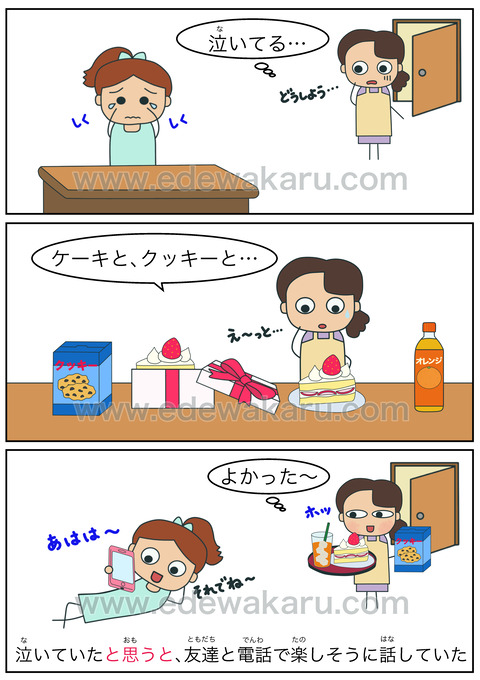
Meaning
A rapid change from ~ to ~
How to use it
Verb [dictionary form] + かと思うと
Verb [た-form] + かと思ったら
Explanation
“Aと思うとB” is a sentence pattern meaning “the change from A to B is rapid” or “it changes immediately from state A to state B.” It is used when you want to say that the shift from being in state “A” to being in state “B” happens very quickly. In most cases, “A” and “B” are actions or states that express opposites. Also, “〜と思うと” can be changed to “〜かと思うと,” “〜と思ったら,” or “〜かと思ったら.”
[Examples]
① Just when I thought she had been crying,
she was happily talking on the phone with her friend
→The change from a crying state to a happy state is rapid
② Just when I thought she had gotten angry,
she burst out laughing
→The change from an angry state to bursting out laughing is rapid
③ Just when I thought he had finally started studying,
he started playing a game
→He started playing a game soon after he began studying
④ Just when I thought the rain had stopped,
it started raining again…
→The change from having stopped to starting again is rapid
⑤ Just when I thought it was starting to feel like summer,
today was as cold as February
→It had felt hot like summer, but suddenly it got cold
“〜と思うと・〜と思ったら” have other usages too, so let’s review them 😊
In context 5 examples
泣いていたと思うと、友達と電話で楽しそうに話していた
Just when I thought she had been crying, she was happily talking on the phone with her friend.
彼女は怒ったと思うと、大声で笑い出した
Just when I thought she had gotten angry, she burst out laughing.
やっと勉強し出したと思うと、ゲームを始めた
Just when I thought he had finally started studying, he started playing a game.
雨がやんだと思うと、また降り出した…
Just when I thought the rain had stopped, it started raining again…
夏らしくなってきたと思うと、今日は2月のような寒さだった
Just when I thought it was starting to feel like summer, today was as cold as February.
Read the original source text
Meaning
〜から〜への変化が速い
How to use it
動詞[辞書形]+かと思うと
動詞[た形]+かと思ったら
Explanation
「Aと思うとB」は「AからBになる変化が速い」「AからBの状態にすぐに変わる」という意味の文型です。これは「A」していた状態から「B」の状態に切りかわるのが、とても速いと言いたい時に使います。ほとんどの場合には「A」と「B」には、反対を表す動作や状態が入ります。また、
「〜と思うと」は「〜かと思うと」「〜と思ったら」「〜かと思ったら」
にチェンジすることができます。
[例]
①泣いていた
と思うと、友達と電話で楽しそうに話していた
→泣いていた状態から、楽しそうにしている状態への変化が速い
②彼女は怒った
と思うと、大声で笑い出した
→怒っていた状態から、笑い出す状態への変化が速い
③やっと勉強し出した
と思うと、ゲームを始めた
→勉強しだしてから、すぐにゲームを始めた
④雨がやんだ
と思うと、また降り出した…
→やんだ状態から、降り出すまでの変化が速い
⑤夏らしくなってきた
と思うと、今日は2月のような寒さだった
→夏らしい暑さだったのに、急に寒くなった
「〜と思うと・〜と思ったら」には、他の用法もありますので復習をしておきましょう😊
Usage 2
Read this source entry ↗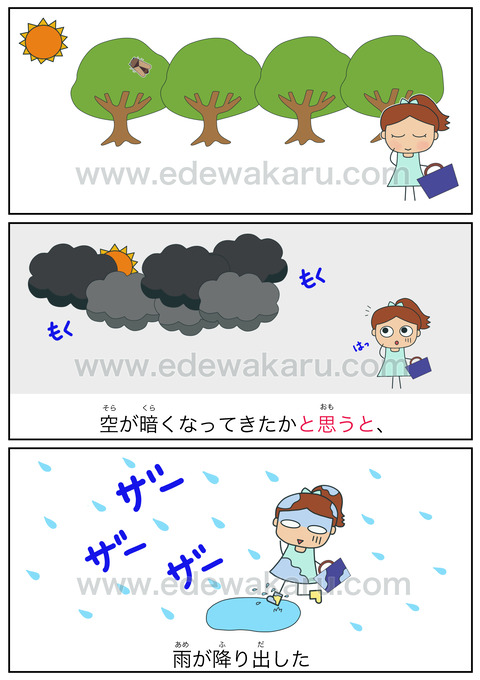
Meaning
When ~ happens, immediately ~
Almost at the same time as ~ happens
How to use it
Verb [dictionary form] + かと思うと
Verb [た-form] + かと思ったら
Explanation
“Aと思うとB・Aと思ったらB” is a sentence pattern meaning “when A happens, B happens immediately” or “B happens almost at the same time as A.” This pattern conveys the speaker’s [surprise] or [feeling that something is unexpected]. It is used when you want to say “something unexpected, B, happened immediately after A.” Also, “〜と思うと” can be changed to “〜かと思うと,” “〜と思ったら,” or “〜かと思ったら.”
[Example]
The sky started getting dark
と思うと, it began to rain
= The sky started getting dark
かと思うと, it began to rain
= The sky started getting dark
と思ったら, it began to rain
= The sky started getting dark
かと思ったら, it began to rain
Also, be careful: this cannot be used about oneself.
[Examples]
❌ I got home
と思うと, I went out again
⭕️ When I got home, I went out again right away
“〜と思うと・〜と思ったら” also has a usage that expresses [rapid change], so let’s learn that as well 😊
[Related patterns]
In context 5 examples
空が暗くなってきたと思うと、雨が降り出した
→空が暗くなってきたら、すぐに雨が降り出したJust as the sky started getting dark, it began to rain. →As soon as the sky got dark, it began to rain.
娘は学校から帰ってきたと思うと、またすぐに出かけていった
→学校から帰ってくると、またすぐに出かけていったJust when my daughter got home from school, she went out again right away. →When she got home from school, she went out again right away.
空が光ったと思うと、雷が鳴った
→空が光ったら、すぐに雷が鳴ったJust as the sky flashed, thunder rumbled. →As soon as the sky flashed, thunder rumbled.
彼女は、下を向いたかと思うと泣き始めた
→下を向くと、すぐに泣き始めたJust as she lowered her gaze, she began to cry. →As soon as she lowered her gaze, she began to cry.
兄は、ぼくの顔を見たかと思うと殴りかかってきた
→ぼくの顔を見ると、すぐに殴りかかってきたJust as my older brother saw my face, he lunged at me. →As soon as he saw my face, he lunged at me.
Read the original source text
Meaning
〜したら、すぐに〜
〜するのと、ほとんど同時に
How to use it
動詞[辞書形]+かと思うと
動詞[た形]+かと思ったら
Explanation
「Aと思うとB・Aと思ったらB」は「Aすると、すぐにB」「Aするのとほとんど同時にB」という意味の文型です。この文型は、話し手の【驚き】や【意外だと思う気持ち】が入ります。
「Aの後、すぐに続いてBという意外なことが起こった」
と言いたい時に使います。また、
「〜と思うと」は「〜かと思うと」「〜と思ったら」「〜かと思ったら」
にチェンジすることができます。
[例]
空が暗くなってきた
と思うと、雨が降り出した
=空が暗くなってきた
かと思うと、雨が降り出した
=空が暗くなってきた
と思ったら、雨が降り出した
=空が暗くなってきた
かと思ったら、雨が降り出した
また、自分のことには使えませんので注意しましょう。
[例]
❌私は家に帰った
と思うと、また出かけた
⭕️私は家に帰ると、またすぐに出かけた
「〜と思うと・〜と思ったら」には【速い変化】を表す用法もありますので、一緒に覚えておきましょう😊
【関連文型】