絵でわかる日本語
Usage 1
Read this source entry ↗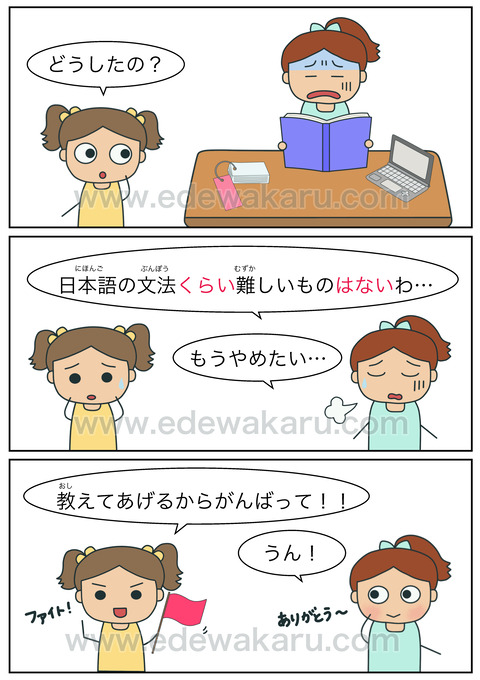
Meaning
~ is the best
How to use it
Noun [dictionary form] + くらい〜はない
Explanation
“Aくらい〜はない” is a sentence pattern meaning “A is the most ~.” It expresses the speaker’s opinion and is used to mean “I think A is the most ~.” In most cases, “〜ない” follows it, but words such as “少ない” or “めずらしい” may also follow. It can also be changed to “〜ほど〜はない,” so let’s learn that as well.
[Example]
There’s nothing as difficult as Japanese grammar…
= There’s nothing as difficult as Japanese grammar…
There are several sentence patterns that include “くらい,” so let’s review them.
In context 5 examples
A:日本語の文法くらい難しいものはないわ…B:教えてあげるからがんばって!
→日本語の文法が一番難しいわ…A: There’s nothing as difficult as Japanese grammar… B: I’ll teach you, so do your best! →Japanese grammar is the most difficult…
山田くんくらいケチな人はいない
→山田くんが一番ケチだThere’s no one as stingy as Yamada-kun. →Yamada-kun is the stingiest.
彼女くらい英語が上手な人は少ない
→彼女は英語がとても上手だThere are few people who speak English as well as she does. →She speaks English extremely well.
彼くらいかっこいい男の子はこの学校にはいないわ
→彼がこの学校で一番かっこいいThere isn’t a boy at this school as handsome as him. →He’s the most handsome at this school.
食べすぎや飲みすぎくらい体に悪いことはないよ
→食べすぎや飲みすぎが体に一番悪いNothing is worse for your health than overeating or drinking too much. →Overeating or drinking too much is the worst thing for your health.
Read the original source text
Meaning
〜が一番〜だ
How to use it
名詞[辞書形]+くらい〜はない
Explanation
「Aくらい〜はない」は「Aが一番〜だ」という意味を表す文型です。話者の考えを表す文型で、
「私はAが一番〜だと思う」
という意味で使われます。ほとんどの場合、後ろには「〜ない」がきますが、「少ない」「めずらしい」などがきたりもします。また「〜ほど〜はない」にチェンジできますので、一緒に覚えておきましょう。
[例]
日本語の文法
くらい
難しいもの
はない
わ…
=日本語の文法
ほど
難しいもの
はない
わ…
「くらい」がつく文型はいくつかありますので、復習をしておきましょう。
Usage 2
Read this source entry ↗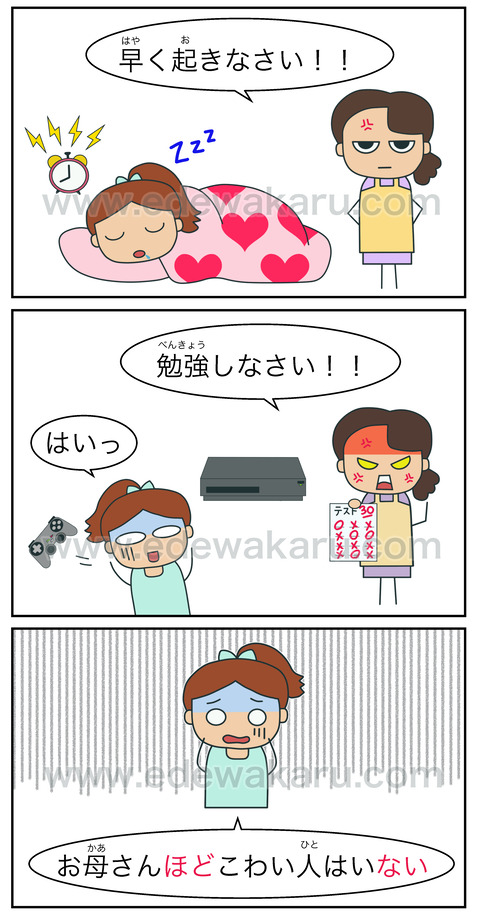
Meaning
~ is the most ~
~ is the very best ~
How to use it
Noun [dictionary form] + ほど〜はない
Explanation
“〜ほど〜はない” is a sentence pattern meaning “~ is the most ~” or “~ is the very best ~.” It is used to say “There is nothing better than ~.” 😊
This pattern is used when the speaker wants to express the feeling that “~ is the best,” so it is not used for general facts. 😮
❌ There is no mountain in Japan as high as Mt. Fuji. [Fact]
→ ⭕️ Mt. Fuji is the highest mountain in Japan.
⭕️ There is no mountain in Japan as beautiful as Mt. Fuji. [Speaker’s feeling]
This is a beginner-level pattern, but it is used very frequently, so be sure to learn it well 😉
In context 5 examples
お母さんほどこわい人はいない
→お母さんが一番こわいThere’s no one as scary as my mother. → My mother is the scariest.
プリンほど好きなものはない
→プリンが一番好きだThere’s nothing I like as much as pudding. → I like pudding best.
彼女ほどかわいい女の子はいない
→彼女が一番かわいい女の子だThere’s no girl as cute as my girlfriend. → She is the cutest girl.
家族ほど大切なものはない
→家族が一番大切だThere’s nothing as important as family. → Family is the most important.
英語ほど嫌いな教科はない
→英語が一番嫌いな教科だThere’s no subject I hate as much as English. → English is the subject I hate most.
Read the original source text
Meaning
〜が一番〜だ
〜が最高に〜だ
How to use it
名詞[辞書形]+ほど〜はない
Explanation
「〜ほど〜はない」は「〜が一番〜だ」「〜が最高に〜だ」という意味を表す文型です。「〜以上のものはな」と言いたい時に使われます😊
この文型は話し手が「〜が一番〜だ」という気持ちを表す場合に使われますので、一般的事実(いっぱんてきじじつ)には使われません
😮
❌日本には富士山
ほど
高い山は
ない
【事実】
→⭕️富士山は日本で一番高い山です
⭕️日本には富士山
ほど
きれいな山は
ない
【話し手の気持ち】
初級で勉強する文型ですが、とてもよく使いますので、しっかりと覚えておいてください😉
文法
Meaning
〜 is the best.
Used when the speaker wants to emphasize subjectively that something is 「the greatest」 or 「the best」.
Therefore, it cannot be used for objective facts.
Incorrect example
× There is no mountain as high as Everest.
→ Everest is the highest mountain in the world.
How to use it
V (dictionary form) こと + ほど・・・はない
N + ほど・・・はない
Notes
・The latter part is often used together with 「他に」 (〜他にない, 〜は他にいない).
・「ほど」 can be replaced with 「くらい/ぐらい」.
In context 13 examples
ゲームをすることほど楽しいことは他にないね。
There's nothing more fun than playing games.
JLPTに合格できなかったことほど悔しかったことはない。
I've never been more frustrated than when I failed to pass the JLPT.
1日中寝ることほど幸せなことはない。
There's nothing happier than sleeping all day.
好きな子に告白することほど、緊張するものはない。
Nothing is more nerve-racking than confessing your feelings to someone you like.
ワンピースほど面白い漫画はない。
There's no manga as interesting as One Piece.
私ほどスマートな人はこの学校にはいないでしょう。
There's no one at this school as smart as me, I bet.
日本ほど治安のいい国はあまりありません。
There aren't many countries as safe as Japan.
私の彼氏ほどかっこいい男はいないよ。
There's no man as handsome as my boyfriend.
日本語の勉強で漢字ほど嫌なものはない。
There's nothing I dislike more than kanji in studying Japanese.
スマホほど便利なものはない。
There's nothing as convenient as a smartphone.
ファイナルファンタジーほどおもしろいRPGはない。
There's no RPG as interesting as Final Fantasy.
アラビア語ほど難しい言語は他にない。
There's no other language as difficult as Arabic.
トムさんほど元気な人はこの学校にはいない。
There's no one at this school as energetic as Tom.
Read the original source text
Meaning
〜が一番いい。
話し手が主観的に「最高だ」、「一番いい」と強調して言いたい時に使う。
そのため、客観的な事実については使えない。
誤用例
× エベレストほど高い山はない。
→ エベレストが世界で一番高い山だ。
How to use it
V(辞書形)こと + ほど・・・はない
N + ほど・・・はない
Notes
・後件「他に」とセットで使うことも多い(〜他にない、〜は他にいない)。
・「ほど」は「くらい/ぐらい」で置き換え可能。
Bunpro Grammar Reference
Meaning
There is not ~ that is not/does not
How to use it
Verb[ない]+ Noun + は + ない
[い]Adjective[ない]+ Noun + は + Verb[ない]
[な]Adjective + じゃない(1) + Noun + は + Verb[ない]
(1) ではない
Nuance
A phrase expressing that there is not something which doesn't or isn't (A).
Explanation
~ない~はない is an example of a double negative in Japanese, and is a grammar construction that requires careful attention in order not to incorrectly interpret. Both the い-Adjective (形容詞), and auxiliary verb forms of ない may be used in this construction, depending on what type of word is being negated. Let's take a look at a few examples.
彼にはピアノで弾けない曲はない。
There is no song that he can't play on the piano.
私は美味しくない食べ物は食べない。
I don't eat food that does not taste good.
彼は安くない靴は買わない。
He doesn't buy shoes that aren't cheap.
Literally, this grammar pattern is very similar to 'there isn't an (A) that doesn't (B)' in English.
Caution
This term is not to to be confused with なくはない, a more advanced grammar pattern which means 'It's not that it isn't (A)'.
私に書けない漢字はない。
There is no kanji that I cannot write.
私は漢字を書けなくはないけど...
It's not that I can't write kanji, but…
In context 17 examples
- 本当に書けない漢字はないの?
Is there really not a single kanji that you cannot write?
- 私は美味しくない食べ物は食べない。
I don't eat food that does not taste good.
- 彼は安くない靴は買わない。
He doesn't buy shoes that aren't cheap.
- 彼にはピアノで弾けない曲はない。
There is no song that he can't play on the piano.
- 夢を見ない人はいないだろう。
There is not a single person who doesn't dream, right?
- 紙を使わない会社は一つもありません。
There is not a single company that does not use paper.
- あそこのカフェで美味しくないコーヒーは絶対ない。
There is no coffee at that cafe that is not delicious.
- 勉強していない文法はなかったから、テストには合格しました。
There was not a single grammar point that I did not study, so I passed the test.
- ボスの家にはテレビを置いていない部屋はない。
There is not a single room in my boss' house that does not have a TV.
- この大学で日本語を勉強していない人はいません。
There is not a person who does not study Japanese at this university.
- 私の家族の中で海外に行ったことのない人はいない。
There is not a single person in my family who has not traveled abroad.
- 私の友達の中でピザが好きじゃない人は一人もいない。
There is not a single person in my group of friends that doesn't like pizza.
- 映画が面白くて、笑わない人は一人もいなかった。
The movie was so funny that there was not a single person who did not laugh.
- お金を持っていない人は買い物に行かない方がいい。
People who do not have money, should not go shopping.
- 父親:「新しいクラスはどう?友達を作ったの?」
子供:「好きじゃないクラスメイトはいないけど、まだ、できてないよ。」Father: 'How is the new class? Did you make any friends?' Child: 'There are no classmates I don't like but I haven't made any new friends.'
- 私に書けない漢字はない。
There is no kanji that I cannot write.
- 私は漢字を書けなくはないけど...
It's not that I can't write kanji, but…
日本語NET JLPT文法解説まとめ
Meaning
~is the best.
Used when the speaker wants to subjectively emphasize that something is “the best” or “the most preferable.”
Therefore, it cannot be used for objective facts.
Incorrect example
× There is no mountain as high as Everest.
→ Everest is the highest mountain in the world.
How to use it
V (dictionary form) こと + ほど・・・はない
N + ほど・・・はない
Explanation
"the best"
When the speaker wants to subjectively emphasize that something is 'the best' or 'the most preferable,' this expression is used. Therefore, it cannot be used for objective facts."
① The latter clause is often used together with 「他に」 (e.g., 「〜他にない」, 「〜は他にいない」).
② 「ほど」 can be replaced with 「くらい/ぐらい」.
① The phrase is often used together with "他に" in the following pattern (e.g., "〜他にない"、"〜は他にいない").
② "ほど" can be replaced with "くらい/ぐらい".
In context 13 examples
ゲームをすることほど楽しいことは他にないね。
There's nothing more fun than playing games.
JLPTに合格できなかったことほど悔しかったことはない。
I've never been more frustrated than when I failed to pass the JLPT.
1日中寝ることほど幸せなことはない。
There's nothing happier than sleeping all day.
好きな子に告白することほど、緊張するものはない。
Nothing is more nerve-racking than confessing your feelings to someone you like.
ワンピースほど面白い漫画はない。
There's no manga as interesting as One Piece.
私ほどスマートな人はこの学校にはいないでしょう。
There's no one at this school as smart as me, I bet.
日本ほど治安のいい国はあまりありません。
There aren't many countries as safe as Japan.
私の彼氏ほどかっこいい男はいないよ。
There's no man as handsome as my boyfriend.
日本語の勉強で漢字ほど嫌なものはない。
There's nothing I dislike more than kanji in studying Japanese.
スマホほど便利なものはない。
There's nothing as convenient as a smartphone.
ファイナルファンタジーほどおもしろいRPGはない。
There's no RPG as interesting as Final Fantasy.
アラビア語ほど難しい言語は他にない。
There's no other language as difficult as Arabic.
トムさんほど元気な人はこの学校にはいない。
There's no one at this school as energetic as Tom.
Read the original source text
Meaning
〜が一番いい。
話し手が主観的に「最高だ」、「一番いい」と強調して言いたい時に使う。
そのため、客観的な事実については使えない。
誤用例
× エベレストほど高い山はない。
→ エベレストが世界で一番高い山だ。
How to use it
V(辞書形)こと + ほど・・・はない
N + ほど・・・はない
Explanation
"the best"
When the speaker wants to subjectively emphasize that something is 'the best' or 'the most preferable,' this expression is used. Therefore, it cannot be used for objective facts."
① 後件「他に」とセットで使うことも多い(〜他にない、〜は他にいない)。
②「ほど」は「くらい/ぐらい」で置き換え可能。
① The phrase is often used together with "他に" in the following pattern (e.g., "〜他にない"、"〜は他にいない").
② "ほど" can be replaced with "くらい/ぐらい".
NINJAL 日本語文型データベース
Usage 1
Meaning
Expresses the speaker’s subjective evaluation that 〜 has the highest degree.
How to use it
N1 ほど N2 はない・N1 ほど N2 はいない
Notes
When talking about people, the form 「〜ほど〜はいない」 is used.
When 「〜」 is a sentence, use 「こと」 to nominalize it before connecting.
In context 7 examples
私にとってゴルフほど楽しいスポーツはない。
For me, there is no sport as enjoyable as golf.
ギャンブルほど人生を狂わせるものはないと思う。
I think nothing throws a life off course as much as gambling.
子どものころ風邪で寝込んでいたときに母が作ってくれたうどんほどおいしいものはなかったと思っています。
I think nothing ever tasted as good as the udon my mother made for me when I was bedridden with a cold as a child.
竹田選手ほど日本チームの優勝に貢献した選手はいない。
No player has contributed as much to the Japanese team’s victory as Takeda.
信用している友達に裏切られることほど悲しいことはありません。
Nothing is as sad as being betrayed by a friend you trust.
社長として、会社の売り上げが上がらないことほど、いら立つことはなかった。
As company president, nothing frustrated me more than the company’s sales failing to rise.
毎日食事がおいしいことほど幸せなことはない。
Nothing is as wonderful as having delicious meals every day.
Read the original source text
Meaning
〜がいちばん程度が高いという話し手の主観的な評価を表します。
How to use it
N1ほどN2はない・N1ほどN2はいない
Notes
人について言うときは「〜ほど〜はいない」の形になります。
「〜」が文のときは、「こと」を使って名詞にして接続します。
Usage 2
Meaning
Expresses the speaker’s subjective evaluation that “〜” is the highest in degree.
How to use it
N1くらいN2はない・N1くらいN2はいない
Notes
When talking about people, use the form “〜くらい〜はいない.”
If “〜” is a sentence, use “こと” to turn it into a noun before connecting it.
In context 6 examples
常日頃、親くらいありがたいものはないと実感しています。
I’m constantly reminded that there’s nothing as precious as one’s parents.
今年の冬くらい雪が積もった冬はそうそうなかったでしょう。
There probably haven’t been many winters with as much snow as this year’s.
祖母は「うちの孫くらいかわいい子はいないね」ってよく言ってた。
My grandmother often used to say, “There isn’t a child as cute as my grandchild.”
家族と一緒にいられることくらい幸せなことはありません。
Nothing is as wonderful as being able to spend time with family.
週に1日も休めないことくらいつらいことはない。
Nothing is as hard as not getting even one day off a week.
バスケットボール選手として、背が高いことくらい有利なことはないだろう。
As a basketball player, nothing is probably as advantageous as being tall.
Read the original source text
Meaning
〜が最も程度が高いという話し手の主観的な評価を表します。
How to use it
N1くらいN2はない・N1くらいN2はいない
Notes
人について言うときは「〜くらい〜はいない」の形になります。
「〜」が文の場合は、「こと」を使って名詞にして接続します。
Usage 3
Meaning
Expresses the speaker’s subjective evaluation that “〜” is the highest in degree.
How to use it
N1くらいN2はない・N1くらいN2はいない
Notes
When talking about people, use the form “〜ぐらい〜はいない.”
If “〜” is a sentence, use “こと” to turn it into a noun before connecting it.
In context 7 examples
睡眠不足ぐらいつらいことはない。
Nothing is as hard as being sleep-deprived.
「山口部長ぐらい世話好きな上司はいませんよね」
“There isn’t a boss as caring as Department Manager Yamaguchi.”
「うちの弟ぐらいわがままな子はいないよ。お母さんが甘やかすからだよ」
“There’s no child as selfish as my younger brother. It’s because Mom spoils him.”
学生時代、中野さんぐらいよく勉強する人はほかにいなかった。
When we were students, there was no one else who studied as hard as Nakano.
日本語の勉強で、漢字を覚えることぐらい大変なことはないと私は思います。
In studying Japanese, I think nothing is as difficult as learning kanji.
お金がないことぐらいわびしく感じることはありません。
Nothing feels as lonely as having no money.
自分の会社の経営状況が良くないことぐらい心配なことはないでしょう。
Nothing is probably as worrying as the fact that your company’s business is not doing well.
Read the original source text
Meaning
〜が最も程度が高いという話し手の主観的な評価を表します。
How to use it
N1くらいN2はない・N1くらいN2はいない
Notes
人について言うときは「〜ぐらい〜はいない」の形になります。
「〜」が文の場合は、「こと」を使って名詞にして接続します。