AIUEO JLPT Grammar
Meaning
「〜には」is used to indicate the means or method to achieve a certain purpose. It connects to the dictionary form of the verb and means “to do in order to.”
How to use it
Verb dictionary form + には
In context 5 examples
料理を速く作るには慣れることが必要です。
If you want to cook quickly, you must be skilled.
健康を維持するには、バランスの取れた食事が必要です。
In order to maintain health, a balanced diet is necessary.
安全に運転するには、規則を守ることが大切です。
In order to drive safely, it’s important to follow the rules.
効果的に働くには、良いチームワークが必要です。
In order to work effectively, good teamwork is necessary.
英語を学ぶには、たくさん聞いて話すことが重要です。
In order to learn English, it’s important to listen and speak a lot.
Read the original source text
Meaning
「〜には」is used to indicate the means or method to achieve a certain purpose. It connects to the dictionary form of the verb and means “to do in order to.”
How to use it
動詞辞書形+には
Explanation · 日本語
「〜には」は、ある目的を達成するための手段や方法を示すために使われる表現です。動詞辞書形に接続して、「〜するためには」の意味を持ちます。
文法
Meaning
Expresses purpose: in order to 〜.
How to use it
V (dictionary form) + には
In context 6 examples
本を借りるには、貸出カードが必要です。
To borrow a book, you need a library card.
お酒を購入するには、20歳以上であることを証明できるものが必要です。
To purchase alcohol, you need something that can prove you are at least 20 years old.
富士登山のツアーに申し込むには、どうすればいいでしょうか。
What should I do to sign up for a Mount Fuji climbing tour?
空港へ行くには、バスを利用すると便利ですよ。
To get to the airport, taking the bus is convenient.
JLPT N1に合格するには、どんな勉強が必要でしょうか。
What kind of studying is necessary to pass JLPT N1?
クレジットカードを作るには、審査が必要です。
You need to undergo a screening to get a credit card.
Read the original source text
Meaning
〜するために目的を表す。
How to use it
V(辞書形)+ には
Bunpro Grammar Reference
Meaning
In order to, In regard to, For
How to use it
Verb + には
Noun + には
Nuance
A short phrase indicating that for (A), or to arrive at end point of (A), (B) exists or is required.
Explanation
には is a common particle combination in Japanese that is used to express contrast in regard to the topic. As a function of the particles that combine to make には, に highlights that something is 'for (A)', while は emphasizes that a generalization or contrast is being made about (A).
Common translations for には include 'in order to', 'in regard to', or 'for'. This structure will appear following either verbs in their dictionary form, or nouns.
このホームセンターは会員制なので、買い物をするには会員登録が必要です。
Since this home improvement store is only open to members, you will need to sign up in order to shop here.
海外に行くにはパスポートが必要です。
You need a passport in order to travel abroad.
この本は子供には難しすぎるだろう。
This book is probably too difficult for children.
通勤には車を使わないでください。
Please do not use your car for commuting.
Fun-fact
Despite having several different translations, には can almost always be thought of as simply meaning 'for', as に highlights that (A) is the 'target', while は shows that whatever happens in (B) is specific to (A), regardless of whatever might be true for another topic.
In context 16 examples
- 「移動にはスクーターを使ったらどう?」
'What about using a scooter for transportation?'
- このホームセンターは会員制なので、買い物をするには会員登録が必要です。
Since this home improvement store is only open to members, you will need to sign up in order to shop here.
- 海外に行くにはパスポートが必要です。
You need a passport in order to travel abroad.
- この本は子供には難しすぎるだろう。
This book is probably too difficult for children.
- 通勤には車を使わないでください。
Please do not use your car for commuting.
- 夢を実現するには時間がかかる。
It takes time in order to make one's dream happen.
- 出産には、我慢強さが必要です。
In order to give birth, endurance is necessary.
- 一戸建てを買うには多くの金がかかる。
It costs a lot of money to buy a detached house.
- 間違いを認めてやり直すには勇気が要ります。
One needs courage in order to admit a mistake and start over.
- 3ヶ月以上の滞在にはビザが必要です。
A visa is necessary for stays longer than three months.
- 短所を改善するには、まずその短所を認めることが必要です。
In order to fix your weaknesses, it is necessary to first acknowledge those weaknesses.
- 外国語を学ぶには一貫性が一番だと思います。
I think that the best way to learn a foreign language is consistency.
- 運動は、健康を維持するには不可欠です。
Exercise is essential in order to maintain good health.
- 通勤には自転車を使う人が最近増えている。
The number of people who have been using a bicycle for commuting has increased.
- 日本で独り暮らしをするには、日本語を話せるようになるべきだ。
In order to live by yourself in Japan, you should be able to speak Japanese.
- 「妹がブランコで遊ぶには、まだ小さすぎます。」と男の子は言いました。
'As for playing on the swings, my sister is still too small', said the boy. (In order to)
Read the original source text
Meaning
In order to, In regard to, For
How to use it
Verb + には
Noun + には
Nuance
A short phrase indicating that for (A), or to arrive at end point of (A), (B) exists or is required.
Explanation
には is a common particle combination in Japanese that is used to express contrast in regard to the topic. As a function of the particles that combine to make には, に highlights that something is 'for (A)', while は emphasizes that a generalization or contrast is being made about (A).
Common translations for には include 'in order to', 'in regard to', or 'for'. This structure will appear following either verbs in their dictionary form, or nouns.
このホームセンターは会員制なので、買い物をするには会員登録が必要です。
Since this home improvement store is only open to members, you will need to sign up in order to shop here.
海外に行くにはパスポートが必要です。
You need a passport in order to travel abroad.
この本は子供には難しすぎるだろう。
This book is probably too difficult for children.
通勤には車を使わないでください。
Please do not use your car for commuting.
Fun-fact
Despite having several different translations, には can almost always be thought of as simply meaning 'for', as に highlights that (A) is the 'target', while は shows that whatever happens in (B) is specific to (A), regardless of whatever might be true for another topic.
Nuance · 日本語
(A)になるため、又は(A)という終点にたどり着くために、(B)が必要または存在している必要があるということを表す短い表現。
Explanation · 日本語
「には」は日本語でよく使われる助詞の組み合わせで、主題に関する対比を表すために使われます。「には」を構成する助詞それぞれの役割として、「に」が手段や目的、時、対象などを表し、「は」が (A) が一般的な内容であることや、対比があることを強調します。
「には」は「(A) のために」や「(A) に関して」というような意味で使われます。この助詞は動詞の辞書形または名詞の後に続いて使われます。
このホームセンターは会員制なので、買い物をするには会員登録が必要です。
Since this home improvement store is only open to members, you will need to sign up in order to shop here.
海外に行くにはパスポートが必要です。
You need a passport in order to travel abroad.
この本は子供には難しすぎるだろう。
This book is probably too difficult for children.
通勤には車を使わないでください。
Please do not use your car for commuting.
豆知識
「には」はいろいろな意味を持ちますが、基本は「に」が (A) が対象であることを示し、「は」が (B) は (A) に特有なことであり、ほかの主題でどうであろうと関係ないことを表します。
DoJG 日本語文法辞典(全集)
Meaning
To; in order to; for; for the purpose of ~
How to use it
(i) Vinformal nonpast | には | |
| 行くには | For going there |
(ii) Noun | には | |
| 仕事には | For one’s work |
Explanation
A conjunction/compound particle to indicate a purpose for doing something.
In context 12 examples
豊かな生活を送るには健康が第一だ。
In order to lead a rich life, health should be your primary concern.
ハイヒールはハイキングには不向きだ。
High-heeled shoes are unsuitable for hiking.
日本を知るには日本語を学ぶのが一番だ。
The best course for getting to know Japan is to study the Japanese language.
人生を豊かにするには趣味を沢山持つことが大事だ。
To enrich your life it is important is to have many hobbies.
人の性格を見抜くには深い洞察力が必要だ。
In order to see through a person's personality, one needs to have deep insight.
外国語の能力を伸ばすにはその国に行くのが一番だろう。
The best way for developing one's proficiency in a foreign language would be to go to the country of that language.
世界の平和を維持するにはエリートの交流より庶民のレベルの交流が肝心だ。
To maintain world peace, exchange among the general public rather than exchange among elites is essential.
期末レポートを書くにはワープロが欠かせない。
A word processor is a must for writing a term paper.
あの人を説得するには時間がかかる。
It takes time to persuade him.
このクラブの会員になるには会員の推薦状が必要だった。
In order to become a member of this club a member's letter of recommendation was necessary.
この鞄は長旅には便利だ。
This bag is suitable for a long travel.
この研究にはかなりの時間とお金がかかる。
This research needs a considerable amount of time and money.
絵でわかる日本語
Meaning
In order to 〜
How to use it
Verb [dictionary form] + には
Explanation
“〜には” is a sentence pattern meaning “in order to 〜.” It expresses [purpose] and is often used to say things like “in order to do 〜, you have to do 〜” or “if you want to do 〜, you should do 〜.”
Be sure to review “〜ために,” which expresses purpose 😊
[Related patterns]
In context 5 examples
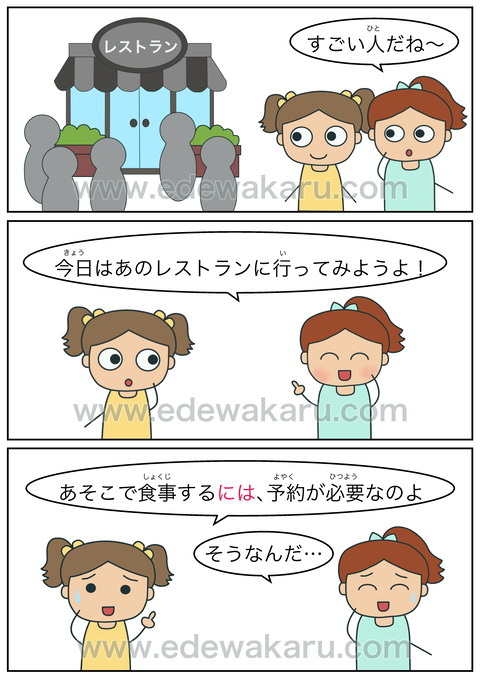
A:今日は、あのレストランに行ってみようよ!B:あそこで食事するには、予約が必要なのよ
→あそこで食事するためには、予約が必要よA: Let’s try going to that restaurant today! B: To eat there, you need a reservation. → You need a reservation in order to eat there.
日本語能力試験に合格するには、どんな勉強をすればいいですか?
→合格するためには、どんな勉強をすればいいですか?What kind of studying should I do in order to pass the Japanese Language Proficiency Test? → What kind of studying should I do in order to pass?
海外旅行に行くには、お金も時間も必要だ
→海外旅行に行くためにはお金も時間も必要だYou need both money and time to travel overseas. → You need both money and time in order to travel overseas.
あのイベントに参加するには、どうすればいいですか?
→あのイベントに参加するためには、どうすればいいですか?What should I do to take part in that event? → What should I do in order to take part in that event?
A:彼女を喜ばすにはどうしたらいいのかな…B:ダイヤモンドでもプレゼントしたらいいんじゃない?
→彼女を喜ばすためにはどうしたらいいのかな…A: I wonder what I should do to make her happy… B: Why don’t you give her a diamond or something? → I wonder what I should do in order to make her happy…
Read the original source text
Meaning
〜するためには
How to use it
動詞[辞書形]+には
Explanation
「〜には」は「〜するためには」という意味の文型です。[目的]を表す文型で、「するためには〜しなければいけない」「〜したいなら、〜するべきだ」などと言いたい時によく使われます。
目的を表す「〜ために」の復習をしておきましょう😊
【関連文型】
日本語文型辞典
Meaning
This is 「は」 added to a noun marked by the particle 「に」 in order to bring it into focus.
a. Nには [time, place, direction, counterpart, etc.]
This adds the meaning of 「は」, which brings into focus a phrase marked by the particle 「に」 that expresses various meanings, presenting it as the topic or showing a contrast with something else. When there is no need to add the meaning of 「は」, it is used with 「に」 alone.
b. Nには [standard of evaluation]
Follows a noun referring to a person and means “for that person.” It indicates what the evaluation expressed by words such as 「大きい」, 「むずかしい」, 「できる」, and 「できない」 is being made in relation to. It carries a contrastive nuance of “as for other things, setting them aside.” It is uncommon to use 「に」 alone; the form 「…には」 is usual.
c. Nには [person shown respect to]
Follows a noun referring to someone of higher standing and is used to show respect to that person. It is used only in formal letters and similar contexts. An even more formal expression is 「…におかれましては」.
Means “in order to do so” or “if one wishes to do that.”
The same verb is repeated to mean “one does (or did) so, at least in some fashion, but it is unclear whether the result will be satisfactory.”
How to use it
Nには
V-るには
V-るにはVが
In context 17 examples
春には桜が咲きます。
Cherry blossoms bloom in spring.
10時には帰ってくると思います。
I think they will be back by ten o’clock.
この町には大学が三つもあります。
There are as many as three universities in this town.
結局国には帰りませんでした。
In the end, I did not return to my country.
山田さんにはきのう会いました。
I met Mr. Yamada yesterday.
みなさんには申し訳ありませんが、今日の集まりは中止になりました。
I’m sorry to everyone, but today’s gathering has been canceled.
このセーターは私には大きすぎる。
This sweater is too big for me.
この問題はむずかしすぎて私には分かりません。
This problem is too difficult for me to understand.
この仕事は経験のない人には無理でしょう。
This job would probably be impossible for someone without experience.
皆様にはお変わりなくお過ごしのことと存じます。
I hope you are all doing well.
先生にはお変わりなくお過ごしのこととお喜び申し上げます。
I am delighted to hear that you are keeping well, Sensei.
そこに行くには険しい山を超えなければならない。
To get there, you have to cross a steep mountain.
その電車に乗るには予約をとる必要があります。
You need to make a reservation to take that train.
健康を維持するには早寝早起きが一番だ。
Going to bed and getting up early is best for maintaining good health.
行くには行くが、彼に会えるかどうかは分からない。
I will go, but I don’t know whether I’ll be able to see him.
A:あしたまでに完成させると約束したんですって?
B:うん。約束するにはしたけれど、できるかどうか自信がないんだ。A: I hear you promised to finish it by tomorrow? B: Yeah. I did promise, but I’m not confident I can do it.
いちおう説明するにはしたのですが、まだみんな、十分に理解できていないようでした。
I did give an explanation, at least, but it seemed that not everyone had fully understood it yet.
Read the original source text
Meaning
助詞の「に」がついた名詞を取り立てるために「は」がつけ加えられたもの。
a. Nには【時・場所・方向・相手なと】
助詞の「に」が付いていろいろな意味を表す句を取り立てて、主題として示したり、他のものとの対比を示したりする「は」の意味が付け加えられたもの。「は」の意味を加える必要が無いときは「に」だけで用いられる。
b. Nには【評価の基準】
人を表す名詞を受けて「その人にとっては」という意を表す。「大きい」「むずかしい」「できる」「できない」などの評価が何に対して下されるのかを示す。「他のものはともかくとして」という対比的な含みが生じる。「に」だけで用いられることは少なく、「…には」の形となるのが普通。
c. Nには【尊敬の対象】
目上の相手を表す名詞を受けて、その人に敬意を表すために用いる。改まった手紙などでしか用いない。さらに改まった表現としては「…におかれましては」がある。
「そうするためには」「そうしたいと思うのなら」という意味を表す。
同じ動詞を繰り返し用いて、「いちおうはそうする(そうした)けれども、満足のいく結果になるかどうかわからない」という意味を表す。
How to use it
Nには
V-るには
V-るにはVが
日本語文型辞典 英語版
Meaning
a. Nには〈time, place, direction, other person, etc.〉
Contains a phrase with the particle に to which は expressing some topic or contrasting N with something else is attached, and emphasizes phrases with various meanings. When either meaning of は is not necessarily expressed, only Nに is used.
b. Nには〈standard of evaluation〉
With a noun expressing a person, expresses the meaning of “for that person.” Shows for whom the speaker’s evaluation, such as 大きい(big), むずかしい(difficult), できる(able to do), or できない(not able to do), is intended. Has the contrastive implication of “setting other people aside.” Nには but not really Nに is used in this usage.
c. Nには〈target of respect〉
With a noun addressing someone in a superior position, used to express the speaker’s respect toward that person. Used only in a formal letter or some similar occasion. To be more formal, ...におかれましては is used.
Expresses the meaning of “in order to do something” or “if you think you want to do something.”
B:うん。約束するにはしたけれど、できるかどうか自信がないんだ。
Yeah, you’re right that I promised, but I’m not sure whether I can.
With the same verb repeated, expresses the meaning of “someone will do/did anyway, but it is not clear if the result will be satisfactory.”
How to use it
1. NにはNには is a form in which は is attached to a noun with the particle に, to emphasize the phrase.
2. V-るには
3. V-るにはVが
In context 17 examples
春には桜が咲きます。
In spring, the cherry trees bloom.
10 時には帰ってくると思います。
By ten o’clock, she should come back.
この町には大学が三つもあります。
In this town, there are three universities.
結局国には帰りませんでした。
In the end, I didn’t go back to my country.
山田さんにはきのう会いました。
As for Yamada-san, I saw him yesterday.
みなさんには申し訳ありませんが、今日の集まりは中止になりました。
I’m sorry to tell everyone this, but the meeting has been canceled today.
このセーターは私には大きすぎる。
This sweater is too big for me.
この問題はむずかしすぎて私には分かりません。
This question is so difficult that I can’t understand it.
この仕事は経験のない人には無理でしょう。
This job is not possible for inexperienced people to do.
皆様にはお変わりなくお過ごしのことと存じます。
I trust that you are all continuing to do well.
先生にはお変わりなくお過ごしのこととお喜び申し上げます。
I trust that you, my teacher, are also keeping well.
そこに行くには険しい山を超えなければならない。
To reach there, we have to go over a steep mountain.
その電車に乗るには予約をとる必要があります。
To take the train, it is necessary to make a reservation.
健康を維持するには早寝早起きが一番だ。
To keep your health, it’s best to go to bed early and get up early.
行くには行くが、彼に会えるかどうかは分からない。
I’ll go anyway, but I don’t know if I can see him.
A:あしたまでに完成させると約束したんですって?
I heard you promised you would finish by tomorrow. Is that right?
いちおう説明するにはしたのですが、まだみんな、十分に理解できていないようでした。
I did explain it once to them, but it didn’t seem that everyone fully understood.
日本語NET JLPT文法解説まとめ
Meaning
In order to …
Expresses purpose.
How to use it
V (dictionary form) + には
In context 6 examples
本を借りるには、貸出カードが必要です。
To borrow a book, you need a library card.
お酒を購入するには、20歳以上であることを証明できるものが必要です。
To purchase alcohol, you need something that can prove you are at least 20 years old.
富士登山のツアーに申し込むには、どうすればいいでしょうか。
What should I do to sign up for a Mount Fuji climbing tour?
空港へ行くには、バスを利用すると便利ですよ。
To get to the airport, taking the bus is convenient.
JLPT N1に合格するには、どんな勉強が必要でしょうか。
What kind of studying is necessary to pass JLPT N1?
クレジットカードを作るには、審査が必要です。
You need to undergo a screening to get a credit card.
Read the original source text
Meaning
〜するために
目的を表す。
How to use it
V(辞書形)+ には
毎日のんびり日本語教師
Meaning
in order to do ~
How to use it
Verb dictionary form+には
Noun(+particle)+には
Person's name noun+には
Explanation
There are two meanings.
① Purpose of an action
The first part states the purpose, and the second part states the conditions necessary to achieve that purpose.
② Criterion for evaluation
When used with a noun that refers to a person, it expresses an evaluation of a situation from that person's perspective.
The second part mainly contains words related to difficulty.
Notes
Nothing in particular.
In context 10 examples
新しい生活に慣れるには時間が必要。
It takes time to get used to a new life.
成功するには、成功するまで決して諦めないことだ。
To succeed, never give up until you do.
痩せるにはまず食生活を見直すことから始めよう。(想要瘦就必须从饮食方面着手。)
To lose weight, let's start by reviewing our eating habits. (If you want to lose weight, you have to start with your diet.)
再び同じ過ちを犯さないようにするには、しっかり反省するのが大切だ。
To avoid making the same mistake again, it is important to reflect carefully.
何かアドバイスをしてあげるには情報が少なすぎる。
There is far too little information to give you any advice.
銀行に行くには、そこの角を左に曲がればいいですよ。
To get to the bank, just turn left at that corner.
恋をするにはまだ若すぎる。(现在谈恋爱未免太年轻了。)
You are still too young to fall in love. (You're too young to be dating now.)
自分を理解してもらうには、まず相手を理解してあげなければ始まらない。
For someone to understand you, you first have to understand them; otherwise, nothing can begin.
これは難しいから子どもには分からない。
This is difficult, so children can't understand it.
この仕事は新人にはできない。
A newcomer can't do this job.
Read the original source text
Meaning
~するためには
How to use it
動辞形+には
名詞(+助詞)+には
人名の名詞+には
Explanation
2つの意味があります。
①動作の目的
前項には目的を、後項にはその目的を達成するために必要な条件を述べます。
②評価の基準
人名を表す名詞について、その人物にとってのある状況に対する評価を表します。
後件には主に難度に関する語がきます。
Notes
特になし