文法
Meaning
It is pointless / no use even if ~
How to use it
V (て-form) + もしかたがない / しょうがない
イAくても + しかたがない / しょうがない
ナAでも + しかたがない / しょうがない
Notes
「しょうがない」 is used in spoken language.
In context 11 examples
テストは明日だし、今から焦って勉強してもしかたがない。
The test is tomorrow, so there’s no point in panicking and studying now.
部長に何を言ってもしかたがないよ。頑固で自分の意見を変えることはないのだから。
There’s no point in saying anything to the department manager. He’s stubborn and won’t change his opinion.
あの時、好きって言わなかったんだから、今さら後悔してもしかたがないよ。
You didn’t tell them you liked them back then, so there’s no point regretting it now.
ジェシカさんと付き合っていることは、もうみんなにバレているので、隠してもしょうがないか。
Everyone already knows that Jessica and I are dating, so I guess there’s no point hiding it.
今日中には答えが出そうにないので、これ以上会議を続けてもしかたがない。
It looks like we won’t reach an answer today, so there’s no point in continuing the meeting any longer.
ミスを上司に報告しなかったんだから、怒られてもしかたがないよ。
You didn’t report your mistake to your boss, so you can’t complain if you get scolded.
上司を殴ったんだから、クビになってもしかたないよ。
You hit your boss, so it can’t be helped if you get fired.
彼女にフラれて悲しいかもしれないけど、落ち込んでてもしょうがないよ。今日はパーっと飲んで元気だそうよ。
You may be sad that she dumped you, but there’s no point in staying down. Let’s go out for a drink and cheer you up today.
どうにもならないことを、悩んでいてもしかたがないよ。
There’s no point worrying about something that can’t be changed.
電車が遅れているからといって、駅のスタッフに文句を言ってもしかがない。
There’s no point complaining to the station staff just because the train is delayed.
全然、勉強して来なかったんだっし、落ちてもしかたないよ。
You didn’t study at all, so it’s no wonder if you fail.
Read the original source text
Meaning
〜ても意味がない / 〜ても無駄だ
How to use it
V(テ形)も + しかたがない / しょうがない
イくても + しかたがない / しょうがない
ナAでも + しかたがない / しょうがない
Notes
「しょうがない」は話し言葉として使われる。
絵でわかる日本語
Meaning
Even if it becomes ~, nothing can be done
There’s no point in ~
How to use it
Verb [て-form] + てもしかたがない
い-adjective [minus ーい] + くてもしかたがない
な-adjective [minus ーな] + でもしかたがない
Noun [dictionary form] + でもしかたがない
Explanation
“〜てもしかたがない” is a sentence pattern meaning “even if ~ happens (which is only natural), nothing can be done about it” or “there’s no point in ~.” It is often used to say “the situation is regrettable, but there’s nothing that can be done” or “I’m dissatisfied, but there’s nothing that can be done.” It can be changed to “〜てもしょうがない.” Also, “〜ても・〜でも” can be changed to the colloquial forms “〜たって・〜だって.”
[Example]
勉強し
てもしかたがない
from now on
= 勉強し
てもしょうがない
from now on
= 勉強し
たってしょうがない
from now on
“〜てもしかたがない” and “〜てしかたがない” are similar, but they are completely different sentence patterns, so be sure to distinguish them.
In context 5 examples
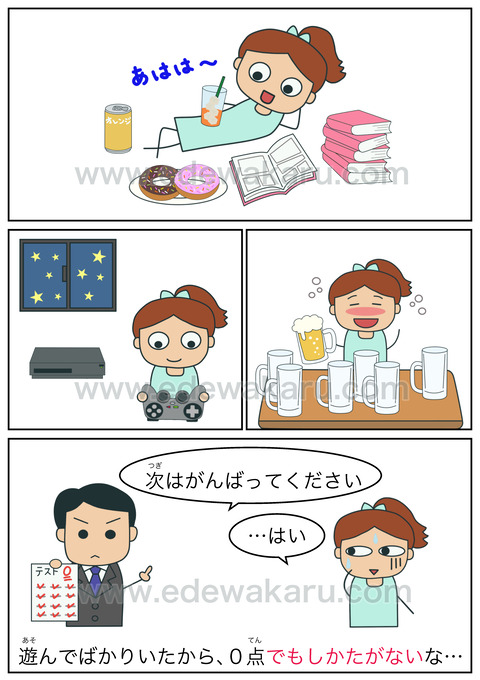
遊んでばかりいたから、0点でもしかたがないな
→0点でもどうもできないなSince you did nothing but play, it’s no wonder you got zero points. →There’s nothing that can be done about getting zero points.
あと5分でテストが始まるし、今さら勉強してもしかたがないよ
→今さら勉強しても意味がないよThe test starts in five minutes, so there’s no point studying at this point. →There’s no point studying at this point.
そんなことをしたら、怒られてもしかたがないよ→怒られてもどうもできないよ
If you do something like that, you can’t complain about getting scolded. →There’s nothing you can do about being scolded.
毎日遅刻していたんだから、首になってもしかたがないと思うよ
→首になってもどうもできないと思うよYou were late every day, so I think it can’t be helped if you get fired. →I think there’s nothing that can be done about getting fired.
そんなに泣いてもしかたがないでしょ!
→そんなにないても意味がないでしょ!There’s no point crying that much, is there! →There’s no point crying that much, is there!
Read the original source text
Meaning
〜の状態になっても、どうもできない
〜ても意味がない
How to use it
動詞[て形]+てもしかたがない
い形容詞[ーい]+くてもしかたがない
な形容詞[ーな]+でもしかたがない
名詞[辞書形]+でもしかたがない
Explanation
「〜てもしかたがない」は「(〜の状態になるのは当然で)その状態になっても、どうもできない」「〜ても意味がない」という意味の文型です。「残念な状態だが、どうすることもできない」「不満があるが、どうすることもできない」と言いたい時によく使われます。「〜てもしょうがない」にチェンジすることができます。また、「〜ても・〜でも」は口語形の「〜たって・〜だって」にチェンジすることもできます。
[例]
今から勉強し
てもしかたがない
=今から勉強し
てもしょうがない
=今から勉強し
たってしょうがない
「〜てもしかたがない」と「〜てしかたがない」は似ていますが、全然違う文型ですので区別をしておきましょう。
日本語文型辞典
Meaning
Core information
N/Na でもしかたがない
A-くてもしかたがない
V-てもしかたがない
Explanation
Both 「…てもしかたがない」 and 「…なくてもしかたがない」 are used. This expresses that although a situation is regrettable or unsatisfactory, it cannot be helped and must be accepted. 「-ては」 is often added to state the cause or reason that brought about the situation.
Example sentences
① With this report, I can’t complain if I’m ordered to do it over.
② With such careless practice, it’s no wonder we lost in the first round.
③ With that much snow falling, it can’t be helped if we don’t arrive on time.
④ With so many people here, it can’t be helped if she can’t be found.
⑤ Since so many players on the team were injured, it can’t be helped if we come in last this time.
⑥ Since there’s no time to go shopping, these old clothes will have to do for tonight’s party.
⑦ Since it’s been raining all the time lately, it can’t be helped if the beer garden has few customers.
⑧ Since this area is convenient, it can’t be helped if apartment prices are high.
Read the original source text
Meaning
基本情報N/Na でもしかたがないA-くてもしかたがないV-てもしかたがない説明「…てもしかたがない」「…なくてもしかたがない」のどちらも使う。残念な、または、不満な状況だが、受け入れざるをえないとする意味を表す。「-ては」をつけて、その状況を生み出した原因や理由を述べることが多い。例文① このレポートでは、やりなおしを命じられても仕方がない。② あんないいかげんな練習では、一回戦で負けてもしかたがない。③ あんなに雪が降っては、時間通りに着けなくてもしかたがない。④ これだけたくさんの人がいては、彼女がみつけられなくても仕方がない。⑤ チームの選手にけが人が多かったから、今回は最下位でもしかたがない。⑥ 買い物にいくひまがないから、今夜のパーティーは古い服でもしかたがない。⑦ このところ雨ばかりだから、ビアガーデンのお客が少なくてもしかたがない。⑧ この辺は便利だから、マンションの値段が高くても仕方がない。
日本語文型辞典 英語版
Meaning
【てもしかたがない】[N/Na でもしかたがない][A-くてもしかたがない][V-てもしかたがない]
Used in both the forms てもしかたがない and なくてもしかたがない. Means that a situation is unfortunate or unsatisfactory, but there is no other choice but to accept it. The cause or reason that brought about the situation at hand is often stated by adding ては to the end of the preceding clause.
In context 8 examples
このレポートでは、やりなおしを命じられても仕方がない。
With this report, it’s no wonder I’ve been ordered to do it over again.
あんないいかげんな練習では、一回戦で負けてもしかたがない。
With such sloppy practice, it’s no wonder they lost the first match.
あんなに雪が降っては、時間通りに着けなくてもしかたがない。
With that heavy a snowfall, it can’t be helped if they don’t arrive on time.
これだけたくさんの人がいては、彼女がみつけられなくても仕方がない。
With this many people around, it’s no surprise we can’t find her.
チームの選手にけが人が多かったから、今回は最下位でもしかたがない。
There were a lot of injured players on the team, so ending up in last place this time was unavoidable.
買い物にいくひまがないから、今夜のパーティーは古い服でもしかたがない。
I don’t have time to go shopping, so I’ll have to wear something old to the party tonight.
このところ雨ばかりだから、ビアガーデンのお客が少なくてもしかたがない。
The small number of customers at the beer gardens is to be expected, with all the rain we’ve had recently.
この辺は便利だから、マンションの値段が高くても仕方がない。
This is a convenient location, so it’s no wonder the condominiums are pricey.
日本語NET JLPT文法解説まとめ
Meaning
It is pointless / no use even if ~
How to use it
V (て-form) + もしかたがない / しょうがない
イAくても + しかたがない / しょうがない
ナAでも + しかたがない / しょうがない
Explanation
it cannot be helped
「しょうがない」is used in spoken language.
In context 11 examples
テストは明日だし、今から焦って勉強してもしかたがない。
The test is tomorrow, so there’s no point in panicking and studying now.
部長に何を言ってもしかたがないよ。頑固で自分の意見を変えることはないのだから。
There’s no point in saying anything to the department manager. He’s stubborn and won’t change his opinion.
あの時、好きって言わなかったんだから、今さら後悔してもしかたがないよ。
You didn’t tell them you liked them back then, so there’s no point regretting it now.
ジェシカさんと付き合っていることは、もうみんなにバレているので、隠してもしょうがないか。
Everyone already knows that Jessica and I are dating, so I guess there’s no point hiding it.
今日中には答えが出そうにないので、これ以上会議を続けてもしかたがない。
It looks like we won’t reach an answer today, so there’s no point in continuing the meeting any longer.
ミスを上司に報告しなかったんだから、怒られてもしかたがないよ。
You didn’t report your mistake to your boss, so you can’t complain if you get scolded.
上司を殴ったんだから、クビになってもしかたないよ。
You hit your boss, so it can’t be helped if you get fired.
彼女にフラれて悲しいかもしれないけど、落ち込んでてもしょうがないよ。今日はパーっと飲んで元気だそうよ。
You may be sad that she dumped you, but there’s no point in staying down. Let’s go out for a drink and cheer you up today.
どうにもならないことを、悩んでいてもしかたがないよ。
There’s no point worrying about something that can’t be changed.
電車が遅れているからといって、駅のスタッフに文句を言ってもしかがない。
There’s no point complaining to the station staff just because the train is delayed.
全然、勉強して来なかったんだっし、落ちてもしかたないよ。
You didn’t study at all, so it’s no wonder if you fail.
Read the original source text
Meaning
〜ても意味がない / 〜ても無駄だ
How to use it
V(テ形)も + しかたがない / しょうがない
イくても + しかたがない / しょうがない
ナAでも + しかたがない / しょうがない
Explanation
it cannot be helped
「しょうがない」は話し言葉として使われる。
AIUEO JLPT Grammar
Meaning
This sentence pattern expresses that something is meaningless or has no effect, implying that no matter what you do, the situation won’t change. It is often used when accepting the inevitability of a situation or making futile efforts.
How to use it
Verb て-form ても + しかたがない or しようがない or しょうがない; adjective て-form ても + しかたがない or しようがない or しょうがない; な-adjective でも + しかたがない or しようがない or しょうがない; noun でも + しかたがない or しようがない or しょうがない
In context 5 examples
彼には何を言ってもしかたがなかった。
There was nothing he could say.
後悔してもしょうがない。次はもっと気をつけよう。
There’s no point in regretting it. Let’s be more careful next time.
どんなに説明してもしかたがない。彼は聞く耳を持たないんだから。
No matter how much I explain, it’s no use. He refuses to listen.
寒くてもしょうがない。暖房が故障しているから。
There’s nothing you can do about the cold. The heater is broken.
今は痛くてもしょうがない。すぐに治るよ。
It can't be helped that it hurts now. It'll get better soon.
Read the original source text
Meaning
This sentence pattern expresses that something is meaningless or has no effect, implying that no matter what you do, the situation won’t change. It is often used when accepting the inevitability of a situation or making futile efforts.
How to use it
動詞て形ても+しかたがないorしようがないorしょうがない形容詞て形ても+しかたがないorしようがないorしょうがない形容動詞でも+しかたがないorしようがないorしょうがない名詞でも+しかたがないorしようがないorしょうがない
Explanation · 日本語
この文型は、何かをしても、それが無意味である、または状況が変わらないという意味を持ちます。通常、無駄な努力や避けられない現実を受け入れるときに使われます。