文法
Meaning
“Speaking of 〜”
・N2 is something or some matter that immediately comes to mind when one hears N1.
・It is often used to introduce a topic or change the subject.
How to use it
N + といえば
In context 14 examples
日本の春といえば、桜だろう。
Speaking of spring in Japan, it would have to be cherry blossoms.
難しい外国語といえば、やっぱりアラビア語かなあ。
Speaking of difficult foreign languages, I guess Arabic, as you'd expect.
冬といえば、やっぱり鍋料理だろう。
Speaking of winter, it has to be hot pot, right?
大阪の食べ物といえば、たこ焼きです。
Speaking of food in Osaka, it's takoyaki.
代表的なファストフードといえば、ハンバーガーです。
Speaking of typical fast food, it's hamburgers.
日本の伝統的なスポーツといえば、相撲だ。
Speaking of traditional Japanese sports, it's sumo.
世界でよく食べられている物といえば、米です。
Speaking of foods commonly eaten around the world, it's rice.
日本の伝統的な夏の行事といえば、花火大会です。
Speaking of traditional Japanese summer events, it's fireworks festivals.
日本の食べ物といえば、寿司でしょうか。
Speaking of Japanese food, would it be sushi?
京都といえば、お寺が有名です。
Speaking of Kyoto, its temples are famous.
Appleといえば、i-phoneで有名な会社です。
Speaking of Apple, it’s a company famous for the iPhone.
大晦日のテレビ番組といえば、やっぱり紅白歌合戦です。
Speaking of TV programs on New Year's Eve, it's the annual Red and White Singing Contest, as you'd expect.
日本で一番有名な大学といえば、東京大学だ。
Speaking of the most famous university in Japan, it's the University of Tokyo.
最近の日本の子供がなりたい職業といえば、YouTuberだろうか。
Speaking of jobs that children in Japan want these days, I wonder if it would be YouTuber.
Read the original source text
Meaning
"〜について話すと"
・N2は、N1と聞いて、すぐに連想できる物や事柄。
・話題の提供や、話の切り替え時に使用されることが多い。
How to use it
N + といえば
Bunpro Grammar Reference
Meaning
Speaking of, If it were the case that
How to use it
Noun + と言えば(1)
(1) と言うと、と言ったら
Nuance
A hypothetical grammar point that is used when (A) suddenly reminds the speaker of something related.
Explanation
と言えば, と言うと, and と言ったら are all expressions that are translated quite closely to 'speaking of (A)', or 'if it were the case that (A)'. Each of these structures has a slightly different nuance, but are largely used in the same situations.
と言えば - More hypothetical, 'were it (A)'.
と言うと - More concrete, 'if it's (A)'.
と言ったら - More situational, 'when it's (A)'.
These constructions are most commonly used after nouns, in response to something that has already been mentioned in the conversation (usually by someone else). The thing that has already been said is quite often the 'trigger' for someone remembering something, causing them to interject with と言えば.
夏と言えばスイカバーでしょ!
If we're talking (about) summer, it's gotta be a Suika-bar, don't you think? (Suika-bars are the best thing when it is summer, don't you think)
タナカさんというと、先月銀行強盗で捕まった人ですよね。
Speaking of Tanaka-san, he is the person that got arrested for robbing a bank last month, right?
ラーメン?日本と言ったら寿司の方が人気でしょう。
Ramen? If it's Japan (we're talking about), sushi is more popular, isn't it?
Caution
Although these phrases are used in response to something that has already been mentioned, their purpose is to change the topic of the conversation somehow (or to add new information), rather than continuing along with the same subject.
夏と言ったら祭りだから、明日の祭りに一緒に行かない?
Speaking of summer, since it's a festival, do you want to go to the festival tomorrow?
キクチ君といえば、幾つなんだろう?
Speaking of Kikuchi-kun, I wonder how old he is.
In context 17 examples
- A(エー):「夏休み、海に行きたいわ。」
B(ビー):「夏といえばかき氷だよね。」A: 'I want to go to the beach during summer vacation.' B: 'Speaking of summer, shaved ice!'
- 夏と言えばスイカバーでしょ!
If we're talking (about) summer, it's gotta be a Suika-bar, don't you think? (Suika-bars are the best thing when it is summer, don't you think)
- ラーメン?日本と言ったら寿司の方が人気でしょう。
Ramen? If it's Japan (we're talking about), sushi is more popular, isn't it?
- タナカさんというと、先月銀行強盗で捕まった人ですよね。
Speaking of Tanaka-san, he is the person that got arrested for robbing a bank last month, right?
- A(エー):「コーヒーがほしい!」
B(ビー):「コーヒーといえば、新しい喫茶店が開店した。じゃあ、一緒に喫茶店に行こうか?」A: 'I want coffee.' B: 'Speaking of coffee, a new coffee shop just opened. Wanna go?'
- A(エー):「ビットコインの評価は最近下ったみたい...。」
B(ビー):「ビットコインといえば、今、売るべきなの?」A: 'It looks like the value of bitcoin has recently decreased...' B: 'Speaking of bitcoin, should I sell now?'
- A(エー):「最近、アニメは国際的に人気になっていくよ。」
B(ビー):「アニメといえばドラグーンボールの新しいシーズンが放送されているね。」A: 'Recently anime is getting popular internationally.' B: 'Speaking of anime, a new season of 'Dragoon ball' has aired, right?'
- A(エー):「カナダではオーロラや野生動物がよく見られるらしい。」
B(ビー):「オーロラの美しさといったら、言葉では表現できませんなあ。」A: 'I have heard that you can see auroras and wild animals in Canada.' B: 'Speaking of the beauty of auroras, it cannot be described with words.' (if you were to speak of...)
- A(エー):「あたしはアメリカの有名人について読むのが好きだわ。」
B(ビー):「アメリカの有名人といえば、トム・クルーズは知っているの?」A: 'I like to read about American celebrities.' B: 'Speaking of American celebrities, do you know Tom Cruise?'
- A(エー):「ドイツの車は世界的に有名ですね。」
B(ビー):「 車といえば日本の中では、トヨタが有名です。」A: 'German cars are known all over the world.' B: 'Speaking of cars, in Japan, Toyota is famous.'
- A(エー):「宇都宮という町、聞いたことがあるの?」
B(ビー):「うん。聞いたことあるよ。宇都宮といえばやっぱり餃子かな。」A: 'Have you ever heard about city of Utsunomiya?' B: 'Yeah! Speaking of Utsunomiya, their gyoza is the best.'
- A(エー):「お金は人生でもっとも重要なもの。」
B(ビー):「重要なものといえば、愛もその内の一つだ。」A: 'Money is the most necessary thing in life.' B: 'Speaking of necessary things, love is one of them too.'
- A(エー):「メアリーさんは今年、卒業したらしい。」
B(ビー):「メアリーといえば、アメリカに帰りたがってると聞いた。」A: 'Apparently Mary graduated this year.' B: 'Speaking of Mary, I heard she wants to go back to the States.'
- A(エー):「昨日、水口さんと永代さんと一緒に居酒屋に行った。」
B(ビー):「永代さんといえば、亡くなった奥さんの名前を聞くと必ず泣き出すらしい...。」A: 'Yesterday I went to a pub with Mizuguchi-san and Eitai-san.' B: 'Speaking of Eitai-san, I heard that whenever he hears his late wife's name, he bursts into tears...'
- 親:「この果物はこの辺では愛の果物という。ハート形のように見えるから。」
子供:「え?そうなの?果物といえば、トマトも果物だ。」Parent: 'This fruit is called 'Fruit of Love' in this area. Because it looks like a heart.' Child: 'Oh, Really? Speaking of fruits, tomatoes are also fruits.'
- 夏と言ったら祭りだから、明日の祭りに一緒に行かない?
Speaking of summer, since it's a festival, do you want to go to the festival tomorrow?
- キクチ君といえば、幾つなんだろう?
Speaking of Kikuchi-kun, I wonder how old he is.
Read the original source text
Meaning
Speaking of, If it were the case that
How to use it
Noun + と言えば(1)
(1) と言うと、と言ったら
Nuance
A hypothetical grammar point that is used when (A) suddenly reminds the speaker of something related.
Explanation
と言えば, と言うと, and と言ったら are all expressions that are translated quite closely to 'speaking of (A)', or 'if it were the case that (A)'. Each of these structures has a slightly different nuance, but are largely used in the same situations.
と言えば - More hypothetical, 'were it (A)'.
と言うと - More concrete, 'if it's (A)'.
と言ったら - More situational, 'when it's (A)'.
These constructions are most commonly used after nouns, in response to something that has already been mentioned in the conversation (usually by someone else). The thing that has already been said is quite often the 'trigger' for someone remembering something, causing them to interject with と言えば.
夏と言えばスイカバーでしょ!
If we're talking (about) summer, it's gotta be a Suika-bar, don't you think? (Suika-bars are the best thing when it is summer, don't you think)
タナカさんというと、先月銀行強盗で捕まった人ですよね。
Speaking of Tanaka-san, he is the person that got arrested for robbing a bank last month, right?
ラーメン?日本と言ったら寿司の方が人気でしょう。
Ramen? If it's Japan (we're talking about), sushi is more popular, isn't it?
Caution
Although these phrases are used in response to something that has already been mentioned, their purpose is to change the topic of the conversation somehow (or to add new information), rather than continuing along with the same subject.
夏と言ったら祭りだから、明日の祭りに一緒に行かない?
Speaking of summer, since it's a festival, do you want to go to the festival tomorrow?
キクチ君といえば、幾つなんだろう?
Speaking of Kikuchi-kun, I wonder how old he is.
Nuance · 日本語
突然(A)が話し手に関連することを思い出させる時に使われる仮定表現。
Explanation · 日本語
「と言えば」「と言うと」「と言ったら」は、「(A) と聞いて、連想するのは (B) だ」という意味の表現です。この三つは、どれも同じような場面で使われますが、ニュアンスは少し異なります。
「と言えば」- 「(A) を話題にするなら」という仮定的なニュアンス。
「と言うと」- 「(A) を聞くと、いつも (B) が思い出される」というニュアンス。
「と言ったら」- 「(A) が話題になる場面では、やっぱり (B) を思い出す」のようなニュアンス。
この文法は、名詞のあとに使われることが多いです。たいていは、ほかの人の発言を聞いたことで何かを思い出して、それを話題にするときに使います。
夏と言えばスイカバーでしょ!
If we're talking (about) summer, it's gotta be a Suika-bar, don't you think? (Suika-bars are the best thing when it is summer, don't you think)
タナカさんというと、先月銀行強盗で捕まった人ですよね。
Speaking of Tanaka-san, he is the person that got arrested for robbing a bank last month, right?
ラーメン?日本と言ったら寿司の方が人気でしょう。
Ramen? If it's Japan (we're talking about), sushi is more popular, isn't it?
注意点
この表現は、前の発言を受けて使われます。ただし、前の話題をそのまま続けるときに使うのではありません。 話題を変えるときや、新しい情報を加えるときに使います。
夏と言ったら祭りだから、明日の祭りに一緒に行かない?
Speaking of summer, since it's a festival, do you want to go to the festival tomorrow?
キクチ君といえば、幾つなんだろう?
Speaking of Kikuchi-kun, I wonder how old he is.
絵でわかる日本語
Meaning
(Talking about an association) Speaking of …
How to use it
Noun [dictionary form] + といえば
Noun [dictionary form] + というと
Explanation
「〜といえば・〜というと」is used to respond to a topic by mentioning something associated with it or talking about it 😀
It is similar to the topic-marking particle 「〜は」. It is used to continue a conversation by taking what the other person said as the topic, or to mention something that came to mind from what one heard 😀 In most cases 「〜といえば」and「〜というと」can be switched, but 「〜といえば」has other uses too, which will be covered next time 😉
【For advanced learners】(A very fine distinction 😳)
In most cases, the associative 「〜といえば」and「〜というと」can be rewritten for one another, but 「〜といえば」is often used when something comes to mind, whereas 「〜というと」tends to be used when asking the other person to clarify.
When asking the other person a question about the topic, 「〜といえば」cannot be used 😨
[Example]
Secretary: President, Mr. Yamada called.
President: When you say Mr. Yamada, do you mean Mr. Yamada from Company A?
Secretary: Yes, that’s right.
In this case, the president is asking the secretary to clarify the topic, “Mr. Yamada,” so 「といえば」cannot be used 😦
⭕️山田さん
というと
A会社の山田さんか? (Clarification is okay)
❌山田さん
といえば
A会社の山田さんか? (Clarification is not okay)
This explanation is a little detailed, but advanced learners should be sure to remember it 😀
【The「という」series】
〜ということだ
〜というところだ
〜というのは
〜というのも〜からだ
〜というもの (Nというもの)
〜というより
In context 4 examples
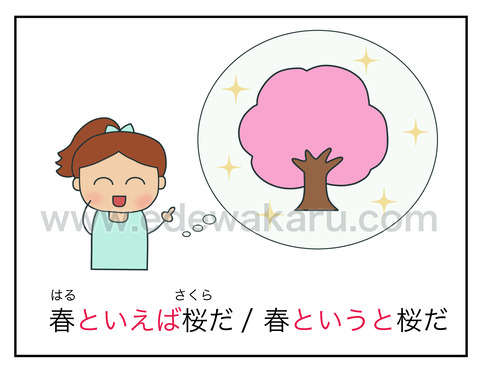
春といえば桜だ / 春というと桜だ
→春と聞くと桜を連想するSpeaking of spring, it’s cherry blossoms / Speaking of spring, it’s cherry blossoms. →When I hear “spring,” I think of cherry blossoms.
2020年といえば東京オリンピックですね / 2020年というと東京オリンピックですね
→2020年は東京オリンピックの年ですねSpeaking of 2020, it’s the Tokyo Olympics / Speaking of 2020, it’s the Tokyo Olympics. →2020 is the year of the Tokyo Olympics.
和食といえばお寿司ね / 和食というとお寿司ね
→和食と聞くと、お寿司を1番に連想するねSpeaking of Japanese food, it’s sushi / Speaking of Japanese food, it’s sushi. →When I hear Japanese food, sushi is the first thing I think of.
A:もう2月だね…時間が経つのは早いねB:2月といえばもうすぐバレンタインだね! / 2月というともうすぐバレンタインだね!
→2月はバレンタインデーがある月だね!A: It’s already February… Time passes so quickly. B: Speaking of February, Valentine’s Day is coming soon! / Speaking of February, Valentine’s Day is coming soon! →February is the month when Valentine’s Day takes place!
Read the original source text
Meaning
(連想することについて話す)〜について話すと
How to use it
名詞[辞書形]+といえば
名詞[辞書形]+というと
Explanation
「〜といえば・〜というと」はある話題を受けて、そこから連想することを言ったり、それについて話したりする時に使われます
😀
主題や話題を表す助詞の「〜は」に似ています。相手が話したことを聞いてそれを話題にして会話を続けたり、相手から聞いて連想したことを言う時に使用されます😀「〜といえば」と「〜というと」はほとんどの場合チェンジすることができますが、「〜といえば」には他の使い方もありますので、それはまた次回掲載します😉
【上級レベルの人へ】(とても細かい説明です😳)
連想を表す「〜といえば」「〜というと」はほとんどの場合書き換えが可能ですが、「〜といえば」が何かを思い出した時に使用されることが多いのに対し「〜というと」は相手に聞き返す場合によく使われるという性質があります。
相手にその話題について質問する場合は「〜といえば」は使えなくなります
😨
[例文]
秘書:社長、山田さんから電話がありました
社長:山田さん
というと
A会社の山田さんか?
秘書:はい、そうです。
この場合、
社長が秘書に話題である「山田さん」について聞き返す状況になっていますので「といえば」は使用不可になります
😦
⭕️山田さん
というと
A会社の山田さんか?(
聞き返しOK)
❌山田さん
といえば
A会社の山田さんか?(
聞き返し不可)
少し細かい説明になりましたが、上級レベルの人はぜひ覚えておいてください😀
【「という」シリーズ】
〜ということだ
〜というところだ
〜というのは
〜というのも〜からだ
〜というもの(Nというもの)
〜というより
日本語文型辞典
Meaning
Used to take up a topic and say something associated with it, or add an explanation about it. Also said as …というと.
An expression that gives contrasting evaluations. It is used to say that, judging from the expression X, one would normally expect evaluation Y, but in fact the contrasting evaluation Z applies.
A tactful way to express an evaluation. Used to soften in the latter part the evaluation stated in the first part. The speaker's main point is often the evaluation in the first part, and a sentence affirming and developing that evaluation often follows, as in ③.
Used to say that there is little of note about the topic being discussed. Often used to speak modestly about oneself.
How to use it
N といえば
…といえば…が
…といえば…かもしれない
…といえば…ぐらいのことだ
In context 12 examples
川口さんといえば、どこへ行ったのか、姿が見えませんね。
Speaking of Mr. Kawaguchi, I wonder where he went; I don't see him.
高木さんといえば切手というぐらい、彼の収集熱は有名だ。
Mr. Takagi is so famous for collecting stamps that you could say “Takagi means stamps.”
森町といえば、昔から木材の産地だが、最近は温泉が吹き出して話題になっている。
Mori Town has long been known as a timber-producing area, but recently it has been in the news because hot springs have started gushing out.
おっとりしているといえば、聞こえがいいが、彼女は何をするのも遅い。
Calling her easygoing sounds nice, but she's slow at everything she does.
緑が豊かだといえば、いい所だと思うが、実際は遠くて行くのが大変だ。
You might think it's a nice place, given all the greenery, but in reality it's far away and difficult to get to.
一日に一回は部下をどなりつけるといえば、こわい上司だと思われるが、実際はみんなにしたわれている。
You might think he's a frightening boss, since he yells at his subordinates at least once a day, but in reality everyone looks up to him.
彼らはビートルズの再来だといえば、ほめすぎかもしれない。
Calling them the Beatles' successors might be overpraising them.
この議会は今までで最低だといえば、問題があるかもしれない。
Calling this parliament the worst ever might be problematic.
この作品が時代の流れを変えるといえば、あまりにおおげさかもしれないが、実際に見ればその素晴らしさがわかるだろう。
Calling this work something that will change the course of the times may be too exaggerated, but if you actually see it, you'll understand its brilliance.
わたしの得意なことといえば、ビールの早飲みぐらいのことだ。
As for what I'm good at, it's really only drinking beer quickly.
町の名所といえば、小さい古墳が残っているぐらいのことだ。
As for the town's attractions, there's little beyond a small ancient burial mound that remains.
うちの子供のとりえといえば、動物をかわいがるぐらいのことだ。
As for my child's redeeming quality, it's really only that they are kind to animals.
Read the original source text
Meaning
ある話題を受けて、そこから連想されることについて述べたり、それについて説明を加えたりするのに用いる。「…というと」とも言う。
対立する評価を述べる表現。Xという言い方から考えるとYという評価を得るのが普通だが、実はそれとは対照的なZという評価が得られるということを表すのに用いる。
婉曲的な評価の表現。前半部分で述べた評価を後半で弱めるのに用いる。話し手の主張したいのは前半部分の評価であることが多く、③のように後ろにその評価を肯定し発展させる文が続くことも多い。
取り上げた話題について、あまりすぐれたものがないと述べるのに用いる。自分に関することを謙遜して述べるときに使うことが多い。
How to use it
Nといえば
…といえば…が
…といえば…かもしれない
…といえば…ぐらいのことだ
日本語文型辞典 英語版
Meaning
This expression is used to take a certain topic and describe what it brings to mind, add further explanation about it, etc. It is also possible to say というと.
Used to state two contrasting evaluations. Means that if you consider things from the viewpoint of statement X, normally evaluation Y would result, but in fact the result is Z, a contrasting evaluation.
This is a roundabout way of expressing an evaluation. The second clause lessens the impact of the evaluation given in the first. The evaluation in the first clause is often what the speaker wants to claim, and a statement that affirms and further develops this evaluation often follows the second clause, as in
(3)
.
Used to say that the topic at hand (a person or thing) does not have many outstanding features. Often used to make self-effacing statements about oneself.
How to use it
1. Nといえば
2. ...といえば...が
3. ...といえば...かもしれない
4. ...といえば...ぐらいのことだ
In context 12 examples
川口さんといえば、どこへ行ったのか、姿が見えませんね。
Now that you mention Kawaguchi-san, where has she gone? I don’t see her here, do you?
高木さんといえば切手というぐらい、彼の収集熱は有名だ。
If you say “Takagi-san,” it’s almost the same as saying “stamps”—that’s how well-known his obsession with collecting them is.
森町といえば、昔から木材の産地だが、最近は温泉が吹き出して話題になっている。
Speaking of the town of Mori, it’s been a lumber production area since long ago, but recently people are talking about it because of the new hot spring that’s gushed up.
おっとりしているといえば、聞こえがいいが、彼女は何をするのものろい。
If you say that she’s easygoing, it sounds good, but really she is slow at everything.
緑が豊かだといえば、いい所だと思うが、実際は遠くて行くのが大変だ。
You might think it’s a wonderful place when you hear about the abundant green forests, but the fact is that it’s far away and really hard to get to.
一日に一回は部下をどなりつけるといえば、こわい上司だと思われるが、実際はみんなにしたわれている。
When you hear that she yells at her subordinates at least once a day you might think she’s an intimidating boss, but the truth is that everyone adores her.
彼らはビートルズの再来だといえば、ほめすぎかもしれない。
To say that they’re the next Beatles might be making too much of them.
この議会は今までで最低だといえば、問題があるかもしれない。
If they say this is the worst assembly ever, there might be a problem.
この作品が時代の流れを変えるといえば、あまりにおおげさかもしれないが、実際に見ればその素晴らしさがわかるだろう。
Saying that this work (of art) would change the course of the times might be too much of an exaggeration, but you’ll understand how splendid it is if you actually see it.
わたしの得意なことといえば、ビールの早飲みぐらいのことだ。
If I have to say something I’m good at, the only thing is chugging beer.
町の名所といえば、小さい古墳が残っているぐらいのことだ。
The only famous site left in this town is just a small ancient burial mound.
うちの子供のとりえといえば、動物をかわいがるぐらいのことだ。
What are our child’s good points? I guess I could say that he’s kind to animals.
Read the original source text
Meaning
This expression is used to take a certain topic and describe what it brings to mind, add further explanation about it, etc. It is also possible to say というと.
Used to state two contrasting evaluations. Means that if you consider things from the viewpoint of statement X, normally evaluation Y would result, but in fact the result is Z, a contrasting evaluation.
This is a roundabout way of expressing an evaluation. The second clause lessens the impact of the evaluation given in the first. The evaluation in the first clause is often what the speaker wants to claim, and a statement that affirms and further develops this evaluation often follows the second clause, as in
(3)
.
Used to say that the topic at hand (a person or thing) does not have many outstanding features. Often used to make self-effacing statements about oneself.
How to use it
1. Nといえば
2. ...といえば...が
3. ...といえば...かもしれない
4. ...といえば...ぐらいのことだ
くらべてわかる日本語表現文型辞典
Meaning
Meaning 1: From the topic A, one associates or recalls B. It is also used when changing the subject.
Meaning 2: Hearing or seeing A brings B to mind. The speaker regards A and B as a pair.
Meaning 3: In the form 「A といえば A が B」. A is acknowledged to some extent, but not fully; it is somewhat A.
How to use it
Explanation
【Contrast 2】
「A といったら B」(Meaning 4, p. 159)
「A といったら B」has the same meaning.
○大阪では夏といったら天神祭だ。
「A ときたら B」(Meaning 2, p. 166)
「A ときたら B」has the nuance that the topic A was something the speaker had been waiting for; it is used when the speaker talks about B as if to say, “I’ve been waiting for this chance.” This nuance is absent from 「A といえば B」.
○ワインときたら、私にまかせてよ。
×ワインといえば、私にまかせてよ。
In context 12 examples
野球といえば、今年の新人賞はだれがとるんだろう。
Speaking of baseball, I wonder who will win this year’s Rookie of the Year award.
「きのう、中華料理作ったのよ。」
「中華料理といえば、駅前に新しい店ができたの知ってる?」“I made Chinese food yesterday.” “Speaking of Chinese food, did you know a new restaurant opened in front of the station?”
「もうすぐ、連休だね。」
「連休といえば、去年の旅行は楽しかったね。」“The long weekend is coming up soon.” “Speaking of long weekends, last year’s trip was fun, wasn’t it?”
「最近、忙しくてジムに通えないんだ。」
「そういえば、あなた最近、太ったんじゃない?」“I’ve been so busy lately that I can’t get to the gym.” “Come to think of it, haven’t you put on weight lately?”
富士山といえば、なんといっても桜だね。
Speaking of Mount Fuji, it has to be cherry blossoms.
酒の肴といえば、めざしに限るよ。
When it comes to snacks to go with sake, dried sardines are the best.
肉じゃがといえば、牛肉ですか、豚肉ですか。
For nikujaga, do you use beef or pork?
海外旅行といえば、最初はやっぱり近場がいいよ。
When it comes to traveling abroad, it’s probably best to start somewhere nearby.
動物は好きだといえば好きだけど、飼いたいとは思わない。
I do like animals, but I don’t want to keep one.
京都は都会といえば都会だ。
Kyoto is a city, to some extent.
あの店の雰囲気はいいといえばいいが、店員の態度が悪い。
That shop does have a nice atmosphere, but the staff have a bad attitude.
あの学生はよくできるといえばよくできるが、もっとできるはずだ。
That student is good, to some extent, but they should be able to do better.
Read the original source text
Meaning
意味1:Aという話題からBを連想したり、思い出したりする。話題を変えるときにも使われる。
意味2:Aということを聞いたり、見たりするとBを連想する。話し手はAとBを一対のもののようにとらえている。
意味3:「AといえばAがB」の形で。Aは一応認めるが、100%認めているわけではない。まあまあAだ。
How to use it
Explanation
【対比2】
「AといったらB」(意味4 P.159)
「AといったらB」は同じ意味。
○大阪では夏といったら天神祭だ。
「AときたらB」(意味2 P.166)
「AときたらB」は話し手にとってAという話題が待ち構えていたものだというニュアンスがあり、待っていましたとばかりにBを話すときに使うが、「AといえばB」にはない。
○ワインときたら、私にまかせてよ。
×ワインといえば、私にまかせてよ。
日本語NET JLPT文法解説まとめ
Meaning
“Speaking of 〜”
・N2 is something or some matter that immediately comes to mind when one hears N1.
・It is often used to introduce a topic or change the subject.
How to use it
N + といえば
Explanation
When it comes to N1, N2 is.... / Speaking of N1, N2 is....
(This phrase is used to show N2 as a typical example of N1)
In context 14 examples
日本の春といえば、桜だろう。
Speaking of spring in Japan, it would have to be cherry blossoms.
難しい外国語といえば、やっぱりアラビア語かなあ。
Speaking of difficult foreign languages, I guess Arabic, as you'd expect.
冬といえば、やっぱり鍋料理だろう。
Speaking of winter, it has to be hot pot, right?
大阪の食べ物といえば、たこ焼きです。
Speaking of food in Osaka, it's takoyaki.
代表的なファストフードといえば、ハンバーガーです。
Speaking of typical fast food, it's hamburgers.
日本の伝統的なスポーツといえば、相撲だ。
Speaking of traditional Japanese sports, it's sumo.
世界でよく食べられている物といえば、米です。
Speaking of foods commonly eaten around the world, it's rice.
日本の伝統的な夏の行事といえば、花火大会です。
Speaking of traditional Japanese summer events, it's fireworks festivals.
日本の食べ物といえば、寿司でしょうか。
Speaking of Japanese food, would it be sushi?
京都といえば、お寺が有名です。
Speaking of Kyoto, its temples are famous.
Appleといえば、iPhoneで有名な会社です。
Speaking of Apple, it's the company famous for the iPhone.
大晦日のテレビ番組といえば、やっぱり紅白歌合戦です。
Speaking of TV programs on New Year's Eve, it's the annual Red and White Singing Contest, as you'd expect.
日本で一番有名な大学といえば、東京大学だ。
Speaking of the most famous university in Japan, it's the University of Tokyo.
最近の日本の子供がなりたい職業といえば、YouTuberだろうか。
Speaking of jobs that children in Japan want these days, I wonder if it would be YouTuber.
Read the original source text
Meaning
"〜について話すと"
・N2は、N1と聞いて、すぐに連想できる物や事柄。
・話題の提供や、話の切り替え時に使用されることが多い。
How to use it
N + といえば
Explanation
When it comes to N1, N2 is.... / Speaking of N1, N2 is....
(This phrase is used to show N2 as a typical example of N1)
NINJAL 日本語文型データベース
Meaning
Used to take something mentioned in the context up as a new topic.
How to use it
Nといえば
Notes
After 「~といえば」 comes a sentence describing an association with 「〜」, a sentence about something else that 「〜」 brought to mind, or a sentence giving a typical example of 「~」.
In context 5 examples
今夜は満月が見られた。満月といえば、「出た、出た月が」で始まる古い童謡が思い出される。
We could see a full moon tonight. Speaking of a full moon, it reminds me of an old children’s song that begins, “出た、出た月が” (“There, there, the moon has risen”).
「干し柿を作ったので、どうぞ」「ありがとうございます。柿といえば、私の祖母の家には大きい柿の木が3本もあったんです。懐かしいです」
“I made some dried persimmons. Here, have some.” “Thank you. Speaking of persimmons, my grandmother’s house had as many as three big persimmon trees. I remember them fondly.”
この県の特産物といえば、真っ先に挙げられるのがぶどうである。
When it comes to this prefecture’s specialty products, the first thing that comes to mind is grapes.
今日は折り紙でアジサイの花を折った。アジサイといえば、小学校の校庭のアジサイの美しさは今でも忘れられない。
Today I folded a hydrangea flower out of origami paper. Speaking of hydrangeas, I still can’t forget how beautiful the hydrangeas in my elementary school courtyard were.
日本酒をおいしくするのが料理との組み合わせだ。日本酒といえば和食というイメージが強いが、和食以外の料理との組み合わせを工夫するのも楽しい。
The key to making sake taste good is pairing it with food. Sake brings Japanese food to mind, but it’s also fun to experiment with pairings with dishes other than Japanese food.
Read the original source text
Meaning
文脈中にある~を新しい話題として取り上げるときに使います。
How to use it
Nといえば
Notes
「~といえば」の後には、「〜」について連想することを述べる文、「〜」から想起された別の内容について述べる文、「~」の代表的な例を示す文がきます。
IMABI
“When it Comes to…” I:というと, といえば, & といったら
Read this IMABI lesson ↗Explanation
“When it Comes to…” I: というと, といえば, & といったら
In this lesson, we will begin coverage on expressions that can roughly all translate to “when it comes to…” to some capacity. The expressions in this lesson all involve the verb 言う in its respective conditional forms. If you have a firm grasp of these forms, the nuance differences that you are to soon be introduced to will not be news to you.
~というと: When/in speaking of…
~というと is used to indicate what is representative or deeply associated with something, and it can even describe an inevitable correlation between something (as seen in Ex. 3). This pattern is quite objective in nature and is seen most frequently in the written language. In a literal sense, you can translate it as “if one were to speak…of,” but its translation can be flexible to more easily translated as “when/in/if speaking of…”
1. 日本にほんの古都ことというと、平安京へいあんきょう、奈良ならでしょう。
In speaking of the former capitals of Japan, they’re Heian-kyō and Nara.
2. イギリスと言いうと、いつも曇くもっているというイメージがあるかと思おもいます。
In speaking of England, I think you might have an image of it always being cloudy.
3. ずっと晴天せいてんが続つづいていたのにお祭まつりだと言いうと天気てんきが悪わるくなるのは気きのせいかな?
Is it just my imagination that the weather certainly gets bad whenever there’s a festival despite it being clear skies the whole time?
4. 5ご大新聞だいしんぶんと言いうと、読売よみうり・朝日あさひ・毎日まいにち・産経さんけい・東京とうきょうを指さすことが多おおい。
When speaking of the five major newspapers, the Yomiuri, Asahi, Mainichi, Sankei, and Tokyo are often referred to.
5. アメリカに根付ねづいた日本文化にほんぶんかというと、寿司すし・生いけ花ばな・アニメ・漫画まんが・禅ぜんなどがあります。
In speaking of Japanese culture that has taken root in America, there is sushi, ikebana, anime, manga, Zen, etc.
6. 天候てんこうというと「晴はれ」「雨あめ」など思おもい浮うかべますが、「波なみ」「風かぜ」も天候てんこうなんですね。
We’re reminded of “clear weather” and “rain” in speaking of the weather, but “waves” and “the wind” are also part of the weather, you know.
7. 政治せいじというと、不審ふしんなものの代名詞だいめいしのように思おもえます。
When speaking of politics, it would certainly seem to be a classic example of something suspicious.
8. 微生物びせいぶつというと、不潔ふけつなばい菌きんや病気びょうきを引ひき起おこす悪者わるものを連想れんそうする人ひとが多おおいかもしれない。
When speaking of microbes, there may be many people who associate them with filthy germs or bad guys that cause illness.
9. 肉眼にくがんで確認かくにんできる太陽系たいようけいの惑星わくせいというと、水星すいせい、金星きんせい、火星かせい、木星もくせい、土星どせいまでであり、それに地球ちきゅうを加くわえて6むっつです。
When speaking of the planets in the solar system that can be verified with the naked eye, there is Mercury, Venus, Mars, Jupiter, and Saturn, and when you add Earth to the mix, there are six.
10. 従来じゅうらい、企業きぎょうの社会的責任しゃかいてきせきにんというと、企業倫理きぎょうりんりや法令順守ほうれいじゅんしゅなどが中心ちゅうしんだった。
Conventionally, when speaking of societal responsibility to the company, company ethics, compliance, and such were at the center.
11. ワシントン州の有名な州立大学というと、ワシントン大学ですね。
In speaking of famous state universities in the State of Washington, there is Washington University.
12. 韓国かんこくドラマというと、不治ふじの病やまいや交通事故こうつうじこ、有あり得えない擦すれ違ちがいなどが頻出ひんしゅつする恋愛れんあいドラマを想像そうぞうするという人ひとが多おおいだろう。
When speaking of Korean dramas, there are probably many people who associate them with romance dramas which frequently feature incurable diseases, traffic accidents, impossible crossing of paths, and what not.
~はというと: As far as…goes
~はというと is very similar to ~というと, but it always intrinsically illustrates a stark contrast of some sort, whether implicitly or explicitly stated.
13. 西田にしださんは魚料理さかなりょうりが好すきで何なんでも食たべますが、肉料理にくりょうりはというとかなり好すき嫌きらいがあるらしいです。
Mr. Nishida loves fish-based dishes and will eat anything, but as far as meat dishes go, he seems to have considerable likes and dislikes.
14. 私わたしは理科系りかけいの科目かもくは得意とくいなんですが、文科系ぶんかけいの科目かもくはというと、全まったく苦手にがてなんです。
I am good at science courses, but as far as liberal arts go, I’m absolutely bad at them.
15. 父ちちも母ははものんびり過すごしていますが、私わたしはというと、毎日まいにちただ忙いそがしくて働はたらいています。
My father and my bother live leisurely, but I on the other hand am just busy at working every day.
16. 草食動物そうしょくどうぶつはというと、基本きほんは植物しょくぶつしか食たべません。
As far as herbivores go, they basically only eat plants.
17. 地球上ちきゅうじょうで最大さいだいの動物どうぶつはというと、南氷洋なんぴょうようのシロナガスクジラです。
As far as the largest animal on Earth goes, that would be the blue whale from the Antarctic Ocean.
18. 日本にほんのように、蕎麦そばを麺めんに加工かこうして食たべる国くにはというと、隣となりの中国ちゅうごくや朝鮮ちょうせんおよびブータンぐらいしかない。
As far as countries that manufacture buckwheat into noodles to eat like Japan go, there are only say neighboring China and Korea as well as Bhutan.
19. 世界せかいで最もっとも幅はばのある海峡かいきょうはというと、カナダのバフィン島とうとグリーンランドに挟はさまれたデービス海峡かいきょうです。
As far as the widest straight in the world goes, it would be the Davis Strait, which is sandwiched between Baffin Island and Greenland.
20. 日本政府にっぽんせいふはというと、菅官房長官すがかんぼうちょうかんは調査ちょうさに否定的ひていてきな見解けんかいを示しめしている。
In speaking of the Japanese government, Chief Secretary Suga has expressed negative views on investigation (of the matter).
21. アメリカ同時多発どうじたはつテロ事件じけんと言いうと、あの頃ころの中東ちゅうとうアジアの情勢悪化じょうせいあっかを思おもい出だします。
In speaking of the American Simultaneous Sequential Terrorist Event (9/11), I think of the worsening state of affairs in the Middle East at the time.
22. 私わたしは兄あにが大嫌だいきらいです。何故なぜかというと、とても自己中心的じこちゅうしんてきだからです。
I hate my older brother. The reason why is because he is extremely self-centered.
~といえば: Speaking of which…
When using ~といえば, a lot of enthusiasm is felt when bringing up something into conversation. It is seen a lot in conversation and can be very definitive as far as the emotional context of one’s statement is concerned.
23. 日本代表の漫画といえばナルトですよね。
Speaking of a manga that represents Japan, that would be Naruto, huh.
24. サンフランシスコで、一番有名いちばんゆうめいな観光名所かんこうめいしょといえば、ゴールデン・ゲート・ブリッジでしょう。
Speaking of the most famous tourist spot in San Francisco, that would be the Golden Gate Bridge.
25. 夏なつの食たべ物ものといえば、スイカ、アイス、素麺そうめんでしょう。
Speaking of summer foods, there’s watermelons, ice cream, and somen.
26. タイ料理りょうりといえば、駅前えきまえに新あたらしいレストランが出来できたの知しってる?
Speaking of Thai cuisine, did you know there’s a new restaurant in front of the station?
27.
A氏し: 市川いちかわさん、先日交通事故せんじつこうつうじこに遭あって入院にゅういんしたらしいですよ。
B氏し: え、そうなんですか。あ、入院にゅういんしたといえば、三上みかみさんが来週退院らいしゅうたいいんだそうですよ。
Person A: It seems that Mr. Ichikawa became hospitalized the other day due to getting in a traffic accident.
Person B: Wow, really? Oh, speaking of being put in the hospital, I hear that Mr. Mikami is to be released from the hospital next week.
28. 古典芸能こてんげいのうといえば、歌舞伎かぶきでしょう。
Speaking of classical theatre, there’s kabuki.
29. 車くるまと言いえば、君きみはトヨタ車しゃを買かったそうだね。
Speaking of cars, I hear you’ve bought yourself a Toyota?
30. リンカーンと言いえば奴隷制度どれいせいどを思おもい出だします。
In speaking of Lincoln, we think of the slavery system.
31. 動物どうぶつと言いえば、僕ぼくの犬いぬは話はなせるんだ。
Speaking of animals, my dog can talk.
32. レオナルドダヴィンチといえば、世界的せかいてきな芸術家げいじゅつかだ。
In speaking of Leonard da Vinci, he is as world-famous artist.
33. イギリスといえば、{紅茶こうちゃ・ロンドン・二階建にかいだてバス・ビートルズ・イギリス王室おうしつ・ハリーポッター}など思おもい浮うかべる人ひとが多おおいでしょう。
In speaking of England, there are surely many people who think of [tea/London/two-story buses/the Beatles/the British Royal Family/Harry Potter].
34. メキシコの代表的だいひょうてきな食たべ物ものといえば、タコスです。
In speaking of Mexico’s signature food, there’s the taco.
35. 今いまの若者わかものの流行りゅうこうといえば、男性だんせいの間あいだではひげが流行はやっていて、女性じょせいの間あいだでは涙袋なみだぶくろメイクが流行はやっている。
In speaking of trends among young people today, beards are trending among men and namidabukuro is trending among women.
Word Note: 涙袋メイク makes it look like you have the impression of tears under your eyes.
Spelling Note: ひげ in 漢字 may either be 髭, 髯, or 鬚. However, the first refers to beards around the mouth, the second refers to beards on the cheeks, and the third refers to beards on the chin. These respectively may be said/written as 口髭・髭, 頬髭・頬髯・髯, and 顎髭・顎鬚・鬚. You are not required to remember this.
~といったら: When it comes to…/speaking of…
In a literal sense, ~といったら means “were to say.”
36. 怖こわくないと言いったら嘘うそになる。
If I said I wasn’t scared, that’d be a lie.
37. フランス人じんに「アミは友達ともだちです」と言いったら混乱こんらんしそうですね。
If were to say “Ami is my friend” to a French person, they might get confused.
In similar contexts seen with ~といえば, however, it is used in much the same way to give example of something intrinsically tied to whatever is the focus of conversation. It is arguably the most common form in conversation. It’s not so ecstatic, but it’s just as assertive.
38. シアトルの景色けしきといったら、口くちで言いい表あらわせない程ほどです。
When it comes to the scenery of Seattle, it’s beyond expression.
39. 山田やまださんの中国語能力ちゅうごくごのうりょくといったら、中国人ちゅうごくじんがびっくりするほどだそうです。
Speaking of Mr. Yamada’s Chinese proficiency, I hear it even surprises Chinese people.
40. アメリカの元大統領もとだいとうりょうといったら、オバマですね。
Speaking of the former president of America, that’d be Obama, right?
41. 一昔前ひとむかしまえはお寿司すしといったら高級こうきゅうな食たべ物ものの代表だいひょうでした。
Long ago when speaking of sushi, it was representative of high class cuisine.
42. 東北とうほくで熊くまといったらツキノワグマです。
Speaking of bears in Tohoku, there’s the Asian black bear.
43. 冬ふゆといったら鍋料理なべりょうりですね。
When it comes to winter, it’s time for hot pot cooking.
44. 果物王国くだものおうこくといったらどこでしょうか。
Speaking of the king of fruit, where would that be?
45. 家具かぐといったらやっぱりイケアですね。
When it comes to furniture, you definitely go with IKEA.
In context 44 examples
日本にほんの古都ことというと、平安京へいあんきょう、奈良ならでしょう。
In speaking of the former capitals of Japan, they’re Heian-kyō and Nara.
イギリスと言いうと、いつも曇くもっているというイメージがあるかと思おもいます。
In speaking of England, I think you might have an image of it always being cloudy.
ずっと晴天せいてんが続つづいていたのにお祭まつりだと言いうと天気てんきが悪わるくなるのは気きのせいかな?
Is it just my imagination that the weather certainly gets bad whenever there’s a festival despite it being clear skies the whole time?
5ご大新聞だいしんぶんと言いうと、読売よみうり・朝日あさひ・毎日まいにち・産経さんけい・東京とうきょうを指さすことが多おおい。
When speaking of the five major newspapers, the Yomiuri, Asahi, Mainichi, Sankei, and Tokyo are often referred to.
アメリカに根付ねづいた日本文化にほんぶんかというと、寿司すし・生いけ花ばな・アニメ・漫画まんが・禅ぜんなどがあります。
In speaking of Japanese culture that has taken root in America, there is sushi, ikebana, anime, manga, Zen, etc.
天候てんこうというと「晴はれ」「雨あめ」など思おもい浮うかべますが、「波なみ」「風かぜ」も天候てんこうなんですね。
We’re reminded of “clear weather” and “rain” in speaking of the weather, but “waves” and “the wind” are also part of the weather, you know.
政治せいじというと、不審ふしんなものの代名詞だいめいしのように思おもえます。
When speaking of politics, it would certainly seem to be a classic example of something suspicious.
微生物びせいぶつというと、不潔ふけつなばい菌きんや病気びょうきを引ひき起おこす悪者わるものを連想れんそうする人ひとが多おおいかもしれない。
When speaking of microbes, there may be many people who associate them with filthy germs or bad guys that cause illness.
肉眼にくがんで確認かくにんできる太陽系たいようけいの惑星わくせいというと、水星すいせい、金星きんせい、火星かせい、木星もくせい、土星どせいまでであり、それに地球ちきゅうを加くわえて6むっつです。
When speaking of the planets in the solar system that can be verified with the naked eye, there is Mercury, Venus, Mars, Jupiter, and Saturn, and when you add Earth to the mix, there are six.
従来じゅうらい、企業きぎょうの社会的責任しゃかいてきせきにんというと、企業倫理きぎょうりんりや法令順守ほうれいじゅんしゅなどが中心ちゅうしんだった。
Conventionally, when speaking of societal responsibility to the company, company ethics, compliance, and such were at the center.
ワシントン州の有名な州立大学というと、ワシントン大学ですね。
In speaking of famous state universities in the State of Washington, there is Washington University.
韓国かんこくドラマというと、不治ふじの病やまいや交通事故こうつうじこ、有あり得えない擦すれ違ちがいなどが頻出ひんしゅつする恋愛れんあいドラマを想像そうぞうするという人ひとが多おおいだろう。
When speaking of Korean dramas, there are probably many people who associate them with romance dramas which frequently feature incurable diseases, traffic accidents, impossible crossing of paths, and what not.
西田にしださんは魚料理さかなりょうりが好すきで何なんでも食たべますが、肉料理にくりょうりはというとかなり好すき嫌きらいがあるらしいです。
Mr. Nishida loves fish-based dishes and will eat anything, but as far as meat dishes go, he seems to have considerable likes and dislikes.
私わたしは理科系りかけいの科目かもくは得意とくいなんですが、文科系ぶんかけいの科目かもくはというと、全まったく苦手にがてなんです。
I am good at science courses, but as far as liberal arts go, I’m absolutely bad at them.
父ちちも母ははものんびり過すごしていますが、私わたしはというと、毎日まいにちただ忙いそがしくて働はたらいています。
My father and my bother live leisurely, but I on the other hand am just busy at working every day.
草食動物そうしょくどうぶつはというと、基本きほんは植物しょくぶつしか食たべません。
As far as herbivores go, they basically only eat plants.
地球上ちきゅうじょうで最大さいだいの動物どうぶつはというと、南氷洋なんぴょうようのシロナガスクジラです。
As far as the largest animal on Earth goes, that would be the blue whale from the Antarctic Ocean.
日本にほんのように、蕎麦そばを麺めんに加工かこうして食たべる国くにはというと、隣となりの中国ちゅうごくや朝鮮ちょうせんおよびブータンぐらいしかない。
As far as countries that manufacture buckwheat into noodles to eat like Japan go, there are only say neighboring China and Korea as well as Bhutan.
世界せかいで最もっとも幅はばのある海峡かいきょうはというと、カナダのバフィン島とうとグリーンランドに挟はさまれたデービス海峡かいきょうです。
As far as the widest straight in the world goes, it would be the Davis Strait, which is sandwiched between Baffin Island and Greenland.
日本政府にっぽんせいふはというと、菅官房長官すがかんぼうちょうかんは調査ちょうさに否定的ひていてきな見解けんかいを示しめしている。
In speaking of the Japanese government, Chief Secretary Suga has expressed negative views on investigation (of the matter).
アメリカ同時多発どうじたはつテロ事件じけんと言いうと、あの頃ころの中東ちゅうとうアジアの情勢悪化じょうせいあっかを思おもい出だします。
In speaking of the American Simultaneous Sequential Terrorist Event (9/11), I think of the worsening state of affairs in the Middle East at the time.
私わたしは兄あにが大嫌だいきらいです。何故なぜかというと、とても自己中心的じこちゅうしんてきだからです。
I hate my older brother. The reason why is because he is extremely self-centered.
日本代表の漫画といえばナルトですよね。
Speaking of a manga that represents Japan, that would be Naruto, huh.
サンフランシスコで、一番有名いちばんゆうめいな観光名所かんこうめいしょといえば、ゴールデン・ゲート・ブリッジでしょう。
Speaking of the most famous tourist spot in San Francisco, that would be the Golden Gate Bridge.
夏なつの食たべ物ものといえば、スイカ、アイス、素麺そうめんでしょう。
Speaking of summer foods, there’s watermelons, ice cream, and somen.
タイ料理りょうりといえば、駅前えきまえに新あたらしいレストランが出来できたの知しってる?
Speaking of Thai cuisine, did you know there’s a new restaurant in front of the station?
古典芸能こてんげいのうといえば、歌舞伎かぶきでしょう。
Speaking of classical theatre, there’s kabuki.
車くるまと言いえば、君きみはトヨタ車しゃを買かったそうだね。
Speaking of cars, I hear you’ve bought yourself a Toyota?
リンカーンと言いえば奴隷制度どれいせいどを思おもい出だします。
In speaking of Lincoln, we think of the slavery system.
動物どうぶつと言いえば、僕ぼくの犬いぬは話はなせるんだ。
Speaking of animals, my dog can talk.
レオナルドダヴィンチといえば、世界的せかいてきな芸術家げいじゅつかだ。
In speaking of Leonard da Vinci, he is as world-famous artist.
イギリスといえば、{紅茶こうちゃ・ロンドン・二階建にかいだてバス・ビートルズ・イギリス王室おうしつ・ハリーポッター}など思おもい浮うかべる人ひとが多おおいでしょう。
In speaking of England, there are surely many people who think of [tea/London/two-story buses/the Beatles/the British Royal Family/Harry Potter].
メキシコの代表的だいひょうてきな食たべ物ものといえば、タコスです。
In speaking of Mexico’s signature food, there’s the taco.
今いまの若者わかものの流行りゅうこうといえば、男性だんせいの間あいだではひげが流行はやっていて、女性じょせいの間あいだでは涙袋なみだぶくろメイクが流行はやっている。
In speaking of trends among young people today, beards are trending among men and namidabukuro is trending among women.
怖こわくないと言いったら嘘うそになる。
If I said I wasn’t scared, that’d be a lie.
フランス人じんに「アミは友達ともだちです」と言いったら混乱こんらんしそうですね。
If were to say “Ami is my friend” to a French person, they might get confused.
シアトルの景色けしきといったら、口くちで言いい表あらわせない程ほどです。
When it comes to the scenery of Seattle, it’s beyond expression.
山田やまださんの中国語能力ちゅうごくごのうりょくといったら、中国人ちゅうごくじんがびっくりするほどだそうです。
Speaking of Mr. Yamada’s Chinese proficiency, I hear it even surprises Chinese people.
アメリカの元大統領もとだいとうりょうといったら、オバマですね。
Speaking of the former president of America, that’d be Obama, right?
一昔前ひとむかしまえはお寿司すしといったら高級こうきゅうな食たべ物ものの代表だいひょうでした。
Long ago when speaking of sushi, it was representative of high class cuisine.
東北とうほくで熊くまといったらツキノワグマです。
Speaking of bears in Tohoku, there’s the Asian black bear.
冬ふゆといったら鍋料理なべりょうりですね。
When it comes to winter, it’s time for hot pot cooking.
果物王国くだものおうこくといったらどこでしょうか。
Speaking of the king of fruit, where would that be?
家具かぐといったらやっぱりイケアですね。
When it comes to furniture, you definitely go with IKEA.
DoJG 日本語文法辞典(全集)
Meaning
Speaking of ~
Explanation
An expression which presents as the topic of a following discourse a phrase which has just been uttered.
In context 3 examples
A:この本は田中さんに借りたんです。 B:田中さんと言えばもう病気は治ったのかしら。
A: I borrowed this book from Mr. Tanaka. B: Speaking of Mr. Tanaka, I wonder if he's gotten over his illness yet.
A:次の日曜日は京都へ行くつもりだ。 B:京都と言えば、春子が京都大学の入学試験に通ったそうだ。
A: I'm going to Kyoto next Sunday. B: Speaking of Kyoto, I heard that Haruko passed Kyoto University's entrance exam.
A:小西君はよく休むね。 B:よく休むと言えば、山本君も最近見ませんね。
A: Mr. Konishi is absent frequently, isn't he? B: Talking about about (someone's) frequent absences, we don't see Mr. Yamamoto these days either, do we?
どんなときどう使う 日本語表現文型辞典
Meaning
speaking of which
How to use it
See 2).
Explanation
~を話題にすれば
B:そうですか。幼児教育といえば、うちの近くに新しい幼稚園ができたんですよ。
B:記録的っていえば、今年の暑さも相当でしたね。
1)その場のだれかが話題にしたこと、または自分の心に思い浮かんだ事柄を取り上げて話題にするときの言い方。
2)接続は、取り上げようとする言葉にそのまま続ける場合が多い。
3)くだけた会話では ❸ のように「っていえば」になる。
3)In informal speech becomes っていえば, as in sentence ❸ .
1)Raises thoughts that come to mind independently or when speaker hears someone discuss certain topic.
2)Often appends directly to phrase described.
In context 3 examples
今年は海外旅行をする人が多かったそうです。海外旅行といえば、来年みんなでタイへ行く話が出ています。
Apparently many people traveled abroad this year. Speaking of overseas travel, people have been talking about going to Thailand together next year.
A:娘の専門は幼児教育なんですよ。子どもが好きなんです。
A: My daughter specializes in early childhood education. She loves children.
A:きのうの台風はすごかったねえ。記録的な大雨だったようですよ。
A: Yesterday’s typhoon was incredible, wasn’t it? It seems there was record-breaking rainfall.
Read the original source text
Meaning
speaking of which
How to use it
2)参照
Explanation
~を話題にすれば
B:そうですか。幼児教育といえば、うちの近くに新しい幼稚園ができたんですよ。
B:記録的っていえば、今年の暑さも相当でしたね。
1)その場のだれかが話題にしたこと、または自分の心に思い浮かんだ事柄を取り上げて話題にするときの言い方。
2)接続は、取り上げようとする言葉にそのまま続ける場合が多い。
3)くだけた会話では ❸ のように「っていえば」になる。
3)In informal speech becomes っていえば, as in sentence ❸ .
1)Raises thoughts that come to mind independently or when speaker hears someone discuss certain topic.
2)Often appends directly to phrase described.