IMABI
The Final Particles よ & ね
Read this IMABI lesson ↗Explanation
The Final Particles よ & ね
Final particles (終助詞) can be categorized into two types: those which serve a particular grammatical function and those that serve to interject emotion into the sentence (間投助詞). Whereas the final particle か indicates a question, the final particle よ highlights a statement in the same way “!” functions in English. These emotion markers are colloquially known in Japanese as 語尾, the name stemming from how they are tagged at the end of phrases.
In this lesson, we will learn about the two most fundamental emotion-marking final particles in Japanese: よ and ね. At their most basic understanding, よ emphasizes emotion, judgment, or assertion, and ね seeks agreement and/or a response from the addressee(s).
The Final Particle よ
The final particle よ, as will be touched on more at the conclusion of this lesson, derives from its original use of calling out someone to action.
1. 日本よ、頑張れ!
Japan! Go for it!
This being said, it has always had a strong exclamatory tone to it. In everyday use, it is known for highlighting something you wish to make absolutely clear to the listener.
2. きょう東京に行きますよ。
I’m going to Tokyo today.
3. セスさんはアメリカ人ですよ。
Seth-san is American.
4. 彼氏に会いたいよ。↗
I want to see my boyfriend!
While this function may seem relatively benign, learners are tempted to overuse it in situations that may sound rude, especially to superiors, when stating a fact/desire is such an authoritative manner is not conducive to overall Japanese etiquette.
5. はい、わかりましたよ。
Yes, I know.
6. 私がやりますよ。
I will do it.
Of these two examples, Ex. 5 is just as problematic in English just as much as it is in Japanese in a formal environment. Although Ex. 6 could be interpreted as the speaker stepping up to the plate to do something that others are not, given the wrong tone, it could just as easily be interpreted as complaining or showing frustration.
For the remainder of this discussion, it is important to distinguish between grammaticality and naturalness. Unless you are not making a declarative statement (肯定文), using よ would not be ungrammatical no matter how much you use it; however, your discourse will sound quite unnatural to the Japanese ears. Nonetheless, the scenarios discussed in this lesson pertaining to its naturalness will be as objective as possible.
For instance, if you are telling something to someone that is beneficial to that person, the use of よ is natural so long as the speaker’s tone is cordial. In fact, the lack of よ from the following examples would make the statements sound as if the speaker has no concern of the listener’s condition.
7. おせんべい、どうぞ。美味しいですよ。
Here are some rice crackers. They’re delicious.
8. 帰ってもいいですよ。
It’s alright for you to go home.
Another scenario in which よ is both natural and innocent in perception is when the speaker is announcing what is about to happen or what they are about to do. The lack of よ in such situations would cause the speaker to sound emotionless.
9. さあ、始めますよ。
Alright, (I/we)’ll be starting.
Speaking of sounding emotionless, the same goes for how one would naturally respond to a cordial, friendly question. Affirmation is often accompanied with よ to add a cheery tone to one’s response.
10. 「授業じゅぎょう、終わった?」「うん、終わったよ」
“Is your class over?” “Yep, it is.”
Intonation
When the use of よ is meant to solicit a response from the listener, it is accompanied with a sentence-wide slight rise in intonation (↗).
11. 髪かみに何かついてますよ。 ↗
Something’s stuck in your hair.
12. それ、超ちょう辛からいよ。 ↗
That’s gonna be hot (spicy).
Giving new information in this way implies that the listener does not already know. This, in turn, requires the speaker to always consider whether what they are saying is genuinely helpful to the listener lest they want to sound pushy, or even demeaning in the event that the listener is actually fully aware of the situation and you willfully do not wish to take notice.
13. 早くしないと遅おくれますよ。↘ (Scolding)
You’ll be late if you don’t hurry.
Nonetheless, when the rise in intonation is held at a minimal level, this usage of よ typically indicates familiarity with the listener.
14. 「本を持ってきてくれた? 」「うん、持ってきたよ。↗」
“Did you bring the book for me?” “Yep, I brought it.”
Downward intonation ↘, on the other hand, may be interpreted as:
You (the speaker) highlighting something you believe the listener ought to have realized by now.
You (the speaker) expressing disappointment.
15. 今日は疲つかれてるから、まっすぐ帰るよ。↘
I’m tired today, so I’m heading straight home.
16. がんばれよ。↘
Come on, hang in there. (Somewhat disappointed tone)
17. リーさんが手伝てつだってくれたおかげで、早く終わったよ。↘
It was thanks to Lee-san’s help I finished early, y’know.
18. やっぱりその本が見つからなかったよ。↘
Unsurprisingly, I didn’t find the book.
Oscillating one’s intonation – ↑↓ – which is often accompanied with elongating よ itself, will result in よ giving off a playful tone, but the exact implication will still rely on the overall context.
19. 曇ってるから、何にも見えないよう。↑↓
Ahhh, we can’t seen anything because it’s cloudy….
20. あいつがまたメールしたよ(う)。↑↓
That guy’s sent another e-mail…..
The Final Particle ね
The primary function of the final particle ね is to seek confirmation from the listener. It may also just as easily respond in affirmation to a question, but with a sense of agreeing with the other person. In doing so, it is usually accompanied with a rise in intonation.
21. 暑あついね。↑
It’s hot, huh.
22. 今日は人がよくいらっしゃいましたね。↑
A lot of people came today, haven’t they.
23. そうだね!↑
Yeah, that’s true!
If the tone is closer to that of a question in which you do not expect any answer, or you do, in fact, earnestly seek confirmation, you may hear ね accompanied with a higher yet slightly more drawn-out intonation. In any case, the use of ね is still felt to be less direct than typical means of marking a question.
24. これが納豆だね。↗
This is natto, right?
25. このペン、ちょっと借りるね。↗
Let me borrow this pen just a moment, k?
26. 到着とうちゃく時間じかんは午後4時50分ですね。↗
The arrival time will be 4:50 PM, right?
ね can just as easily reject a premise or lessen the directness of any given answer with similar intonation, although rejecting a premise may still be accompanied with a not-so-friendly tone.
27. 「日本は今、何時?」「ええと、昼2時くらいだね。↑」
“What time is it now in Japan?” “Um, it’s about 2 in the afternoon.”
28. 「なんとか頼たのむよ。↘」「嫌だね。↑」
“I need your help somehow. “I don’t wanna.”
The interpretation of ね is not as sensitive to intonation as よ, as it ultimately function as a tone softener. In fact, ね is often used rather flippantly with no particular thought put into it.
29. 着いたね。↑・↘・↑↓
We’ve arrived.
Yet, it is still possible for ね to be used sarcastically.
30. 知らないね。↑・↘・↑↓
Beats me.
None of these intonations particularly means that there was any problem with arriving at one’s destination, but if there were problems, ↘・↑↓ could potentially reflect the speaker’s composed response to the situation.
31. そうですねえ。↘
Yeah…..
This sentence implies hesitation, or at the very least pondering, on the part of the speaker, which is in considerable contrast with Ex. 23.
Combinations w/ よ・ね
It is worth noting that the final particles よ・ね can be combined with a number of other final particles as well as with each other. Each final particle contributes its own emotional flair to the sentence, and the resultant reception will always be an amalgam of whatever is involved.
■~わよ: Exclamatory ending seen in stereotypically highly effeminate speech.
32. このケーキ、美味しいわよ。
This cake is delicious!
■~よね: Viewed as a softer iteration of よ, the speaker is not necessarily seeking agreement with the listener more so than they are stating their opinion is in agreeance with the listener. In colloquial speech in which it is found, the assumption is that there is mutual recognition (共有認識) regarding the statement.
33. 可笑おかしいよね。
That’s so strange, no kidding?
34. 「あんまりおいしくなった」「だよね」
“It wasn’t that tasty.” “You got that right.”
■~のだよ・んだよ
Though the purpose for ~のだ・んだ itself can be just as varied as ~よ, it typically emphasizes reasoning on the part of the speaker’s mindset and/or intent. As such, the inclusion of ~よ strongly highlights the already opinionated statement. It is a common mistake by leaners to overuse this combination; however, doing so may lead the listener to conclude that you are being far too verbose and overbearing in your assertions.
35. アイツが来てから全部変わったんだよ!
Everything’s changed since that guy came!
It is also worth noting that ~んだよ can exacerbate the emotions of a highly charged question, as forming a stern question is one of ~のだ・んだ’s functions.
36. があったんだよ?(Coarse)
What the heck happened?
Lastly, it is worth noting that in feminine speech, だ is often dropped from ~んだ, resulting in ~のよ.
37. 泣かなくてもいいのよ。(Feminine) ↗↘
It’s OK not to cry.
■~んだよね
Meanwhile, the further addition of ね levels the overall tone of ~んだよ, at least somewhat for the speaker may still be serious about the topic at hand. Just as before, the speaker is not so much interested in a response as they are implying that the right understanding of the circumstance ought to be mutual.
38. 彼は銀行に勤めてるんだよね。(Rhetorical)
So, he works at the bank, yeah?
■~かね: Often viewed as a gender neutral, softer version of かな for “I wonder” or as a means of softening the directness of a request made in casual speech.
39 来てくれるかね。
Could you come over?
40. そんな手にだれが乗りますかね。
I wonder who would drive in such transportation.
The Ungrammaticality of よろしいですよ
A commonly reported misuse (誤用) of ~よ among natives happens to be the phrase よろしいですよ. The intent behind this phrase is to give their permission or consent to something being carried out by the other party, but both the formality of よろしい and the perceived tone given off よ with it are equally problematic.
Firstly, it is not quite the case that よろしい is a politer form of よい. In actuality, it has a rather self-important air to it when not used in an interrogative sentence. Coupled with よ emphasizes the speaker’s own desire, this goes against the principles of humble speech. Indeed, when we see よろしい used in isolation, it is used by superiors to inferiors.
41. 部長ぶちょう:「よろしい。私が考えよう」
Alright. I’ll think about it.
Instead of using よろしいですよ, it is more proper to instead use phrases such as:
42. はい、承知しょうちしました 。
Yes, understood.
ね・よ as Filler Words
You may also see ね・よ used as filler words after phrases in a sentence to add their respective effects. In this situation, they are always followed by a pause.
43. あのね、僕ぼく、これがね、ほしいの。
Um, I, I really want this, you see.
44. 明日はね、都合つごうがいいんだ。
Tomorrow, you see, will be convenient for me.
45. それがよ、すごく面白くて・・・
That right there is so interesting and…
~ね After Commands
ね may also follow commands involving the て form to lessen the tone in casual speech. You often hear ~てくださいね to emphasize familial emotion between the speaker and listener, and ~てね is frequently heard between close friends as well as when speaking to children or out of an attempt to sound cute.
46. ここで待ってね。
Wait here, OK?
47. いつでも遊びに来てくださいね。
Please feel free to drop by anytime.
~よ After Nouns: Calling out
Another use of よ is to call out for someone. This is often heard in dramatizations.
48. 神よ、助けてくれ!
Oh God, save me!
49. 罪人よ、罪を白状しろ。
Sinner, confess your sins.
50. 月よ星よと眺める。
Literally: To gaze up at the sky as if to say, “O Moon, O the stars (which doth shine)!”
To gaze with great admiration.
蝶よ花よ, which derives from this usage of よ and literally translate as “oh butterflies, oh flowers!” In its figurative sense, it idyllically relates to someone who has been raised in such luxury as to have no better time on their hands as to call out to nature’s wonders. In English, they are often translated as “bringing up (one’s daughter) like a princess.”
51. 娘を蝶よ花よと育てた。
I raised my daughter like a princess.
In context 50 examples
日本よ、頑張れ!
Japan! Go for it!
きょう東京に行きますよ。
I’m going to Tokyo today.
セスさんはアメリカ人ですよ。
Seth-san is American.
彼氏に会いたいよ。↗
I want to see my boyfriend!
はい、わかりましたよ。
Yes, I know.
私がやりますよ。
I will do it.
おせんべい、どうぞ。美味しいですよ。
Here are some rice crackers. They’re delicious.
帰ってもいいですよ。
It’s alright for you to go home.
さあ、始めますよ。
Alright, (I/we)’ll be starting.
「授業じゅぎょう、終わった?」「うん、終わったよ」
“Is your class over?” “Yep, it is.”
髪かみに何かついてますよ。 ↗
Something’s stuck in your hair.
それ、超ちょう辛からいよ。 ↗
That’s gonna be hot (spicy).
早くしないと遅おくれますよ。↘ (Scolding)
You’ll be late if you don’t hurry.
「本を持ってきてくれた? 」「うん、持ってきたよ。↗」
“Did you bring the book for me?” “Yep, I brought it.”
今日は疲つかれてるから、まっすぐ帰るよ。↘
I’m tired today, so I’m heading straight home.
がんばれよ。↘
Come on, hang in there. (Somewhat disappointed tone)
リーさんが手伝てつだってくれたおかげで、早く終わったよ。↘
It was thanks to Lee-san’s help I finished early, y’know.
やっぱりその本が見つからなかったよ。↘
Unsurprisingly, I didn’t find the book.
曇ってるから、何にも見えないよう。↑↓
Ahhh, we can’t seen anything because it’s cloudy….
あいつがまたメールしたよ(う)。↑↓
That guy’s sent another e-mail…..
暑あついね。↑
It’s hot, huh.
今日は人がよくいらっしゃいましたね。↑
A lot of people came today, haven’t they.
そうだね!↑
Yeah, that’s true!
これが納豆だね。↗
This is natto, right?
このペン、ちょっと借りるね。↗
Let me borrow this pen just a moment, k?
到着とうちゃく時間じかんは午後4時50分ですね。↗
The arrival time will be 4:50 PM, right?
「日本は今、何時?」「ええと、昼2時くらいだね。↑」
“What time is it now in Japan?” “Um, it’s about 2 in the afternoon.”
「なんとか頼たのむよ。↘」「嫌だね。↑」
“I need your help somehow. “I don’t wanna.”
着いたね。↑・↘・↑↓
We’ve arrived.
知らないね。↑・↘・↑↓
Beats me.
そうですねえ。↘
Yeah…..
このケーキ、美味しいわよ。
This cake is delicious!
可笑おかしいよね。
That’s so strange, no kidding?
「あんまりおいしくなった」「だよね」
“It wasn’t that tasty.” “You got that right.”
アイツが来てから全部変わったんだよ!
Everything’s changed since that guy came!
があったんだよ?(Coarse)
What the heck happened?
泣かなくてもいいのよ。(Feminine) ↗↘
It’s OK not to cry.
彼は銀行に勤めてるんだよね。(Rhetorical)
So, he works at the bank, yeah?
そんな手にだれが乗りますかね。
I wonder who would drive in such transportation.
部長ぶちょう:「よろしい。私が考えよう」
Alright. I’ll think about it.
はい、承知しょうちしました 。
Yes, understood.
あのね、僕ぼく、これがね、ほしいの。
Um, I, I really want this, you see.
明日はね、都合つごうがいいんだ。
Tomorrow, you see, will be convenient for me.
それがよ、すごく面白くて・・・
That right there is so interesting and…
ここで待ってね。
Wait here, OK?
いつでも遊びに来てくださいね。
Please feel free to drop by anytime.
神よ、助けてくれ!
Oh God, save me!
罪人よ、罪を白状しろ。
Sinner, confess your sins.
月よ星よと眺める。
Literally: To gaze up at the sky as if to say, “O Moon, O the stars (which doth shine)!”
娘を蝶よ花よと育てた。
I raised my daughter like a princess.
絵でわかる日本語
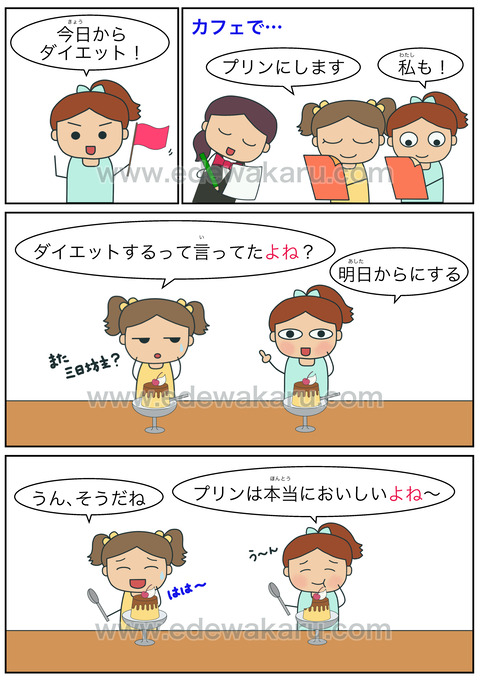
Explanation
“〜よね” is an expression used to check something with the other person or to seek their agreement. When it is used to seek agreement, it carries the feeling “I think ~, and do you think so too?”
[Examples]
①A: You said you were going to diet, right?
B: I’m starting the diet tomorrow!
[Checking with the other person]
②A: Pudding really is delicious, isn’t it!
B: It sure is.
→I think pudding is really delicious; do you think so too?
[Seeking agreement]
③A: The test is tomorrow, right?
B: It’s today…
[Checking with the other person]
④A: The N1 is really difficult, isn’t it…
B: Yeah, it really is difficult.
→I think the N1 is really difficult; do you think so too?
[Seeking agreement]
⑤Daughter: Mom, Dad doesn’t like cake, right?
Mother: Right. He really can’t handle sweet things.
[Checking with the other person]
The polite form can also be said as “〜ですよね?” 😮 You can use it in conversations with a senior you are close to, or with someone you have just met.
[Example]
A: The N1 is really difficult, isn’t it?
B: Yes, it really is difficult.
“〜よね” is very often used in conversation with friends, family, and seniors you are close to, so I think it’s good to learn it 😉
In context 5 examples
A:ダイエットするって言ってたよね?B:ダイエットは明日からにする!
A: You said you were going to diet, right? B: I’m starting the diet tomorrow!
A:プリンは本当においしいよね!B:そうだね
A: Pudding really is delicious, isn’t it! B: It sure is.
A:テストは明日だよね?B:今日だよ…
A: The test is tomorrow, right? B: It’s today…
A:N1ってすごく難しいよね…B:うん、本当に難しいね
A: The N1 is really difficult, isn’t it… B: Yeah, it really is difficult.
娘:お母さん、お父さんはケーキが嫌いだよね?母:うん。甘いものはまるでダメなのよ
Daughter: Mom, Dad doesn’t like cake, right? Mother: Right. He really can’t handle sweet things.
Read the original source text
Explanation
「〜よね」は相手に確認する時や、相手に同意してもらいたい時に使われる表現です。相手に同意してもらいたいという時に使う場合は、「私は〜だと思うんだけど、あなたも〜だと思う?」という気持ちを込めて使われます。
[例]
①A:ダイエットするって言ってた
よね?
B:ダイエットは明日からだよ〜
【相手に確認】
②A:プリンは本当においしい
よね!
B:そうだね
→私はプリンは本当においしいと思うんだけど、あなたもそう思う?
【同意してほしい】
③A:テストは明日だ
よね?
B:今日だよ…
【相手に確認】
④A:N1ってすごく難しい
よね
…
B:うん、本当に難しいね
→私はN1はすごく難しいと思うんだけど、あなたもそう思う?
【同意してほしい】
⑤娘:お母さん、お父さんはケーキが嫌いだ
よね?
母:うん。甘いものはまるでダメなのよ
【相手に確認】
「〜よね」は丁寧形について「〜ですよね?」という言い方もあります
😮仲がいい先輩や、初めて会った人との会話でも使うことができます。
[例]
A:N1ってすごく難しい
ですよね
…
B:はい、本当に難しいですね
「〜よね」は、
友達や家族、仲がいい先輩
などとの会話でとてもよく使われる表現ですので、覚えておくといいと思います😉