絵でわかる日本語
Meaning
since it’s to such an extent, it must be 〜
How to use it
Verb/adjective/noun [plain form] + くらいだから
Explanation
「〜くらいだから」 is a sentence pattern meaning “since it’s to such an extent, it must be 〜.” It is used when the speaker observes the degree of a situation and expresses their judgment or conjecture.
[Patterns often used with it]
・〜くらいだから + 〜だろう
・〜くらいだから + 〜に違いない
・〜くらいだから + 〜はずだ
・〜くらいだから + 〜はずがない
・〜くらいだから + 〜に決まっている
There are many sentence patterns containing 「くらい」, so review them.
In context 4 examples
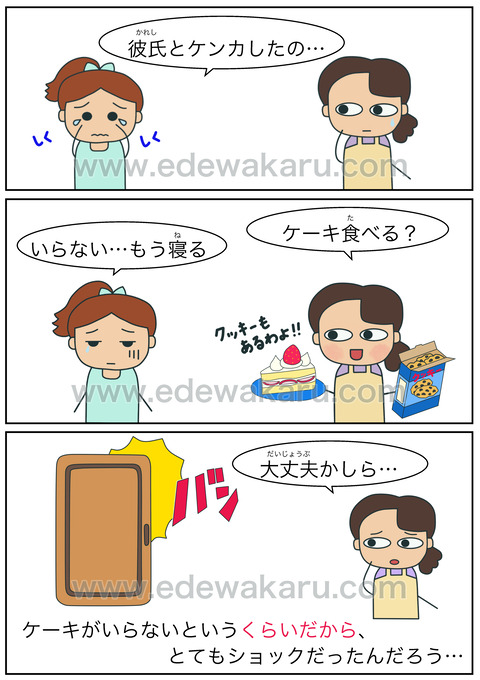
ケーキがいらないというくらいだから、とてもショックだったんだろう
→ケーキが大好きなのにいらないと言っている状況を見て、「すごくショックだったんだろう」と推測しているSince she says she doesn’t want cake, she must have been really shocked. →Seeing that she said she didn’t want cake even though she loves it, the speaker infers that she must have been really shocked.
徹夜してでも読みたくなるくらいだから、この本はすごくおもしろいんだろう
→友達が「徹夜してでも読みたい」と言っているのを聞いて、「この本はすごくおもしろいんだろう」と推測しているSince it makes you want to read it even if you have to stay up all night, this book must be really interesting. →Hearing a friend say, “I want to read it even if I have to stay up all night,” the speaker infers that the book must be really interesting.
優しいお父さんが怒るくらいだから、お母さんはすごくひどいことを言ったに違いない
→いつもは怒らないお父さんが怒っているのを見て、「お母さんはひどいことを言ったんだろう」と推測しているSince even a kind father gets angry, the mother must have said something really awful. →Seeing that a father who usually never gets angry is angry, the speaker infers that the mother must have said something awful.
「絶対に合格したと思う」と言っているくらいだから、きっと自信があるんだろう
→「絶対に合格したと思う」と言っているのを聞いて、「自信があるんだろう」と推測しているSince he says, “I’m sure I passed,” he must be confident. →Hearing him say, “I’m sure I passed,” the speaker infers that he must be confident.
Read the original source text
Meaning
〜のような程度だから、きっと〜だろう
How to use it
動詞・形容詞・名詞[普通形]+くらいだから
Explanation
「〜くらいだから」は「〜のような程度だから、きっと〜だろう」という意味を表す文型です。話者が状態の程度を見て、自分の判断や推量を表す時に使われます。
[よく一緒に使われる文型]
・〜くらいだから+
〜だろう
・〜くらいだから+
〜に違いない
・〜くらいだから+
〜はずだ
・〜くらいだから+
〜はずがない
・〜くらいだから+
〜に決まっている
「くらい」がつく文型はたくさんありますので、復習をしておきましょう。
毎日のんびり日本語教師
Meaning
Degree
Subjective judgment
How to use it
Verb plain form + くらい/ぐらい~
い-adjective plain form + くらい/ぐらい~
な-adjective stem + な/だった + くらい/ぐらい~
Noun + だった + くらい/ぐらい~
Explanation
This sentence pattern expresses the speaker’s subjective judgment or conjecture.
The first clause states the degree of an action or state (something from the past or a fact), and the second clause gives a subjective judgment inferred from that degree.
For that reason, the second clause tends to pair with expressions of the speaker’s conjecture, such as 「~だろう」, 「~でしょう」, 「~はずだ」, and 「~と思う」.
Notes
There is no difference between “くらい” and “ぐらい.” They mean the same thing whichever one you use.
The “くらい/ぐらい” series
In context 8 examples
あそこのケーキ屋、テレビで紹介されるぐらいだから、さぞ美味しいんだろう。
That cake shop over there was featured on TV, so it must be delicious.
死亡事故も発生しているくらいだから、使用の際は注意が必要だ。
There have even been fatal accidents, so you need to be careful when using it.
アレルギーは最悪死に至ることもあるくらいだから、決して甘く見てはいけない。
Allergies can even be fatal in the worst cases, so you must never take them lightly.
君は痩せ過ぎなぐらいだから、少し贅肉がついたくらいがちょうどいいよ。
You’re practically too thin already, so having a little extra fat would be just right.
電池は今や格安で売られているぐらいなので、充電式の電池をわざわざ買う必要があるかどうかは疑問だ。
Batteries are sold very cheaply nowadays, so I wonder whether it’s really necessary to go out of your way to buy rechargeable ones.
痛い痛いと言って泣いているぐらいだから、あの子供に何かあったのだろう。
Since that child is crying and saying, “It hurts, it hurts,” something must have happened to them.
「大は小を兼ねる」という言葉があるぐらいなので、作文では書けるだけ書くのが良い。
There’s a saying, “Big can serve the purpose of small,” so when writing an essay, it’s best to write as much as you can.
彼女はA大学の首席だったぐらいだから、今頃とんでもない仕事に就いているんだろう。
She graduated top of her class at A University, so she must have an incredible job by now.
Read the original source text
Meaning
程度
主観的な判断
How to use it
動詞普通形+くらい/ぐらい~
イ形普通形+くらい/ぐらい~
ナ形語幹+な/だった+くらい/ぐらい~
名詞+だった+くらい/ぐらい~
Explanation
話し手の主観的な判断や推測を述べる文型です。
前件にはある動作や状態の程度(過去のことや事実)が述べられ、後件ではその程度から推測される主観的な判断を述べます。
そのため、後件では「~だろう」「~でしょう」「~はずだ」「~と思う」などの話し手の推量を表す表現が呼応しやすいです。
Notes
「くらい」と「ぐらい」に違いはありません。どちらを使っても意味は同じです。
「くらい/ぐらい」シリーズ