日本語文型辞典
Meaning
Expresses a small quantity or low degree. It is usually used in speech.
a. ちょっと【softening the degree】
A euphemistic expression used in conversation. The meaning of a small quantity is not strong; it hints that something is minor in degree. It is used when speakers talk about their own actions or make requests of others. Adding “ちょっと” to requests makes them sound softer. Example ⑦ is a set phrase used as a greeting when meeting someone.
b. ちょっと【softening the tone】
Used with negative expressions such as “大変,” “無理,” and “むずかしい” to soften the tone.
c. ちょっと【trailing off】
Used in conversation. Saying only “ちょっと” and omitting the rest of the sentence implies something negative. It is a way to avoid saying something difficult. For example, in ① the speaker indicates that they do not really like the place. It is also used with expressions of refusal and the like to soften their tone. As in ② and ③, when the rest of the sentence is omitted, it can be understood on its own as a substitute for an expression of refusal and so on. A sentence expressing a positive meaning, such as acceptance, is usually not left unfinished.
When “ちょっと” is used with an expression that describes a positive evaluation or attribute, it becomes a euphemistic expression indicating that the speaker judges it to be better than usual, rather than that the degree is low. It is close to “かなり.” “すこし” does not have this usage.
a. ちょっと…ない【positive evaluation】
Used with a negative expression to emphasize the negation, but often when making an above-average evaluation. Example ① is praise for an interesting movie.
b. ちょっと…ない【softening the tone】
Used with a negative expression. It does not mean “a little”; it softens the negative statement. For instance, B’s words in ① are a euphemistic way of saying “I don’t understand at all,” not that there are just a few parts they don’t understand.
Used to attract someone’s attention. In addition to simply calling out, intonation can convey feelings such as reproach, intimidation, or pleading.
a. ちょっとしたN 【softening the degree】
Means “minor,” “not very significant,” or “trivial.”
b. ちょっとしたN 【positive evaluation】
Means “above average.” It can often be rephrased as “かなりのN.” “ちょっとしたN” expresses a judgment or evaluation modestly and somewhat vaguely.
How to use it
ちょっと【degree】
ちょっと
ちょっと【positive evaluation】
ちょっと…ない
ちょっと【calling out】
ちょっとしたN
In context 44 examples
ちょっと食べてみた。
I tried a little.
借りた本はまだちょっとだけしか読んでいない。
I’ve only read a little of the book I borrowed so far.
目標額の10万円にはちょっと足りない。
It’s a little short of the target amount of 100,000 yen.
手紙をちょっと書き直した。
I made a few revisions to the letter.
韓国語は、ちょっとだけ話せる。
I can speak just a little Korean.
ちょっと左へ寄ってください。
Please move a little to the left.
今日はちょっと寒い。
It’s a little cold today.
試験の問題はいつもよりちょっとむずかしかったが、なんとかと解けた。
The exam questions were a little harder than usual, but I somehow managed to solve them.
ちょっと電話してきます。
I’m just going to make a quick phone call.
ちょっと用がありますので、これで失礼します。
I have a small errand, so I’ll take my leave now.
ちょっとおたずねしますが、この辺に有田さんというお宅はありませんか。
Excuse me, but is there a household called Arita’s around here?
すみません、ちょっと手伝ってください。
Excuse me, could you help me for a moment?
A:ちょっとこの辺でお茶でも飲みませんか。
B:ええ、そうですね。A: Shall we stop for tea somewhere around here? B: Yes, that sounds good.
A:これで決まりですね。
B:ちょっと待ってください。わたしはまだいいとは言っていません。A: So that settles it. B: Please wait a moment. I haven’t said I agree yet.
A:おでかけですか。
B:ええ、ちょっとそこまで。A: Are you going out? B: Yes, just nearby.
A:この手紙の文章は、ちょっとかたすぎませんか。
B:そうですか。じゃ、もう一度書き直してみます。A: Isn’t the wording of this letter a little too stiff? B: Is it? Then I’ll try rewriting it.
A:山田さんが急病で、当分会社に出てこられないそうです。
B:そうか、それはちょっと大変だな。A: I hear Yamada has suddenly fallen ill and won’t be able to come to work for a while. B: I see. That’s rather serious.
この問題は君にはちょっと難しすぎるんじゃないかな。
Don’t you think this problem is a little too difficult for you?
一日で仕上げるのはちょっと無理だ。
Finishing it in one day is a bit impossible.
A:十時ではいかがでしょうか。
B:十時はちょっと都合が悪いんですけど。A: How about ten o’clock? B: Ten is a little inconvenient for me.
A:この写真ここに飾ったらどう?
B:そこはちょっとね…。A: How about hanging this picture here? B: That spot is a little…
A:ご都合が悪いんですか。
B:ええ、ちょっと月曜日は。A: Is it inconvenient for you? B: Yes, Monday is a little difficult.
A:このコピー機空いていますか?
B:あ、すみません。まだ、ちょっと…。A: Is this copier free? B: Oh, sorry. Not quite yet…
この本、ちょっとおもしろいよ。
This book is pretty interesting.
この先にちょっといいレストランをみつけた。
I found a pretty good restaurant farther up the road.
A:彼がどんな小説を書くか、ちょっと楽しみです。
B:そうですね。A: I’m rather looking forward to seeing what kind of novels he writes. B: Yes, me too.
A:新しい職場はどう?
B:課長さんがちょっとすてきな人なの。A: How’s the new workplace? B: The section chief is quite a wonderful person.
こんなにおもしろい映画は最近ちょっとない。
You don’t often see a movie as interesting as this one these days.
この本は読み出したらちょっとやめられませんよ。
Once you start reading this book, it’s pretty hard to put down.
こんなおいしいもの、ちょっとほかでは食べられない。
You can’t get food this delicious just anywhere.
あの人のあんな演説は、ちょっとほかの人にはまねができないだろう。
I doubt anyone else could imitate a speech like that one of his.
A:田中先生の研究室はどちらですか。
B:すみません。ちょっとわかりません。A: Where is Professor Tanaka’s office? B: Sorry, I’m not really sure.
A:あしたまでに全部現像してもらえますか。
B:それは、ちょっとできかねます。A: Can you have all of these developed by tomorrow? B: I’m afraid that would be a little difficult.
A:今、ちょっと手が放せないので、あとでこちらからお電話します。
B:そうですか。じゃあ、あとでよろしく。A: I can’t step away right now, so I’ll call you back later. B: I see. All right, please do.
ちょっと、そこのおくさん、財布落としましたよ。
Excuse me, ma’am, you dropped your wallet.
ちょっと、これは何ですか。スープの中にハエが入ってるじゃないの。
Hey, what is this? There’s a fly in my soup!
ちょっと、だれか来て手伝って。
Hey, someone come and help me!
ちょっと、お願いだからもう少し静かにしてて。
Hey, please, just be quiet for a little longer.
ちょっとしたアイデアだったが、大金になった。
It was just a small idea, but it made a lot of money.
ちょっとした風邪がもとで、亡くなった。
He died because of what seemed like a minor cold.
酒のつまみには、何かちょっとしたものがあればそれでいい。
For a snack with drinks, anything small will do.
かれは、両親の死後、ちょっとした財産を受け継いだので、生活には困らない。
After his parents died, he inherited a modest fortune, so he has no financial worries.
パーティーでは奥さんの手料理が出た。素人の料理とはいえ、ちょっとしたものだった。
At the party, his wife served food she had cooked herself. Though it was amateur cooking, it was quite something.
彼の帰国は、まわりの人にとって、ちょっとした驚きだった。
His return to Japan came as quite a surprise to those around him.
Read the original source text
Meaning
量の少なさ、程度の低さを表す。話しことばで使うのが普通。
a. ちょっと【程度のやわらげ】
会話で用いる婉曲表現。量の少なさという意味は強くなく、程度が軽いことを匂わせる。話し手が自分の行為について述べる場合や、相手に頼んだりする場合などに使う。依頼などでは、「ちょっと」をつける方がやわらかく響く。⑦は、人に会ったときのあいさつの定型表現。
b. ちょっと【語調のやわらげ】
「大変」「無理」「むずかしい」のような否定的な表現につけて、語調をやわらげるのに使う。
c. ちょっと【言いさし】
会話で使う。「ちょっと」だけ述べて、後の文は省略した形で、否定的な内容を暗示するのに使う。言いにくいことを回避する表現。たとえば、①では、話し手は、その場所があまり気にいらないという気持ちを示している。また、断りの表現などに付いて調子を和らげる。②③のように、後の文を省略すると、断りの表現などの代わりに用いられ、それだけで、相手に理解される。受諾など肯定的な意味を表す文の場合は省略しないのが普通。
「ちょっと」を、いい意味をもつ評価や属性を表す表現につけると、程度の低さより、話し手が普通以上によいと判断していることを示す、婉曲的な表現になる。「かなり」に近い。「すこし」にはこの用法はない。
a. ちょっと…ない【プラス評価】
否定表現とともに使って、否定を強調するが、普通以上に評価する場合に使うことが多い。①は、おもしろい映画に対するほめ言葉。
b. ちょっと…ない【語調のやわらげ】
否定表現とともに使う。「すこし」という意味ではなく、否定の言い方を和らげるのに使う。たとえば、①のBのことばは、実際には「全然わからない」ということを婉曲に言っており、「すこしわからない部分がある」という意味ではない。
人の注意を引き付けるのに使う。単に、呼びかけるだけでなく、イントネーションによって、非難、威嚇、哀願などの気持ちを表す。
a. ちょっとしたN 【程度のやわらげ】
「軽い」、「あまりたいしたものではない」、「ささいなもの」という意味。
b. ちょっとしたN 【プラス評価】
普通以上だということ。「かなりのN」でいいかえられることが多い。「ちょっとしたN」は、ややぼかして控えめに判断・評価を述べる。
How to use it
ちょっと【程度】
ちょっと
ちょっと【プラス評価】
ちょっと…ない
ちょっと【呼びかけ】
ちょっとしたN
絵でわかる日本語
Usage 1
Read this source entry ↗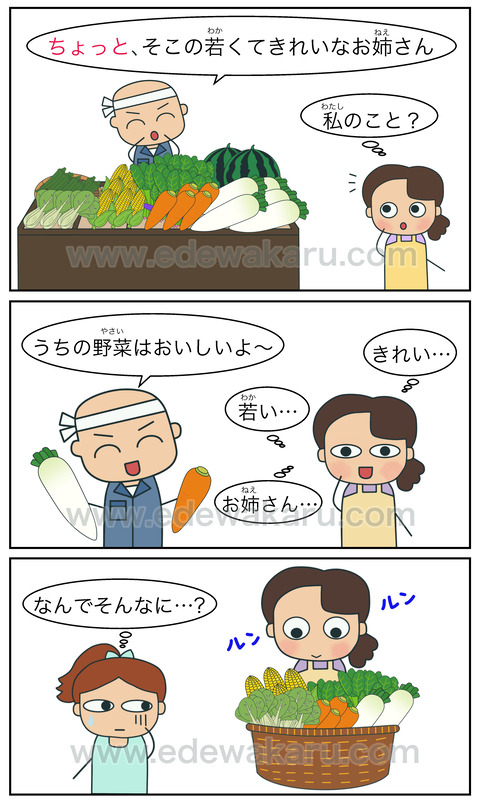
Explanation
“ちょっと、〜” is an expression used to get someone’s attention. It does not mean “a little”; it is used when calling out to someone or complaining to them. 😮
[Examples]
①
ちょっと、
young and beautiful lady over there!
[Calling out]
②
ちょっと、
Be quiet!
[Complaint] [Reproach]
③
ちょっと、
Stop it!
[Complaint] [Reproach]
④
ちょっと、
Someone give me a hand~
[Calling out] [Request]
⑤
ちょっと、
Don’t eat my pudding!
[Complaint] [Reproach]
“ちょっと” has many meanings, but remember that the “ちょっと、〜” covered here is used to get someone’s attention in everyday conversation. 😀
(Review: 〜において・〜におけるN)
Read the original source text
Explanation
「ちょっと、〜」は相手の注意を引く場合に使われる表現です。「少し」という意味ではなく、相手を呼んだり、相手に文句を言ったりする時に使われます😮
[例]
①
ちょっと、
そこの若くてきれいなお姉さん!
【呼びかけ】
②
ちょっと、
静かにしてよ!
【文句】【非難】
③
ちょっと、
やめてよ!
【文句】【非難】
④
ちょっと、
誰か手を貸して〜
【呼びかけ】【依頼】
⑤
ちょっと、
私のプリンを食べないでよ!
【文句】【非難】
「ちょっと」にはたくさん意味がありますが、今回の「ちょっと、〜」は日常会話(にちじょうかいわ)において
相手の注意を引く時
に使われると覚えておきましょう😀
(復習:〜において・〜におけるN)
Usage 2
Read this source entry ↗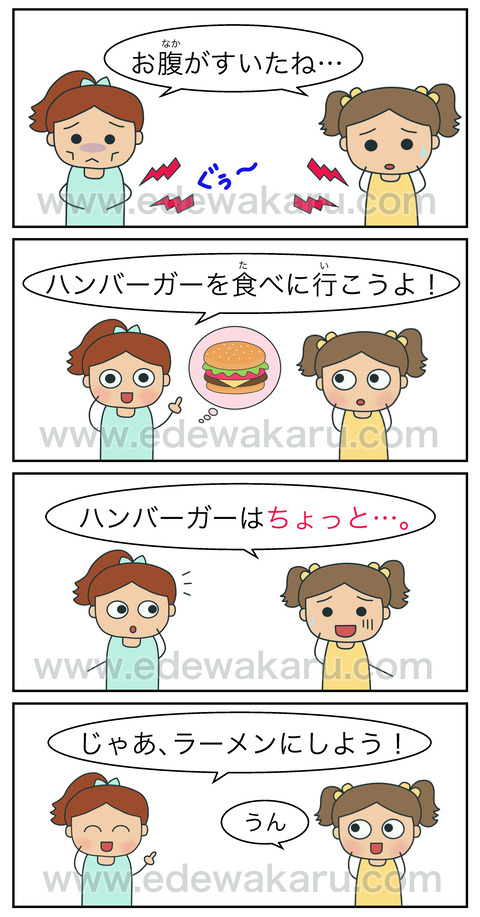
Explanation
“ちょっと…” is an expression used when saying something negative or when not stating something difficult to say clearly.
It is just right for indirectly saying something a little difficult to say directly, such as “I don’t want to,” “I don’t like it,” “That won’t work,” or “That’s impossible.” 😊 It is also often used when turning someone down.
(Review: 〜といった)
[Examples]
①ハンバーガーは
ちょっと…
You can make the other person understand that “I don’t like hamburgers” or “I don’t want hamburgers.” 😉
②A: Let’s go to the movies on Sunday.
B: Sunday is…
Even without clearly saying “Sunday won’t work,” “Sunday is impossible,” or “Sunday is inconvenient for me,” you can get the other person to understand that it won’t work. 😀
Japanese people often use indirect ways of speaking, so I think it’s good to learn this expression. 😉 Try using it in everyday conversation too. 😊
Read the original source text
Explanation
「ちょっと…。」は否定的な内容を言う時や、言いにくいことをはっきりと言わない時に使う表現です。
「嫌だ」「嫌いだ」「ダメだ」「無理だ」
といった、少し言いにくいことをはっきり言わない時にぴったりの表現です😊断る時にもよく使われます。
(復習:〜といった)
[例]
①ハンバーガーは
ちょっと…
「ハンバーガーは
好きじゃない」「ハンバーガーは
嫌だ」とわかってもらえます😉
②A:日曜日、映画に行こうよ
B:日曜日は
ちょっと…
「日曜日は
ダメだ」「日曜日は
無理だ」「日曜日は
都合が悪い」とはっきり言わなくても、相手に「ダメだ」と理解してもらうことができます😀
日本人は婉曲的(えんきょくてき)な言い方をよく使いますので、覚えておくといいと思います😉みなさんも日常会話(にちじょうかいわ)で使ってみてくださいね😊
日本語文型辞典 英語版
Meaning
This expresses a small amount or a low degree. It is normally used in spoken language.
B:ええ、そうですね。
Yes, let’s do that.
B:ちょっと待ってください。わたしはまだいいとは言っていません。
Wait a minute. I haven’t said OK yet.
B:ええ、ちょっとそこまで。
Yes, just around the corner.
A euphemistic expression which is used in spoken language. Does not mean a small amount, but rather hints that the degree is small. Used when the speaker is talking about his own action or when he is asking someone to do something. Adding ちょっと softens the sentence when requesting something.
(7)
is a set phrase used in greetings.
b. ちょっと〈softening of tone〉
B:そうですか。じゃ、もう一度書き直してみます。
You think so? I’ll try to re-write it then.
B:そうか、それはちょっと大変だな。
Is that so? That’s a problem.
B:10時はちょっと都合が悪いんですけど。
I’m afraid ten o’clock is not convenient for me.
Used to soften the tone by attaching it to negative expressions such as 大変 (serious/problematic), 無理 (impossible), むずかしい (difficult).
c. ちょっと〈unfinished sentence〉
B:そこはちょっとね...。
There? Well...
B:ええ、ちょっと月曜日は...。
Yes, I’m afraid Monday is not so good.
B:あ、すみません。まだ、ちょっと...。
Oh, sorry, not just yet I’m afraid.
Used in conversation. Only ちょっと is uttered and the rest of the sentence is omitted. Hints at negative content used for avoiding something which is difficult to say.
(1)
, for example, indicates that the speaker doesn’t like the place very much. Also used to soften the tone in expressions of refusal. When the latter sentence is omitted, as in
(2)
and
(3)
, it is used on its own instead of expressions of refusal, and is so understood by the listener. When using it for positive meaning such as acceptance, the latter part of the sentence is not normally omitted.
B:そうですね。
Yeah, it will.
B:課長さんがちょっとすてきな人なの。
The section chief is kind of attractive.
When attached to a good evaluation or an expression which indicates attribution, ちょっと indicates that the speaker judges something to be “better than usual,” rather than “a little.” A euphemistic expression. Close to かなりin meaning. すこし does not have this type of usage.
Used with a negative expression for emphasis, but is in fact often used when evaluating something of higher or greater value than usual.
(1)
is an expression for praising a good film.
b. ちょっと...ない〈softening of tone〉
B:すみません。ちょっとわかりません。
Sorry, I’m not sure.
B:それは、ちょっとできかねます。
That’s just not going to be possible.
B:そうですか。じゃあ、あとでよろしく。
I see. OK, I’ll leave it with you (please call me later).
Used with negative expressions. Softens the negative phrase. Does not mean “little.” B’s words in
(1)
, for example, are a euphemistic expression for saying that the speaker actually “doesn’t know at all,” not “there is just some part which he doesn’t know.”
Used to attract attention. Not just for calling someone, but can express feelings such as criticism, intimidation, or appeal, depending on the intonation.
Means “something light, not especially considerable, something small.”
b. ちょっとしたN〈positive evaluation〉
Signifies something above average and is often replaced by かなりのN. ちょっとしたN describes judgment or evaluation in a somewhat vague, moderate way.
How to use it
1. ちょっと〈degree〉
2. ちょっとa. ちょっと〈moderation of degree〉
3. ちょっと〈positive evaluation〉
4. ちょっと...ないa. ちょっと...ない〈positive evaluation〉
5. ちょっと〈appeal〉
6. ちょっとしたNa. ちょっとしたN〈moderation of degree〉
In context 44 examples
ちょっと食べてみた。
I tried eating a little.
借りた本はまだちょっとだけしか読んでいない。
I’ve only read a little of the book I borrowed.
目標額の10万円にはちょっと足りない。
It’s not quite enough for the target price of 100,000 yen.
手紙をちょっと書き直した。
I revised the letter a little.
韓国語は、ちょっとだけ話せる。
I can only speak a little Korean.
ちょっと左へ寄ってください。
Please move a little to the left.
今日はちょっと寒い。
It’s a bit cold today.
試験の問題はいつもよりちょっとむずかしかったが、なんとか解けた。
The exam questions were a bit harder than usual, but I somehow managed to solve them.
ちょっと電話してきます。
I’ll just go and make a phone call.
ちょっと用がありますので、これで失礼します。
There’s something I have to do, so please excuse me.
ちょっとおたずねしますが、この辺に有田さんというお宅はありませんか。
Could I just ask you if there is a family named Arita-san residing near here?
すみません、ちょっと手伝ってください。
Excuse me, could you help me a little?
A:ちょっとこの辺でお茶でも飲みませんか。
Shall we have some tea somewhere near here?
A:これで決まりですね。
All right, so it’s decided then.
A:おでかけですか。
Are you going out?
A:この手紙の文章は、ちょっとかたすぎませんか。
The sentences in this letter are a little formal, aren’t they?
A:山田さんが急病で、当分会社に出てこられないそうです。
I hear Yamada-san has suddenly taken ill and won’t be able to come to the office for some time.
この問題は君にはちょっと難しすぎるんじゃないかな。
This question is a little too hard for you, isn’t it?
一日で仕上げるのはちょっと無理だ。
It’s impossible to finish it in one day.
A:10時ではいかがでしょうか。
What about ten o’clock?
A:この写真ここに飾ったらどう?
How about putting this picture here?
A:ご都合が悪いんですか。
Is that not a good time for you?
A:このコピー機空いていますか?
Is this photocopy machine free?
この本、ちょっとおもしろいよ。
This book is quite interesting.
この先にちょっといいレストランをみつけた。
I found a pretty nice restaurant just up ahead.
A:彼がどんな小説を書くか、ちょっと楽しみです。
It’s going to be fun to see what kind of novel he’ll write.
A:新しい職場はどう?
How is your new workplace?
こんなにおもしろい映画は最近ちょっとない。
You don’t often see such an interesting film nowadays.
この本は読み出したらちょっとやめられませんよ。
You really can’t stop once you start reading this book.
こんなおいしいもの、ちょっとほかでは食べられない。
You can’t easily eat something so delicious elsewhere.
あの人のあんな演説は、ちょっとほかの人にはまねができないだろう。
I don’t think many others can match those presentation skills of his.
A:田中先生の研究室はどちらですか。
Where is Tanaka-sensei’s research laboratory?
A:あしたまでに全部現像してもらえますか。
Can I have all these photos printed by tomorrow?
A:今、ちょっと手が放せないので、あとでこちらからお電話します。
I just can’t drop what I’m doing now, so I’ll give you a call later.
ちょっと、そこのおくさん、財布落としましたよ。
Excuse me, madam, you’ve dropped your wallet.
ちょっと、これは何ですか。スープの中にハエが入ってるじゃないの。
Hey, what’s this! Isn’t this a fly in the soup?
ちょっと、だれか来て手伝って。
Hey, someone come give me a hand.
ちょっと、お願いだからもう少し静かにしてて。
Come on, can I ask you to be a little quieter?
ちょっとしたアイデアだったが、大金になった。
It was just a small idea, but it led to a large profit.
ちょっとした風邪がもとで、亡くなった。
It was only a minor cold to start with but led to his death.
酒のつまみには、何かちょっとしたものがあればそれでいい。
For snacks to go with the sake, if you have something light, that would do.
彼は、両親の死後、ちょっとした財産を受け継いだので、生活には困らない。
He inherited a little bit of a fortune after his parents’ death, so he has no trouble in everyday life.
パーティーでは奥さんの手料理が出た。素人の料理とはいえ、ちょっとしたものだった。
His wife’s homemade cooking was served at the party. Even though it was just an amateur’s cooking, it was rather good.
彼の帰国は、まわりの人にとって、ちょっとした驚きだった。
His return to his home country was a bit of a surprise to people around him.