AIUEO JLPT Grammar
Meaning
This sentence pattern is used when the action or words related to a noun include certain emotions or thoughts.
How to use it
Noun を + 込めて
In context 5 examples
感謝の気持ちを込めて、手紙を書きました。
I wrote the letter with a heart full of gratitude.
母は愛情を込めて、毎朝お弁当を作ってくれる。
My mother makes my lunch every morning with love.
心を込めて、プレゼントを選びました。
I carefully chose this gift with all my heart.
誕生日のメッセージには、友達への思いを込めました。
I put my feelings for my friend into the birthday message.
愛をこめて花束を贈ります。
Send you a bouquet of flowers with love.
Read the original source text
Meaning
This sentence pattern is used when the action or words related to a noun include certain emotions or thoughts.
How to use it
名詞を+込めて
Explanation · 日本語
この文型は、名詞に接続して使われ、その行動や言葉に特定の感情や思いを含めることを表す表現です。
文法
Meaning
With ~ put into it / together with ~
Means doing something while putting one's feelings, strength, or similar into it.
How to use it
N + を込めて
Notes
[Words often used together]
Love, feelings, heart, prayer, grudge, strength, wish
In context 12 examples
ちょっと照れ臭かったですが、感謝の気持ちを込めて、母に手紙を書きました。
I felt a little embarrassed, but I wrote my mother a letter with gratitude in my heart.
皆さんにありがとうの気持ちを込めて、この曲を歌います。聞いてください。
I’ll sing this song with gratitude to all of you. Please listen.
もうすぐ七夕ですね。願いを込めて短冊にお願いごとを書きましょう。
Tanabata is coming soon. Let’s write our wishes on strips of paper, putting our hopes into them.
父の日には、いつも頑張っているお父さんに感謝の気持ちを込めてプレゼントを贈りましょう。
For Father’s Day, let’s give a present to our hardworking dads with gratitude in our hearts.
力を込めて精一杯バットを振ったら、ホームランになった。
I swung the bat with all my strength, and it became a home run.
1周年記念に思いを込めて作った僕の動画を見て、彼女は泣いた。
She cried when she watched the video I made with heartfelt emotion for our first anniversary.
当店の製品は全て職人が心を込めて手作業で作っています。
All of our store’s products are handmade by artisans with great care.
私は夫のために毎日愛情を込めてお弁当を作っています。
I make my husband’s lunch every day with love.
日本人は親しみの気持ちを込めて「本屋さん」や「お寿司屋さん」のようにお店に「さん」を付けて言うことがある。
Japanese people sometimes add 「さん」 to store names affectionately, as in 「本屋さん」 and 「お寿司屋さん」.
千羽鶴は願いや祈りを込めて作る特別な折り紙です。
Senbazuru are special origami cranes made with wishes and prayers in them.
夫への憎しみの気持ちを込めて、ちょっと恥ずかしい弁当を作ってやった。
I made my husband a slightly embarrassing lunch with resentment toward him in my heart.
愛をこめて花束を(歌のタイトル)
A Bouquet with Love (song title)
Read the original source text
Meaning
〜を入れて / 〜と一緒に
気持ちや力などを入れて何かをするという意味
How to use it
N + を込めて
Notes
[一緒によく使われる言葉]
愛、気持ち、心、祈り、恨み、力、願い
Bunpro Grammar Reference
Meaning
Full of, Filled with, With ~
How to use it
Noun + を込めて
Nuance
A construction meaning that something is filled with, or jam-packed with (A). Often used in relation to feelings.
Explanation
をこめて, or を込めて when appearing in its kanji form, is a phrase that expresses when something is 'full of (A)', or 'filled with (A)'. The structure is comprised of を, and the て-form of the る-Verb 込める, which means 'to pack into', or 'to load with'. In this way, the literal meaning is fairly consistent with the standard English translations.
をこめて will appear directly after the noun expressing the particular feeling or emotion being discussed.
感謝の気持ちを込めて、1年間お世話になった先生に花束をあげた。
Full of the feeling of gratitude, I gave a bouquet of flowers to a teacher who has taken care of me for the past year.
夫は毎晩、愛を込めて晩御飯を作ってくれる。
My husband cooks dinner filled with love every night.
歌うのが下手でも、心を込めて歌えば上手に聞こえる。
Even if you are not a good singer, you can sound like a good singer if you sing with all your heart.
Caution
It is important to note that this particular structure is treated as a set phrase, and will primarily only be used when some particular feeling or emotion is the thing that is being 'packed into (A)'.
In context 15 examples
- 感謝の気持ちを込めて、プレゼントを贈った。
Full of the feeling of gratitude, I gave a present. (filled with feelings of)
- 感謝の気持ちを込めて、1年間お世話になった先生に花束をあげた。
Full of the feeling of gratitude, I gave a bouquet of flowers to a teacher who has taken care of me for the past year.
- 歌うのが下手でも、心を込めて歌えば上手に聞こえる。
Even if you are not a good singer, you can sound like a good singer if you sing with all your heart.
- 夫は毎晩、愛を込めて晩御飯を作ってくれる。
My husband cooks dinner filled with love every night.
- 彼女が愛を込めて作った弁当を食べたい!
I want to eat a bento made full of love by my girlfriend. (filled with feelings of)
- 憧れを込めて伯父さんの背中を見ていた。
I watched my uncle from behind, filled with admiration. (filled with feelings of)
- 祈りを込めて書いた詩に涙した。
I shed tears at the poem that was written full of prayer. (filled with feelings of)
- 願いを込めてステージで歌う姿にジーンときた。
Seeing them sing on stage, full of hope, gave me the chills. (filled with feelings of)
- 敬意を込めて述べたのに、うまく伝わりませんでした。
Although my expression was full of respect, I did not communicate it well. (filled with feelings of)
- 「祖父より愛を込めて」といった葉書が届いた。
A postcard saying 'From grandpa with love' arrived. (filled with feelings of)
- 希望を込めて、人々は代表チームを応援している!
Filled with hope, people cheer for a national team! (filled with feelings of)
- 期待を込めて少し厳しいことを言ってしまいました。
Full of anticipation, I unfortunately said something a little over the top. (filled with feelings of)
- 素人でも、思いを込めて作った作品には味がある。
Even an amateur's eagerly made piece has charm (full of eagerness). (filled with feelings of)
- 皮肉を込めて言ったのに、彼は喜んでいた。
Even though what I said was filled with sarcasm, he was delighted. (filled with feelings of)
- 心を込めて作った料理を食べてもらえなかった。
I wasn't able to have them eat cuisine made with all of my heart. (full of heart/wholeheartedly・filled with feelings of)
Read the original source text
Meaning
Full of, Filled with, With ~
How to use it
Noun + を込めて
Nuance
A construction meaning that something is filled with, or jam-packed with (A). Often used in relation to feelings.
Explanation
をこめて, or を込めて when appearing in its kanji form, is a phrase that expresses when something is 'full of (A)', or 'filled with (A)'. The structure is comprised of を, and the て-form of the る-Verb 込める, which means 'to pack into', or 'to load with'. In this way, the literal meaning is fairly consistent with the standard English translations.
をこめて will appear directly after the noun expressing the particular feeling or emotion being discussed.
感謝の気持ちを込めて、1年間お世話になった先生に花束をあげた。
Full of the feeling of gratitude, I gave a bouquet of flowers to a teacher who has taken care of me for the past year.
夫は毎晩、愛を込めて晩御飯を作ってくれる。
My husband cooks dinner filled with love every night.
歌うのが下手でも、心を込めて歌えば上手に聞こえる。
Even if you are not a good singer, you can sound like a good singer if you sing with all your heart.
Caution
It is important to note that this particular structure is treated as a set phrase, and will primarily only be used when some particular feeling or emotion is the thing that is being 'packed into (A)'.
Nuance · 日本語
何かが(A)で溢れている、又は(A)で敷き詰められているという意味をする表現。感情に関して話している時に使われることが多い。
Explanation · 日本語
「をこめて」または漢字で「を込めて」は、「(A) を入れて」や「(A) でいっぱいにして」といった意味で使われる表現です。これは、助詞の「を」に、「何かの中に詰める」といった意味を持つ一段動詞「込める」のテ形を組み合わせたものです。
「をこめて」は感情や気持ちなどを表す名詞の直後に置かれます。
感謝の気持ちを込めて、1年間お世話になった先生に花束をあげた。
Full of the feeling of gratitude, I gave a bouquet of flowers to a teacher who has taken care of me for the past year.
夫は毎晩、愛を込めて晩御飯を作ってくれる。
My husband cooks dinner filled with love every night.
歌うのが下手でも、心を込めて歌えば上手に聞こえる。
Even if you are not a good singer, you can sound like a good singer if you sing with all your heart.
注意点
「をこめて」は定型句として扱われており、感情や気持ち以外にはほとんど使われません。
どんなときどう使う 日本語表現文型辞典
Meaning
with
How to use it
N + を込めて
Explanation
~を入れて/とともに
「愛、願いなどの気持ちをあるものに入れて」という意味で使う。ほかに「心をこめて・祈りをこめて・思いをこめて・恨みをこめて・力をこめて」などがよく使われる。
Put love, hopes, or other feelings into something. Also often used in 心をこめて, 祈りをこめて, 思いをこめて, 恨みをこめて, or 力をこめて (with strength).
In context 3 examples
先生、ありがとうございました。わたしたちの感謝を込めてこの文集を作りました。
Thank you, teacher. We made this collection of writings with our gratitude.
昔の子どもたちは遠足の前の日などに「あした、天気になりますように」と願いを込めて「てるてる坊主」という小さい人形を作って、窓の外につるした。
In the past, children would make a small doll called a teru teru bozu and hang it outside the window on the eve of an outing, putting their wish into it and saying, “May the weather be good tomorrow.”
あなたに、愛を込めてこの指輪を贈ります。
I give you this ring with love.
Read the original source text
Meaning
with
How to use it
N+を込めて
Explanation
~を入れて/とともに
「愛、願いなどの気持ちをあるものに入れて」という意味で使う。ほかに「心をこめて・祈りをこめて・思いをこめて・恨みをこめて・力をこめて」などがよく使われる。
Put love, hopes, or other feelings into something. Also often used in 心をこめて, 祈りをこめて, 思いをこめて, 恨みをこめて, or 力をこめて (with strength).
絵でわかる日本語
Usage 1
Read this source entry ↗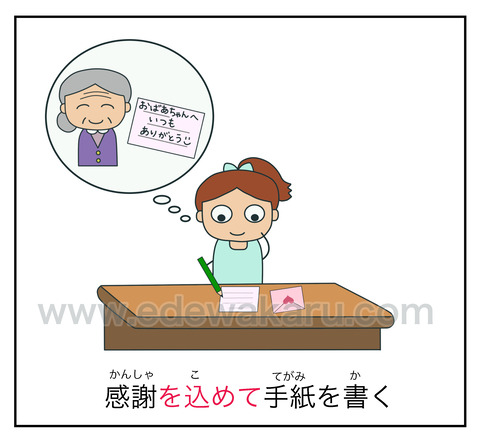
Meaning
Do … with … infused in it
How to use it
Noun [dictionary form] + を込めて
Noun [dictionary form] + を込めた + noun
Explanation
「〜を込めて」is an expression used when you want to say “do … with [a feeling called] … infused in it” 😊 It is not an idiom, but it is often used with words that express feelings, and the words it is used with are mostly fixed.
Remember that this pattern can be used for both [good things] and [bad things].
[Commonly used words]
愛・愛情
感謝
心・思い
願い・祈り
親しみ
敬意
恨み
怒り
憎しみ
〜の気持ち・〜の思い
[Exception]
力
*力 does not express a feeling, but 「力を込めて」is an idiomatic expression meaning “putting strength into it” or “with all one’s strength,” so memorize it 😉
【Supplementary explanation】
When used with a noun, the form 「〜を込めた+名詞」is common, but it may also be useful to remember the form 「〜の込もった+名詞」😀
[Examples]
愛
を込めた
お弁当
愛
の込もった
お弁当
This pattern appears often, so be sure to learn it well 😌
In context 4 examples
感謝を込めて手紙を書く
→感謝の気持ちを入れて手紙を書くWrite a letter with gratitude. →Write a letter with feelings of gratitude.
愛を込めて料理を作る
→愛する気持ちを入れて料理を作るCook with love. →Cook with loving feelings.
ありがとうの思いを込めて歌を歌う
→ありがとうという気持ちを入れて歌を歌うSing a song with feelings of thankfulness. →Sing a song with the feeling “thank you.”
殺意を込めて料理に毒を入れた
→殺意(殺そうとういう気持ち)を入れて料理に毒を入れたI put poison in the food with murderous intent. →I put poison in the food with the intention of killing.
Read the original source text
Meaning
〜を中に入れて
How to use it
名詞[辞書形]+を込めて
名詞[辞書形]+を込めた+名詞
Explanation
「〜を込めて」は「〜(という気持ち)を中に入れて…する」と言いたい時に使用される表現です😊慣用表現ではありませんが、「気持ち」を表す単語によく使われ、使用される単語はほとんど決まっています。
この文型は【いいこと】【悪いこと】両方に使えると覚えておきましょう。
[よく使われる単語]
愛・愛情
感謝
心・思い
願い・祈り
親しみ
敬意
恨み
怒り
憎しみ
〜の気持ち・〜の思い
[例外]
力
*力は気持ちを表すものではありませんが、
「力を込めて」は「力を入れて」「力いっぱいに」という慣用表現ですので暗記してしまいましょう
😉
【補足説明】
名詞と一緒に使う場合は
「〜を込めた+名詞」が一般的ですが、「〜の込もった+名詞」という形もあることを覚えておくといいと思います
😀
[例]
愛
を込めた
お弁当
愛
の込もった
お弁当
よく出てくる文型ですのでしっかりと覚えておきましょう😌
Usage 2
Read this source entry ↗Meaning
Do … with … infused in it
How to use it
Noun [dictionary form] + を込めて
Noun [dictionary form] + を込めた + noun
Explanation
「〜を込めて」is an expression used when you want to say “do … with [a feeling called] … infused in it” 😊 It is not an idiom, but it is often used with words that express feelings, and the words it is used with are mostly fixed.
Remember that this pattern can be used for both [good things] and [bad things].
[Commonly used words]
愛・愛情
感謝
心・思い
願い・祈り
親しみ
敬意
恨み
怒り
憎しみ
〜の気持ち・〜の思い
[Exception]
力
*力 does not express a feeling, but 「力を込めて」is an idiomatic expression meaning “putting strength into it” or “with all one’s strength,” so memorize it 😉
【Supplementary explanation】
When used with a noun, the form 「〜を込めた+名詞」is common, but it may also be useful to remember the form 「〜の込もった+名詞」😀
[Examples]
愛
を込めた
お弁当
愛
の込もった
お弁当
This pattern appears often, so be sure to learn it well 😌
Read the original source text
Meaning
〜を中に入れて
How to use it
名詞[辞書形]+を込めて
名詞[辞書形]+を込めた+名詞
Explanation
「〜を込めて」は「〜(という気持ち)を中に入れて…する」と言いたい時に使用される表現です😊慣用表現ではありませんが、「気持ち」を表す単語によく使われ、使用される単語はほとんど決まっています。
この文型は【いいこと】【悪いこと】両方に使えると覚えておきましょう。
[よく使われる単語]
愛・愛情
感謝
心・思い
願い・祈り
親しみ
敬意
恨み
怒り
憎しみ
〜の気持ち・〜の思い
[例外]
力
*力は気持ちを表すものではありませんが、
「力を込めて」は「力を入れて」「力いっぱいに」という慣用表現ですので暗記してしまいましょう
😉
【補足説明】
名詞と一緒に使う場合は
「〜を込めた+名詞」が一般的ですが、「〜の込もった+名詞」という形もあることを覚えておくといいと思います
😀
[例]
愛
を込めた
お弁当
愛
の込もった
お弁当
よく出てくる文型ですのでしっかりと覚えておきましょう😌
日本語NET JLPT文法解説まとめ
Meaning
Putting ... into it / together with ...
Means doing something while putting feelings, strength, or the like into it.
How to use it
N + を込めて
Explanation
with
This sentence pattern expresses the act of putting feelings or effort into something.
In context 12 examples
ちょっと照れ臭かったのですが、感謝の気持ちを込めて、母に手紙を書きました。
I felt a little embarrassed, but I wrote my mother a letter with gratitude in my heart.
皆さんにありがとうの気持ちを込めて、この曲を歌います。聞いてください。
I’ll sing this song with gratitude to all of you. Please listen.
もうすぐ七夕ですね。願いを込めて短冊にお願いごとを書きましょう。
Tanabata is coming soon. Let’s write our wishes on strips of paper, putting our hopes into them.
父の日には、いつも頑張っているお父さんに感謝の気持ちを込めてプレゼントを贈りましょう。
For Father’s Day, let’s give a present to our hardworking dads with gratitude in our hearts.
力を込めて精一杯バットを振ったら、ホームランになった。
I swung the bat with all my strength, and it became a home run.
1周年記念に思いを込めて作った僕の動画を見て、彼女は泣いた。
She cried when she watched the video I made with heartfelt emotion for our first anniversary.
当店の製品は全て職人が心を込めて手作業で作っています。
All of our store’s products are handmade by artisans with great care.
私は夫のために毎日愛情を込めてお弁当を作っています。
I make my husband’s lunch every day with love.
日本人は親しみの気持ちを込めて「本屋さん」や「お寿司屋さん」のようにお店に「さん」を付けて言うことがある。
Japanese people sometimes add 「さん」 to store names affectionately, as in 「本屋さん」 and 「お寿司屋さん」.
千羽鶴は願いや祈りを込めて作る特別な折り紙です。
Senbazuru are special origami cranes made with wishes and prayers in them.
夫への憎しみの気持ちを込めて、ちょっと恥ずかしい弁当を作ってやった。
I made my husband a slightly embarrassing lunch with resentment toward him in my heart.
愛を込めて花束を(歌のタイトル)
A bouquet filled with love (song title)
Read the original source text
Meaning
〜を入れて / 〜と一緒に
気持ちや力などを入れて何かをするという意味
How to use it
N + を込めて
Explanation
with
This sentence pattern expresses the act of putting feelings or effort into something.
毎日のんびり日本語教師
How to use it
Noun + を込めて
Noun + を込めた + noun
Noun + がこもった + noun
Noun + のこもった + noun
Explanation
Indicates putting emotions such as love or gratitude into an object and entrusting them to it.
It is often associated with positive feelings such as 愛, 心, 気持ち, 感謝, 思い, and 念, but it can also rarely be associated with negative words such as 殺意, 恨み, and 怒り.
Notes
Nothing in particular.
In context 16 examples
皆さまへ感謝の気持ちを込めて、クリスマスプレゼントをご用意しました。
We have prepared Christmas presents for you all, with gratitude in our hearts.
彼への愛を込めてチョコを作った。
I made chocolate with love for him.
たくさんの心のこもったお土産をありがとう。
Thank you for all the souvenirs made with so much care.
うちに帰ると温かくて気持ちのこもった手料理が食べられる。(回到家就能吃到热乎乎的亲手做的料理。)
When I get home, I can eat a warm, home-cooked meal made with care.
一曲一曲心を込めて歌ってくれた。
They sang each song with all their heart.
一発一発殺意を込めて殴る。(一击一击满怀杀意地殴打。)
He punches with murderous intent behind every blow.
感情のこもった演技に感動させられた。(被充满感情的演技所感动。)
I was moved by the emotionally charged performance.
店長が魂を込めたラーメン
The ramen the manager made with all his soul.
当店自慢の手打ちパスタは毎日シェフが心を込めて作っております。
Our house specialty, handmade pasta, is lovingly prepared by the chef every day.
あなたが言葉や行動に全力で愛を込めてくれたら、私は嫉妬なんかしません。
If you put all your love into your words and actions, I won’t get jealous or anything.
彼は周囲から親しみを込めて「兄さん」と呼ばれている。
People around him affectionately call him “Big Brother.”
口内炎治りますようにって祈りを込めてサプリメントを飲む。
I take supplements with a prayer that my mouth ulcer will heal.
もし死ぬなら、全ての恨みを込めた遺書を書いて死にたい。
If I were to die, I’d want to die after writing a will filled with all my resentment.
全ての怒りを込めた一撃を相手の顔にぶつけたい。
I want to slam a blow full of all my anger into the other person’s face.
愛がこもった手紙をもらった。
I received a letter full of love.
色々な想いがこもった一曲だから、聴くだけで泣けてくる。
It’s a song filled with all kinds of feelings, so just listening to it makes me want to cry.
Read the original source text
How to use it
名詞+を込めて
名詞+を込めた+名詞
名詞+がこもった+名詞
名詞+のこもった+名詞
Explanation
愛情や感謝などの感情を物に注ぎ入れ託すことを表します。
「愛」「心」「気持ち」「感謝」「思い」「念」などの良い感情に結びつくことが多いですが、「殺意」「恨み」「怒り」などの良くない語にも稀に結び付くことがあります。
Notes
特になし