日本語文型辞典
Meaning
Basic information: V-ることができる. Indicates the presence or absence of “ability” (①, ②) or “possibility” (③, ④). It can also be rephrased using V-れる to express possibility, as in 話せる (“can speak”) or 泳げる (“can swim”), but in formal situations and formal writing, ことができる tends to be somewhat preferred, especially when expressing possibility.
Examples:
① Can you speak Arabic?
② I hear that person can swim 20 or even 30 kilometers, if they go slowly.
③ I’m sorry, but we cannot meet your request.
④ It may also be possible to reconsider “education” from the viewpoint of “reproducing” the members of that society or class.
Read the original source text
Meaning
基本情報V-ることができる説明「能力」(①②)や「可能性」(③④)の有無を表す。「話せる」「泳げる」のように可能を表す「V-れる」で言いかえることもできるが、あらたまった場面やかたい文章では、(特に可能性を表す場合は)やや「ことができる」のほうが好まれる傾向がある。例文① アラビア語を話すことができますか。② あの人は、ゆっくりなら20kmでも30kmでも泳ぐことができるそうだよ。③ 残念ですが、ご要望におこたえすることはできません。④ その社会や階級の構成員を「再生産」するという観点から、「教育」というものをとらえ直してみることもできるだろう。
絵でわかる日本語
Usage 1
Read this source entry ↗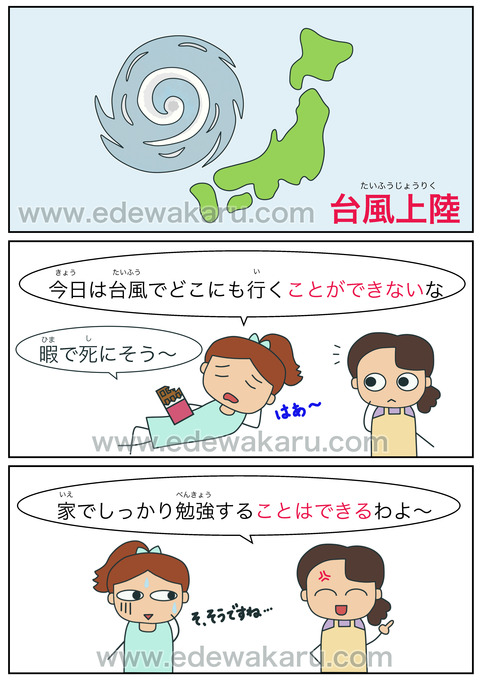
Meaning
To be in a state where one can do ~
To be in a state where one cannot do ~
How to use it
Verb [dictionary form]+ことができる
Verb [dictionary form]+ことができない
Explanation
「〜ことができる」is a grammar pattern meaning “to be in a state where one can do ~.” Its negative form is 「〜ことができない」, meaning “to be in a state where one cannot do ~.”
[Examples]
① Daughter: Because of the typhoon, I can’t go anywhere today…
Mother: You can study properly at home.
→ I’m in a state where it’s impossible to go anywhere.
② You can use the internet at this shop.
→ It is possible to use the internet.
③ Smoking is not allowed at school.
→ It is impossible to smoke.
④ Since it’s raining, we can’t practice tennis today…
→ It’s impossible to play tennis.
⑤ You can borrow any book you like at the library.
→ It is possible to borrow any book you like.
⑥ You can get to Tokyo by train or car.
→ It is possible to get to Tokyo by train or car.
「〜ことができる」has one usage that expresses [a state of possibility] and another that expresses [ability], so let’s learn them together 😀
[The “こと” series]
〜こと (command)
〜ことか
〜ことから
〜ことがある
〜ことができる (possibility)
〜ことができる (ability)
〜ことこの上ない
〜ことだ・〜ないことだ
〜ことだから
〜ことだし
〜ことで (about N)
〜こととて
〜ことなしに
〜ことなく
〜ことに
〜ことにしている
〜ことにする
〜ことになっている
〜ことになる・〜こととなる
〜ことには
〜ことは〜が① (adjectives and nouns)
〜ことは〜が② (verbs)
〜ことはない
〜ことはならない
〜たことがある (experience)
〜だこと!
(〜は)〜てのこと
〜ても〜すぎることはない
〜ということだ
〜とのことだ
〜ないこともない
〜ないことには
〜なかったことがある
In context 6 examples
娘:今日は台風でどこにも行くことができないな…母:家でしっかり勉強することはできるわよ
Daughter: I can’t go anywhere today because of the typhoon… Mother: You can study properly at home.
このお店ではインターネットを使うことができる
You can use the internet at this shop.
学校ではタバコを吸うことができません
Smoking is not allowed at school.
雨が降っているので、今日はテニスの練習をすることができないね…
Since it’s raining, we can’t practice tennis today…
図書館では、好きな本を借りることができます
You can borrow any book you like at the library.
東京へは、電車や車で行くことができるよ
You can get to Tokyo by train or car.
Read the original source text
Meaning
〜することが可能な状態だ
〜することが不可能な状態だ
How to use it
動詞[辞書形]+ことができる
動詞[辞書形]+ことができない
Explanation
「〜ことができる」は「〜することが可能な状態だ」という意味の文型です。否定形は「〜ことができない」で、「〜することが不可能な状態だ」となります。
[例]
①娘:今日は台風でどこにも行く
ことができない
な…
母:家でしっかり勉強する
ことはできる
わよ
→どこにも行く
ことが不可能な状態だ
②このお店ではインターネットを使う
ことができる
→インターネットを使う
ことが可能だ
③学校ではタバコを吸う
ことができません
→タバコを吸う
ことが不可能な状態だ
④雨が降っているので、今日はテニスの練習をする
ことができない
ね…
→テニスをする
ことが不可能な状態だ
⑤図書館では、好きな本を借りる
ことができます
→好きな本を借りる
ことが可能です
⑥東京へは、電車や車で行く
ことができる
よ
→東京へは、電車や車で行く
ことが可能だ
よ
「〜ことができる」には【可能な状態】を表すものと【能力】を表すものがありますので、一緒に覚えておきましょう😀
【「こと」シリーズ】
〜こと(命令)
〜ことか
〜ことから
〜ことがある
〜ことができる(可能)
〜ことができる(能力)
〜ことこの上ない
〜ことだ・〜ないことだ
〜ことだから
〜ことだし
〜ことで(Nのことで)
〜こととて
〜ことなしに
〜ことなく
〜ことに
〜ことにしている
〜ことにする
〜ことになっている
〜ことになる・〜こととなる
〜ことには
〜ことは〜が①(形容詞・名詞)
〜ことは〜が②(動詞)
〜ことはない
〜ことはならない
〜たことがある(経験)
〜だこと!
(〜は)〜てのこと
〜ても〜すぎることはない
〜ということだ
〜とのことだ
〜ないこともない
〜ないことには
〜なかったことがある
Usage 2
Read this source entry ↗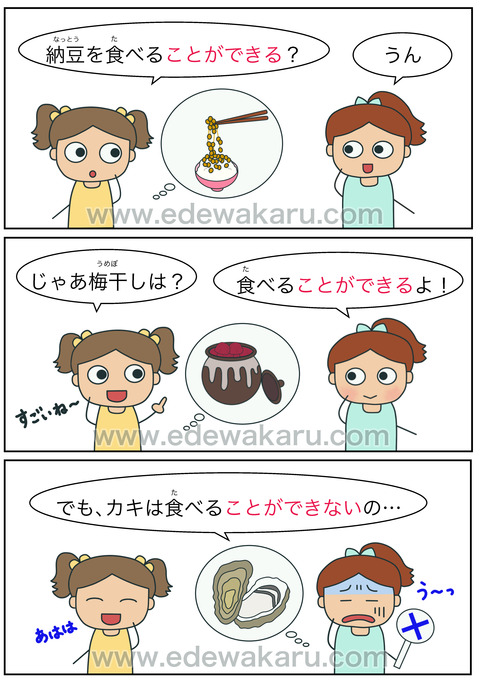
Meaning
To have the ability to do ~
How to use it
Verb [dictionary form]+ことができる
Verb [dictionary form]+ことができない
Explanation
「〜ことができる」is a grammar pattern meaning “to have the ability to do ~.” It can be changed to the potential form 「〜れる」.
[Examples]
① A: Can you eat natto?
= Can you eat natto?
② She can speak English.
= She can speak English.
③ He can run very fast.
= He can run very fast.
④ My mother can make any kind of dish.
= She can make any kind of dish.
⑤ Yamada-kun can’t speak well when there are a lot of people around.
= He can’t speak well.
「〜ことができる」also has a usage that expresses [possibility/impossibility].
There are many grammar patterns that use 「こと」, so it may be good to review them 😊
[The “こと” series]
〜こと (command)
〜ことか
〜ことから
〜ことがある
〜ことができる (possibility)
〜ことができる (ability)
〜ことこの上ない
〜ことだ・〜ないことだ
〜ことだから
〜ことだし
〜ことで (about N)
〜こととて
〜ことなしに
〜ことなく
〜ことに
〜ことにしている
〜ことにする
〜ことになっている
〜ことになる・〜こととなる
〜ことには
〜ことは〜が① (adjectives and nouns)
〜ことは〜が② (verbs)
〜ことはない
〜ことはならない
〜たことがある (experience)
〜だこと!
(〜は)〜てのこと
〜ても〜すぎることはない
〜ということだ
〜とのことだ
〜ないこともない
〜ないことには
〜なかったことがある
In context 5 examples
A:納豆を食べることができる?B:うんA:梅干しは?B:食べることができるよA:すごいね〜B:でもカキは食べることができないの…
A: Can you eat natto? B: Yes. A: What about pickled plums? B: I can eat them. A: That’s amazing~ B: But I can’t eat oysters…
彼女は英語を話すことができる
She can speak English.
彼はとても速く走ることができる
He can run very fast.
私のお母さんは、どんな料理でも作ることができます
My mother can make any kind of dish.
山田くんはたくさん人がいると、うまく話すことができない
Yamada-kun can’t speak well when there are a lot of people around.
Read the original source text
Meaning
〜する能力がある
How to use it
動詞[辞書形]+ことができる
動詞[辞書形]+ことができない
Explanation
「〜ことができる」は「〜する能力がある」という意味を表す文型です。
この文型は可能形「〜れる」にチェンジできます。
[例]
①A:納豆を食べる
ことができる?
=納豆が食べ
られる?
②彼女は英語を話す
ことができる
=英語が話
せる
③彼はとても早く走る
ことができる
=彼はとても早く走
れる
④私のお母さんは、どんな料理でも作る
ことができます
=どんな料理でも作
れます
⑤山田くんはたくさん人がいると、うまく話す
ことができない
=うまく話
せない
「〜ことができる」には【可能・不可能】を表す用法もあります。
また、「こと」がつく文型はたくさんありますので、復習しておくといいと思います😊
【「こと」シリーズ】
〜こと(命令)
〜ことか
〜ことから
〜ことがある
〜ことができる(可能)
〜ことができる(能力)
〜ことこの上ない
〜ことだ・〜ないことだ
〜ことだから
〜ことだし
〜ことで(Nのことで)
〜こととて
〜ことなしに
〜ことなく
〜ことに
〜ことにしている
〜ことにする
〜ことになっている
〜ことになる・〜こととなる
〜ことには
〜ことは〜が①(形容詞・名詞)
〜ことは〜が②(動詞)
〜ことはない
〜ことはならない
〜たことがある(経験)
〜だこと!
(〜は)〜てのこと
〜ても〜すぎることはない
〜ということだ
〜とのことだ
〜ないこともない
〜ないことには
〜なかったことがある
毎日のんびり日本語教師
How to use it
Verb dictionary form + ことができる
Explanation
Expresses ability or possibility. The negative form is “~ことができない.”
However, stative verbs such as 降る, いる, ある, and 分かる, and intransitive verbs whose subjects are things, such as 崩れる, 壊れる, 光る, and 蒸発する, do not have potential forms, so this construction cannot attach to them.
An expression such as “失敗したら罰ゲームを受けることができる” (“If you fail, you can receive a punishment game”) is incorrect; it cannot be used for bad things. It must always be used in a positive sense.
Notes
Related grammar: 【N4 grammar】~れる/られる/できる (potential forms)
In context 10 examples
子供の頃から追いかけてきた夢を叶えることができた。(从小追求的梦想终于实现了。)
I was able to make the dream I had pursued since childhood come true.
全力を尽くした結果、合格を掴むことができた。
As a result of giving it my all, I was able to secure a passing result.
めちゃめちゃ寒かったですが、たくさんの流星を見ることができました。
It was incredibly cold, but I was able to see lots of meteors.
苦労したけど、大きな壁を乗り越えることができたと思う。
It was hard, but I think I was able to overcome a major obstacle.
とても大きな成果を挙げることができた。(取得了很大的成果。)
I was able to achieve a very great result.
5キロくらい痩せることができた。(瘦了5公斤左右。)
I was able to lose about five kilograms.
高校時代はほとんどなかった運動する習慣をつけることができた。
I was able to develop a habit of exercising, something I hardly ever did in high school.
幸せの青い鳥と呼ばれるルリビタキは、滅多に見ることができません。
The red-flanked bluetail, known as the blue bird of happiness, is rarely seen.
この気持ちは言葉に表すことができない。
I can’t put this feeling into words.
人生はやり直すことができない。
You can’t start your life over.
Read the original source text
How to use it
動詞辞書形+ことができる
Explanation
能力や可能性を表します。否定形は「~ことができない」です。
ただし、降る、いる、ある、分かる等の状態を表す動詞や、崩れる、壊れる、光る、蒸発する等の主語が物の時の自動詞には可能形がありませんので接続することができません。
「失敗したら罰ゲームを受けることができる」のような表現は誤りで、悪いことに使うことはできません。必ず良い方面に用います。
Notes
関連文法「【N4文法】~れる/られる/できる(可能態)」
日本語文型辞典 英語版
Meaning
【ことができる】[V-ることができる]
Expresses the existence/non-existence of an ability (
(1)
,
(2)) or possibility (
(3)
,
(4)). Can be substituted with V-れる, which shows possibility, as in 話せる (can speak) and 泳げる (able to swim). However, there is a slight tendency for ことができる to be preferred in formal situations and formal written language, especially when expressing possibility.
In context 4 examples
アラビア語を話すことができますか。
Can you speak Arabic?
あの人は、ゆっくりなら 20 kmでも 30 kmでも泳ぐことができるそうだよ。
They say she can swim as far as twenty or thirty kilometers, if she goes slowly.
残念ですが、ご要望におこたえすることはできません。
Unfortunately, I am unable to respond to your request.
その社会や階級の構成員を「再生産」するという観点から、「教育」というものをとらえ直してみることもできるだろう。
From the perspective of “reproducing” the members of that society or social class, I suppose it is possible to try to re-think the idea of “education.”
Bunpro Grammar Reference
Meaning
Can, Be able to
How to use it
Verb + こと + が + できる
Noun + が + できる
Verb + こと + が + できます
Noun + が + できます
Nuance
A grammar point that can highlight an entire phrase as being possible.
Explanation
Like ことがある, ことができる is an expression that nominalizes what comes before it (turns it into a noun-phrase), and then highlights something about that (A) phrase. In the case of ことができる, the thing being highlighted about (A) is that it is 'possible'. This translates as 'can do (A)', or 'to be able to do (A)'.
魚のように泳ぐことができるように毎日練習する。
I practice everyday so that I will be able to swim like a fish.
彼は料理をすることができる。
He is able to cook.
However, こと is only required when the (A) phrase needs nominalization (is not a noun to begin with). Due to this, ができる may be used by itself when following a noun, without changing the meaning.
運転ができる彼氏が欲しい。
I want a boyfriend that can drive.
力仕事ができる人を探しています。
We are looking for a person that is able to do physical labor.
Fun Fact
のが (or のは) is also frequently used for nominalization, but this is rarely the case when a verb follows it. Some other expressions where のが may not be swapped for こと are as follows:
ことがある - For (A) to exist.
ことにする - To make something (A).
ことになる - For (A) to come to be.
In context 16 examples
- 馬に乗る事が出来る。
I can ride a horse.
- 運転ができる彼氏が欲しい。
I want a boyfriend that can drive.
- 力仕事ができる人を探しています。
We are looking for a person that is able to do physical labor.
- 魚のように泳ぐことができるように毎日練習する。
I practice everyday so that I will be able to swim like a fish.
- 彼は料理をすることができる。
He is able to cook.
- 泳ぐ事が出来ますか?
Can you swim?
- 初めて、漢字を書く事が出来た。
I was able to write kanji for the first time.
- 私の姉は歌う事が出来る。
My older sister can sing.
- 約束を守る事が出来なくてすみません。
I am sorry that I am unable to keep my promise.
- 歌う事が出来るでしょう?やりなさい。
You are able to sing, right? Do it!
- やらなくてはいけない事が出来ない。
I am unable to do the things I have to do.
- 私の子供は一人で買い物が出来る。
My kid can go shopping by himself.
- 明日までに提出する事が出来ると思います。
I think that I will be able to submit it by tomorrow.
- 私より君の方がピアノをうまく弾く事が出来る。
You can play the piano better than me.
- 日本語を読む事が出来るだけで、凄いと思います。
Just from the fact that you are able to read Japanese, I think you are amazing.
- 毎日日本語を勉強するだけで、将来日本語を話す事が出来る。
Just by studying Japanese every day, you will be able to speak Japanese in the future.
NINJAL 日本語文型データベース
Meaning
[1] Expresses having the ability to make ~ happen.
[2] Expresses that circumstances make ~ possible. It can refer to a general situation due to rules, for example, or to a specific situation.
How to use it
Vることができる
Notes
[1] 「~」 takes a verb expressing a deliberate action, such as 「作る・見る・説明する」.
[2] 「~」 takes a verb expressing a deliberate action, such as 「行く・見る・参加する」.
When referring to a general situation, the person performing the action often does not appear in the sentence.
In context 13 examples
本田さんは英語、フランス語、スペイン語、中国語を話すことができる。
Honda can speak English, French, Spanish, and Chinese.
学生時代、私は水泳が得意で、何キロでも泳ぐことができたのだが……。
When I was a student, I was good at swimming and could swim any number of kilometers, but…
「100mを10秒以内で走ることができますか」「いいえ、できません」
“Can you run 100 meters in under 10 seconds?” “No, I can’t.”
人間は周波数20キロヘルツ以上の音を聴き取ることはできない。
Humans cannot hear sounds with frequencies of 20 kilohertz or higher.
人の話を黙って最後まで聴くことができるようになりたい。
I want to become able to listen quietly to what people say all the way to the end.
どんな困難に出会っても乗り越えることができる気力と体力を身につけよう。
Let’s build up the mental and physical strength to overcome any difficulties we encounter.
前は料理を短時間で作ることはできなかったが、今はだいぶ慣れてきて、手早く作ることができるようになった。
I used to be unable to cook a meal in a short time, but now I’ve gotten much more used to it and can cook quickly.
晴れれば、この歩道橋の上から富士山を見ることができます。
If the weather is clear, you can see Mt. Fuji from the top of this pedestrian bridge.
日本では、20歳にならないとお酒を飲むことはできません。
In Japan, you cannot drink alcohol until you turn 20.
幼なじみの私たちは、近くに住んでいたころはいつでも会うことができたが、私が外国にいる今は、そうはいかない。
When we childhood friends lived nearby, we could meet whenever we wanted, but now that I’m abroad, we can’t do that.
クーポンを忘れて行ってしまったので、今日は割引で食事をすることができなかった。
I forgot to bring the coupon, so I couldn’t get a discount on my meal today.
この橋が完成すれば、向こうの村まで短時間で行くことができるようになるだろう。
Once this bridge is completed, it will probably become possible to get to the village over there in a short time.
これは誰でも自由に参加することができるオンライン講座です。
This is an online course that anyone can freely take part in.
Read the original source text
Meaning
[1] ~を実現する能力があることを表します。
[2] ~が実現可能な状況であることを表します。規則などによる一般的な状況を言う場合と、個別的な状況を言う場合があります。
How to use it
Vることができる
Notes
[1] 「~」には、「作る・見る・説明する」など、意志的な行為を表す動詞がきます。
[2] 「~」には、「行く・見る・参加する」など、意志的な行為を表す動詞がきます。
一般的な状況を言う場合は、動作の主体は文中に現れないことが多いです。
どんなときどう使う 日本語表現文型辞典
Meaning
can
How to use it
Vる+こと/N+ができる (can; be able to)
Explanation
1)可能の意味を表す。 ❶ ~ ❸ は、技術的、身体的な能力を表す。 ❹ ~ ❻ は、決まりや状況などで行為の実現が可能であることを表す。
2)「Nができる」のNは、する動詞の名詞(見学、練習など)や外国語、スポーツなどの名詞。
3)「られる(可能)」とほとんど同じように使うことができるが、「られる」より硬い感じがする。また、前後にほかの言葉がつくときや、動詞の単純な形ではない場合には、「ことができる」の方がよく使われる。
◆ 疲れて、もう歩くこともできない。/わたしは漢字を読むことだけはできますが、書くことはまだできません。/試験中はとなりの人と話したり、教科書を見たりすることはできません。
2)The N in N ができるis nominal of する verb, such as 見学, 練習, or a noun such as name of foreign language or sport.
3)Can be used in nearly same way as られる, but sounds more formal. When other words are appended as prefixes or suffixes and the verb is not in its pure form, ことができる is often used.
1)Possibility. Sentences ❶ to ❸ show technical or physical ability. Sentences ❹ to ❻ show that realization of an action through regulations or conditions is possible.
In context 6 examples
わたしは今、すこし日本語を話すことができます。
I can speak a little Japanese now.
ロボットは危険な所でも仕事をすることができます。
Robots can work even in dangerous places.
先週退院しました。わたしはもう元気です。散歩も軽い運動もできます。
I was discharged from the hospital last week. I'm well now. I can go for walks and do light exercise.
19歳以下の人は、たばこを吸うことはできません。
People aged 19 and under cannot smoke.
今月はいそがしくてゴルフができませんでしたが、来月はできると思います。
I was busy this month and couldn't play golf, but I think I can next month.
(立て札)ここは危険ですからキャンプはできません。
(Sign) This is a dangerous place, so camping is not allowed.
Read the original source text
Meaning
can
How to use it
Vる+こと/N+ができる
Explanation
1)可能の意味を表す。 ❶ ~ ❸ は、技術的、身体的な能力を表す。 ❹ ~ ❻ は、決まりや状況などで行為の実現が可能であることを表す。
2)「Nができる」のNは、する動詞の名詞(見学、練習など)や外国語、スポーツなどの名詞。
3)「られる(可能)」とほとんど同じように使うことができるが、「られる」より硬い感じがする。また、前後にほかの言葉がつくときや、動詞の単純な形ではない場合には、「ことができる」の方がよく使われる。
◆ 疲れて、もう歩くこともできない。/わたしは漢字を読むことだけはできますが、書くことはまだできません。/試験中はとなりの人と話したり、教科書を見たりすることはできません。
2)The N in N ができるis nominal of する verb, such as 見学, 練習, or a noun such as name of foreign language or sport.
3)Can be used in nearly same way as られる, but sounds more formal. When other words are appended as prefixes or suffixes and the verb is not in its pure form, ことができる is often used.
1)Possibility. Sentences ❶ to ❸ show technical or physical ability. Sentences ❹ to ❻ show that realization of an action through regulations or conditions is possible.