AIUEO JLPT Grammar
Meaning
This sentence pattern is used to acknowledge that something stated previously is true but emphasizes that the actual situation or degree is different from what was expected. It is used to correct or provide additional information to modify someone’s expectations.
How to use it
Ordinary sentence と + いっても
In context 5 examples
料理ができるといっても、簡単なものしか作れません。
Even though I say I can cook, I can only make simple dishes.
寒いといっても、コートを着るほどではありません。
Even though it’s cold, it’s not cold enough to wear a coat.
簡単だといっても、油断すると失敗するかもしれません。
Even though it’s simple, if you’re careless, you might fail.
休みといっても、家で過ごすだけです。
Even though it’s a holiday, I’m just spending it at home.
日本料理が好きといっても、寿司しか食べません。
Even though I say I like Japanese food, I only eat sushi.
Read the original source text
Meaning
This sentence pattern is used to acknowledge that something stated previously is true but emphasizes that the actual situation or degree is different from what was expected. It is used to correct or provide additional information to modify someone’s expectations.
How to use it
普通文と+いっても
Explanation · 日本語
この文型は、前に述べたことが事実であることを認めつつも、実際の状況や程度がそれとは異なることを強調する表現で、話し手が何かを説明するときに、相手の期待や想像を修正したり、補足的な情報を提供するために使われます。
文法
Meaning
“You might say 〜, but in reality ...”
Used to express that the reality differs from what one might expect from 〜.
How to use it
V (plain form) + といっても
い-adjective (plain form) + といっても
な-adjective (plain form) + といっても
Nだ + といっても
In context 9 examples
日本語ができるといっても、読んだり、書いたりできない。
Although I can speak Japanese, I can't read or write it.
お金持ちといっても、彼が住んでいる家の家賃は5万円だ。
Although he's rich, the rent for the place he lives in is 50,000 yen.
古いといっても、まだ十分に使える物ばかりだ。
Although they're old, all of them are still perfectly usable.
会社を作ったといっても、社員が2人だけの会社だ。
Although he started a company, it's a company with only two employees.
私はマンションに住んでいるといっても、2LDKの小さなマンションだ。
Although I live in an apartment building, it's a small two-bedroom apartment.
海外で生活したことがあるといっても、実は1か月だけなんです。
Although I've lived abroad, it was actually for just one month.
自分のホームページを1から作ったといっても、ほとんど別のサイトのコピーだけどね。
Although I built my own website from scratch, it's mostly just a copy of another site.
新しいアルバイトが見つかったといっても、夏休みの間だけですよ。
Although I found a new part-time job, it's only for the summer vacation.
ギターが弾けるといっても、3曲だけですけどね。
Although I can play the guitar, I only know three songs.
Read the original source text
Meaning
~というけれども、実際は・・・。
〜から考えられるものと実際が違うことを表現するときに使う。
How to use it
V(普通形)+ といっても
イA(普通形)+ といっても
ナA(普通形)+ といっても
Nだ + といっても
どんなときどう使う 日本語表現文型辞典
Meaning
may be, but…in name only
How to use it
N / 〔Plain form〕 + といっても
Explanation
~というけれども、実は
「~といっても、…」の形で、「~から予想されるものと違って、実は…だ」と実態の説明をするときの言い方。
Unlike what was expected, actual situation is different.
In context 5 examples
わたしの住んでいる所はマンションといっても9戸だけの小さなものです。
What I call an apartment building where I live is a small one with only nine units.
旅費は高いといっても払えない額ではなかった。
Although the travel expenses were high, they weren’t an amount I couldn’t afford.
アフリカで暮らしたことがあるといっても、実は1カ月だけなんです。
Although I’ve lived in Africa, it was actually only for one month.
彼はロシア語ができるといっても日常会話だけで、読み書きはできない。
Although he can speak Russian, it’s only conversational Russian; he can’t read or write it.
わたしは日本人だといっても外国育ちだから漢字はほとんど読めないんです。
Although I’m Japanese, I grew up abroad, so I can hardly read kanji.
Read the original source text
Meaning
may be, but…in name only
How to use it
N/〔普通形〕+といっても
Explanation
~というけれども、実は
「~といっても、…」の形で、「~から予想されるものと違って、実は…だ」と実態の説明をするときの言い方。
Unlike what was expected, actual situation is different.
絵でわかる日本語
Meaning
You say ~, but in reality ~
I said ~, but in reality ~
How to use it
Verb・adjective・noun [plain form]+といっても
Explanation
「Aといっても」 is a sentence pattern meaning “you say A, but in reality ~.” It is used when talking about something mentioned earlier and wanting to say, “In reality, the extent of A isn’t that impressive” 😊
[Examples]
I’ve studied abroad, but only for two weeks.
→ It was only a two-week study abroad, so it’s not that impressive.
I can speak English, but only enough to greet people.
→ I only know “Hello” and “Thank you,” so my ability to speak isn’t very impressive.
「といっても」 can also be used at the beginning of a sentence 😮
[Examples]
I can speak English.
That said, I can only manage greetings…
I’ve studied abroad.
That said, it was only for two weeks.
Remember the similar sentence patterns too 😀
In context 5 examples
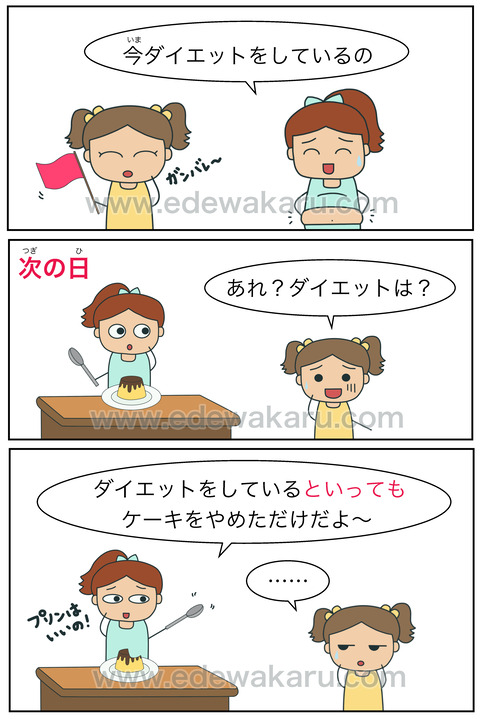
ダイエットをしているといっても、ケーキをやめただけだよ〜
→ダイエットをしていると言ったけど、実際はケーキをやめただけだよ〜(復習:〜ている(結果の状態))I’m dieting, but all I’ve done is give up cake~ → I said I’m dieting, but in reality all I’ve done is give up cake~ (Review: 〜ている (resulting state))
留学したことがあるといっても、2週間だけです
→留学したことがあると言いましたが、実際は2週間留学しただけですI’ve studied abroad, but only for two weeks. → I said I’ve studied abroad, but in reality I only studied abroad for two weeks.
英語が話せるといっても「ハロー」と「サンキュー 」しか知らない
→英語が話せるといったけど、実際は「ハロー」と「サンキュー」しか知らないI can speak English, but I only know “Hello” and “Thank you.” → I said I can speak English, but in reality I only know “Hello” and “Thank you.”
料理ができるといっても、簡単なものしか作れない
→料理ができると言ったが、実際は簡単なものしか作れないI can cook, but I can only make simple things. → I said I can cook, but in reality I can only make simple things.
社長だといっても、社員3人の小さな会社です
→社長だと言いましたが、実際は社員3人の小さな会社ですI’m the company president, but it’s a small company with only three employees. → I said I’m the president, but in reality it’s a small company with only three employees.
Read the original source text
Meaning
〜と言うけれども、実際は〜
〜と言ったが、実際は〜
How to use it
動詞・形容詞・名詞[普通形]+といっても
Explanation
「Aといっても」は「Aと言うけれども、実際は〜」という意味を表す文型です。この文型は、前に言ったことについて「
実際には、Aの程度はそんなにすごくない」
と言いたい時に使われます😊
[例]
留学したことがある
といっても、2週間だけです
→「2週間の留学」なので、そんなにすごくない
英語が話せる
といっても、あいさつぐらいだ
→「HelloとThank youしか知らない」ので、話せる程度はすごくない
「といっても」は文頭に使うこともできます😮
[例]
私は英語が話せます。
といっても、あいさつぐらいですけど…
留学したことがあります。
といっても、2週間だけですけどね
類似文型(るいじぶんけい)も覚えておきましょう😀
日本語文型辞典
Meaning
Used to qualify and limit something stated in the preceding sentence by adding that, in reality, it is not as serious or extensive as one might expect.
a. …といっても
Used to add that something mentioned earlier is not actually so serious or extensive.
b. ひとくちに…といっても
Means that although something is being summed up simply, in reality it is complex.
Used to indicate that a special situation has arisen and that something might naturally be expected from it, but in reality it is not serious and causes no problem.
Means “it would not be wrong to evaluate it that way.” An expression for stating an interpretation, judgment, or criticism of a matter or person. More tactful than …といえる. A 䖵画峇 expression.
Means “it would not be an exaggeration to put it that way.” Used to state an assertion strongly. In formal written language, 過言 may be used instead of 言いすぎ.
How to use it
といっても
…といっても
c…といっても…ない
…といってもいいだろう
…といってもいいすぎではない
In context 23 examples
ビデオの作品を作った。といっても、せいぜい10分の短い作品だが。
I made a video. That said, it's a short piece, ten minutes at most.
新しいアルバイトが見つかった。といっても、友達の代わりに一週間働くだけだ。
I found a new part-time job. That said, I'll only be working for a week as a substitute for a friend.
あの人がこのクラブの会長です。といっても、大会であいさつするだけですが。
That person is the chair of this club. That said, all they do is give a greeting at competitions.
仕事場が変わりました。といっても、同じ階の端から端へ移っただけなんですけど。
My workplace changed. That said, I only moved from one end of the same floor to the other.
A:休みには故郷へ帰ります。
B:じゃあ、当分お目にかかれませんね。
A:いや、帰るといっても、二週間程度で、すぐまた帰って来ます。A: I'm going back to my hometown for the holidays. B: Then we won't be able to see each other for a while. A: Well, when I say I'm going back, it'll only be for about two weeks, and I'll be right back.
料理ができるといっても、卵焼きぐらいです。
I can cook, but only things like omelets.
シンガポールへ行ったといっても、実際は一日滞在しただけです。
I went to Singapore, but in reality I only stayed for one day.
A:去年は珍しく雪が降りました。
B:へえ、あんな暖かい所でも降るんですか。
A:いや、降ったといっても、ほんの少しで、すぐ消えてしまいました。A: It snowed last year, which was unusual. B: Really? It snows even in such a warm place? A: Well, when I say it snowed, it was only a little, and it melted right away.
日本舞踊ができるといっても、ほんのお遊び程度です。
I can do Japanese dance, but only at a very amateur level.
一口にアジアといっても、広大で、多種多様な文化があるのです。
Although we call it Asia as a whole, it is vast and has a diverse range of cultures.
一口にバラといっても、実に豊富な種類があります。
Although we speak of roses as one kind, there are actually a great many varieties.
一口にE本人の考え方といっても、いろいろな考え方があるので、どうとは決めにくいのです。
Although we speak broadly of Japanese people's way of thinking, there are many different views, so it's hard to say anything definitive.
A:来週はテストがあるんです。
B:じゃあ、このハイキングはだめですね。
A:いえ、テストがあるといっても、そんなにたいしたものじゃありませんから、一日ぐらいはだいじょうぶです。A: I have a test next week. B: Then this hike is out. A: No, when I say I have a test, it's not anything that serious, so taking a day off should be fine.
山登りが趣味だと言っても、そんなに経験があるわけではありません。
Even though I say mountain climbing is my hobby, it's not as if I have that much experience.
風邪を引いたと言っても、そんなに熱はない。
Even though I say I have a cold, I don't have much of a fever.
アルバイトの人がやめたといっても、店のほうは別に支障はない。
Even though a part-time worker quit, it doesn't really affect the store.
土曜日には、夫の姉が遊びに来ることになっている。しかし、お客が来るといっても、別に得に忙しいわけではない。
My husband's older sister is coming to visit on Saturday. But even though we're having a guest, it's not as if we'll be especially busy.
これは、この作家の最高の傑作だといってもいいだろう。
You could say this is the author's greatest masterpiece.
川田さんは、かれの本当の恩師だといってもいいだろう。
You could say Mr. Kawada is his true mentor.
事実上の決勝は、この試合だと言ってもいいだろう。
You could say that this match is, in effect, the final.
環境破壊の問題は、これから世界の最も重要な課題になるといっても言い過ぎではない。
It is no exaggeration to say that environmental destruction will become the world's most important issue from now on.
成功はすべて有田さんのおかげだといってもいいすぎではない。
It is no exaggeration to say that all the success is thanks to Mr. Arita.
(例) そのニュースは国中の人々を幸福な気分にさせたといっても過言ではない。
(Example) It is no exaggeration to say that the news made people throughout the country feel happy.
Read the original source text
Meaning
前文で述べたことから期待されることがらに対して、実際はそれほど程度が重くないと修正をくわえ、限定するのに使う。
a. …といっても
前に述べたことについて、それが実際にはそれほど程度の重いことではないとつけ足すのに用いる。
b. ひとくちに…といっても
簡単にまとめていうが、実際は複雑だという意味を表す。
ある特別な事態が生じていることを示し、そこから当然予測されることがあるが、実際には程度は重くない、問題は生じないと述べるのに用いる。
「そのように評価してまちがいではないだろう」の意味。ことがらや人についての解釈、判断、批評を述べる表現。「…といえる」より、婉曲な表現。蟀画峇表現
「そのように述べることもおおげさではない」という意味。主張を強く述べるのに用いる。かたい書きことばでは、「言いすぎ」のかわりに「過言」が用いられることがある。
How to use it
といっても
…といっても
c…といっても…ない
…といってもいいだろう
…といってもいいすぎではない
日本語文型辞典 英語版
Meaning
Used to revise an expectation that arises from the previous sentence by indicating that the degree or extent of something is actually not very great. Indicates a limit.
B:じゃあ、当分お目にかかれませんね。
Well then, we won’t be seeing you for a while, will we?
A:いや、帰るといっても、一週間程度で、すぐまた帰って来ます。
Actually, even though I’m going home, it’s only for about a week, so I'll be back soon.
B:へえ、あんな暖かい所でも降るんですか。
Really? It snows even in such a warm place?
A:いや、降ったといっても、ほんの少しで、すぐ消えてしまいました。
Well, it did snow, but only a little that melted right away.
Used to supplement a previous statement by indicating that the degree or extent of something is actually not very great.
b. ひとくちに...といっても
Expresses that something summed up rather simply is actually more complex in nature.
c. ...といっても...ない
B:じゃあ、このハイキングはだめですね。
Well, I guess we can’t go hiking then.
A:いえ、テストがあるといっても、そんなにたいしたものじゃありませんから、一日ぐらいはだいじょうぶです。
No, even though it’s a test, it’s not such a big deal, so taking one day off shouldn’t be a problem.
Used to indicate that some kind of special situation has come about, and that although a certain consequence is expected, its degree or extent will not be very great, or no particular problem will arise.
Means “such-and-such an evaluation is probably not mistaken.” Used when offering an interpretation, judgment, or critique of a situation or person. A more euphemistic expression than ...といえる.
Means “to say such-and-such is not an exaggeration.” Used for strong emphasis of an assertion. In formal written language, 言いすぎ can be replaced by 過言.
(例)そのニュースは国中の人々を幸福な気分にさせたといっても過言ではない。
It is not an exaggeration to say that this news made people all throughout the nation very happy.
How to use it
1. といっても
2. ...といってもa. ...といっても
3. ...といってもいいだろう
4. ...といってもいいすぎではない
In context 22 examples
ビデオの作品を作った。といっても、せいぜい 10 分の短い作品だが。
I made a video piece. But it was a short piece, no more than ten minutes at most.
新しいアルバイトが見つかった。といっても、友達の代わりに一週間働くだけだ。
I found a new part-time job. That is, I’m just filling in for a friend for a week.
あの人がこのクラブの会長です。といっても、大会であいさつするだけですが。
That’s the president of this club. Which is to say that she just gives the official speeches at tournaments.
仕事場が変わりました。といっても、同じ階の端から端へ移っただけなんですけど。
I’m working in a new place. But I’ve really just moved from one end of the same floor to the other.
A:休みには故郷へ帰ります。
I’m going back to my hometown for the vacation.
料理ができるといっても、卵焼きぐらいです。
I say I can cook, albeit just tamagoyaki (Japanese omelet).
シンガポールへ行ったといっても、実際は一日滞在しただけです。
Although I have been to Singapore, it was really just a one-day stopover.
A:去年は珍しく雪が降りました。
Last year we had an unusual snowfall.
日本舞踊ができるといっても、ほんのお遊び程度です。
I can do traditional Japanese dance, but it’s just for fun, nothing more.
一口にアジアといっても、広大で、多種多様な文化があるのです。
The term “Asia” is a simple one, but it refers to a vast area with many diverse cultures.
一口にバラといっても、実に豊富な種類があります。
What we call “the rose” actually includes an abundant range of varieties.
一口に日本人の考え方といっても、いろいろな考え方があるので、どうとは決めにくいのです。
Even if you say “the Japanese way of thinking,” it is not easy to determine what this is, because there are many different ways of thinking.
A:来週はテストがあるんです。
I’ve got a test next week.
山登りが趣味だと言っても、そんなに経験があるわけではありません。
I may say that mountain-climbing is one of my hobbies, but that doesn't mean I have very much experience.
風邪を引いたと言っても、そんなに熱はない。
I’ve caught some kind of bug, but I don’t have any temperature to speak of.
アルバイトの人がやめたといっても、店のほうは別に支障はない。
It’s true that a part-time worker has quit, but that won’t cause any problems for the store.
土曜日には、夫の姉が遊びに来ることになっている。しかし、お客が来るといっても、別に特に忙しいわけではない。
My husband’s sister will be coming to visit us on Saturday. But even though we’ll have a guest, I won’t be particularly busy.
これは、この作家の最高の傑作だといってもいいだろう。
I think it could be said that this work is the author’s masterpiece.
川田さんは、かれの本当の恩師だといってもいいだろう。
I suppose you could say that Kawada-san is his true mentor.
事実上の決勝は、この試合だと言ってもいいだろう。
I think it’s possible to say that, for all intents and purposes, this match will be the final.
環境破壊の問題は、これから世界の最も重要な課題になるといっても言い過ぎではない。
It’s not an overstatement to say that the problem of environmental destruction will be the crucial issue facing the entire world from now on.
成功はすべて有田さんのおかげだといってもいいすぎではない。
It’s not too much to say that all our success is thanks to Arita-san.
Read the original source text
Meaning
Used to revise an expectation that arises from the previous sentence by indicating that the degree or extent of something is actually not very great. Indicates a limit.
B:じゃあ、当分お目にかかれませんね。
Well then, we won’t be seeing you for a while, will we?
A:いや、帰るといっても、一週間程度で、すぐまた帰って来ます。
Actually, even though I’m going home, it’s only for about a week, so I'll be back soon.
B:へえ、あんな暖かい所でも降るんですか。
Really? It snows even in such a warm place?
A:いや、降ったといっても、ほんの少しで、すぐ消えてしまいました。
Well, it did snow, but only a little that melted right away.
Used to supplement a previous statement by indicating that the degree or extent of something is actually not very great.
b. ひとくちに...といっても
Expresses that something summed up rather simply is actually more complex in nature.
c. ...といっても...ない
B:じゃあ、このハイキングはだめですね。
Well, I guess we can’t go hiking then.
A:いえ、テストがあるといっても、そんなにたいしたものじゃありませんから、一日ぐらいはだいじょうぶです。
No, even though it’s a test, it’s not such a big deal, so taking one day off shouldn’t be a problem.
Used to indicate that some kind of special situation has come about, and that although a certain consequence is expected, its degree or extent will not be very great, or no particular problem will arise.
Means “such-and-such an evaluation is probably not mistaken.” Used when offering an interpretation, judgment, or critique of a situation or person. A more euphemistic expression than ...といえる.
Means “to say such-and-such is not an exaggeration.” Used for strong emphasis of an assertion. In formal written language, 言いすぎ can be replaced by 過言.
(例)そのニュースは国中の人々を幸福な気分にさせたといっても過言ではない。
It is not an exaggeration to say that this news made people all throughout the nation very happy.
How to use it
1. といっても
2. ...といってもa. ...といっても
3. ...といってもいいだろう
4. ...といってもいいすぎではない
くらべてわかる日本語表現文型辞典
Meaning
Meaning 1: B denies that A is what people generally think it is, or adds an explanation about A.
Meaning 2: A is true, but only to a small extent. Alternatively, B adds that there is at least a little of A.
Meaning 3: A expresses a hope or claim, and B, taking up A, presents reality. A is something impossible or extremely difficult under the current circumstances.
How to use it
Explanation
【Contrast 1】
「A ものの B」(「A とはいうものの B」)(Meaning 1, p. 312)
「A (とはいう) ものの B」means that the result or state expected from A did not occur, and instead B occurred; B is the result. In 「A といっても B」, B is not a result.
○まじめに働いているものの、全然お金がたまらない。
×まじめに働いているといっても、全然お金がたまらない。
×まじめに働いているものの、1週間に2日だけだ。
○まじめに働いているといっても、1週間に2日だけだ。
「A とはいえ B」(Meaning 1, p. 185)
「A といえども B」(Meaning 1, p. 156)
「A からといって B」(Meaning 1, p. 69)
In context 12 examples
ダイエットといっても、ただ食べないだけじゃないんです。
Dieting doesn’t just mean not eating.
ダイヤモンドは高いといっても、これは傷があるからそれ程でもない。
Diamonds are expensive, but this one isn’t that much because it has a flaw.
今の仕事は暇だといっても、拘束時間は長い。
Even though I say my current job is easy, the hours I’m tied up are long.
彼を知っているといっても、話をしたことはない。
I do know him, but I’ve never spoken to him.
酒は飲めないといっても、一杯ぐらいなら飲める。
I can’t drink, but I can manage about one glass.
行ったことがあるといっても、一度だけだ。
I have been there, but only once.
ボーナスがもらえるといっても、あの会社ほどじゃない。
We do get bonuses, but they’re nothing like the ones at that company.
中国語を習っているといっても、まだあいさつ程度しかしゃべれない。
I am studying Chinese, but I can only speak enough to greet people so far.
大学に進学したいといっても、この成績じゃねえ。
I do want to go to university, but with grades like these…
夏休みに海外旅行へ行くといっても、金がない。
I’m going overseas during summer vacation, but I don’t have any money.
あの時、謝っておけばよかったといっても、今さらもう遅い。
I should have apologized back then, but it’s far too late now.
「締切までになんとかするよ」
「なんとかするといっても、あと2日しかないよ。」“I’ll find some way to get it done by the deadline.” “Even so, there are only two days left.”
Read the original source text
Meaning
意味1:Aが一般に考えられるAではないとBで否定したり説明を加えたりする。
意味2:Aは確かだがほんの少しだ。あるいは少しはあるとBで補足する。
意味3:Aに希望・主張がきて、そのAを受けた形でBには現実がくる。Aは実現不可能あるいは現状ではきわめて困難なこと。
How to use it
Explanation
【対比1】
「AもののB(AとはいうもののB)」(意味1 P.312)
「A(とはいう)もののB」はAから予想される結果・状態にならず、Bになったという意味で、Bは結果。「AといってもB」のBは結果ではない。
○まじめに働いているものの、全然お金がたまらない。
×まじめに働いているといっても、全然お金がたまらない。
×まじめに働いているものの、1週間に2日だけだ。
○まじめに働いているといっても、1週間に2日だけだ。
「AとはいえB」(意味1 P.185)
「AといえどもB」(意味1 P.156)
「AからといってB」(意味1 P.69)
日本語NET JLPT文法解説まとめ
Meaning
“You might say 〜, but in reality ...”
Used to express that the reality differs from what one might expect from 〜.
How to use it
V (plain form) + といっても
い-adjective (plain form) + といっても
な-adjective (plain form) + といっても
Nだ + といっても
Explanation
Though ~ , (The reality is different from what should be expected from ~.)
In context 9 examples
日本語ができるといっても、読んだり、書いたりできない。
Although I can speak Japanese, I can't read or write it.
お金持ちといっても、彼が住んでいる家の家賃は5万円だ。
Although he's rich, the rent for the place he lives in is 50,000 yen.
古いといっても、まだ十分に使える物ばかりだ。
Although they're old, all of them are still perfectly usable.
会社を作ったといっても、社員が2人だけの会社だ。
Although he started a company, it's a company with only two employees.
私はマンションに住んでいるといっても、2LDKの小さなマンションだ。
Although I live in an apartment building, it's a small two-bedroom apartment.
海外で生活したことがあるといっても、実は1か月だけなんです。
Although I've lived abroad, it was actually for just one month.
自分のホームページを1から作ったといっても、ほとんど別のサイトのコピーだけどね。
Although I built my own website from scratch, it's mostly just a copy of another site.
新しいアルバイトが見つかったといっても、夏休みの間だけですよ。
Although I found a new part-time job, it's only for the summer vacation.
ギターが弾けるといっても、3曲だけですけどね。
Although I can play the guitar, I only know three songs.
Read the original source text
Meaning
~というけれども、実際は・・・。
〜から考えられるものと実際が違うことを表現するときに使う。
How to use it
V(普通形)+ といっても
イA(普通形)+ といっても
ナA(普通形)+ といっても
Nだ + といっても
Explanation
Though ~ , (The reality is different from what should be expected from ~.)
NINJAL 日本語文型データベース
Meaning
Used when acknowledging something said in the previous sentence or present in the context, then adding that in reality things are different from what one might expect from it.
How to use it
V plain form + といっても
i-A plain form + といっても
na-A plain form + といっても (「na-Aだ」 can also take the forms 「na-A+といっても」 or 「na-Aである+といっても」)
N plain form + といっても (「Nだ」 can also take the forms 「N+といっても」 or 「Nである+といっても」)
Notes
After 「〜といっても」 comes a sentence that explains the actual situation.
In context 18 examples
私は海外に住んだことがあるといっても、たった3か月のことだ。
Although I’ve lived overseas, it was only for three months.
英語が話せないといっても、簡単な単語の意味ぐらいはわかります。
Although I can’t speak English, I do at least know the meanings of simple words.
年をとって体力が落ちたといっても、祖父は長年テニスをしていたので元気なほうだと思う。
Although my grandfather has gotten older and lost some stamina, I think he’s still fairly energetic because he played tennis for many years.
雨が降っていたといっても霧雨だったので、傘をささずに歩いた。
Although it was raining, it was only a drizzle, so I walked without an umbrella.
学生時代はお金がなかったと言っても、アルバイトをしていたし、日々の生活に困るようなことはなかった。
Although I didn’t have much money as a student, I had a part-time job, and I never had trouble making ends meet.
どんなに忙しいといっても、1本電話を入れる時間くらいは取れるはずだ。
No matter how busy you are, you should be able to find time to make one phone call.
試験の点数が悪いといっても、たまたまその試験に失敗してしまったということもあるかもしれません。
Even if your test score is bad, it may simply be that you happened to do poorly on that particular test.
今朝は早く起きたのでちょっと眠い。早かったといっても、6時ごろだが。
I got up early this morning, so I’m a little sleepy. Although it was early, it was around six.
昨日大阪はそれほど寒くなかったと言っても、コートは必要だった。
Although it wasn’t all that cold in Osaka yesterday, I still needed a coat.
インターネットの自動翻訳は便利だといっても、やはり誤訳やおかしな文が出てくることも多い。
Although automatic translation on the internet is convenient, mistranslations and awkward sentences still often come up.
仕事が大変といっても、食事もできないほどではないだろう。
Although the job is hard, it can’t be so hard that you can’t even eat.
小学生のころは、図工の授業が好きだった。好きだったといっても、物を作るのはそれほど上手ではなかったが。
When I was in elementary school, I liked art class. Although I liked it, I wasn’t very good at making things.
昨日の試験は、簡単ではなかったと言っても、しっかり勉強していれば無理なく解けるレベルだったと思います。
Although yesterday’s exam wasn’t easy, I think it was at a level that you could solve without difficulty if you had studied properly.
学生だといっても、もう18歳を超えた大人なのだ。自分のことは自分で判断しなければならない。
Although he’s a student, he’s already an adult over 18. He has to make his own decisions.
私の住所は、東京都内といっても23区内ではなくて市部だ。
Although my address is in Tokyo, it’s in the suburban cities, not within the 23 wards.
この店は喫茶店ではないといっても、お茶やデザートもメニューにあるので、喫茶店代わりに使う人もいる。
Although this place isn’t a coffee shop, it has tea and desserts on the menu, so some people use it as one.
彼とは同じ学校だったといっても、年齢も離れているので、面識はありません。
Although we went to the same school, we’re far apart in age, so we don’t know each other.
重傷ではなかったと言っても、けがはけがだ。無理をしないほうがいい。
Although it wasn’t a serious injury, an injury is still an injury. You’d better not overdo it.
Read the original source text
Meaning
前の文で言った、あるいは文脈中にある〜については認めるが、実際にはそこから予想されることとは異なるという補足説明をするときに使います。
How to use it
V普通形+といっても
i-A普通形+といっても
na-A普通形+といっても(「na-Aだ」→「na-A+といっても・na-Aである+といっても」の形になることもある)
N普通形+といっても(「Nだ」→「N+といっても・Nである+といっても」の形になることもある)
Notes
「〜といっても」の後には、実際の状況を説明する文がきます。
DoJG 日本語文法辞典(全集)
Meaning
Although ~ say/said that ~; even though ~ say/said that ~
How to use it
(i) Noun | と言っても | |
| 先生と言っても | Although (I) say, “teacher” |
(ii) {V/Adjective(い/な)/Noun+Copula}informal | と言っても | |
| {行く/行った}と言っても | Although (I) say that someone {will go/went} |
| {安い/安かった}と言っても | Although (I) say that it is/was cheap |
| {静か/静かだった}と言っても | Although (I) say that it is/was quiet |
| {病気だ/病気だった}と言っても | Although (I) say that someone is/was ill |
Explanation
A phrase which is used to clarify a statement in the preceding discourse which might be misleading.
In context 8 examples
私には子供がいます。子供と言ってももう大学生ですが。
I have a child. Well, although I said, "child," he is already a college student (literally: he is already a college student, though).
A:毎日お忙しいんでしょうね。B:いえ、忙しいと言っても週末は休んでいますから。
A: You are busy every day, aren't you? B: No, although people may say that I'm busy, I do not work on weekends, so . . .
もう三月だ。しかし、三月と言ってもこの辺はまだ寒い。
It's already March. But even though I say, "March," it is still cold around here.
山崎先生はまだお若いです。勿論、若いと言っても五十代ですが。
Professor Yamazaki is still young. Of course, even though I said, "young," he is in his fifties (literally: he is in his fifties, though)
仕事が見つかりました。と言ってもパートなんですが。
I've found a job. Well, although I said, "job", it is part-time (literally: it is a part-time job, though).
A: 韓国語をご存知なんでしょう?B:いや、知っていると言っても二年勉強しただけですから大したことはありません。
A: You know Korean, right? B: No, even though people say that I know it, my knowledge is limited because I studied it only two years.
A:辻村さんが手伝ってくれるそうですよ。B: でも、手伝ってくれると言ってもせいぜい二、三時間でしょう。
A: I heard that Mr. Tsujimura will help us. B: But, even though he says that he will help us, it will probably be for a couple of hours at most.
A: あの子は強いですよ。B: いや、強いと言ってもたかが小学生ですよ。
A: That boy is strong, you know. B: Well, even though you say he is strong, he is only an elementary school kid.
毎日のんびり日本語教師
How to use it
Noun + (だ)と言っても
な-adjective stem + (だ)と言っても
Verb plain form + と言っても
い-adjective plain form + と言っても
Explanation
This is a concessive expression.
The first clause acknowledges a fact, and the second states that the result is not what one might expect from the first clause.
As in examples (2) and (5), forms such as 「とは言っても」 can also be used independently like conjunctions.
The most colloquial expressions are 「~と言っても」 and 「~とは言っても」; the most formal are 「~とは言うものの」 and 「~とは言い条」.
Notes
Nothing in particular.
In context 8 examples
いくら美味しいと言っても、見た目が良くなければ食べたくならない。
No matter how delicious it is, if it doesn't look good, I won't want to eat it.
ここは最寄り駅。とは言っても自宅まで歩いて30分もかかる。
This is the nearest station. That said, it still takes a full 30 minutes to walk home.
10月とは言えまだまだ暑い。
Even though it's October, it's still really hot.
結婚には年の差は関係ないとは言えども、実際、世代間のギャップはあるだろう。
Although an age gap doesn't matter in marriage, there will probably be a generation gap in reality.
風邪は治った。とは言うものの、咳で喉を痛めたせいでまだ声が出しづらい。
I've recovered from my cold. That said, my throat was hurt by coughing, so it's still hard to speak.
厳密には違いがあるとは言い条、素人目から見ると判断がつくものではない。
Although there are strictly speaking differences, they aren't discernible to the untrained eye.
ゲームとは言っても頭を使うのは大事だ。
Even though it's a game, it's important to use your head.
所詮夢だとは言っても、リアルすぎて汗までかいた。
Even though it was only a dream, it was so realistic I even broke a sweat.
Read the original source text
How to use it
名詞+(だ)と言っても
な形容詞語幹+(だ)と言っても
動詞普通形+と言っても
い形容詞普通形+と言っても
Explanation
逆接表現です。
前件で事実を認め、後件で前件から予想されるような結果にはならないことを述べます。
例文(2)(5)のように、「とは言っても」などと単独で接続詞的に用いることもできます。
最も口語で使われる表現は「~と言っても」「~とは言っても」で、最も硬い表現は「~とは言うものの」「~とは言い条」です。
Notes
特になし