日本語文型辞典
Usage 1
Meaning
a. NのN [possession/association]
Modifies a noun and indicates its owner, affiliation, location, etc.
b. NのN [quality]
Modifies a noun and expresses various meanings, such as the noun’s quality, state, type, or quantity.
c. NのN [apposition]
Indicates that the preceding N and following N refer to the same thing. The following N is often a proper noun, such as a person’s or thing’s name.
d. N (+ particle) の N
The relationship between 「子供が成長する」 (a child grows), 「自転車を修理する」 (repair a bicycle), and 「アメリカから観光客が来る」 (tourists come from America)—that is, between 「子供」 and 「成長」, 「自転車」 and 「修理」, and 「アメリカ」 and 「観光客」—is expressed by having the first noun modify the second. When 「が」 and 「を」 are used, as in 「子供が成長する」 and 「自転車を修理する」, the result is 「子供の成長」 and 「自転車の修理」, and 「が」 and 「を」 do not appear. With other particles, the particle must also appear, as in 「アメリカからの観光客」 and 「田中さんとの旅行」. This use does not exist for the particle 「に」; instead, 「へ」 is used.
e. Nの…N
When the particle 「が」 is used inside a clause that modifies a noun, as in 「彼が書いた絵」 (a picture he painted) and 「タイプが上手な人」 (a person who types well), 「の」 is used in place of that 「が」.
a. Nの
Means “N’s one” or “one belonging to N.”
b. …の
Attaches to a verb or adjective and means “a thing that is …” or “a thing that I made,” for example.
c. Nの…の
In the form 「Nの+modifier+の」, it is used to specifically indicate a thing related to what N denotes that is in the state described by the modifier. For example, ② means “with regard to beer, the cold bottles among it.”
How to use it
NのN
…の
Naなの
A / V の
NのNaなの
Nの A / V の
In context 34 examples
これはあなたの財布じゃないですか。
Isn’t this your wallet?
こちらは東京電気の田中さんです。
This is Mr. Tanaka from Tokyo Electric.
東京のアパートはとても高い。
Apartments in Tokyo are very expensive.
病気の人を見舞う。
Visit someone who is ill.
バラの花を贈る。
Give someone a rose.
3時の電車に乗る。
Take the three o’clock train.
カップ1杯の水を加える。
Add one cup of water.
友人の和男に相談した。
I consulted my friend Kazuo.
社長の木村さんをご紹介しましょう。
Let me introduce Mr. Kimura, the company president.
これは次女の安子でございます。
This is my second daughter, Yasuko.
子供の成長は早い。
Children grow up quickly.
自転車の修理を頼んだ。
I asked someone to repair my bicycle.
アメリカからの観光客を案内する。
Show tourists from America around.
京都までのバスに乗った。
I took a bus bound for Kyoto.
田中さんとの旅行は楽しかった。
The trip with Mr. Tanaka was fun.
京都での宿泊はホテルより旅館のほうがいい。
For lodging in Kyoto, an inn is better than a hotel.
(誤) 母にの手紙
(Incorrect) a letter to my mother
(正) 母への手紙
(Correct) a letter to my mother
彼の書いた絵はすばらしい。
The picture he painted is wonderful.
学生たちの歌う声が聞こえる。
I can hear the students singing.
タイプの上手な人を探している。
I’m looking for someone who is good at typing.
花の咲く頃にまた来てください。
Please come again when the flowers are in bloom.
これは私のです。
This one is mine.
電気製品はこの会社のが使いやすい。
Electrical products from this company are easy to use.
この電話は壊れてますので、隣の部屋のをお使い下さい。
This phone is broken, so please use the one in the next room.
ラーメンなら、駅前のそば屋のが安くておいしいよ。
If you want ramen, the one at the soba shop in front of the station is cheap and tasty.
柄物のハンカチしか置いてないけど、無地のはありませんか。
They only have patterned handkerchiefs, but do they have any plain ones?
これはちょっと小さすぎます。もう少し大きいのはないですか。
This is a little too small. Do you have one that’s a little bigger?
みんなで料理を持ちよってパーティーをしたんだけど、私が作ったのが一番評判よかったんだ。
We had a party where everyone brought a dish, and the one I made got the best reviews.
これは大きすぎて使いにくい。もっと小さくて便利なのを探さなくてはならない。
This is too big and hard to use. I have to look for something smaller and more convenient.
その牛乳は古いから、さっき買ってきたのを使って下さい。
That milk is old, so please use the one I just bought.
戸棚のなるべく頑丈なのを探してきてほしい。
I’d like you to find the sturdiest one in the cupboard that you can.
ビールの冷えたのはないですか。
Do you have any cold beer?
袋の中にリンゴの腐ったのが入っていた。
There was a rotten apple in the bag.
Read the original source text
Meaning
a. NのN 【所属】
名詞を修飾し、その名詞が表すものの所有者や所属先や所在などを表す。
b. NのN 【性質】
名詞を修飾し、その名詞の性質・状態・種類・数量など、さまざまな意味を表す。
c. NのN 【同格】
前のNと後ろのNが同じものであることを表す。後ろのNには人やものの名前といった固有名詞が用いられることが多い。
d. N(+助詞)のN
「子供が成長する」「自転車を修理する」「アメリカから観光客が来る」の「子供」と「成長」、「自転車」と「修理」、「アメリカ」と「観光客」の関係を、前の名詞が後ろの名詞を修飾することによって表す。「子供が成長する」「自転車を修理する」のように「が」と「を」が用いられている時は「子供の成長」「自転車の修理」となり、「が」や「を」は表れない。それ以外の助詞の場合は「アメリカからの観光客」「田中さんとの旅行」のように助詞も表さなければならない。また、助詞の「に」にはこの用法がなく、代わりに「へ」が用いられる。
e. Nの…N
「彼が書いた絵」「タイプが上手な人」のように、名詞(この場合は「絵」「人」)を修飾する節の中に助詞「が」が用いられている場合、この「が」の代わりに「の」を用いたもの。
a. Nの
「Nのもの」という意味を表す。
b. …の
動詞や形容詞に付いて、「大きいもの」「私が作ったもの」などの意味を表す。
c. Nの…の
「Nの+修飾句十の」という形で、Nの表すものに関して、修飾句の示すような状態にあるものを特に限定して指し示す場合に用いる。例えば②は、「ビールに関して、その中の冷えたど-ル」という意味。
How to use it
NのN
…の
Naなの
A/V の
NのNaなの
Nの A/V の
Usage 2
Meaning
With rising intonation, it expresses a question. It is used in spoken language with children or people one is close to.
With falling intonation, it is used by children or women to make a statement in a lighthearted tone.
With rising or falling intonation, it is used to confirm something with the other person.
With level or falling intonation, it is used by women to give a lighthearted order or prohibition to someone of lower standing.
How to use it
…の [question]
N / Na なの
A / V の
…の [light assertion]
N / Na なの
A / V の
…の [confirmation]
…の [light command]
V-る / V-ない の
In context 16 examples
A:遊んでばかりいて。試験、本当に大丈夫なの?
B:心配するなよ。大丈夫だってば。A: You’re always playing around. Are you really going to be all right for the exam? B: Don’t worry. I told you I’ll be fine.
A:明子ちゃんは、なにをして遊びたいの?
B:バトミントン。A: Akiko, what do you want to play? B: Badminton.
A:スポーツは何が得意なの?
B:テニスです。A: What sport are you good at? B: Tennis.
元気ないね。どうしたの?
You don’t look well. What’s wrong?
お母さん、あの子がいじわるするの。
Mom, that kid is being mean to me.
A:あした映画に行きませんか。
B:残念だけど、明日はほかに用事があるの。A: Would you like to go to the movies tomorrow? B: Sorry, but I have something else to do tomorrow.
彼は私に腹を立てているみたいなの。
It seems he’s angry with me.
A:元気ないですね。
B:ええ、ちょっと気分が悪いの。A: You don’t look well. B: Yes, I’m feeling a little unwell.
A:もう少し早く歩けない?
B:ごめんね。ちょっと足が痛いの。A: Can’t you walk a little faster? B: Sorry. My leg hurts a little.
A:やあ、明子さん。今日は。
B:あら和夫さん。来てたの。A: Hey, Akiko. Hello. B: Oh, Kazuo. You’re here.
春子:正子さん、朝日高校出身なんですって?私もよ。
正子:へえ、春子さんも朝日高校出身なの。Haruko: Masako, I hear you graduated from Asahi High School? So did I. Masako: Oh, you graduated from Asahi High School too, Haruko?
A:君の発表すごくおもしろかったよ。
B:あれ、君も聞いてくれていたの。A: Your presentation was really interesting. B: Oh, you were listening too?
病気なんだから、大人しく寝てているの。
You’re sick, so lie quietly in bed.
そんなわがままは言わないの。
Don’t be so selfish.
明日は早いんだから、今晩は早く寝るの。
You have to get up early tomorrow, so go to bed early tonight.
男の子はこんなことで泣かないの。
Boys don’t cry over something like this.
Read the original source text
Meaning
上昇調のイントネーションを伴って質問を表す。子供や親しい人に対する話しことばに用いられる。
下降調のイントネーションを伴って、子供や女性が軽い調子で断定するのに用いる。
上昇、または下降調のイントネーションを伴って、相手に確認するのに用いられる。
平板、または下降調のイントネーションを伴って、女性が目下の人に対して軽い調子で命令したり禁止したりする場合に用いる。
How to use it
…の【質問】
N/Na なの
A/V の
…の【軽い断定】
N/Na なの
A/V の
…の【確認】
…の【軽い命令】
V-る/V-ない の
Usage 3
Meaning
Lines up things of the same kind and expresses the manner of fussing over this and that. There are also set expressions such as the following.
a. …の…ないのと
Lines up contrasting content and expresses the manner of fussing over this and that.
b. …の…ないのって
Expresses an extremely intense degree. Means “in an awful … state.” What happened as a result is often described afterward. It is also said as 「…のなんのって」. Used in casual spoken language.
a. …のなんのと
Expresses the manner of fussing over various undesirable things.
b. …のなんのって A / V のなんのって
Same as 「…の…ないのって」 in 2b.
How to use it
…の…のと
NだのNだのと
NaだのNaだのと
AのAのと
VのVのと
…の…ないの
A-いのA-くないのと
V-るのV-ないのと
A-いのA-くないのって
V-るのV-ないのって
のなんの
A / V のなんのと
In context 17 examples
量が多すぎるの少なすぎるのと文句ばかり言っている。
They keep complaining that the amount is too much or too little.
頭が痛いの気が進まないのと言っては、誘いを断っている。
They keep turning down invitations, saying they have a headache or don’t feel like it.
形が気にいらないの色が嫌いだのと、気むずかしいことばかり言っている。
They keep making fussy complaints, saying they don’t like the shape or hate the color.
私の父は、行儀が悪いの言葉づかいが悪いのと、口うるさい。
My father nags about everything, saying people have bad manners or use bad language.
(例) なんのか(ん)のと(=ああだこうだと、いろいろ)文句ばかり言っている。
四の五の言わずに(=あれこれ言わずに)ついてこい。(Example) They keep complaining about one thing or another. Stop with all the quibbling and come along.
行くの行かないのと言い争っている。
They are arguing over whether to go or not.
結婚したいのしたくないのとわがままを言う。
They selfishly say they want to get married and then that they don’t.
会社を辞めるの辞めないのと悩んでいた。
They were agonizing over whether to quit the company or not.
A:あの二人、離婚するんですって?
B:ううん。離婚するのしないのと大騒ぎしたけど、結局はうまくおさまったみたいよ。A: I hear those two are getting divorced? B: No. They made a huge fuss about whether to get divorced or not, but it seems things worked out in the end.
A:北海道、寒かったでしょ。
B:寒いの寒くないのって。耳が凍るんじゃないかと思ったよ。A: Hokkaido was cold, wasn’t it? B: Cold is an understatement. I thought my ears were going to freeze.
A:あの治療は痛かったでしょうね。
B:痛いの痛くないのって。思わす大声で叫んじゃったよ。A: That treatment must have been painful. B: Painful is an understatement. I ended up shouting out loud without thinking.
高すぎるのなんのと、文句ばかり言っている。
They keep complaining that it’s so expensive and this and that.
やりたくないのなんのとわがままを言い始めた。
They started acting selfishly, saying they didn’t want to do it and so on.
頭が痛いのなんのと理由をつけては学校を休んでいる。
They keep skipping school, making excuses like having a headache and whatnot.
A:彼女に会って驚いたんじゃない?
B:驚いたのなんのって。すっかり変わっちゃてるんだもの。始めは全然違う人かと思ったよ。A: You must have been surprised when you saw her, right? B: Surprised is an understatement. She’s changed completely. At first I thought she was someone else.
A:あのホテルは車の音がうるさくありませんでしたか。
B:いやあ、うるさいのなんのって、結局一晩中寝られなかった。A: Wasn’t the traffic noise loud at that hotel? B: Oh, it was incredibly noisy; in the end I couldn’t sleep all night.
喜んだのなんのって、あんなに嬉しそうな顔は見たことがない。
I can't tell you how happy they were; I've never seen such a delighted expression.
Read the original source text
Meaning
同類のものを並べ上げて、あれやこれやとうるさく言う様子を表す。次のような慣用句もある。
a. …の…ないのと
対比的な内容を並べ上げて、あれやこれやとうるさく言う様子を表す。
b. …の…ないのって
程度が極端に激しいことを表す。「ひどく…な状態だ」という意味。後ろにはそのために生じたことがらが述べられることが多い。「…のなんのって」とも言う。くだけた話しことばに用いる。
a. …のなんのと
好ましくないことをあれこれうるさく言う様子を表す。
b. …のなんのって A/V のなんのって
2bの「…の…ないのって」と同じ。
How to use it
…の…のと
NだのNだのと
NaだのNaだのと
AのAのと
VのVのと
…の…ないの
A-いのA-くないのと
V-るのV-ないのと
A-いのA-くないのって
V-るのV-ないのって
のなんの
A/V のなんのと
絵でわかる日本語
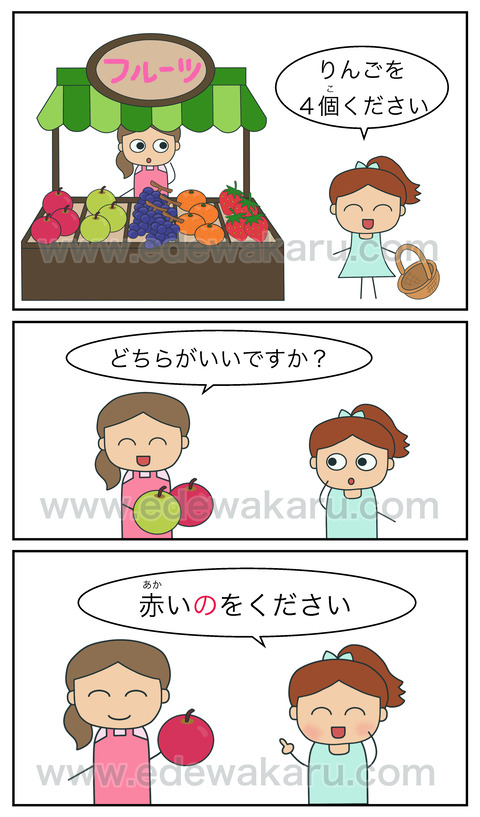
Meaning
~ thing
How to use it
Verb [た-form・ている-form] + の
い-adjective [dictionary form] + の
な-adjective [ーな] + の
Explanation
“〜の” is used to mean “〜もの” (thing). It is used when what it refers to is clear. 😊
[Examples]
① Please give me the red one → Please give me the red apple.
[It is clear that the thing being referred to is “apple.”]
③ I want one that is easy to use → I want a smartphone that is easy to use.
[It is clear that the thing being referred to is “smartphone.”]
④ The one Yamada made was delicious → The food Yamada made was delicious.
[It is clear that the thing being referred to is “food.”]
This is the “の” taught at the beginner level, and it is a very important expression that is also used frequently in conversation. Do your best to use it naturally in conversation too 😉
In context 4 examples
赤いのをください
→赤いものをくださいPlease give me the red one. → Please give me the red thing.
店員:サイズはいかがですか?客:もっと小さいのはありませんか?
→もっと小さいものはありませんか?Clerk: How is the size? Customer: Do you have a smaller one? → Do you have a smaller thing?
A:どんなスマホが欲しいんですか?B:使い方が簡単なのがいいですね
→使い方が簡単なものがいいですねA: What kind of smartphone do you want? B: One that’s easy to use would be good. → One that’s easy to use would be good.
A:どの料理がおいしかった?B:山田さんが作ったのが一番おいしかったよ
→山田さんが作ったものが一番おいしかったよA: Which dish was delicious? B: The one Yamada made was the most delicious. → The thing Yamada made was the most delicious.
Read the original source text
Meaning
〜もの
How to use it
動詞[た形・ている形]+の
い形容詞[辞書形]+の
な形容詞[ーな]+の
Explanation
「〜の」は「〜もの」という意味で使われるます。何を指しているかはっきりしている場合に使われます😊
[例]
①赤い
の
をください→赤い
リンゴ
をください
【指すものが
「りんご」
とはっきりわかっている】
③使い方が簡単な
の
が欲しい→使い方が簡単な
スマホ
が欲しい
【指すものが
「スマホ」
とはっきりわかっている】
④山田さんが作った
の
がおいしかった→山田さんが作った
料理
がおいしかった
【指すものが
「料理」
とはっきりわかっている】
これは初級で勉強する「の」ですが、会話でもとてもよく使うとても大切な表現です。みなさんも会話の中で自然に使えるようにがんばってくださいね😉
日本語文型辞典 英語版
Usage 1
Meaning
The first noun modifies the noun that comes after it and expresses the owner, affiliation, location, etc. of the thing indicated by the second noun.
b. NのN〈characteristic〉
The first noun modifies the noun that comes after it and expresses a variety of meanings, such as a characteristic, the state, the kind, or the quantity of the noun.
c. NのN〈apposition〉
Expresses that the N preceding の and the N following it are the same person/thing. The second noun slot is often filled by a proper noun, such as the name of someone or something.
d. N(+助詞)のN
Expresses the relationship between two nouns: 子供 and 成長 in 子供が成長する (children grow up), 自転車 and 修理 in 自転車を修理する (repair the bicycle), アメリカ and 観光客 in アメリカから観光客が来る (tourists come from the United States). The first noun modifies the second. When the particles が and を are used in the kernel (basic) clauses, as in 子供が成長する and 自転車を修理する, these particles do not appear in the NのN phrases, which in this case are 子供の成長 (children’s growth) and 自転車の修理 (bicycle repairs). Other types of particles, however, must be retained, as in アメリカからの観光客 (tourists from the United States) and 田中さんとの旅行 (the trip with Tanaka-san). The particle に does not appear in this pattern at all. へ is used instead of に, as in the example below.
(×)母にの手紙
a letter to for my mother
(○)母への手紙
a letter to my mother
e. Nの...N
In this pattern, の is used instead of が in a clause that modifies a noun. For example, the clauses 彼が書いた絵 (the picture he drew) and タイプが上手な人 (a person who is good at typing), which modify the nouns 絵 (picture) and 人 (person), respectively, become 彼の書いた絵 and タイプの上手な人.
Means “something from/in (that belongs to/that has) N.”
b. ...の[Na なの][A/V の]
Placed after a verb or an adjective and means “something large,” “something I made,” etc.
c. Nの...の[Nの Na なの][Nの A/V の]
Used to talk about the thing denoted by N, referring in particular to a restricted class of things that are in the state expressed by the modifying clause. For instance,
(2)
literally means “with regard to beer, the ones (bottles/cans) that have been chilled.”
B:心配するなよ。大丈夫だってば。
Don’t worry about me. I’ll be all right.
B:バトミントン。
Badminton.
B:テニスです。
Tennis.
Used with rising intonation to express a question. Used in spoken Japanese, when the speaker is talking to a child or someone s/he knows well.
B:残念だけど、明日はほかに用事があるの。
I’m afraid I have something else to do tomorrow.
B:ええ、ちょっと気分が悪いの。
No, I don’t feel so well.
B:ごめんね。ちょっと足が痛いの。
Sorry. My foot hurts.
Used with falling intonation to make a mild assertion. Usually used by women or children.
明子: あら和夫さん。来てたの。
Akiko: Oh, Kazuo-san. So you’re here.
正子: へえ、春子さんも朝日高校出身なの。
Masako: Really? You went to Asahi High School too?
B:あれ、君も聞いてくれていたの。
Oh, were you listening too?
Used with either rising or falling intonation to ask the listener to confirm something.
Used with level or falling intonation when a woman gives a mild order or prohibition to someone of lower status.
How to use it
1. NのNa. NのN〈affiliation〉
2. ...のa. Nの
1. ...の〈question〉[N/Na なの][A/V の]
2. ...の〈mild assertion〉[N/Na なの][A/V の]
3. ...の〈confirmation〉
4. ...の〈mild imperative〉[V-る/V-ない の]
In context 48 examples
これはあなたの財布じゃないですか。
Isn’t this your wallet?
こちらは東京電気の田中さんです。
This is Tanaka-san, from the Tokyo Electric Company.
東京のアパートはとても高い。
Apartments in Tokyo are very expensive.
病気の人を見舞う。
(I) visit the patient.
バラの花を贈る。
(I) give roses.
3時の電車に乗る。
(I) take the three o’clock train.
カップ1杯の水を加える。
(I) add a cup of water.
友人の和男に相談した。
I consulted my friend, Kazuo.
社長の木村さんをご紹介しましょう。
Let me introduce you to Kimura-san, the company president.
これは次女の安子でございます。
This is my second daughter, Yasuko.
子供の成長は早い。
Children grow up fast.
自転車の修理を頼んだ。
(I) requested bicycle repairs.
アメリカからの観光客を案内する。
(I) guide tourists from the United States.
京都までのバスに乗った。
(I) took the bus that goes to Kyoto.
田中さんとの旅行は楽しかった。
The trip with Tanaka-san was fun.
京都での宿泊はホテルより旅館のほうがいい。
If you stay in Kyoto, you should try a Japanese-style inn rather than a hotel.
彼の書いた絵はすばらしい。
The picture he drew is marvelous.
学生たちの歌う声が聞こえる。
I can hear the students singing.
タイプの上手な人を探している。
I am looking for a person who is good at typing.
花の咲く頃にまた来てください。
Please come to visit us again when flowers are in bloom.
これは私のです。
This is mine.
電気製品はこの会社のが使いやすい。
Regarding electric products, the ones from this company are easy to use.
この電話は壊れてますので、隣の部屋のをお使い下さい。
This phone is out of order, so please use the one in the next room.
ラーメンなら、駅前のそば屋のが安くておいしいよ。
When it comes to Chinese noodles, those in the noodle shop by the station are delicious and inexpensive.
柄物のハンカチしか置いてないけど、無地のはありませんか。
I can find only handkerchiefs with a pattern...do you have any plain ones?
これはちょっと小さすぎます。もう少し大きいのはないですか。
This is a little too small. Do you have one that’s a little larger?
みんなで料理を持ちよってパーティーをしたんだけど、私が作ったのが一番評判よかったんだ。
We had a potluck party where everyone brought a dish, and the one I made was the most popular.
これは大きすぎて使いにくい。もっと小さくて便利なのを探さなくてはならない。
This one is hard to use because it’s too big. I have to look for something smaller and handier.
その牛乳は古いから、さっき買ってきたのを使って下さい。
That milk is old, so please use the one that I’ve just bought.
戸棚のなるべく頑丈なのを探してきてほしい。
I want you to go out and find a cabinet that’s as sturdy as possible.
ビールの冷えたのはないですか。
Is there any beer that’s been chilled?
袋の中にリンゴの腐ったのが入っていた。
There was a rotten apple in the bag.
A:遊んでばかりいて。試験、本当に大丈夫なの?
All you do is fool around. Are you really sure you can pass the exam?
A:明子ちゃんは、なにをして遊びたいの?
Akiko-chan, what do you want to play?
A:スポーツは何が得意なの?
What sport are you good at?
元気ないね。どうしたの?
You seem a little out of spirits. What’s the matter?
お母さん、あの子がいじわるするの。
Mom, that kid is mean to me.
A:あした映画に行きませんか。
Would you like to go to see a movie tomorrow?
彼は私に腹を立てているみたいなの。
He seems to be angry with me.
A:元気ないですね。
You don’t look very peppy.
A:もう少し早く歩けない?
Can’t you walk a little faster?
和夫: やあ、明子さん。今日は。
Kazuo: Hi, Akiko-san. How are you?
春子: 正子さん、朝日高校出身なんですって? 私もよ。
Haruko: Masako-san, did I hear that you went to Asahi High School? Me, too.
A:君の発表すごくおもしろかったよ。
Your presentation was really interesting.
病気なんだから、大人しく寝ているの。
You’re sick, so you need to be quiet and stay in bed.
そんなわがままは言わないの。
Don’t be so selfish.
明日は早いんだから、今晩は早く寝るの。
You’ll be leaving early tomorrow, so go to bed early tonight.
男の子はこんなことで泣かないの。
Boys shouldn’t cry over something like this.
Usage 2
Meaning
...の...のと lists two things that are similar and expresses that someone is fussy about a lot of things. There are also idiomatic expressions that use this pattern, as below.
(例)なんのか(ん)のと(=ああだこうだと、いろいろ)文句ばかり言っている。
She is always complaining about one thing or another (= various things).
(例)四の五の言わずに(=あれこれ言わずに)ついてこい。
Just shut up (= without grumbling about this and that) and follow me.
B:ううん。離婚するのしないのと大騒ぎしたけど、結局はうまくおさまったみたいよ。
No. They made a big fuss about whether or not to get a divorce, but apparently they were eventually able to work things out.
Lists two things that contrast and expresses that someone is making a fuss about a lot of things.
b. ...の...ないのって[A-いのA-くないのって][V-るのV-ないのって]
B:寒いの寒くないのって。耳が凍るんじゃないかと思ったよ。
It wasn’t just cold. I thought my ears would freeze!
B:痛いの痛くないのって。思わず大声で叫んじゃったよ。
Did it ever hurt! I couldn’t help screaming.
Expresses an extremely intense degree of something. Means “an extremely...state or condition.” Often followed by the description of a situation that arose as a result of the extreme condition. Also used in the form ...のなんのって. Used in casual spoken Japanese.
Expresses the way that someone is making a fuss about something unfavorable or unpleasant.
b. ...のなんのって[A/V のなんのって]
B:驚いたのなんのって。すっかり変わっちゃってるんだもの。初めは全然違う人かと思ったよ。
Was I ever! She has completely changed. At first I thought she was somebody else.
B:いやあ、うるさいのなんのって、結局一晩中寝られなかった。
Did it ever! I ended up not being able to sleep all night.
Has the same meaning as ...の...ないのって in 2b.
How to use it
1. ...の...のと[NだのNだのと][Na だのNa だのと][AのAのと][VのVのと]
2. ...の...ないのa. ...の...ないのと[A-いのA-くないのと][V-るのV-ないのと]
3. ...のなんのa. ...のなんのと[A/V のなんのと]
In context 16 examples
量が多すぎるの少なすぎるのと文句ばかり言っている。
She’s always complaining that there’s too much or too little.
頭が痛いの気が進まないのと言っては、誘いを断っている。
He always declines invitations, saying he has a headache or doesn’t feel like going.
形が気にいらないの色が嫌いだのと、気むずかしいことばかり言っている。
She’s always fussy about things, saying she doesn’t like the shape or hates the color.
私の父は、行儀が悪いの言葉づかいが悪いのと、口うるさい。
My father is always lecturing me, saying that my manners are bad and I use bad language.
行くの行かないのと言い争っている。
They’re arguing about whether to go or not.
結婚したいのしたくないのとわがままを言う。
He’s being selfish about whether he wants to get married or not.
会社を辞めるの辞めないのと悩んでいた。
She was worried about whether she should leave the company or not.
A:あの二人、離婚するんですって?
Is it true that those two are getting a divorce?
A:北海道、寒かったでしょ。
It was cold in Hokkaido, wasn’t it?
A:あの治療は痛かったでしょうね。
That treatment must have been very painful.
高すぎるのなんのと、文句ばかり言っている。
She’s always complaining, saying it’s too expensive and so on.
やりたくないのなんのとわがままを言い始めた。
He has started getting selfish, saying he doesn’t want to do this or that.
頭が痛いのなんのと理由をつけては学校を休んでいる。
She’s been making excuses for not coming to school, saying she has a headache or whatever.
A:彼女に会って驚いたんじゃない?
Weren’t you surprised to see her?
A:あのホテルは車の音がうるさくありませんでしたか。
Didn’t the noise of the traffic bother you at that hotel?
喜んだのなんのって、あんなに嬉しそうな顔は見たことがない。
How delighted she was! I’ve never seen such a happy face.
Read the original source text
Meaning
...の...のと lists two things that are similar and expresses that someone is fussy about a lot of things. There are also idiomatic expressions that use this pattern, as below.
(例)なんのか(ん)のと(=ああだこうだと、いろいろ)文句ばかり言っている。
She is always complaining about one thing or another (= various things).
(例)四の五の言わずに(=あれこれ言わずに)ついてこい。
Just shut up (= without grumbling about this and that) and follow me.
B:ううん。離婚するのしないのと大騒ぎしたけど、結局はうまくおさまったみたいよ。
No. They made a big fuss about whether or not to get a divorce, but apparently they were eventually able to work things out.
Lists two things that contrast and expresses that someone is making a fuss about a lot of things.
b. ...の...ないのって[A-いのA-くないのって][V-るのV-ないのって]
B:寒いの寒くないのって。耳が凍るんじゃないかと思ったよ。
It wasn’t just cold. I thought my ears would freeze!
B:痛いの痛くないのって。思わず大声で叫んじゃったよ。
Did it ever hurt! I couldn’t help screaming.
Expresses an extremely intense degree of something. Means “an extremely...state or condition.” Often followed by the description of a situation that arose as a result of the extreme condition. Also used in the form ...のなんのって. Used in casual spoken Japanese.
Expresses the way that someone is making a fuss about something unfavorable or unpleasant.
b. ...のなんのって[A/V のなんのって]
B:驚いたのなんのって。すっかり変わっちゃってるんだもの。初めは全然違う人かと思ったよ。
Was I ever! She has completely changed. At first I thought she was somebody else.
B:いやあ、うるさいのなんのって、結局一晩中寝られなかった。
Did it ever! I ended up not being able to sleep all night.
Has the same meaning as ...の...ないのって in 2b.
How to use it
1. ...の...のと[NだのNだのと][Na だのNa だのと][AのAのと][VのVのと]
2. ...の...ないのa. ...の...ないのと[A-いのA-くないのと][V-るのV-ないのと]
3. ...のなんのa. ...のなんのと[A/V のなんのと]
AIUEO JLPT Grammar
Meaning
「〜の」is a sentence-ending particle used in conversation and colloquial speech to soften expressions and add nuance to questions or confirmations.
How to use it
Verb + の; adjective + の; な-adjective + な + の; noun + な + の
In context 5 examples
今日すごいことがあったの。
Something amazing happened today.
この映画は面白いの。
This movie is interesting.
どうして来なかったの?
Why didn’t you come?
明日、一緒に行くの?
Are you going together tomorrow?
彼女が来るのはいつなの?
When is she coming?
Read the original source text
Meaning
「〜の」is a sentence-ending particle used in conversation and colloquial speech to soften expressions and add nuance to questions or confirmations.
How to use it
動詞+の形容詞+の形容動詞な+の名詞な+の
Explanation · 日本語
「の」は、終助詞として、会話や口語で用いられる柔らかい表現で、また質問や確認のニュアンスを加えるために使われます。
Bunpro Grammar Reference
Usage 1
Meaning
Verb nominalizer, The one who..., That which...
How to use it
Verb + の
Nuance
An expression that groups the previous information, and then describes it further.
Explanation
In Japanese, のは and のが behave in a very similar way to the words 'that' and 'which' in English. This means that they perform a task called nominalization. Nominalization is when a phrase is treated in the same way as a single noun.
沢山食べるのは彼です。
He is the one that eats a lot. (Literally 'the one that eats a lot, he is')
私はバスに乗るのが嫌いです。
I don't like riding the bus. (Literally 'that which is riding a bus, I hate')
Rather than a single noun, we can see from these examples that the phrases 沢山食べるのは and バスに乗るのが are behaving in the same way that a single noun would. In English, this can either mean 'that which', or 'the one who/that'.
This construction can be used after verbs in any tense, except for the polite ます or ません, which are only used at the end of a sentence, or certain clauses.
彼は走るのが好き。
He likes running. (That which is)
お菓子を全部食べたのは、娘だ。
My daughter is the one that ate all of the candy.
山を登っているのは、今田さんだ。
The one who is climbing the mountain is Imada-San.
Caution
の cannot be used as a substitute for こと in set expressions like ことができる, or ことがある. It also may not be followed by だ, である, or です, as this would become the explanatory ~んです, or のです in that case.
In context 17 examples
- 読むのは私です。
I am the one who reads.
- 沢山食べるのは彼です。
He is the one that eats a lot. (Literally 'the one that eats a lot, he is')
- 彼は走るのが好き。
He likes running. (That which is)
- お菓子を全部食べたのは、娘だ。
My daughter is the one that ate all of the candy.
- 山を登っているのは、今田さんだ。
The one who is climbing the mountain is Imada-San.
- 私はバスに乗るのが嫌いです。
I don't like riding the bus. (Literally 'that which is riding a bus, I hate')
- 君を愛するのは、私だ。
I am the one who loves you.
- この仕事をするのは私だ。
I am the one who does this job.
- 寿司を食べるのは、彼だ。
He is the one who eats sushi.
- 漢字を覚えるのは、彼女です。
She is the one who memorizes kanji.
- 文法を勉強するのは、私です。
I am the one who studies grammar.
- 富士山を登るのは、君だ。
You are the one who will climb Mt. Fuji.
- 灰皿を使うのは、誰ですか。
Who is the one who uses the ashtray?
- 文プロを使うのは、私だ。
I am the one who uses Bunpro.
- 本を読むのは、勉強にいいです。
The thing that is good for studying is reading books.
- 漢字を覚えるのは、キムです。
Kim is the one who is remembering kanji. (that which is...)
- プールで泳ぐのは、健康にいいです。
Swimming in a pool is good for your health. (that which is...)
Read the original source text
Meaning
Verb nominalizer, The one who..., That which...
How to use it
Verb + の
Nuance
An expression that groups the previous information, and then describes it further.
Explanation
In Japanese, のは and のが behave in a very similar way to the words 'that' and 'which' in English. This means that they perform a task called nominalization. Nominalization is when a phrase is treated in the same way as a single noun.
沢山食べるのは彼です。
He is the one that eats a lot. (Literally 'the one that eats a lot, he is')
私はバスに乗るのが嫌いです。
I don't like riding the bus. (Literally 'that which is riding a bus, I hate')
Rather than a single noun, we can see from these examples that the phrases 沢山食べるのは and バスに乗るのが are behaving in the same way that a single noun would. In English, this can either mean 'that which', or 'the one who/that'.
This construction can be used after verbs in any tense, except for the polite ます or ません, which are only used at the end of a sentence, or certain clauses.
彼は走るのが好き。
He likes running. (That which is)
お菓子を全部食べたのは、娘だ。
My daughter is the one that ate all of the candy.
山を登っているのは、今田さんだ。
The one who is climbing the mountain is Imada-San.
Caution
の cannot be used as a substitute for こと in set expressions like ことができる, or ことがある. It also may not be followed by だ, である, or です, as this would become the explanatory ~んです, or のです in that case.
Nuance · 日本語
前に出てきた情報をまとめて、それについてさらに説明するときに使われる表現。
Usage 2
Meaning
Indicates possession
How to use it
Noun (A) + の + Noun (B)
Nuance
A structure used for highlighting ownership or a relationship between (A) and (B).
Explanation
From the perspective of English, の has several different meanings. It can indicate possession, like putting (A)'s on the end of a word. In Japanese, however, the meaning is a bit broader, and shows that (B) is an attribute/possession of (A).
これは妹の車です。
This is my younger sister's car.
今日の夜。
Today's night (tonight).
In the first sentence, we can see that の is showing ownership, however in the second sentence, it is simply showing a relationship between (A) and (B).
の is also often used in the same way as が, to highlight the subject of a statement. Our lesson for が will be covered separately.
私が好きなお酒はビールです。
My preferred drink is beer. (Alcoholic drink)
私の好きなお酒はビールです。
My preferred drink is beer. (Alcoholic drink)
Both of these examples are slightly advanced and use adjectives, but don't worry, we will be covering them next!
Caution
の is usually used after nouns, but can also be used after other types of words, specifically when it is transforming them into a noun-like phrase. This is called nominalization in English. We will cover this in detail in the の - Nominalization grammar point.
In context 15 examples
- あれは私のペンです。
That over there is my pen.
- 今日の夜。
Today's night. (Not very natural in English, but 'tonight' is an attribute of 'today' in Japanese, so it works)
- 私の好きなお酒はビールです。
My preferred drink is beer. (Alcoholic drink)
- 私が好きなお酒はビールです。
My preferred drink is beer. (Alcoholic drink)
- これは妹の車です。
This is my younger sister's car.
- これも私のペンです。
This is also my pen.
- これは私の猫です。
This is my cat.
- 先生の傘です。
(It) is the teacher's umbrella.
- あなたの名前は?
Your name is?
- これは、私の兄だ。
This is my older brother.
- これは生徒のノートです。
This is the student's notebook.
- 駅のホーム。
The station's platform.
- これも生徒のノートです。
This is also the student's notebook.
- これはお父さんの時計だ。
This is dad's watch (clock).
- これはお母さんの部屋です。
This is mom's room.
Read the original source text
Meaning
Indicates possession
How to use it
Noun (A) + の + Noun (B)
Nuance
A structure used for highlighting ownership or a relationship between (A) and (B).
Explanation
From the perspective of English, の has several different meanings. It can indicate possession, like putting (A)'s on the end of a word. In Japanese, however, the meaning is a bit broader, and shows that (B) is an attribute/possession of (A).
これは妹の車です。
This is my younger sister's car.
今日の夜。
Today's night (tonight).
In the first sentence, we can see that の is showing ownership, however in the second sentence, it is simply showing a relationship between (A) and (B).
の is also often used in the same way as が, to highlight the subject of a statement. Our lesson for が will be covered separately.
私が好きなお酒はビールです。
My preferred drink is beer. (Alcoholic drink)
私の好きなお酒はビールです。
My preferred drink is beer. (Alcoholic drink)
Both of these examples are slightly advanced and use adjectives, but don't worry, we will be covering them next!
Caution
の is usually used after nouns, but can also be used after other types of words, specifically when it is transforming them into a noun-like phrase. This is called nominalization in English. We will cover this in detail in the の - Nominalization grammar point.
Nuance · 日本語
所有権や、(A)と(B)の関係性を表すときに使われる構造。
Usage 3
Meaning
Possessive use (Noun omission)
How to use it
Noun + の + (previously mentioned noun)
Note: The previously mentioned noun is dropped.
Nuance
A particle used to refer back to (A) as being the one previously mentioned.
Explanation
A common pattern in Japanese is referring back to a noun that has already been mentioned, without actually repeating it. This is achieved through the use of the particle の, in a similar way to its standard possessive use. The noun that would usually follow の is dropped, as it has either been said earlier in the sentence, or is understood clearly from context.
この本はたけしさんのです。
This book is Takeshi-san's (book).
そのペンは誰の?あなたの?
That pen, whose (pen) is it? Is it your (pen)?
In these examples, it would also be grammatically correct to use the same noun following の, but as can be seen in the English translation, it results in unnecessary repetition. This is called word stacking/redundant words (重ね言葉) in Japanese, and is considered a poor writing/speech habit. Despite this, it is important to know that this の is exactly the same as the possessive の (with the following word simply being left out).In the following sentence, we can see another common use of の that translates similarly to 'one' in English, when referring to non-specific things.
あの車、あなたが乗っているのですか。
That car, is it the car (one) you drive? (の is used here instead of repeating 'car'.)
From this, it is clear that the repeated noun is not needed. Japanese is a language that avoids repeating words in many situations. This example shows noun replacement, rather than noun omission, another common use of の which we will cover in another lesson.
In context 15 examples
- その帽子は娘の(帽子)です。
That hat is my daughter's (hat).
- この本はたけしさんのです。
This book is Takeshi-san's (book).
- そのペンは誰の?あなたの?
That pen, whose (pen) is it? Is it your (pen)?
- あのパソコンは君の(パソコン)でしょう?
That computer is your(s) (computer) right?
- 木綿のスカーフは私の(スカーフ)です。
The cotton scarf is my (scarf).
- 「この本は誰の(本)?」
「先週に来たお客さんの(本)。」'Whose book is this (book)?' 'It's the customer's (who came in last week) (book).'
- この駐車場もあなたの会社の(駐車場)ですか。
This parking lot is also your company's (parking lot)?
- これは僕のじゃないです。田中さんのです。
This is not mine. It is Tanaka-san's.
- 日本の(寿司)は美味しいですよ。
Japan's (sushi) is delicious.
- 今日きた手紙はタケルの(手紙)。
The letter that came today is Takeru's (letter).
- 昨日行った家はヨシのだ。
The house that I went to yesterday was Yoshi's (house).
- あそこにある服は私の(服)だけど、それはあなたの(服)。
The clothes over there are my (clothes), but those are your (clothes).
- 「自転車で行った?誰の(自転車)で?」
「友達の(自転車)で行ったよ。」'You went by bicycle? Whose (bicycle) did you go on?' 'I went on my friend's (bicycle).'
- 「これは誰のか教えてください。」
「それは私のです。」'Please tell me whose this is.' 'That is mine.'
- あの車、あなたが乗っているのですか。
That car, is it the car (one) you drive? (の is used here instead of repeating 'car'.)
Usage 4
Meaning
The 'one' that... (Indefinite pronoun, Adjective nominalization)
How to use it
[な]Adjective + な + の + は(1)
[い]Adjective + の + は(1)
(1) が、も
Nuance
A construction showing that (B) is the one that has the characteristic of (A).
Explanation
One of the roles that the particle の can take in Japanese is replacing a noun that has already been mentioned, or one that has not been mentioned yet. In this way, it is similar to 'the one that (A)' in English. When using this expression, we will need to use な before の, when a な-Adjective is being used.
可愛いのは私の犬です。
The one that is cute is my dog.
心配なのはあなたです。
The one that is to be worried about is you.
When using this expression, の will be followed by は, が, or も, depending on what the speaker/writer wants to express.
安いのはあのペンだ。
The one that is cheap is that pen. (Without much consideration for other things)
熱いのがこれです。
This is the one that is hot. (Specifically highlighting one thing out of several)
冷たいのも好きです。
I also like the one that is cold.
Caution
の may be used more than once in the same sentence, referring to the same noun.
ここにある車の中で好きなのはあの赤いの。
Out of the cars that are here, the one that I like is that red one over there.
In context 18 examples
- 新しいのは彼の車だ。
The one that is new is his car.
- 熱いのがこれです。
This is the one that is hot. (Specifically highlighting one thing out of several)
- 心配なのはあなたです。
The one that is to be worried about is you.
- 可愛いのは私の犬です。
The one that is cute is my dog.
- 冷たいのも好きです。
I also like the one that is cold.
- 安いのはあのペンだ。
The one that is cheap is that pen. (Without much consideration for other things)
- 元気なのは社長です。
The one that is energetic is the manager.
- 難しいのは歴史だ。
The one that is difficult is history.
- 彼女が素敵なのは服だけだ。
The only (one) thing that is great about her is her clothes.
- 暑いのも好きだから、エアコンがなくてもいい。
I also like the heat, so it's alright if I don't have an air conditioner.
- この中で一番好きなのは赤いの。
The one I like the most out of these is the red one.
- 高いのは子供の人形だ。
The one that is expensive is the child's doll.
- 大変なのは忙しい仕事。
The one that is difficult is a busy job.
- 「この家の中で一番明るい部屋はどれ?」
「息子の部屋が一番明るいの。」'Which room is the most well-lit in this house?' 'The one that is the most well-lit is my son's room.'
- 心配なのは彼のことだ。
The one that I am worried about is him.
- まずいのは彼女が作ったカレーです。
The one that is unsavory is the curry that she made.
- 必要なのはペンと紙だけです。
The only things (ones) that you need are a pen and paper.
- ここにある車の中で好きなのはあの赤いの。
Out of the cars that are here, the one that I like is that red one over there.
Read the original source text
Meaning
The 'one' that... (Indefinite pronoun, Adjective nominalization)
How to use it
[な]Adjective + な + の + は(1)
[い]Adjective + の + は(1)
(1) が、も
Nuance
A construction showing that (B) is the one that has the characteristic of (A).
Explanation
One of the roles that the particle の can take in Japanese is replacing a noun that has already been mentioned, or one that has not been mentioned yet. In this way, it is similar to 'the one that (A)' in English. When using this expression, we will need to use な before の, when a な-Adjective is being used.
可愛いのは私の犬です。
The one that is cute is my dog.
心配なのはあなたです。
The one that is to be worried about is you.
When using this expression, の will be followed by は, が, or も, depending on what the speaker/writer wants to express.
安いのはあのペンだ。
The one that is cheap is that pen. (Without much consideration for other things)
熱いのがこれです。
This is the one that is hot. (Specifically highlighting one thing out of several)
冷たいのも好きです。
I also like the one that is cold.
Caution
の may be used more than once in the same sentence, referring to the same noun.
ここにある車の中で好きなのはあの赤いの。
Out of the cars that are here, the one that I like is that red one over there.
Nuance · 日本語
(B)が(A)の特徴を持っているということを表すために使われる表現。
Usage 5
Meaning
Combined particles
How to use it
Noun + Particle(1) + の + Noun
(1) から、と、へ、で、まで
Nuance
A particle construction which shows the ownership or relationship of (B) with where (A) is from, going, done with, done until, etc.
Explanation
In Japanese, many particles are often grouped together with the case marking particle の. The primary function of this is to form a link between noun (A), and noun (B). In each of these cases, noun (B) will be considered to have all of the qualities described by noun (A), and the first particle that follows it.
The particle that comes before の will always be something that adds some form of immediate information about noun (A). The most common ones are as follows:
Noun (A) から の Noun (B) - The (B) that is 'from' (A).
これはアメリカからのお土産です。
This is a souvenir from America.
Noun (A) と の Noun (B) - The (B) that is 'grouped with' (A).
別れた後、彼との関係はどうなるんだろう。
After breaking up with him, I wonder what our relationship would be like.
Noun (A) へ の Noun (B) - The (B) that is 'toward' (A).
海外への手紙はこちらのポストにお入れください。
Please put letters to be sent internationally into this mailbox.
Noun (A) で の Noun (B) - The (B) that is 'done with' (A).
環境に悪いので車での通勤は控えてください。
Because it is bad for the environment, please refrain from commuting by car.
Noun (A) まで の Noun (B) - The (B) that is 'until' (A).
出発までの時間、何をします?
What do you want to do until departure?
Caution
Because noun (A) is describing noun (B), noun (B) will be considered as the subject of the statement. Due to this, particles that usually mark subjects, topics, or objects of actions cannot be paired directly with の. This includes に, も, は, が, and を.
In context 17 examples
- あちゃんとの握手会に行こう!
Let's go to the handshake event with A-chan! (A-chan's event)
- これはアメリカからのお土産です。
This is a souvenir from America.
- 出発までの時間、何をします?
What do you want to do until departure?
- 別れた後、彼との関係はどうなるんだろう。
After breaking up with him, I wonder what our relationship would be like.
- 海外への手紙はこちらのポストにお入れください。
Please put letters to be sent internationally into this mailbox.
- 環境に悪いので車での通勤は控えてください。
Because it is bad for the environment, please refrain from commuting by car.
- これまでの話はなかなかおもしろい。
The story so far is interesting.
- 彼は癌との戦いに勝ったそうだ。
I heard that he won the battle with cancer.
- なぎさんは、はやてさんへの手紙をずっと書いている。
Nagi constantly writes letters to Hayate.
- サマーキャンプでの生活はとても楽しいですよ!
Life at summer camp is very fun.
- 14時からのパネルディスカッションに出るつもりだ。
I plan on attending the panel discussion that starts from 2 p.m.
- 昨晩からの雨はやっと止んだよ。とうとう友達に会いに行けるよ。
The rain that started from yesterday evening finally stopped! I can finally go meet up with my friends!
- おじいちゃんはポーランドでの思い出をだんだんと忘れてきた。
Grandpa has been slowly forgetting his memories of Poland.
- 彼は彼女への愛情でいっぱいのメッセージをいつも書いている。
He always writes messages that are filled with love towards her.
- 今までの対立の原因は広く知られていない。
The reason for the conflict up until now is not widely known.
- クライアントからの手紙には私への不満がいっぱい書かれていた。
The letter from the client was full of complaints about me.
- 郵便屋さんから母からの小包を受け取った。
I took the package from my mother from the postman.
Yokubi — The Common Grammar Guide (https://yoku.bi)
Usage 1
Explanation
Another question particle similar to か is の. Questions asked with の carry a connotation that is quite different from that of those asked with か. We will explain the nuance implication later, let's focus on the structure first.
To ask questions with の, in casual form you just add の at the end of verbs and い-adjectives, and なの after nouns and な-adjectives (without だ). The question mark is optional.
| | |
|-----------------|------------------|
| 学生(だ) | 学生なの? |
| He is a student | Is he a student? |
| | |
|--------------|---------------|
| 普通(だ) | 普通なの? |
| It is normal | Is it normal? |
| | |
|------------|-------------|
| 寒い | 寒いの? |
| It is cold | Is it cold? |
| | |
|------------|----------------|
| 魚を食べる | 魚を食べるの? |
| I eat fish | You eat fish? |
In polite form, we just add ですか after the の, even if it's a verb sentence. This is commonly slurred in speech as んですか instead of のですか
| Casual | Polite |
|----------------|----------------------|
| 学生なの? | 学生なんですか? |
| 普通なの? | 普通なんですか? |
| 寒いの? | 寒いんですか? |
| 魚を食べるの? | 魚を食べるんですか? |
の can also be used to end statements, rather than questions. In this usage, the intonation should make it clear it's not a question, but also the structure is slightly different.
To make の statements, in casual Japanese, you apply the same rule as for の questions, but instead end with のだ (or んだ):
And in polite form it's the same as with のですか questions, just get rid of the か after です.
Ending statements with だ can sound stark and often people tend to soften the tone adding よ or ね after んだ in casual statements. We'll see よ and ね sentence ending particles in a later section.
You can also end の statements with の directly, without だ, but it comes across as feminine so be careful.
Let's talk now about the nuance these の questions and statements give.
At a surface level, both の questions and のだ statements look similar to normal questions and statements without の(だ), but the presence of this の(だ) adds some kind of "explanatory" or "inquisitive" tone to them.
When you ask a question with の? or んですか? you are adding some implication that you expect the other person to provide an explanation, excuse, or reasoning for what you are asking them. You usually ask such questions when you are seeking clarification about something.
You may ask this when you come to the conclusion that Mary might be a student due to circumstantial evidence that might have transpired from a conversation you were having but you aren't certain about. You are seeking some confirmation.
You may ask this as you see someone playing happily with cats and are seeking some confirmation.
To make it even clearer, let's compare these two sentences
Note: the "doing" in the second sentence is stressed in italics to indicate tone in English.
You can imagine the first to be used when asking your friend over the phone what they are up to, just cause you're curious and are looking for a topic of conversation. However, the second one sounds more inquisitive, maybe even aggressive, and you can imagine using it if you see someone breaking into your car as you catch him red-handed. Like "Dude, wtf are you doing?" You are expecting, even demanding, some explanation.
In a similar way, when we make statements with an explanatory nuance, we use んだ. Just like questions with の? are seeking clarification, statements with んだ are providing an explanation or additional information that the speaker wants to make known to the listener.
There are a few usages that are common with んだ but we won't go over all of them here as it is a very nuanced topic that is hard to explain and beyond the scope of a beginner guide. You will see them used a lot through immersion and exposure. Just be aware of this basic difference:
The former sounds like a simple statement, matter of fact. You are stating something about yourself. The latter, on the other hand, sounds like you are explaining something or trying to clarify a situation. Its specific meaning depends on the context, however the nuance that comes across is that you feel like you need to provide an explanation or clarification by stating that fact.
A specific usage of んだ that is worth pointing out is that it is often used in situations where the speaker realizes some new information. This is often used in past tense to highlight the transitioning from the state of "not knowing" to the state of "knowing".
It can also be used as some kind of set phrase to tell the listener that you are following the conversation.
It is common to answer questions asked with の with statements that end in のだ.
Note: Sometimes you may see の questions that end with のだ instead, often with a ? at the end and the tone will make it clear it's a question. There is no big difference from a normal の question but it sounds stronger and potentially more aggressive: 何してるんだ?!
In context 3 examples
何をしてるの?
What are you doing?
世の中にはいろんなことがあるんだ
There are all kinds of things in this world (I'm telling you)
それからのことはよく覚えていないんだ
I don't remember well what happened after that (I'm providing an excuse about myself)
Usage 2
Explanation
事 and 物 both mean "thing". 事 is generally used for intangible things like actions or states, and 物 is generally used for tangible things like objects. Grammatically, they are nouns, so just like any other noun they can be modified by verbs and adjectives.
所 is a word that means "place". It is used in similar patterns, including ones about intangible places like moments in time or progress, and aspects of an entity. It is often contracted to とこ.
All three of these generic nouns can turn entire phrases into nouns. This lets Japanese use phrases like things without using embedded clauses. This is basically a special simplified case of the relative clauses we learned about in [Lesson 14](../../Section1/Part1/Lesson14.md).
These generic nouns are the base of common phrases and expressions like the following:
死ぬことはない is literally something like 'there is no “will die” event/moment'.
Another one is \<verb\>たことがある which literally means something like "the action of having done \<verb\> exists" and it means "to have done \<verb\> before":
こと in particular is often used to nominalize verbs. We do a similar thing in English with the ‘ing' construction: "To play soccer" is an action, but "the act of play**ing** soccer" is a(n abstract) thing.
In Japanese we can also use の to achieve a similar result. There are some instances where こと and の cannot replace each other, but for the most part their usage is very similar when nominalizing actions.
の can also be used as a generic noun to replace a more specific word when what we are talking about can be inferred from context. This works with both adjectives and verbs.
In context 4 examples
美味しいものが食べたい
I want to eat something tasty
こういうところが彼女のいいところだ。
This aspect of her is what is good (about her)
私は歌を歌うのが好き
I like singing songs
赤いのはいいよ
The red one is okay.
Usage 3
Explanation
の is a particle. It's a possessive marker and an attributive marker. "Attributive" here means that something is an attribute of something else, like an attribute in a video game, like the "flame" in "flame sword". The relationship is always straightforward.
If you get lost, the easiest way to remember の is: It's like "of", but it applies backwards.
Sometimes "of" gets confusing, and you have to remember the idea of "attribute".
の is literally the single most common word in all of japanese, so make sure you remember it well!
In context 7 examples
私のネコ
My cat
ネコの先
Ahead of the cat
男の子
Boy (metaphorically, male child)
夜の人
Person of the night
夜の海
The night sea
海の夜
Night on the sea (NOT "night of the sea")
彼女の子供の名前だ。
It is her child's name.
NINJAL 日本語文型データベース
Meaning
[1] Used to explain, ask for an explanation of, or confirm facts that form the premise of something, or the reasons, causes, circumstances, and so on behind a situation.
It is formed by omitting 「だ」 from 「〜のだ」.
Used when speaking to people psychologically close to you, such as friends and family.
[2] Used to tell someone something emphatically, persuade them, or give them an order. Also used to tell oneself something emphatically.
It is formed by omitting 「だ」 from 「〜のだ」.
How to use it
V plain form+の
i-A plain form+の
na-A plain form+の (however, 「na-Aだ」→「na-Aな+の」)
N plain form+の (however, 「Nだ」→「Nな+の」)
Other forms
Vるの/Vないの
In context 24 examples
「このバッグ、本当に私にくれるの?」「どうぞ。私はもう使わないの」
“Are you really giving me this bag?” “Go ahead. I don't use it anymore.”
「あれ、ご飯食べないの?」「うん、おなかすいてないの」
“Oh, aren't you eating?” “Yeah, I'm not hungry.”
「そのけが、どうしたの? 転んだの?」「違うよ。柱にぶつかったんだ」
“What happened to that injury? Did you fall?” “No, I bumped into a pillar.”
「今日、病院に行かなかったの?」「うん、来週行くの」
“Didn't you go to the hospital today?” “No, I'm going next week.”
「誰が何と言っても今日はこの服がいいの。これを着ていく」
“No matter what anyone says, I want to wear these clothes today. I'm going to wear them.”
「お母さん、私、学校楽しくないの。だから、行きたくないの」
“Mom, I'm not having fun at school. That's why I don't want to go.”
「あれ、またセーター買ったの?」「うん、すごく安かったの」
“Oh, you bought another sweater?” “Yeah, it was really cheap.”
「この間のテスト、点数がよくなかったの。今度はもっと頑張らなくちゃ」
“I didn't get a good score on the last test. I have to try harder next time.”
「毎日ショパンの曲ばかり聴いているんだね」「うん。大好きなの」
“You listen to Chopin's music every day.” “Yeah. I love it.”
「私、人に指図されるのだけは嫌なの」
“I hate being told what to do, above all.”
「父は昔、俳優だったの。けっこう有名だったのよ」「へー、知らなかった」
“My father used to be an actor. He was quite famous.” “Wow, I had no idea.”
「ママ、私、この魚、好きじゃないの。残してもいい?」
“Mom, I don't like this fish. Can I leave it?”
「あれ、もう閉店なの?」「そう。残念だけど、この店、10時が閉店の時間なの」
“Oh, you're already closed?” “Yes. Unfortunately, this store closes at 10.”
「私、未婚の母なの」「あ、そうなんだ。知らなかった」
“I'm an unmarried mother.” “Oh, I see. I didn't know.”
「食事、キャンセル? どういうことなの?」「あなたと一緒には行かないっていう意味!」
“Canceling dinner? What do you mean?” “I mean I'm not going with you!”
「理恵さん、歌がうまいね。プロみたい」「実は私、昔、歌手だったの。ライブハウスで歌ってたんだ」
“Rie, you're good at singing. You sound like a pro.” “Actually, I used to be a singer. I sang at live music venues.”
「今晩みんなで外食しようって、お父さん、今日夜勤じゃないの?」「今日じゃないんだよ。あさってだよ」
“Dad said we should all eat out tonight, but isn't he working the night shift today?” “Not today. The day after tomorrow.”
「あれ、新婚旅行はスペインじゃなかったの?」「僕はスペインがよかったんだけど、妻がフランスに行きたいって言うから変更したんだ」
“Oh, wasn't your honeymoon going to be in Spain?” “I wanted to go to Spain, but my wife said she wanted to go to France, so we changed our plans.”
「あれ、由紀、明日の会、欠席?」「そうなの。急用ができちゃって」
“Oh, Yuki, are you missing tomorrow's meeting?” “Yes. Something urgent came up.”
父「ほら、カズ、早く着替えするの。出かけるよ」
Father: “Come on, Kazu, hurry up and get changed. We're going out.”
母「マー君、風邪ひいてるんだから、今日は一日寝てるの。出かけないのよ」
Mother: “Maa-kun, you have a cold, so stay in bed all day today. Don't go out.”
「シロ、そんなに吠えないの。お客様でしょ」
“Shiro, don't bark so much. They're guests, you know.”
子「もっとゲーム、やりたかったなあ。もう少しで最後まで行くところだったんだけどなあ」母「いつまでもぐずぐず言わないの。もう諦めなさい」
Child: “I wanted to play the game more. I was so close to getting to the end...” Mother: “Stop whining on and on. Give up already.”
ああ、ケーキおいしそう……。でも、我慢するの。ダイエット中なんだから。
Ah, that cake looks delicious... But I'll resist. I'm on a diet.
Read the original source text
Meaning
[1] ある事柄の前提となる事実や、状況の背後にある理由・原因・事情などを説明したり、説明を求めたり、確かめたりするときに使います。
「〜のだ」の「だ」を省略した形です。
友達・家族など心理的に近い人に言うときに使います。
[2] 相手に言い聞かせたり、説得したり命令したりするときに使います。また、自分自身に言い聞かせるときにも使います。
「〜のだ」の「だ」を省略した形です。
How to use it
V普通形+の
i-A普通形+の
na-A普通形+の(ただし「na-Aだ」→「na-Aな+の」)
N普通形+の(ただし「Nだ」→「Nな+の」)
その他
Vるの/Vないの
IMABI
The Attributive Marker の
Read this IMABI lesson ↗Explanation
The Attributive Marker の
The case particle の is essential to marking phrases as attributes. Although it possesses various functions, we will be focusing only on how it is used as the attribute marker1.
The Case Particle の: The Japanese “Of”
The most essential role that the case particle の has is establishing Noun A as an attribute of Noun B.
Terminology Note: The case particle の is also known in Japanese grammar as a 連体助詞 (attributive particle). Noun A (the modifier noun) = 修飾名詞, and Noun B (the modified noun) = 被修飾名詞.
Grammar Pattern: Noun A + の + Noun B
i. 本のページ page(s) of a book or book(‘s) page(s)
ii. 雲の形 shape of a cloud or cloud(‘s) shape
iii. 家の外 exterior of a house or house(‘s) exterior
The attribute marking function of の is often translated as “of” or even as “-‘s” in English, but how do these grammatically different translations relate to の?
The definition of “of” in English is defined as “expressing the relationship between a part and a whole.” Because “of” is a preposition, it is actually marking the “whole” as the attribute of the part. It is just that the word order is the opposite of that of “-‘s” in English, which serves the same function.
The particle の does not follow a different logic, but Japanese word order prevents the flipping of the modifier noun and the modified noun. In Japanese, Noun A is always the modifier, and it is の’s job as the attribute marker to label it as the bigger picture. Since its word order is fixed, it may be easier to view it as the Japanese “-‘s” instead.
What happens, then, in Japanese when the “bigger picture” (modifier noun) and the “smaller picture” (modified noun) are flipped? The bigger and smaller pictures swap roles entirely.
iv. 外の家 House outside (a certain bounds)
In iv., the “outside” is a place far removed and is far larger in scale than talking about the exterior “part” of a house. We can also see that what the sentence is about also shifts focus. The subject is always Noun B, not Noun A.
The bigger picture adds context to what the speaker wants to talk about. As one can imagine, then, the sort of contexts that can be viewed as attributes can all be categorized to better help understand how の functions.
Let’s take a look at one more example. The difference between v. and vi. is a complete 180 because the relationships being described are from opposite standpoints. As for the particle の itself, its role does not change.
v. 秘書の上司
The secretary’s boss
Who is the boss affiliated with in the big picture? The secretary.
vi. 上司の秘書
The boss’ secretary.
Who is the secretary affiliated with in the big picture? The boss.
There are occasionally situations in which flipping Noun A and Noun B does not result in much of a change of meaning. This occurs when one of them is a verbal noun.
vii. 狩猟の名人
Expert in hunting
viii. 名人の狩猟
Expert hunting
※It must be noted that there is no limit to how many attributes can be linked together with の. Meaning, Noun A may be the attribute of Noun B, Noun B may be the attribute of Noun C, etc. The longer the chain, the narrower the following noun will be, capturing more “smaller pictures.”
■When Noun B is Affiliated with Noun A
The most important kind of relation that の marks is best described with the Japanese word 所属先. 所属 means “affiliation/belonging to” and 先 indicates where that belonging is had. Since we know Noun A is the “big picture” modifier, it would make sense that の serves to show where Noun B belongs. In turn, Noun A may be the owner of possession, the “whole” of a part, affiliation (often a place), as well as the place where Noun B belongs.
1. 私の意見を伝えました。
I shared my opinion.
2. アメリカの人口は何人ですか。
What is the population of the US?
3. その言葉の意味を辞書で調べました。
I looked up the meaning of that word in a dictionary.
Grammar Note: The particle の is embedded in この (this), その (that), etc.
4. 猫の耳は冷たい。
Cat ears are cold.
5. 高校の先生に会いました。
I met my high school teacher.
6. アリゾナ州のフェニックスに行ったことがありますか。
Have you been to Phoenix, Arizona?
7. 現地の人たちが、留学生と交流しながら2、日本の文化を体験しました。
The locals experienced Japanese culture while interacting with exchange students.
8. ニューヨークの冬はとても寒いですね。
New York winters are really cold, aren’t they?
9. ハワイの海岸は綺麗です。
The Hawaiian coast is pretty.
10. 私宛てのメッセージはありますか。
Are there any messages for me?
11. その赤ちゃんの顔は日焼けしている。
The baby’s face is sunburned.
12. 彼の時計の時刻を直しました。
I fixed the time on his watch.
There are also modifier nouns which express some sort of situation in which the modified noun is an element, focus, or byproduct of said modifier, and this logic is in line with what is affiliated with what. If Noun B rests within Noun A, の is there to mark that.
13. 訪問の目的は何ですか。
What is the purpose of visiting?
14. ルールの変更の理由を教えてください。
Please tell the reason for the rule change.
15. 警察は事故の原因を詳しく調べています。
The police are closely investigating the cause of the accident.
16. 失敗の可能性はゼロではありません。
The possibility of failure is not zero.
17. 試験の結果が発表された。
The exam results were announced.
18. この写真は、起きた悲劇の悲しみを象徴しています。
This picture represents the sadness of the tragedy that occurred.
19. 日本語の勉強はうまくいっていますか。
Are your Japanese studies going well?
■When Noun A Marks the Nature of Noun B
When の indicates that Noun A describes the nature of Noun B, many relationships can be established. It could mark anything regarding disposition or nature such as appearance, substance, location, kind, position, purpose, occupation, age, gender, quantity, quality, material, style, etc.
20. 高台の建物に住んでいます。
I live in a building on high ground.
21. 5歳の男の子が一人います。
There is one 5-year-old boy.
22. 社長の満塩さんと相談しました。
I consulted with Company President Mitsushio.
23. 友達のテイラー君を紹介しました。
I introduced my friend Taylor.
24. 旅行中は、フェレットのパンケーキ君を友達に預けました。
I entrusted my ferret Pancake to a friend while traveling.
25. ガラスのコップが割れました。
The glass cup cracked.
26. 途中で小さな木の橋を渡りました。
I crossed a small, wooden bridge along the way.
27. 桜の木を植えました。
I planted a cherry blossom tree.
28. あのスーツの女性はお知り合いですか。
Is that woman in the suit an acquaintance of yours?
29. 安全の問題を解決しましょう。
Let’s solve the safety issues.
30. 季節の移り変りは面白い。
The changing of the seasons is interesting.
31. 帰り(のための)切符を買いました。
I bought a ticket for getting home.
32. 彼女のことが気になっている。
I’m concerned about her.
Grammar Note: ~のこと is often seen after Noun A. The こと, being Noun B, encompasses everything about Noun A in the broadest sense possible. In this example, there is something about “her” that is concerning or bothering the speaker.
33. 東京の町に活気が戻ってきています。
Liveliness is returning to the town of Tokyo.
Grammar Note: The use of の is equivalent to という, meaning the sentence should not be interpreted as “a town in Tokyo,” although such an interpretation is possible given the proper context. Here, 町 is being used in a figurative fashion, preventing の from being interpreted as にある.
34. モンスターが親の僕は一体何者?
What exactly am I with my parents being monsters?
Grammar Note: In this sentence, although we see の after the noun 親 (parent), it is actually taking the place of である by connecting [モンスターが親] to 僕. It is fairly common to see の replace である in such contexts.
35. ゼレンスキー大統領はロシア軍から奪還した黒海の拠点の島、ズミイヌイ島を訪れた。
President Zelensky visited Zmiinyi Island, (which is) an island base in the Black Sea which (they) recaptured from the Russian Army.
Grammar Note: The comma in between [ロシア軍から奪還した黒海の拠点の島] and [ ズミイヌイ島] grammatically stands for の・である and this omission is equivalent to how “which is” is unnecessary in English.
Of the many things that Noun A can be when paired with の, there is such a thing as no-adjectival nouns (ノ形容詞) which utilize の instead of the 連体形 of the copula だ – な. This grammar is possible for several reasons. Firstly, we have seen how の can replace the copula in predicate clauses used as a participle (Exs. 34-35). Secondly, the naming of の as a 連体助詞 indicates how it and the 連体形 of adjectives and verbs serve the same function.
36. 本当の自分がわからないと感じることはありませんか?
Do you not ever feel that you don’t know your true self?
37. 最高の味を味わいたい!
I want to taste the finest flavor!
38. あの移民たちは、心を抉る、底なしの恐怖を体験した。
Those immigrants have experienced heart-wrenching, endlessly deep horror.
39. 寝不足の彼氏とデートに行きますわ(笑)!
I’m going on a date with my sleep-deprived boyfriend (lol)!
40. 大型のクラゲが出現した。
A large-sized jellyfish appeared.
Significant overlap exists between の and な, and when to choose which is often a matter of nuancing.
The particle の may also follow adverbial nouns in an adjectival sense, which in turn is a subset of ノ形容詞 which encompass words relating to degree. Also note that some adverbial particles may also be used as nominal phrases when の follows.
41. しばらくの間、活動を休止させていただきます。
(We) are taking the liberty of pausing our activities for the time being.
42. 普段、降水量の少ない地域では少しの雨でも土砂災害や川の氾濫などの危険度が急激に高まるおそれがあります。
There is the risk of the severity of landslides, river deluges, etc. rapidly rising even with little rain in areas which usually have low precipitation.
43. 日本に来たばかりの頃の経験について話したいと思います。
I’d like to talk about an experience I had when I had just come to Japan.
■Noun A as the Point of Reference of Noun B
Relative nouns (相対名詞) such as 上 (top), 下 (bottom/below), 左 (left), 右 (right), 前 (in front/before), 後 (after), etc. may be paired with modifier nouns in the following ways.
1. When Noun B describes a location, Noun A serves as the thing which exists in said space.
2. When Noun B describes a time, Noun A serves as the event which occurs in that point of reference, and so Noun A is the timeline itself.
Spatial Temporal
~の上 (top of/above…)~の時 (time when…)
~の下 (below/under/beneath of…)~の頃 (around when…)
~の前 (before/in front of…)~の前 (before…)
~の後ろ (behind/back of…)~の後 (after…)
~の横 ((be)side of…)~の直前 (right before)
~の隣 (next (door) to…)~の直後 (right after)
~の左(側) (left of…)~の始め (start of…)
~の右(側) (right of…)~の終わり (end of…)
~の中 (inside of/through…)~の中 (midst of…)
~の間 (in between…)~の間 (while)
Phrase Note: 側 translates to “side” and can be used in the literal sense as the “side of something” or figuratively like in a “side of an argument.”
44. 吹雪の中を捜索する。
To search through the blizzard.
45. 橇は氷の上を滑った。
The sleigh slid atop the ice.
46. クリックしたセルの左に列を挿入してください。
Please insert a row to the left of the cell that you clicked.
47. エスカレーターは階段の右側に設置されています。
The escalator is installed to the right of the staircase.
48. 停車している車の横を、速度を落として通り過ぎました。
I passed by the side of a parked car, slowing my speed.
49. 会議の前にその旨を伝えておきました。
I relayed that message ahead of time before the meeting.
50. 子供の頃は病弱でした。
I was sickly when I was a kid.
51. 余震とは、最初の大きな地震の直後に、震源地から近い地域で多発する、本震より小さな揺れのことです。
An aftershock is a smaller tremor than the main shock, which frequently occurs in the area close to where the epicenter was right after the first, large quake.
Particle Note: Though not an issue regarding how の is used in this sentence, you may have noticed that ~から近い is used instead of ~に近い. Both are valid, but the former is more likely to be present when the starting point of a situation is of particular importance, and the latter is more likely when the location marked is being viewed as a destination.
■When Noun A Supplements a Situation Described by Noun B
When Noun B is a verbal noun, 動作名詞, meaning a noun with a verbal form, Noun A marked by の is supplementary context to the situation described by Noun B. In the following three examples, pay attention to how grammatical case works.
52a. カビゴンが登場しました。
Snorlax has made its appearance.
→52b. カビゴンの登場
Snorlax’s appearance
53a. 株を売買する。
To buy and sell stocks.
→53b. 株の売買
The buying and selling of stocks
54a. ピッツバーグで開催します。
It will be hosted in Pittsburgh.
→54b. ピッツバーグでの開催
Hosting in Pittsburgh
In Ex. 52b, we see that the subject in Ex. 52a is marked with の. In Ex. 53b, the object in Ex. 53a is marked with の, but in Ex. 54, the location marker で occurs along with の. We see that in all three examples, の functions as a nominalizing agent to allow a modifier noun with important supplementary information in the form of a particle to be expressed as an attribute. In the case of the subject marker が and the object marker を, they cannot be used in tangent with の, and so their role is absorbed into の.
In fact, a lot of insight can be had into how all case particles work based on whether they can or cannot appear in a modifying noun expression with の.
ParticleMeaning + の Examples
がSubject
Object ✕
✕カビゴン{がの X・の 〇}登場
英語{がの X・の X}得意
を Object
Transit ✕
✕株{をの X・の 〇}売買
空港{をの X・の X}出発
からStarting Point
Cause
Subject (from)〇
〇
〇空港{からの 〇・の X}出発
誤解{からの 〇・の X}恋愛
私{からの 〇・の △}連絡
までEnd Point〇東京{までの 〇・の X}郵送
でPlace
Means
Cause
Extent
Subject (among)〇
〇
〇
〇
〇ピッツバーグ{での 〇・の X}開催
包丁{での 〇・の X}殺害
コロナ{での 〇・の X}死亡
月末{での 〇・の 〇}閉店
私たち{での 〇・の △}調査
とPartner
Change
Detail (Citation)〇
✕
〇友達{との 〇・の X}相談
蛙{との X・の X}変身
プロ{との 〇・の X}自称
より Starting Point〇10時{よりの 〇・の 〇*}開始
にPlace
Destination
Partner
Change
Role
Time✕
✕
✕
✕
✕
✕米国{にの X・の X}居住
東京{にの X・の X}フライト
友達{にの X・のX}相談
蛙{にの X・のX}変身
目的{にの X・のX}利用
10時{にの X・の 〇}開始
へDestination
Change
Role〇
〇
〇日本{への 〇・の X}旅
蛙{への 〇・の X}変身
目的{への 〇・の X}利用
From this chart, we can see that が, を, and に cannot be used with の under any circumstance. Most other case particles and their individual functions can fit with の, but for the instances that cannot, there tends to be another particle which plays a similar role that can be used with の. This can be said for the meanings of に.
It must be noted that for all the X in the chart that this assignment is based on whether the case function expressed by the particle in question can coexist with の or be supplemented by の. In the case of からの・よりの with time expressions, it is not the case that “time phrase + の” is ungrammatical because の can supplement に, but the sense of “starting point” as opposed to when something simply occurs cannot be supplemented by の.
55. 神への道は全く異なります。
The way to the gods/God is completely different.
56. これは母からの手紙です。
This is a letter from my mother.
57. ウクライナのゼレンスキー大統領は更なる領土奪還への決意を示しています。
Ukrainian President Zelensky is expressing his resolution to retake even more territory.
58. 2025年には火星への人間の初上陸がなされるかもしれない。
Man’s first landing on Mars may be had in 2025.
59. 東京までの郵送料金はいくらくらいですか。
About how much is the cost for mailing all the way to Tokyo?
60. 包丁での殺害シーンが生々しかった。
The murder scene with the kitchen knife was vivid.
61. グリーンカードは、米国での居住と就労を許可するものである。
A green card is what allows for residence and employment in the US.
62. プロとの自称はしていません。
I am not self-proclaiming as a pro.
63. 後継者不足などを理由に今月末での閉店を決めました。
We have decided on closing the store at the end of the month due to having not enough successors and such.
64. 誤解からの恋愛なんて認めない。
I wouldn’t accept romance from a misunderstanding.
65. 国内で初めて新型コロナでの死亡となった。
It became the first death from COVID-19 in the country.
66. 営利目的への利用は許可されていません。
Usage with the intent of profit is not authorized.
67. ニューヨークから東京へのフライトは、どの航空会社が運航していますか?
Which airline companies run flights to Tokyo from New York?
68. TOEICは英語の{得意さ・能力}を測る試験ではありません。
The TOEIC is not an exam to measure your [adeptness/ability] at English.
Grammar Note: The use of ~さ, which nominalizes adjectives, can aid in the grammaticality of の supplementing the object marking function of が, but because the adjective predicate in question would no longer be such, the resultant phrase would be a typical example of の marking the nature of Noun B.
The Omission of の
There are several situations in which the case particle の may be omitted. In any case, its function ought to be understood whether it is present or not.
In native vocabulary, the omission of の is permissible so long as Noun A would not otherwise function as an object. With two or more Sino-Japanese words, the longer the chain, the more likely の is dropped, but omission is not likely when words of mixed etymology are put together.
69. 指(の)先を火傷する。
To burn the tip of one’s fingers.
70. 私は学級(の)委員を務めました。
I served on the class committee.
71. 世界(の)平和を齎(もたら)す。
To bring about world peace.
72. 大日本帝国陸軍兵器一覧
List of Imperial Japanese Army Equipment
73. 気候変動(への)対応
Handling Climate Change
Grammar Note: There are some contexts in which への may be omitted, but such situations rely on its unnecessity in Chinese grammar proper, which would influence Sino-Japanese word use in high-frequency contexts such as this.
Overlap with Other Grammar
As alluded to earlier, there is natural overlap between the particle の and other grammatical items which share the ability of marking an attribute.
For instance, there are several adjectival nouns which may take either な, の, or both, but nuancing is often affected by one’s choice.
ix. バカな人 VS バカの人
Whereas ix. simply describes people being stupid, the latter authoritatively labels ‘stupid person’ as such.
74. 平等の権利を与える。
To give equal rights.
75. 平等な{扱い・世界・社会・問題・ルール}
Fair {treatment/world/society/problem/rule}
Verbs can be used as attributes via the 連体形. When a verbal element is the final part of a compound expression, the 連体形 is often not the natural way to create an attribute. In these situations, it is more natural to render the compound-originated verbal phrase into its 連用形 then follow it with の. This trend is currently reversing, resulting in rephrases like 76b. in which the 連体形 is preferred.
76a. 土砂降りの雨
76b. 土砂降る雨
Pouring rain
There are also rare expressions with の after verbs to mark an attribute. These can be viewed as remnants of a more common phenomenon seen in early modern literature in which の could follow the 連体形 of verbs to emphasize important attributes.
77. 殴る蹴るの暴力を受ける。
To receive violence of punches and kicks.
78. 民を苦しめるの暴国あらば赴いて平定せよと、不才謙信に身にあまる御諚であった。
It was an (imperial) command far too great for me, Kenshin, who lacked the talent, “to go to rampaging regions tormenting the people to restore law and order.”
From 『上杉謙信』by 吉川英治.
Orthography: 之 & 乃
In writing, you may on rare occasion see the particle の spelled as 之 or even 乃. Of these two, 之 is more common. In practical use, place names serve as the most likely environment for you to find these variant spellings.
In kanbun3, only 之 possesses the meaning of marking attributes, whereas 乃 has the meaning of “that is to say.” Though this an important factor for why 之 is more common, the convention of using 乃 to stand for the particle の has its own history. 乃 stood for the mora /no/ in man’yо̄gana4, and the cursive form of 乃 gave rise to the hiragana の. While any instance of 乃 standing for the particle の is consequently ateji, ateji itself is the underlying origin of all kana spellings.
Previous Lesson
Next Lesson
The grammatical case that の marks is also known formally as the “genitive case” (属格). ↩︎
~ながら is a conjunctive particle which follows the continuative form (連用形) of verbs for the meaning of “while” in the sense that whatever action is being described in the first clause is happening simultaneously with what is happening in the following clause. ↩︎
Kanbun (漢文) is the Japanese means of producing and analyzing Literary Chinese. ↩︎
Man’yо̄gana (万葉仮名) is the use of Chinese characters to represent the Japanese language before the invention of the current mixed script involving both Chinese characters and the kana syllabaries. ↩︎
In context 79 examples
私の意見を伝えました。
I shared my opinion.
アメリカの人口は何人ですか。
What is the population of the US?
その言葉の意味を辞書で調べました。
I looked up the meaning of that word in a dictionary.
猫の耳は冷たい。
Cat ears are cold.
高校の先生に会いました。
I met my high school teacher.
アリゾナ州のフェニックスに行ったことがありますか。
Have you been to Phoenix, Arizona?
現地の人たちが、留学生と交流しながら2、日本の文化を体験しました。
The locals experienced Japanese culture while interacting with exchange students.
ニューヨークの冬はとても寒いですね。
New York winters are really cold, aren’t they?
ハワイの海岸は綺麗です。
The Hawaiian coast is pretty.
私宛てのメッセージはありますか。
Are there any messages for me?
その赤ちゃんの顔は日焼けしている。
The baby’s face is sunburned.
彼の時計の時刻を直しました。
I fixed the time on his watch.
訪問の目的は何ですか。
What is the purpose of visiting?
ルールの変更の理由を教えてください。
Please tell the reason for the rule change.
警察は事故の原因を詳しく調べています。
The police are closely investigating the cause of the accident.
失敗の可能性はゼロではありません。
The possibility of failure is not zero.
試験の結果が発表された。
The exam results were announced.
この写真は、起きた悲劇の悲しみを象徴しています。
This picture represents the sadness of the tragedy that occurred.
日本語の勉強はうまくいっていますか。
Are your Japanese studies going well?
高台の建物に住んでいます。
I live in a building on high ground.
5歳の男の子が一人います。
There is one 5-year-old boy.
社長の満塩さんと相談しました。
I consulted with Company President Mitsushio.
友達のテイラー君を紹介しました。
I introduced my friend Taylor.
旅行中は、フェレットのパンケーキ君を友達に預けました。
I entrusted my ferret Pancake to a friend while traveling.
ガラスのコップが割れました。
The glass cup cracked.
途中で小さな木の橋を渡りました。
I crossed a small, wooden bridge along the way.
桜の木を植えました。
I planted a cherry blossom tree.
あのスーツの女性はお知り合いですか。
Is that woman in the suit an acquaintance of yours?
安全の問題を解決しましょう。
Let’s solve the safety issues.
季節の移り変りは面白い。
The changing of the seasons is interesting.
帰り(のための)切符を買いました。
I bought a ticket for getting home.
彼女のことが気になっている。
I’m concerned about her.
東京の町に活気が戻ってきています。
Liveliness is returning to the town of Tokyo.
モンスターが親の僕は一体何者?
What exactly am I with my parents being monsters?
ゼレンスキー大統領はロシア軍から奪還した黒海の拠点の島、ズミイヌイ島を訪れた。
President Zelensky visited Zmiinyi Island, (which is) an island base in the Black Sea which (they) recaptured from the Russian Army.
本当の自分がわからないと感じることはありませんか?
Do you not ever feel that you don’t know your true self?
最高の味を味わいたい!
I want to taste the finest flavor!
あの移民たちは、心を抉る、底なしの恐怖を体験した。
Those immigrants have experienced heart-wrenching, endlessly deep horror.
寝不足の彼氏とデートに行きますわ(笑)!
I’m going on a date with my sleep-deprived boyfriend (lol)!
大型のクラゲが出現した。
A large-sized jellyfish appeared.
しばらくの間、活動を休止させていただきます。
(We) are taking the liberty of pausing our activities for the time being.
普段、降水量の少ない地域では少しの雨でも土砂災害や川の氾濫などの危険度が急激に高まるおそれがあります。
There is the risk of the severity of landslides, river deluges, etc. rapidly rising even with little rain in areas which usually have low precipitation.
日本に来たばかりの頃の経験について話したいと思います。
I’d like to talk about an experience I had when I had just come to Japan.
吹雪の中を捜索する。
To search through the blizzard.
橇は氷の上を滑った。
The sleigh slid atop the ice.
クリックしたセルの左に列を挿入してください。
Please insert a row to the left of the cell that you clicked.
エスカレーターは階段の右側に設置されています。
The escalator is installed to the right of the staircase.
停車している車の横を、速度を落として通り過ぎました。
I passed by the side of a parked car, slowing my speed.
会議の前にその旨を伝えておきました。
I relayed that message ahead of time before the meeting.
子供の頃は病弱でした。
I was sickly when I was a kid.
余震とは、最初の大きな地震の直後に、震源地から近い地域で多発する、本震より小さな揺れのことです。
An aftershock is a smaller tremor than the main shock, which frequently occurs in the area close to where the epicenter was right after the first, large quake.
カビゴンが登場しました。
Snorlax has made its appearance.
株を売買する。
To buy and sell stocks.
ピッツバーグで開催します。
It will be hosted in Pittsburgh.
神への道は全く異なります。
The way to the gods/God is completely different.
これは母からの手紙です。
This is a letter from my mother.
ウクライナのゼレンスキー大統領は更なる領土奪還への決意を示しています。
Ukrainian President Zelensky is expressing his resolution to retake even more territory.
2025年には火星への人間の初上陸がなされるかもしれない。
Man’s first landing on Mars may be had in 2025.
東京までの郵送料金はいくらくらいですか。
About how much is the cost for mailing all the way to Tokyo?
包丁での殺害シーンが生々しかった。
The murder scene with the kitchen knife was vivid.
グリーンカードは、米国での居住と就労を許可するものである。
A green card is what allows for residence and employment in the US.
プロとの自称はしていません。
I am not self-proclaiming as a pro.
後継者不足などを理由に今月末での閉店を決めました。
We have decided on closing the store at the end of the month due to having not enough successors and such.
誤解からの恋愛なんて認めない。
I wouldn’t accept romance from a misunderstanding.
国内で初めて新型コロナでの死亡となった。
It became the first death from COVID-19 in the country.
営利目的への利用は許可されていません。
Usage with the intent of profit is not authorized.
ニューヨークから東京へのフライトは、どの航空会社が運航していますか?
Which airline companies run flights to Tokyo from New York?
TOEICは英語の{得意さ・能力}を測る試験ではありません。
The TOEIC is not an exam to measure your [adeptness/ability] at English.
指(の)先を火傷する。
To burn the tip of one’s fingers.
私は学級(の)委員を務めました。
I served on the class committee.
世界(の)平和を齎(もたら)す。
To bring about world peace.
大日本帝国陸軍兵器一覧
List of Imperial Japanese Army Equipment
気候変動(への)対応
Handling Climate Change
平等の権利を与える。
To give equal rights.
平等な{扱い・世界・社会・問題・ルール}
Fair {treatment/world/society/problem/rule}
土砂降りの雨
Pouring rain
土砂降る雨
Pouring rain
殴る蹴るの暴力を受ける。
To receive violence of punches and kicks.
民を苦しめるの暴国あらば赴いて平定せよと、不才謙信に身にあまる御諚であった。
It was an (imperial) command far too great for me, Kenshin, who lacked the talent, “to go to rampaging regions tormenting the people to restore law and order.”
The Particle の II
Read this IMABI lesson ↗Explanation
The Particle の II
This lesson will be about two interesting usages of の. The first will be about its unique role in attribute clauses in which it is sometimes interchangeable with が. We will then learn how の can even be used like a noun!
In Attribute Clauses
の may be used to mark the thing or person carrying out an action that is the attribute of something. In other words, it may replace が. This is only seen in attributive expressions.
1. 雪の降る夜
A snowy night
2. 書類の入ったかばんは?
(What about) the bag with the documents?
3. 本当も本当、嘘偽うそいつわりのない話だよ。
It’s really really true, it’s a story without any lies.
Particle Note: Sometimes の is required when there is still a sense of possession. This is the case for Exs. 4 and 5.
4. 公園で子供の遊んでいる声が聞こえる。
I can hear the voices of kids playing in the park.
5. 地面の緩い状態が続いています。
The ground’s instability continues.
Grammar Note: Japanese usually allows the use of either が or を in an attribute clause, and length doesn’t have much to do with the decision unless the phrase is excessively long, in which case が is often obligatory. One case, though, in which が is clearly obligatory is when a dummy noun is used to attach to an otherwise independent clause.
Think of patterns involving こと. You can’t say ~XのYことができる. Below, [] brackets enclose attribute phrases. The nouns they modify will be right outside the right bracket.
6. [[北部の人口の少ない]自治体など作業が完了した]ところから[順に開票結果が発表される]見通しです。
With the northern municipalities with little population completing operation, voting results are planned to be announced one by one.
From NHK on September 9, 2014.
7. 独立への賛成が反対を上回れば、投票率に関係なく、[スコットランドのイギリスからの独立が決まる]ことになり、 イギリスの公共放送BBCは終夜、開票速報番組を放送するなど、関心の高さを示しています。
From NHK on September 9, 2014.
In disregard to voter turnout, if supporters for independence surpass the opposition, the decision for whether Scotland receives independence from England is made, and the British public broadcasting network BBC is showing its heightened interest in the matter by airing a voting result program all night.
Practice (1): Translate the following. You may use a dictionary.
1. A mother that likes video games. 2. A rainy day. 3. Her pencil. 4. Apartment in New York.
The Nominalizer の
It may also be used as a nominalizer. 読むのが好すきだ = I like reading; の makes 読む a noun. This usage of の is very interesting grammatically as it is treated like a dummy noun. So, it may be best to not think of it as a particle in this context.
8. 私は泳ぐのが好きです。
I like to swim/I like swimming.
9. 私は歌うのが好きではありません。
I don’t like to sing.
10. それを買うのはだめだ。
Buying that is useless.
Practice (2): Translate the following. You may use a dictionary.
1. I don’t like movies.
2. I don’t like to go to the movie theater.
3. The blue one.
One
の can be used to make indefinite pronouns by nominalizes things. With things other than the non-past form a verb, the result of の-nominalization is an indefinite pronoun. An indefinite pronoun has the same properties as a noun. So, although we’re using a particle to make it, other particles may follow including の. Now, the doubling of particles is usually unnatural. However, it is sometimes inevitable.
11. 私が買ったの
The one I bought
12. あれは緑色のです。
That over there is a green one.
13. この傘かさはだれのですか。
Whose umbrella is this?
14. どっちの本が僕ぼくのですか。
Which book is mine?
15. 刺身は{新しい・新鮮しんせんな}のがおいしい。
As for sashimi, fresh ones are delicious.
Grammar Note: If you were to have something nominalized with の and then made possessive, you get two の in a row.
16. 白っぽいのの二種類がある。
They have two kinds of the whitish ones.
17. 足が臭いのを治す方法を教えてくれませんか。
Could you tell me of ways to fix my feet from stinking?
18. 死んだのが馬鹿だったということは間違いない。
There is no doubt that the one who died was an idiot.
11. この傘かさはだれのですか。
Whose umbrella is this?
12. どっちの本が僕ぼくのですか。
Which book is mine?
11. この傘かさはだれのですか。
Whose umbrella is this?
12. どっちの本が僕ぼくのですか。
Which book is mine?
Keys
Practice (1)
1. ビデオゲームの好きな母親ははおや。
2. 雨の降る日; 雨降りの日。
3. 彼女の鉛筆えんぴつ 。
4. ニューヨークのアパート。
Practice (2)
1. 映画えいがが好きじゃない。
2. 映画館えいがかんに行くのが好きじゃない。
3. 青
In context 25 examples
雪の降る夜
A snowy night
書類の入ったかばんは?
(What about) the bag with the documents?
本当も本当、嘘偽うそいつわりのない話だよ。
It’s really really true, it’s a story without any lies.
公園で子供の遊んでいる声が聞こえる。
I can hear the voices of kids playing in the park.
地面の緩い状態が続いています。
The ground’s instability continues.
[[北部の人口の少ない]自治体など作業が完了した]ところから[順に開票結果が発表される]見通しです。
With the northern municipalities with little population completing operation, voting results are planned to be announced one by one.
独立への賛成が反対を上回れば、投票率に関係なく、[スコットランドのイギリスからの独立が決まる]ことになり、 イギリスの公共放送BBCは終夜、開票速報番組を放送するなど、関心の高さを示しています。
From NHK on September 9, 2014.
私は泳ぐのが好きです。
I like to swim/I like swimming.
私は歌うのが好きではありません。
I don’t like to sing.
それを買うのはだめだ。
Buying that is useless.
私が買ったの
The one I bought
あれは緑色のです。
That over there is a green one.
この傘かさはだれのですか。
Whose umbrella is this?
どっちの本が僕ぼくのですか。
Which book is mine?
刺身は{新しい・新鮮しんせんな}のがおいしい。
As for sashimi, fresh ones are delicious.
白っぽいのの二種類がある。
They have two kinds of the whitish ones.
足が臭いのを治す方法を教えてくれませんか。
Could you tell me of ways to fix my feet from stinking?
死んだのが馬鹿だったということは間違いない。
There is no doubt that the one who died was an idiot.
ビデオゲームの好きな母親ははおや。
Practice (2)
雨の降る日; 雨降りの日。
Practice (2)
彼女の鉛筆えんぴつ 。
Practice (2)
ニューヨークのアパート。
Practice (2)
映画えいがが好きじゃない。
I don’t like movies.
映画館えいがかんに行くのが好きじゃない。
I don’t like going to movie theaters.
青
blue
Read the original source text
Explanation
The Particle の II
This lesson will be about two interesting usages of の. The first will be about its unique role in attribute clauses in which it is sometimes interchangeable with が. We will then learn how の can even be used like a noun!
In Attribute Clauses
の may be used to mark the thing or person carrying out an action that is the attribute of something. In other words, it may replace が. This is only seen in attributive expressions.
1. 雪の降る夜
A snowy night
2. 書類の入ったかばんは?
(What about) the bag with the documents?
3. 本当も本当、嘘偽うそいつわりのない話だよ。
It’s really really true, it’s a story without any lies.
Particle Note: Sometimes の is required when there is still a sense of possession. This is the case for Exs. 4 and 5.
4. 公園で子供の遊んでいる声が聞こえる。
I can hear the voices of kids playing in the park.
5. 地面の緩い状態が続いています。
The ground’s instability continues.
Grammar Note: Japanese usually allows the use of either が or を in an attribute clause, and length doesn’t have much to do with the decision unless the phrase is excessively long, in which case が is often obligatory. One case, though, in which が is clearly obligatory is when a dummy noun is used to attach to an otherwise independent clause.
Think of patterns involving こと. You can’t say ~XのYことができる. Below, [] brackets enclose attribute phrases. The nouns they modify will be right outside the right bracket.
6. [[北部の人口の少ない]自治体など作業が完了した]ところから[順に開票結果が発表される]見通しです。
With the northern municipalities with little population completing operation, voting results are planned to be announced one by one.
From NHK on September 9, 2014.
7. 独立への賛成が反対を上回れば、投票率に関係なく、[スコットランドのイギリスからの独立が決まる]ことになり、 イギリスの公共放送BBCは終夜、開票速報番組を放送するなど、関心の高さを示しています。
From NHK on September 9, 2014.
In disregard to voter turnout, if supporters for independence surpass the opposition, the decision for whether Scotland receives independence from England is made, and the British public broadcasting network BBC is showing its heightened interest in the matter by airing a voting result program all night.
Practice (1): Translate the following. You may use a dictionary.
1. A mother that likes video games. 2. A rainy day. 3. Her pencil. 4. Apartment in New York.
The Nominalizer の
It may also be used as a nominalizer. 読むのが好すきだ = I like reading; の makes 読む a noun. This usage of の is very interesting grammatically as it is treated like a dummy noun. So, it may be best to not think of it as a particle in this context.
8. 私は泳ぐのが好きです。
I like to swim/I like swimming.
9. 私は歌うのが好きではありません。
I don’t like to sing.
10. それを買うのはだめだ。
Buying that is useless.
Practice (2): Translate the following. You may use a dictionary.
1. I don’t like movies.
2. I don’t like to go to the movie theater.
3. The blue one.
One
の can be used to make indefinite pronouns by nominalizes things. With things other than the non-past form a verb, the result of の-nominalization is an indefinite pronoun. An indefinite pronoun has the same properties as a noun. So, although we’re using a particle to make it, other particles may follow including の. Now, the doubling of particles is usually unnatural. However, it is sometimes inevitable.
11. 私が買ったの
The one I bought
12. あれは緑色のです。
That over there is a green one.
13. この傘かさはだれのですか。
Whose umbrella is this?
14. どっちの本が僕ぼくのですか。
Which book is mine?
15. 刺身は{新しい・新鮮しんせんな}のがおいしい。
As for sashimi, fresh ones are delicious.
Grammar Note: If you were to have something nominalized with の and then made possessive, you get two の in a row.
16. 白っぽいのの二種類がある。
They have two kinds of the whitish ones.
17. 足が臭いのを治す方法を教えてくれませんか。
Could you tell me of ways to fix my feet from stinking?
18. 死んだのが馬鹿だったということは間違いない。
There is no doubt that the one who died was an idiot.
11. この傘かさはだれのですか。
Whose umbrella is this?
12. どっちの本が僕ぼくのですか。
Which book is mine?
11. この傘かさはだれのですか。
Whose umbrella is this?
12. どっちの本が僕ぼくのですか。
Which book is mine?
Keys
Practice (1)
1. ビデオゲームの好きな母親ははおや。
2. 雨の降る日; 雨降りの日。
3. 彼女の鉛筆えんぴつ 。
4. ニューヨークのアパート。
Practice (2)
1. 映画えいがが好きじゃない。
2. 映画館えいがかんに行くのが好きじゃない。
3. 青
Nominalizers: の, こと, & もの
Read this IMABI lesson ↗Explanation
Nominalizers: の, こと, & もの
This lesson formally introduces you to the topic of “nominalization,” and specifically through the use of three of the most common nominalizers. First, let’s define both “nominalization” and “nominalizer” for the purpose of this discussion:
Nominalization: The grammatical process of rendering one part of speech, such as a verb or adjective, or even entire phrases and abstract nouns, into a single nominal phrase that functions as a noun, which may be done out of grammatical necessity or for some other purpose.
Nominalizer: There are three primary morphemes which may be used to nominalize something: the particle の, こと, and もの. These morphemes are collectively referred to as dummy nouns (形式名詞).
The Nominalizers の and こと
The nominalizers の and こと are both used to nominalize predicates to have them rendered as nouns syntactically, although the degree to which the resultant “noun” is noun-like is limited. At a basic understanding, the nominalizers の and こと semantically differ largely on perceived objectivity/subjectivity of the resultant statement formed.
An objective perspective is one that is not influenced by personal emotions, static in its relationship to truth statements, whereas a subject perspective would (heavily) interject emotional appeal to whatever statement is being made.
Relating all this to these nominalizers, 事 as a standalone noun1, not to be confused with its dummy function used as a nominalizer, can be translated as “matter/thing,” but it can also be translated as “circumstance.” It is this latter translation that serves as a bridging context with its nominalizer function, which is why it appears in so many constructions involving nominalizing verbal/adjectival predicates for the purpose of denoting factual statements from an objective point of view.
1. 見ることは信ずる2ことである。
Seeing is believing.
Judging whether a statement is objective or subjective is not an “all-or-nothing” dynamic. Rather, certain grammatical structures lean one way or another, creating the syntactical and desired emotional framework for what the speaker is aiming to get across. Here, the underlying structure is XはYである. Here, X and Y must both be nouns, and a sense of grammatical parallelism is enforced to make the resultant definition of X as Y. While believing whether “seeing is believing” can be a subjective debate to be had, within the confines of this sentence, こと is used as opposed to の because 見ること and 信ずること are being treated as distinct entities=circumstances that can be defined.
Meanwhile, a more subjective-leaning construction will likely involve the nominalizer の. Although it does derive from the particle の, as a nominalizer, it functions as a dummy noun. just like こと.
2. お二人が会うのは初めてですか。
Is this the first time you two have met?
The speaker (one asking the question) does not know the nature of the meeting of the two people in question. Truly, [初めてですか] is an educated guess at best, which speaks to the subjectivity of the statement as a whole. Compare this with Ex. 3, which is objectively clear about the circumstance surrounding [会うこと].
3. 私自身マッチングアプリの男性と会うことは初めてで不安です。
It’s my first time meeting a guy on an dating app, and I’m anxious about it.
Subjectivity is not always about there being an emotional appeal in the sentence. Here, the speaker is speaking about their own experience in the making, and descriptions of one’s own emotions are a reflection of one’s reality. Conjecture regarding that reality would be subjective, but, as is a common theme when debating over whether to use こと or の, is irrelevant in the context of this sentence. In the next set of examples, however, the subjectivity behind the claim made in Ex. 5 starkly differs from the generic, objective statement of fact in Ex. 4.
4. カナダが寒いことに気づいた。(Objective)
I just noticed that Canada is cold.
5. カナダってペンギンも生きれるほど寒いのに気づいたんだ!(Subjective)
I realized that Canada is cold enough for penguins to even live!
Next, for Exs. 6-10, こと is the correct nominalizer. In each sentence, the predicate encased in [] is a concrete circumstance whose truth statement is not contingent on emotional biases.
6. [彼が有名ゆうめいな音楽家おんがくかだという]ことを知りませんでした。
I didn’t know that he is a famous musician.
7. [彼女が昨夜遅さくやおそく帰ってきた]ことを知ってた。
I’ve known that she came home late last night.
8. [新鮮しんせんな息いきを吸すう]ことは素晴すばらしい。
Breathing fresh air is wonderful.
9. [警察けいさつが今ここにある]ことは疑うたがえない。
You can’t doubt that there are police here now.
10. [歌う]ことは諦あきらめていただけに[偶然ぐうぜん(に)初舞台はつぶたいを踏ふめた]ことはとても嬉うれしかったです。
Since I had given up singing, being able to debut by chance was very delightful.
For Exs. 11-19, the correct nominalizer is の. The contexts in which の are used are actually more varied than with こと, which is thanks to not being limited to things that are objective statements of reality, which makes it perfect for personal observations that may still be faulty.
11. 恋人こいびとたちは一緒いっしょにサンバを踊おどるのをやめました。
The couple stopped dancing the samba together.
12. 教育を受けるのは当たり前だ。
Receiving an education is only natural.
13. 毎日散歩まいにちさんぽするのは健康けんこうにとてもいいようです。
It seems that going for a walk every day is very good for your health.
14. 容疑者ようぎしゃがその部屋から慌あわてて出てくるのを見ましたよ。
I saw the suspect come out flustered from the room.
15. 宿題をしないで授業じゅぎょうに来るのはよくないです。
It’s not good to come to class without having done our homework.
16. 彼女の電話番号を調べるのに時間がかかった。
It took a lot of time to find her phone number.
17. 日本が経済大国になれたのは、何と言ってもアメリカのおかげではないと思います。
No matter what they say, I don’t think that Japan was able to become an economic power thanks to America.
18. 単純労働でお金を稼ぐのは大変だ。
It is difficult to earn money by simple labor.
19. 明らかに情報をもう一度目を通すのは当然ですよ。
It’s evident that we clearly look over the information once more.
こと & の As Pronouns
A similar yet different environment in which こと vs の is also apparent is when they act more as pronouns as opposed to (dummy) nouns. Here, instead of objectivity/subjectivity being the deciding factor, how exactly they replace the referent noun is what distinguishes them.
By using the pronoun の, it is clear within context that it is replacing a concrete noun that is readily inferable in said context.
By using こと, while it is clear that it means “thing,” what “thing” in particular is in the air, and it is the context that seeks to provide that clarity.
The choice between the two can also affect what sort of structures are used in tandem and how predicates with multiple meanings are ultimately interpreted (Exs. 20-22b.).
20. ドライブ中に聞く曲は、どんなのを聞いていますか。
As for the songs you listen to while driving, what kinds have you been listening to?
21a. 「どんなことを聞きましたか」「亮太君が京都に行ったか聞きました」
“What sort of thing did you ask?” “I asked whether Ryota-kun went to Kyoto.”
22b. 「どんなことを聞きましたか」「亮太君が京都に行っていると聞きました」
“What sort of thing did you hear?” “I asked whether Ryota-kun had gone to Kyoto.”
23. 生うまれたのも育ったの3もニューヨークです。
I was born and raised in New York.
24. 生まれたのは中国だが、国籍はインドネシアだ。
I was born in China, but my nationality is Indonesian.
25. もう一つ君に尋たずねたいことがある。
There’s another thing I’d like to ask you about.
26. 先生、もう一つ伺いたいことがあるんですけれども(よろしいですか)。
Sensei, there is one other thing that I would like to ask about. (Is that okay?)
27. あたし、そんなことはいわんかったわ。(Feminine; dialectical)
I didn’t say anything like that!
28. (あなたが)見たことを話してくださいませんか。
Could you tell me what you saw?
29. 彼女のいうことを真まに受うけたな。
You took her at her word, didn’t you?
Noun + のこと
At a basic understanding, there are two different yet intertwined functions of こと. The first is to focus on a certain action or state as the object of attention. The other is to expand the scope of something to encompass the situation surrounding it. In this latter sense, it abstracts. At face value, this seems like the opposite of focusing. However, this isn’t really the case.
When こと attaches itself to verbs and adjectives, which in both cases could involve an entire sentence, こと packs up these expressions into a noun phrase, making it refer to the action/state at hand. This is the focusing aspect. When it follows a noun, however, it’s following something that is already concrete to some extent. By using こと, which literally means “matter/circumstance,” you are no longer literally talking about the physical entity at hand. Rather, you’re talking about its essence, which is truly the matter at hand.
30. あの事件のことをよく覚えています。
I remember that incident well.
Sentence Note: In this example, the speaker remembers a lot about the incident. If のこと were omitted, the speaker would still remember that the incident happened, but it would not necessarily sound that he/she knows much about the incident.
31. ピザのことをピッツァーと言う人がいます。
There are some people who pronounce “piza” as “pittsā.”
32. この文は現在のことを言っています。
This sentence is talking about the present.
33. 誰の事を指しているんですか。
Who are you referring to?
34. 私たちはまだまだこの大きな地球のことを理解していないのです。
We still do not understand this great planet of ours.
35. 自分のことをどのくらい知っていますか。
How much do you know about yourself?
36. これからのことを考えるのは賢いですね。
It sure is wise to think about the future?
37. 日本語を話せる人の間では常識のことだ。
It’s common sense among Japanese speakers.
38. 僕のことがすき?
Do you like me?
In Ex. 38, the speaker is asking the listener not just that the listener likes “him” in the mere sense of physical attraction. The speaker is asking if that individual likes him at a personal level as well. In the case of 好きだ and 嫌いだ, the use of のこと also helps solve semantic ambiguity between two possible interpretations. If the sentence were just 僕が好き?, it would normally be interpreted as “do you like me?” but it could also mean “Do I like…?” depending on the context. The use of のこと, thus, helps bring clarity to what is the object at hand.
Adverb + ~のこと
Oddly enough, when ~のこと follows adverbs, the resulting phrase is still an adverb, but the emphasis is heightened, as if making the implication of said adverb sound more like a “big deal” than it otherwise would be perceived as.
39. もちろん(のこと)、あいつは失敗した。
Of course that guy failed.]
Adjective + ~こと = Adverb?
長いこと
The phrase 長いこと, literally meaning “being a long (time)” in the context of time, can be used adverbially for a “long time,” much like how “great deal of time” can also be used adverbially in English for the same nuance.
40. 長いこと待つ。
To wait for a long time.
The Nominalizer もの
The nominalizer もの, also seen colloquially as もん, derives from the noun 物, which refers to any thing. Unlike the other nominalizers, the use of もの implies that the statement is undoubtedly true.
41. 油あぶらは水に浮うくものだ。
Oil floats on water.
42. 子犬になりたいものですわ!(Feminine)
I want to become a puppy!
You may also see the nominalizer もの in the pattern よく~たものだ, which is used to refer to habitual actions in the past that the speaker is reminiscing about.
43. よく金曜日に海で泳いだものだね。
I used to swim in the sea on Fridays, you know.
もの・物・者
もの can be anything. This もの can be in particle constructions like above. 物 is a tangible (and possibly living) thing or force, used in many set expressions. When specifically used to refer to people and written in kanji as 者, it is used in a very humble/condescending tone.
44. 物ものの怪けにとりつかれる。
To be possessed by an evil spirit.
45. 物も言いようで角かどが立つ。
People may be offended by the way you speak.
46. 物の数分もしないうちに
In no more than a few minutes.
47. 物言ものいえば唇くちびる寒さむし。(Proverb)
Least said, soonest mended.
48. 早い者もの勝がち。
First come, first served.
As a nominalizer, こと is usually spelled in hiragana. However, 事 is still preferred by a not-so-small minority of writers, and writing in kanji is more common the older the work you are reading is. For means of disambiguating, in this lesson, the nominalizer こと will not be spelled in kanji for easier identification. ↩︎
信ずる is the traditional 連体形 of the verb 信ず, which is the traditional 終止形 of the verb 信じる meaning “to believe.” These so-called zuru-verbs are the traditional equivalent of their modern jiru-verb equivalents. Both constitute a single group that corresponds to suru-verbs which involve the voicing of する upon being attached to the root Sino-Japanese morpheme. ↩︎
It may even be the case that の is used in place of a thing, person, or place. In this case の refers to the city that the speaker was raised in. ↩︎
In context 48 examples
見ることは信ずる2ことである。
Seeing is believing.
お二人が会うのは初めてですか。
Is this the first time you two have met?
私自身マッチングアプリの男性と会うことは初めてで不安です。
It’s my first time meeting a guy on an dating app, and I’m anxious about it.
カナダが寒いことに気づいた。(Objective)
I just noticed that Canada is cold.
カナダってペンギンも生きれるほど寒いのに気づいたんだ!(Subjective)
I realized that Canada is cold enough for penguins to even live!
[彼が有名ゆうめいな音楽家おんがくかだという]ことを知りませんでした。
I didn’t know that he is a famous musician.
[彼女が昨夜遅さくやおそく帰ってきた]ことを知ってた。
I’ve known that she came home late last night.
[新鮮しんせんな息いきを吸すう]ことは素晴すばらしい。
Breathing fresh air is wonderful.
[警察けいさつが今ここにある]ことは疑うたがえない。
You can’t doubt that there are police here now.
[歌う]ことは諦あきらめていただけに[偶然ぐうぜん(に)初舞台はつぶたいを踏ふめた]ことはとても嬉うれしかったです。
Since I had given up singing, being able to debut by chance was very delightful.
恋人こいびとたちは一緒いっしょにサンバを踊おどるのをやめました。
The couple stopped dancing the samba together.
教育を受けるのは当たり前だ。
Receiving an education is only natural.
毎日散歩まいにちさんぽするのは健康けんこうにとてもいいようです。
It seems that going for a walk every day is very good for your health.
容疑者ようぎしゃがその部屋から慌あわてて出てくるのを見ましたよ。
I saw the suspect come out flustered from the room.
宿題をしないで授業じゅぎょうに来るのはよくないです。
It’s not good to come to class without having done our homework.
彼女の電話番号を調べるのに時間がかかった。
It took a lot of time to find her phone number.
日本が経済大国になれたのは、何と言ってもアメリカのおかげではないと思います。
No matter what they say, I don’t think that Japan was able to become an economic power thanks to America.
単純労働でお金を稼ぐのは大変だ。
It is difficult to earn money by simple labor.
明らかに情報をもう一度目を通すのは当然ですよ。
It’s evident that we clearly look over the information once more.
ドライブ中に聞く曲は、どんなのを聞いていますか。
As for the songs you listen to while driving, what kinds have you been listening to?
「どんなことを聞きましたか」「亮太君が京都に行ったか聞きました」
“What sort of thing did you ask?” “I asked whether Ryota-kun went to Kyoto.”
「どんなことを聞きましたか」「亮太君が京都に行っていると聞きました」
“What sort of thing did you hear?” “I asked whether Ryota-kun had gone to Kyoto.”
生うまれたのも育ったの3もニューヨークです。
I was born and raised in New York.
生まれたのは中国だが、国籍はインドネシアだ。
I was born in China, but my nationality is Indonesian.
もう一つ君に尋たずねたいことがある。
There’s another thing I’d like to ask you about.
先生、もう一つ伺いたいことがあるんですけれども(よろしいですか)。
Sensei, there is one other thing that I would like to ask about. (Is that okay?)
あたし、そんなことはいわんかったわ。(Feminine; dialectical)
I didn’t say anything like that!
(あなたが)見たことを話してくださいませんか。
Could you tell me what you saw?
彼女のいうことを真まに受うけたな。
You took her at her word, didn’t you?
あの事件のことをよく覚えています。
I remember that incident well.
ピザのことをピッツァーと言う人がいます。
There are some people who pronounce “piza” as “pittsā.”
この文は現在のことを言っています。
This sentence is talking about the present.
誰の事を指しているんですか。
Who are you referring to?
私たちはまだまだこの大きな地球のことを理解していないのです。
We still do not understand this great planet of ours.
自分のことをどのくらい知っていますか。
How much do you know about yourself?
これからのことを考えるのは賢いですね。
It sure is wise to think about the future?
日本語を話せる人の間では常識のことだ。
It’s common sense among Japanese speakers.
僕のことがすき?
Do you like me?
もちろん(のこと)、あいつは失敗した。
Of course that guy failed.]
長いこと待つ。
To wait for a long time.
油あぶらは水に浮うくものだ。
Oil floats on water.
子犬になりたいものですわ!(Feminine)
I want to become a puppy!
よく金曜日に海で泳いだものだね。
I used to swim in the sea on Fridays, you know.
物ものの怪けにとりつかれる。
To be possessed by an evil spirit.
物も言いようで角かどが立つ。
People may be offended by the way you speak.
物の数分もしないうちに
In no more than a few minutes.
物言ものいえば唇くちびる寒さむし。(Proverb)
Least said, soonest mended.
早い者もの勝がち。
First come, first served.
The Particles の & と
Read this IMABI lesson ↗Explanation
第025課: The Particles の & と
This lesson will be about the particles の and と as they were used in Classical Japanese.
The Case Particle の
The case particle の has been interchangeable with が from the onset. Although this is so, it appears that が was originally limited to noun phrases with an emotional connection, particularly human nouns. This leaves everything else to の. This can explain why even today Japanese say 我が国, although 我の did exist at one point when this distinction faded away.
They were both used as attribute markers and after the subject(s) of a sentence. Differentiating between these two different usages is a matter of looking at the logical relationships found in the sentence. If the next word is the object of the sentence but の is clearly after the subject, then you wouldn’t interpret it as the attribute marker の.
Examples
1. 思ひあまり出いでにし魂たまのあるならん。
My soul must have ventured out of an excess of love…
From the 伊勢物語.
2. 山崎の橋見ゆ。
The Yamazaki Bridge appeared.
From the 土佐日記.
3. 秋芽者 可咲有良之 吾屋戸之 淺茅之花乃 散去見者 (原文)
秋萩は咲くべくあらし 吾がやどの浅茅が花の散りゆく見れば
There is no doubt that the clovers have bloomed, once you look at the cogon grass flowers that have scatter in my yard…
From the 万葉集.
4. 風のをとにぞおどろかれぬる。
It is by the sound of the wind that I find myself startled.
From the 古今和歌集.
5. 久方のひかりのどけき春の日にしづ心なく花の散るらむ。
In this spring day with the sun beaming tranquilly, why have the cherry blossoms not yet calmed?
From the 古今和歌集.
6. 山の端はに日のかかるほど、住吉の浦を過ぐ。
When the sun reached the edge of the mountain, we passed through the Sumiyoshi Bay.
From the 更級日記.
7. 女をんなの女らしからざる、男の男らしからざる、共に天然の道に背きて醜き事の頂上ちやうじやうなり。
Women not acting like women, men not acting like men, both contrary to nature, are the zenith of ugly things.
By 幸田露伴.
8. 雪のおもしろう降りたりし朝あした、人のがり言ふべき事ありて文ふみをやるとて、雪のこと何とも言はざりし返事かへりごとに、この雪いかが見ると、一筆のたまはせぬほどのひがひがしからむ人の仰おほせらるること、聞き入るべきかは。
On a morning when the snow fell elegantly, I had something to say to a certain person, and in writing the letter, I in the reply to which I mentioned nothing of the snow, how must one even comply to such a request from an unrefined, perverse person who doesn’t even ask about what one thinks of this snow!?
From the 徒然草.
Just like in Modern Japanese, の can stand in the place of another nominal. This usage remains a very important function in Japanese and can become very context dependent quickly.
9. 草の花なでしこ。唐のはさらなり、大和のもいとめでたし。
As for grass flowers, the pink (are the best). The Chinese ones go without saying.
The Japanese ones are also very splendid.
From the 枕草子.
A usage that is not seen any more is showing apposition, the indication that the subject of the preceded phrase and that of the following are the same. This is replaced in Modern Japanese with であって or (もの)で.
10. 白き鳥の、嘴はしと脚と赤き、鴫しぎの大きさなる、水みづの上うへに遊びつつ魚を食くふ。
It was a white bird, and it had a red beak and legs; this bird, which was as big as a snipe, was eating fish as it played on top of the water.
From the 伊勢物語.
Other usages that you might find is in making similes just like のような. A usage that has been limited to rarer 美化語・雅語 speech but was far more common in Classical Japanese was the usage of の after the stems of adjectives. This was far more productive. Compare the first two examples and then the rare modern examples. This grammar pattern is a relic now and was actually more common some 100 years ago in literature.
11. 露の命、はかなきものを朝夕に生きたるかぎりあひ見てしがな。
Life like dew, oh how I would like to watch and confront this vain thing till death.
From the 続後撰集.
12. 逢ふと見て ことぞともなく 明けぬなり はかなの夢の 忘れがたみや
I met the person (in a dream), and it was like the night broke oh too soon. That vain dream is a memento to make me remember that person.
From the 新古今和歌集.
13. 永の別れ
Eternal separation
14. 愛しの君へ
To you, my dear
15. 麗しの富士
Lovely Mt. Fuji
The Case Particle と
Just like in Modern Japanese, the case particle と can be used to show actions done “with” someone as well as the equivalent of “and.” As for the “and” function, it is seen in the pattern XとYと. It also serves a citation particle and a result marker in the same way as it does in Modern Japanese.
16. 魚いをと鳥とのありさまを見よ。
Look at the appearance of the fish and birds.
From the 方丈記.
17. 「よさり、このありつる人たまへ」と。
(He) said, “take this person from a while ago (into my room) once it becomes night!”.
From the 伊勢物語.
18. 唐土とこの國とは、言異なるものなれど
Although the languages of China and this country differ
From 土佐.
19. 「長き御世にもあらなん」とぞ、思ひはべる。
She thought, “May she have long life.”
From the 源氏物語.
20. 野干玉之夜者須柄尓此床乃比師跡鳴左右嘆鶴鴨 (原文)
ぬばたまの夜はすがらにこの床のひしと鳴るまで嘆きつるかも
All throughout the pitch-black night I sighed to the point that the floor rang sharply.
From the 万葉集.
21. 声絶たず鳴けや鶯ひととせに再びとだに来べき春かは。
Cry and don’t stop bush warbler! If spring went by now, there wouldn’t be another time this year!
From the 古今和歌集.
Sentence Note: Ex. 21 shows how that even way back when と could be after an adverb like 再び in a sentence with negative implications.
22. 遊士跡吾者聞流乎屋戸不借吾乎還利於曽能風流士 (原文)
遊士とわれは聞けるを屋戸貸さず吾を還せりおその風流士
Although you heard that I was a man of elegance, you didn’t lend me lodging and made me go home, saying I was a foolish, elegant man.
From the 万葉集.
Reading Note: 遊士 and 風流士 are both read as みやびを in this poem.
23. 一声にあくると聞けど郭公まだ深き夜の月に鳴くなり。
I’ve been hearing that voice since dawn broke, but even still in the deep of night, the cuckoo cried because of the moon light.
From the 続後拾遺.
Usage Note: Starting in the 鎌倉時代, と often became used after the 連体形 as in Ex. 23.
と may also be used like ~のように often with verbs like 聞こゆ. You can also see it used like として. It can also be used to show a comparison.
24. 笛の音のただ秋風と聞こゆ。
The sound of the flute sounds just like the autumn wind.
From the 更級日記.
25. 奥波 来依荒礒乎 色妙乃 枕等巻而 奈世流君香聞 (原文)
沖つ波来寄る荒磯をしきたへの枕とまきて寝せる君かも
Oh you who are sleeping making a pillow of the reef coast which the offing waves are washing over
From the 万葉集.
26. 中〃尓人跡不有者酒壺二成而師鴨酒二染甞 (原文)
なかなかに人とあらずは酒壺に成りにてしかも酒に染みなむ
I would like to turn into a sake jar without being a rash person so I can be immersed in as much sake as I want.
From the 万葉集.
Development Note: と+あり → the copula auxiliary verb たり after the 平安時代.
とて
と, often in the form of とて, with a citation verb implied with とて, can be used to show objective.
27. 牟佐々婢波 木末求跡 足日木乃 山能佐都雄尓 相尓来鴨 (原文)
むささびは 木末求むと あしひきの 山のさつ男に あひにけるかも
The giant flying squirrel was aiming to climb to the tips of big trees and got found by a hunter.
From the 万葉集.
28. からすの寝所へ行くとて、みつよつ、ふたつみつなどとびいそぐさへあはれなり。
Just the sight of the crows, three or four, two or three, and such, hurrying for a rest place, is moving.
From the 枕草子.
29. 山吹はあやなな咲きそ花見むと植ゑけむ君がこよひ来なくに。
The kerria mustn’t bloom in vain, though the one who planted and aimed to see the flowers won’t come tonight.
From the 古今和歌集.
連用形 + と
と can be seen after the 連用形 of a verb and then be followed again by that verb to give a meaning of “without exception.” This usage is still commonly seen in the phrase 生きとし生けるもの (all living things).
30. 生きと生けるものいづれかうたをよまざりける。
Out of all the living things, which does not recite poetry?
From the 古今和歌集.
31. 家の中にありとあるもの、声を調へて泣かなしむ。
All in the house, massing their voices together, bewailed.
From the 平家物語.
Origin Note: The particle と has its roots as an adverb in phrases like とある (a certain) and とかく (apt to; anyhow; this and that).
In context 31 examples
思ひあまり出いでにし魂たまのあるならん。
My soul must have ventured out of an excess of love…
山崎の橋見ゆ。
The Yamazaki Bridge appeared.
秋芽者 可咲有良之 吾屋戸之 淺茅之花乃 散去見者 (原文)
秋芽者 可咲有良之 吾屋戸之 淺茅之花乃 散去見者 (Original text)
風のをとにぞおどろかれぬる。
It is by the sound of the wind that I find myself startled.
久方のひかりのどけき春の日にしづ心なく花の散るらむ。
In this spring day with the sun beaming tranquilly, why have the cherry blossoms not yet calmed?
山の端はに日のかかるほど、住吉の浦を過ぐ。
When the sun reached the edge of the mountain, we passed through the Sumiyoshi Bay.
女をんなの女らしからざる、男の男らしからざる、共に天然の道に背きて醜き事の頂上ちやうじやうなり。
Women not acting like women, men not acting like men, both contrary to nature, are the zenith of ugly things.
雪のおもしろう降りたりし朝あした、人のがり言ふべき事ありて文ふみをやるとて、雪のこと何とも言はざりし返事かへりごとに、この雪いかが見ると、一筆のたまはせぬほどのひがひがしからむ人の仰おほせらるること、聞き入るべきかは。
On a morning when the snow fell elegantly, I had something to say to a certain person, and in writing the letter, I in the reply to which I mentioned nothing of the snow, how must one even comply to such a request from an unrefined, perverse person who doesn’t even ask about what one thinks of this snow!?
草の花なでしこ。唐のはさらなり、大和のもいとめでたし。
As for grass flowers, the pink (are the best). The Chinese ones go without saying.
白き鳥の、嘴はしと脚と赤き、鴫しぎの大きさなる、水みづの上うへに遊びつつ魚を食くふ。
It was a white bird, and it had a red beak and legs; this bird, which was as big as a snipe, was eating fish as it played on top of the water.
露の命、はかなきものを朝夕に生きたるかぎりあひ見てしがな。
Life like dew, oh how I would like to watch and confront this vain thing till death.
逢ふと見て ことぞともなく 明けぬなり はかなの夢の 忘れがたみや
I met the person (in a dream), and it was like the night broke oh too soon. That vain dream is a memento to make me remember that person.
永の別れ
Eternal separation
愛しの君へ
To you, my dear
麗しの富士
Lovely Mt. Fuji
魚いをと鳥とのありさまを見よ。
Look at the appearance of the fish and birds.
「よさり、このありつる人たまへ」と。
(He) said, “take this person from a while ago (into my room) once it becomes night!”.
唐土とこの國とは、言異なるものなれど
Although the languages of China and this country differ
「長き御世にもあらなん」とぞ、思ひはべる。
She thought, “May she have long life.”
野干玉之夜者須柄尓此床乃比師跡鳴左右嘆鶴鴨 (原文)
野干玉之夜者須柄尓此床乃比師跡鳴左右嘆鶴鴨 (Original text)
声絶たず鳴けや鶯ひととせに再びとだに来べき春かは。
Cry and don’t stop bush warbler! If spring went by now, there wouldn’t be another time this year!
遊士跡吾者聞流乎屋戸不借吾乎還利於曽能風流士 (原文)
遊士跡吾者聞流乎屋戸不借吾乎還利於曽能風流士 (Original text)
一声にあくると聞けど郭公まだ深き夜の月に鳴くなり。
I’ve been hearing that voice since dawn broke, but even still in the deep of night, the cuckoo cried because of the moon light.
笛の音のただ秋風と聞こゆ。
The sound of the flute sounds just like the autumn wind.
奥波 来依荒礒乎 色妙乃 枕等巻而 奈世流君香聞 (原文)
奥波 来依荒礒乎 色妙乃 枕等巻而 奈世流君香聞 (Original text)
中〃尓人跡不有者酒壺二成而師鴨酒二染甞 (原文)
中〃尓人跡不有者酒壺二成而師鴨酒二染甞 (Original text)
牟佐々婢波 木末求跡 足日木乃 山能佐都雄尓 相尓来鴨 (原文)
牟佐々婢波 木末求跡 足日木乃 山能佐都雄尓 相尓来鴨 (Original text)
からすの寝所へ行くとて、みつよつ、ふたつみつなどとびいそぐさへあはれなり。
Just the sight of the crows, three or four, two or three, and such, hurrying for a rest place, is moving.
山吹はあやなな咲きそ花見むと植ゑけむ君がこよひ来なくに。
The kerria mustn’t bloom in vain, though the one who planted and aimed to see the flowers won’t come tonight.
生きと生けるものいづれかうたをよまざりける。
Out of all the living things, which does not recite poetry?
家の中にありとあるもの、声を調へて泣かなしむ。
All in the house, massing their voices together, bewailed.
Read the original source text
Explanation
第025課: The Particles の & と
This lesson will be about the particles の and と as they were used in Classical Japanese.
The Case Particle の
The case particle の has been interchangeable with が from the onset. Although this is so, it appears that が was originally limited to noun phrases with an emotional connection, particularly human nouns. This leaves everything else to の. This can explain why even today Japanese say 我が国, although 我の did exist at one point when this distinction faded away.
They were both used as attribute markers and after the subject(s) of a sentence. Differentiating between these two different usages is a matter of looking at the logical relationships found in the sentence. If the next word is the object of the sentence but の is clearly after the subject, then you wouldn’t interpret it as the attribute marker の.
Examples
1. 思ひあまり出いでにし魂たまのあるならん。
My soul must have ventured out of an excess of love…
From the 伊勢物語.
2. 山崎の橋見ゆ。
The Yamazaki Bridge appeared.
From the 土佐日記.
3. 秋芽者 可咲有良之 吾屋戸之 淺茅之花乃 散去見者 (原文)
秋萩は咲くべくあらし 吾がやどの浅茅が花の散りゆく見れば
There is no doubt that the clovers have bloomed, once you look at the cogon grass flowers that have scatter in my yard…
From the 万葉集.
4. 風のをとにぞおどろかれぬる。
It is by the sound of the wind that I find myself startled.
From the 古今和歌集.
5. 久方のひかりのどけき春の日にしづ心なく花の散るらむ。
In this spring day with the sun beaming tranquilly, why have the cherry blossoms not yet calmed?
From the 古今和歌集.
6. 山の端はに日のかかるほど、住吉の浦を過ぐ。
When the sun reached the edge of the mountain, we passed through the Sumiyoshi Bay.
From the 更級日記.
7. 女をんなの女らしからざる、男の男らしからざる、共に天然の道に背きて醜き事の頂上ちやうじやうなり。
Women not acting like women, men not acting like men, both contrary to nature, are the zenith of ugly things.
By 幸田露伴.
8. 雪のおもしろう降りたりし朝あした、人のがり言ふべき事ありて文ふみをやるとて、雪のこと何とも言はざりし返事かへりごとに、この雪いかが見ると、一筆のたまはせぬほどのひがひがしからむ人の仰おほせらるること、聞き入るべきかは。
On a morning when the snow fell elegantly, I had something to say to a certain person, and in writing the letter, I in the reply to which I mentioned nothing of the snow, how must one even comply to such a request from an unrefined, perverse person who doesn’t even ask about what one thinks of this snow!?
From the 徒然草.
Just like in Modern Japanese, の can stand in the place of another nominal. This usage remains a very important function in Japanese and can become very context dependent quickly.
9. 草の花なでしこ。唐のはさらなり、大和のもいとめでたし。
As for grass flowers, the pink (are the best). The Chinese ones go without saying.
The Japanese ones are also very splendid.
From the 枕草子.
A usage that is not seen any more is showing apposition, the indication that the subject of the preceded phrase and that of the following are the same. This is replaced in Modern Japanese with であって or (もの)で.
10. 白き鳥の、嘴はしと脚と赤き、鴫しぎの大きさなる、水みづの上うへに遊びつつ魚を食くふ。
It was a white bird, and it had a red beak and legs; this bird, which was as big as a snipe, was eating fish as it played on top of the water.
From the 伊勢物語.
Other usages that you might find is in making similes just like のような. A usage that has been limited to rarer 美化語・雅語 speech but was far more common in Classical Japanese was the usage of の after the stems of adjectives. This was far more productive. Compare the first two examples and then the rare modern examples. This grammar pattern is a relic now and was actually more common some 100 years ago in literature.
11. 露の命、はかなきものを朝夕に生きたるかぎりあひ見てしがな。
Life like dew, oh how I would like to watch and confront this vain thing till death.
From the 続後撰集.
12. 逢ふと見て ことぞともなく 明けぬなり はかなの夢の 忘れがたみや
I met the person (in a dream), and it was like the night broke oh too soon. That vain dream is a memento to make me remember that person.
From the 新古今和歌集.
13. 永の別れ
Eternal separation
14. 愛しの君へ
To you, my dear
15. 麗しの富士
Lovely Mt. Fuji
The Case Particle と
Just like in Modern Japanese, the case particle と can be used to show actions done “with” someone as well as the equivalent of “and.” As for the “and” function, it is seen in the pattern XとYと. It also serves a citation particle and a result marker in the same way as it does in Modern Japanese.
16. 魚いをと鳥とのありさまを見よ。
Look at the appearance of the fish and birds.
From the 方丈記.
17. 「よさり、このありつる人たまへ」と。
(He) said, “take this person from a while ago (into my room) once it becomes night!”.
From the 伊勢物語.
18. 唐土とこの國とは、言異なるものなれど
Although the languages of China and this country differ
From 土佐.
19. 「長き御世にもあらなん」とぞ、思ひはべる。
She thought, “May she have long life.”
From the 源氏物語.
20. 野干玉之夜者須柄尓此床乃比師跡鳴左右嘆鶴鴨 (原文)
ぬばたまの夜はすがらにこの床のひしと鳴るまで嘆きつるかも
All throughout the pitch-black night I sighed to the point that the floor rang sharply.
From the 万葉集.
21. 声絶たず鳴けや鶯ひととせに再びとだに来べき春かは。
Cry and don’t stop bush warbler! If spring went by now, there wouldn’t be another time this year!
From the 古今和歌集.
Sentence Note: Ex. 21 shows how that even way back when と could be after an adverb like 再び in a sentence with negative implications.
22. 遊士跡吾者聞流乎屋戸不借吾乎還利於曽能風流士 (原文)
遊士とわれは聞けるを屋戸貸さず吾を還せりおその風流士
Although you heard that I was a man of elegance, you didn’t lend me lodging and made me go home, saying I was a foolish, elegant man.
From the 万葉集.
Reading Note: 遊士 and 風流士 are both read as みやびを in this poem.
23. 一声にあくると聞けど郭公まだ深き夜の月に鳴くなり。
I’ve been hearing that voice since dawn broke, but even still in the deep of night, the cuckoo cried because of the moon light.
From the 続後拾遺.
Usage Note: Starting in the 鎌倉時代, と often became used after the 連体形 as in Ex. 23.
と may also be used like ~のように often with verbs like 聞こゆ. You can also see it used like として. It can also be used to show a comparison.
24. 笛の音のただ秋風と聞こゆ。
The sound of the flute sounds just like the autumn wind.
From the 更級日記.
25. 奥波 来依荒礒乎 色妙乃 枕等巻而 奈世流君香聞 (原文)
沖つ波来寄る荒磯をしきたへの枕とまきて寝せる君かも
Oh you who are sleeping making a pillow of the reef coast which the offing waves are washing over
From the 万葉集.
26. 中〃尓人跡不有者酒壺二成而師鴨酒二染甞 (原文)
なかなかに人とあらずは酒壺に成りにてしかも酒に染みなむ
I would like to turn into a sake jar without being a rash person so I can be immersed in as much sake as I want.
From the 万葉集.
Development Note: と+あり → the copula auxiliary verb たり after the 平安時代.
とて
と, often in the form of とて, with a citation verb implied with とて, can be used to show objective.
27. 牟佐々婢波 木末求跡 足日木乃 山能佐都雄尓 相尓来鴨 (原文)
むささびは 木末求むと あしひきの 山のさつ男に あひにけるかも
The giant flying squirrel was aiming to climb to the tips of big trees and got found by a hunter.
From the 万葉集.
28. からすの寝所へ行くとて、みつよつ、ふたつみつなどとびいそぐさへあはれなり。
Just the sight of the crows, three or four, two or three, and such, hurrying for a rest place, is moving.
From the 枕草子.
29. 山吹はあやなな咲きそ花見むと植ゑけむ君がこよひ来なくに。
The kerria mustn’t bloom in vain, though the one who planted and aimed to see the flowers won’t come tonight.
From the 古今和歌集.
連用形 + と
と can be seen after the 連用形 of a verb and then be followed again by that verb to give a meaning of “without exception.” This usage is still commonly seen in the phrase 生きとし生けるもの (all living things).
30. 生きと生けるものいづれかうたをよまざりける。
Out of all the living things, which does not recite poetry?
From the 古今和歌集.
31. 家の中にありとあるもの、声を調へて泣かなしむ。
All in the house, massing their voices together, bewailed.
From the 平家物語.
Origin Note: The particle と has its roots as an adverb in phrases like とある (a certain) and とかく (apt to; anyhow; this and that).
The Scope Marker ~のだ
Read this IMABI lesson ↗Explanation
The Scope Marker ~のだ
Having learned about how the particles から and ので indicate reason, it is time to learn about the third most important method of indicating reason in Japanese: ~のだ.
At first glance, ~のだ appears to be the sentence-final rendition of the conjunctive particle ので. While this is true from an etymological standpoint, the precise functions which ~のだ possesses as well as its relationship to ので and から are incredibly complex and intricate.
What is ~のだ?
From a literal breakdown, ~のだ is the combination of the nominalizing function of the particle の and the copula だ. Unlike other utilizations of the nominalizer の (準体助詞) , however, ~のだ does not allow for が・の interchangeability.
1. テイラー君{が・の}到着したのを知っていますか。
Do you know that Taylor-kun has arrived?
2. テイラー君{が 〇・の X}到着したのだ。
a. It is that Taylor-kun has arrived. (Scope Marker)
b. Taylor-kun has arrived. (Mood Marker)
While there is this nominalizing effect, how and why it does so is not so straightforward, and in the case of Ex. 2, it is not clear without context why ~のだ was inserted.
Even so, a small sampling of sentences, all containing ~のだ, can exhibit an array of different yet interrelated applications. While the function of ~のだ may not be so apparent for all of these examples via their translations, there are some important observations that can still be made.
3. テイラー君は、経済学部を卒業したのではない。芸術学部を卒業したのだ。
It is not the case that Taylor-kun is a graduate of the economics department; he is a graduate of the fine arts department.
4. テイラー君が来ない。多分用事があるんだ。
Taylor-kun won’t be coming; he probably has stuff to do.
5. そうか、右に行くのだね。
Huh, taking a right, yeah?
6. すみません、きょうは用事があるんです。
Sorry, I got stuff to do today.
In Ex. 3, we see how のだ can conjugate, possessing negative, past, and negative-past forms. The purpose ~のだ has in both instances here is defining the scope of the statement being made. This is how ~のだ is associated with providing explanation and behaves the most like a noun: [~の] is what is or is not true.
In Exs. 4-6, ~のだ indicates various moods which are interpreted by various factors such as whether the statement is directed at a situation or a person. While etymologically tied to the notion of “explaining,” the application of that notion is stretched to its limit. We can also see how ~のだ has all the variation endowed to it by its individual parts—の contracting to ん and the copula utilizing its own different forms based on politeness, etc.
This lesson will combat ~のだ by first going into great detail on how it functions as a scope marker. Before delving, however, a few things must be made abundantly clear. For our first lesson on ~のだ, we will principally be looking at it in declarative positive sentences in sentence-final position.
That being said, variations based on politeness, formality, and tone will appear in their respective capacities1. Meaning, whether it shows up as ~んだ, ~のです, ~んです, ~のである, ~の, ~のじゃ, what have you, they are all one of the same. As such, the grammar point at hand will be uniformly be referred to as ~のだ.
Furthermore, ~のだ itself follows all predicate types to take over that very role of predicate for whatever nuance effect the speaker is trying to make. Of course, what it means is the primary focus of this lesson, but we must not forget the basics of conjugation: that being how ~のだ attaches itself.
~のだ attaches to the 連体形 of conjugational parts of speech. This manifests as follows:
Part of Speech連体形 + ~のだ
Verb見るのだ
Adjective暑いのだ
Adjectival Noun簡単なのだ
Noun雨なのだ
Auxiliaries言わないのだ
言ったのだ
言わなかったのだ
~のだ does not follow the politeness markers です or ます2.
The Scope Marker ~のだ
Scope in grammar is defined as the semantic range in which a certain concept is applied to. For instance, consider the following sentences in English.
[scope of negation]
i. Seth-sensei did not drink beer, but he did drink soju.
In this example, the range of [not], the negation element, extends to [drink beer] but not to [drink soju].
Japanese does not always utilize the same protocols as English against structural ambiguity caused by mishandled scope. In place of parallelism or punctuation to indicate a predictable range=scope, the scope of any given word is determined by relationships perceived to be obvious via context (previously disclosed information) and/or structural limitations.
Consider the following sentence and try to define the scope of negation.
7a. 僕は悲しいから泣いたのじゃないよ。
It’s not the case I cried because I was sad.
Because of the nominalizing effect of の itself, the negation marker ~ない denies the premise of [悲しいから泣いた], which means that the speaker did still cry. As both a structural limitation and as a general given, the scope of negation pertains to what immediately comes before the negation marker. For every scope, though, there is a part of it called the focus which helps provide context to said scope. In this scenario, [悲しいから] is the focus (greyed in the examples that follow), as it puts the scope of negation into perspective.
Next, let’s consider the following paraphrasing of Ex. 7a and what its sentence structure implies about scope and the nominalization effect of ~のだ.
7b. 僕が泣いたのは悲しいからじゃないよ。
My having cried is not because I’m sad.
This is what is known as a cleft sentence (分裂文). A cleft sentence is a complex sentence that could have been stated by a simple sentence, but the speaker chooses to elevate a certain section for some emphatic purpose. In 7b., we can see how [泣いた] is elevated to the topic of the sentence and how の remains crucial for it being nominalized just as it was in 7a. The scope of negation has not changed, but the scope of ~のだ, which defines what is what, does appear to truly derive from the nominalizer の. Just from [僕が泣いたのは], it is understood that the reasoning for why is to follow. Likewise, with [悲しいから泣いたの], we know that either that is indeed what is up, or it is precisely not what is up. hinging on whether the copula is positive or negative.
Defining that the scope of ~のだ is “what is what” does enable it to define the statement as being significant in the grander scheme of things. However, this does come with its own number of limitations, specifically what can go inside said scope.
Even when dealing with emotional phenomena (like the crying in Ex. 8), ~のだ portrays the scopes it defines as being objective truths not affected and/or dependent on the speaker’s subjective thoughts of external factors/information.
8. [地面が濡れているから雨が降っている]のではない。[人が傘を差しているから雨が降っている]のだ。X
It is not that it is raining because the ground is wet; it is that it is raining because people have their umbrellas out. X
If the scope function of のだ is rooted in objectivity, both statements made in Ex. 8 are inherently absurd, too reliant on rushing to judgment (subjectivity), and relying on external factors to come to not one, but two falsehoods. Many reasons can be posited for why the ground may be wet, and none of those reasons have bearing on the rain falling. Likewise, rain falling from the sky is not contingent on people using umbrellas, nor is it raining the be-all and end-all reason for why people use umbrellas. Simply put, they are improper focuses for the individual scopes of のだ.
9. [テイラー君は行った]のではありません。[セス先生は行った]のです。X
Taylor-kun having gone is not it; Seth-sensei having gone is it. X
The particle は cannot be inside the scope of のだ. Topicalization via は presents a multitude of potential insinuations, most of which are contingent on external factors. In 7a., the sentence does indeed start with [僕は], but it is not in the scope of のだ.
There are some mood markers that can be inside the scope of ~のだ , but there is one subset of mood markers that is completely ungrammatical with it due to perceived objectivity: the auxiliaries for supposition ~だろう (positive: “probably”) and ~まい (negative: “probably not”).
10. 健三は[行くだろう]のじゃない。恵美は[行くまい]のだ。X
Kenzo probably will go is not it; Emi probably will not go is not it. X
11. [世界が終わるかもしれない3]のではない。[終わるに違いない]のだ。
It is not that the world might end; it is, in fact, that the world will end.
Before spoiling our conversation on mood when it pertains to ~のだ (See Lesson ???), while “the world might end” and stating as a matter of fact “that it will end” seem subjective in nature, the perceived objectivity is admissible from context. Moreover, there is no judgment call being made at the time of utterance. It is understood that the situations within the scope of ~のだ is already established for what they are, which also diminishes the otherwise subjective nature of those mood markers.
To summarize what we know about the scope of ~のだ, we know it defines a situation for what it is. There is often a clarification of what is not the case first, in which we see ~のではない, which is then followed by what is the case. The judgment, regardless of whether the negative clarification is present or not, must also be something the speaker knows to be objectively so—causing ludicrous conjectures like Ex. 8 to at least be the ungrammatical way of going about making the statement in Japanese.
For a moment, let’s take a step back and show examples of ~のだ demonstrating scope in straight-up affirmative declarative or interrogative sentences.
12.「私に聞いているんですか?」「はい、テイラー君に聞いてる{んです ◎・ ∅ X}。」
“Are you asking me?” “Yes, I am asking you, Taylor-kun.”
When のではない is used in its scope defining capacity, we saw in Ex. 7a. how ~ない itself denied the crying for being said, not that the crying did not occur. This is because the verb stem 泣い is a part of the focus. If the verb stem alone is the focus, then it would seem that ~ない is denying that the verb happened, but what it is actually denying is that the verb in question was the situation that occurred. A situation still occurred, and that is presumed to then be clarified. Simply stating that something did not happen would be a simple sentence in the negative. Let’s see what happens if these two sentence types are confused.
13.「あれ、こんな高い本を買ったの?」
“What’s this, did you buy this sorta expensive book?”
14a. 「あ、買ったんじゃないよ。セス君に借りたんだ。」〇
14b. 「あ、買わなかったよ。セス君に借りた。」X
“Ah, no, I didn’t buy it; I borrowed it from Seth-kun.”
Ex. 13 uses ~のだ in an interrogative form because the questioner clearly sees that the other person has an expensive book in their possession. The question is more so why the book is there, with the most logical scope being chosen as the premise to ask for clarity. The responder knows the objective truth of the situation that occurred. If the plain negative were to be used (14b.), the impression would be that no action occurred—neither buying nor borrowing. Therefore, the speaker responds by defining the “it” of the matter. Now, the English translation does not use its own “it is that…” structure, which is most parallel to ~のだ, because of how natural English works. In Japanese, we see that ~のだ, in so far, is crucial in stating things for what they are provided there is an “it” established.
Let’s look at another example but with the only context difference being the presence or lack of ~のだ.
15a. 試合に負けた選手たちは泣いていない。
The athletes who lost the match are not crying.
15b. 試合に負けた選手たちは泣いているのではない。
As for the athletes who lost the match, it’s not that they’re crying.
Ex. 15a. is a simple negation that the athletes are crying. Whereas in Ex. 15b, the nature of what is going on is being put into question. Given the context, the crying itself may or may not be what is being negated based on what the speaker has an issue with that description. They could be upset that the athletes’ tears are being portrayed as whining as opposed to a natural response, their faces could be covered in sweat and just looks like they are crying, they may even not be crying at all (but something serious is still occurring). Whatever the case may be, it would be incorrect to say that Ex. 15a. and Ex. 15b. are synonymous.
So far, we have only seen the focus of ~のだ as being either in the affirmative or the negative, the focus of ~のだ can be just as varied as predicates can be themselves. Notice in the following examples how the focuses are different grammatical concepts.
16. 見たんじゃない。聞いただけなんだ。(Focus: Defining)
I didn’t see it; I only heard it.
17. 見たんじゃない!こっちが見られたんだよ!(Focus: Voice)
I didn’t look at (him)! I was the one who got watched!
18. 見るんじゃない。見ているんだ。(Focus: Aspect)
It’s not I will watch it; I am watching it.
19. やるんじゃない。やったんだ。(Focus: Tense)
It’s not that I will do it; I did it.
Ex. 16 is of particular interest. Despite being the same as the examples thus far, there is one crucial detail regarding the focus in question that has yet to be discussed. Exs. 16-19 all utilize verbal predicates. What, then, if we were to look at the simplest of nominal predicates whose focuses naturally pertain to defining? In this scenario, we find that ~のだ becomes unnatural due to redundancy without further explication, as the nouns themselves function as the focus, and already being nouns means that they do not need ~のだ to intervene to nominalize them.
20a. セスさんは学生ではありません。先生です。
20b. セスさんは学生なのではありません。先生なのです。??
20a. Seth-san is not a student. He is a teacher.
20b. It’s not that Seth-san is a student; it’s that he is a teacher. ??
Of course, this does not mean that ~のだ cannot be used with nominal predicates. It means that the nominal predicate’s focus must be placed on something other than the predicate. In that case, a redefinition of X is warranted, but never Y—referring back to the basic sentence structure XはYだ that is still in play here.
21. セスさんが学生なのではありません。テイラー君が学生なのです。
It is not the case that Seth-san is the one who is the student. Tayor-kun is the one who is the student.
Having the elements in grey as the focus for these juxtaposed nominal predicates is what makes Ex. 21 natural as opposed to Ex. 20b.
As for simple adjectival/adjectival noun predicates without additional complements inside the focus, we can find examples of ~のだ present and absent.
22. 悲しいんじゃありません。実のところ嬉しいんです。
It’s not that I’m sad. In fact, I’m happy.
23. お風呂は熱くない。逆に冷たい。
The bath isn’t warm. On the contrary, it’s cold.
Stripping away the (adverbial/tone) modifiers from Exs. 22-23 would not affect their grammaticality, but the absence of ~のだ in Ex. 23 shows how adjectival/adjectival nominal predicates can at times behave more like nominal predicates, being in no need of the scope marker in some contexts while being necessary in others (Ex. 22).
Conditions for Omitting Scope ~のだ
Non-verbal predicates such as these beg the question: why not just omit ~のだ if that is a possibility? The better question to ask is, “when should the scope marker ~のだ not be used because the parameter=scope of the matter is already sufficiently defined?”
Understanding the Scope of Other Elements
To better understand why the scope marker ~のだ would ever be absent, it is important to take a step back and understand the scope of other elements that it would be interacting with.
Earlier in this lesson, we touched on the scope of negation and learned that its scope is defined as what immediately comes before the negation element. What, though, counts as being “immediately before” it is worth further defining. So long as the modifier highly ties into the scenario described by the predicate, it may be viewed as being within the scope of negation; otherwise, modifiers with a weaker and/or more complex relation with the predicate may not be considered as being within the scope of negation. Consider the following, but just as before, [] will denote the scope of negation, and its focus will be greyed.
24. 諒君は[一生懸命勉強しな]かった。
Ryo-kun did not work as hard as he could.
25. 諒君はセス君に[はっきり答えな]かった。
Ryo-kun did not clearly answer Seth-kun.
26. 諒君はのんびり[働かな]かった。???
Ryo-kun did not leisurely work. X
27. 諒君はセス君と語るふりをしながら目の前の相手に[答えな]かった。#
While Ryo-kun was pretending to talk with Seth-kun, he did not answer the person before him.
Intended: Ryo-kun did not . → # (NOT reflective of actual interpretation of Ex. 27)
While the adverbial modifiers in Exs. 24-25 are unequivocally within the scope of negation, the same cannot be said for the adverbial modifier in Ex. 26 or the conjunctive modifier in Ex. 27. Most peculiarly, Ex. 26 greatly aids in presenting this notion of “scope of negation” as not being so foreign to an English speaker, with the same problem arising.
Ex. 27, though, provides a particular insight to how the necessity of the scope marker ~のだ may kick in, for it is particularly difficult to justify that dependent clauses4 can fit within the scope of negation or that of the main clause predicate 答える, and it is ~のだ which can define a “higher” scope to include such clauses, thus definitively justifying its appearance in many of the examples we have seen thus far.
Speaking of this tight-knit connection between a modifying complement and its predicate, consider focus particles like も, whose nuancing can be quite complex, at times, but its exact interpretation does, indeed, hinge on this notion of connection (結びつき) between what it is emphasizing and the predicate.
28(a-b). 諒君は図書館にも行った。
28a: Ryo-kun also went to the library.
28b: Ryo-kun also went to the library (among doing other things).
In Ex. 28, the scope of the predicate 行く (to go) does include the location complement 図書館に (to the library), as where one is going is the focus of that action. The addition of も, though, provides two separate interpretations of the proposition (命題) at hand: 同型の命題 (isomorphic proposition) vs 異型の命題 (heteromorphic proposition)5. The proposition (命題) is the logical statement formed by the combination of the scope, its focus, and other modifiers within (in this case the emphasizer も). In the case of 28a., the isomorphic proposition is that Ryo-kun went to other locations other than the library. In the case of 28ab., the heteromorphic proposition is that Ryo-kun did other actions aside from going to the library. 異型の命題, in particular, necessitate that も’s complement have a strong connection with the predicate, to the point that, together, they can be viewed as one thought being juxtaposed with other thoughts.
In Exs. 29-31, however, the complement emphasized by も cannot be viewed as a having a tight-knit relationship with the predicate. In fact, despite these two sentences seemingly appearing so parallel, the role も plays is influenced by how the nature of で is also different for three.
29. 諒君は元気でも休んだ。(~で = condition (状態)
Ryo-kun rested even when well.
30. 諒君は病気でも休んだ。(~で = cause (原因))
Ryo-kun also rested from illness.
31. 諒君は夢の中でも遊んでいる。(~で = location (場所))
Ryo-kun is enjoying himself even in his dreams.
From these two verbs (predicates), 休む and 遊ぶ, we can see how these three types of complements (condition, cause, location) marked by で and emphasized by も are highly ancillary, contrary to how the destination/objective (着点・目的) complements marked by に and emphasized by も are quintessential to their predicate 行く.
These relationships have been demonstrated to further showcase how predicates interact with their complements and vice versa. Moreover, understanding what complements (elements) of a sentence fit naturally within the scope of the predicate at hand is contingent on the predicate itself.
With all this in mind, you have been taken on a logical rabbit hole for the purpose of understanding how sentences WITHOUT ~のだ function.
As another litmus test for whether you are looking at a sentence type that requires the scope marker ~のだ or not, the concept of “multiple choice” (マルチプル・チョイス式)6 for explaining the scopes of negation and questions expanding beyond the predicate or a tight-knit modifier, which would in theory, render ~のだ redundant if additional complements can logically fit within the predicate’s scope without its aid. Consider the following.
32. 今日は自転車で来なかったから、{歩いて・バスで・列車に乗って}帰らなきゃいけない。
Today, I didn’t come by bicycle, so I’ll have to return home {by foot/by buss/by riding the train}.
33. 今日はバスで来た(か)?
Did you come by bus today?
In Exs. 32-33, the mode of transportation provided to the agent is viewed as being the focus of negation (Ex. 32)/focus of the question (Ex. 33). These statements inherently imply a limited set of multiple choices that the agent had at their disposal, and with those choices providing the context of the statements, the scope marker ~のだ is not necessary.
For there to be multiple choices inherit to these scenarios, that means this dynamic is, once again, intrinsic to the predicate. The one situation where this “multiple choice” dynamic seems to break is when the complement is a dependent clause (also think back to Ex. 27).
34a. 「諒君、あのー、悲しくて泣いてるの?それとも、嬉しくて泣いてるの?」「悲しくて泣いてないから、心配しないで」???
34b. ・・・「悲しくて泣いてるんじゃないから、心配しないで」◎
34a. “Ryo-kun, umm, are you crying from being sad, or are you crying from being happy?” “Because I’m sad and not crying crying, don’t worry.” ???
34b. …”I’m not crying because I’m sad, so don’t worry.”
The dependent clause 悲しくて within Ryo-kun’s answer cannot be viewed as being within the scope of 泣く, even though the multiple-choice scenario provided indicate that his tears are either due to being sad or happy. Instead, the lack of ~のだ creates a rather bizarre turn in interpretation in which “being sad” is not even being negated but as the first reason of two for why the listener ought not worry, which creates another source of unnaturalness to the statement from not actually answering the question.
Even with dependent clauses presenting themselves as a wrench in the notion of “multiple-choice” scenarios not needing ~のだ, the level of association the choices presented have with the predicate may differ in strength. How does commuting relate to modes of transportation? Greatly, they go hand in hand. With that fresh in your mind, consider the following.
35. 諒君は病院で生まれなかったので、お母さんが大変だったらしいです。
Since Ryo-kun was not born in a hospital, it was apparently rough for his mother.
36a.「諒君は東京で生まれたの?」「いや、俺は東京では生まれなかった」???
36b.・・・「いや、俺は神奈川で生まれたのだよ7」〇
36c. ・・・「いや、東京で生まれたのではないよ」〇
36a. “Were you born in Tokyo, Ryo?” “No, I wasn’t born in Tokyo.” ?
36b. … “No, I was born in Kanagawa.”
36c. … “No, I was not born in Tokyo.”
In Ex. 35, the connection between being born and that action (predicate) taking place in a hospital is so strong that that not occurring in Ex. 35 leaves us with a strong guess (at home) as to where his mother gave birth to him, and that logic is crucial to tight-knit multiple choice scenarios. Meanwhile, in Ex. 36, there are just as many places to be born as there are people who are alive, so we see that even the questioner naturally inserts ~の? (interrogative form) to even pose the question as to whether Ryo-kun’s birth took place in Tokyo. His response in Ex. 36a is unnatural for similar reasons as to why Ex 34a’s response was unnatural. Firstly, he is not answering the question, and while stating that Tokyo is not his birthplace is a logical response, the lack of ~のだ causes his reply to sound disjunct. It would only leave the questioner with more questions than an answer. Secondly, it sounds as though [東京では] is within the scope of the predicate, and with it also being negated, was he even born? If that sounds preposterous, then you are getting closer to understanding when and how ~のだ becomes necessary.
Context still remains key to how everything comes together in a sentence. With that being said, there are contexts (and lack thereof) which would affect ~のだ’s necessity with the predicate 生まれる at the center of discussion for Exs. 35-36.
37a. 僕は病院で生まれなかった。△
Intended: I was not born in a hospital.
With [病院で] sounding as it is a part=within the scope of the predicate, a focus particle like は・も ought to be placed to indicate that this complement is within just the scope of the negative element ~ない and not “[病院で] and the act of being born” being combined. Even then, ~のだ would likely still appear to define the scope clearly as “being born and where at.”
37b. 僕は病院では生まれなかった。(?)
Intended: I wasn’t born in a hospital.
Without context, we expect that this is the speaker explaining their backstory from the very beginning, as the focus marker は, while doing its part in highlighting [病院で] as a point of contrast, also provides contrast for [病院で生まれなかった] with a “normal” scenario. This would usually trigger the use of ~のだ. Sure enough, in the full context (37c), we see that the defining of [病院では生まれなかった] is manifested with ~の, indicating that was not entirely absent after all, albeit not within the same sentence.
37c. 僕は病院では生まれなかった。産声を上げたのは、どこかの空き家だったかな。
I was not born in a hospital. I suppose where I uttered my first cries was an empty house somewhere.
The presence of ~のだ in the first sentence would hinge on its use as a mood marker, in which case, the listener would anticipate a major implication as to what befell the speaker for not having been born in a hospital, or better yet, why the matter is even being brought up. If the claim were being challenged, that would be well within the realm of ~のだ, but then the level of uncertainty felt in the second sentence would be unnatural. As such, [僕は病院では生まれなかった] in context is merely a statement of fact not pertaining to the notion of multiple-choice scenarios, but the speaker does still then switch over to providing that context anyway as part of defining the scenario at hand.
Let’s also consider a context in which [東京で生まれなかった] and the “multiple-choice” dynamic between it and simply “not being a Tokyoite” having an effect be only natural to surmise, thus allowing also for ~のだ not to be present.
38. 諒君は東京で生まれなかったから、共通語を習得するには時間がかかった。
Because Ryo-kun was not born in Tokyo, it took some time for him to learn Standard Japanese.
In this context, there is no need to juxtapose [東京で] with other places. The dynamic is clear: those not born where Standard Japanese is spoken natively (Tokyo) end up having to learn it. The situation itself sufficiently defines its own parameters=scopes (think about both clauses) without the need for ~のだ.
What these contexts have shown is that, for the scope marker ~のだ to not be invoked with verbal predicates, the complements pertaining to the establishment of said predicate must be tight-knit, with the connection being apparent to both the speaker and potential listeners. Even so, ~のだ may still need to be present to prevent ambiguity, given how certain modifiers work (think about adverbial modifiers which are extensions of the predicate or on dependent clauses).
39a. わざとやったのであれば、別の話だが、わざとやらなかったから、大丈夫だろう。X
39b. わざとやったのであれば、別の話だが、わざとやったんじゃないから、大丈夫だろう。〇
39a. If (he) had done it on purpose, that’d be one thing, but since he didn’t do it, that being on purpose, things’ll be fine. X
39b. If (he) had done it on purpose, that’d be one thing, but since he didn’t do it on purpose, things’ll be fine.
39a is not spared from an outright “X”—unlike previous examples which were barely spared—because of how わざと would make it sound like the agent purposefully did not act, but that does not make sense because an action did occur; the speaker is trying to make it clear that that act was not intentional. As such, ~のだ is necessary to bring about this interpretation.
For sentences without ~のだ, the establishment of the predicate becomes the focus of affirmation or negation itself, and so adding a “scope marker” becomes grammatically redundant.
40. 諒君は日本人だ。
Ryo-kun is Japanese.
41. 外は寒くない。
It is not cold outside.
42. ラファエル君はきょうは、仕事に行かなかった。
Rafael-kun did not go to work today.
When we do see the scope marker ~のだ, that clues us in to there being an element separate from the predicate establishing itself but that which is still involved. That additional element(s) becomes its focus, and ~のだ then ties everything together. If this relation happens to be intrinsically obvious based on certain criteria, ~のだ may be foregone (Exs. 32-33, 35, 38) , but other sentence dynamics (adverbial modifiers, etc. )can easily disrupt these criteria (Ex. 39).
Having seen so many sentences utilizing negation because of how much impact it has on the utility of ~のだ, let’s step back and look at questions in the affirmative and how focus on a particular element (complement) would warrant ~のだ.
43.(表面に『EXPO 2025』という文字の書かれた饅頭を見て)
a. これ、大阪で買ったんですか?◎
b. これ、大阪で買いましたか?(?)
(Looks at manju with the words “EXPO 2025” written on the surface)
a. Did you buy this in Osaka?
b. Intended: Did you buy this in Osaka?
Without ~のだ, [大阪で] would sound more integral to the predicate, which if the speaker were mocking the listener for “buying in Osaka,” that would make sense, but then the “intended” meaning would be given # as its grammaticality judgment. With ~のだ, it is abundantly clear that [大阪で] is the focus and that the speaker wants an explanation for the other person’s action.
Comparing Scope ~のだ with Nominal Predicates
This lesson has demonstrated in great detail how the scope marker ~のだ functions, and while we have defined it as being composed of the nominalizer の and the copula, we will now delve into “why” this grammar emerges from this combination by comparing it with the very nominal predicates that it relates to.
Going back to the basics, we find that both the scope marker ~のだ and nominal predicates allow for negation, questioning, and tense to be marked with the copula.
44. 諒君は僕の彼氏【だ】よ。(Nominal Predicate in Affirmative)
Ryo-kun is my boyfriend.
45. お前は俺の弟子ではないの8【か】?(Question with か)
Are you not my apprentice?
46. 寒波は熱帯雨林の気候【ではない】。(Negative Non-Past)
Cold waves are not (part of) tropical rainforest weather.
47. 百合子とその両親は、一緒に出掛けていたの【ではなかった】。(Negative Past)
Yuriko and her parents had not gone out together.
48. 気候、風景、芸術、文学、法律ー英国ではすべてが完璧なの【だった】。(Past)
The climate, the scenery, the arts, the literature, the laws—everything was perfect in England.
From 『パリ・ロンドン放浪記』by ジョージ・オーウェル(小野寺健訳)
Taking one more step back, though, let’s think about the logical implications of the most basic grammar pattern in Japanese: XはYだ.
In XはYだ, Y is defined as a description fitting of X, other Ys that are not fitting descriptions of X create unnatural statements. Likewise, in XはYではない, any Y that is not a suitable description of X are natural, but fitting descriptions of X would not create natural statements.
For instance, if Seth is a graduate from UT Austin, he cannot be a graduate from all other schools he did not attend, and listener(s) do not have to know this prior, for once XはYだ is defined, so too are the logical ramifications. In fact, oftentimes, a lot of information may be obtained from XはYだ.
49. セスはテキサス州オースティン校卒だ。アリゾナ州大学卒ではない。
Seth is a graduate of the University of Texas at Austin. (He) is not a graduate of Arizona State University.
50. セスはテキサス州オースティン校卒だ。日本語の教師でもある。
Seth is a graduate of the University of Texas at Austin. (He) is also a Japanese teacher.
Consecutive XはYだ statements need not always be contrary (Ex. 49), but when they complement each other (Ex. 50), we begin to see a glimpse of where the mood marker ~のだ, which we will examine in our next lesson on ~のだ.
While a lot can be gleaned from XはYだ, the same cannot be said about verbal predicates.
51. セスは同僚たちに日本語を教えなかった。
Seth did not teach his colleagues Japanese.
From Ex. 51, all we know is that Seth did not teach his colleagues Japanese. Anything and everything else pertaining to his conduct, or even his own attributes, are unknown. Meanwhile, when we see the scope marker ~のだ attached to verbal predicates, we see that the statement regains the logical inclusion/exclusion of appropriate Ys.
52. 諒君が泣いたんじゃない。
It’s not that Ryo-kun cried.
From Ex. 52, either someone other than Ryo-kun cried, or the action that Ryo-kun did is not represented by 泣く. In either case, these assessments are ascertainable thanks to the sentence structure itself. One other assessment overlooked is that since Ryo-kun still did something, Ex. 53a is both ungrammatical and illogical, but 53b is just fine because of there being no other ascertainable information implied.
53a. 諒君が泣いたんじゃない。誰も泣かなかった。X
53b. 諒君は泣かなかったよ。というか、誰も泣かなかった。
53a. Intended: It’s not that Ryo-kun cried; no one cried.
53b. Ryo-kun didn’t cry. Come to think of it, no one cried.
The word “focus” has appeared in our discussion a lot, but let’s take a moment to evaluate what “focus” means for nominal predicates, then relate that knowledge to the “focus” in sentences with the scope marker ~のだ.
In Ex. 54, the focus is on what is modifying 料理.
54. 担々麵は日本料理ではありません。四川料理です。
Dandanmian is not Japanese dish. It is a Szechuan dish.
Oftentimes, the focus is not so straightforward. Consider the following.
55. 「それは辞書ですか」「いえ、辞書じゃありませんよ。教科書です」
“Is that a dictionary?” No, it is not a dictionary. It is a textbook.”
56. 「その段ボール、大変重そうですね。本ですか?」「いえ、本じゃありませんよ。食器です」
“That cardboard box seems awfully heavy; are there books? “No, there aren’t books (inside). They’re dishes.”
While the focus of Ex. 55 could be considered the genre of the book, in which case the negative copula ではない’s focus is not negating the preceding noun in its entirety, the focus of Ex. 56 does imply that the focus is the Y in its entirety. Thus, Exs. 54-56 demonstrate that the extent of Y that may be considered the focus varies depending on context, and that that information is gathered by what logical Y are available.
With this in mind, we should expect the scope marker ~のだ to inherit this same context-dependent boundary of what constitutes its focus. To examine this, let’s return back to Ex. 3.
3. テイラー君は、経済学部を卒業したのではない。芸術学部を卒業したのだ。
It is not the case that Taylor-kun is a graduate of the economics department; he is a graduate of the fine arts department.
Here, we see that the greyed areas constitute the focus of ~のでない and ~のだ respectively, and that in this context, “graduating itself” is not part of the focus. However, in Ex. 57, “graduating” is part of the focus.
57. ラファエル君の元カノは卒業したのでない。中退したのだ。
Rafael-kun’s ex-girlfriend didn’t graduate; she dropped out.
Also, just as was the case in Ex. 56, there are also times when the focus does include the complement and predicate. We know this is possible from dependent clauses, but even when a dependent clause is not present, this may still be the case.
58. 「あれ、指に包帯してますね。包丁で切ったんですか」「いえ、包丁で切ったんじゃありません。車のドアに挟んだんです」
“Oh no, your finger is bandaged. Did you cut it with a kitchen knife?” No, I didn’t cut it with a kitchen knife. I smashed it in a car door.”
In Ex. 58, as was also the case in Ex. 52, an event happening, though one would think that would be the most macro approach to defining focus, is not what is being negated. Something did happen, and that is evident from the first ~のだ in the exchange, and at which point, the search for what Y is for the main predicate (~のだ) is on and then answered by the second speaker.
If we were to search for a difference regarding nuance between scope marker ~のだ statements and nominal predicate ones (think Ex. 56.), it would be that whereas the focus of a nominal predicate, whether it is part or all of Y, is still reflective of basic sentence structure, for ~のだ statements, an active choice is made to attribute its properties to whatever it follows. Ultimately, the basic negative form of 切った is 切らなかった, so the choice to say 切ったんじゃない has more meaning than just “‘Y’ didn’t happen.” If that meaning is clear, you have successfully learned about the scope marker ~のだ. But, it is just as important to still know when “‘Y’ didn’t happen” really is all what happened.
What can be the Focus of ~のだ
Back in Exs. 16-19, we saw how various grammatical entities may constitute the focus of the scope marker ~のだ, but now it is time to take a closer look at what all the focus could be placed on as well as where in the sentence said focus is placed.
So long as the context supports and upholds the juxtaposition, the focus of ~のだ could be any of the following kinds of complements:
Noun+ Case Particle
Adverb(ial Modifier)
Tense
Negation
Aspect
Voice9
Mood10
Verb (Root)
Any Modifier Restricting Definition of Modified Element
59. 僕の顔が大きいのではない。皆の顔が小さいのだ。(Focus = Noun + が)
It’s not that my face is big; everyone else’s faces are small!
60. 君は自分の目的の実現のために頑張ったのではない。人に気に入られようと自分を欺いて頑張ったのである。(Focus = Adverbial Modifiers)
It isn’t that you worked hard to achieve your goals; you worked hard by deceiving yourself to be liked by others.
61. 辞めたのではない。辞めさせられたのだ。(Focus = Voice)
It’s not that I quit; I was made to quit.
62. 竜巻が発生するかもしれないのではない。発生するに違いないのだ。(Focus = Mood)
It’s not that a tornado might form; tornado(s) will undoubtedly form.
63. 全員首にするんじゃない。すでにしてるんだ。(Focus: Tense)
It’s not the case that I’ll fire everyone; I’ve already fired them.
64. 死ぬのではない。生まれ変わるのだ。(Focus: Verb)
It’s not you will die; you are reborn.
65. 決して欧米のマネをしているのではない。欧米の技術をベースに、日本独自の技術を研究開発してきているのだ。(Focus: Verb Root)
Japan is by no means imitating the West. Japan has been researching and developing its own unique technology based on Western technology.
From 『儲かる企業の新常識』by 唐津一
Generally speaking, what can be inside the scope of ~のだ may be the focus, but negation is quite particular, often being unnatural if ~のだ is also in the negative and the ~ない within the scope is also the focus. If it is not the focus, then the issue is resolved.
66. お金がないのではない。時間がないのだ。
It’s not that I don’t have money; it’s that I don’t have time.
67. 日本に行かないのではない。行くのだ。△
It’s not that I will not go to Japan; I will go to Japan. (?)
68. 出来ないのではない。やりたくないのだ。
It’s not that I can’t do it; I don’t want to do it.
Multiple focuses can lead to unique internal redefinitions of the scope within the bounds of ~のだ.
69. マネジャーがポリシーを決めるのではない。ポリシーがその人間を決定するのだ。
It is not the case that managers decide policies. Policies are what determine who those people.
In Ex. 69, the components within the scope of ~のではない can be viewed as [XがYをZ], which is then redefined as being [YがXをZ], which further exemplifies the extent of parallelism between a specific element, in this case, a whole syntax pattern, may be focused on to prove a point upon defining a circumstance.
While we have seen many kinds of focuses and instances in which the focus is made of more than one part, what if there is more than one complement in the sentence that can be focus? Unlike Ex. 69, in which case the greyed elements constitute one focus, sentences can be ambiguous if the mixing of different kinds of potential focuses appear simultaneously. As a severe example of ambiguity, consider the following. Possible focuses are encased in 【】.
70. 【きのう】【用事があって】、【諒君が】【セス君に】【電話】したんじゃない。??
a. It’s not that Ryo had stuff to do yesterday and called Seth-kun.
b. It’s not that, yesterday, Ryo had stuff to do and didn’t call Seth-kun.
c. It’s not that Ryo-kun having stuff to do is why he called Seth-kun.
d. It’s not that Ryo had stuff to do and didn’t call Seth-kun yesterday.
e. It’s not that Ryo had stuff to and called Seth-kun yesterday.
If this sentence were spoken, the prominent element would undoubtedly be accompanied with higher intonation, potentially alleviating the intense structural ambiguity of the sentence. Even when written down, however, as undesirable as this is for even Japanese standards, the idea of “prominence” can help us determine which of these five interpretations is more likely. The more ancillary a complement feels, the less fathomable that it is the focus becomes.
In Ex. 70, the predicate is 電話する, and since the point of calling is to call someone, a is the most likely interpretation based on the notion of prominence and the exclusion of ancillary details from that designation. In turn, the least likely interpretation b, with the second worst being c. Though not unfathomable, d is odd because prominence has it that a is most likely, with e being potentially high if solid external context whatsoever indicates strongly what Ryo did in actuality and why mentioning the wrong action is even pertinent. Though a rather specific threshold, it is more likely than b or c. If Ryo is not the one who called, who did, and who was it, then, who had stuff to do yesterday? Yet, what makes this more likely is the likelihood of external context having already filled in that blank.
Typically, when there are two or more complements that could be interpreted as the focus, the one with the strongest (most intrinsic) relationship with the predicate wins, as we are beginning to see.
71. 【テイラー君が】【自分の猫に】餌をあげたのではない。
a. It’s not that Taylor gave his own cat food. (…He gave Seth’s cat food) ◎
b. It’s not that Taylor gave his own cat food. (…Seth did)
The reason why the strongest relationship equates to prominence is that the way a verb intrinsically works does not change even if the elements of the sentence are switched around due to however the speaker, quite simply, feels. For the verb あげる, its most intrinsic complement is “to whom” one is giving. This can be proven in English by how unnatural ii is.
ii. I gave a watch. ?
If you are already thinking of donation drives, etc., your mind is forcibly reinserting that intrinsic complement the verb requires to make sense. Turning back to Ex. 71, [自分の猫に] not being directly next to its predicate あげる is irrelevant.
参照
『の(だ)の機能』by 野田春美 (1997)
Using tonality and politeness markers correctly are facets of natural speech, so ungrammatical judgments based on poor execution on these grounds must be first viewed on the basis of diction, as the functionality of ~のだ is likely irrelevant. ↩︎
The final particle の, which is believed to derive from ~のだ, breaks this convention. However, there are rare instances of ~のだ following ~ます in colloquial female speech via hypercorrection.
Ex. 主人はお人好しでバカだから、今でもあんなこと言ってますんです。
From『理由』by 宮部みゆき. ↩︎
~かもしれない and ~に違いない constitute mood markers, and they so happen to be compatible with the scope marker ~のだ. ↩︎
What constitutes as a dependent clause (従属節) is mostly straightforward from an English mindset, but one type of complement that may not appear as such is nominal predicates. At the etymological level, all complements made with the particle で are dependent clauses by default, resulting in their complements not inherently sharing a tight-knit relationship with their predicates.
↩︎
These terms are borrowed from 益岡隆志’s 『とりたての焦点に関する議論』 (1991) ↩︎
This exceptional extension of the scope of negation and interrogative markers are explained in 久野暲 (1983). ↩︎
Also consider the following as grammatically correct responses and their implications as to how ~のだ functions:
・・・いや、生まれたのは神奈川だよ。◎
・・・いや、出身は神奈川だよ。〇
The first alternative listed here is the most grammatically parallel means of answering the premise of the questioner’s inquiry and providing the ultimate answer the questioner would then want to know in one sentence. The second alternative rewrites this with a simple nominal predicate, which switches out [生まれたの] with an equivalent noun, and the lack of ~のだ is substantiated by what we have learned regarding the scope of said predicates. Once again, we are faced with the reality that ~のだ is a nominalizer because ~の is a nominalizer. ↩︎
~のだか does not realize in main-clause predicate position. However, the copula is still present in the deep-sentence structure of ~のか. ↩︎
“Voice” in grammar describes the relationship between the action (state) expressed by the verb and the participants. Think “active” voice vs “passive” voice:
The cat ate the bug. (Active)
The bug was eaten by the cat. (Passive) ↩︎
Verbal inflections which express the speaker’s attitude toward what they are saying. ↩︎
In context 81 examples
テイラー君{が・の}到着したのを知っていますか。
Do you know that Taylor-kun has arrived?
テイラー君{が 〇・の X}到着したのだ。
a. It is that Taylor-kun has arrived. (Scope Marker)
テイラー君は、経済学部を卒業したのではない。芸術学部を卒業したのだ。
It is not the case that Taylor-kun is a graduate of the economics department; he is a graduate of the fine arts department.
テイラー君が来ない。多分用事があるんだ。
Taylor-kun won’t be coming; he probably has stuff to do.
そうか、右に行くのだね。
Huh, taking a right, yeah?
すみません、きょうは用事があるんです。
Sorry, I got stuff to do today.
僕は悲しいから泣いたのじゃないよ。
It’s not the case I cried because I was sad.
僕が泣いたのは悲しいからじゃないよ。
My having cried is not because I’m sad.
[地面が濡れているから雨が降っている]のではない。[人が傘を差しているから雨が降っている]のだ。X
It is not that it is raining because the ground is wet; it is that it is raining because people have their umbrellas out. X
[テイラー君は行った]のではありません。[セス先生は行った]のです。X
Taylor-kun having gone is not it; Seth-sensei having gone is it. X
健三は[行くだろう]のじゃない。恵美は[行くまい]のだ。X
Kenzo probably will go is not it; Emi probably will not go is not it. X
[世界が終わるかもしれない3]のではない。[終わるに違いない]のだ。
It is not that the world might end; it is, in fact, that the world will end.
「私に聞いているんですか?」「はい、テイラー君に聞いてる{んです ◎・ ∅ X}。」
“Are you asking me?” “Yes, I am asking you, Taylor-kun.”
「あれ、こんな高い本を買ったの?」
“What’s this, did you buy this sorta expensive book?”
「あ、買ったんじゃないよ。セス君に借りたんだ。」〇
“Ah, no, I didn’t buy it; I borrowed it from Seth-kun.”
「あ、買わなかったよ。セス君に借りた。」X
“Ah, no, I didn’t buy it; I borrowed it from Seth-kun.”
試合に負けた選手たちは泣いていない。
The athletes who lost the match are not crying.
試合に負けた選手たちは泣いているのではない。
As for the athletes who lost the match, it’s not that they’re crying.
見たんじゃない。聞いただけなんだ。(Focus: Defining)
I didn’t see it; I only heard it.
見たんじゃない!こっちが見られたんだよ!(Focus: Voice)
I didn’t look at (him)! I was the one who got watched!
見るんじゃない。見ているんだ。(Focus: Aspect)
It’s not I will watch it; I am watching it.
やるんじゃない。やったんだ。(Focus: Tense)
It’s not that I will do it; I did it.
セスさんは学生ではありません。先生です。
20a. Seth-san is not a student. He is a teacher.
セスさんは学生なのではありません。先生なのです。??
20a. Seth-san is not a student. He is a teacher.
セスさんが学生なのではありません。テイラー君が学生なのです。
It is not the case that Seth-san is the one who is the student. Tayor-kun is the one who is the student.
悲しいんじゃありません。実のところ嬉しいんです。
It’s not that I’m sad. In fact, I’m happy.
お風呂は熱くない。逆に冷たい。
The bath isn’t warm. On the contrary, it’s cold.
諒君は[一生懸命勉強しな]かった。
Ryo-kun did not work as hard as he could.
諒君はセス君に[はっきり答えな]かった。
Ryo-kun did not clearly answer Seth-kun.
諒君はのんびり[働かな]かった。???
Ryo-kun did not leisurely work. X
諒君はセス君と語るふりをしながら目の前の相手に[答えな]かった。#
While Ryo-kun was pretending to talk with Seth-kun, he did not answer the person before him.
諒君は元気でも休んだ。(~で = condition (状態)
Ryo-kun rested even when well.
諒君は病気でも休んだ。(~で = cause (原因))
Ryo-kun also rested from illness.
諒君は夢の中でも遊んでいる。(~で = location (場所))
Ryo-kun is enjoying himself even in his dreams.
今日は自転車で来なかったから、{歩いて・バスで・列車に乗って}帰らなきゃいけない。
Today, I didn’t come by bicycle, so I’ll have to return home {by foot/by buss/by riding the train}.
今日はバスで来た(か)?
Did you come by bus today?
「諒君、あのー、悲しくて泣いてるの?それとも、嬉しくて泣いてるの?」「悲しくて泣いてないから、心配しないで」???
34a. “Ryo-kun, umm, are you crying from being sad, or are you crying from being happy?” “Because I’m sad and not crying crying, don’t worry.” ???
・・・「悲しくて泣いてるんじゃないから、心配しないで」◎
34a. “Ryo-kun, umm, are you crying from being sad, or are you crying from being happy?” “Because I’m sad and not crying crying, don’t worry.” ???
諒君は病院で生まれなかったので、お母さんが大変だったらしいです。
Since Ryo-kun was not born in a hospital, it was apparently rough for his mother.
「諒君は東京で生まれたの?」「いや、俺は東京では生まれなかった」???
36a. “Were you born in Tokyo, Ryo?” “No, I wasn’t born in Tokyo.” ?
・・・「いや、俺は神奈川で生まれたのだよ7」〇
36a. “Were you born in Tokyo, Ryo?” “No, I wasn’t born in Tokyo.” ?
・・・「いや、東京で生まれたのではないよ」〇
36a. “Were you born in Tokyo, Ryo?” “No, I wasn’t born in Tokyo.” ?
僕は病院で生まれなかった。△
Intended: I was not born in a hospital.
僕は病院では生まれなかった。(?)
Intended: I wasn’t born in a hospital.
僕は病院では生まれなかった。産声を上げたのは、どこかの空き家だったかな。
I was not born in a hospital. I suppose where I uttered my first cries was an empty house somewhere.
諒君は東京で生まれなかったから、共通語を習得するには時間がかかった。
Because Ryo-kun was not born in Tokyo, it took some time for him to learn Standard Japanese.
わざとやったのであれば、別の話だが、わざとやらなかったから、大丈夫だろう。X
39a. If (he) had done it on purpose, that’d be one thing, but since he didn’t do it, that being on purpose, things’ll be fine. X
わざとやったのであれば、別の話だが、わざとやったんじゃないから、大丈夫だろう。〇
39a. If (he) had done it on purpose, that’d be one thing, but since he didn’t do it, that being on purpose, things’ll be fine. X
諒君は日本人だ。
Ryo-kun is Japanese.
外は寒くない。
It is not cold outside.
ラファエル君はきょうは、仕事に行かなかった。
Rafael-kun did not go to work today.
(表面に『EXPO 2025』という文字の書かれた饅頭を見て)
(Looking at a bun with the words “EXPO 2025” written on its surface)
諒君は僕の彼氏【だ】よ。(Nominal Predicate in Affirmative)
Ryo-kun is my boyfriend.
お前は俺の弟子ではないの8【か】?(Question with か)
Are you not my apprentice?
寒波は熱帯雨林の気候【ではない】。(Negative Non-Past)
Cold waves are not (part of) tropical rainforest weather.
百合子とその両親は、一緒に出掛けていたの【ではなかった】。(Negative Past)
Yuriko and her parents had not gone out together.
気候、風景、芸術、文学、法律ー英国ではすべてが完璧なの【だった】。(Past)
The climate, the scenery, the arts, the literature, the laws—everything was perfect in England.
セスはテキサス州オースティン校卒だ。アリゾナ州大学卒ではない。
Seth is a graduate of the University of Texas at Austin. (He) is not a graduate of Arizona State University.
セスはテキサス州オースティン校卒だ。日本語の教師でもある。
Seth is a graduate of the University of Texas at Austin. (He) is also a Japanese teacher.
セスは同僚たちに日本語を教えなかった。
Seth did not teach his colleagues Japanese.
諒君が泣いたんじゃない。
It’s not that Ryo-kun cried.
諒君が泣いたんじゃない。誰も泣かなかった。X
53a. Intended: It’s not that Ryo-kun cried; no one cried.
諒君は泣かなかったよ。というか、誰も泣かなかった。
53a. Intended: It’s not that Ryo-kun cried; no one cried.
担々麵は日本料理ではありません。四川料理です。
Dandanmian is not Japanese dish. It is a Szechuan dish.
「それは辞書ですか」「いえ、辞書じゃありませんよ。教科書です」
“Is that a dictionary?” No, it is not a dictionary. It is a textbook.”
「その段ボール、大変重そうですね。本ですか?」「いえ、本じゃありませんよ。食器です」
“That cardboard box seems awfully heavy; are there books? “No, there aren’t books (inside). They’re dishes.”
ラファエル君の元カノは卒業したのでない。中退したのだ。
Rafael-kun’s ex-girlfriend didn’t graduate; she dropped out.
「あれ、指に包帯してますね。包丁で切ったんですか」「いえ、包丁で切ったんじゃありません。車のドアに挟んだんです」
“Oh no, your finger is bandaged. Did you cut it with a kitchen knife?” No, I didn’t cut it with a kitchen knife. I smashed it in a car door.”
僕の顔が大きいのではない。皆の顔が小さいのだ。(Focus = Noun + が)
It’s not that my face is big; everyone else’s faces are small!
君は自分の目的の実現のために頑張ったのではない。人に気に入られようと自分を欺いて頑張ったのである。(Focus = Adverbial Modifiers)
It isn’t that you worked hard to achieve your goals; you worked hard by deceiving yourself to be liked by others.
辞めたのではない。辞めさせられたのだ。(Focus = Voice)
It’s not that I quit; I was made to quit.
竜巻が発生するかもしれないのではない。発生するに違いないのだ。(Focus = Mood)
It’s not that a tornado might form; tornado(s) will undoubtedly form.
全員首にするんじゃない。すでにしてるんだ。(Focus: Tense)
It’s not the case that I’ll fire everyone; I’ve already fired them.
死ぬのではない。生まれ変わるのだ。(Focus: Verb)
It’s not you will die; you are reborn.
決して欧米のマネをしているのではない。欧米の技術をベースに、日本独自の技術を研究開発してきているのだ。(Focus: Verb Root)
Japan is by no means imitating the West. Japan has been researching and developing its own unique technology based on Western technology.
お金がないのではない。時間がないのだ。
It’s not that I don’t have money; it’s that I don’t have time.
日本に行かないのではない。行くのだ。△
It’s not that I will not go to Japan; I will go to Japan. (?)
出来ないのではない。やりたくないのだ。
It’s not that I can’t do it; I don’t want to do it.
マネジャーがポリシーを決めるのではない。ポリシーがその人間を決定するのだ。
It is not the case that managers decide policies. Policies are what determine who those people.
【きのう】【用事があって】、【諒君が】【セス君に】【電話】したんじゃない。??
a. It’s not that Ryo had stuff to do yesterday and called Seth-kun.
【テイラー君が】【自分の猫に】餌をあげたのではない。
a. It’s not that Taylor gave his own cat food. (…He gave Seth’s cat food) ◎
Read the original source text
Explanation
The Scope Marker ~のだ
Having learned about how the particles から and ので indicate reason, it is time to learn about the third most important method of indicating reason in Japanese: ~のだ.
At first glance, ~のだ appears to be the sentence-final rendition of the conjunctive particle ので. While this is true from an etymological standpoint, the precise functions which ~のだ possesses as well as its relationship to ので and から are incredibly complex and intricate.
What is ~のだ?
From a literal breakdown, ~のだ is the combination of the nominalizing function of the particle の and the copula だ. Unlike other utilizations of the nominalizer の (準体助詞) , however, ~のだ does not allow for が・の interchangeability.
1. テイラー君{が・の}到着したのを知っていますか。
Do you know that Taylor-kun has arrived?
2. テイラー君{が 〇・の X}到着したのだ。
a. It is that Taylor-kun has arrived. (Scope Marker)
b. Taylor-kun has arrived. (Mood Marker)
While there is this nominalizing effect, how and why it does so is not so straightforward, and in the case of Ex. 2, it is not clear without context why ~のだ was inserted.
Even so, a small sampling of sentences, all containing ~のだ, can exhibit an array of different yet interrelated applications. While the function of ~のだ may not be so apparent for all of these examples via their translations, there are some important observations that can still be made.
3. テイラー君は、経済学部を卒業したのではない。芸術学部を卒業したのだ。
It is not the case that Taylor-kun is a graduate of the economics department; he is a graduate of the fine arts department.
4. テイラー君が来ない。多分用事があるんだ。
Taylor-kun won’t be coming; he probably has stuff to do.
5. そうか、右に行くのだね。
Huh, taking a right, yeah?
6. すみません、きょうは用事があるんです。
Sorry, I got stuff to do today.
In Ex. 3, we see how のだ can conjugate, possessing negative, past, and negative-past forms. The purpose ~のだ has in both instances here is defining the scope of the statement being made. This is how ~のだ is associated with providing explanation and behaves the most like a noun: [~の] is what is or is not true.
In Exs. 4-6, ~のだ indicates various moods which are interpreted by various factors such as whether the statement is directed at a situation or a person. While etymologically tied to the notion of “explaining,” the application of that notion is stretched to its limit. We can also see how ~のだ has all the variation endowed to it by its individual parts—の contracting to ん and the copula utilizing its own different forms based on politeness, etc.
This lesson will combat ~のだ by first going into great detail on how it functions as a scope marker. Before delving, however, a few things must be made abundantly clear. For our first lesson on ~のだ, we will principally be looking at it in declarative positive sentences in sentence-final position.
That being said, variations based on politeness, formality, and tone will appear in their respective capacities1. Meaning, whether it shows up as ~んだ, ~のです, ~んです, ~のである, ~の, ~のじゃ, what have you, they are all one of the same. As such, the grammar point at hand will be uniformly be referred to as ~のだ.
Furthermore, ~のだ itself follows all predicate types to take over that very role of predicate for whatever nuance effect the speaker is trying to make. Of course, what it means is the primary focus of this lesson, but we must not forget the basics of conjugation: that being how ~のだ attaches itself.
~のだ attaches to the 連体形 of conjugational parts of speech. This manifests as follows:
Part of Speech連体形 + ~のだ
Verb見るのだ
Adjective暑いのだ
Adjectival Noun簡単なのだ
Noun雨なのだ
Auxiliaries言わないのだ
言ったのだ
言わなかったのだ
~のだ does not follow the politeness markers です or ます2.
The Scope Marker ~のだ
Scope in grammar is defined as the semantic range in which a certain concept is applied to. For instance, consider the following sentences in English.
[scope of negation]
i. Seth-sensei did not drink beer, but he did drink soju.
In this example, the range of [not], the negation element, extends to [drink beer] but not to [drink soju].
Japanese does not always utilize the same protocols as English against structural ambiguity caused by mishandled scope. In place of parallelism or punctuation to indicate a predictable range=scope, the scope of any given word is determined by relationships perceived to be obvious via context (previously disclosed information) and/or structural limitations.
Consider the following sentence and try to define the scope of negation.
7a. 僕は悲しいから泣いたのじゃないよ。
It’s not the case I cried because I was sad.
Because of the nominalizing effect of の itself, the negation marker ~ない denies the premise of [悲しいから泣いた], which means that the speaker did still cry. As both a structural limitation and as a general given, the scope of negation pertains to what immediately comes before the negation marker. For every scope, though, there is a part of it called the focus which helps provide context to said scope. In this scenario, [悲しいから] is the focus (greyed in the examples that follow), as it puts the scope of negation into perspective.
Next, let’s consider the following paraphrasing of Ex. 7a and what its sentence structure implies about scope and the nominalization effect of ~のだ.
7b. 僕が泣いたのは悲しいからじゃないよ。
My having cried is not because I’m sad.
This is what is known as a cleft sentence (分裂文). A cleft sentence is a complex sentence that could have been stated by a simple sentence, but the speaker chooses to elevate a certain section for some emphatic purpose. In 7b., we can see how [泣いた] is elevated to the topic of the sentence and how の remains crucial for it being nominalized just as it was in 7a. The scope of negation has not changed, but the scope of ~のだ, which defines what is what, does appear to truly derive from the nominalizer の. Just from [僕が泣いたのは], it is understood that the reasoning for why is to follow. Likewise, with [悲しいから泣いたの], we know that either that is indeed what is up, or it is precisely not what is up. hinging on whether the copula is positive or negative.
Defining that the scope of ~のだ is “what is what” does enable it to define the statement as being significant in the grander scheme of things. However, this does come with its own number of limitations, specifically what can go inside said scope.
Even when dealing with emotional phenomena (like the crying in Ex. 8), ~のだ portrays the scopes it defines as being objective truths not affected and/or dependent on the speaker’s subjective thoughts of external factors/information.
8. [地面が濡れているから雨が降っている]のではない。[人が傘を差しているから雨が降っている]のだ。X
It is not that it is raining because the ground is wet; it is that it is raining because people have their umbrellas out. X
If the scope function of のだ is rooted in objectivity, both statements made in Ex. 8 are inherently absurd, too reliant on rushing to judgment (subjectivity), and relying on external factors to come to not one, but two falsehoods. Many reasons can be posited for why the ground may be wet, and none of those reasons have bearing on the rain falling. Likewise, rain falling from the sky is not contingent on people using umbrellas, nor is it raining the be-all and end-all reason for why people use umbrellas. Simply put, they are improper focuses for the individual scopes of のだ.
9. [テイラー君は行った]のではありません。[セス先生は行った]のです。X
Taylor-kun having gone is not it; Seth-sensei having gone is it. X
The particle は cannot be inside the scope of のだ. Topicalization via は presents a multitude of potential insinuations, most of which are contingent on external factors. In 7a., the sentence does indeed start with [僕は], but it is not in the scope of のだ.
There are some mood markers that can be inside the scope of ~のだ , but there is one subset of mood markers that is completely ungrammatical with it due to perceived objectivity: the auxiliaries for supposition ~だろう (positive: “probably”) and ~まい (negative: “probably not”).
10. 健三は[行くだろう]のじゃない。恵美は[行くまい]のだ。X
Kenzo probably will go is not it; Emi probably will not go is not it. X
11. [世界が終わるかもしれない3]のではない。[終わるに違いない]のだ。
It is not that the world might end; it is, in fact, that the world will end.
Before spoiling our conversation on mood when it pertains to ~のだ (See Lesson ???), while “the world might end” and stating as a matter of fact “that it will end” seem subjective in nature, the perceived objectivity is admissible from context. Moreover, there is no judgment call being made at the time of utterance. It is understood that the situations within the scope of ~のだ is already established for what they are, which also diminishes the otherwise subjective nature of those mood markers.
To summarize what we know about the scope of ~のだ, we know it defines a situation for what it is. There is often a clarification of what is not the case first, in which we see ~のではない, which is then followed by what is the case. The judgment, regardless of whether the negative clarification is present or not, must also be something the speaker knows to be objectively so—causing ludicrous conjectures like Ex. 8 to at least be the ungrammatical way of going about making the statement in Japanese.
For a moment, let’s take a step back and show examples of ~のだ demonstrating scope in straight-up affirmative declarative or interrogative sentences.
12.「私に聞いているんですか?」「はい、テイラー君に聞いてる{んです ◎・ ∅ X}。」
“Are you asking me?” “Yes, I am asking you, Taylor-kun.”
When のではない is used in its scope defining capacity, we saw in Ex. 7a. how ~ない itself denied the crying for being said, not that the crying did not occur. This is because the verb stem 泣い is a part of the focus. If the verb stem alone is the focus, then it would seem that ~ない is denying that the verb happened, but what it is actually denying is that the verb in question was the situation that occurred. A situation still occurred, and that is presumed to then be clarified. Simply stating that something did not happen would be a simple sentence in the negative. Let’s see what happens if these two sentence types are confused.
13.「あれ、こんな高い本を買ったの?」
“What’s this, did you buy this sorta expensive book?”
14a. 「あ、買ったんじゃないよ。セス君に借りたんだ。」〇
14b. 「あ、買わなかったよ。セス君に借りた。」X
“Ah, no, I didn’t buy it; I borrowed it from Seth-kun.”
Ex. 13 uses ~のだ in an interrogative form because the questioner clearly sees that the other person has an expensive book in their possession. The question is more so why the book is there, with the most logical scope being chosen as the premise to ask for clarity. The responder knows the objective truth of the situation that occurred. If the plain negative were to be used (14b.), the impression would be that no action occurred—neither buying nor borrowing. Therefore, the speaker responds by defining the “it” of the matter. Now, the English translation does not use its own “it is that…” structure, which is most parallel to ~のだ, because of how natural English works. In Japanese, we see that ~のだ, in so far, is crucial in stating things for what they are provided there is an “it” established.
Let’s look at another example but with the only context difference being the presence or lack of ~のだ.
15a. 試合に負けた選手たちは泣いていない。
The athletes who lost the match are not crying.
15b. 試合に負けた選手たちは泣いているのではない。
As for the athletes who lost the match, it’s not that they’re crying.
Ex. 15a. is a simple negation that the athletes are crying. Whereas in Ex. 15b, the nature of what is going on is being put into question. Given the context, the crying itself may or may not be what is being negated based on what the speaker has an issue with that description. They could be upset that the athletes’ tears are being portrayed as whining as opposed to a natural response, their faces could be covered in sweat and just looks like they are crying, they may even not be crying at all (but something serious is still occurring). Whatever the case may be, it would be incorrect to say that Ex. 15a. and Ex. 15b. are synonymous.
So far, we have only seen the focus of ~のだ as being either in the affirmative or the negative, the focus of ~のだ can be just as varied as predicates can be themselves. Notice in the following examples how the focuses are different grammatical concepts.
16. 見たんじゃない。聞いただけなんだ。(Focus: Defining)
I didn’t see it; I only heard it.
17. 見たんじゃない!こっちが見られたんだよ!(Focus: Voice)
I didn’t look at (him)! I was the one who got watched!
18. 見るんじゃない。見ているんだ。(Focus: Aspect)
It’s not I will watch it; I am watching it.
19. やるんじゃない。やったんだ。(Focus: Tense)
It’s not that I will do it; I did it.
Ex. 16 is of particular interest. Despite being the same as the examples thus far, there is one crucial detail regarding the focus in question that has yet to be discussed. Exs. 16-19 all utilize verbal predicates. What, then, if we were to look at the simplest of nominal predicates whose focuses naturally pertain to defining? In this scenario, we find that ~のだ becomes unnatural due to redundancy without further explication, as the nouns themselves function as the focus, and already being nouns means that they do not need ~のだ to intervene to nominalize them.
20a. セスさんは学生ではありません。先生です。
20b. セスさんは学生なのではありません。先生なのです。??
20a. Seth-san is not a student. He is a teacher.
20b. It’s not that Seth-san is a student; it’s that he is a teacher. ??
Of course, this does not mean that ~のだ cannot be used with nominal predicates. It means that the nominal predicate’s focus must be placed on something other than the predicate. In that case, a redefinition of X is warranted, but never Y—referring back to the basic sentence structure XはYだ that is still in play here.
21. セスさんが学生なのではありません。テイラー君が学生なのです。
It is not the case that Seth-san is the one who is the student. Tayor-kun is the one who is the student.
Having the elements in grey as the focus for these juxtaposed nominal predicates is what makes Ex. 21 natural as opposed to Ex. 20b.
As for simple adjectival/adjectival noun predicates without additional complements inside the focus, we can find examples of ~のだ present and absent.
22. 悲しいんじゃありません。実のところ嬉しいんです。
It’s not that I’m sad. In fact, I’m happy.
23. お風呂は熱くない。逆に冷たい。
The bath isn’t warm. On the contrary, it’s cold.
Stripping away the (adverbial/tone) modifiers from Exs. 22-23 would not affect their grammaticality, but the absence of ~のだ in Ex. 23 shows how adjectival/adjectival nominal predicates can at times behave more like nominal predicates, being in no need of the scope marker in some contexts while being necessary in others (Ex. 22).
Conditions for Omitting Scope ~のだ
Non-verbal predicates such as these beg the question: why not just omit ~のだ if that is a possibility? The better question to ask is, “when should the scope marker ~のだ not be used because the parameter=scope of the matter is already sufficiently defined?”
Understanding the Scope of Other Elements
To better understand why the scope marker ~のだ would ever be absent, it is important to take a step back and understand the scope of other elements that it would be interacting with.
Earlier in this lesson, we touched on the scope of negation and learned that its scope is defined as what immediately comes before the negation element. What, though, counts as being “immediately before” it is worth further defining. So long as the modifier highly ties into the scenario described by the predicate, it may be viewed as being within the scope of negation; otherwise, modifiers with a weaker and/or more complex relation with the predicate may not be considered as being within the scope of negation. Consider the following, but just as before, [] will denote the scope of negation, and its focus will be greyed.
24. 諒君は[一生懸命勉強しな]かった。
Ryo-kun did not work as hard as he could.
25. 諒君はセス君に[はっきり答えな]かった。
Ryo-kun did not clearly answer Seth-kun.
26. 諒君はのんびり[働かな]かった。???
Ryo-kun did not leisurely work. X
27. 諒君はセス君と語るふりをしながら目の前の相手に[答えな]かった。#
While Ryo-kun was pretending to talk with Seth-kun, he did not answer the person before him.
Intended: Ryo-kun did not . → # (NOT reflective of actual interpretation of Ex. 27)
While the adverbial modifiers in Exs. 24-25 are unequivocally within the scope of negation, the same cannot be said for the adverbial modifier in Ex. 26 or the conjunctive modifier in Ex. 27. Most peculiarly, Ex. 26 greatly aids in presenting this notion of “scope of negation” as not being so foreign to an English speaker, with the same problem arising.
Ex. 27, though, provides a particular insight to how the necessity of the scope marker ~のだ may kick in, for it is particularly difficult to justify that dependent clauses4 can fit within the scope of negation or that of the main clause predicate 答える, and it is ~のだ which can define a “higher” scope to include such clauses, thus definitively justifying its appearance in many of the examples we have seen thus far.
Speaking of this tight-knit connection between a modifying complement and its predicate, consider focus particles like も, whose nuancing can be quite complex, at times, but its exact interpretation does, indeed, hinge on this notion of connection (結びつき) between what it is emphasizing and the predicate.
28(a-b). 諒君は図書館にも行った。
28a: Ryo-kun also went to the library.
28b: Ryo-kun also went to the library (among doing other things).
In Ex. 28, the scope of the predicate 行く (to go) does include the location complement 図書館に (to the library), as where one is going is the focus of that action. The addition of も, though, provides two separate interpretations of the proposition (命題) at hand: 同型の命題 (isomorphic proposition) vs 異型の命題 (heteromorphic proposition)5. The proposition (命題) is the logical statement formed by the combination of the scope, its focus, and other modifiers within (in this case the emphasizer も). In the case of 28a., the isomorphic proposition is that Ryo-kun went to other locations other than the library. In the case of 28ab., the heteromorphic proposition is that Ryo-kun did other actions aside from going to the library. 異型の命題, in particular, necessitate that も’s complement have a strong connection with the predicate, to the point that, together, they can be viewed as one thought being juxtaposed with other thoughts.
In Exs. 29-31, however, the complement emphasized by も cannot be viewed as a having a tight-knit relationship with the predicate. In fact, despite these two sentences seemingly appearing so parallel, the role も plays is influenced by how the nature of で is also different for three.
29. 諒君は元気でも休んだ。(~で = condition (状態)
Ryo-kun rested even when well.
30. 諒君は病気でも休んだ。(~で = cause (原因))
Ryo-kun also rested from illness.
31. 諒君は夢の中でも遊んでいる。(~で = location (場所))
Ryo-kun is enjoying himself even in his dreams.
From these two verbs (predicates), 休む and 遊ぶ, we can see how these three types of complements (condition, cause, location) marked by で and emphasized by も are highly ancillary, contrary to how the destination/objective (着点・目的) complements marked by に and emphasized by も are quintessential to their predicate 行く.
These relationships have been demonstrated to further showcase how predicates interact with their complements and vice versa. Moreover, understanding what complements (elements) of a sentence fit naturally within the scope of the predicate at hand is contingent on the predicate itself.
With all this in mind, you have been taken on a logical rabbit hole for the purpose of understanding how sentences WITHOUT ~のだ function.
As another litmus test for whether you are looking at a sentence type that requires the scope marker ~のだ or not, the concept of “multiple choice” (マルチプル・チョイス式)6 for explaining the scopes of negation and questions expanding beyond the predicate or a tight-knit modifier, which would in theory, render ~のだ redundant if additional complements can logically fit within the predicate’s scope without its aid. Consider the following.
32. 今日は自転車で来なかったから、{歩いて・バスで・列車に乗って}帰らなきゃいけない。
Today, I didn’t come by bicycle, so I’ll have to return home {by foot/by buss/by riding the train}.
33. 今日はバスで来た(か)?
Did you come by bus today?
In Exs. 32-33, the mode of transportation provided to the agent is viewed as being the focus of negation (Ex. 32)/focus of the question (Ex. 33). These statements inherently imply a limited set of multiple choices that the agent had at their disposal, and with those choices providing the context of the statements, the scope marker ~のだ is not necessary.
For there to be multiple choices inherit to these scenarios, that means this dynamic is, once again, intrinsic to the predicate. The one situation where this “multiple choice” dynamic seems to break is when the complement is a dependent clause (also think back to Ex. 27).
34a. 「諒君、あのー、悲しくて泣いてるの?それとも、嬉しくて泣いてるの?」「悲しくて泣いてないから、心配しないで」???
34b. ・・・「悲しくて泣いてるんじゃないから、心配しないで」◎
34a. “Ryo-kun, umm, are you crying from being sad, or are you crying from being happy?” “Because I’m sad and not crying crying, don’t worry.” ???
34b. …”I’m not crying because I’m sad, so don’t worry.”
The dependent clause 悲しくて within Ryo-kun’s answer cannot be viewed as being within the scope of 泣く, even though the multiple-choice scenario provided indicate that his tears are either due to being sad or happy. Instead, the lack of ~のだ creates a rather bizarre turn in interpretation in which “being sad” is not even being negated but as the first reason of two for why the listener ought not worry, which creates another source of unnaturalness to the statement from not actually answering the question.
Even with dependent clauses presenting themselves as a wrench in the notion of “multiple-choice” scenarios not needing ~のだ, the level of association the choices presented have with the predicate may differ in strength. How does commuting relate to modes of transportation? Greatly, they go hand in hand. With that fresh in your mind, consider the following.
35. 諒君は病院で生まれなかったので、お母さんが大変だったらしいです。
Since Ryo-kun was not born in a hospital, it was apparently rough for his mother.
36a.「諒君は東京で生まれたの?」「いや、俺は東京では生まれなかった」???
36b.・・・「いや、俺は神奈川で生まれたのだよ7」〇
36c. ・・・「いや、東京で生まれたのではないよ」〇
36a. “Were you born in Tokyo, Ryo?” “No, I wasn’t born in Tokyo.” ?
36b. … “No, I was born in Kanagawa.”
36c. … “No, I was not born in Tokyo.”
In Ex. 35, the connection between being born and that action (predicate) taking place in a hospital is so strong that that not occurring in Ex. 35 leaves us with a strong guess (at home) as to where his mother gave birth to him, and that logic is crucial to tight-knit multiple choice scenarios. Meanwhile, in Ex. 36, there are just as many places to be born as there are people who are alive, so we see that even the questioner naturally inserts ~の? (interrogative form) to even pose the question as to whether Ryo-kun’s birth took place in Tokyo. His response in Ex. 36a is unnatural for similar reasons as to why Ex 34a’s response was unnatural. Firstly, he is not answering the question, and while stating that Tokyo is not his birthplace is a logical response, the lack of ~のだ causes his reply to sound disjunct. It would only leave the questioner with more questions than an answer. Secondly, it sounds as though [東京では] is within the scope of the predicate, and with it also being negated, was he even born? If that sounds preposterous, then you are getting closer to understanding when and how ~のだ becomes necessary.
Context still remains key to how everything comes together in a sentence. With that being said, there are contexts (and lack thereof) which would affect ~のだ’s necessity with the predicate 生まれる at the center of discussion for Exs. 35-36.
37a. 僕は病院で生まれなかった。△
Intended: I was not born in a hospital.
With [病院で] sounding as it is a part=within the scope of the predicate, a focus particle like は・も ought to be placed to indicate that this complement is within just the scope of the negative element ~ない and not “[病院で] and the act of being born” being combined. Even then, ~のだ would likely still appear to define the scope clearly as “being born and where at.”
37b. 僕は病院では生まれなかった。(?)
Intended: I wasn’t born in a hospital.
Without context, we expect that this is the speaker explaining their backstory from the very beginning, as the focus marker は, while doing its part in highlighting [病院で] as a point of contrast, also provides contrast for [病院で生まれなかった] with a “normal” scenario. This would usually trigger the use of ~のだ. Sure enough, in the full context (37c), we see that the defining of [病院では生まれなかった] is manifested with ~の, indicating that was not entirely absent after all, albeit not within the same sentence.
37c. 僕は病院では生まれなかった。産声を上げたのは、どこかの空き家だったかな。
I was not born in a hospital. I suppose where I uttered my first cries was an empty house somewhere.
The presence of ~のだ in the first sentence would hinge on its use as a mood marker, in which case, the listener would anticipate a major implication as to what befell the speaker for not having been born in a hospital, or better yet, why the matter is even being brought up. If the claim were being challenged, that would be well within the realm of ~のだ, but then the level of uncertainty felt in the second sentence would be unnatural. As such, [僕は病院では生まれなかった] in context is merely a statement of fact not pertaining to the notion of multiple-choice scenarios, but the speaker does still then switch over to providing that context anyway as part of defining the scenario at hand.
Let’s also consider a context in which [東京で生まれなかった] and the “multiple-choice” dynamic between it and simply “not being a Tokyoite” having an effect be only natural to surmise, thus allowing also for ~のだ not to be present.
38. 諒君は東京で生まれなかったから、共通語を習得するには時間がかかった。
Because Ryo-kun was not born in Tokyo, it took some time for him to learn Standard Japanese.
In this context, there is no need to juxtapose [東京で] with other places. The dynamic is clear: those not born where Standard Japanese is spoken natively (Tokyo) end up having to learn it. The situation itself sufficiently defines its own parameters=scopes (think about both clauses) without the need for ~のだ.
What these contexts have shown is that, for the scope marker ~のだ to not be invoked with verbal predicates, the complements pertaining to the establishment of said predicate must be tight-knit, with the connection being apparent to both the speaker and potential listeners. Even so, ~のだ may still need to be present to prevent ambiguity, given how certain modifiers work (think about adverbial modifiers which are extensions of the predicate or on dependent clauses).
39a. わざとやったのであれば、別の話だが、わざとやらなかったから、大丈夫だろう。X
39b. わざとやったのであれば、別の話だが、わざとやったんじゃないから、大丈夫だろう。〇
39a. If (he) had done it on purpose, that’d be one thing, but since he didn’t do it, that being on purpose, things’ll be fine. X
39b. If (he) had done it on purpose, that’d be one thing, but since he didn’t do it on purpose, things’ll be fine.
39a is not spared from an outright “X”—unlike previous examples which were barely spared—because of how わざと would make it sound like the agent purposefully did not act, but that does not make sense because an action did occur; the speaker is trying to make it clear that that act was not intentional. As such, ~のだ is necessary to bring about this interpretation.
For sentences without ~のだ, the establishment of the predicate becomes the focus of affirmation or negation itself, and so adding a “scope marker” becomes grammatically redundant.
40. 諒君は日本人だ。
Ryo-kun is Japanese.
41. 外は寒くない。
It is not cold outside.
42. ラファエル君はきょうは、仕事に行かなかった。
Rafael-kun did not go to work today.
When we do see the scope marker ~のだ, that clues us in to there being an element separate from the predicate establishing itself but that which is still involved. That additional element(s) becomes its focus, and ~のだ then ties everything together. If this relation happens to be intrinsically obvious based on certain criteria, ~のだ may be foregone (Exs. 32-33, 35, 38) , but other sentence dynamics (adverbial modifiers, etc. )can easily disrupt these criteria (Ex. 39).
Having seen so many sentences utilizing negation because of how much impact it has on the utility of ~のだ, let’s step back and look at questions in the affirmative and how focus on a particular element (complement) would warrant ~のだ.
43.(表面に『EXPO 2025』という文字の書かれた饅頭を見て)
a. これ、大阪で買ったんですか?◎
b. これ、大阪で買いましたか?(?)
(Looks at manju with the words “EXPO 2025” written on the surface)
a. Did you buy this in Osaka?
b. Intended: Did you buy this in Osaka?
Without ~のだ, [大阪で] would sound more integral to the predicate, which if the speaker were mocking the listener for “buying in Osaka,” that would make sense, but then the “intended” meaning would be given # as its grammaticality judgment. With ~のだ, it is abundantly clear that [大阪で] is the focus and that the speaker wants an explanation for the other person’s action.
Comparing Scope ~のだ with Nominal Predicates
This lesson has demonstrated in great detail how the scope marker ~のだ functions, and while we have defined it as being composed of the nominalizer の and the copula, we will now delve into “why” this grammar emerges from this combination by comparing it with the very nominal predicates that it relates to.
Going back to the basics, we find that both the scope marker ~のだ and nominal predicates allow for negation, questioning, and tense to be marked with the copula.
44. 諒君は僕の彼氏【だ】よ。(Nominal Predicate in Affirmative)
Ryo-kun is my boyfriend.
45. お前は俺の弟子ではないの8【か】?(Question with か)
Are you not my apprentice?
46. 寒波は熱帯雨林の気候【ではない】。(Negative Non-Past)
Cold waves are not (part of) tropical rainforest weather.
47. 百合子とその両親は、一緒に出掛けていたの【ではなかった】。(Negative Past)
Yuriko and her parents had not gone out together.
48. 気候、風景、芸術、文学、法律ー英国ではすべてが完璧なの【だった】。(Past)
The climate, the scenery, the arts, the literature, the laws—everything was perfect in England.
From 『パリ・ロンドン放浪記』by ジョージ・オーウェル(小野寺健訳)
Taking one more step back, though, let’s think about the logical implications of the most basic grammar pattern in Japanese: XはYだ.
In XはYだ, Y is defined as a description fitting of X, other Ys that are not fitting descriptions of X create unnatural statements. Likewise, in XはYではない, any Y that is not a suitable description of X are natural, but fitting descriptions of X would not create natural statements.
For instance, if Seth is a graduate from UT Austin, he cannot be a graduate from all other schools he did not attend, and listener(s) do not have to know this prior, for once XはYだ is defined, so too are the logical ramifications. In fact, oftentimes, a lot of information may be obtained from XはYだ.
49. セスはテキサス州オースティン校卒だ。アリゾナ州大学卒ではない。
Seth is a graduate of the University of Texas at Austin. (He) is not a graduate of Arizona State University.
50. セスはテキサス州オースティン校卒だ。日本語の教師でもある。
Seth is a graduate of the University of Texas at Austin. (He) is also a Japanese teacher.
Consecutive XはYだ statements need not always be contrary (Ex. 49), but when they complement each other (Ex. 50), we begin to see a glimpse of where the mood marker ~のだ, which we will examine in our next lesson on ~のだ.
While a lot can be gleaned from XはYだ, the same cannot be said about verbal predicates.
51. セスは同僚たちに日本語を教えなかった。
Seth did not teach his colleagues Japanese.
From Ex. 51, all we know is that Seth did not teach his colleagues Japanese. Anything and everything else pertaining to his conduct, or even his own attributes, are unknown. Meanwhile, when we see the scope marker ~のだ attached to verbal predicates, we see that the statement regains the logical inclusion/exclusion of appropriate Ys.
52. 諒君が泣いたんじゃない。
It’s not that Ryo-kun cried.
From Ex. 52, either someone other than Ryo-kun cried, or the action that Ryo-kun did is not represented by 泣く. In either case, these assessments are ascertainable thanks to the sentence structure itself. One other assessment overlooked is that since Ryo-kun still did something, Ex. 53a is both ungrammatical and illogical, but 53b is just fine because of there being no other ascertainable information implied.
53a. 諒君が泣いたんじゃない。誰も泣かなかった。X
53b. 諒君は泣かなかったよ。というか、誰も泣かなかった。
53a. Intended: It’s not that Ryo-kun cried; no one cried.
53b. Ryo-kun didn’t cry. Come to think of it, no one cried.
The word “focus” has appeared in our discussion a lot, but let’s take a moment to evaluate what “focus” means for nominal predicates, then relate that knowledge to the “focus” in sentences with the scope marker ~のだ.
In Ex. 54, the focus is on what is modifying 料理.
54. 担々麵は日本料理ではありません。四川料理です。
Dandanmian is not Japanese dish. It is a Szechuan dish.
Oftentimes, the focus is not so straightforward. Consider the following.
55. 「それは辞書ですか」「いえ、辞書じゃありませんよ。教科書です」
“Is that a dictionary?” No, it is not a dictionary. It is a textbook.”
56. 「その段ボール、大変重そうですね。本ですか?」「いえ、本じゃありませんよ。食器です」
“That cardboard box seems awfully heavy; are there books? “No, there aren’t books (inside). They’re dishes.”
While the focus of Ex. 55 could be considered the genre of the book, in which case the negative copula ではない’s focus is not negating the preceding noun in its entirety, the focus of Ex. 56 does imply that the focus is the Y in its entirety. Thus, Exs. 54-56 demonstrate that the extent of Y that may be considered the focus varies depending on context, and that that information is gathered by what logical Y are available.
With this in mind, we should expect the scope marker ~のだ to inherit this same context-dependent boundary of what constitutes its focus. To examine this, let’s return back to Ex. 3.
3. テイラー君は、経済学部を卒業したのではない。芸術学部を卒業したのだ。
It is not the case that Taylor-kun is a graduate of the economics department; he is a graduate of the fine arts department.
Here, we see that the greyed areas constitute the focus of ~のでない and ~のだ respectively, and that in this context, “graduating itself” is not part of the focus. However, in Ex. 57, “graduating” is part of the focus.
57. ラファエル君の元カノは卒業したのでない。中退したのだ。
Rafael-kun’s ex-girlfriend didn’t graduate; she dropped out.
Also, just as was the case in Ex. 56, there are also times when the focus does include the complement and predicate. We know this is possible from dependent clauses, but even when a dependent clause is not present, this may still be the case.
58. 「あれ、指に包帯してますね。包丁で切ったんですか」「いえ、包丁で切ったんじゃありません。車のドアに挟んだんです」
“Oh no, your finger is bandaged. Did you cut it with a kitchen knife?” No, I didn’t cut it with a kitchen knife. I smashed it in a car door.”
In Ex. 58, as was also the case in Ex. 52, an event happening, though one would think that would be the most macro approach to defining focus, is not what is being negated. Something did happen, and that is evident from the first ~のだ in the exchange, and at which point, the search for what Y is for the main predicate (~のだ) is on and then answered by the second speaker.
If we were to search for a difference regarding nuance between scope marker ~のだ statements and nominal predicate ones (think Ex. 56.), it would be that whereas the focus of a nominal predicate, whether it is part or all of Y, is still reflective of basic sentence structure, for ~のだ statements, an active choice is made to attribute its properties to whatever it follows. Ultimately, the basic negative form of 切った is 切らなかった, so the choice to say 切ったんじゃない has more meaning than just “‘Y’ didn’t happen.” If that meaning is clear, you have successfully learned about the scope marker ~のだ. But, it is just as important to still know when “‘Y’ didn’t happen” really is all what happened.
What can be the Focus of ~のだ
Back in Exs. 16-19, we saw how various grammatical entities may constitute the focus of the scope marker ~のだ, but now it is time to take a closer look at what all the focus could be placed on as well as where in the sentence said focus is placed.
So long as the context supports and upholds the juxtaposition, the focus of ~のだ could be any of the following kinds of complements:
Noun+ Case Particle
Adverb(ial Modifier)
Tense
Negation
Aspect
Voice9
Mood10
Verb (Root)
Any Modifier Restricting Definition of Modified Element
59. 僕の顔が大きいのではない。皆の顔が小さいのだ。(Focus = Noun + が)
It’s not that my face is big; everyone else’s faces are small!
60. 君は自分の目的の実現のために頑張ったのではない。人に気に入られようと自分を欺いて頑張ったのである。(Focus = Adverbial Modifiers)
It isn’t that you worked hard to achieve your goals; you worked hard by deceiving yourself to be liked by others.
61. 辞めたのではない。辞めさせられたのだ。(Focus = Voice)
It’s not that I quit; I was made to quit.
62. 竜巻が発生するかもしれないのではない。発生するに違いないのだ。(Focus = Mood)
It’s not that a tornado might form; tornado(s) will undoubtedly form.
63. 全員首にするんじゃない。すでにしてるんだ。(Focus: Tense)
It’s not the case that I’ll fire everyone; I’ve already fired them.
64. 死ぬのではない。生まれ変わるのだ。(Focus: Verb)
It’s not you will die; you are reborn.
65. 決して欧米のマネをしているのではない。欧米の技術をベースに、日本独自の技術を研究開発してきているのだ。(Focus: Verb Root)
Japan is by no means imitating the West. Japan has been researching and developing its own unique technology based on Western technology.
From 『儲かる企業の新常識』by 唐津一
Generally speaking, what can be inside the scope of ~のだ may be the focus, but negation is quite particular, often being unnatural if ~のだ is also in the negative and the ~ない within the scope is also the focus. If it is not the focus, then the issue is resolved.
66. お金がないのではない。時間がないのだ。
It’s not that I don’t have money; it’s that I don’t have time.
67. 日本に行かないのではない。行くのだ。△
It’s not that I will not go to Japan; I will go to Japan. (?)
68. 出来ないのではない。やりたくないのだ。
It’s not that I can’t do it; I don’t want to do it.
Multiple focuses can lead to unique internal redefinitions of the scope within the bounds of ~のだ.
69. マネジャーがポリシーを決めるのではない。ポリシーがその人間を決定するのだ。
It is not the case that managers decide policies. Policies are what determine who those people.
In Ex. 69, the components within the scope of ~のではない can be viewed as [XがYをZ], which is then redefined as being [YがXをZ], which further exemplifies the extent of parallelism between a specific element, in this case, a whole syntax pattern, may be focused on to prove a point upon defining a circumstance.
While we have seen many kinds of focuses and instances in which the focus is made of more than one part, what if there is more than one complement in the sentence that can be focus? Unlike Ex. 69, in which case the greyed elements constitute one focus, sentences can be ambiguous if the mixing of different kinds of potential focuses appear simultaneously. As a severe example of ambiguity, consider the following. Possible focuses are encased in 【】.
70. 【きのう】【用事があって】、【諒君が】【セス君に】【電話】したんじゃない。??
a. It’s not that Ryo had stuff to do yesterday and called Seth-kun.
b. It’s not that, yesterday, Ryo had stuff to do and didn’t call Seth-kun.
c. It’s not that Ryo-kun having stuff to do is why he called Seth-kun.
d. It’s not that Ryo had stuff to do and didn’t call Seth-kun yesterday.
e. It’s not that Ryo had stuff to and called Seth-kun yesterday.
If this sentence were spoken, the prominent element would undoubtedly be accompanied with higher intonation, potentially alleviating the intense structural ambiguity of the sentence. Even when written down, however, as undesirable as this is for even Japanese standards, the idea of “prominence” can help us determine which of these five interpretations is more likely. The more ancillary a complement feels, the less fathomable that it is the focus becomes.
In Ex. 70, the predicate is 電話する, and since the point of calling is to call someone, a is the most likely interpretation based on the notion of prominence and the exclusion of ancillary details from that designation. In turn, the least likely interpretation b, with the second worst being c. Though not unfathomable, d is odd because prominence has it that a is most likely, with e being potentially high if solid external context whatsoever indicates strongly what Ryo did in actuality and why mentioning the wrong action is even pertinent. Though a rather specific threshold, it is more likely than b or c. If Ryo is not the one who called, who did, and who was it, then, who had stuff to do yesterday? Yet, what makes this more likely is the likelihood of external context having already filled in that blank.
Typically, when there are two or more complements that could be interpreted as the focus, the one with the strongest (most intrinsic) relationship with the predicate wins, as we are beginning to see.
71. 【テイラー君が】【自分の猫に】餌をあげたのではない。
a. It’s not that Taylor gave his own cat food. (…He gave Seth’s cat food) ◎
b. It’s not that Taylor gave his own cat food. (…Seth did)
The reason why the strongest relationship equates to prominence is that the way a verb intrinsically works does not change even if the elements of the sentence are switched around due to however the speaker, quite simply, feels. For the verb あげる, its most intrinsic complement is “to whom” one is giving. This can be proven in English by how unnatural ii is.
ii. I gave a watch. ?
If you are already thinking of donation drives, etc., your mind is forcibly reinserting that intrinsic complement the verb requires to make sense. Turning back to Ex. 71, [自分の猫に] not being directly next to its predicate あげる is irrelevant.
参照
『の(だ)の機能』by 野田春美 (1997)
Using tonality and politeness markers correctly are facets of natural speech, so ungrammatical judgments based on poor execution on these grounds must be first viewed on the basis of diction, as the functionality of ~のだ is likely irrelevant. ↩︎
The final particle の, which is believed to derive from ~のだ, breaks this convention. However, there are rare instances of ~のだ following ~ます in colloquial female speech via hypercorrection.
Ex. 主人はお人好しでバカだから、今でもあんなこと言ってますんです。
From『理由』by 宮部みゆき. ↩︎
~かもしれない and ~に違いない constitute mood markers, and they so happen to be compatible with the scope marker ~のだ. ↩︎
What constitutes as a dependent clause (従属節) is mostly straightforward from an English mindset, but one type of complement that may not appear as such is nominal predicates. At the etymological level, all complements made with the particle で are dependent clauses by default, resulting in their complements not inherently sharing a tight-knit relationship with their predicates.
↩︎
These terms are borrowed from 益岡隆志’s 『とりたての焦点に関する議論』 (1991) ↩︎
This exceptional extension of the scope of negation and interrogative markers are explained in 久野暲 (1983). ↩︎
Also consider the following as grammatically correct responses and their implications as to how ~のだ functions:
・・・いや、生まれたのは神奈川だよ。◎
・・・いや、出身は神奈川だよ。〇
The first alternative listed here is the most grammatically parallel means of answering the premise of the questioner’s inquiry and providing the ultimate answer the questioner would then want to know in one sentence. The second alternative rewrites this with a simple nominal predicate, which switches out [生まれたの] with an equivalent noun, and the lack of ~のだ is substantiated by what we have learned regarding the scope of said predicates. Once again, we are faced with the reality that ~のだ is a nominalizer because ~の is a nominalizer. ↩︎
~のだか does not realize in main-clause predicate position. However, the copula is still present in the deep-sentence structure of ~のか. ↩︎
“Voice” in grammar describes the relationship between the action (state) expressed by the verb and the participants. Think “active” voice vs “passive” voice:
The cat ate the bug. (Active)
The bug was eaten by the cat. (Passive) ↩︎
Verbal inflections which express the speaker’s attitude toward what they are saying. ↩︎