AIUEO JLPT Grammar
Meaning
This sentence pattern shows that a certain event or situation depends on other elements or conditions.
How to use it
Noun + 次第で; noun + 次第だ
In context 5 examples
結果は、あなたの努力次第です。
The result depends on your effort.
明日の予定は天気次第で決まります。
Tomorrow’s plans will be decided based on the weather.
この計画がうまくいくかどうかは、資金次第だ。
Whether this plan will work or not depends on the funding.
人間関係は、相手の対応次第で良くも悪くもなります。
Human relationships can be good or bad depending on how the other person responds.
あなたの行動次第で、このチャンスを生かすこともできます。
Depending on your actions, you can make the most of this opportunity.
Read the original source text
Meaning
This sentence pattern shows that a certain event or situation depends on other elements or conditions.
How to use it
名詞+次第で名詞+次第だ
Explanation · 日本語
この文型は、ある事柄や状況が他の要素や条件に依存することを示す表現です。
どんなときどう使う 日本語表現文型辞典
Meaning
depends on
How to use it
Noun+次第で
Explanation
~で
1)主として程度や種類の違いを表す語につながり、「それに対応してあることが変わる、あることを決める」と言いたいときに使う。「~次第で」の「~」が後の事柄の決定要素となっていることを表す。「いかんで」と意味・用法が同じだが、「いかんで」より日常的な言葉。
2)文末では ❸ のように「しだいだ」という形になる。
1)Mainly links to expressions of difference in degree or type. Conveys notion of change in response or decision depending on that difference. Factors preceding しだい decide what follows it. Meaning and usage are same as for いかんで, but しだいで is more common in daily conversation.
2)Becomes しだいだ at end of sentence, as in sentence ❸ .
In context 3 examples
言葉の使い方次第で相手を怒らせることもあるし、喜ばせることもある。
Depending on how you use your words, you may make the other person angry or make them happy.
わたしはその日の天気次第で、1日の行動の予定を決めます。
I decide what I plan to do each day depending on the weather that day.
国の援助を受けられるか受けられないかは、この仕事の結果次第です。
Whether or not we can receive aid from the country depends on the outcome of this work.
Read the original source text
Meaning
depends on
How to use it
N+次第で
Explanation
~で
1)主として程度や種類の違いを表す語につながり、「それに対応してあることが変わる、あることを決める」と言いたいときに使う。「~次第で」の「~」が後の事柄の決定要素となっていることを表す。「いかんで」と意味・用法が同じだが、「いかんで」より日常的な言葉。
2)文末では ❸ のように「しだいだ」という形になる。
1)Mainly links to expressions of difference in degree or type. Conveys notion of change in response or decision depending on that difference. Factors preceding しだい decide what follows it. Meaning and usage are same as for いかんで, but しだいで is more common in daily conversation.
2)Becomes しだいだ at end of sentence, as in sentence ❸ .
絵でわかる日本語
Meaning
... is decided by the circumstances of ...
... changes depending on the circumstances of ...
How to use it
Noun [dictionary form] + 次第で
Noun [dictionary form] + 次第だ
Explanation
“A次第でB” and “BはA次第だ” mean “B is decided by the circumstances of A” and “The state of B changes depending on the circumstances of A.” These patterns are used when you want to say that the state of B varies depending on A.
The grammar pattern 次第 meaning “as soon as…” is a different pattern, so be sure to distinguish them. There are also several other grammar patterns that include 次第, so let’s review them.
[Related patterns]
In context 6 examples
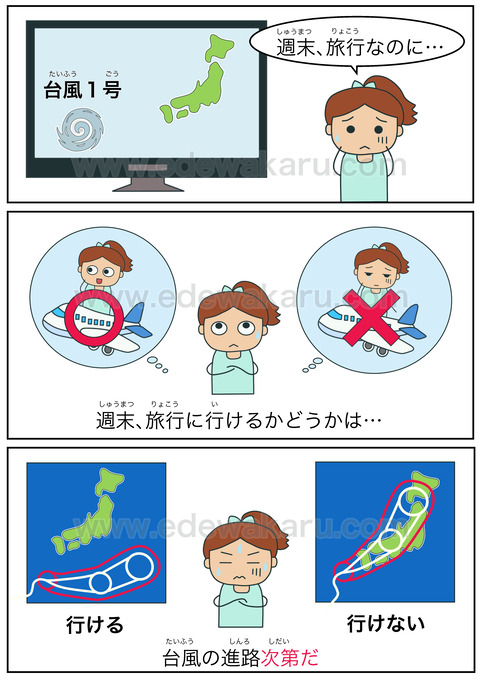
週末旅行に行けるかどうかは、台風の進路次第だ
→週末旅行に行けるかどうかは、台風の進路がどうなるかで決まるWhether we can go on a weekend trip depends on the typhoon’s path. →Whether we can go on a weekend trip will be decided by what happens with the typhoon’s path.
テストの結果次第で、日本に留学できるかどうかが決まる
→テストの結果で、留学できるかどうかが決まるWhether I can study in Japan depends on my test results. →My test results will decide whether I can study abroad.
野菜やフルーツは、天候次第で値段がすごく変わる
→野菜やフルーツの値段は、天候ですごく変わるThe prices of vegetables and fruit change a lot depending on the weather. →The prices of vegetables and fruit change a lot with the weather.
N1に合格するかどうかは、君の努力次第だ
→N1に合格するかどうかは、どれくらい努力するかで決まるWhether you pass N1 depends on your effort. →Whether you pass N1 will be decided by how hard you work.
やりかた次第で、勉強も楽しくなるよ〜
→やりかたによって、勉強も楽しくなるよ〜Depending on how you do it, studying can be fun too~ →Studying can be fun too, depending on how you do it~
次の試合に勝てるかどうかは、毎日の練習次第だと思うよ!
→試合に勝てるかどうかは、毎日の練習によって決まると思うよ!I think whether we win the next match depends on our daily practice! →I think whether we win the match is decided by our daily practice!
Read the original source text
Meaning
〜の状況で、〜が決まる
〜は、〜の状況で変わる
How to use it
名詞[辞書形]+次第で
名詞[辞書形]+次第だ
Explanation
「A次第でB」「BはA次第だ」は「Aの状況で、Bが決まる」「Bの状態は、Aの状況で変わる」という意味の文型です。「Aによって、Bの状態がいろいろ変わる」と言いたい時に使われます。
「〜たら、すぐに」という意味を表す「〜次第」は、別の文法です
ので区別しておきましょう。また「次第」がつく文型はいくつかありますので、復習をしておきましょう。
【関連文型】
NINJAL 日本語文型データベース
Meaning
Use this when you want to say that, depending on how ~ differs, what follows also changes or is changed, varies, or is decided.
How to use it
N次第で
Notes
“~” is preceded by words expressing something that can vary or differ, such as “天候,” “価格,” “やり方,” “対応,” and “返答.” The clause after “~次第で” indicates that there are various possibilities.
In context 5 examples
アルコールは飲み方次第で、毒にも薬にもなり得る。
Depending on how it is consumed, alcohol can be either poison or medicine.
天候次第で、よく売れたり全く売れなかったりする商品がある。
Some products sell well or not at all depending on the weather.
旅行は、同行者次第で楽しさが変わると思う。
I think how enjoyable a trip is changes depending on one’s travel companion.
明日からのリハビリの進み方次第で退院の日が決まるらしい。頑張ろう。
Apparently, the discharge date will be decided based on how rehabilitation progresses starting tomorrow. Let’s do our best.
今年の出来栄え次第で、来年この畑にどんな野菜を植えるかを決めるつもりだ。
I intend to decide what vegetables to plant in this field next year based on how well this year’s crops turn out.
Read the original source text
Meaning
~が違えばそれに対応して後のことも変わる・変える・さまざまだ・決まるということを言いたいときに使います。
How to use it
N次第で
Notes
「~」には、「天候・価格・やり方・対応・返答」など、幅や違いがあることを表す言葉がきます。「〜次第で」の後には、さまざまな可能性があることを意味する文がきます。