くらべてわかる日本語表現文型辞典
Meaning
Meaning 1: A is the basis for judging B. Judging from the point of A, B.
Meaning 2: B states a judgment from the standpoint or perspective of A.
How to use it
A からすると B (A からすれば B / A からしたら B)
[noun with no particle] からすると
Explanation
[Contrast 1]
「A からみると B」 (Meaning 1, p. 70)
For 「A からみると B」, the relationship between A as the basis for judgment and B must be close, and A must clearly show the grounds for reaching judgment B. 「A からみると B」 is more commonly used when the grounds are objective. With 「A からすると B」, both objective and subjective grounds are possible.
○私の考え方からすると、君の意見はまちがっていると思う。 — From my way of thinking, I believe your opinion is wrong.
×私の考え方からみると、君の意見はまちがっていると思う。 — From my way of thinking, I believe your opinion is wrong.
○彼の考え方からみると、君の意見はまちがっていると思う。 — From his way of thinking, I believe your opinion is wrong.
○彼の考え方からみると、君の意見はまちがっていると思う。 — From his way of thinking, I believe your opinion is wrong.
「A からして B」 (Meaning 2, p. 67)
「A からいうと B」 (Meaning 1, p. 66)
「A あたり B」 (Meaning 3, p. 29)
Notes
[Note 1]
・When A is based on a sensory impression, B becomes an inference.
○階段を上がってくる足音からすると、夫は何かいいことがあったにちがいない。 — Judging from the footsteps coming up the stairs, something good must have happened to my husband.
In context 8 examples
この空模様からすると、一雨来そうだな。
Judging from this sky, it looks like we’re in for a shower.
公平性の観点からすると、彼の考えは間違っていた。
From the standpoint of fairness, his idea was wrong.
海外の基準からしたら、日本のタバコはまだ安い。
By international standards, cigarettes in Japan are still cheap.
例年の傾向からすれば、今年の冬物は期待以上の売れ行きだ。
Judging from trends in previous years, this year’s winter clothes are selling better than expected.
教師からすると、よく勉強する学生がいい学生であり、学生からすると、やさしい先生がいい先生ということになる。
From a teacher’s point of view, students who study hard are good students; from a student’s point of view, kind teachers are good teachers.
わが国からすると、この協定は不公平といわざるをえない。
From our country’s point of view, we have no choice but to call this agreement unfair.
消費者からすると、円高で輸入品が安くなるのは歓迎すべきことだ。
From the consumer’s point of view, it is welcome that imported goods become cheaper when the yen strengthens.
有権者からすると、魅力的な政党がないことが問題だ。
From the voters’ point of view, the problem is that there are no appealing political parties.
Read the original source text
Meaning
意味1:AはBの判断材料。Aという点から判断するとB。
意味2:Aという立場や観点からの判断をBで述べる。
How to use it
AからするとB(AからすればB/AからしたらB)
[名詞-∅]からすると
Explanation
【対比1】
「AからみるとB」(意味1 P.70)
「AからみるとB」はAの判断材料とBの関係が密で、Bの判断を下す根拠がAに明確に表れていなければならず、客観的な根拠ほど「AからみるとB」がよく使われる。「AからするとB」のAは客観的・主観的両方の根拠が可能である。
○私の考え方からすると、君の意見はまちがっていると思う。
×私の考え方からみると、君の意見はまちがっていると思う。
○彼の考え方からみると、君の意見はまちがっていると思う。
○彼の考え方からみると、君の意見はまちがっていると思う。
「AからしてB」(意味2 P.67)
「AからいうとB」(意味1 P.66)
「AあたりB」(意味3 P.29)
Notes
【注意1】
・Aが感覚的になるとBは推測になる。
○階段を上がってくる足音からすると、夫は何かいいことがあったにちがいない。
絵でわかる日本語
Usage 1
Read this source entry ↗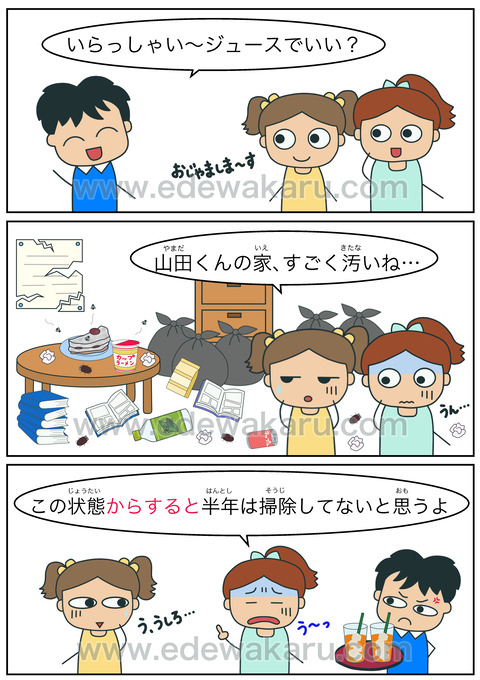
Meaning
judging from ...
judging by looking at ...
How to use it
Noun [dictionary form] + からすると・からすれば
Explanation
〜からすると・〜からすれば is a grammar pattern meaning “judging from ...” It is used when stating a judgment made after seeing or hearing something. It is often followed by 〜だろう, 〜かもしれない, 〜と思う, and similar expressions.
〜からすると・〜からすれば also means “considering it from the standpoint of ...” There are many grammar patterns that include から, so let’s review them 😊
In context 6 examples
A:山田くんの家、すごく汚いね…B:この状態からすると、半年くらい掃除してないと思うよ
→この状態を見て判断すると、半年くらい掃除してないと思うよA: Yamada’s house is really dirty… B: Judging from the state it’s in, I don’t think they’ve cleaned for about six months. →Judging by this state, I don’t think they’ve cleaned for about six months.
彼女の実力からすると、N1に合格できるだろう
→彼女の実力を見て判断すると、N1に合格できると思うJudging from her ability, she’ll probably pass N1. →Judging from her ability, I think she can pass N1.
あの様子からすると、何かいいことがあったんだと思うよ
→あの様子を見て判断すると、何かいいことがあったんだと思うよJudging from the way they look, I think something good must have happened.
A:まだカフェに着かないの?B:…地図からすると、この近くにあるはずなんだけどな
→この地図を見て判断すると、この近くにあるはずなんだけどなA: Aren’t you at the café yet? B: …Judging from the map, it should be somewhere around here.
あの歩き方からすると、彼は足をケガしているんだと思います
→あの歩き方を見て判断すると、彼は足をケガしているんだと思いますJudging from the way he walks, I think he has injured his leg.
あの態度からすると、彼女は私のことが嫌いなようだ
→あの態度から判断すると、彼女は私のことが嫌いなようだJudging from her attitude, it seems she doesn’t like me.
Read the original source text
Meaning
〜から判断すると
〜を見て判断すると
How to use it
名詞[辞書形]+からすると・からすれば
Explanation
「〜からすると・〜からすれば」は「〜から判断すると」という意味の文型です。何かを見たり聞いたりして判断したことを言う時に使われます。後ろには「〜だろう」「〜かもしれない」「〜と思う」などがよく使われます。
「〜からすると・〜からすれば」には「〜の立場から考えると」という意味もあります。また「から」がつく文型はたくさんありますので、復習をしておきましょう😊
Usage 2
Read this source entry ↗
Meaning
considering it from the standpoint of ...
speaking from the standpoint of ...
looking at it from the standpoint of ...
How to use it
Noun [dictionary form] + からすると・からすれば
Explanation
“Aからすると・Aからすれば” is a grammar pattern meaning “considering it from the standpoint of A” or “speaking from A’s standpoint.” It is used to say something from A’s standpoint or point of view.
〜からすると and 〜からすれば also have a use that expresses [judgment]. There are many grammar patterns that include から, so let’s review them.
[Grammar patterns that include から]
In context 5 examples
音を出してラーメンを食べることは、外国人からすると考えられないらしい
→外国人の立場から言うと、考えられないらしいEating ramen noisily seems unthinkable to foreigners. →From a foreigner’s point of view, it seems unthinkable.
日本人からすると、靴をはいたまま家に入るなんてありえない
→日本人の立場から言うと、靴をはいたまま家に入るなんてありえないFrom a Japanese person’s point of view, going into a house with your shoes on is unthinkable.
北海道に住んでいる人からすると、雪なんて全然めずらしくない
→北海道に住んでいる人の立場から言うと、雪なんて全然めずらしくないFrom the point of view of people who live in Hokkaido, snow is not unusual at all.
親からすると、子供のことは何歳になっても心配なものだ
→親の立場から言うと、子供のことは何歳になっても心配なものだFrom a parent’s point of view, you worry about your children no matter how old they get.
太りやすい私からすると、食べても太らないとはうらやましい限りだ
→太りやすい私の立場から言うと、食べても太らないとはうらやましい限りだAs someone who gains weight easily, I couldn’t be more envious of people who don’t gain weight even when they eat.
Read the original source text
Meaning
〜の立場で考えると
〜の立場から言うと
〜の立場から見ると
How to use it
名詞[辞書形]+からすると・からすれば
Explanation
「Aからすると・Aからすれば」は「Aの立場で考えると」「Aの立場から言うと」という意味の文型です。「A」の立場や視点から何かを言う時に使われます。
「〜からすると・〜からすれば」には【判断】を表す用法もあります。また、「から」がつく文型はたくさんありますので、復習しておきましょう。
【「から」がつく文型】
どんなときどう使う 日本語表現文型辞典
Meaning
from the standpoint of
How to use it
N+からすると (from the standpoint of; judging from)
Explanation
~の立場で考えると
1)判断・評価をする立場・着眼点を表す。その立場に立って考えるとどうであるかを言うときの表現。「からいうと」と意味・用法が同じ。
2) ❷ の「からすれば」、 ❸ ❹ の「からして」の形もある。
1)Judgments, positions from which to make appraisals, or focus of something. Shows how to approach issue from particular standpoint. Same meaning and usage as からいうと.
2)Also takes forms からすれば, as in sentence ❷ , and からして, as in sentences ❸ and ❹ .
In context 4 examples
米を作る農家からすると、涼しい夏はあまりありがたくないことだ。
From the perspective of farmers who grow rice, a cool summer is not very welcome.
安全を守るという点からすれば、子どもたちの行動をある程度制限するのはしかたがないことだろう。
From the standpoint of ensuring safety, it is probably unavoidable to restrict the children's behavior to some extent.
年金生活者の立場からして、増税はとても認められない政策だ。
From the standpoint of people living on pensions, a tax increase is a policy they simply cannot accept.
びんや缶などの資源回収は資源の保護から見て望ましいことだが、生産者の側からしても有益なことだと思う。
Collecting recyclable resources such as bottles and cans is desirable from the viewpoint of conserving resources, and I think it is also beneficial from the producers' side.
Read the original source text
Meaning
from the standpoint of
How to use it
N+からすると
Explanation
~の立場で考えると
1)判断・評価をする立場・着眼点を表す。その立場に立って考えるとどうであるかを言うときの表現。「からいうと」と意味・用法が同じ。
2) ❷ の「からすれば」、 ❸ ❹ の「からして」の形もある。
1)Judgments, positions from which to make appraisals, or focus of something. Shows how to approach issue from particular standpoint. Same meaning and usage as からいうと.
2)Also takes forms からすれば, as in sentence ❷ , and からして, as in sentences ❸ and ❹ .
日本語NET JLPT文法解説まとめ
Meaning
From the standpoint of ~
How to use it
Noun + からすると
Explanation
from the standpoint of 〜 / Judging form 〜
In context 6 examples
ネイティブの日本人からすると、トムさんの日本語はまだまだです。
From a native Japanese person’s point of view, Tom’s Japanese still has a long way to go.
ラーメンを食べるときにに音を出す習慣は外国人からすると、考えられないことだそうです。
Apparently, the custom of making noise while eating ramen is unthinkable to foreigners.
あの服装からすると、彼はおそらくデザイナーでしょう。
Judging from those clothes, he is probably a designer.
今度のJLPTですが、今の皆さんの実力からすると問題なく合格できるでしょう。
As for the upcoming JLPT, given your current ability, you should be able to pass without any problems.
お金の持ちのトムさんを羨む人が多いですが、私からすると最低限生活できるお金があれば幸せなので、何とも思いません。
Many people envy Tom for having a lot of money, but from my point of view, I’d be happy as long as I had enough money to live on, so I don’t think anything of it.
フィリピンでトイレットペーパーが流せないなんて、日本人からすると信じられないことかもしれない。
The idea that you can’t flush toilet paper in the Philippines may be unbelievable to Japanese people.
Read the original source text
Meaning
〜の立場で考えると
How to use it
N + からすると
Explanation
from the standpoint of 〜 / Judging form 〜
毎日のんびり日本語教師
Meaning
~judging from
How to use it
Noun + からすると
Noun + からすれば
Noun + からしたら
Explanation
This grammar is used when evaluating or making a judgment based on a certain matter.
Notes
Nothing in particular.
In context 8 examples
経験者からすれば天と地の差だ。
From the perspective of someone with experience, it's like night and day.
富裕層は世界全体の人口からすれば、本当に一握りでしかない。
The wealthy make up only a tiny handful of the world's total population.
雪国育ちの私からすれば、この程度の寒さは寒くない。
From my perspective, having grown up in a snowy region, this level of cold isn't cold.
跳び箱は運動神経が無い人からすれば絶対にできない。
From the perspective of someone with no athletic ability, doing the vault is absolutely impossible.
他人からすれば羨ましく思うかもしれない。
Other people might envy me.
私の感覚からすれば受け入れがたいものです。
From my perspective, it's hard to accept.
食べても太らないなんて、私からすると夢のような話です。
Not gaining weight even when you eat sounds like a dream to me.
喫煙者の私からしたら、街中であちこち禁煙になってつらい。
As a smoker, it's hard having smoking banned here and there throughout the city.
Read the original source text
Meaning
~から判断すると
How to use it
名詞+からすると
名詞+からすれば
名詞+からしたら
Explanation
ある事柄から評価・判断するときに用いる文法です。
Notes
特になし
AIUEO JLPT Grammar
Meaning
This sentence pattern is used when making judgments or speculations from a particular perspective or standpoint. It expresses “from the standpoint of ~,” often used to offer an opinion based on a specific situation or person’s point of view.
How to use it
Noun から + すると; noun から + すれば
In context 5 examples
彼の表情からすると、あまり興味がないようだ。
Judging from his expression, he doesn’t seem very interested.
この結果からすると、もう少し努力が必要だろう。
Judging from these results, more effort might be needed.
消費者の視点からすれば、この商品は魅力的だ。
From the consumer’s perspective, this product is attractive.
彼女の話し方からすれば、彼女はとても自信があるようだ。
Judging from the way she speaks, she seems very confident.
このデータからしますと、売上が増えているようです。
Judging from this data, it seems that sales are increasing.
Read the original source text
Meaning
This sentence pattern is used when making judgments or speculations from a particular perspective or standpoint. It expresses “from the standpoint of ~,” often used to offer an opinion based on a specific situation or person’s point of view.
How to use it
名詞から+すると名詞から+すれば
Explanation · 日本語
この文型は、名詞に接続して使われる表現で、その名詞が示す立場や視点から見て、推測や判断を行うときに使われます。この表現は「〜から考えると」「〜から見て」という意味で、特定の状況や人の立場、意見などから推測や判断を下すときに使われます。
文法
Meaning
From the standpoint of ~
How to use it
Noun + からすると
In context 6 examples
ネイティブの日本人からすると、トムさんの日本語はまだまだです。
From a native Japanese person’s point of view, Tom’s Japanese still has a long way to go.
ラーメンを食べるときにに音を出す習慣は外国人からすると、考えられないことだそうです。
Apparently, the custom of making noise while eating ramen is unthinkable to foreigners.
あの服装からすると、彼はおそらくデザイナーでしょう。
Judging from those clothes, he is probably a designer.
今度のJLPTですが、今の皆さんの実力からすると問題なく合格できるでしょう。
As for the upcoming JLPT, given your current ability, you should be able to pass without any problems.
お金の持ちのトムさんを羨む人が多いですが、私からすると最低限生活できるお金があれば幸せなので、何とも思いません。
Many people envy Tom for having a lot of money, but from my point of view, I’d be happy as long as I had enough money to live on, so I don’t think anything of it.
フィリピンでトイレットペーパーが流せないなんて、日本人からすると信じられないことかもしれない。
The idea that you can’t flush toilet paper in the Philippines may be unbelievable to Japanese people.
Read the original source text
Meaning
〜の立場で考えると
How to use it
N + からすると
Bunpro Grammar Reference
Meaning
Judging from, Considering
How to use it
Noun + からすると
Noun + からすれば
Nuance
A hypothetical expression used to cast judgements that go off from the previous statement.
Explanation
からすると is an expression combining the conjunction particle から 'from', する 'to do', and either of the hypothetical markers と or ば. It may be translated as 'judging from (A), (B)', or 'considering (A), (B)'. However, the way that する behaves in these types of sentences is quite comparable to expressions like 'going off' in English, in that it just indicates that (A) is the basis from which the speaker is about to make their judgment.
からすると or からすれば will be seen following nouns, before the (B) part of the sentence will highlight the speaker's assessment of (A).
この成績からすると、あなたは全然勉強をしていないでしょう?
Judging from these grades, you didn't study at all, did you?
この甘さからすると、塩と間違えて砂糖を入れてしまったに違いない。
Judging from how sweet this is, they must've mistakenly added sugar instead of salt.
日本育ちの私からすれば、これは寿司ではない。
Going off being a person raised in Japan, this is not sushi.
彼女の反応からすると、本当に驚いているようだ。
Going off her reaction, it seems like she is genuinely surprised.
Fun-fact
In almost all cases that する is paired with a hypothetical structure like と, ば, or たら, it indicates that the speaker is 'going with' the assumption of (A) being true, before further expressing what applies based on that assumption.
In context 16 examples
- あの煙突からすると、たぶん薪ストーブですね。
Judging from that chimney, maybe it is a wood stove.
- 彼女の反応からすると、本当に驚いているようだ。
Going off her reaction, it seems like she is genuinely surprised.
- この成績からすると、あなたは全然勉強をしていないでしょう?
Judging from these grades, you didn't study at all, did you?
- この甘さからすると、塩と間違えて砂糖を入れてしまったに違いない。
Judging from how sweet this is, they must've mistakenly added sugar instead of salt.
- 日本育ちの私からすれば、これは寿司ではない。
Going off being a person raised in Japan, this is not sushi.
- 歴史からすると、京都はかつて首都でした。
Judging from history, Kyoto was once the capital.
- あなたが言っていることからすると、彼はそこにいなかったようですね。
Judging from what you are saying, it seems that he wasn't there right?
- 足の速さからすると、彼はプロの選手になれるだろう。
Considering how fast he is, he can probably become a professional athlete.
- あのアクセントからすると彼は日本人ではないようです。
Judging from his accent, it appears that he is not Japanese.
- あの手さばきからすると、あの人は編物のプロに違いない。
Judging from that handiwork, there is no doubt that that person is a knitting pro.
- お辞儀の仕方からすると、彼は日本にいたことがあるはずだ。
Judging from how he bowed, he is sure to have been to Japan before.
- 植木のかんじからすれば、かなり腕のいい植木職人が手入れをしているな。
Judging from my impression of these trees, a rather skilled gardener is tending to them.
- あの写し方からすると、これは有名な写真家が撮ったものだと思います。
Judging from the way that it was taken, I think this was taken by a famous photographer.
- この仕上がりからすれば、作成者は大雑把な性格ですね。
Judging from this finish, the author is someone who doesn't worry about details.
- あの落ち着きからすれば学生には見えないけど、まだ彼らは中学生なんだって。
Judging from their composure, they don't look like students, but I heard they are still junior high schoolers.
- あのウエイトレスの対応からすれば、この店は社員教育がしっかりしているのだろう。
Judging from my interactions with that waitress, this restaurant has a solid employee training program.
Read the original source text
Meaning
Judging from, Considering
How to use it
Noun + からすると
Noun + からすれば
Nuance
A hypothetical expression used to cast judgements that go off from the previous statement.
Explanation
からすると is an expression combining the conjunction particle から 'from', する 'to do', and either of the hypothetical markers と or ば. It may be translated as 'judging from (A), (B)', or 'considering (A), (B)'. However, the way that する behaves in these types of sentences is quite comparable to expressions like 'going off' in English, in that it just indicates that (A) is the basis from which the speaker is about to make their judgment.
からすると or からすれば will be seen following nouns, before the (B) part of the sentence will highlight the speaker's assessment of (A).
この成績からすると、あなたは全然勉強をしていないでしょう?
Judging from these grades, you didn't study at all, did you?
この甘さからすると、塩と間違えて砂糖を入れてしまったに違いない。
Judging from how sweet this is, they must've mistakenly added sugar instead of salt.
日本育ちの私からすれば、これは寿司ではない。
Going off being a person raised in Japan, this is not sushi.
彼女の反応からすると、本当に驚いているようだ。
Going off her reaction, it seems like she is genuinely surprised.
Fun-fact
In almost all cases that する is paired with a hypothetical structure like と, ば, or たら, it indicates that the speaker is 'going with' the assumption of (A) being true, before further expressing what applies based on that assumption.
Nuance · 日本語
前に述べられたことから何かを判断するということを表す仮定表現。
Explanation · 日本語
「からすると」は接続助詞「から」と「する」、そして仮定を表す「と」または「ば」から成り立つ表現です。「(A) から判断して (B)」や「(A) を考えると (B)」というような意味で使われます。この表現における「する」は、「行う」という意味ではなく、(A) をもとに話し手が判断しようとしていることを示しています。
「からすると」や「からすれば」は名詞の後に置かれます。そして、文の (B) の部分で (A) に対する話し手の評価が述べられます。
この成績からすると、あなたは全然勉強をしていないでしょう?
Judging from these grades, you didn't study at all, did you?
この甘さからすると、塩と間違えて砂糖を入れてしまったに違いない。
Judging from how sweet this is, they must've mistakenly added sugar instead of salt.
日本育ちの私からすれば、これは寿司ではない。
Going off being a person raised in Japan, this is not sushi.
彼女の反応からすると、本当に驚いているようだ。
Going off her reaction, it seems like she is genuinely surprised.
豆知識
「する」が仮定を表す「と」「ば」「たら」と一緒に使われる場合、話し手は (A) を事実だと仮定し、その仮定のもとに話を進めていることがほとんどです。
NINJAL 日本語文型データベース
Meaning
This is used when there are various positions or grounds, but you want to say that your evaluation or judgment focuses on one of them.
How to use it
Nからすると
Notes
The “〜” slot takes a word that serves as a position, grounds for judgment, or criterion. After 「〜からすると」 comes a sentence expressing a judgment, impression, evaluation, opinion, or inference. Such sentences often express what the speaker considers an obvious conclusion.
In context 4 examples
販売業者からすると、長持ちしすぎる製品は好ましくないのかもしれない。
From a retailer's point of view, products that last too long may not be desirable.
保育者の立場からすると、幼児の行動に手を貸してしまった方がむしろ楽なんです。でも、それでは子どもの自立心は育ちません。
From a childcare worker's standpoint, it's actually easier to help young children with what they're doing. But that doesn't help foster children's independence.
「話し方からすると木村さんはお笑いタレントみたいだけど、実は数学の先生なんだって」
“Judging from the way Kimura talks, he seems like a comedian, but apparently he's actually a math teacher.”
医師「手術後の回復具合からすると、あと3、4日で退院できると思います」
Doctor: “Judging from your recovery after the surgery, I think you'll be able to leave the hospital in another three or four days.”
Read the original source text
Meaning
いろいろな立場・根拠があるが、そのうち〜に焦点をおいた評価・判断であると言いたいときに使います。
How to use it
Nからすると
Notes
「~」には、立場・判断の根拠・基準になる言葉がきます。「〜からすると」の後には、判断・感想・評価・意見・推測などの文がきます。話し手が当然の帰結だと思うことを表す文が多いです。