AIUEO JLPT Grammar
Meaning
This sentence pattern emphasizes that as a result of a certain event or situation, a bad result or unexpected conclusion occurred. It is used when something worsens or a problem arises, ultimately leading to an unfavorable situation.
How to use it
Verb (dictionary form) + 始末だ
In context 5 examples
彼は借金を返せず、ついには家を売る始末だ。
He couldn’t repay his debt, and in the end, he even had to sell his house.
彼女は毎日遅刻して、ついにはクビになる始末だった。
She was late every day, and in the end, she was fired.
パソコンが壊れて、修理もできず、結局買い替える始末だ。
My computer broke down, couldn’t be repaired, and I ended up having to buy a new one.
彼は健康管理を怠り、病気になって入院する始末でした。
He neglected his health, fell ill, and ended up being hospitalized.
毎月浪費ばかりして、ついには貯金がゼロになる始末だ。
I kept wasting money every month, and in the end, my savings reached zero.
Read the original source text
Meaning
This sentence pattern emphasizes that as a result of a certain event or situation, a bad result or unexpected conclusion occurred. It is used when something worsens or a problem arises, ultimately leading to an unfavorable situation.
How to use it
動詞辞書形+始末だ
Explanation · 日本語
この文型は、ある出来事や状況の結果として、悪い結果や予期しない結末に至ったことを強調する表現です。この表現は、何かが悪化したり、問題が起こったりして、最終的に不都合な状況に陥ったことを述べるときに使われます。
文法
Meaning
The result is that ~. Used when you want to say that, after various developments, things ultimately ended in a bad result.
How to use it
V (dictionary form) + (という)始末だ
Notes
A set phrase is 「この始末」. It means “this is what actually happened,” and conveys the speaker's exasperation.
In context 5 examples
やってもいないのに、痴漢だと疑われ、さらには警察にまで逮捕されてしまうという始末だ。
I hadn’t even done anything, but I was suspected of being a groper and even arrested by the police. That’s how it ended up.
まったく最近の若い者は。悪いことをしたから注意しただけなのに、逆ギレする始末だ。
Honestly, young people these days! I only warned him because he did something wrong, but he ended up getting angry at me instead.
息子はせっかく3年間、日本語へ留学したのに、授業中居眠りばかりしていたせいでこの始末だ。まったく誰のお金だと思っているんだ。
My son studied in Japan for three whole years, only to end up like this because he kept sleeping in class. Honestly, whose money does he think it is?
彼がシステムトラブルをすぐに報告せず、一人で解決しようとしたせいで、この始末だ。被害は全社レベルにまで広がり、みな不眠不休で対応に追われている。
He didn’t report the system problem right away and tried to solve it alone, and this is how it ended up. The damage spread company-wide, and everyone is scrambling to deal with it without sleep or rest.
部屋で遊んだら、片付けるように厳しく言ったのに、この始末だ。何度注意すればきちんと片付けられるようになるのだろう。
I strictly told them to clean up after playing in their room, but this is what happened. How many times do I have to remind them before they learn to clean up properly?
Read the original source text
Meaning
〜という結果だ色々と経過を経て、最後には悪い結果になったと言いたい時に使う。
How to use it
V(辞書形)+ (という)始末だ
Notes
慣用的な使い方に「この始末」という言い方がある。これは「実際はこのとおりだ」という意味で、話し手のあきれた気持ちを表す。
Bunpro Grammar Reference
Meaning
Ends up, Finally, In the end, (Unfortunately) As a result, This is what happened, To come about, To wind up
How to use it
Verb[る] + 始末だ
この始末だ
Nuance
A strong construction, showing the unfavorable result of (A). From start to finish it all wound up as (A).
Explanation
始末, a noun meaning ‘settlement’, or ‘end result’ is commonly used in order to indicate a negative sequence of events that has been passed through, causing an equally negative result to come about at the end. It will be translated as ‘to wind up as (A)’, ‘to end up as (A)’, or ‘to come about that (A)’.
This expression will be used primarily after verbs in their dictionary form.
あんだけダブルチェックをするように言ったのに、この始末だ。
I told him so many times to double check, but this is the result.
みんなで祭りに行くつもりだったのに、みんながドタキャンするから、結局一人で行く始末だ。
We were supposed to go to the festival together, but everyone canceled suddenly, so I ended up going alone.
その客は店中をぐちゃぐちゃにしたあげく、何も買わないで帰る始末だ。
After messing up the whole store, they ended up leaving without buying anything.
Due to 始末 being used to highlight negative outcomes that are the result of going through a specific event, it will often appear in sentences that also include words like とうとう ‘to come to a head’, 挙げ句 ‘after a long process’, or 結局 ‘in the end’. It may seem redundant to include these phrases, but as 始末 has the more literal translation of ‘to culminate in’ (including everything from beginning to end), it is more emphatic, rather than redundant.
In context 10 examples
- 武田さんは小さな声で職場でハラスメントを受けたことを伝えてきて、しまいに大きな声で泣き出す始末だ。
Takeda-san quietly told me that she was being harassed at work, and wound up crying out loud.
- みんなで祭りに行くつもりだったのに、みんながドタキャンするから、結局一人で行く始末だ。
We were supposed to go to the festival together, but everyone canceled suddenly, so I ended up going alone.
- あんだけダブルチェックをするように言ったのに、この始末だ。
I told him so many times to double check, but this is the result.
- その客は店中をぐちゃぐちゃにしたあげく、何も買わないで帰る始末だ。
After messing up the whole store, they ended up leaving without buying anything.
- あいつは、自分が起こしたミスなのに、謝るどころか私のせいにする始末だ。
Even though it was a mistake that he had made, far from apologizing, he ended up blaming me!
- せっかく友達と海へ行く計画を立てたのに、田中は大事な用があって行けないとか、武田もシフトが入ってたとかで、結局私一人だけで行く始末だ。
Even though I went out of my way to plan this trip to the beach with friends, Tanaka said that he had something important to do and couldn't go, while Takeda said that he had a shift. So I ended up going all by myself.
- 武田:「山田さん、顔色が悪いですけど・・・」
山田:「夜遅くまでゲームをしていたので、おかげでこの始末だ。」Takeda: 'Yamada-san, you don't look so good...' Yamada : 'I was playing video games until late at night, and this is the result.'
- 田中には二度と仕事は頼まないぞ。納期は守らないし仕上がりも悪かったのに、言い訳ばかりならべて。最後には追加の料金を払えと言い出す始末だ。
I'll never ask Tanaka to work for me again. He can't meet deadlines, his workmanship is poor, and he only gives excuse after excuse. In the end he told me to pay an additional fee.
- プロジェクトを期限内に終えることができなくて、上司の逆鱗に触れてしまう始末だ。
I couldn't finish the project on time, and I wound up infuriating my boss.
- 重い買い物袋が破れて中身が地面に落ちたところ:「下から抱えなかったら、この始末だ。」
After a heavy shopping bag has just ripped, and the contents fell out: 'This is what comes about when you don't hold it from the bottom.'
Read the original source text
Meaning
Ends up, Finally, In the end, (Unfortunately) As a result, This is what happened, To come about, To wind up
How to use it
Verb[る] + 始末だ
この始末だ
Nuance
A strong construction, showing the unfavorable result of (A). From start to finish it all wound up as (A).
Explanation
始末, a noun meaning ‘settlement’, or ‘end result’ is commonly used in order to indicate a negative sequence of events that has been passed through, causing an equally negative result to come about at the end. It will be translated as ‘to wind up as (A)’, ‘to end up as (A)’, or ‘to come about that (A)’.
This expression will be used primarily after verbs in their dictionary form.
あんだけダブルチェックをするように言ったのに、この始末だ。
I told him so many times to double check, but this is the result.
みんなで祭りに行くつもりだったのに、みんながドタキャンするから、結局一人で行く始末だ。
We were supposed to go to the festival together, but everyone canceled suddenly, so I ended up going alone.
その客は店中をぐちゃぐちゃにしたあげく、何も買わないで帰る始末だ。
After messing up the whole store, they ended up leaving without buying anything.
Due to 始末 being used to highlight negative outcomes that are the result of going through a specific event, it will often appear in sentences that also include words like とうとう ‘to come to a head’, 挙げ句 ‘after a long process’, or 結局 ‘in the end’. It may seem redundant to include these phrases, but as 始末 has the more literal translation of ‘to culminate in’ (including everything from beginning to end), it is more emphatic, rather than redundant.
Nuance · 日本語
(A)という好ましくない結果を強く示す表現。最初から最後まで(A)だった。
Explanation · 日本語
「始末」は、「処理」や「最終的な結果」を表す名詞ですが、文法表現として使う場合は、良くない出来事が続いた末に、悪い結果になったことを表します。「(A) という(悪い)結果に終わった」や「(A) という結末になった」といった意味で使われます。
この表現は、主に動詞の辞書形の後に使われます。
あんだけダブルチェックをするように言ったのに、この始末だ。
I told him so many times to double check, but this is the result.
みんなで祭りに行くつもりだったのに、みんながドタキャンするから、結局一人で行く始末だ。
We were supposed to go to the festival together, but everyone canceled suddenly, so I ended up going alone.
その客は店中をぐちゃぐちゃにしたあげく、何も買わないで帰る始末だ。
After messing up the whole store, they ended up leaving without buying anything.
「始末」は「とうとう」「挙句」「結局」といった副詞と一緒に使われることも多いです。これらの表現は一見すると無駄な繰り返しに見えるかもしれませんが、「始末」が持つ「初めから終わりまでの一連の流れを経てそうなった」という意味をより強調する役割を果たしています。
どんなときどう使う 日本語表現文型辞典
Meaning
turn out badly; end up
How to use it
Vる+しまつだ
Explanation
~という悪い結末だ
1)「 悪いことを経て、とうとう最後にもっと悪い結果になった」とその経緯を言うときに使う。
2)後の文では「とうとう・最後は」などの言葉をよくいっしょに使う。
2)Often used with words such as とうとう(ultimately), and 最後は (in the end).
1)Shows process of events going from bad to worse.
In context 3 examples
あの子は乱暴で本当に困る。学校のガラスを割ったり、いすを壊したり、とうとうきのうは友だちとけんかして、けがをさせてしまうしまつだ。
That child is so rough and really causes trouble. They’ve broken the school windows and smashed chairs, and yesterday they finally got into a fight with a friend and injured them—that’s how bad things have gotten.
きのうはいやな日だった。会社では社長に注意されるし、夜は友人とけんかしてしまうし、最後は帰りの電車の中にかばんを忘れてきてしまうしまつだ。
Yesterday was an awful day. At work, the president scolded me, then I got into a fight with a friend at night, and to top it all off, I ended up leaving my bag on the train home.
君はきのうもまた打ち合わせの時間に遅れたそうじゃないか。そんなしまつじゃ人に信用されないよ。
I hear you were late for the meeting again yesterday. If you keep that up, people won’t trust you.
Read the original source text
Meaning
turn out badly; end up
How to use it
Vる+しまつだ
Explanation
~という悪い結末だ
1)「 悪いことを経て、とうとう最後にもっと悪い結果になった」とその経緯を言うときに使う。
2)後の文では「とうとう・最後は」などの言葉をよくいっしょに使う。
2)Often used with words such as とうとう(ultimately), and 最後は (in the end).
1)Shows process of events going from bad to worse.
絵でわかる日本語
Meaning
In the end, it turned into...
It resulted in a bad outcome of...
How to use it
Verb [dictionary form] + 始末だ
Explanation
“〜始末だ” is a sentence pattern meaning “in the end, it resulted in the bad outcome of....” It is used when a bad situation continues and ultimately results in a bad outcome. A sentence explaining what happened before the bad outcome comes before it. It expresses exasperation toward someone who has caused a troublesome or bothersome situation.
“This 始末だ” is an idiomatic expression meaning “things have gotten this bad.” It is used when a problem has occurred, with a sense of criticism.
[Example]
Even though I told you not to lend or borrow money, look at the mess we’re in.
*“Lending and borrowing” means lending or borrowing.
“〜始末だ” is often used with the N2 pattern “〜あげく,” so review it. 😊
In context 5 examples
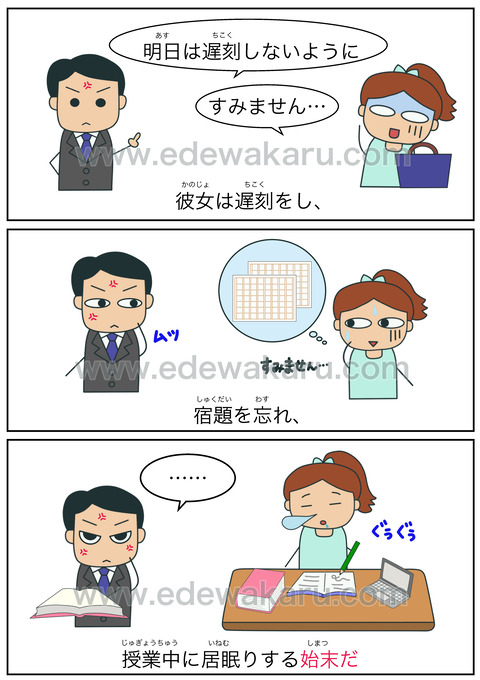
彼女は遅刻し、宿題を忘れ、授業中に居眠りする始末だ
She was late, forgot her homework, and ended up falling asleep in class.
息子は勉強もせずに遊びまわり、退学になる始末だ
My son did nothing but play around without studying, and ended up getting expelled.
彼はお金を全部ゲームに使い、友達にお金を借りる始末だ
He spent all his money on games and ended up borrowing money from his friends.
山田くんは彼女と別れたと言ってお酒を飲みまくり、泣き出す始末だ
Yamada said he broke up with his girlfriend, drank like crazy, and ended up bursting into tears.
歩きスマホを注意したら、彼は反省するどころか怒り出す始末だった
When I warned him about using his phone while walking, he got angry instead of reflecting on it.
Read the original source text
Meaning
最後には〜になった
〜という悪い結果になった
How to use it
動詞[辞書形]+始末だ
Explanation
「〜始末だ」は「最後には〜という悪い結果になった」という意味の文型です。「悪い状況が続いていて、最後には〜という悪い結果になった」と言いたい時に使われます。悪い結果になるまで、どんなことがあったを説明する文が前にきます。 困った状況や迷惑な状況を起こした人に対して、あきれた気持ちを表します。
「この始末だ」
は慣用的な表現で、「こんなに悪い状況になっている」という意味で使われます。何か問題が起きた場合に非難の気持ちを込めて使われます。
[例]
お金の貸し借りはするなと言ったのに、
この始末だ
*「貸し借り」とは「貸したり、借りたりすること」という意味です
「〜始末だ」は、N2の文型「〜あげく」とよく使われますので、復習しておきましょう😊
日本語文型辞典
Meaning
Basic information
V-る始末だ
Attached to the dictionary form of a verb, it expresses that a troublesome or vexing situation has arisen because of someone’s actions. The first part describes what happened leading up to the situation, and the form is used to say that the situation occurred as a result. This is a conventional expression, “この始末だ,” used to point to a problem with a sense of reproach when something goes wrong.
Examples: ① She went on and on listing her husband’s faults, and in the end she started crying and said she was getting a divorce. ② My son says that studying at university is useless and devotes himself to his part-time job; lately, he has even started saying that he wants to drop out and work. ③ I only gave him advice once, but he says I’m the only one he can rely on and even calls me in the middle of the night.
Example: Yamada hadn’t been coming to school lately, and look what happened. A student who causes a traffic accident on a motorcycle has no choice but to be expelled.
Read the original source text
Meaning
基本情報V-るしまつだ説明動詞の辞書形に付いて、誰かの行為による困った状況や迷惑な状況が生じることを表す。前半でその状況に至るまでにどんなことがあったかを述べ、その結果としてその状況が起こったということを言うのに用いる。次の「この始末だ」ぼ野用的な表現で、何か問題が起こったときに非兼の気持ちを込めてそれを指し示すのに用いる。例文① 彼女は夫の欠点を延々と並べ上げ、あげくの果てには離婚すると言って泣き出す始末だった。② 息子は大学の勉強は何の役にも立たないと言ってアルバイトに精を出し、この頃は中退して働きたいなどと言い出す始未だ。③ 一度相談にのってあげただけなのに、彼はあなただけが頼りだと言って、真夜中にでも電話をかけてくる始末だった。例文(例) 山田はどうもこの頃学校に来ないと思ったらこの始末だ。バイクで人身事故を起こすような学生には、もう退学してもらうしかない。
日本語NET JLPT文法解説まとめ
Meaning
end up with ~
Used when you want to say that after various things have happened, the final result was a bad one.
How to use it
V (dictionary form) + (という)始末だ
Explanation
"end up"
Used in Japanese to describe a situation that has ended in a negative or undesirable outcome.
There is an idiomatic expression 「この始末」. It means “this is what actually happened,” and expresses the speaker’s exasperation.
In context 5 examples
やってもいないのに、痴漢だと疑われ、さらには警察にまで逮捕されてしまうという始末だ。
I hadn’t even done anything, but I was suspected of being a groper and even arrested by the police. That’s how it ended up.
まったく最近の若い者は。悪いことをしたから注意しただけなのに、逆ギレする始末だ。
Honestly, young people these days! I only warned him because he did something wrong, but he ended up getting angry at me instead.
息子はせっかく3年間、日本語へ留学したのに、授業中居眠りばかりしていたせいでこの始末だまったく誰のお金だと思っているんだ。
My son studied in Japan for three whole years, and yet he kept sleeping through classes, so this is what happened! Whose money does he think it is, anyway?
彼がシステムトラブルをすぐに報告せず、一人で解決しようとしたせいで、この始末だ。被害は全社レベルにまで広がり、みな不眠不休で対応に追われている。
He didn’t report the system problem right away and tried to solve it alone, and this is how it ended up. The damage spread company-wide, and everyone is scrambling to deal with it without sleep or rest.
部屋で遊んだら、片付けるように厳しく言ったのに、この始末だ。何度注意すればきちんと片付けられるようになるのだろう。
I strictly told them to clean up after playing in their room, but this is what happened. How many times do I have to remind them before they learn to clean up properly?
Read the original source text
Meaning
〜という結果だ
色々と経過を経て、最後には悪い結果になったと言いたい時に使う。
How to use it
V(辞書形)+ (という)始末だ
Explanation
"end up"
Used in Japanese to describe a situation that has ended in a negative or undesirable outcome.
慣用的な使い方に「この始末」という言い方がある。これは「実際はこのとおりだ」という意味で、話し手のあきれた気持ちを表す。
毎日のんびり日本語教師
How to use it
Verb dictionary form + 始末だ
Verb ない-form + 始末だ
この + 始末だ
その + 始末だ
あの + 始末だ
Explanation
Indicates that a series of bad things continued and ultimately led to a bad result.
It includes the speaker’s feeling of regret or dismay.
It can form patterns such as “あげく~始末だ” and “挙句の果てに~始末だ.”
Notes
Nothing in particular.
In context 12 examples
昨晩飲み過ぎたせいでこの始末だ。
This is what happened because I drank too much last night.
遅刻した上にペンすら持ってこず、更に居眠りまでする始末だ。
On top of being late, he didn’t even bring a pen, and then he went so far as to fall asleep in class.
自分で不倫をしておきながら謝りもせず開き直る始末だ。
He cheated on his partner himself, yet didn’t even apologize and instead had the nerve to act defiant.
眠くて眠くて授業もほとんど寝ちゃう始末だ。
I was so sleepy that I ended up sleeping through almost the entire class.
誰一人覚えておらず、みんな忘れる始末だ。
Not a single person remembered; everyone forgot.
今の40代50代は驕り高ぶっていて、何かあればすぐ若者の文句を言う始末だ。
People in their 40s and 50s nowadays are arrogant and conceited, and at the slightest thing they immediately complain about young people.
私がやったものだと勘違いされ、最後は謝れとまで言われる始末だ。
They mistakenly thought I was the one who did it, and in the end went so far as to tell me to apologize.
あれほど忘れるなと言ったのに、結局忘れてくる始末だ。
Even though I told them so many times not to forget, they ended up forgetting after all.
早く涼しくなるのを願っていたが、今度は雨で洗濯物が乾かない始末。
I’d been hoping it would cool down soon, but now the rain means the laundry won’t dry.
あそこの医者はこっちがあれこれ聞かないと検査の結果も教えてくれない始末。患者を舐めてる。
That doctor there won’t even tell us the test results unless we ask all sorts of questions. They look down on their patients.
デッサン能力がなくて筋肉も関節も不自然。何を描いてもその始末だ。
He has no drawing skills, so the muscles and joints all look unnatural. No matter what he draws, it always turns out like that.
多額の税金を使ってあの始末。もう現政権には何も期待しない。
After spending a huge amount of taxpayer money, this is the result. I no longer expect anything from the current administration.
Read the original source text
How to use it
動辞形+始末だ
動ない形+始末だ
この+始末だ
その+始末だ
あの+始末だ
Explanation
良くないことが続き、結局良くない結果になったことを表します。
話者の残念な気持ちが含まれます。
「あげく~始末だ」「挙句の果てに~始末だ」という文型になることがあります。
Notes
特になし
NINJAL 日本語文型データベース
Meaning
It indicates that, after a bad situation has unfolded, things have ended in an even worse outcome.
Words such as 「〜も・〜まで・〜さえ」 are often used to emphasize the extent of the bad outcome.
How to use it
V dictionary form+始末だ
Notes
It is not used in the negative form.
The sentence before 「〜始末だ」 often explains how the bad situation unfolded.
The outcome itself has already happened, but if it continues to have an effect in the present, the sentence ends in the present form 「〜だ」. If it is described as a past event unrelated to the present, it ends in the past form 「〜だった」.
In context 4 examples
ふたりは仲が悪く、何度も口論になり、ついに口もきかなくなる始末だ。
The two were on bad terms and argued repeatedly, until eventually they stopped speaking to each other altogether.
彼は怪しいビジネスに手を出して借金を重ね、とうとう家族にまで見放される始末だ。
He got involved in a shady business and piled up debts, until eventually even his family disowned him.
就職面接では緊張しすぎて頭が真っ白になり、会社の名前さえ言い間違える始末だった。
I was so nervous in the job interview that my mind went blank, and I even got the company’s name wrong.
高校生のころ、私はカタカナの名前が苦手だった。世界史のテストに書いた名前がどれも少しずつ間違っていて、妹にまで笑われるしまつだった。
When I was in high school, I was bad with names written in katakana. Every name I wrote on my world history test was a little bit wrong, and even my younger sister laughed at me.
Read the original source text
Meaning
悪い状況が経過した後、さらに悪い結末になったことを表します。
「〜も・〜まで・〜さえ」などのような言葉で、悪い結末の程度を強調することが多いです。
How to use it
Vる始末だ
Notes
否定形にはしません。
「〜始末だ」の文の前に、悪い状況の経過についての説明があることが多いです。
結末そのものはすでに起こったことですが、現在にも影響が残っている結末の場合、文末は現在形「〜だ」になります。現在と関係がない過去の出来事として説明する場合、過去形「〜だった」になります。
IMABI
Result
Read this IMABI lesson ↗Explanation
Result: ~結果, ~うえで, ~挙句, ~すえに, & ~始末だ
Though these patterns show result, they have their own special nuances. So, even when there is interchangeability, that doesn’t mean you are saying 100% the same thing.
~結果
~結果 utilizes the word for “result”. It is seen after nouns or the past tense of verbs. What follows is a result and what precedes is a cause. Whether it is in one sentence or two, this is how the pattern works. It is objective and 書き言葉的. It is preceded by verbs of thought/consideration and followed by verbs of result.
1. やるだけはやったのだから、静かに結果を待とう。
I’ve done just what to do, so I will quietly await the results.
2. 消防車しょうぼうしゃなど13台が消火にあたった結果、火はおよそ1時間半後に消し止められましたが、部屋は全焼しまし た。
As a result of 13 fire trucks fighting the fire, the fire was extinguished after approximately an hour and a half, but the room was completely burned.
From the NHK article 県営けんえい住宅焼け1人死亡1人重体じゅうたい on 2013年7月3日 2時11分.
3. 2日のロンドン外国為替かわせ市場は、ニューヨーク市場や東京市場で株価かぶかが上昇じょうしょうしたことなどを背景はいけいに、世界経済の先行さきゆきに対する懸念けねんがいくぶん和やわらぎ、ドルを買って円を売る動きが次第しだいに強まりました。その結果、円相場そうばは一時、先月上旬じょうじゅん以来およそ1か月ぶりに1ドル=100円台前半ぜんはんまで値下ねさがりしました。
The London Foreign Stock Exchange on the second, against the background of stocks having risen in the New York and Tokyo Exchanges, concerns towards the world economy’s future have somewhat eased, and the trend of buying dollars and selling yes has gradually strengthened.
As a result, the yen exchange rate for a moment dropped down to the low 1$ = 100\ mark after about a month since the first part of last month.
From the NHK article ロンドン市場 1か月ぶり100円台 on 2013年7月2日 21時36分.
4. この問題は、東日本大震災の復興予算ふっこうよさんが、自治体じちたいなどが管理する基金を通じて、被災地ひさいち以外の事業にも使われているという指摘してきが出ていたもので、政府は、財務省や復興庁など関係省庁しょうちょうを通じて実態調査じったいちょうさを進めてきました。その結果、調査の対象となった各自治体などが管理する16の基金には、およそ1兆1500億円の復興予算が配分され、その大半はすでに執行されていましたが、およそ1400億円がまだ使われていないことが分かりました。
As for this problem, with the indication having come out that the East Japan Great Earthquake Disaster Recovery Budget, through funds the municipalities manages are being used even in projects outside the devastated areas, the government has forwarded investigations into the actual circumstances through the ministries and offices concerned such as the Ministry of Office and the Recovery Agency.
As a result, in the 16 funds that each of the municipalities that have become the object of investigation manage, approximately 1 trillion 150 billion yen recovery budget has been allocated, and the great majority of which has already been administered, but it has been found out that approximately 140 billion yen has yet to be used.
From the NHK article未使用の復興予算 返還要請へんかんようせいへ on 2013年7月2日 12時48分.
~うえで
~うえで works grammaticality just like ~結果. It too is seen after nouns or the past tense of a verb. ~うえで shows a willful aspect in taking the next action based on the results of the present/clause or context. This makes it quite different for all of the other patterns in this lesson. It is preceded by verbs of thought/consideration, and then it is followed by verbs of conclusion. Adverbs frequently used in the first clause include よく and 十分(に).
5. 十分に事件を勘案かんあんしたうえで返事します。
I will reply after having sufficiently considered the matter.
6. 上司と詳くわしく相談したうえで、お返事いたします。
I will reply after having consulted in detail with my boss.
7. ASEAN=東南アジア諸国連合しょこくれんごうと、日本やアメリカ、それに北朝鮮も含む、27の国と国際機関の外相がいしょうなどが参加して、2日にブルネイで開かれたARFは、会議の締しめくくりとして議長声明を採択さいたくしました。
議長声明では、ほとんどの参加国の共通認識きょうつうにんしきとして、北朝鮮に核実験かくじっけんの停止ていしなどを求めた過去の国連安保理あんぽり決議と、北朝鮮による既存きそんの核計画の放棄ほうきなどを盛もり込こんだ、6か国協議の共同声明の義務を果はたすよう、北朝鮮に求めています。
そのうえで、「参加国のほとんどは朝鮮半島の非核化に向けた努力を支持する」としています。
ARF, which was opened in Brunei on the second with foreign ministers from 27 international organizations including ASEAN (Association of Southeast Asian Nations), Japan, America, as well as North Korea participating, adopted the chairman’s proclamation as the meeting’s close. With the chairman’s proclamation, as almost all of the participating nations’ common understanding, it is calling for North Korea to carry out its duties of the six nation conference joint statement, including things such as U.N Security Council Resolution of the past which sought the halt of nuclear tests in North Korea and the abandonment of current nuclear plans by North Korea.
Moreover, it is asserting that “almost all of the participating nations support the efforts towards the denuclearization of the Korean Peninsula”.
From the NHK Article ARF議長声明 朝鮮半島の非核化支持ひかくかしじ on 2013年7月3日 0時9分.
8. 新潟県にいがたけん知事「地元軽視けいしだ」
新潟県の泉田知事いずみだちじは「事前に連絡はなく、こんな地元軽視はない」と強い不快感ふかいかんを示しました。
そのうえで、「東京電力は福島第一原発の事故の際のTV会議の状況をすべて公開していないなど、検証けんしょうが不十分で事故の責任せきにんもとっていない。運転再開について議論を行う段階ではない」と東京電力の姿勢を改めて批判しました。
国も理解得る努力を茂木もてぎ経済産業大臣けいざいさんぎょうだいじんは、訪問中ほうもんちゅうのベトナムで「申請しんせいが出された段階で原子力規制委員会きせいいいんかいには厳正げんせいで速すみやかな審査しんさを行っていただきたい。そのうえで安全性が確認されたら東京電力任せではなくて国としても前面 ぜんめんに出て自治体などの理解を得るよう努力どりょくをしていきたい」と述べました。
Niigata Prefecture Governor “It’s local neglect”
Niigata Prefecture Governor Izumida demonstrated strong displeasure saying that “there isn’t local neglect like this without contact beforehand”.
Moreover, he again criticized the position of Tokyo Electric saying, “Tokyo Electric aren’t even taking responsibility for the accident, not completely making public the conditions of the TV meeting at the time of the Fukushima No. 1 Reactor accident and with the inspections being insufficient. This is not the stage to debates about the restart of operations”.
The Nation Too to Strive for Receiving Understanding
Ministry of Economy, Trade and Industry Motegi, stated while in Vietnam “I would like for a strict and speedy hearing in the Nuclear Energy Regulations Committee on the phase of having sent an application. Moreover, once safety is confirmed, not being left up to Tokyo Electric, but as a nation, I want us to come to the front and strive to seek the understanding of the municipalities.
From the NHK article柏崎刈羽原発かしわざきかりわげんぱつ 安全審査の申請決定 on 2013年7月2日 15時12分.
9.菅官房長官すがかんぼうちょうかんは、東京都内で講演こうえんし、参議院選挙さんぎいんせんきょでは自民・公明両党こうめいりょうとうで非改選ひかいせんも含め過半数を確保することが最低限の目標だとしたうえで、経済の再生を最優先さいゆうせんに掲かかげて選挙戦に臨みたいという考えを示しました。
そのうえで、菅官房長官は、参議院選挙で訴うったえる政策せいさくについて、「憲法けんぽう改正は、自民党の党是であり今回の選挙戦でも訴えることになる。しかし、今の状況での優先順位じゅんいは、国民やいろいろな人から話を聞いても、経済だ」と述べ、経済の再生を最優先に掲げて選挙戦に臨みたいという考えを示しました。
Chief Cabinet Secretary Suga held a lecture in Tokyo and suggested that they look forward to the election battle carrying the economy’s recover as their top priority, with both the Liberal Democratic Party and the Justice Party securing the majority including those not up for reelection in the House of Councilors election as a minimal goal.
Moreover, Chief Cabinet Secretary Suga, in regards to the policies they’re calling for in the election stated, “As for Constitution revision, it is the LDP’s party platform, and we are to call for it in this election battle as well. However, our current priority is on the economy no matte what we hear from citizens or others”, suggesting that carrying the economy’s recover is their top priority.
From the NHK article 菅氏「過半数目標 経済前面に」on 2013年7月2日 15時12分.
~挙句
挙句 あげく, normally negative, is used with a noun or the past tense of a verb to show that one spends a lot of effort on something but something else comes out of it with the outcome often being a last resort. 挙句 is close to “after a great deal of” and is often used with the adverb 散々さんざんmeaning “repeatedly”. Verbs that precede it entail thought/consideration, but they are mainly verbs with negative outcomes such as 悩む, 迷う, 議論する, 文句もんくをいう, etc. Passive and causative expressions are also common.
Expressions found in the latter clause involve result just like ~結果. However, again, it is usually negative, and even if the result isn’t totally bad, it definitely gives the sense that it’s not worth much. With that said, you are not likely to see it much in the news as the news is typically written in an objective fashion.
Orthography Note: 挙(げ)句 can also be spelled as 揚(げ)句.
Examples
10. 散々文句を言った挙句、出たばかりだよ。
After a great deal of repeatedly arguing, she just left!
11. 三人が酔よっ払ぱらった挙句の果てに高圧線こうあつせんに襲おそいかけて感電死かんでんししたという。
It’s said that after three men had gotten drunk that they crashed into a high-voltage line and were electrocuted to death.
12. 色々いろいろ勉強の揚句、地元の大学に入学することにしました。
After a great deal of various studies, I decided to enter a local college (although I tried for more).
13. 頑張った挙句の果てに諦あきらめただけさ。(Casual)
After trying my best, I just gave up.
~すえに
すえ is noun that literally refers to the “end/tip”. You see it in temporal phrases such as 7月の末. However, it also shares something in common with the speech modals of this lesson. Used in the same fashion as them, it shows a temporal conclusion in which “after a certain course of events has run its way, in the end it becomes as such”.
14. 夜を徹てっして議論した{△ 結果・〇 挙句・Xうえで・〇すえに}、白紙はくしに戻もどしてやり直すことになった。
After having debated all night, it became decided that we should redo and go back to the drawing board.
From 中級日本語文法と教え方のポイント by 市川保子.
From this sentence it resembles 挙句, but it is actually more objective. It also doesn’t have to seem negative. What they do share, though, is that they demonstrate a long trial of sorts.
15. 「コマキさん、楽器は何か演奏できる」
固い布団に横たわりながら、モウリさんが聞いた。長く逃げてきたすえ、よく知らない西の町の海辺に、部屋を借りているのだった。モウリさんは町のはずれにあるゴムの工場に勤めていた。三日に一回ある夜勤から帰った日だったかもしれない。窓の外が明るみはじめていた。
“Komaki, can you play any instrument?”, Mouri asked as she lay on the hard futon. After having ran away a long ways, we were renting a room on the shore in a town to the west we didn’t quite know. Mouri was working at a rubber factory at the edge of the town. It might have been the day she returned from a certain night shift once every three days. The outside from the window was beginning to brighten up.
From 溺レる by 川上弘美.
16. あの国は長年ながねんの紛争ふんそうを経へた{〇 結果・△ 挙句・Xうえで・〇 すえに}、ようやく反対デモもなく自主選挙じしゅせんきょを行なうことができた。
That nation after having gone through years of conflict was able to finally carry out voluntary elections without even any opposition demonstrations.
Finally: やっと, ようやく, ついに, Etc.
There are many adverbs that are translated as “finally”. If there are so many words, there must be differences between them. The sentence above shows a very typical instance of ようやく, but the sentence would sound unnatural to various degrees if you were to replace it with another synonymous phrase.
やっと: After one’s effort over a long period of time, something finally/narrowly realizes. やっと is a positive and shows considerable satisfaction. Whether it is a place, time, or money, after a narrow situation, there is a final realization/conclusion. If the speaker has gone through much trial/struggle in achieving a result that is positive yet contrary to original expectation, やっと can’t be used.
17. やっと安心して眠れる。
I’m finally able to sleep with ease.
18. やっとこさ全部片づいたよ。
I’ve finally finished it all.
Slang Note: In slang it can be seen as やっとこさ.
ついに・遂に: At the final stage of something, X either realizes or it doesn’t. The situation one has been in has lasted a long time (like やっと), and there is the potential that what you wanted ends up not happening at all (not like やっと). ついに can rather coldly state non-realization. If it is a positive outcome, it may have a light sense of happiness or relief. However, although やっと doesn’t foster an indifferent attitude, it usually implies that the speaker wished the good outcome would have come earlier.
19. 警察はついに犯人を逮捕した。
The police finally arrested the criminal.
ようやく・漸く: やっと and ついに capture the moment of realization, but ようやく places stress on the process. ようやく shows a positive, objective evaluation of planned change, and it expressed an effort that one has waited on. This is in relation to time and not something like money or physical labor. ようやく is inappropriate in showing one’s 本音 due to its objectivity.
20. ようやく分かった気がする。
I think I finally understand.
21. ようやく秋が来た。
Fall has finally come.
22. 寮での集団生活にようやく慣れました。
I have finally gotten used to group living in the dormitory.
23. 私は漸くほっとした心もちになって、巻煙草まきたばこに火をつけながら、始めて懶ものうい睚まぶたをあげて、前の席に腰を下していた小娘の顔を一瞥いちべつした。
I finally became relieved, and while I lit my cigar, I first started to raise my languid eyes and glanced at the little girl’s face, who was sitting in the seat in front of me.
From 蜜柑 by 芥川龍之介.
Form Note: It can be seen as ようよう・漸う in older language. ようやっと, the fusion of やっと and ようやく, also exists and is essentially the same as やっと with the time nuance of ようやく.
とうとう・到頭: This is similar to ようやく in that it places stress on the process rather than instant of realization. It is either used in positive or negative situations to show that after repeated efforts and over the course of a long time, an expected change either does or doesn’t happen. This is subjective rather than objective. If you were to use it or ついに instead of やっと in something like あっ、やっと電車が来た!, your statement would be quite hyperbolic.
24. 彼らはとうとう行っちゃったよ。
They finally left.
25. すると間もなく凄すさまじい音をはためかせて、汽車が隧道トンネルへなだれこむと同時に、小娘の開けようとした硝子戸がらすどは、とうとうばたりと下へ落ちた。
Then, in no time at all, the girl caused a fierce noise to flutter about, and at the same time the train plunged into the tunnel, the glass door that she had tried to open finally fell and plopped down below.
From 蜜柑 by 芥川龍之介.
辛うじて: This is a literary word that shows an extremely close-call situation in one’s favor. So, it is often translated as “barely”, but it is much like やっと. But, it doesn’t have the same requirement that it have the prerequisite of something going as planned. かろうじて can easily be used to refer to future event. If it is an nonfactual probability, it can’t be replaced with やっと or ようやく. It can be if it is a factual probability, but in this case ついに and とうとう aren’t good because they aren’t used with future expressions.
26. 辛うじて生きてろ!
Narrowly live!
27. 辛うじて手に入った。
I narrowly got a hold of it.
いよいよ・愈(々)・ 弥弥: This can be very similar to the above when it shows that after some time, an event reaches an important situation. In this sense it is very similar to ついに. It is not emotionally cold like ついに. However, it is more objective than the other options like やっと. It also has other meanings such as “more and more” in which it implies increase in momentum.
28. あの皸しわだらけの頬は愈いよいよ赤くなって、時々鼻洟はなをすすりこむ音が、小さな息の切れる声と一しょに、せわしなく耳へはいって来る。
Her wrinkle covered cheeks at last became red, and the occasional sound of her sniffling her nose along with the sound of her breath running out restlessly entered my ears.
From 蜜柑 by 芥川龍之介.
~始末だ
There are four simple meanings of 始末. The first is to mean “beginning and end”. It may mean “end result” in a negative fashion. As a noun or a verb with する, it means “clean up/get rid of”. Lastly, it can mean “thrifty” as a noun or as a verb with する.
29. 事の始末を語った。
He gave the story of it (an event) from beginning to end.
30. 彼はしまいに、逃げ出す始末だった。
He, in the end, had to run away (from there).
31. 不法滞在して国外追放になる始末だ。
Illegal overstaying in a country results in deportation.
32. 酔ようと始末に終えない。
Obstreperous.
33. 始末屋
A thrifty person
In context 33 examples
やるだけはやったのだから、静かに結果を待とう。
I’ve done just what to do, so I will quietly await the results.
消防車しょうぼうしゃなど13台が消火にあたった結果、火はおよそ1時間半後に消し止められましたが、部屋は全焼しまし た。
As a result of 13 fire trucks fighting the fire, the fire was extinguished after approximately an hour and a half, but the room was completely burned.
2日のロンドン外国為替かわせ市場は、ニューヨーク市場や東京市場で株価かぶかが上昇じょうしょうしたことなどを背景はいけいに、世界経済の先行さきゆきに対する懸念けねんがいくぶん和やわらぎ、ドルを買って円を売る動きが次第しだいに強まりました。その結果、円相場そうばは一時、先月上旬じょうじゅん以来およそ1か月ぶりに1ドル=100円台前半ぜんはんまで値下ねさがりしました。
The London Foreign Stock Exchange on the second, against the background of stocks having risen in the New York and Tokyo Exchanges, concerns towards the world economy’s future have somewhat eased, and the trend of buying dollars and selling yes has gradually strengthened.
この問題は、東日本大震災の復興予算ふっこうよさんが、自治体じちたいなどが管理する基金を通じて、被災地ひさいち以外の事業にも使われているという指摘してきが出ていたもので、政府は、財務省や復興庁など関係省庁しょうちょうを通じて実態調査じったいちょうさを進めてきました。その結果、調査の対象となった各自治体などが管理する16の基金には、およそ1兆1500億円の復興予算が配分され、その大半はすでに執行されていましたが、およそ1400億円がまだ使われていないことが分かりました。
As for this problem, with the indication having come out that the East Japan Great Earthquake Disaster Recovery Budget, through funds the municipalities manages are being used even in projects outside the devastated areas, the government has forwarded investigations into the actual circumstances through the ministries and offices concerned such as the Ministry of Office and the Recovery Agency.
十分に事件を勘案かんあんしたうえで返事します。
I will reply after having sufficiently considered the matter.
上司と詳くわしく相談したうえで、お返事いたします。
I will reply after having consulted in detail with my boss.
ASEAN=東南アジア諸国連合しょこくれんごうと、日本やアメリカ、それに北朝鮮も含む、27の国と国際機関の外相がいしょうなどが参加して、2日にブルネイで開かれたARFは、会議の締しめくくりとして議長声明を採択さいたくしました。
The ARF, held in Brunei on the 2nd with foreign ministers and other officials from 27 countries and international organizations—including ASEAN (the Association of Southeast Asian Nations), Japan, the United States, and North Korea—adopted a chair’s statement to conclude the meeting.
新潟県にいがたけん知事「地元軽視けいしだ」
Niigata Prefecture governor: “The local area was treated with disregard.”
菅官房長官すがかんぼうちょうかんは、東京都内で講演こうえんし、参議院選挙さんぎいんせんきょでは自民・公明両党こうめいりょうとうで非改選ひかいせんも含め過半数を確保することが最低限の目標だとしたうえで、経済の再生を最優先さいゆうせんに掲かかげて選挙戦に臨みたいという考えを示しました。
Chief Cabinet Secretary Suga gave a speech in Tokyo. He said that the minimum goal for the House of Councillors election was to secure a majority for the Liberal Democratic and Komeito parties, including seats not up for election, and expressed his intention to enter the election campaign with economic recovery as the top priority.
散々文句を言った挙句、出たばかりだよ。
After a great deal of repeatedly arguing, she just left!
三人が酔よっ払ぱらった挙句の果てに高圧線こうあつせんに襲おそいかけて感電死かんでんししたという。
It’s said that after three men had gotten drunk that they crashed into a high-voltage line and were electrocuted to death.
色々いろいろ勉強の揚句、地元の大学に入学することにしました。
After a great deal of various studies, I decided to enter a local college (although I tried for more).
頑張った挙句の果てに諦あきらめただけさ。(Casual)
After trying my best, I just gave up.
夜を徹てっして議論した{△ 結果・〇 挙句・Xうえで・〇すえに}、白紙はくしに戻もどしてやり直すことになった。
After having debated all night, it became decided that we should redo and go back to the drawing board.
「コマキさん、楽器は何か演奏できる」
“Komaki, can you play any musical instruments?”
あの国は長年ながねんの紛争ふんそうを経へた{〇 結果・△ 挙句・Xうえで・〇 すえに}、ようやく反対デモもなく自主選挙じしゅせんきょを行なうことができた。
That nation after having gone through years of conflict was able to finally carry out voluntary elections without even any opposition demonstrations.
やっと安心して眠れる。
I’m finally able to sleep with ease.
やっとこさ全部片づいたよ。
I’ve finally finished it all.
警察はついに犯人を逮捕した。
The police finally arrested the criminal.
ようやく分かった気がする。
I think I finally understand.
ようやく秋が来た。
Fall has finally come.
寮での集団生活にようやく慣れました。
I have finally gotten used to group living in the dormitory.
私は漸くほっとした心もちになって、巻煙草まきたばこに火をつけながら、始めて懶ものうい睚まぶたをあげて、前の席に腰を下していた小娘の顔を一瞥いちべつした。
I finally became relieved, and while I lit my cigar, I first started to raise my languid eyes and glanced at the little girl’s face, who was sitting in the seat in front of me.
彼らはとうとう行っちゃったよ。
They finally left.
すると間もなく凄すさまじい音をはためかせて、汽車が隧道トンネルへなだれこむと同時に、小娘の開けようとした硝子戸がらすどは、とうとうばたりと下へ落ちた。
Then, in no time at all, the girl caused a fierce noise to flutter about, and at the same time the train plunged into the tunnel, the glass door that she had tried to open finally fell and plopped down below.
辛うじて生きてろ!
Narrowly live!
辛うじて手に入った。
I narrowly got a hold of it.
あの皸しわだらけの頬は愈いよいよ赤くなって、時々鼻洟はなをすすりこむ音が、小さな息の切れる声と一しょに、せわしなく耳へはいって来る。
Her wrinkle covered cheeks at last became red, and the occasional sound of her sniffling her nose along with the sound of her breath running out restlessly entered my ears.
事の始末を語った。
He gave the story of it (an event) from beginning to end.
彼はしまいに、逃げ出す始末だった。
He, in the end, had to run away (from there).
不法滞在して国外追放になる始末だ。
Illegal overstaying in a country results in deportation.
酔ようと始末に終えない。
Obstreperous.
始末屋
A thrifty person
Read the original source text
Explanation
Result: ~結果, ~うえで, ~挙句, ~すえに, & ~始末だ
Though these patterns show result, they have their own special nuances. So, even when there is interchangeability, that doesn’t mean you are saying 100% the same thing.
~結果
~結果 utilizes the word for “result”. It is seen after nouns or the past tense of verbs. What follows is a result and what precedes is a cause. Whether it is in one sentence or two, this is how the pattern works. It is objective and 書き言葉的. It is preceded by verbs of thought/consideration and followed by verbs of result.
1. やるだけはやったのだから、静かに結果を待とう。
I’ve done just what to do, so I will quietly await the results.
2. 消防車しょうぼうしゃなど13台が消火にあたった結果、火はおよそ1時間半後に消し止められましたが、部屋は全焼しまし た。
As a result of 13 fire trucks fighting the fire, the fire was extinguished after approximately an hour and a half, but the room was completely burned.
From the NHK article 県営けんえい住宅焼け1人死亡1人重体じゅうたい on 2013年7月3日 2時11分.
3. 2日のロンドン外国為替かわせ市場は、ニューヨーク市場や東京市場で株価かぶかが上昇じょうしょうしたことなどを背景はいけいに、世界経済の先行さきゆきに対する懸念けねんがいくぶん和やわらぎ、ドルを買って円を売る動きが次第しだいに強まりました。その結果、円相場そうばは一時、先月上旬じょうじゅん以来およそ1か月ぶりに1ドル=100円台前半ぜんはんまで値下ねさがりしました。
The London Foreign Stock Exchange on the second, against the background of stocks having risen in the New York and Tokyo Exchanges, concerns towards the world economy’s future have somewhat eased, and the trend of buying dollars and selling yes has gradually strengthened.
As a result, the yen exchange rate for a moment dropped down to the low 1$ = 100\ mark after about a month since the first part of last month.
From the NHK article ロンドン市場 1か月ぶり100円台 on 2013年7月2日 21時36分.
4. この問題は、東日本大震災の復興予算ふっこうよさんが、自治体じちたいなどが管理する基金を通じて、被災地ひさいち以外の事業にも使われているという指摘してきが出ていたもので、政府は、財務省や復興庁など関係省庁しょうちょうを通じて実態調査じったいちょうさを進めてきました。その結果、調査の対象となった各自治体などが管理する16の基金には、およそ1兆1500億円の復興予算が配分され、その大半はすでに執行されていましたが、およそ1400億円がまだ使われていないことが分かりました。
As for this problem, with the indication having come out that the East Japan Great Earthquake Disaster Recovery Budget, through funds the municipalities manages are being used even in projects outside the devastated areas, the government has forwarded investigations into the actual circumstances through the ministries and offices concerned such as the Ministry of Office and the Recovery Agency.
As a result, in the 16 funds that each of the municipalities that have become the object of investigation manage, approximately 1 trillion 150 billion yen recovery budget has been allocated, and the great majority of which has already been administered, but it has been found out that approximately 140 billion yen has yet to be used.
From the NHK article未使用の復興予算 返還要請へんかんようせいへ on 2013年7月2日 12時48分.
~うえで
~うえで works grammaticality just like ~結果. It too is seen after nouns or the past tense of a verb. ~うえで shows a willful aspect in taking the next action based on the results of the present/clause or context. This makes it quite different for all of the other patterns in this lesson. It is preceded by verbs of thought/consideration, and then it is followed by verbs of conclusion. Adverbs frequently used in the first clause include よく and 十分(に).
5. 十分に事件を勘案かんあんしたうえで返事します。
I will reply after having sufficiently considered the matter.
6. 上司と詳くわしく相談したうえで、お返事いたします。
I will reply after having consulted in detail with my boss.
7. ASEAN=東南アジア諸国連合しょこくれんごうと、日本やアメリカ、それに北朝鮮も含む、27の国と国際機関の外相がいしょうなどが参加して、2日にブルネイで開かれたARFは、会議の締しめくくりとして議長声明を採択さいたくしました。
議長声明では、ほとんどの参加国の共通認識きょうつうにんしきとして、北朝鮮に核実験かくじっけんの停止ていしなどを求めた過去の国連安保理あんぽり決議と、北朝鮮による既存きそんの核計画の放棄ほうきなどを盛もり込こんだ、6か国協議の共同声明の義務を果はたすよう、北朝鮮に求めています。
そのうえで、「参加国のほとんどは朝鮮半島の非核化に向けた努力を支持する」としています。
ARF, which was opened in Brunei on the second with foreign ministers from 27 international organizations including ASEAN (Association of Southeast Asian Nations), Japan, America, as well as North Korea participating, adopted the chairman’s proclamation as the meeting’s close. With the chairman’s proclamation, as almost all of the participating nations’ common understanding, it is calling for North Korea to carry out its duties of the six nation conference joint statement, including things such as U.N Security Council Resolution of the past which sought the halt of nuclear tests in North Korea and the abandonment of current nuclear plans by North Korea.
Moreover, it is asserting that “almost all of the participating nations support the efforts towards the denuclearization of the Korean Peninsula”.
From the NHK Article ARF議長声明 朝鮮半島の非核化支持ひかくかしじ on 2013年7月3日 0時9分.
8. 新潟県にいがたけん知事「地元軽視けいしだ」
新潟県の泉田知事いずみだちじは「事前に連絡はなく、こんな地元軽視はない」と強い不快感ふかいかんを示しました。
そのうえで、「東京電力は福島第一原発の事故の際のTV会議の状況をすべて公開していないなど、検証けんしょうが不十分で事故の責任せきにんもとっていない。運転再開について議論を行う段階ではない」と東京電力の姿勢を改めて批判しました。
国も理解得る努力を茂木もてぎ経済産業大臣けいざいさんぎょうだいじんは、訪問中ほうもんちゅうのベトナムで「申請しんせいが出された段階で原子力規制委員会きせいいいんかいには厳正げんせいで速すみやかな審査しんさを行っていただきたい。そのうえで安全性が確認されたら東京電力任せではなくて国としても前面 ぜんめんに出て自治体などの理解を得るよう努力どりょくをしていきたい」と述べました。
Niigata Prefecture Governor “It’s local neglect”
Niigata Prefecture Governor Izumida demonstrated strong displeasure saying that “there isn’t local neglect like this without contact beforehand”.
Moreover, he again criticized the position of Tokyo Electric saying, “Tokyo Electric aren’t even taking responsibility for the accident, not completely making public the conditions of the TV meeting at the time of the Fukushima No. 1 Reactor accident and with the inspections being insufficient. This is not the stage to debates about the restart of operations”.
The Nation Too to Strive for Receiving Understanding
Ministry of Economy, Trade and Industry Motegi, stated while in Vietnam “I would like for a strict and speedy hearing in the Nuclear Energy Regulations Committee on the phase of having sent an application. Moreover, once safety is confirmed, not being left up to Tokyo Electric, but as a nation, I want us to come to the front and strive to seek the understanding of the municipalities.
From the NHK article柏崎刈羽原発かしわざきかりわげんぱつ 安全審査の申請決定 on 2013年7月2日 15時12分.
9.菅官房長官すがかんぼうちょうかんは、東京都内で講演こうえんし、参議院選挙さんぎいんせんきょでは自民・公明両党こうめいりょうとうで非改選ひかいせんも含め過半数を確保することが最低限の目標だとしたうえで、経済の再生を最優先さいゆうせんに掲かかげて選挙戦に臨みたいという考えを示しました。
そのうえで、菅官房長官は、参議院選挙で訴うったえる政策せいさくについて、「憲法けんぽう改正は、自民党の党是であり今回の選挙戦でも訴えることになる。しかし、今の状況での優先順位じゅんいは、国民やいろいろな人から話を聞いても、経済だ」と述べ、経済の再生を最優先に掲げて選挙戦に臨みたいという考えを示しました。
Chief Cabinet Secretary Suga held a lecture in Tokyo and suggested that they look forward to the election battle carrying the economy’s recover as their top priority, with both the Liberal Democratic Party and the Justice Party securing the majority including those not up for reelection in the House of Councilors election as a minimal goal.
Moreover, Chief Cabinet Secretary Suga, in regards to the policies they’re calling for in the election stated, “As for Constitution revision, it is the LDP’s party platform, and we are to call for it in this election battle as well. However, our current priority is on the economy no matte what we hear from citizens or others”, suggesting that carrying the economy’s recover is their top priority.
From the NHK article 菅氏「過半数目標 経済前面に」on 2013年7月2日 15時12分.
~挙句
挙句 あげく, normally negative, is used with a noun or the past tense of a verb to show that one spends a lot of effort on something but something else comes out of it with the outcome often being a last resort. 挙句 is close to “after a great deal of” and is often used with the adverb 散々さんざんmeaning “repeatedly”. Verbs that precede it entail thought/consideration, but they are mainly verbs with negative outcomes such as 悩む, 迷う, 議論する, 文句もんくをいう, etc. Passive and causative expressions are also common.
Expressions found in the latter clause involve result just like ~結果. However, again, it is usually negative, and even if the result isn’t totally bad, it definitely gives the sense that it’s not worth much. With that said, you are not likely to see it much in the news as the news is typically written in an objective fashion.
Orthography Note: 挙(げ)句 can also be spelled as 揚(げ)句.
Examples
10. 散々文句を言った挙句、出たばかりだよ。
After a great deal of repeatedly arguing, she just left!
11. 三人が酔よっ払ぱらった挙句の果てに高圧線こうあつせんに襲おそいかけて感電死かんでんししたという。
It’s said that after three men had gotten drunk that they crashed into a high-voltage line and were electrocuted to death.
12. 色々いろいろ勉強の揚句、地元の大学に入学することにしました。
After a great deal of various studies, I decided to enter a local college (although I tried for more).
13. 頑張った挙句の果てに諦あきらめただけさ。(Casual)
After trying my best, I just gave up.
~すえに
すえ is noun that literally refers to the “end/tip”. You see it in temporal phrases such as 7月の末. However, it also shares something in common with the speech modals of this lesson. Used in the same fashion as them, it shows a temporal conclusion in which “after a certain course of events has run its way, in the end it becomes as such”.
14. 夜を徹てっして議論した{△ 結果・〇 挙句・Xうえで・〇すえに}、白紙はくしに戻もどしてやり直すことになった。
After having debated all night, it became decided that we should redo and go back to the drawing board.
From 中級日本語文法と教え方のポイント by 市川保子.
From this sentence it resembles 挙句, but it is actually more objective. It also doesn’t have to seem negative. What they do share, though, is that they demonstrate a long trial of sorts.
15. 「コマキさん、楽器は何か演奏できる」
固い布団に横たわりながら、モウリさんが聞いた。長く逃げてきたすえ、よく知らない西の町の海辺に、部屋を借りているのだった。モウリさんは町のはずれにあるゴムの工場に勤めていた。三日に一回ある夜勤から帰った日だったかもしれない。窓の外が明るみはじめていた。
“Komaki, can you play any instrument?”, Mouri asked as she lay on the hard futon. After having ran away a long ways, we were renting a room on the shore in a town to the west we didn’t quite know. Mouri was working at a rubber factory at the edge of the town. It might have been the day she returned from a certain night shift once every three days. The outside from the window was beginning to brighten up.
From 溺レる by 川上弘美.
16. あの国は長年ながねんの紛争ふんそうを経へた{〇 結果・△ 挙句・Xうえで・〇 すえに}、ようやく反対デモもなく自主選挙じしゅせんきょを行なうことができた。
That nation after having gone through years of conflict was able to finally carry out voluntary elections without even any opposition demonstrations.
Finally: やっと, ようやく, ついに, Etc.
There are many adverbs that are translated as “finally”. If there are so many words, there must be differences between them. The sentence above shows a very typical instance of ようやく, but the sentence would sound unnatural to various degrees if you were to replace it with another synonymous phrase.
やっと: After one’s effort over a long period of time, something finally/narrowly realizes. やっと is a positive and shows considerable satisfaction. Whether it is a place, time, or money, after a narrow situation, there is a final realization/conclusion. If the speaker has gone through much trial/struggle in achieving a result that is positive yet contrary to original expectation, やっと can’t be used.
17. やっと安心して眠れる。
I’m finally able to sleep with ease.
18. やっとこさ全部片づいたよ。
I’ve finally finished it all.
Slang Note: In slang it can be seen as やっとこさ.
ついに・遂に: At the final stage of something, X either realizes or it doesn’t. The situation one has been in has lasted a long time (like やっと), and there is the potential that what you wanted ends up not happening at all (not like やっと). ついに can rather coldly state non-realization. If it is a positive outcome, it may have a light sense of happiness or relief. However, although やっと doesn’t foster an indifferent attitude, it usually implies that the speaker wished the good outcome would have come earlier.
19. 警察はついに犯人を逮捕した。
The police finally arrested the criminal.
ようやく・漸く: やっと and ついに capture the moment of realization, but ようやく places stress on the process. ようやく shows a positive, objective evaluation of planned change, and it expressed an effort that one has waited on. This is in relation to time and not something like money or physical labor. ようやく is inappropriate in showing one’s 本音 due to its objectivity.
20. ようやく分かった気がする。
I think I finally understand.
21. ようやく秋が来た。
Fall has finally come.
22. 寮での集団生活にようやく慣れました。
I have finally gotten used to group living in the dormitory.
23. 私は漸くほっとした心もちになって、巻煙草まきたばこに火をつけながら、始めて懶ものうい睚まぶたをあげて、前の席に腰を下していた小娘の顔を一瞥いちべつした。
I finally became relieved, and while I lit my cigar, I first started to raise my languid eyes and glanced at the little girl’s face, who was sitting in the seat in front of me.
From 蜜柑 by 芥川龍之介.
Form Note: It can be seen as ようよう・漸う in older language. ようやっと, the fusion of やっと and ようやく, also exists and is essentially the same as やっと with the time nuance of ようやく.
とうとう・到頭: This is similar to ようやく in that it places stress on the process rather than instant of realization. It is either used in positive or negative situations to show that after repeated efforts and over the course of a long time, an expected change either does or doesn’t happen. This is subjective rather than objective. If you were to use it or ついに instead of やっと in something like あっ、やっと電車が来た!, your statement would be quite hyperbolic.
24. 彼らはとうとう行っちゃったよ。
They finally left.
25. すると間もなく凄すさまじい音をはためかせて、汽車が隧道トンネルへなだれこむと同時に、小娘の開けようとした硝子戸がらすどは、とうとうばたりと下へ落ちた。
Then, in no time at all, the girl caused a fierce noise to flutter about, and at the same time the train plunged into the tunnel, the glass door that she had tried to open finally fell and plopped down below.
From 蜜柑 by 芥川龍之介.
辛うじて: This is a literary word that shows an extremely close-call situation in one’s favor. So, it is often translated as “barely”, but it is much like やっと. But, it doesn’t have the same requirement that it have the prerequisite of something going as planned. かろうじて can easily be used to refer to future event. If it is an nonfactual probability, it can’t be replaced with やっと or ようやく. It can be if it is a factual probability, but in this case ついに and とうとう aren’t good because they aren’t used with future expressions.
26. 辛うじて生きてろ!
Narrowly live!
27. 辛うじて手に入った。
I narrowly got a hold of it.
いよいよ・愈(々)・ 弥弥: This can be very similar to the above when it shows that after some time, an event reaches an important situation. In this sense it is very similar to ついに. It is not emotionally cold like ついに. However, it is more objective than the other options like やっと. It also has other meanings such as “more and more” in which it implies increase in momentum.
28. あの皸しわだらけの頬は愈いよいよ赤くなって、時々鼻洟はなをすすりこむ音が、小さな息の切れる声と一しょに、せわしなく耳へはいって来る。
Her wrinkle covered cheeks at last became red, and the occasional sound of her sniffling her nose along with the sound of her breath running out restlessly entered my ears.
From 蜜柑 by 芥川龍之介.
~始末だ
There are four simple meanings of 始末. The first is to mean “beginning and end”. It may mean “end result” in a negative fashion. As a noun or a verb with する, it means “clean up/get rid of”. Lastly, it can mean “thrifty” as a noun or as a verb with する.
29. 事の始末を語った。
He gave the story of it (an event) from beginning to end.
30. 彼はしまいに、逃げ出す始末だった。
He, in the end, had to run away (from there).
31. 不法滞在して国外追放になる始末だ。
Illegal overstaying in a country results in deportation.
32. 酔ようと始末に終えない。
Obstreperous.
33. 始末屋
A thrifty person