文法
Meaning
[Meaning: merely ~]
An expression that emphasizes a low degree in terms of quality or quantity.
How to use it
V (plain form) + にすぎない
い-adjective (plain form) + にすぎない
な-adjective (である) + にすぎない
N (である) + にすぎない
In context 8 examples
いくら高くて、性能のいいコンピューターを買っても、使わなければ、ただの箱にすぎない。
No matter how expensive or high-performing a computer you buy, if you don’t use it, it’s nothing but a box.
私はこの会社の一社員にすぎませんから、決定権はありません。
I’m just one employee at this company, so I have no decision-making authority.
今日お配りした資料は全体のほんの一部にすぎません。
The materials I handed out today are only a small part of the whole.
結局、仕事は生活するための手段にすぎません。
In the end, work is nothing more than a means of making a living.
彼のスピーチは他の人を真似したにすぎない。
His speech was nothing more than an imitation of someone else.
アルバイトの収入は1ヶ月1万円にすぎない。
My part-time job income is only 10,000 yen a month.
彼がインサイダー取引をしたという話は、噂にすぎない。
The story that he engaged in insider trading is nothing but a rumor.
彼の言っていることは、デマカセにすぎない。
What he’s saying is nothing but made-up nonsense.
Read the original source text
Meaning
[意味:ただ〜だけだ]
質的・量的に程度の低さを強調する表現。
How to use it
V普 + にすぎない
A普 + にすぎない
Na(である) + にすぎない
N(である) + にすぎない
Bunpro Grammar Reference
Meaning
No more than, Just, Merely
How to use it
Verb +(だけ)にすぎない
[い]Adjective +(だけ)にすぎない
[な]Adjective +(なだけ)にすぎない
Noun +(だけ)にすぎない
Verb +(だけ)にすぎません
[い]Adjective +(だけ)にすぎません
[な]Adjective +(なだけ)にすぎません
Noun +(だけ)にすぎません
Nuance
A grammar point that indicates that (A) is no more than that, or not too much of (A).
Explanation
にすぎない is a common structure in Japanese used for indicating that something is 'no more than (A)', or 'merely (A)'. This expression is constructed from に, and the negated form of the る-Verb 過ぎる, meaning 'to exceed', or 'to be more than'. Due to this, the literal translation of 'to not be more than (A)' reflects the English interpretations closely.
にすぎない is slightly formal, but is heard fairly often in day-to-day speech as well. This grammar pattern may be used after verbs in any of their standard forms, い-Adjectives, な-Adjectives, or nouns.
私はお金が欲しかったから、あなたを助けたにすぎない。
I helped you just because I wanted money.
どんだけ勉強していても、ちゃんと集中して勉強をしないと時間を無駄にしているにすぎない。
No matter how much you study, if you don't focus on your studies properly, you are just wasting your time.
あの建物は古いだけにすぎない。
That building is nothing more than old.
田中さんはハンサムなだけにすぎない。
Tanaka-san is nothing more than handsome.
藤田さん、君は子供にすぎない。
Fujita-san, you are nothing more than a child.
にすぎない is often seen paired with structures that will emphasize the phrase even further, such as ただ 'merely' or だけ 'just'. In the case of だけ, it will come between the target word and にすぎない. Also, standard conjugation rules will need to be remembered, such as adding な after a な-Adjective before だけ.
この納豆はただくさいだけにすぎない。
This natto just smells.
田舎はただ不便なだけにすぎない。
The countryside is nothing more than inconvenient.
Fun-fact
にすぎない may occasionally appear in set phrases, such as 氷山の一角にすぎない, which means 'to merely be the tip of the iceberg'.
これは氷山の一角にすぎないとおもう...
I think that this is just the tip of the iceberg…
In context 20 examples
- 君は学生にすぎない。
You are nothing more than a student.
- 私はお金が欲しかったから、あなたを助けたにすぎない。
I helped you just because I wanted money.
- どんだけ勉強していても、ちゃんと集中して勉強をしないと時間を無駄にしているにすぎない。
No matter how much you study, if you don't focus on your studies properly, you are just wasting your time.
- 田中さんはハンサムなだけにすぎない。
Tanaka-san is nothing more than handsome.
- 藤田さん、君は子供にすぎない。
Fujita-san, you are nothing more than a child.
- この納豆はただくさいだけにすぎない。
This natto just smells.
- 田舎はただ不便なだけにすぎない。
The countryside is nothing more than inconvenient.
- あの建物は古いだけにすぎない。
That building is nothing more than old.
- 行動しなかったら、口だけにすぎない。
If you don't act, then that is nothing more than talk.
- 運が悪いだけにすぎない。
It is just bad luck. (nothing more than)
- 利害関係があるから、親切にしているにすぎない。
Since I have an interest/stake in it, I am merely being kind. (nothing more than)
- 「いつか飲みましょう」って言ったけど、あれは社交辞令にすぎない。
I said, 'Let's drink sometime,' but that is no more than social etiquette.
- あの行事は儀式にすぎない。みんなやりたくてやっているわけではない。
That event is no more than a ceremony. It doesn't mean that everyone is doing it because they want to.
- あの悔しがり方は芝居にすぎない。騙されてはいけない。
That way of resent/regretting is no more than an act. You shouldn't be fooled.
- あの謙虚な態度はまやかしにすぎません。本当はふてぶてしい人です。
That humble attitude is no more than a deception. He is really a shameless person.
- その線は目安にすぎません。多少越えても大丈夫です。
That line is no more than an estimate. It is okay to go a little over it.
- 北枕がよくないというのは、迷信にすぎない。
It is said that laying down with one's head to the north is bad for you. That is no more than superstition.
- あの国王は飾りにすぎない。牛耳っているのは国王の妻だ。
That king is no more than a decoration. The person in control is the king's wife.
- この喜びは束の間にすぎない。明日からはまた厳しい練習が待っているのだ。
This happiness is no more than a brief moment. We still have hard practices waiting for us from tomorrow.
- これは氷山の一角にすぎないとおもう...
I think that this is just the tip of the iceberg…
どんなときどう使う 日本語表現文型辞典
Meaning
merely; nothing more than
How to use it
N / [plain form] (な-adjective + である / N + である) + にすぎない
Explanation
ただ~だけだ
B:いいえ、ただちょっとギリシャ文字が読めるにすぎません。
「それ以上のものではない・ただその程度のものだ」と言って、程度の低さを強調するときの表現。 「ただ~にすぎない・ほんの~にすぎない」の形で使うことが多い。
Something doesn't exceed a certain level; emphasizes how low level is. Often used in patterns ただ~にすぎない or ほんの~にすぎない.
In context 4 examples
A:あなたはギリシャ語ができるそうですね。
A: I hear you can speak Greek.
この問題について正しく答えられた人は、60人中3人にすぎなかった。
Only three out of sixty people were able to answer this question correctly.
わたしは無名の一市民にすぎませんが、この事件について政府に強く抗議します。
I am no more than an ordinary, unknown citizen, but I strongly protest to the government about this incident.
彼はただ父親が有名であるにすぎない。彼に実力があるのではない。
He is merely the son of a famous father. It’s not that he has any ability of his own.
Read the original source text
Meaning
merely; nothing more than
How to use it
N/〔普通形〕(ナAである/Nである)+にすぎない
Explanation
ただ~だけだ
B:いいえ、ただちょっとギリシャ文字が読めるにすぎません。
「それ以上のものではない・ただその程度のものだ」と言って、程度の低さを強調するときの表現。 「ただ~にすぎない・ほんの~にすぎない」の形で使うことが多い。
Something doesn't exceed a certain level; emphasizes how low level is. Often used in patterns ただ~にすぎない or ほんの~にすぎない.
絵でわかる日本語
Meaning
nothing more than ~
just ~
How to use it
Verb・adjective・noun [plain form] +にすぎない
Explanation
「〜にすぎない」 is a sentence pattern meaning “nothing more than ~” or “just ~.” It is used with the feeling that “it is merely ~ and is not important.” 😮 It is often used when saying that something is of a low degree, is not a big deal, or with a sense of belittling it 😞
(Review: 〜を込めて・〜を込めた)
(Review: 〜など・〜なんか・〜なんて)
[Examples]
① She is nothing more than a friend.
→She is just a friend,
and nothing more.
② I only helped a little.
→I only helped;
I didn’t do anything important.
③ I am just one of the employees,
so I don’t know.
→I’m not the president or a department manager; I’m just an employee,
so I don’t know.
④ That story is nothing more than a rumor.
→That story is just a rumor,
and it isn’t important.
【For advanced learners】
There is an idiom, 「氷山の一角(ひょうざんのいっかく)」 (“the tip of the iceberg”). It is often used together with 「〜にすぎない」, so remember it 😉
[Example]
The people arrested in this incident are probably nothing more than the tip of the iceberg.
→The people arrested in this incident are only a small fraction; there are probably many more.
This expression is often used in the news and elsewhere, so it may be useful to learn it 😊
In context 4 examples
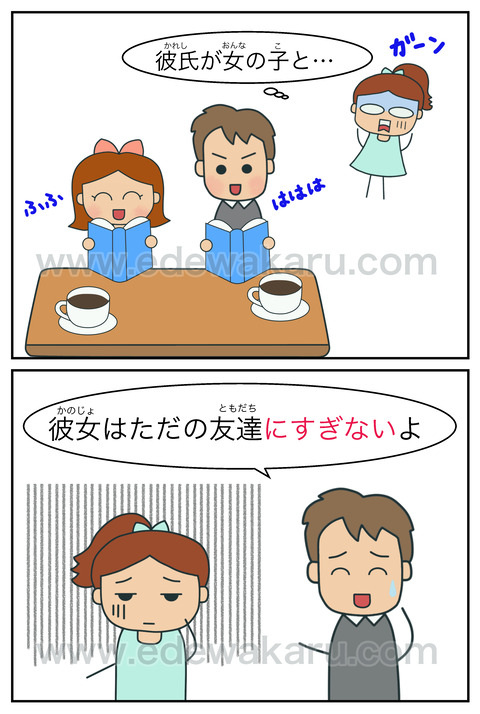
彼女はただの友達にすぎないよ
→彼女とはただ友達なだけだShe’s nothing more than a friend. →She’s just a friend, nothing more.
私は少し手伝ったにすぎません
→私はただ少し手伝っただけですI only helped a little. →I just helped a little.
私は社員の1人にすぎませんので、わかりません
→私はただの社員ですので、わかりませんI’m just one of the employees, so I don’t know. →I’m just an employee, so I don’t know.
そんな話、ただのうわさにすぎないよ
→そんな話、ただのうわさだよThat story is nothing more than a rumor. →That story is just a rumor.
Read the original source text
Meaning
ただ〜だけだ
How to use it
動詞・形容詞・名詞[普通形]+にすぎない
Explanation
「〜にすぎない」は「ただ〜だけだ」という意味を表す文型です。この文型は、
「単に〜なだけで、重要ではない」という気持ちを込めて使われま
す😮程度が低い、大変なことではないと言いたい時や、軽視の気持ちなどを入れてよく使われます😞
(復習:〜を込めて・〜を込めた)
(復習:〜など・〜なんか・〜なんて)
[例]
①彼女は友達
にすぎない
→彼女はただの友達で、
それ以上ではない
②私は少し手伝った
にすぎません
→私はただ手伝っただけで、
重要なことはしていません
③私は社員の1人
にすぎません
ので、わかりません
→私は
社長や部長ではなく、ただの社員です
のでわかりません
④そんな話、うわさ
にすぎない
よ
→そんな話はただのうわさで、
重要ではない
よ
【上級レベルの人へ】
「氷山の一角(ひょうざんのいっかく)」という慣用句があります。この慣用句は「〜にすぎない」とよく一緒に使われますので、覚えておきましょう😉
[例]
今回の事件で逮捕された人たちは
氷山の一角にすぎない
だろう
→今回の事件で逮捕された人たちは
ほんの一部
で、本当はもっとたくさんいるだろう
ニュースなどでもよく使われる表現ですから、覚えておくといいと思います😊
くらべてわかる日本語表現文型辞典
Meaning
X is nothing more than A; X is merely A. The speaker regards A as boring, trivial, worthless, or small in quantity.
How to use it
(X is) Aにすぎない (AにすぎないB)
[Verb – past form / ている] にすぎない
[i-adjective – い / かった] にすぎない
[na-adjective – である / だった] にすぎない
[Noun – ∅ / である / だった] にすぎない
Explanation
【Contrast 1】
“Aにほかならない” (Meaning 1, p. 259)
In context 4 examples
英語がわかるといっても、あいさつ程度にすぎない。
Even when I say I understand English, it amounts to no more than basic greetings.
当然のことをしたにすぎないのに、そんなに感謝されると恐縮です。
I only did what was obvious, so I feel embarrassed when people thank me so much.
ただ美しいにすぎない言葉より、心のこもった行いのほうがいい。
Actions done with sincerity are better than words that are merely beautiful.
あの店の料理は見た目がきれいであるにすぎない。
The food at that restaurant is nothing more than pleasing to the eye.
Read the original source text
Meaning
XはAでしかない、XはAであるだけだ。話し手はAをつまらない・くだらない・価値のない・数が少ないものと思っている。
How to use it
(Xは)Aにすぎない(AにすぎないB)
[動詞-た形/ている]にすぎない
[イ形-い/かった]にすぎない
[ナ形-である/だった]にすぎない
[名詞-∅/である/だった]にすぎない
Explanation
【対比1】
「Aにほかならない」(意味1 P.259)
日本語NET JLPT文法解説まとめ
How to use it
V (plain form) + にすぎない
い-adjective (plain form) + にすぎない
な-adjective (である) + にすぎない
N (である) + にすぎない
Explanation
Emphasizes the low level of something in terms of quality or quantity.
In context 8 examples
いくら高くて、性能のいいコンピューターを買っても、使わなければ、ただの箱にすぎない。
No matter how expensive or high-performing a computer you buy, if you don’t use it, it’s nothing but a box.
私はこの会社の一社員にすぎませんから、決定権はありません。
I’m just one employee at this company, so I have no decision-making authority.
今日お配りした資料は全体のほんの一部にすぎません。
The materials I handed out today are only a small part of the whole.
結局、仕事は生活するための手段にすぎません。
In the end, work is nothing more than a means of making a living.
彼のスピーチは他の人を真似したにすぎない。
His speech was nothing more than an imitation of someone else.
アルバイトの収入は1ヶ月1万円にすぎない。
My part-time job income is only 10,000 yen a month.
彼がインサイダー取引をしたという話は、噂にすぎない。
The story that he engaged in insider trading is nothing but a rumor.
彼の言っていることは、デマカセにすぎない。
What he’s saying is nothing but made-up nonsense.
Read the original source text
How to use it
V普 + にすぎない
A普 + にすぎない
Na(である) + にすぎない
N(である) + にすぎない
Explanation
Emphasizes the low level of something in terms of quality or quantity.
NINJAL 日本語文型データベース
Meaning
Used to emphasize that the quantity is small, the degree is low, or something is not important.
How to use it
V plain form + にすぎない
i-A plain form + にすぎない
na-A plain form + にすぎない (however, “na-Aだ” → “na-Aである + にすぎない”)
N plain form + にすぎない (however, “Nだ” → “Nにすぎない・Nであるにすぎない”)
In context 24 examples
私は絵をただ好きで描いているにすぎない。展覧会などに出すつもりなどない。
I draw simply because I enjoy painting. I have no intention of submitting my work to exhibitions or anything like that.
毎日、10分程度練習しているにすぎないが、けっこう漢字が書けるようになってきた。
I do nothing more than practice for about ten minutes every day, but I’ve become able to write quite a lot of kanji.
多くの人は生活の中で何かしら不安を抱えている。ただ口に出さないにすぎない。
Many people have some kind of anxiety in their lives. They simply don’t say it out loud.
ほんの少しワインを入れたにすぎないのに、料理の味がかなりよくなった。
Even though I added only a little wine, the dish tasted much better.
ほんのわずかお手伝いをしたにすぎない私が、お礼の品なんていただけません。どうぞお気遣いなく。
I only helped out a little, so I can’t accept a gift of thanks or anything like that. Please don’t trouble yourself.
就職の面接試験に不合格でも、その会社で求めていた人材のイメージとたまたま合わなかったに過ぎないのだと考えよう。次の試験に向けて気持ちを切り替えたほうがいい。
Even if you fail the job interview, let’s think of it as simply not matching the kind of person the company happened to be looking for. It would be better to put it behind you and focus on the next interview.
この部屋は、飾りっ気もなく、ただ広いにすぎない。
This room has no decorative touches; it is simply spacious.
中学生の息子は大人っぽく見られるが、体格がいいにすぎないのだ。
My junior high school son looks mature, but he’s simply well-built.
今から思えば、山本先生の話は単に話し方が面白かったにすぎない。内容は大してなかったように思う。
Looking back now, Professor Yamamoto’s talk was simply interesting in the way it was delivered. I don’t think there was much substance to it.
テニスのコーチ「試合には負けたけど、今回はほんの少し運がよくなかったに過ぎないよ。次回頑張ればいい」
Tennis coach: “We lost the match, but this time we were just a little unlucky. You can do your best next time.”
このタレントはインターネット上で活動しており、ごく一部の人たちの間で有名であるにすぎない。
This entertainer is active online and is known only among a very small group of people.
あの人は根は優しい人だ。言葉が少し乱暴であるにすぎない。
Deep down, that person is kind. Their language is simply a little rough.
この人物が17世紀後半に実在していたことは確かである。資料が少なく、生没年などの情報が明らかでないにすぎない。
It is certain that this person existed in the latter half of the 17th century. There is simply little documentation, so details such as their birth and death dates are unknown.
当時私は自分が優秀だと思い込んでいたが、クラスの中で比較的優秀だったにすぎない。社会に出ればいくらでも優秀な人はいた。
At the time, I was convinced that I was excellent, but I was simply relatively outstanding within my class. Once I entered society, I found there were any number of people who were excellent.
家事を専業で行う「主夫」は、当時いなかったのではなく、一般的でなかったに過ぎない。
It’s not that there were no men who did housework full-time; it’s simply that “househusbands” were not common at the time.
私にとってパソコンは、仕事をする上での単なる道具にすぎない。
To me, a computer is simply a tool for doing my job.
これからお見せする絵は、私のコレクションのほんの一部にすぎません。
The paintings I’m about to show you are only a small part of my collection.
「単なるうわさ話にすぎないと思うから、田中さんの言うことは気にしないほうがいいよ」
“I think it’s nothing more than a rumor, so you shouldn’t pay attention to what Tanaka says.”
私はただの一市民にすぎませんが、一言意見を述べたいと思います。
I’m just an ordinary citizen, but I’d like to offer a brief opinion.
公的な社会保障を利用できる人々は、世界人口のわずか20%にすぎないという。
They say that only 20 percent of the world’s population can access public social security.
兄が転勤するという話は、父のただの思い込みにすぎなかった。
The story that my older brother was being transferred was nothing more than my father’s assumption.
私はほんの小さな組織の責任者であるにすぎず、大きな力は持っていません。
I am only in charge of a very small organization, and I don’t have much power.
このタイプのデザインの服は、最近着ている人が少ないが、デザイン自体が良くないわけではない。ただ流行でないにすぎない。
Few people wear this type of design lately, but that doesn’t mean the design itself is bad. It’s simply out of fashion.
この工場の安全管理体制には問題があることがわかった。今まで事故が起こっていなかったのは、ただ幸運だったにすぎないと言える。
It turned out that this factory’s safety management system had problems. We can say that the only reason no accidents had happened so far was simply good luck.
Read the original source text
Meaning
数量が少ないこと・程度が低いこと・重要ではないことを強調するときに使います。
How to use it
V普通形+にすぎない
i-A普通形+にすぎない
na-A普通形+にすぎない(ただし「na-Aだ」→「na-Aである+にすぎない」
N普通形+にすぎない(ただし「Nだ」→「Nにすぎない・Nであるにすぎない」
DoJG 日本語文法辞典(全集)
Meaning
Nothing more than; not more than; mere; merely; only; just; as little/few as; that's all
How to use it
(i) Noun | に過ぎない | |
| 学生に過ぎない | Just a student |
(ii) Number+Counter | に過ぎない | |
| 五人に過ぎない | As a few as five people |
(iii) Vinformal(だけ) | に過ぎない | |
| 話している(だけ) に過ぎない | Someone is doing nothing but talking |
| 話した(だけ) に過ぎない | Someone did nothing more than talk |
Explanation
Something or someone is nothing more than what is stated in terms of amount, degree, status, significance, etc.
In context 12 examples
これは私の私見に過ぎない。
This is nothing more than my personal opinion.
今期の売り上げの伸びは三パーセントに過ぎない。
The sales increase this term is as little as three percent.
あの男は(ただ)言われたことをしている(だけ)に過ぎない。
That man is not doing more than what he was told to do.
彼は私のボーイフレンドの一人に過ぎない。
He is nothing more than one of my boyfriends.
これは数ある中のほんの一例に過ぎない。
This is only one example among many.
今言ったことは私の希望に過ぎませんので、あまり深刻に考えないで下さい。
What I've just told you is nothing more than my hope, so please don't take it too seriously.
私の収入はアルバイトを入れても年二万ドルに過ぎない。
My income is only $20,000 even if I include my side job (income).
私を支持してくれる人は身内を入れても五十人程度に過ぎない。
There are no more than about 50 people who support me (literally: The people who support me are no more than about fifty), even if I include my relatives.
あの子はまだ十五に過ぎないが、なかなかしっかりしている。
That girl is only fifteen, but she is quite mature.
彼は(ただ)人の意見を受け売りしている(だけ)に過ぎない。
He is doing nothing more than echoing other people's opinions.
彼の演説は(ただ)原稿を読み上げた(だけ)に過ぎない。
His speech was nothing more than the reading of a prepared manuscript.
私と山野氏は初対面の時、簡単な挨拶を交わした(だけ)に過ぎない。
Mr. Yamano and I did nothing more than exchange simple greetings when we first met each other.
毎日のんびり日本語教師
How to use it
Verb plain form + に過ぎない
い-adjective plain form + に過ぎない
な-adjective stem + である + に過ぎない
Noun (+ である) + に過ぎない
Explanation
Indicates a very low degree, meaning “nothing more than ~” or “only ~,” and carries a dismissive nuance such as insignificant, not much, or not very important.
It may pair with expressions such as 「ほんの」「ただ」「ただの」「たった」 and 「単なる」.
Notes
Nothing in particular.
In context 8 examples
これはあくまで私一個人の意見に過ぎません。
This is nothing more than my personal opinion.
愛と憎しみは全く同じものである。ただ、前者は積極的であり、後者は消極的であるに過ぎない。
Love and hatred are exactly the same thing. The former is merely active, and the latter merely passive.
自信無くするのは失敗した時の保身に過ぎない。
Losing confidence is nothing more than self-protection when one has failed.
報道されていることは氷山の一角に過ぎない。
What is being reported is only the tip of the iceberg.
肉体は魂の入れ物に過ぎない。
The body is nothing more than a vessel for the soul.
私はただのアルバイトに過ぎないので、詳しいことは分かりません。
I’m only a part-time worker, so I don’t know the details.
人と人に優劣をつけるなんてただの自己満足に過ぎない。
Assigning superiority and inferiority to people is nothing more than self-satisfaction.
地球も太陽系の惑星の一つに過ぎない。
Earth is just one of the planets in the solar system.
Read the original source text
How to use it
動詞普通形+に過ぎない
い形容詞普通形+に過ぎない
な形容詞語幹+である+に過ぎない
名詞(+である)+に過ぎない
Explanation
非常に低い程度、「~でしかない」という意味を表し、取るに足らない、たいしたことはない、あまり重要ではないなどの軽視したニュアンスが含まれます。
「ほんの」「ただ」「ただの」「たった」「単なる」など呼応することがあります。
Notes
特になし