日本語文型辞典
Usage 1
Meaning
It means “directed toward that” or “in response to that,” and is followed by an expression indicating some action or attitude directed toward it. When modifying a noun, the forms are 「…にたいしてのN」 and 「…にたいするN」.
Using a number expressed as a quantity as the unit, it means “in proportion to that unit.” It can be rephrased as 「…について」 or 「…につき」.
It is used to present two things in contrast.
How to use it
…にたいして
Nにたいして
Naなのにたいして
A-いのにたいして
Vのにたいして
N+数量詞+にたいして
…のにたいして
In context 11 examples
私の発言に対して彼は猛烈に攻撃を加えてきた。
He launched a fierce attack in response to my remarks.
私の質問に対して何も答えてくれなかった。
He did not answer any of my questions.
彼は女性に対しては親切に指導してくれる。
He gives women kind guidance.
現在容疑者に対しての取り調べが行われているところです。
The suspect is currently being questioned.
私が手を振って合図したのに対して、彼女は大きく腕を振って応えてくれた。
In response to my signaling with a wave, she waved her arm broadly to answer me.
研究員1人に対して年間40万円の補助金が与えられる。
An annual subsidy of 400,000 yen is provided for each researcher.
学生20人に対して教員一人が配置されている。
One teacher is assigned for every 20 students.
砂3に対して1の割合で土を混ぜます。
Mix in soil at a ratio of one part soil to three parts sand.
学生1人に対して20平米のスペースが確保されている。
Twenty square meters of space is allocated per student.
彼が自民党を支持しているのに対して、彼女は共産党を支援している。
While he supports the Liberal Democratic Party, she supports the Communist Party.
兄が背が高いのに対して、弟の方はクラスで一番低い。
While the older brother is tall, the younger brother is the shortest in his class.
Read the original source text
Meaning
「そのものごとに向けて/応じて」などの意味を表し、後ろにはそれに向けられた行為や態度など、なんらかの働きかけを示す表現が続く。名詞を修飾するときは「…にたいしてのN」「…にたいするN」となる。
数量で表された数を単位として、「その単位に応じて」の意を表す。「…について」「…につき」に言いかえられる。
対比的なふたつのことがらを並べて示すのに用いる。
How to use it
…にたいして
Nにたいして
Naなのにたいして
A-いのにたいして
Vのにたいして
N+数量詞+にたいして
…のにたいして
Usage 2
Meaning
Basic information: Followed by a negative, it indicates that the degree is not high. As in ②, ③, and ④, it is often used with 「のに」 in a sentence making a negative evaluation. For example, ④ can also be rephrased as “even though he doesn’t have much ability” or “even though his ability is nothing special.” Examples: ① It isn’t that cold today. Shall we go for a walk? ② That sushi restaurant is far too expensive, even though the food isn’t particularly good. ③ They’re good, aren’t they? Even though they haven’t practiced that much. ④ That politician doesn’t seem particularly capable, yet apparently has served for 25 years. I wonder what kind of people vote for him.
Read the original source text
Meaning
基本情報説明後ろに否定をともなって、程度が高くないことを表す。②③④のように、「のに」と共に用いて、マイナスの評価を下すような文に使うことが多い。またたとえば④なら「大した能力でもないのに」「能力は大したことがないのに」のように言いかえることができる。例文① きょうはたいして寒くないね。散歩にでも行こうか。② あのすし屋は高すぎる。たいしてうまくもないのに。③ あの人、うまいねえ。大して練習しているわけでもないのに。④ 大して有能でもないのに、あの議員は勤続25年だそうだ。一体どんな人が投票しているんだろう。
日本語文型辞典 英語版
Usage 1
Meaning
Expresses the meaning of “toward a thing/state/event, responding to a thing/state/event,” and is followed by some expression indicating some kind of motion such as an action or attitude toward the thing/state/event. When modifying a noun, becomes ...にたいしてのN or ...にたいするN.
With a numbered unit expressed in quantity or size, expresses the meaning of “according to some unit.” Can be rephrased as ...について or ...につき.
Used to juxtapose two items in contrast.
How to use it
1. ...にたいして[Nにたいして][Naなのにたいして][A-いのにたいして][Vのにたいして]
2. N+数量詞+にたいして
3. ...のにたいして
In context 11 examples
私の発言に対して彼は猛烈に攻撃を加えてきた。
He criticized me aggressively about my remarks.
私の質問に対して何も答えてくれなかった。
I didn’t get any answer to my questions.
彼は女性に対しては親切に指導してくれる。
With women, he offers kind guidance.
現在容疑者に対しての取り調べが行われているところです。
The interrogation of the suspect is underway at the moment.
私が手を振って合図したのに対して、彼女は大きく腕を振って応えてくれた。
When I waved my hand to her to give a sign, she responded to me by giving me a big wave.
研究員1人に対して年間 40万円の補助金が与えられる。
400,000 yen is allocated to each researcher as an annual subsidy.
学生 20 人に対して教員一人が配置されている。
For every twenty students, one teacher is assigned.
砂3に対して1の割合で土を混ぜます。
Sand is mixed with soil in a ratio of three to one.
学生1人に対して 20 平米のスペースが確保されている。
A space of twenty square meters is reserved for each student.
彼が自民党を支持しているのに対して、彼女は共産党を支援している。
He supports the Liberal Democratic Party, whereas she supports the Communist Party.
兄が背が高いのに対して、弟の方はクラスで一番低い。
Although the elder brother is tall, the younger brother is the shortest in his class.
Read the original source text
Meaning
Expresses the meaning of “toward a thing/state/event, responding to a thing/state/event,” and is followed by some expression indicating some kind of motion such as an action or attitude toward the thing/state/event. When modifying a noun, becomes ...にたいしてのN or ...にたいするN.
With a numbered unit expressed in quantity or size, expresses the meaning of “according to some unit.” Can be rephrased as ...について or ...につき.
Used to juxtapose two items in contrast.
How to use it
1. ...にたいして[Nにたいして][Naなのにたいして][A-いのにたいして][Vのにたいして]
2. N+数量詞+にたいして
3. ...のにたいして
Usage 2
Meaning
Followed by a negative form and expresses that the degree of something is not very great. Often combined with のに (despite, even though) and used to express a negative evaluation, as in
(2)
,
(3)
, and
(4)
. Can also be paraphrased using大した, as in the following paraphrases of
(4)
: 大した能力でもないのに (although he doesn’t have much capability), 能力は大したことがないのに (even though his ability is not that good).
In context 4 examples
きょうはたいして寒くないね。散歩にでも行こうか。
It’s not particularly cold today. Shall we take a walk?
あのすし屋は高すぎる。たいしてうまくもないのに。
That sushi restaurant is too expensive. It’s not particularly good, either.
あの人、うまいねえ。大して練習しているわけでもないのに。
He’s really good, isn’t he. Even though he doesn’t practice all that much.
大して有能でもないのに、あの議員は勤続 25 年だそうだ。一体どんな人が投票しているんだろう。
I hear that Diet member has held his seat continuously for 25 years, despite not being especially capable. I wonder what kind of people are voting for him.
IMABI
~に対して
Read this IMABI lesson ↗Explanation
~に対して
~に対して is something that gets abused and confused with a lot of things. One of the biggest errors with it is using it in the first place. On top of that, it is frequently confused with other phrases as ~にとって and ~について, and students often don’t know when to add は to make ~に対しては. This lesson will hopefully enable you to avoid such errors.
~に対して
“Noun + ~に対して” gives a meaning of targeting something and facing/confronting it.
1. この頃の親は子供に(対して)甘すぎる。
Parents these days are being too sweet towards their kids.
2. 政府に(対して)不満を{言う・持つ}な。
Don’t complain about the government.
3a. 大統領は記者団の質問に対して事実関係を否定した。〇
3b. 大統領は記者団の質問に事実関係を否定した。X
The president denied all facts of the case to the press group’s questions.
At the end of the sentence there is a verb or adjective that shows some sort of urging/pressure. It wouldn’t change the meaning to get rid of ~に対して in the sentences above, but it’s used to clearly state the object and direction of action. However, in sentences like the third one, it has to be used because it’s used in a sense of “against“.
4. 今の意見に質問がありますか。今の意見に対してご質問、ご意見があったらお願いします。
Do you have questions to the opinion now? If you have any questions or ideas concerning this opinion, please feel free.
5. 寄生虫きせいちゅうに対して、どうしたらいいでしょうか。
What should we do against parasites?
~に対しては
This is still used in the spoken language, but it does have somewhat of a formal tone. ~に対しては strengthens the speaker’s judgment/feeling by emphasizing/contrasting.
6. 報道官は記者団に対してはまだ何も答えていません。
The Press Secretary is still not answering anything to the press corps.
7. 日本人は知らない人に対しては消極的だが、親しい人に対しては積極的な態度を見せることが多い。
Japanese people often show negative attitudes towards people they don’t know and positive attitudes to people that they are close with.
8. 危険を与えるようなものに対しては、人間側が配慮すべきであろう。
The human side should consider things that cause hazard.
文体
~に対しまして (very polite) and ~に対し (very stiff/formal/literary) are also possible.
9. 今回の不祥事ふしょうじに対して、お詫わび申し上げます。
I deeply apologize for this scandal.
10. ご家族の皆様に対し、心よりお悔くやみ申し上げます。
To all of those in the families, please accept my heartfelt condolences.
読み物: 殺害の事件
3日夜神奈川県かながわけん葉山町はやまちょうの住宅で9歳と生後9ヶ月の姉妹が刃物はもので刺さされて殺害された事件で殺人未遂さつじんみすいの疑いで逮捕たいほされた母親が、警察の調べに対し「果物くだものナイフで刺した」と供述しているということで、警察は動機や経緯けいいについて調べを進めることにしています。
The mother arrested on the night of the third under the charge of attempted manslaughter of her daughters aged 9 and 9 months old by stabbing them at home in Hayama Town, Kanagawa Prefecture says in her affidavit in the police investigation that she “stabbed (them) with a fruit knife”, and the police are to investigate the motive and cause.
From NHK on October, 3, 2012.
1. How is に対して being used in this sentence?
2. Why would using に alone instead be wrong?
~に対して、というより
“に対して、というより” is a very common combination. In this case, you would not see ~に、というより. This would beat the point of making something stand out.
11. このことは日本人に対して、というよりすべての国の人に知っておいてほしいことです。
Rather than to Japanese, but I want this to be known to people of all countries.
連体形
There are two attributive forms of this pattern that are generally interchangeable, ~に対する and ~に対しての.
12. 結婚{に対しての・に対する}両家りょうけの価値観かちかんの違いに不安を感じます。
I feel anxiety over the differences of the two families values towards marriage.
13. 汚染おせん問題に対する解決策は余分よぶんの法律を可決するというわけではありませんよ。
The resolution to our pollution problem is not to pass further legislation.
数量+~に対して: 割合
With number/counter phrases, ~に対して shows a ratio.
14. 白菜はくさい1キロに対して塩50グラム入れてください。
For every kilogram of nappa, add 50 grams of salt.
15. 彼には一人の敵に対して百人もの味方みかたがいた。
For one enemy he had a hundred friends.
~に対して VS ~について・に関して
Now, when is this phrase similar to ~について and ~に関して? They all have a commonality of targeting something to show concern. However, the kinds of relation they represent are never the same. ~に対して shows something in regards of confronting whereas ~について・に関して state something regarding to the thing itself.
16a. その問題に対して説明してください。X
16b. その問題について説明してください。〇
Please explain that problem.
17. スピード違反いはんに対する3万円の反則金はんそくきんなんて辛いんだよな。
A penalty of 30,000 yen for a traffic ticket is harsh, isn’t it?
18a. その意見について反対します。X
18b. その意見に対して反対します。〇
I am against that opinion.
19a. 昨日、水不足に関して節水制限せっすいせいげんが導入どうにゅうされました。X
19b. 昨日、水不足に対して節水制限が導入されました。〇
Yesterday, water restrictions were introduced concerning the water shortage.
Examples
As one can never have too many examples, the following examples will hopefully give you even more data to pull on in understanding ~に対して.
20a. 勉強しない学生に対して、除名じょめいしましょう。X
20b. 勉強しない学生を除名しましょう。
Let’s drop students that don’t study.
21. 軍隊ぐんたいは反乱軍に対して嘗かつてないほどの大規模な攻撃をした。
The army made the biggest ever large-scale attack against the rebel army.
Orthography Note: 嘗て is normally just written as かつて.
22. 高田がぐうたらであるのに対して、益田は勤勉きんべんだ。
In comparison to Takada being lazy, Masuda is a hard worker.
23. 2010年に円はドルに対してずっと手堅てがたい動きをしていた。
The yen stayed firm against the dollar in 2010.
24. 我が国は、アジア諸国しょこくの人々に(対して)多大の損害そんがいと苦痛くつうを与えました。
Our country brought great damage and pain to all of the peoples of Asia.
Based off of the 村山談話.
25. むしこなーずは何の虫に対して効果こうかがありますか。
What bugs does “big corners” have an effect on?
Word Note: むしこなーず is a kind of bug killer/repellent.
26. 私たちに(対して)遠慮えんりょしないでください。
Please speak outright to us.
27. この品は値段に対して品質が悪い。
As for these goods, the quality is bad for the price.
28. 日本では平均へいきんして職員一人に対して百万円の経費けいひがかかります。
In Japan, on average, for a single worker, the outlay costs 1 million yen.
29. 和平に対する北朝鮮の疑惑ぎわくは日本の防衛を脅おびやかしています。
Suspicions of North Korea for peace threatens Japanese security.
30. キックに対してもパンチに対しても使うのですか?
Do you even use it in regards to a kick or even a punch?
31. 取扱説明書は、コンピュータに対する静電気の危険性きけんせいを、間接的に警告します。
Guidebooks indirectly warn of the danger to computers by static electricity.
32. 友だちの経済学に対する関心はもっぱら学問上のもののようですが。
It seems that my friends’ interest in economics is largely academic.
Particle Note: が shows that the sentence is cut off, perhaps leading into something else.
33. トヨタのものづくりに対する情熱じょうねつと、日本のものづくりに対するこだわりは創業そうぎょう以来、決して変わらない。
The passion towards Toyota manufacturing and dwelling on Japanese manufacturing, since our founding, will never change.
By 豊田章男 in April 2013.
In context 40 examples
この頃の親は子供に(対して)甘すぎる。
Parents these days are being too sweet towards their kids.
政府に(対して)不満を{言う・持つ}な。
Don’t complain about the government.
大統領は記者団の質問に対して事実関係を否定した。〇
The president denied all facts of the case to the press group’s questions.
大統領は記者団の質問に事実関係を否定した。X
The president denied all facts of the case to the press group’s questions.
今の意見に質問がありますか。今の意見に対してご質問、ご意見があったらお願いします。
Do you have questions to the opinion now? If you have any questions or ideas concerning this opinion, please feel free.
寄生虫きせいちゅうに対して、どうしたらいいでしょうか。
What should we do against parasites?
報道官は記者団に対してはまだ何も答えていません。
The Press Secretary is still not answering anything to the press corps.
日本人は知らない人に対しては消極的だが、親しい人に対しては積極的な態度を見せることが多い。
Japanese people often show negative attitudes towards people they don’t know and positive attitudes to people that they are close with.
危険を与えるようなものに対しては、人間側が配慮すべきであろう。
The human side should consider things that cause hazard.
今回の不祥事ふしょうじに対して、お詫わび申し上げます。
I deeply apologize for this scandal.
ご家族の皆様に対し、心よりお悔くやみ申し上げます。
To all of those in the families, please accept my heartfelt condolences.
How is に対して being used in this sentence?
How is に対して being used in this sentence?
Why would using に alone instead be wrong?
Why would it be wrong to use に alone instead?
このことは日本人に対して、というよりすべての国の人に知っておいてほしいことです。
Rather than to Japanese, but I want this to be known to people of all countries.
結婚{に対しての・に対する}両家りょうけの価値観かちかんの違いに不安を感じます。
I feel anxiety over the differences of the two families values towards marriage.
汚染おせん問題に対する解決策は余分よぶんの法律を可決するというわけではありませんよ。
The resolution to our pollution problem is not to pass further legislation.
白菜はくさい1キロに対して塩50グラム入れてください。
For every kilogram of nappa, add 50 grams of salt.
彼には一人の敵に対して百人もの味方みかたがいた。
For one enemy he had a hundred friends.
その問題に対して説明してください。X
Please explain that problem.
その問題について説明してください。〇
Please explain that problem.
スピード違反いはんに対する3万円の反則金はんそくきんなんて辛いんだよな。
A penalty of 30,000 yen for a traffic ticket is harsh, isn’t it?
その意見について反対します。X
I am against that opinion.
その意見に対して反対します。〇
I am against that opinion.
昨日、水不足に関して節水制限せっすいせいげんが導入どうにゅうされました。X
Yesterday, water restrictions were introduced concerning the water shortage.
昨日、水不足に対して節水制限が導入されました。〇
Yesterday, water restrictions were introduced concerning the water shortage.
勉強しない学生に対して、除名じょめいしましょう。X
Let’s drop students that don’t study.
勉強しない学生を除名しましょう。
Let’s drop students that don’t study.
軍隊ぐんたいは反乱軍に対して嘗かつてないほどの大規模な攻撃をした。
The army made the biggest ever large-scale attack against the rebel army.
高田がぐうたらであるのに対して、益田は勤勉きんべんだ。
In comparison to Takada being lazy, Masuda is a hard worker.
2010年に円はドルに対してずっと手堅てがたい動きをしていた。
The yen stayed firm against the dollar in 2010.
我が国は、アジア諸国しょこくの人々に(対して)多大の損害そんがいと苦痛くつうを与えました。
Our country brought great damage and pain to all of the peoples of Asia.
むしこなーずは何の虫に対して効果こうかがありますか。
What bugs does “big corners” have an effect on?
私たちに(対して)遠慮えんりょしないでください。
Please speak outright to us.
この品は値段に対して品質が悪い。
As for these goods, the quality is bad for the price.
日本では平均へいきんして職員一人に対して百万円の経費けいひがかかります。
In Japan, on average, for a single worker, the outlay costs 1 million yen.
和平に対する北朝鮮の疑惑ぎわくは日本の防衛を脅おびやかしています。
Suspicions of North Korea for peace threatens Japanese security.
キックに対してもパンチに対しても使うのですか?
Do you even use it in regards to a kick or even a punch?
取扱説明書は、コンピュータに対する静電気の危険性きけんせいを、間接的に警告します。
Guidebooks indirectly warn of the danger to computers by static electricity.
友だちの経済学に対する関心はもっぱら学問上のもののようですが。
It seems that my friends’ interest in economics is largely academic.
トヨタのものづくりに対する情熱じょうねつと、日本のものづくりに対するこだわりは創業そうぎょう以来、決して変わらない。
The passion towards Toyota manufacturing and dwelling on Japanese manufacturing, since our founding, will never change.
Read the original source text
Explanation
~に対して
~に対して is something that gets abused and confused with a lot of things. One of the biggest errors with it is using it in the first place. On top of that, it is frequently confused with other phrases as ~にとって and ~について, and students often don’t know when to add は to make ~に対しては. This lesson will hopefully enable you to avoid such errors.
~に対して
“Noun + ~に対して” gives a meaning of targeting something and facing/confronting it.
1. この頃の親は子供に(対して)甘すぎる。
Parents these days are being too sweet towards their kids.
2. 政府に(対して)不満を{言う・持つ}な。
Don’t complain about the government.
3a. 大統領は記者団の質問に対して事実関係を否定した。〇
3b. 大統領は記者団の質問に事実関係を否定した。X
The president denied all facts of the case to the press group’s questions.
At the end of the sentence there is a verb or adjective that shows some sort of urging/pressure. It wouldn’t change the meaning to get rid of ~に対して in the sentences above, but it’s used to clearly state the object and direction of action. However, in sentences like the third one, it has to be used because it’s used in a sense of “against“.
4. 今の意見に質問がありますか。今の意見に対してご質問、ご意見があったらお願いします。
Do you have questions to the opinion now? If you have any questions or ideas concerning this opinion, please feel free.
5. 寄生虫きせいちゅうに対して、どうしたらいいでしょうか。
What should we do against parasites?
~に対しては
This is still used in the spoken language, but it does have somewhat of a formal tone. ~に対しては strengthens the speaker’s judgment/feeling by emphasizing/contrasting.
6. 報道官は記者団に対してはまだ何も答えていません。
The Press Secretary is still not answering anything to the press corps.
7. 日本人は知らない人に対しては消極的だが、親しい人に対しては積極的な態度を見せることが多い。
Japanese people often show negative attitudes towards people they don’t know and positive attitudes to people that they are close with.
8. 危険を与えるようなものに対しては、人間側が配慮すべきであろう。
The human side should consider things that cause hazard.
文体
~に対しまして (very polite) and ~に対し (very stiff/formal/literary) are also possible.
9. 今回の不祥事ふしょうじに対して、お詫わび申し上げます。
I deeply apologize for this scandal.
10. ご家族の皆様に対し、心よりお悔くやみ申し上げます。
To all of those in the families, please accept my heartfelt condolences.
読み物: 殺害の事件
3日夜神奈川県かながわけん葉山町はやまちょうの住宅で9歳と生後9ヶ月の姉妹が刃物はもので刺さされて殺害された事件で殺人未遂さつじんみすいの疑いで逮捕たいほされた母親が、警察の調べに対し「果物くだものナイフで刺した」と供述しているということで、警察は動機や経緯けいいについて調べを進めることにしています。
The mother arrested on the night of the third under the charge of attempted manslaughter of her daughters aged 9 and 9 months old by stabbing them at home in Hayama Town, Kanagawa Prefecture says in her affidavit in the police investigation that she “stabbed (them) with a fruit knife”, and the police are to investigate the motive and cause.
From NHK on October, 3, 2012.
1. How is に対して being used in this sentence?
2. Why would using に alone instead be wrong?
~に対して、というより
“に対して、というより” is a very common combination. In this case, you would not see ~に、というより. This would beat the point of making something stand out.
11. このことは日本人に対して、というよりすべての国の人に知っておいてほしいことです。
Rather than to Japanese, but I want this to be known to people of all countries.
連体形
There are two attributive forms of this pattern that are generally interchangeable, ~に対する and ~に対しての.
12. 結婚{に対しての・に対する}両家りょうけの価値観かちかんの違いに不安を感じます。
I feel anxiety over the differences of the two families values towards marriage.
13. 汚染おせん問題に対する解決策は余分よぶんの法律を可決するというわけではありませんよ。
The resolution to our pollution problem is not to pass further legislation.
数量+~に対して: 割合
With number/counter phrases, ~に対して shows a ratio.
14. 白菜はくさい1キロに対して塩50グラム入れてください。
For every kilogram of nappa, add 50 grams of salt.
15. 彼には一人の敵に対して百人もの味方みかたがいた。
For one enemy he had a hundred friends.
~に対して VS ~について・に関して
Now, when is this phrase similar to ~について and ~に関して? They all have a commonality of targeting something to show concern. However, the kinds of relation they represent are never the same. ~に対して shows something in regards of confronting whereas ~について・に関して state something regarding to the thing itself.
16a. その問題に対して説明してください。X
16b. その問題について説明してください。〇
Please explain that problem.
17. スピード違反いはんに対する3万円の反則金はんそくきんなんて辛いんだよな。
A penalty of 30,000 yen for a traffic ticket is harsh, isn’t it?
18a. その意見について反対します。X
18b. その意見に対して反対します。〇
I am against that opinion.
19a. 昨日、水不足に関して節水制限せっすいせいげんが導入どうにゅうされました。X
19b. 昨日、水不足に対して節水制限が導入されました。〇
Yesterday, water restrictions were introduced concerning the water shortage.
Examples
As one can never have too many examples, the following examples will hopefully give you even more data to pull on in understanding ~に対して.
20a. 勉強しない学生に対して、除名じょめいしましょう。X
20b. 勉強しない学生を除名しましょう。
Let’s drop students that don’t study.
21. 軍隊ぐんたいは反乱軍に対して嘗かつてないほどの大規模な攻撃をした。
The army made the biggest ever large-scale attack against the rebel army.
Orthography Note: 嘗て is normally just written as かつて.
22. 高田がぐうたらであるのに対して、益田は勤勉きんべんだ。
In comparison to Takada being lazy, Masuda is a hard worker.
23. 2010年に円はドルに対してずっと手堅てがたい動きをしていた。
The yen stayed firm against the dollar in 2010.
24. 我が国は、アジア諸国しょこくの人々に(対して)多大の損害そんがいと苦痛くつうを与えました。
Our country brought great damage and pain to all of the peoples of Asia.
Based off of the 村山談話.
25. むしこなーずは何の虫に対して効果こうかがありますか。
What bugs does “big corners” have an effect on?
Word Note: むしこなーず is a kind of bug killer/repellent.
26. 私たちに(対して)遠慮えんりょしないでください。
Please speak outright to us.
27. この品は値段に対して品質が悪い。
As for these goods, the quality is bad for the price.
28. 日本では平均へいきんして職員一人に対して百万円の経費けいひがかかります。
In Japan, on average, for a single worker, the outlay costs 1 million yen.
29. 和平に対する北朝鮮の疑惑ぎわくは日本の防衛を脅おびやかしています。
Suspicions of North Korea for peace threatens Japanese security.
30. キックに対してもパンチに対しても使うのですか?
Do you even use it in regards to a kick or even a punch?
31. 取扱説明書は、コンピュータに対する静電気の危険性きけんせいを、間接的に警告します。
Guidebooks indirectly warn of the danger to computers by static electricity.
32. 友だちの経済学に対する関心はもっぱら学問上のもののようですが。
It seems that my friends’ interest in economics is largely academic.
Particle Note: が shows that the sentence is cut off, perhaps leading into something else.
33. トヨタのものづくりに対する情熱じょうねつと、日本のものづくりに対するこだわりは創業そうぎょう以来、決して変わらない。
The passion towards Toyota manufacturing and dwelling on Japanese manufacturing, since our founding, will never change.
By 豊田章男 in April 2013.
DoJG 日本語文法辞典(全集)
Meaning
Toward; to; in contrast to; whereas; in regard to; in; per
How to use it
(i) Noun | に対して | |
| 先生に対して | Towards one’s teacher |
(ii) {V/Adjective い} informal | のに対して | |
| {話す/話した}のに対して | Someone talks/talked, whereas ~ |
| {若い/若かった}のに対して | Someone is/was young, whereas ~ |
(iii) {Adjective な stem/Noun} {な/である/だった/であった} | のに対して | |
| 元気{な/である/だった/であった}のに対して | Someone is/was healthy, whereas ~ |
| 学生{な/である/だった/であった}のに対して | Someone is/was a student, whereas ~ |
(iv) Noun | に{対する/対しての}Noun | |
| 結婚に{対する/対しての}考え方 | One’s view of marriage |
Explanation
に対して/対する Regarding something/someone one opposes, compares, or shows interest in regarding something/someone one opposes, compares or shows interest in.
In context 16 examples
これまで日本は外国に対して閉鎖的な政策を取ってきた。
Up until now Japan has taken a closed policy toward foreign countries.
日本の大学は入学するのが難しいのに対して、アメリカの大学は卒業するのが難しい。
Japanese colleges are hard to enter; whereas American colleges are hard to graduate from.
アメリカでは離婚に{対する/対しての}考え方が大分変わってきた。
In America, attitudes toward divorce have greatly changed.
鈴木さんは誰に対しても丁寧だ。
Mr. Suzuki is polite towards everybody.
日本は外国に対して市場をもっと開放すべきた。
Japan should open its market more widely towards foreign countries.
私は政治に対して強い関心がある。
I have a strong interest in politics.
手数料は一万円に対して五百円です。
The commission charge will be 500 yen per 10,000 yen.
市民は増税に対して強く反対している。
The citizens are strongly opposed to the tax hike.
私は高校生の時から、日本の文化に対して興味があった。
Since my high school days, I have had an interest in Japanese culture.
去年は自動車事故が少なかったのに対して、今年は大変多かった。
Last year there were very few car accidents, whereas this year the number was very high.
日本人は褒められた時、よく「とんでもない」と言う。これに対して、アメリカ人はよく「ありがとう」と言う。
When Japanese get compliments, they often say "Oh, not at all." In contrast to this, Americans often say "Thank you."
女性の地位は日本ではまだ低いのに対して、欧米では比較的高い。
Women's position is still low in Japan, whereas in Europe and America it is relatively high
東ヨーロッパの国々が民主化に向かっているのに対して、中国大陸と北朝鮮は民主化がまだ遅れているようだ。
Eastern European countries are progressing towards democratization, whereas Continental China and North Korea appear to be slower in democratization.
ロシアに対してのアメリカ人の見方は最近友好的になった。
American views of Russia have recently become friendlier.
部長は岡田に対して有利な発言をした。
The departmental chief made a remark in Okada's favour.
その経済学者の説に{対する・対して}反論はなかった。
There wasn't a counterargument against the economist's thesis.
どんなときどう使う 日本語表現文型辞典
Usage 1
Meaning
(target) toward
How to use it
N + に対して
Explanation
にたいして〈対象〉
~に/~を相手として
1)行為や感情が向けられる相手や対象を表す。相手に直接、行為や気持ちが及ぶときに使う。後には相手に向けて働きかける行為、態度を表す表現が来る。
2)後に名詞が来る場合は ❹ のように「に対するN」という形になる。
2)When followed by a noun, becomes に対する N, as in sentence ❹ .
1)Describes target or person that is object of actions or feelings. Used when action or feeling directly affects other party. Expressions of actions or attitudes appealing to other party follow.
In context 4 examples
小林先生は勉強が嫌いな学生に対して、特に親しみをもって接していた。
Mr. Kobayashi was especially friendly toward students who disliked studying.
この奨学金は将来教員になりたいと思っている人に対して与えられるものです。
This scholarship is awarded to people who want to become teachers in the future.
今のランさんの発言に対して、何か反対の意見がある方は手を挙げてください。
If anyone has an opposing opinion in response to what Lan just said, please raise your hand.
青年の親に対する反抗心は、いつごろ生まれ、いつごろ消えるのだろうか。
When does a young person’s rebellious attitude toward their parents begin, and when does it disappear?
Read the original source text
Meaning
(target) toward
How to use it
N+に対して
Explanation
にたいして〈対象〉
~に/~を相手として
1)行為や感情が向けられる相手や対象を表す。相手に直接、行為や気持ちが及ぶときに使う。後には相手に向けて働きかける行為、態度を表す表現が来る。
2)後に名詞が来る場合は ❹ のように「に対するN」という形になる。
2)When followed by a noun, becomes に対する N, as in sentence ❹ .
1)Describes target or person that is object of actions or feelings. Used when action or feeling directly affects other party. Expressions of actions or attitudes appealing to other party follow.
Usage 2
Meaning
(contrast) as opposed to; in contrast to
How to use it
N / [plain form] (な-adjective + な / な-adjective + である / N + な / N + である) + の + に対して
Explanation
にたいして〈対比〉
~と対比して考えると
ある事柄について二つの状況を対比するときに使う。
Contrasts state of two things.
In context 3 examples
活発な姉に対して、妹は静かなタイプです。
In contrast to her lively older sister, the younger sister is a quiet type.
日本人の平均寿命は、男性78歳であるのに対して、女性85歳です。
The average life expectancy of Japanese people is 78 for men, whereas it is 85 for women.
日本海側では、冬、雪が多いのに対して、太平洋側では晴れの日が続く。
On the Sea of Japan side, there is a lot of snow in winter, whereas on the Pacific side, sunny days continue.
Read the original source text
Meaning
(contrast) as opposed to; in contrast to
How to use it
N/〔普通形〕(ナAな・ナAである/Nな・Nである)+の+に対して
Explanation
にたいして〈対比〉
~と対比して考えると
ある事柄について二つの状況を対比するときに使う。
Contrasts state of two things.
絵でわかる日本語
Usage 1
Read this source entry ↗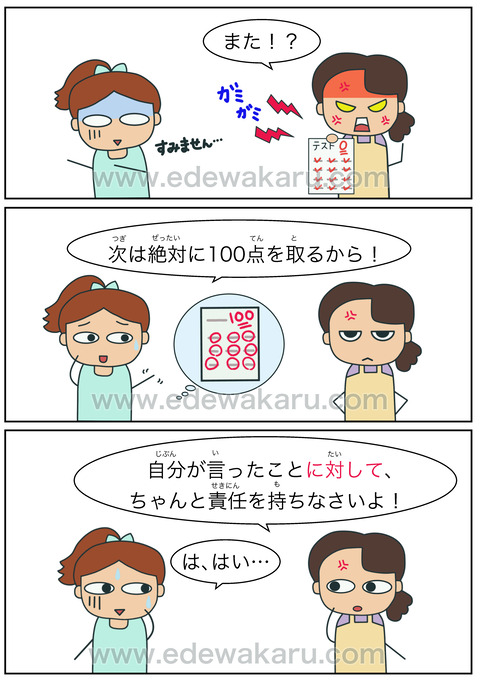
Meaning
Toward ~
With ~ as the other party
How to use it
Verb [plain form] + のに対して
Noun [dictionary form] + に対して
Explanation
「Aに対して」 is a sentence pattern meaning “toward A” or “with A as the other party.” A can be a person or a matter. When a noun follows, use 「Aに対する+noun」 or 「Aに対しての+noun」.
[Examples]
My mother’s attitude
toward me
に対する
is strict
My mother’s attitude
toward me
に対しての
is strict
「〜に対して」 also has a use expressing contrast, so learn that as well 😀
In context 5 examples
自分が言ったことに対して、ちゃんと責任を持ちなさいよ!
→自分が言ったことに、ちゃんと責任を持ちなさいよ!You should take proper responsibility for what you said! →You should take proper responsibility for what you said!
お母さんは妹に対しては優しいのに、私に対してはとても厳しい…
→妹には優しいのに、私にはとても厳しいMy mother is kind to my little sister, but very strict with me… →She’s kind to my little sister, but very strict with me.
彼の意見に対して、反対の人はいますか?
→彼の意見に、反対の人はいますか?Is there anyone who disagrees with his opinion? →Is there anyone who disagrees with his opinion?
先生は、私の質問に対して答えてくれた
→私の質問に答えてくれたThe teacher answered my question. →The teacher answered my question.
目上の人に対して、タメ口を使うものじゃないよ
→目上の人に、タメ口を使うものじゃないよYou shouldn’t speak casually to someone senior to you. →You shouldn’t speak casually to someone senior to you.
Read the original source text
Meaning
〜に
〜を相手に
How to use it
動詞[普通形]+のに対して
名詞[辞書形]+に対して
Explanation
「Aに対して」は「Aに」「Aを相手に」という意味を表す文型です。
「A」には【人】や【こと】が入ります。また、後ろに名詞がくる場合は「Aに対する+名詞」「Aに対しての+名詞」になります。
[例]
お母さんの私
に対する
態度は厳しい
お母さんの私
に対しての
態度は厳しい
「〜に対して」には【対比】を表す用法もありますので、一緒に覚えておきましょう😀
Usage 2
Read this source entry ↗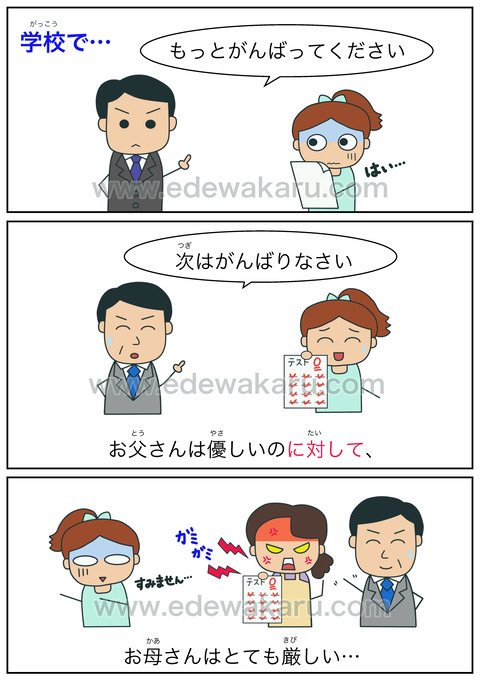
Meaning
A is ~. By comparison, B is ~.
A is ~. Unlike that, B is ~.
How to use it
Verb/adjective [plain form] + のに対して
Noun [dictionary form] + なのに対して
Noun [dictionary form] + であるのに対して
Explanation
「Aに対してB」 is a sentence pattern expressing contrast and is used to mean “A is ~. By comparison, B is ~” or “A is ~. Unlike that, B is ~.” It is used when comparing two things and stating their differences clearly 😊 It is often used to say that A and B are completely different or opposites. The て in 「〜に対して」 may also be omitted.
[Example]
Dad is kind, whereas Mom is strict
に対して
=Dad is kind, whereas Mom is strict
に対し
「〜に対して」 also has a use expressing a target, so learn that as well.
In context 5 examples
お父さんは優しいのに対して、お母さんはとても厳しい
→お父さんは優しい。それに比べて、お母さんは厳しいDad is kind, whereas Mom is very strict. →Dad is kind. By comparison, Mom is strict.
去年の冬は寒かったのに対して、今年はとても暖かい
→去年の冬は寒かった。それとは違って、今年はとても暖かいLast winter was cold, whereas this year it’s very warm. →Last winter was cold. Unlike that, this year it’s very warm.
今、日本は冬なのに対してオーストラリアは夏だ
→今、日本は冬だ。それとは違って、オーストラリアは夏だIt’s winter in Japan now, whereas it’s summer in Australia. →It’s winter in Japan now. Unlike that, it’s summer in Australia.
兄はスポーツが得意なのに対して、弟は運動音痴(うんどうおんち)だ
→兄はスポーツが得意だ。それとは違って、弟は運動音痴だMy older brother is good at sports, whereas my younger brother is completely unathletic. →My older brother is good at sports. Unlike that, my younger brother is unathletic.
息子はゲームをしてばかりいるのに対して、娘は勉強ばかりしている
→息子はゲームをしてばかりいる。それに比べて、娘は勉強ばかりしているMy son does nothing but play games, whereas my daughter does nothing but study. →My son does nothing but play games. By comparison, my daughter does nothing but study.
Read the original source text
Meaning
Aは〜。それに比べて、Bは〜
Aは〜。それとは違ってBは〜
How to use it
動詞・形容詞[普通形]+のに対して
名詞[辞書形]+なのに対して
名詞[辞書形]+であるのに対して
Explanation
「Aに対してB」は[対比]を表す文型で、「Aは〜。それに比べてBは〜」「Aは〜。それとは違ってBは〜」という意味で使われます。この文型は2つのことを比べて、その違いをはっきり言いたい時に使用されます😊「AとBが全然違う」「AとBは反対だ」と言いたい時によく使われます。 また、「〜に対して」の「て」は省略することができます。
[例]
お父さんは優しいの
に対して、お母さんは厳しい
=お父さんは優しいの
に対し、お母さんは厳しい
「〜に対して」には【対象】を表す用法もありますので、一緒に覚えておきましょう。
くらべてわかる日本語表現文型辞典
Meaning
Meaning 1: A indicates the target of B.
Meaning 2: A and B are in a comparative or opposing relationship. A is ~; on the other hand, B is ~.
Meaning 3: Indicates a ratio as a general matter. A is the number that is the target of the action B.
How to use it
Aに対してB (Aに対するB / それに対してB)
Connection 1:
[Verb] + こと + に対して
[Noun – ∅] に対して
Connection 2:
[Verb] + の + に対して
[i-adjective – plain form] + の + に対して
[na-adjective – な / である / だった / ではない] + の + に対して
[Noun – ∅] に対して
[Noun – ∅] + (なの) + に対して
Connection 3:
[Noun – ∅] に対して
Explanation
【Contrast 1】
“Aに向かってB” (Meanings 1 and 2, p. 260)
“Aに関してB” (Meaning 1, p. 223)
“AについてB” (Meaning 1, p. 247)
“Aに反してB” (Meaning 2, p. 256)
【Contrast 2】
“Aに反してB” (Meaning 1, p. 256)
“AにひきかえB” (Meanings 1 and 2, p. 258)
“Aに比べてBはC” (Meanings 1 and 2, p. 226)
【Contrast 3】
“AにつきB” (Meaning 2, p. 248)
Notes
【Note 2】
・“A. それに対してB.” is a conjunctive expression.
【Note 3】
・A is a combination of a noun and a number.
In context 12 examples
母は妹に対してとても優しい。
My mother is very kind to my younger sister.
増税に対する市民の考えを聞く。
We will hear what citizens think about the tax increase.
当店は万引きに対しては厳しく対処しています。
Our store deals strictly with shoplifting.
発熱に対して処方される薬剤の副作用が問題になっている。
The side effects of medications prescribed for fever have become an issue.
500人の敵に対して、味方は200人しかいない。
Against 500 enemy soldiers, we have only 200 on our side.
妻がスポーツ好きなのに対して、ぼくは読書好きだ。
While my wife likes sports, I like reading.
今年開業したホテルに対して、老朽化した旅館では勝負にならない。
An aging inn cannot compete with a hotel that opened this year.
女性の中で経済力を結婚しない理由に挙げたのは約3割だった。それに対して、男性は5割近くもいた。
About 30% of women named financial independence as a reason not to marry. By contrast, nearly 50% of men did.
子ども一人に対して5000円、国から補助金が支払われる。
The government pays a subsidy of 5,000 yen per child.
しょうゆ2に対して酢1の割合で合わせる。
Mix them in a ratio of two parts soy sauce to one part vinegar.
玄米1合に対して、白米3合を混ぜて炊くとおいしい。
It tastes good if you mix three cups of white rice with one cup of brown rice and cook them.
少子高齢化により、やがて若者1に対して、老人2の社会がやってくるに違いない。
With the declining birthrate and aging population, a society with two elderly people for every young person is sure to come eventually.
Read the original source text
Meaning
意味1:AはBの対象を示す。
意味2:AとBは比較・対立関係にある。Aは~だ。一方、Bは~だ。
意味3:割合を一般的事柄として示す。AはBという行為の対象となる数である。
How to use it
Aに対してB(Aに対するB/それに対してB)
接続1:
[動詞]+こと+に対して
[名詞-∅]に対して
接続2:
[動詞]+の+に対して
[イ形-普]+の+に対して
[ナ形-な/である/だった/ではない]+の+に対して
[名詞-∅]に対して
[名詞-∅]+(なの)+に対して
接続3:
[名詞-∅]に対して
Explanation
【対比1】
「Aに向かってB」(意味1,2 P.260)
「Aに関してB」(意味1 P.223)
「AについてB」(意味1 P.247)
「Aに反してB」(意味2 P.256)
【対比2】
「Aに反してB」(意味1 P.256)
「AにひきかえB」(意味1,2 P.258)
「Aに比べてBはC」(意味1,2 P.226)
【対比3】
「AにつきB」(意味2 P.248)
Notes
【注意2】
・「A。それに対してB。」は接続表現である。
【注意3】
・Aは名詞と数との組み合わせ。
毎日のんびり日本語教師
How to use it
Noun + に対して
Noun + に対する/対しての + noun
Verb plain form + のに対して
I-adjective plain form + のに対して
Na-adjective stem + な/である + のに対して
Explanation
There are three meanings.
① Target of an action
Attaches only to nouns.
② Proportion
Attaches to nouns expressing quantities and indicates a proportion.
③ Contrast
Attaches to nouns, verbs, i-adjectives, and na-adjectives, and indicates a contrast between two things.
Notes
Nothing in particular.
In context 12 examples
皆さまのご支援に対し、深く感謝申し上げます。
I would like to express my deepest gratitude for your support.
悪口に対しては無視するのが一番良い。
The best thing to do about insults is to ignore them.
彼は仕事や何に対しても言い訳ばかりだ。
He makes excuses about work and everything else.
日本の性暴力に対する刑は軽いと思う。
I think the penalties for sexual violence in Japan are light.
今回の区議会選挙では定数30人に対して、立候補者は60人もいた。
In this ward council election, there were as many as 60 candidates for 30 available seats.
水100ccに対して砂糖、塩それぞれ5g入れます。(每100cc水中分别放入5g砂糖、5g盐。)
Add 5 g each of sugar and salt to every 100 cc of water. (Add 5 g of sugar and 5 g of salt per 100 cc of water.)
漢字の多くは、一つの漢字に対して複数の読み方がある。
Many kanji have multiple readings for a single character.
お客様1人に対して、スタッフ3人で対応致します。
Three staff members will assist each customer.
兄は成績が良いのに対して、弟はそうでもない。
My older brother gets good grades, whereas my younger brother doesn't do as well.
2016年の調査によると、健康寿命は男性が72.14歳だったのに対して、女性は74.79際だった。
According to a 2016 survey, healthy life expectancy was 72.14 years for men, compared with 74.79 years for women.
日本海側はよく雪が降るのに対し、太平洋側の降雪量はそれほどでもない。
It often snows on the Sea of Japan side, whereas the amount of snowfall on the Pacific side is not that great.
駅の北側は商業施設が密集し人々が行き交うのに対し、南側は住宅街があり物静かな印象を受ける。
The area north of the station is packed with commercial facilities and bustling with people, whereas the south side has a residential neighborhood and feels quiet.
Read the original source text
How to use it
名詞+に対して
名詞+に対する/対しての+名詞
動詞普通形+のに対して
い形容詞普通形+のに対して
な形容詞語幹+な/である+のに対して
Explanation
3つの意味があります。
①動作の対象
名詞にのみ接続します。
②比例
数量を表す名詞に接続して、比例を表します。
③対比
名詞、動詞、イ形容詞、ナ形容詞に接続して、2つの物事の対比を表します。
Notes
特になし
NINJAL 日本語文型データベース
Usage 1
Meaning
Used when you want to say that ~ contrasts with something else. It can also be used when you want to say that the qualities of two things are completely different.
How to use it
V plain form + の + に対して
i-A plain form + の + に対して
na-A plain form + の + に対して (however, “na-Aだ” → “na-Aな + の + に対して” or “na-Aである + の + に対して”)
Nに対して・N plain form + の + に対して (however, “Nな + の + に対して” or “Nである + の + に対して”)
Notes
When “~” is a sentence, use の to turn it into a noun before connecting.
In context 23 examples
軽井沢は夏には避暑客でにぎわうのに対して、冬にはスキー客でにぎわう。
Karuizawa is bustling with visitors escaping the summer heat in summer, whereas in winter it is bustling with skiers.
天気予報によると、明日は関東では春の陽気になるのに対して、北海道では雪が降るそうです。
According to the weather forecast, tomorrow will feel like spring in the Kanto region, whereas it will snow in Hokkaido.
姉が家の手伝いをあまりしないのに対して、妹は進んでよくする。
My older sister rarely helps with the housework, whereas my younger sister often does so willingly.
一人で行く旅行が味気ないのに対して、気の合う仲間と行く旅行は楽しい。
Traveling alone is dull, whereas traveling with friends you get along with is fun.
会社全体の利益率は、上半期は昨年に比べ低迷していたのに対して、下半期は2倍の利益率だった。新製品の売り上げが好調だったためだ。
The company’s overall profit margin was sluggish in the first half of the year compared with last year, whereas in the second half it was twice as high. This was because sales of the new product were strong.
この店が客が多いのに対して、隣の店はがらがらだ。
This shop is crowded with customers, whereas the neighboring shop is empty.
日本の大学は、入学が難しいのに対して、卒業は易しいと長年言われてきた。
It has long been said that getting into a Japanese university is difficult, whereas graduating is easy.
うちには猫と犬が1匹ずついる。猫が10歳でもう若くないのに対して、犬の方は生まれたばかりだ。
We have one cat and one dog at home. The cat is ten years old and no longer young, whereas the dog has just been born.
父親が厳しかったのに対して、母親はとても優しかった。頼み事があるときはいつも母親に相談していた。
My father was strict, whereas my mother was very kind. Whenever I needed to ask for something, I always talked to my mother.
私が運動神経がよくなかったのに対して、弟はスポーツ万能だった。運動会ではいつも弟が家族のヒーローだった。
I wasn’t very athletic, whereas my younger brother excelled at every sport. He was always the family hero at sports day.
この道は人通りが多くてにぎやかなのに対して、一本向こうの道は静かだ。
This road is busy and lively, whereas the road one block over is quiet.
母が器用であるのに対して、父はとても不器用だ。そのため、家の大工仕事はすべて母がやっている。
My mother is handy, whereas my father is very clumsy. That is why my mother does all the carpentry around the house.
田中君が何事にも積極的でないのに対して、加藤君は好奇心旺盛でどんなことにも精力的にチャレンジする。
Tanaka is not very proactive about anything, whereas Kato is highly curious and energetically takes on any challenge.
デパートで売られている服が安価ではないのに対して、ファストファッションの店では誰もが手の出る値段の服が販売されている。
Clothes sold in department stores are not cheap, whereas fast-fashion shops sell clothes at prices anyone can afford.
小学校のとき、私は算数が苦手だったのに対して、兄は得意でした。算数の宿題はいつも兄にやってもらっていました。
When I was in elementary school, I was bad at math, whereas my older brother was good at it. I always had him do my math homework for me.
昨年は冷夏のためビールの売り上げが順調でなかったのに対して、今年は猛暑ということもあり、昨年の2倍の売り上げが見込まれている。
Last year, beer sales were sluggish because of the cool summer, whereas this year, partly because of the extremely hot weather, sales are expected to be twice last year’s.
田舎の静けさに対して、都会の雑踏や喧噪は、決して心安らぐものではないと祖母がよく言っていた。
My grandmother often said that, in contrast to the quiet of the countryside, the bustle and din of the city are by no means soothing.
昨年のトレンドカラーはブルーだった。それに対して今年はピンクが流行っている。
Last year’s trend color was blue. In contrast, pink is in fashion this year.
今、日本は真冬なのに対して、ブラジルは真夏です。
It is the middle of winter in Japan now, whereas it is the middle of summer in Brazil.
国会は参議院と衆議院とで構成されている。参議院の任期が6年であるのに対して、衆議院の任期は4年である。
The National Diet consists of the House of Councillors and the House of Representatives. The term of office for members of the House of Councillors is six years, whereas that for members of the House of Representatives is four.
私は物事を突き詰めるような性格でないのに対して、妹は何事にも妥協しない完璧主義者だ。
I’m not the type to pursue things to the very end, whereas my younger sister is a perfectionist who never compromises on anything.
父が理科系だったのに対して、兄は文科系だった。二人とも物の捉え方がまったく異なるので、意見が交わることはなかった。
My father studied science, whereas my older brother studied humanities. The two of them saw things in completely different ways, so their opinions never met.
我が社の人事評価は、景気が悪化する前は能力至上主義ではなかったのに対して、不景気になってからは、まさに能力至上主義そのものだ。
Before the economy worsened, our company’s personnel evaluations were not based solely on ability, whereas since the recession they have become the very epitome of ability-based evaluation.
Read the original source text
Meaning
〜が他の事柄と対比的であると言いたいときに使います。2つの事柄の性質がまったく異なると言いたいときにも使います。
How to use it
V普通形+の+に対して
i-A普通形+の+に対して
na-A普通形+の+に対して(ただし、「na-Aだ」→「na-Aな+の+に対して・na-Aである+の+に対して」)
Nに対して・N普通形+の+に対して(ただし、「Nな+の+に対して・Nである+の+に対して)
Notes
「〜」が文の場合は、「の」を使って名詞にして接続します。
Usage 2
Meaning
Indicates the target toward which an action, interest, or emotion is directed.
How to use it
Nに対して
Notes
After “~に対して,” a word expressing an action or attitude toward “~” follows.
In context 5 examples
私は母に対して、長い間反感を持っていた。
I felt resentment toward my mother for a long time.
市の外国人相談窓口では、相談に訪れる外国人に対して、できるだけ簡単な日本で説明することを心がけています。
At the city’s consultation desk for foreign residents, we try to explain things in Japanese as simply as possible to the foreigners who come to seek advice.
「君は今の政治に対して文句ばかり言ってるけど、それなら何か1つ、小さいことでもいいから具体的な政策案を出してみたらどうかな」
“You’re always complaining about current politics, but if that’s the case, why don’t you come up with at least one concrete policy proposal, even a small one?”
私は子どものころから教師というものに対して苦手意識がある。これまで自分に合う先生に巡り合ってこなかったせいかもしれない。
Ever since I was a child, I’ve felt uncomfortable around teachers. Maybe it’s because I’ve never met a teacher who was a good fit for me.
犬や猫などの動物に対して優しい人が、人に対しても優しいとは限らない。
People who are kind to animals such as dogs and cats are not necessarily kind to people as well.
Read the original source text
Meaning
動作・関心・感情などが向かう対象を表します。
How to use it
Nに対して
Notes
「〜に対して」の後には、「~」への行為や態度などを表す言葉がきます。