絵でわかる日本語
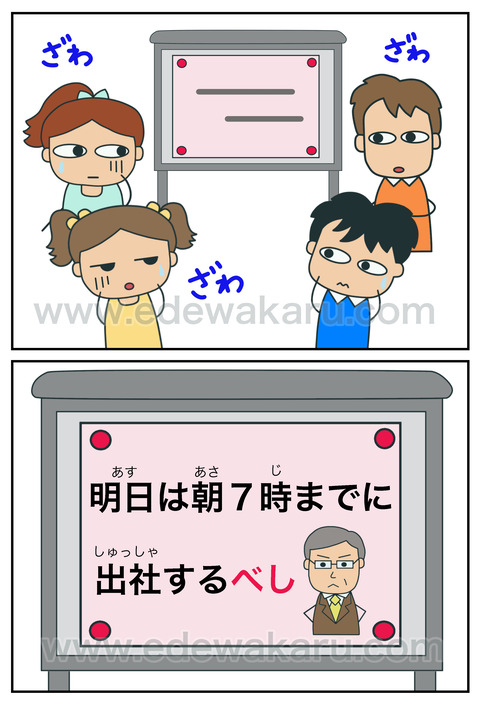
Meaning
〜ought to be done
〜must be done
How to use it
Verb [dictionary form] + べし
Explanation
“〜べし” is a grammar pattern expressing a [command] and meaning “〜ought to be done.” It is an old form of “〜べきだ” 😮 Since it is old-fashioned, it is not used in conversation 😅 It is mostly used in writing or in set expressions. Advanced learners may want to memorize some of the set expressions 😊
[Set expressions using “〜べし”]
・恐るべし
→frightening; so extraordinary that it inspires awe
・推して知るべし
→easy to infer
・すべからく〜べし
→one must naturally 〜
Also, with “する,” both “〜するべし” and “〜すべし” can be used.
[Examples]
Students should study diligently.
Students should study diligently.
“〜べきだ” (Review: 〜べきだ) is often used in conversation, but I don’t think you’ll have many chances to hear or use “〜べし” 😅 Those taking N1 should learn it for the test. “〜べし” may sometimes be used in dramas or programs set in contexts such as NHK historical dramas 😉
[Grammar patterns containing “べき”]
〜べからず・〜べからざる
〜べきだ
〜べきだった・〜べきではなかった
〜べく
〜べくして
〜べくもない
〜べし
In context 3 examples
明日は朝7時までに出社するべし
→明日は朝7時までに出社しろYou are to report to work by 7 a.m. tomorrow. →Report to work by 7 a.m. tomorrow.
学生はしっかりと勉強するべし
→学生はしっかりと勉強するのが当然だStudents should study diligently. →It is only natural that students study diligently.
社長の命令には従うべし
→社長の命令には従わなければならないOne must obey the president’s orders. →One must obey the president’s orders.
Read the original source text
Meaning
〜するのが当然だ
〜なければいけない
How to use it
動詞[辞書形]+べし
Explanation
「〜べし」は「〜するのが当然だ」という意味で【命令】を表す文型です。「〜べきだ」の古い形です😮(復習:〜べきだ)古い言い方ですので会話で使われることはありません😅 書き言葉で使用されるか、慣用表現として使われるのがほとんどです。上級レベルの人は慣用表現をいくつか覚えておくといいと思います😊
[「〜べし」を使った慣用表現]
・
恐るべし
→恐ろしい・すばらしすぎて恐ろしいと感じる
・
推して知るべし
→簡単に推測できる
・
すべからく〜べし
→当然〜しなければならない
また、
「する」の場合は「〜するべし」「〜すべし」を使うことができます。
[例]
学生はしっかりと勉強
すべし
学生はしっかりと勉強
するべし
「〜べきだ」(復習:〜べきだ)は会話でもよく使われますが、「〜べし」は聞く機会も使うチャンスもほとんどないと思います😅N1を受ける人はテスト用に覚えておけばいいと思います。NHK大河ドラマなど、が出てくる場面があるようなドラマや番組では「〜べし」が使われる場合があるかもしれませんね😉
【「べき」がつく文型】
〜べからず・〜べからざる
〜べきだ
〜べきだった・〜べきではなかった
〜べく
〜べくして
〜べくもない
〜べし
日本語文型辞典
Meaning
V-るべし
A literary expression, hardly used in modern language except in set expressions. It expresses an order, meaning “one must do this as a matter of course” or “it is only natural to do this.” Example sentences: ① Students should without fail apply themselves to their studies. ② The young are to be feared. ③ The next exam seems to have been very difficult: even the best student in the class scored only 60. The rest is easy to infer. Explanation: ① is in the form “すべからく…べし,” meaning “Students, as something you naturally must do, apply yourselves to your studies.” ② is an idiom meaning “Young people have great potential to grow in the future, so they should be valued.” ③’s “後は推して知るべしだ” is an idiom meaning “one can readily infer the rest.” Here it means “Needless to say, the other students did even worse.”
Read the original source text
Meaning
基本情報V-るべし説明文語の表現で、現代語では医用的な表現以外ほとんど使われない。「当然のこととしてしなければいけない」「するのが当然だ」という意味で、命令を表す。例文① 学生はすべからく勉強に励むべし。② 後生おそるべし。③ 今度の試験は、よほど難しかったらしく、クラスで一番良くできる生徒でも60点しかとれなかった。後は推して知るべしだ。説明①は「すべからく…べし」の形で、「学生は当然しなければいけないこととして、勉強しなさい」という意味。説明②は「若い人はこれから将来、おおいに成長していく可能性があるので大切にしなければいけない」という意味の慣用句。説明③の「後は推して知るべしだ」は、慣用表現で、「推量すれば、すぐにわかる」という意味。ここでは「他の学生は、言うまでもなくもっと悪い」という意味になる。
IMABI
Phrases Made w/ the Bases of ~べきだ
Read this IMABI lesson ↗Explanation
Phrases Made w/ the Bases of ~べきだ: ~べくもない, ~べからず・ざる, ~べく, ~べくして, & ~べし
Back in our first lesson on ~べきだ, we learned how it is an auxiliary verb pertaining to “obligation” but that its scope of use has been diminished substantially in Modern Japanese. Nonetheless, the auxiliary still holds on, with most of its bases still functional despite having become archaic.
In this lesson, we will go over various advanced grammar points which are derived from its other bases, and in doing so, we will view these other bases as being derived from ~べきだ’s predecessor ~べし.
The Extant Bases of ~べし
The auxiliary “verb/adjective” ~べきだ is etymologically1 better viewed as an “auxiliary adjective,” as it is merely slightly corrupted by the addition of the copula verb to its 連体形. While this did give rise to its new, modern 終止形 of ~べきだ, it also rendered certain other bases obsolete, notably its /-kari/ 連用形 and its 已然形, whose functionalities have been taken over by the copula built into ~べきだ.
Nonetheless, this lesson will be more so an introduction to ~べし as it pertains to Modern Japanese than it is a second installment of ~べきだ. As such, without further ado, the bases of ~べし are as follows:
未然形連用形終止形連体形已然形命令形
べから-べく-
(べかり-)べしべき-・
(べかる-) (べけれ- ) 〇
Orthography Note: ~べし can rarely be seen written in kanji as 可し.
While the modern ~べきだ heavily emphasizes duty and what is deemed appropriate, in the past, these usages all stimmed for an overarching notion of latent potential as well as natural course of events, with agency or the lack thereof among other factors dictating the exact nuance of the auxiliary. The loss of nuances attached to latent potential (潜勢), nuances which we will soon touch upon in their individual environments, is likely attributed to the inclusion of the declarative copula だ into the structure.
~べからず・べからざる
The 未然形 of ~べし, べから-, is heavily used in Modern Japanese with the classical negative auxiliary verb ~ず in the context of to-the-point negative imperatives. While not so common in the spoken language, this pattern is great for signage. Think “DO NOT TOUCH” or “KEEP OFF THE GRASS” as perfect environments for this grammar to be employed.
1. 触るべからず!
DO NOT TOUCH!
2. 芝に入るべからず!
KEEP OFF THE GRASS!
3. この橋、渡るべからず
DO NOT CROSS THIS BRIDGE!
4. 関係者以外、敷地内に入るべからず
NO UNAUTHORIZED PERSONS ARE ALLOWED TO ENTER THE PREMISES
5. 働かざる者は食うべからず
Those who do not work shall not eat
The auxiliary ~べし largely revolves around the notion of obligation, which is also anchored in place by the notion of “latent potential.” The things that ought to be the case are the things that one naturally can and should do. As it pertains to negative structures, we see that while still quite archaic, ~べからず can still be used to mean ~することができない, with a heavy emphasis on it naturally being the case that the agent cannot perform X. Moreover, this lack of “latent potential” is more likely to be seen as ~べからざる with X directly modifying a nominal phrase. Note that ざる‐ is simply the 連体形 of the auxiliary ~ず.
6. 予測すべからざる事態
A situation that one cannot predict
7. 許すべからざる罪
An unforgivable sin/crime
8. 現代社会では、スマホやインターネットなどは欠くべからざる存在となっている。
In the modern age, things such as smartphones and the Internet have become indispensable things (in our lives).
9. 遼平君は、我がチームには、欠くべからざる一員である。
Ryohei-kun is an integral member of our team.
10. 羽はねなければ空をも飛ぶべからず。
If one has no wings, one cannot fly through the skies.
Another pattern utilizing ~べからず worth noting is ~ざるべからず, which is akin to the modern ~なければならない to indicate obligation via a double negative construction. Of the two, ~ざるべからず places even heavier emphasis on the duty bore by the agent.
11. 天皇てんのうを重おもんぜざるべからず。
One must honor the emperor.
~べくもない
~べくもない is a combination of the /ku/-type 連用形 of ~べし followed by the adverbial particle も and the negative auxiliary ~ない. Together, the structure translates to “there is no way/it is possible” even if there is intention to make it happen. While we view the modern ~べきだ as pertaining solely to “obligation,” several other usages existed for its predecessor ~べし which have since fallen out of use. Of these, the indication of “potential,” albeit always with negative forms, was one of those now obsolete meanings. Granted, this sense of “potential” does derive from the underlining meaning of “obligation/strong resolve/appropriateness,” with negation facilitating the inability for said impetus to be set in motion.
12. 将来、東京大学の教授になろうなんて望むべくもない。
There’s no way that I could ever become something like a Tokyo University professor in the future.
13. そう聞いても、ザイダさんには想像するべくもない光景だった。
Though Zaida-san was hearing about it, the scene was one that she couldn’t have ever imagined.
14. セスは遼平を死ぬほど愛している、これは疑うべくもない。
Seth loves Ryohei to death; there is no doubt about that.
The closest structure to ~べくもない would be ~できるはずがない, which focuses on there being no means, whereas with ~べくもない, the focus would be on there being no chance of that resolve or circumstance ever coming to pass in a very emotionally charged fashion. One other major difference, however, is that ~べくもない can also be paired with non-volitional verbs to indicate the zero chance of something ever occurring.
15. 季節の推移はやむべくもない。
The changing of the seasons is inevitable.
~べく
The /ku/-type 連用形 of ~べし, ~べく attaches to verbs of volition, which serves as the initiative that the speaker feels determined/obligated to pursuit, with the predicate Y that follows being the means. As such, ~べく is quite similar to ~ために but with added emphasis on duty.
16. 早く帰るべく、準備じゅんびをし始めた。
I’ve become to make preparations so that I may get home early.
17. 我々は、将来を担うべく努力することを誓います。
We vow to endeavor to bear the future.
18. 国民を守るべく、研鑽を欠かさない。
(He) never falls short of improving (himself) so that (he) may protect (his) citizenry.
19. 作文嫌いを克服すべく、毎日、セス先生が掲げてきた「The Document Challenge」に挑むことにしています。
So that I may overcome my dislike of writing, I have decided to take on “The Document Challenge” which Seth-sensei has touted up to this point.
20. 筆者は最近、社長になるべく日夜努力を重ねている。
I (the person writing to you) have been recently working day and night to become a company president.
One set phrase which utilizes ~べく that is of considerable importance in formal settings, is the word しかるべく which roughly translates to “as one sees fit.” It combines しかり―a contraction of しかあり meaning “absolutely the case”―and ~べく.
21. しかるべく対応いたします。
I shall handle the matter as is appropriate.
~べくして
Utilizing the conjunctive particle して, ~べくして is most often used to indicate the necessity behind something that is predicted by the speaker to happen having happened. Incidentally, in this construction, the verb that precedes ~べくして will also be the same verb that follows it, leading to a translation for ~べくして of “it’s only natural that.” This meaning of a “natural course of events” is inherently tied to the latent potential hinted at in other structures (like in ~べくもない in the negative).
While this structure is largely used with intransitive verbs, the commonality behind all examples of this pattern does not lie in transitivity but rather in how “volition” does not play a part in the action occurring.
22. これは勝つべくして勝った試合です。
As for what you see here, this match was one that we were naturally going to win.
23. チャンスを掴める人は、掴むべくして掴んでいる。
Those who snag chances are those who naturally grab them (as they come along).
24. 起こるべくして起こった出来事だ。
What occurred is what would have naturally taken place.
25. 負けるべくして負けた。
It’s only natural that (we) lost.
Though not nearly as common and not touched on at all in the JLPT N1, ~べくして does have a rarely seen 逆接 nuance of “even if one can do X, (outcome Y is unfeasible).” This can also be adapted in a way so that the verb standing in as Y is marked by a negative form of ~べし to capitalize on this unfeasibility, which in the case of Ex. is to indicate a negative command of the vein of “should not.”
26. その教科書を読むべくして理解しがたい。
Even if you can read the textbook, it is difficult to understand.
27. この説せつは言うべくして行うべからず。
Even if you can say the theory, you shouldn’t carry it out.
~べし
Though clearly archaic, from the sense of obligation, the 終止形 ~べし may also indicate a forceful command related to duty. It is the affirmative rendition of ~べからず mentioned earlier.
28. 辞職すべし。
You should resign!
29. 培った力を存分に発揮すべし!
You must make full use of the strength/skills you’ve nurtured!
~ざるべし
When ~べし follows the negative auxiliary verb ~ず, ~べし follows its 連体形2, and in this context, ~べし simply denotes the meaning of “absolute certainty” that the predicates is NOT the case, as it is being paired with the negative.
30. この人々の深き志は、この海にも劣らざるべし。
The deep kindness of those here surely outmatches that of this sea (in its depth).
From the 『土佐日記』.
~べし is believed to be derived from the adjective 宜(うべ)し, with a likely meaning of “to be certain.” ↩︎
The 連体形 is employed instead of the 終止形 with ラ変-type conjugations. ↩︎
In context 30 examples
触るべからず!
DO NOT TOUCH!
芝に入るべからず!
KEEP OFF THE GRASS!
この橋、渡るべからず
DO NOT CROSS THIS BRIDGE!
関係者以外、敷地内に入るべからず
NO UNAUTHORIZED PERSONS ARE ALLOWED TO ENTER THE PREMISES
働かざる者は食うべからず
Those who do not work shall not eat
予測すべからざる事態
A situation that one cannot predict
許すべからざる罪
An unforgivable sin/crime
現代社会では、スマホやインターネットなどは欠くべからざる存在となっている。
In the modern age, things such as smartphones and the Internet have become indispensable things (in our lives).
遼平君は、我がチームには、欠くべからざる一員である。
Ryohei-kun is an integral member of our team.
羽はねなければ空をも飛ぶべからず。
If one has no wings, one cannot fly through the skies.
天皇てんのうを重おもんぜざるべからず。
One must honor the emperor.
将来、東京大学の教授になろうなんて望むべくもない。
There’s no way that I could ever become something like a Tokyo University professor in the future.
そう聞いても、ザイダさんには想像するべくもない光景だった。
Though Zaida-san was hearing about it, the scene was one that she couldn’t have ever imagined.
セスは遼平を死ぬほど愛している、これは疑うべくもない。
Seth loves Ryohei to death; there is no doubt about that.
季節の推移はやむべくもない。
The changing of the seasons is inevitable.
早く帰るべく、準備じゅんびをし始めた。
I’ve become to make preparations so that I may get home early.
我々は、将来を担うべく努力することを誓います。
We vow to endeavor to bear the future.
国民を守るべく、研鑽を欠かさない。
(He) never falls short of improving (himself) so that (he) may protect (his) citizenry.
作文嫌いを克服すべく、毎日、セス先生が掲げてきた「The Document Challenge」に挑むことにしています。
So that I may overcome my dislike of writing, I have decided to take on “The Document Challenge” which Seth-sensei has touted up to this point.
筆者は最近、社長になるべく日夜努力を重ねている。
I (the person writing to you) have been recently working day and night to become a company president.
しかるべく対応いたします。
I shall handle the matter as is appropriate.
これは勝つべくして勝った試合です。
As for what you see here, this match was one that we were naturally going to win.
チャンスを掴める人は、掴むべくして掴んでいる。
Those who snag chances are those who naturally grab them (as they come along).
起こるべくして起こった出来事だ。
What occurred is what would have naturally taken place.
負けるべくして負けた。
It’s only natural that (we) lost.
その教科書を読むべくして理解しがたい。
Even if you can read the textbook, it is difficult to understand.
この説せつは言うべくして行うべからず。
Even if you can say the theory, you shouldn’t carry it out.
辞職すべし。
You should resign!
培った力を存分に発揮すべし!
You must make full use of the strength/skills you’ve nurtured!
この人々の深き志は、この海にも劣らざるべし。
The deep kindness of those here surely outmatches that of this sea (in its depth).
日本語文型辞典 英語版
Meaning
【べし】[V-るべし]
An expression used in the classical written language, rarely used in modern language except in idioms. Expresses a command with the meaning of “ought to do ... as a matter of course” or “it is appropriate to do ....”
(1)
takes the form of すべからく...べし and in this context it means, “It’s a matter of course that students must study, so study!”
(2)
is an idiom meaning, “Young people have great potential and therefore they should be nurtured.”
(3)
is an idiomatic phrase meaning, “if one thinks about it, it will become apparent.” In the context of this example, it means that it goes without saying that all the rest of the students got poorer marks.
In context 3 examples
学生はすべからく勉強に励むべし。
Students should apply themselves to their studies.
後生おそるべし。
The next generation carries our hopes.
今度の試験は、よほど難しかったらしく、クラスで一番良くできる生徒でも 60 点しかとれなかった。後は推して知るべしだ。
The recent examination must have been very difficult because even the brightest student in the class got only sixty points. You can imagine how the rest of the class did.
NINJAL 日本語文型データベース
Meaning
Means that doing ~ is the proper thing to do. Used in commands and slogans.
「推して知るべし・後世畏るべし」 are set expressions.
How to use it
Vるべし (「する」 may also take the form 「すべし」)
In context 5 examples
大学合格のためには、今からしっかり勉強するべし。
To get into university, study hard from now on.
この映画はとても面白かった!絶対見るべし。
This movie was so interesting! You absolutely must see it.
当たり前のことだが、健康のためには、夜はしっかり寝るべし。疲れたら休むべし。適度に運動すべし。
It goes without saying, but for your health, get a good night’s sleep. Rest when you’re tired. Exercise in moderation.
この問題は秀才の先輩でも解けなかった。ほかは推して知るべし、だよ。
Even that brilliant senior student couldn’t solve this problem. You can imagine how the others did.
若干15歳で世の中の人を感動させる素晴らしい絵を描くなんて。後生畏るべし。
To think that someone can paint such a wonderful picture that moves people at just 15 years old! The young are truly formidable.
Read the original source text
Meaning
~するのが当然だという意味を表します。命令やスローガンに使います。
「推して知るべし・後世畏るべし」は慣用的な言い方です。
How to use it
Vるべし(「する」→「すべし」という形になることもある)