AIUEO JLPT Grammar
Meaning
This sentence pattern expresses that a result or situation is consistent with its cause or background.「〜だけあって」implies a positive evaluation,「〜だけに」emphasizes the strong influence or expectation, and「〜だけのことはある」is used when one is convinced or impressed with the result.
How to use it
Verb or i-adjective or na-adjective な or Noun + だけ + あって; Verb or i-adjective or na-adjective な or Noun + だけに; Verb or i-adjective or na-adjective な or Noun + だけの + ことはある
In context 5 examples
この本はベストセラーだけのことはあって、非常に面白い。
As expected from a bestseller, this book is very interesting.
このケーキは高級なだけに、味も一流だ。
As expected from a high-end store, this cake tastes excellent.
彼は努力しただけのことはあって、見事に試験に合格した。
His hard work paid off, and he passed the exam with flying colors.
この建物は歴史があるだけに、風格がある。
As expected from a building with such history, it has character.
彼はプロの料理人だけありますね。
He's just a professional chef.
Read the original source text
Meaning
This sentence pattern expresses that a result or situation is consistent with its cause or background.「〜だけあって」implies a positive evaluation,「〜だけに」emphasizes the strong influence or expectation, and「〜だけのことはある」is used when one is convinced or impressed with the result.
How to use it
動詞or形容詞or形容動詞なor名詞+だけ+あって動詞or形容詞or形容動詞なor名詞+だけに動詞or形容詞or形容動詞なor名詞+だけの+ことはある
Explanation · 日本語
この文型は、ある結果や状況が、その原因や背景に見合っていることを表す表現です。「〜だけあって」は肯定的な評価を伴い、「〜だけに」はその影響や期待が強いことを強調し、「〜だけのことはある」は結果に納得したり感心したりするときに使います。
文法
Meaning
Since ~, naturally ...
How to use it
V(plain form) + だけあって
イA(plain form) + だけあって
ナA(plain form) + だけあって
N + だけあって
Notes
① A word expressing an evaluation follows.
② Cannot be used in future, volitional, imperative, or conjectural sentences.
③ Tends to be used when expressing admiration or praise.
In context 12 examples
山下さんは5年アメリカに住んでいただけあって、とても英語が上手だ。
Since Mr. Yamashita lived in America for five years, he's very good at English.
木村さんは3年間、マレーシアに住んでいただけあって、かなりマレーシアに詳しい。
Since Ms. Kimura lived in Malaysia for three years, she knows quite a lot about Malaysia.
この場所は有名なだけあって、たくさんの観光客が人がいる。
This place is famous, as you'd expect, and there are lots of tourists.
田中先生は日本語の先生だけあって、漢字に詳しい。
Since Mr. Tanaka is a Japanese teacher, he's knowledgeable about kanji.
このホテルは5つ星ホテルだけあって、サービスが素晴らしい。
Since this is a five-star hotel, the service is excellent.
たくさん練習しただけあって、ジョンさんのスピーチはとても素晴らしかった。
Since John practiced a lot, his speech was excellent.
山下さんは世界5周しただけあって、海外の文化や地理にとても詳しい。
Since Mr. Yamashita has traveled around the world five times, he's very knowledgeable about foreign cultures and geography.
料理教室に通っているだけあって、彼女の作る料理はとても美味しい。
Since she attends cooking classes, the food she makes is very delicious.
彼はアナウンサー志望だけあって、話すのが上手だ。
Since he wants to be an announcer, he's good at speaking.
このアパートは駅に近いだけあって、やっぱり家賃も高い。
Since this apartment is close to the station, as you'd expect, the rent is high too.
鈴木さんは東京大学出身だけあって、頭が切れるね。
Since Mr. Suzuki is a graduate of the University of Tokyo, he's really sharp.
石田さんはワインが好きなだけあって、ワインについてよく知っている。
Since Mr. Ishida likes wine, he knows a lot about it.
Read the original source text
Meaning
〜ので、当然・・・だ。
How to use it
V(普通形) + だけあって
イA(普通形) + だけあって
ナA(普通形) + だけあって
N + だけあって
Notes
① 後ろには評価する言葉が来る。
② 未来文、意向文、命令文、推量文では使えない。
③ 感心したり、褒めたりする時に使われる傾向にある。
Bunpro Grammar Reference
Meaning
Is only natural, …Being the case, Because, As might be expected
How to use it
Verb + だけ(のことは)あって
[い]Adjective + だけ(のことは)あって
[な]Adjective + な + だけ(のことは)あって
Noun + だけ(のことは)あって
Nuance
An expression that indicates that just the existence of (A) leads to (B) being expected or natural.
Explanation
Like だけに, だけあって is a phrase that is used to show that something is 'only natural for (A)', or 'as might be expected of (A)'. This structure includes the particle だけ 'just', or 'only', and the て-form of the う-Verb ある 'to be'. In this way, the more literal meaning may be interpreted as 'just being (A), (B)', and implies that the innate trait or traits of (A) led to the expected result of (B).
だけあって will only be used when the expected result is something that is positive in relation to (A).
Like most other grammar patterns that begin with だけ, this structure may be used with verbs, い-Adjectives, な-Adjectives followed by な, or nouns.
彼は10年間日本に住んでいただけあって、日本語を日本人のように話せる。
As one might expect, he can speak Japanese like a Japanese person because he lived in Japan for 10 years.
あのホテルは高いだけあって、サービスがとてもいい。
As one might expect, that hotel has great service because it is expensive.
浅草は有名なだけあって、平日でも観光客で賑わっている。
As might be expected with how popular Asakusa is, it is crowded with tourists even on weekdays.
田中先生は習字の先生だけあって、漢字を書くのが上手です。
As expected, Tanaka-sensei is good at writing kanji because she is a calligraphy teacher.
Caution
As だけあって emphasizes an innate or constant quality of (A), it will not be used for things that are not obvious, or have not yet happened. This means that だけあって will not appear in sentences discussing things that may happen in the future, and will also not often be utilized with phrases such as だろう, でしょう, かもしれない, or similar structures that express uncertainty.
幼い頃からアイススケートを習っていただけあって、将来はオリンピック選手になるでしょう。
As expected from someone who has been learning ice skating from a young age, she will probably be an Olympic athlete in the future. (Unnatural Japanese)
毎日一生懸命勉強しただけあって、彼は試験に合格するだろう。
As expected, he studied hard everyday, and would probably do well on his exams. (Unnatural Japanese)
In context 18 examples
- 茶道を習っているだけあって、礼儀が正しい。
As one might expect, since she is learning tea ceremony, she is polite.
- 彼は10年間日本に住んでいただけあって、日本語を日本人のように話せる。
As one might expect, he can speak Japanese like a Japanese person because he lived in Japan for 10 years.
- あのホテルは高いだけあって、サービスがとてもいい。
As one might expect, that hotel has great service because it is expensive.
- 浅草は有名なだけあって、平日でも観光客で賑わっている。
As might be expected with how popular Asakusa is, it is crowded with tourists even on weekdays.
- 田中先生は習字の先生だけあって、漢字を書くのが上手です。
As expected, Tanaka-sensei is good at writing kanji because she is a calligraphy teacher.
- 昼寝しただけあって、午後から眠くなることはなかった。
(As might be expected) because I took a nap, I didn't become tired in the afternoon.
- あの二人は仲良しなだけあって、いつも一緒にいるよね。
As might be expected with how close those two are, they are always together.
- 揚げ物を控えただけあって、私は3キロも痩せた。
As might be expected, I avoided eating fried food and I lost three kilograms.
- アナウンサーだけあって、早口言葉が得意だ。
As might be expected from an announcer, tongue twisters are his strong point.
- 判事だけあって、普段から真面目な生活をしているんですね。
As might be expected from a judge, he habitually leads an honest life.
- 勉強時間を増やしただけあって、どんどん上達している。
As might be expected from increasing my study hours, I am rapidly seeing improvement.
- 専門家だけあって、彼はいつも中身の濃い提案をしてくれる。
As might be expected from a specialist, he always gives us proposals with dense content.
- 国語の先生だけあって、俳句を詠むのが上手ですね。
As might be expected of a Japanese teacher, she is good at reciting haikus.
- 彼は列車の運転士だけあって、この路線の駅名を全て暗記している。
As expected from a train driver, he remembers all the station names along the route.
- 頑張って勉強しただけあって、妹はいい大学に入学できた。
As expected, my little sister studied hard, and got into a good college.
- とても幼いころから空手を学んでいただけあって、13歳なのに黒帯も持っているし、トーナメントにも多数優勝した。
As expected from someone who has learned Karate from a very young age, despite being 13 she has a black belt and has won numerous tournaments.
- 幼い頃からアイススケートを習っていただけあって、将来はオリンピック選手になるでしょう。
As expected from someone who has been learning ice skating from a young age, she will probably be an Olympic athlete in the future. (Unnatural Japanese)
- 毎日一生懸命勉強しただけあって、彼は試験に合格するだろう。
As expected, he studied hard everyday, and would probably do well on his exams. (Unnatural Japanese)
DoJG 日本語文法辞典(全集)
Meaning
And as one would expect; so (naturally); for good reason
How to use it
(i) Vinformal | だけあって | |
| {教えている/教えていた}だけあって | Someone is/was teaching something, and as one would expect |
(ii) Adjective い informal | だけあって | |
| {若い/若かった}だけあって | Someone is/was young, and as one would expect |
(iii) Adjective な stem {な/だった} | だけあって | |
| 上手{な/だった}だけあって | Someone is/was good at something, and as one would expect |
(iv) Noun {Ø/だった} | だけあって | |
| 先生{Ø/だった}だけあって | Someone is/was a teacher, and as one would expect |
Explanation
A phrase that means "and as one would expect" or "for good reason".
In context 14 examples
彼女は人気女優だけあってすごいうちに住んでいる。
She is a popular actress and, as one would expect, she lives in a splendid house.
聡子は小さい時からバレエをしているだけあって体が柔らかい。
Satoko has practiced ballet since she was a child, so naturally she is limber.
彼が自慢するだけあって、彼のオフィスからの眺めはちょっとほかでは見られないものだった。
He is proud of his office for good reason: the view is something you could never see from other offices.
日本は火山国だけあって年中地震が絶えない。
Japan is a volcanic country, and, as one would expect, earthquakes occur constantly throughout the year.
この壷はさすが名工の作品だけあって色や形に気品がある。
This pot was made by a master craftsman, so naturally its colours and shape are graceful.
オーストラリア南端の地だけあって八月のメルボルンは実に寒い。
Melbourne, as one would expect from its location in the southern comer of Australia, is really cold in August.
さすが日本一の花火大会と言われるだけあって、規模も芸術性も素晴らしいものだった。
As one would expect from what is called Japan's best fireworks festival, both its scale and artistry were outstanding.
As one would expect from what people call the best fireworks in Japan, the scale and artistry were both amazing. (ii) People call it the best fireworks show in Japan for good reason: Its scale and artistic quality were both excellent.
As one would expect from what people call the best fireworks in Japan, the scale and artistry were both amazing. (ii) People call it the best fireworks show in Japan for good reason: Its scale and artistic quality were both excellent.
あのレストランは笠原さんのお薦めだけあって美味しかったです。
As one would expect from Ms. Kasahara's recommendation, that restaurant was delicious.
Ms. Kasahara recommended that restaurant, and, as one would expect, the food was delicious. (ii) Ms. Kasahara recommended that restaurant for good reason: The food was delicious. [Ms. Kasahara is known as a gourmet.]
Ms. Kasahara recommended that restaurant, and, as one would expect, the food was delicious. (ii) Ms. Kasahara recommended that restaurant for good reason: The food was delicious. [Ms. Kasahara is known as a gourmet.]
この鞄は高いだけあって材料もいいし作りもしっかりしている。
As you would expect given the price, this bag has good materials and is well made.
As one would expect from the (high) price of this bag, the material is good and it's also well made. (ii) This bag is expensive for good reason: The material is good and it's well made.
As one would expect from the (high) price of this bag, the material is good and it's also well made. (ii) This bag is expensive for good reason: The material is good and it's well made.
あのうるさい社長が信頼するだけあって、彼の秘書は実に有能だ。
As one would expect from the fact that that demanding company president trusts him, his secretary is truly capable.
As you can guess from the way that president, who is so critical, relies on his secretary, she is truly capable. (ii) That president, who is so critical, relies on his secretary for good reason: She is truly capable.
As you can guess from the way that president, who is so critical, relies on his secretary, she is truly capable. (ii) That president, who is so critical, relies on his secretary for good reason: She is truly capable.
Read the original source text
Meaning
And as one would expect; so (naturally); for good reason
How to use it
(i) Vinformal | だけあって | |
| {教えている/教えていた}だけあって | Someone is/was teaching something, and as one would expect |
(ii) Adjective い informal | だけあって | |
| {若い/若かった}だけあって | Someone is/was young, and as one would expect |
(iii) Adjective な stem {な/だった} | だけあって | |
| 上手{な/だった}だけあって | Someone is/was good at something, and as one would expect |
(iv) Noun {Ø/だった} | だけあって | |
| 先生{Ø/だった}だけあって | Someone is/was a teacher, and as one would expect |
Explanation
A phrase that means "and as one would expect" or "for good reason".
どんなときどう使う 日本語表現文型辞典
Meaning
as might be expected
How to use it
Noun/〔Plain form〕(na-adjective な)+だけあって
Explanation
~ので、それにふさわしく
1)「その才能や努力や地位、経験にふさわしく」と感心したり、ほめたりするときの言い方。後には結果・能力・特徴があると評価する言葉が来る。「さすが」とともによく使う。 ❺ の「だけある」はくだけた言い方。
2) ❸ ~ ❺ のように文末では「だけのことはある・だけある」という形になる。
1)Used for admiring or praising someone's achievement as befitting his talent, effort, position, or experience. Used with words that evaluate results, abilities, or characteristics. Often used with さすが. だけある in sentence ❺ is informal.
2)Becomes だけのことはある or だけある at end of sentences, as in sentences ❸ to ❺ .
In context 5 examples
彼女はさすがオリンピック・チャンピオンだけあって、期待どおりの見事な演技を見せてくれた。
As you’d expect from an Olympic champion, she gave a superb performance that lived up to expectations.
木村さんは10年も北京に住んでいただけあって、北京のことは何でも知っている。
Kimura has lived in Beijing for as long as ten years, so he knows everything there is to know about the city.
A:加藤さんは足が長くてスタイルがいいね。B:さすが、若いときにバレリーナだっただけのことはあるね。
A: Kato has long legs and a great figure. B: As you’d expect, she was a ballerina when she was young.
A:きのうのロック・コンサート、どうだった? 10年ぶりに来日したんだろう?B:素晴らしかった! 長年待っただけのことはあったよ。
A: How was the rock concert yesterday? They came to Japan for the first time in ten years, right? B: It was wonderful! They were worth the long wait.
このギターは実にいい音がする。名人が作っただけあるよ。
This guitar has a really beautiful sound. You can tell a master made it.
Read the original source text
Meaning
as might be expected
How to use it
N/〔普通形〕(ナAな)+だけあって
Explanation
~ので、それにふさわしく
1)「その才能や努力や地位、経験にふさわしく」と感心したり、ほめたりするときの言い方。後には結果・能力・特徴があると評価する言葉が来る。「さすが」とともによく使う。 ❺ の「だけある」はくだけた言い方。
2) ❸ ~ ❺ のように文末では「だけのことはある・だけある」という形になる。
1)Used for admiring or praising someone's achievement as befitting his talent, effort, position, or experience. Used with words that evaluate results, abilities, or characteristics. Often used with さすが. だけある in sentence ❺ is informal.
2)Becomes だけのことはある or だけある at end of sentences, as in sentences ❸ to ❺ .
絵でわかる日本語
Meaning
〜, so naturally
〜of a level suitable for 〜
〜with the ability suited to 〜
〜of a value appropriate for 〜
How to use it
Verb, adjective, or noun [plain form] + だけあって
Verb, adjective, or noun [plain form] + だけのことはあって
Verb, adjective, or noun [plain form] + だけある
Verb, adjective, or noun [plain form] + だけのことはある
Explanation
“〜だけあって” is a sentence pattern used to mean “〜, so naturally 〜” or “〜 is of a fitting level, ability, or value, so 〜.” It is used when giving a 【positive evaluation】 of someone’s 【worth】 or 【ability】. 😊
“〜だけあって” is a shortened form of “〜だけのことはあって.” 😮 When it comes at the end of a sentence, use “〜だけある” or “〜だけのことはある.”
[Examples]
She studied abroad, so naturally she’s good at English.
= She studied abroad, so naturally she’s good at English.
She’s good at English. She studied abroad, after all.
= She’s good at English. She studied abroad, after all.
There are several sentence patterns similar to “〜だけあって,” so make sure to learn to distinguish them. 😉
In context 5 examples
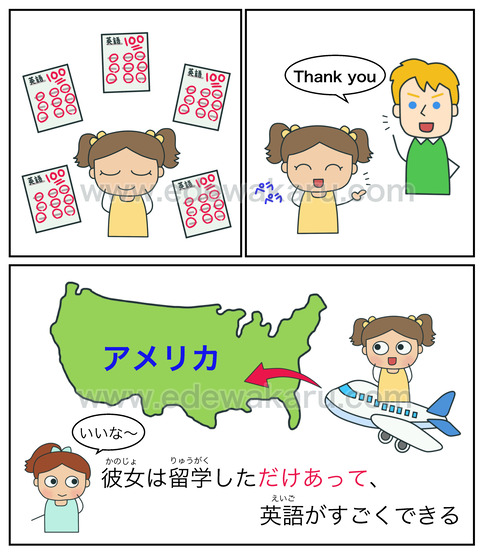
彼女はアメリカに留学しただけあって、英語がすごくできる
→彼女はアメリカに留学したから、当然英語がすごくできるShe studied abroad in America, so naturally she’s very good at English. → She studied abroad in America, so of course she’s very good at English.
人気レストランと言われるだけあって、ここの料理はとてもおいしい
→人気レストランと言われるのにふさわしい価値あって、ここの料理はとてもおいしいThis restaurant is called popular for good reason; the food here is very delicious. → The food here is very delicious, befitting its reputation as a popular restaurant.
東大生だけあって、頭がいい
→東大生だから、当然頭がいい*東大生とは東京大学(とうきょうだいがく)の学生のことです(復習:〜とは(定義・説明))Since he’s a University of Tokyo student, he’s naturally smart. → He’s a University of Tokyo student, so naturally he’s smart. *A University of Tokyo student means a student at the University of Tokyo. (Review: 〜とは (definition/explanation))
一流ホテルだけあって、すばらしいサービスだ
→一流ホテルだから、当然すばらしいサービスだIt’s a first-class hotel, so naturally the service is excellent. → It’s a first-class hotel, so naturally the service is excellent.
有名な観光地だけあって、毎日たくさんの観光客(かんこうきゃく)が来ている
→有名な観光地だから当然、毎日たくさんの観光客が来ているIt’s a famous tourist spot, so naturally many tourists come every day. → Since it’s a famous tourist spot, many tourists naturally come every day.
Read the original source text
Meaning
〜だから当然
〜にふさわしい程度の〜
〜にふさわしい能力の〜
〜にあった価値の〜
How to use it
動詞・形容詞・名詞[普通形]+だけあって
動詞・形容詞・名詞[普通形]+だけのことはあって
動詞・形容詞・名詞[普通形]+だけある
動詞・形容詞・名詞[普通形]+だけのことはある
Explanation
「〜だけあって」は「〜だから当然〜」「〜にふさわしい程度・能力・価値あって〜」という意味で使われる文型です。「〜だけあって」は「価値」や「能力」について
【いい評価】
をする時に使われます😊
また「〜だけあって」は「〜だけのことはあって」の省略形(しょうりゃくけい)です😮文末にくる場合は「〜だけある」「〜だけのことはある」を使いましょう。
[例]
彼女は留学した
だけあって、英語が上手だ
=彼女は留学した
だけのことはあって、英語が上手だ
彼女は英語が上手だ。留学した
だけある
=彼女は英語が上手だ。留学した
だけのことはある
「〜だけあって」と似ている文型がいくつかありますので、しっかりと区別をして覚えておきましょう😉
くらべてわかる日本語表現文型辞典
Meaning
Because A is the case, B is indeed as expected. The emphasis is on B: one is first impressed by it, then takes the form “as expected, it’s because A.”
How to use it
AだけあってB (Aだけのことはある)
[Verb] だけあって
[i-adjective—plain form] だけあって
[na-adjective—な/である/だった/ではない] だけあって
[Noun—∅/ではない/だった] だけあって
Explanation
【Contrast 1】
“AだけにB” (Meaning 1, p. 115)
“AだけにB” emphasizes A, while “AだけあってB” emphasizes B.
○あの先生はベテランだけに教え方がうまい。 — That teacher is experienced, so they teach well.
The fact that the teacher is “experienced” is acknowledged, so it naturally follows that they “teach well.” B is a result that accompanies A.
○あの先生はベテランだけあって、教え方がうまい。 — That teacher teaches well, as you’d expect from someone so experienced.
The emphasis is on “teaches well,” leading to “as expected, since they are experienced.”
Also, “だけに” can be used in sentences with a negative evaluation, but “だけあって” generally cannot, except in special cases.
○あの子は幼いだけに、我慢できない。 — The child is young, so they can’t be patient.
×あの子は幼いだけあって、我慢できない。 — The child is young, as expected, so they can’t be patient.
“AだけにB” (Meaning 2, p. 115)
“AだけにB” can also be used for results that go against expectations or hopes, but “AだけあってB” reaffirms A, as in “as expected, it’s because of A.”
○当たるとは思っていなかっただけに、宝くじが当たった時は驚いた。 — Because I hadn’t expected to win, I was surprised when I won the lottery.
×当たるとは思っていなかっただけあって、宝くじが当たったときは驚いた。 — Because I hadn’t expected to win, I was surprised when I won the lottery. (Using だけあって)
“AとあってB” (Meaning 1, p. 150)
Notes
【Note 1】
・It does not attach to future, conjectural, imperative, or volitional sentences.
×今夜は冷え込むだけあって、明日は雪が降るだろう。 — Since it will get cold tonight, it will probably snow tomorrow.
・It is difficult to use in a sentence with a negative evaluation.
×勉強しなかっただけあって、不合格だった。 — Since I didn’t study, I failed.
However, even a negative evaluation can sometimes be used when the sentence expresses admiration and exasperation that things turned out as expected.
○このおもちゃは、安いだけあってすぐ壊れた。 — As you’d expect from such a cheap toy, it broke right away.
・“AだけあってB” is a combination of “Aだけのことはある. B.” into one sentence.
○自慢するだけのことはあるよ。彼は英語が上手だね。 — He has every reason to be proud. He speaks English well.
○彼は自慢するだけあって、英語が上手だね。 — He speaks English well, as you’d expect from someone so proud.
In context 4 examples
あのホテルは有名なだけあって、サービスが行き届いている。
That hotel is famous, as you’d expect; its service is excellent.
この栄養ドリンクは高いだけあって、よく効くね。
This nutritional drink is expensive, as you’d expect—it works well.
さすが横綱だけあって、見事な勝ちっぷりだったね。
As you’d expect from a yokozuna, that was an impressive victory.
素晴らしい演奏だった。コンクールで優勝しただけのことはある。
That was a wonderful performance. It’s no wonder he won the competition.
Read the original source text
Meaning
Aだから、さすが・やっぱりBだ。Bに重点が置かれ、そのことにまず感心し、やっぱりAだからだという形をとる。
How to use it
AだけあってB(Aだけのことはある)
[動詞]だけあって
[イ形-普]だけあって
[ナ形-な/である/だった/ではない]だけあって
[名詞-∅/ではない/だった]だけあって
Explanation
【対比1】
「AだけにB」(意味1 P.115)
「AだけにB」はAの部分に重点があり、「AだけあってB」はBに重点がある。
○あの先生はベテランだけに教え方がうまい。
「ベテランである」という事実を認め、だから当然「教え方がうまい」となる。BはAに付随してくる結果である。
○あの先生はベテランだけあって、教え方がうまい。
「教え方がうまい」に重点があり、「やっぱりベテランだから」となる。
また、「だけに」はマイナス評価文にもつくが、「だけあって」は特別な場合を除いてつかない。
○あの子は幼いだけに、我慢できない。
×あの子は幼いだけあって、我慢できない。
「AだけにB」(意味2 P.115)
「AだけにB」は予想・期待に反した結果に対しても使えるが、「AだけあってB」は「やっぱりAだからだ」とAを再確認する。
○当たるとは思っていなかっただけに、宝くじが当たった時は驚いた。
×当たるとは思っていなかっただけあって、宝くじが当たったときは驚いた。
「AとあってB」(意味1 P.150)
Notes
【注意1】
・未来文・推量文・命令文・意向文にはつかない。
×今夜は冷え込むだけあって、明日は雪が降るだろう。
・マイナス評価の文にはつきにくい。
×勉強しなかっただけあって、不合格だった。
ただし、マイナス評価であっても、それを逆に感心してやっぱりとあきれるような文には使うことがある。
○このおもちゃは、安いだけあってすぐ壊れた。
・「AだけあってB」は「Aだけのことはある。B。」を一文にしたもの。
○自慢するだけのことはあるよ。彼は英語が上手だね。
○彼は自慢するだけあって、英語が上手だね。
日本語NET JLPT文法解説まとめ
Meaning
Since ~, naturally ...
How to use it
V(plain form) + だけあって
イA(plain form) + だけあって
ナA(plain form) + だけあって
N + だけあって
Explanation
① Evaluative words follow it.
② It cannot be used in future-tense, expressions of intention, commands, or speculative statements.
③ It tends to be used when expressing admiration or praise.
① It is followed by evaluative words.
② It cannot be used in future tense, intention, command, or speculative statements.
③ It tends to be used when expressing admiration or praise.
In context 12 examples
山下さんは5年アメリカに住んでいただけあって、とても英語が上手だ。
Since Mr. Yamashita lived in America for five years, he's very good at English.
木村さんは3年間、マレーシアに住んでいただけあって、かなりマレーシアに詳しい。
Since Ms. Kimura lived in Malaysia for three years, she knows quite a lot about Malaysia.
この場所は有名なだけあって、たくさんの観光客が人がいる。
This place is famous, as you'd expect, and there are lots of tourists.
田中先生は日本語の先生だけあって、漢字に詳しい。
Since Mr. Tanaka is a Japanese teacher, he's knowledgeable about kanji.
このホテルは5つ星ホテルだけあって、サービスが素晴らしい。
Since this is a five-star hotel, the service is excellent.
たくさん練習しただけあって、ジョンさんのスピーチはとても素晴らしかった。
Since John practiced a lot, his speech was excellent.
山下さんは世界5周しただけあって、海外の文化や地理にとても詳しい。
Since Mr. Yamashita has traveled around the world five times, he's very knowledgeable about foreign cultures and geography.
料理教室に通っているだけあって、彼女の作る料理はとても美味しい。
Since she attends cooking classes, the food she makes is very delicious.
彼はアナウンサー志望だけあって、話すのが上手だ。
Since he wants to be an announcer, he's good at speaking.
このアパートは駅に近いだけあって、やっぱり家賃も高い。
Since this apartment is close to the station, as you'd expect, the rent is high too.
鈴木さんは東京大学出身だけあって、頭が切れるね。
Since Mr. Suzuki is a graduate of the University of Tokyo, he's really sharp.
石田さんはワインが好きなだけあって、ワインについてよく知っている。
Since Mr. Ishida likes wine, he knows a lot about it.
Read the original source text
Meaning
〜ので、当然・・・だ。
How to use it
V(普通形) + だけあって
イA(普通形) + だけあって
ナA(普通形) + だけあって
N + だけあって
Explanation
① 後ろには評価する言葉が来る。
② 未来文、意向文、命令文、推量文では使えない。
③ 感心したり、褒めたりする時に使われる傾向にある。
① It is followed by evaluative words.
② It cannot be used in future tense, intention, command, or speculative statements.
③ It tends to be used when expressing admiration or praise.
IMABI
だけに・だけ(のことは)あって
Read this IMABI lesson ↗Explanation
Given That: だけに・だけ(のことは)あって
In this lesson, we will learn about very similar grammar points which utilize the particle だけ that represent an inherent consequence/evaluation. Before delving into the grammar points at the core of this discussion, let’s first recap how だけ connects to various predicates1, but in the context of ~だけに.
Verbal Predicates連体形 + ~だけ
ex. するだけに
Adjectival Predicates 連体形 + ~だけ
ex. 高いだけに
Adjectival-Noun Predicates連体形 + ~だけ
ex. 有名なだけに
Bare2 Noun-PredicatesNoun + ~だけ
ex. 犬だけに
Non-Bare/Embedded Noun-PredicatesNoun + {な・である}だけ
ex. 場所が場所であるだけに
Generally speaking, ~だけ can follow any conjugation of these predicate types. This is particularly important to keep in mind for when and when not to use the copula with it for noun-predicates, but more of that dynamic will be discussed throughout this lesson.
~だけに
The basic function of ~だけに is as follows: Situation B is an expected result given Situation A. The expected result=outcome (Situation B) may be either a positive or negative outcome.
1. ここは有名ゆうめいなだけに、沢山たくさんの人が訪おとずれます。
With how famous this place is, lots of people visit it.
2. よく勉強しただけに、いい成績で合格しました。
I passed with a good grade as expected given how often I studied.
3. 彼は政治屋だけに口が巧うまいだろう。
He’s probably a good talker for being a politician.
4. 津波で町全体が荒らされただけに、一戸の建物さえ残っているのにびっくりしました。
Given how the entire town was devastated by the tsunami, I was surprised that just one building remained.
5. 民主党が勝手に頑固たる政策方針を結束して言い張り続けただけに、選挙戦に敗戦して自民党・公明党が当選を果たしたのだろう。
Given how the DJP continued to insist, in solidarity, on their stubborn policy stance as they pleased, they lost in the election battle and the LDP and Komeito won (as expected).
6. 敵の防壁を潔く突破しただけに、宮殿に入ってからすぐに殺されたという戦死の告知は母国に大嘘だと見なされた。
Given how (he) had gracefully burst through the enemy bulwark, the notice of his death in war after being killed once he had entered the palace was taken as a big lie in his homeland.
7. 台風の被害が大きかっただけに、都市の復興振ぶりには目を見張るものがあった。
Given how great the damage from the typhoon was, the state of the city’s reconstruction was quite something to behold.
8. それだけに3、1台当たりの単価が凄く高いんだ!
So that‘s precisely why the cost for 1 device is so expensive!
If the outcome is negative, the overall tone and word choices made throughout the sentence will often be abrasive. Moreover, the scale at which the outcome is bad directly reflects how bad the input (cause = Situation A) is.
9. 遊んでばかりで勉強しなかっただけに、さすがの俺も不合格だった。
It’s only natural that I, too, failed given how all I did was goof around and not study.
Non-Bare/Embedded Noun-Predicate
+{な・である・∅}だけに
Incidentally, while it is often the case that ~だけに directly attaches to “bare” noun-predicates like in Exs. 3 and 8, the copula may still overtly intervene4. As to be expected, if it does overtly intervene, it does so in the 連体形, in which case な・である5 are both viable, with な being the overwhelming choice, especially in the spoken language.
One situation in which the overt appearance of the copula usually occurs is when the noun predicate is composed of the same noun being duplicated in NがN fashion.
10. 場所が場所なだけに、トラブルに巻き込まれるのも想像に難くない。
Given the location is what it is, it’s not hard to imagine at all that one would get into trouble there.
11. 性格が性格なだけに、本音をはっきり言えないことが多い。
Given (their) personality, (they) often find themselves incapable of speaking (their) mind.
12. 話が話なだけに胸が苦しくなる。
Just talking about it makes my heart ache.
Literally: The discussion itself being what it is makes my heart ache.
When the noun-predicate can be viewed as a full-fledged embedded clause, for that clause to then modify ~だけに, the 連体形 of a verbal element MUST be present. To make this point obvious, [] will be used to demarcate these embedded clauses. Also note the use of the particle が and how は cannot appear inside said embedded clauses. However, a topicalized phrase can appear outside said embedded clause, including at the front of the sentence like in Exs. 14 and 15.
13. [婚約者というやつが、実にエゴイストで、嫌われ者である]だけに、なおさら観客の同情は彼女に集中する。
Given how her fiancé is truly an egoist and such a hated individual, the audience’s sympathy focuses on her all the more.
14. 母も[書道もあまりに身近な存在だった]だけに、客観視することができなかったのかもしれない。
Since mom also had too close of an existence with calligraphy too, she might not have been able to see (her work) from an objective point of view.
From『文藝春秋 2008 (2)』by 武田双雲.
15. 韓国は[儒教文化が残るとされる国]なだけに、パク・クネ氏が初めての女性として大統領選挙で選び出されたことは韓国社会の変化を象徴しているだけでなく、アジア諸国の社会変動も象徴しているのかもしれません。
Given how South Korea is considered a nation in which Confucian culture has held on, the election of Park Geun-hye as the first female president not only symbolizes change in Korean society, but it may also symbolize societal change in all of Asia.
Now, for non-embedded noun-predicates that take ~だけに, the absence of the copula can be explained by it simply not overtly being present, instead residing in the deep structure of this grammar point, with the heightened adverbial nature of the phrase triggering the copula’s ellipsis. Conversely, with any level of complexity in a noun-predicate triggering the presence of the copula, any noun-predicate outside the affirmative non-past and any noun-predicate with added modifiers would meet that threshold of complexity.
16. 亮君は普段から優しい性格なだけに、かえって6怒らせたらえらく怖いだろう。
Given how Ryo-kun is normally such a kind person, if you were to anger him, he’d probably be terribly scary.
As such, instead of limiting the appearance of the copula to “embedded” noun-predicates, the copula may appear to any “non-bare” noun-predicate, meaning any which exhibit any sort of modifiers (such as the modify shown in grey in Ex. 16).
~だけあって
While ~だけあって similarly indicates that Situation B is only expected given Situation A, it is only used for when said outcome (Situation B) is a positive situation. Not only is the outcome positive, but the scale of said outcome is a direct reflection of how outstanding the cause (Situation A) is.
17. ずいぶん遠くから通ってくる{だけあって X・だけに 〇}、よく遅刻しますね。
Given quite the distance you travel to commute here, you sure are often late.
18. インドネシアは赤道に近いだけあって、うだるように蒸し暑いですね。僕の親友がジャワ島に住んでいますから、訪ねるために身軽な服装を持っていかないといけないでしょう。
Given how Indonesia is close to the Equator, it would make sense that it’s so swelteringly hot, huh. Since my close friend lives on Java Island, I’ll probably have to take light clothing to visit.
19. ここは港町というだけあって、いつも船の出入りが多いね。
Given how this here is a port town, there are always so many ships coming and going.
The natural positive feel ~だけあって does beg the question as to how “positive” evaluations made with だけに really are in comparison. Consider the following:
20a. 毎日、産地から直送されてくるだけに、ここの料理はいつも美味しい。
20b. 毎日、産地から直送されてくるだけあって、ここの料理はいつも美味しい。
In Ex. 20a, ~だけに does state in a matter-of-fact tone that the deliciousness of the food is to be expected because of how ingredients are directly sent to the establishment on a daily basis, but the calmness behind how it would be uttered leaves much to be desired. Is there not more to the speaker’s evaluation. What about that act being a reflection of the management’s dedication? In a way, although Situation B is not a negative outcome, there is not as big of an emotional tug implied like there is with ~だけあって. In other words, ~だけあって is more suitable for implying genuine admiration/exhilaration.
Incidentally, in situations in which Situation B (outcome) would otherwise be negative but ~だけあって is still used, in theory, the sentence may still very well be grammatical. The difference, then, will be that the version with ~だけあって spins Situation B into a positive light as a joke or sarcasm.
21. 言語学者だけあって、セスさんの質問がやたら専門的すぎるんだよな。
As you’d expect from a linguist, Seth-san’s questions are way too technical, huh!
さすが(の)
The adverb(ial noun) さすが(の) often accompanies the structure ~だけあって whenever Situation A is simply a certain agent/subject being themselves/itself.
22. 串カツは、さすが田中さんだけあってどれも味がギュッと詰まっていた。
Just as you’d expect from Tanaka-san, his kushikatsu were all packed with flavor.
23. さすが評判の旅館7だけあって、料理もサービスもこの上なく素晴らしい。
Just as you’d expect of a highly rated inn, the food and service were utmost excellent.
Of course, さすが can also be used as a typical adverb with ~だけあって to further emphasize how obvious a scenario being so is to be expected.
24. さすが若いだけあってあっという間に習得するんだね。
(He)’s learning it in no time, just like you’d expect of someone as young as (him).
~だけ: Corresponding/Proportional Degree/Change ⇒ Natural Casual Relationship/Course of Events
While ~だけ’s basic function is to express extent like the English word “only,” this notion of “extent” can be extended over its ability to show “the corresponding extent of worth” behind whatever it follows. Consider the following sentences in which this is true that do not utilize だけに・だけあって.
25. 熱で寝込まないだけいつもよりましだ。
At least I’m not bedridden with a fever like I’d usually have.
26. 信奉者は、生きていけることだけでも家族が無事なだけでも十分神さまの恩恵を感じて幸福なのだろう。
Believers will surely feel blessed by God, happy for just being able to get by or for their families to be safe.
Of course, the exact interpretations of だけに・だけあって still require two situations in the picture: a cause and an effect. Contrast this with when だけ simply means “only,” in which case だけ is only delineating the extent of whatever it is following—a fact still true for the sentences we just saw.
27. 苺味を加えてやっただけだ。
All I did was add strawberry flavoring.
28. この身体が、愛する人のためだけに8穢されていく。
This body (of mine) is to be defiled purely for the sake of the one I love.
Now, as a bridging context, whenever you see the pattern V+~たいだけ+V, while there are not two scenarios, the degree≈value behind V being executed is as much as however the agent wants to do said verb.
29. 笑いたいだけ笑わせればいい。
Have (them) laugh however much (they) wish to laugh.
30. 一方、睡眠不足で不健康にはなっても、逆に寝たいだけ寝ても健康を害することはないという。
On the other hand, while lack of sleep can be detrimental to your health, sleeping as much as you want will not harm your health, as they say.
~だけのことはあって
~だけあって is actually a contraction of ~だけのことはあって. The purpose of having こと present in the structure was to more concretely refer to the value/worth/effect being positively evaluated. If that worth is readily ascertainable by Situation A, [のことは] may be omitted, but it turns out that if said valuable is not so apparent, [のことは] should not be omitted from the structure.
31. 値段{だけのことはあって 〇・だけあって △}、いいワインでしたね。
Given the price, it was a nice wine, huh.
32. カルロスさんは若いころからバルセロナに住んでいただけ(のことは)あって、さすがカタルーニャ語もうまいんだね。
Given how Carlos has lived in Barcelona since he was young, it’s no wonder he is also fluent in Catalan.
~だけ(のことは)ある
Having recapped だけ functions and learned about ~だけ(のことは)あって, it would only be natural ~だけ(のことは)ある may follow a predicate to indicate its worth/adequacy of fulfilling a goal. As this structure only covers the “cause,” the positive effect is understood in context.
32. 公費こうひを削減さくげんするだけのことはある。
Cutting public spending is worth it.
33. 高かっただけのことはあるな。
It was expensive but worth it.
34. さすが(に)大学に行っただけのことはある。
As expected, (he)’s what you’d expect of someone who went to college.
To conclude, when we think about what ~こと means in this structure, it would only make sense that こと can be replaced with a concrete word. It turns out that this is most definitely possible, as だけ’s ability to show sufficient extent can be attributed to nouns that are being positively assessed.
35. 日本代表には、W杯で何かを成し遂げるだけの力がある。
Those representing Japan have the power to accomplish something at the World Cup.
36. 山頂からの素晴らしい眺めは登るだけの価値がある。
The amazing view from the summit is very much worth the climb.
In this example, the concern is whether the view has enough value to go up the mountain, and the use of だけ indicates that it most certainly does, and that that assessment is only natural.
This lesson is not about how the adverbial particle ~だけ attaches to nouns (with or without case particles attached). Instead, it follows entire predicates with said predicates modifying it much like they would a noun, with the resultant phrase behaving much like an adverb. This is made possible by how ~だけ does ultimately derive from the noun 丈 meaning “length.” ↩︎
“Bare” in this context refers to exhibiting no modifiers on the noun that constitutes the Y in “X is Y.” ↩︎
Demonstratives gain their meaning via context, and this example of それだけに shows just how much semantic weight is being placed on それ—in this context, an entire Situation A (= “given all that”). ↩︎
Japanese resources, both in print and online, contradict each other as to whether they list “N + なだけに.” As this lesson showcases, what triggers the native mind to use な or not is not all that simple, even if its presence is never grammatically wrong, which is the likely reason for not mentioning its inclusion as a valid option. ↩︎
In the case of adjectival-noun predicates as well, である can be seen replacing な, but this is limited to formal, mostly written language in practice. ↩︎
The adverb かえって is often used with this pattern to emphasis how counterintuitively likely the opposite (bad) outcome would be so. ↩︎
While 評判の is a modifier, the resultant [評判の旅館] can be viewed as a compound noun. However, this does not negate the possibility of the copula overtly appearing. ↩︎
Instances of だけに like that found in Ex. 29 ought not be misconstrued for the grammar point ~だけに that follows predicates. ↩︎
In context 38 examples
ここは有名ゆうめいなだけに、沢山たくさんの人が訪おとずれます。
With how famous this place is, lots of people visit it.
よく勉強しただけに、いい成績で合格しました。
I passed with a good grade as expected given how often I studied.
彼は政治屋だけに口が巧うまいだろう。
He’s probably a good talker for being a politician.
津波で町全体が荒らされただけに、一戸の建物さえ残っているのにびっくりしました。
Given how the entire town was devastated by the tsunami, I was surprised that just one building remained.
民主党が勝手に頑固たる政策方針を結束して言い張り続けただけに、選挙戦に敗戦して自民党・公明党が当選を果たしたのだろう。
Given how the DJP continued to insist, in solidarity, on their stubborn policy stance as they pleased, they lost in the election battle and the LDP and Komeito won (as expected).
敵の防壁を潔く突破しただけに、宮殿に入ってからすぐに殺されたという戦死の告知は母国に大嘘だと見なされた。
Given how (he) had gracefully burst through the enemy bulwark, the notice of his death in war after being killed once he had entered the palace was taken as a big lie in his homeland.
台風の被害が大きかっただけに、都市の復興振ぶりには目を見張るものがあった。
Given how great the damage from the typhoon was, the state of the city’s reconstruction was quite something to behold.
それだけに3、1台当たりの単価が凄く高いんだ!
So that‘s precisely why the cost for 1 device is so expensive!
遊んでばかりで勉強しなかっただけに、さすがの俺も不合格だった。
It’s only natural that I, too, failed given how all I did was goof around and not study.
場所が場所なだけに、トラブルに巻き込まれるのも想像に難くない。
Given the location is what it is, it’s not hard to imagine at all that one would get into trouble there.
性格が性格なだけに、本音をはっきり言えないことが多い。
Given (their) personality, (they) often find themselves incapable of speaking (their) mind.
話が話なだけに胸が苦しくなる。
Just talking about it makes my heart ache.
[婚約者というやつが、実にエゴイストで、嫌われ者である]だけに、なおさら観客の同情は彼女に集中する。
Given how her fiancé is truly an egoist and such a hated individual, the audience’s sympathy focuses on her all the more.
母も[書道もあまりに身近な存在だった]だけに、客観視することができなかったのかもしれない。
Since mom also had too close of an existence with calligraphy too, she might not have been able to see (her work) from an objective point of view.
韓国は[儒教文化が残るとされる国]なだけに、パク・クネ氏が初めての女性として大統領選挙で選び出されたことは韓国社会の変化を象徴しているだけでなく、アジア諸国の社会変動も象徴しているのかもしれません。
Given how South Korea is considered a nation in which Confucian culture has held on, the election of Park Geun-hye as the first female president not only symbolizes change in Korean society, but it may also symbolize societal change in all of Asia.
亮君は普段から優しい性格なだけに、かえって6怒らせたらえらく怖いだろう。
Given how Ryo-kun is normally such a kind person, if you were to anger him, he’d probably be terribly scary.
ずいぶん遠くから通ってくる{だけあって X・だけに 〇}、よく遅刻しますね。
Given quite the distance you travel to commute here, you sure are often late.
インドネシアは赤道に近いだけあって、うだるように蒸し暑いですね。僕の親友がジャワ島に住んでいますから、訪ねるために身軽な服装を持っていかないといけないでしょう。
Given how Indonesia is close to the Equator, it would make sense that it’s so swelteringly hot, huh. Since my close friend lives on Java Island, I’ll probably have to take light clothing to visit.
ここは港町というだけあって、いつも船の出入りが多いね。
Given how this here is a port town, there are always so many ships coming and going.
毎日、産地から直送されてくるだけに、ここの料理はいつも美味しい。
Since the food here is delivered directly from the place of production every day, it is always delicious.
毎日、産地から直送されてくるだけあって、ここの料理はいつも美味しい。
As you would expect, the food here is always delicious, since it is delivered directly from the place of production every day.
言語学者だけあって、セスさんの質問がやたら専門的すぎるんだよな。
As you’d expect from a linguist, Seth-san’s questions are way too technical, huh!
串カツは、さすが田中さんだけあってどれも味がギュッと詰まっていた。
Just as you’d expect from Tanaka-san, his kushikatsu were all packed with flavor.
さすが評判の旅館7だけあって、料理もサービスもこの上なく素晴らしい。
Just as you’d expect of a highly rated inn, the food and service were utmost excellent.
さすが若いだけあってあっという間に習得するんだね。
(He)’s learning it in no time, just like you’d expect of someone as young as (him).
熱で寝込まないだけいつもよりましだ。
At least I’m not bedridden with a fever like I’d usually have.
信奉者は、生きていけることだけでも家族が無事なだけでも十分神さまの恩恵を感じて幸福なのだろう。
Believers will surely feel blessed by God, happy for just being able to get by or for their families to be safe.
苺味を加えてやっただけだ。
All I did was add strawberry flavoring.
この身体が、愛する人のためだけに8穢されていく。
This body (of mine) is to be defiled purely for the sake of the one I love.
笑いたいだけ笑わせればいい。
Have (them) laugh however much (they) wish to laugh.
一方、睡眠不足で不健康にはなっても、逆に寝たいだけ寝ても健康を害することはないという。
On the other hand, while lack of sleep can be detrimental to your health, sleeping as much as you want will not harm your health, as they say.
値段{だけのことはあって 〇・だけあって △}、いいワインでしたね。
Given the price, it was a nice wine, huh.
カルロスさんは若いころからバルセロナに住んでいただけ(のことは)あって、さすがカタルーニャ語もうまいんだね。
Given how Carlos has lived in Barcelona since he was young, it’s no wonder he is also fluent in Catalan.
公費こうひを削減さくげんするだけのことはある。
Cutting public spending is worth it.
高かっただけのことはあるな。
It was expensive but worth it.
さすが(に)大学に行っただけのことはある。
As expected, (he)’s what you’d expect of someone who went to college.
日本代表には、W杯で何かを成し遂げるだけの力がある。
Those representing Japan have the power to accomplish something at the World Cup.
山頂からの素晴らしい眺めは登るだけの価値がある。
The amazing view from the summit is very much worth the climb.
Read the original source text
Explanation
Given That: だけに・だけ(のことは)あって
In this lesson, we will learn about very similar grammar points which utilize the particle だけ that represent an inherent consequence/evaluation. Before delving into the grammar points at the core of this discussion, let’s first recap how だけ connects to various predicates1, but in the context of ~だけに.
Verbal Predicates連体形 + ~だけ
ex. するだけに
Adjectival Predicates 連体形 + ~だけ
ex. 高いだけに
Adjectival-Noun Predicates連体形 + ~だけ
ex. 有名なだけに
Bare2 Noun-PredicatesNoun + ~だけ
ex. 犬だけに
Non-Bare/Embedded Noun-PredicatesNoun + {な・である}だけ
ex. 場所が場所であるだけに
Generally speaking, ~だけ can follow any conjugation of these predicate types. This is particularly important to keep in mind for when and when not to use the copula with it for noun-predicates, but more of that dynamic will be discussed throughout this lesson.
~だけに
The basic function of ~だけに is as follows: Situation B is an expected result given Situation A. The expected result=outcome (Situation B) may be either a positive or negative outcome.
1. ここは有名ゆうめいなだけに、沢山たくさんの人が訪おとずれます。
With how famous this place is, lots of people visit it.
2. よく勉強しただけに、いい成績で合格しました。
I passed with a good grade as expected given how often I studied.
3. 彼は政治屋だけに口が巧うまいだろう。
He’s probably a good talker for being a politician.
4. 津波で町全体が荒らされただけに、一戸の建物さえ残っているのにびっくりしました。
Given how the entire town was devastated by the tsunami, I was surprised that just one building remained.
5. 民主党が勝手に頑固たる政策方針を結束して言い張り続けただけに、選挙戦に敗戦して自民党・公明党が当選を果たしたのだろう。
Given how the DJP continued to insist, in solidarity, on their stubborn policy stance as they pleased, they lost in the election battle and the LDP and Komeito won (as expected).
6. 敵の防壁を潔く突破しただけに、宮殿に入ってからすぐに殺されたという戦死の告知は母国に大嘘だと見なされた。
Given how (he) had gracefully burst through the enemy bulwark, the notice of his death in war after being killed once he had entered the palace was taken as a big lie in his homeland.
7. 台風の被害が大きかっただけに、都市の復興振ぶりには目を見張るものがあった。
Given how great the damage from the typhoon was, the state of the city’s reconstruction was quite something to behold.
8. それだけに3、1台当たりの単価が凄く高いんだ!
So that‘s precisely why the cost for 1 device is so expensive!
If the outcome is negative, the overall tone and word choices made throughout the sentence will often be abrasive. Moreover, the scale at which the outcome is bad directly reflects how bad the input (cause = Situation A) is.
9. 遊んでばかりで勉強しなかっただけに、さすがの俺も不合格だった。
It’s only natural that I, too, failed given how all I did was goof around and not study.
Non-Bare/Embedded Noun-Predicate
+{な・である・∅}だけに
Incidentally, while it is often the case that ~だけに directly attaches to “bare” noun-predicates like in Exs. 3 and 8, the copula may still overtly intervene4. As to be expected, if it does overtly intervene, it does so in the 連体形, in which case な・である5 are both viable, with な being the overwhelming choice, especially in the spoken language.
One situation in which the overt appearance of the copula usually occurs is when the noun predicate is composed of the same noun being duplicated in NがN fashion.
10. 場所が場所なだけに、トラブルに巻き込まれるのも想像に難くない。
Given the location is what it is, it’s not hard to imagine at all that one would get into trouble there.
11. 性格が性格なだけに、本音をはっきり言えないことが多い。
Given (their) personality, (they) often find themselves incapable of speaking (their) mind.
12. 話が話なだけに胸が苦しくなる。
Just talking about it makes my heart ache.
Literally: The discussion itself being what it is makes my heart ache.
When the noun-predicate can be viewed as a full-fledged embedded clause, for that clause to then modify ~だけに, the 連体形 of a verbal element MUST be present. To make this point obvious, [] will be used to demarcate these embedded clauses. Also note the use of the particle が and how は cannot appear inside said embedded clauses. However, a topicalized phrase can appear outside said embedded clause, including at the front of the sentence like in Exs. 14 and 15.
13. [婚約者というやつが、実にエゴイストで、嫌われ者である]だけに、なおさら観客の同情は彼女に集中する。
Given how her fiancé is truly an egoist and such a hated individual, the audience’s sympathy focuses on her all the more.
14. 母も[書道もあまりに身近な存在だった]だけに、客観視することができなかったのかもしれない。
Since mom also had too close of an existence with calligraphy too, she might not have been able to see (her work) from an objective point of view.
From『文藝春秋 2008 (2)』by 武田双雲.
15. 韓国は[儒教文化が残るとされる国]なだけに、パク・クネ氏が初めての女性として大統領選挙で選び出されたことは韓国社会の変化を象徴しているだけでなく、アジア諸国の社会変動も象徴しているのかもしれません。
Given how South Korea is considered a nation in which Confucian culture has held on, the election of Park Geun-hye as the first female president not only symbolizes change in Korean society, but it may also symbolize societal change in all of Asia.
Now, for non-embedded noun-predicates that take ~だけに, the absence of the copula can be explained by it simply not overtly being present, instead residing in the deep structure of this grammar point, with the heightened adverbial nature of the phrase triggering the copula’s ellipsis. Conversely, with any level of complexity in a noun-predicate triggering the presence of the copula, any noun-predicate outside the affirmative non-past and any noun-predicate with added modifiers would meet that threshold of complexity.
16. 亮君は普段から優しい性格なだけに、かえって6怒らせたらえらく怖いだろう。
Given how Ryo-kun is normally such a kind person, if you were to anger him, he’d probably be terribly scary.
As such, instead of limiting the appearance of the copula to “embedded” noun-predicates, the copula may appear to any “non-bare” noun-predicate, meaning any which exhibit any sort of modifiers (such as the modify shown in grey in Ex. 16).
~だけあって
While ~だけあって similarly indicates that Situation B is only expected given Situation A, it is only used for when said outcome (Situation B) is a positive situation. Not only is the outcome positive, but the scale of said outcome is a direct reflection of how outstanding the cause (Situation A) is.
17. ずいぶん遠くから通ってくる{だけあって X・だけに 〇}、よく遅刻しますね。
Given quite the distance you travel to commute here, you sure are often late.
18. インドネシアは赤道に近いだけあって、うだるように蒸し暑いですね。僕の親友がジャワ島に住んでいますから、訪ねるために身軽な服装を持っていかないといけないでしょう。
Given how Indonesia is close to the Equator, it would make sense that it’s so swelteringly hot, huh. Since my close friend lives on Java Island, I’ll probably have to take light clothing to visit.
19. ここは港町というだけあって、いつも船の出入りが多いね。
Given how this here is a port town, there are always so many ships coming and going.
The natural positive feel ~だけあって does beg the question as to how “positive” evaluations made with だけに really are in comparison. Consider the following:
20a. 毎日、産地から直送されてくるだけに、ここの料理はいつも美味しい。
20b. 毎日、産地から直送されてくるだけあって、ここの料理はいつも美味しい。
In Ex. 20a, ~だけに does state in a matter-of-fact tone that the deliciousness of the food is to be expected because of how ingredients are directly sent to the establishment on a daily basis, but the calmness behind how it would be uttered leaves much to be desired. Is there not more to the speaker’s evaluation. What about that act being a reflection of the management’s dedication? In a way, although Situation B is not a negative outcome, there is not as big of an emotional tug implied like there is with ~だけあって. In other words, ~だけあって is more suitable for implying genuine admiration/exhilaration.
Incidentally, in situations in which Situation B (outcome) would otherwise be negative but ~だけあって is still used, in theory, the sentence may still very well be grammatical. The difference, then, will be that the version with ~だけあって spins Situation B into a positive light as a joke or sarcasm.
21. 言語学者だけあって、セスさんの質問がやたら専門的すぎるんだよな。
As you’d expect from a linguist, Seth-san’s questions are way too technical, huh!
さすが(の)
The adverb(ial noun) さすが(の) often accompanies the structure ~だけあって whenever Situation A is simply a certain agent/subject being themselves/itself.
22. 串カツは、さすが田中さんだけあってどれも味がギュッと詰まっていた。
Just as you’d expect from Tanaka-san, his kushikatsu were all packed with flavor.
23. さすが評判の旅館7だけあって、料理もサービスもこの上なく素晴らしい。
Just as you’d expect of a highly rated inn, the food and service were utmost excellent.
Of course, さすが can also be used as a typical adverb with ~だけあって to further emphasize how obvious a scenario being so is to be expected.
24. さすが若いだけあってあっという間に習得するんだね。
(He)’s learning it in no time, just like you’d expect of someone as young as (him).
~だけ: Corresponding/Proportional Degree/Change ⇒ Natural Casual Relationship/Course of Events
While ~だけ’s basic function is to express extent like the English word “only,” this notion of “extent” can be extended over its ability to show “the corresponding extent of worth” behind whatever it follows. Consider the following sentences in which this is true that do not utilize だけに・だけあって.
25. 熱で寝込まないだけいつもよりましだ。
At least I’m not bedridden with a fever like I’d usually have.
26. 信奉者は、生きていけることだけでも家族が無事なだけでも十分神さまの恩恵を感じて幸福なのだろう。
Believers will surely feel blessed by God, happy for just being able to get by or for their families to be safe.
Of course, the exact interpretations of だけに・だけあって still require two situations in the picture: a cause and an effect. Contrast this with when だけ simply means “only,” in which case だけ is only delineating the extent of whatever it is following—a fact still true for the sentences we just saw.
27. 苺味を加えてやっただけだ。
All I did was add strawberry flavoring.
28. この身体が、愛する人のためだけに8穢されていく。
This body (of mine) is to be defiled purely for the sake of the one I love.
Now, as a bridging context, whenever you see the pattern V+~たいだけ+V, while there are not two scenarios, the degree≈value behind V being executed is as much as however the agent wants to do said verb.
29. 笑いたいだけ笑わせればいい。
Have (them) laugh however much (they) wish to laugh.
30. 一方、睡眠不足で不健康にはなっても、逆に寝たいだけ寝ても健康を害することはないという。
On the other hand, while lack of sleep can be detrimental to your health, sleeping as much as you want will not harm your health, as they say.
~だけのことはあって
~だけあって is actually a contraction of ~だけのことはあって. The purpose of having こと present in the structure was to more concretely refer to the value/worth/effect being positively evaluated. If that worth is readily ascertainable by Situation A, [のことは] may be omitted, but it turns out that if said valuable is not so apparent, [のことは] should not be omitted from the structure.
31. 値段{だけのことはあって 〇・だけあって △}、いいワインでしたね。
Given the price, it was a nice wine, huh.
32. カルロスさんは若いころからバルセロナに住んでいただけ(のことは)あって、さすがカタルーニャ語もうまいんだね。
Given how Carlos has lived in Barcelona since he was young, it’s no wonder he is also fluent in Catalan.
~だけ(のことは)ある
Having recapped だけ functions and learned about ~だけ(のことは)あって, it would only be natural ~だけ(のことは)ある may follow a predicate to indicate its worth/adequacy of fulfilling a goal. As this structure only covers the “cause,” the positive effect is understood in context.
32. 公費こうひを削減さくげんするだけのことはある。
Cutting public spending is worth it.
33. 高かっただけのことはあるな。
It was expensive but worth it.
34. さすが(に)大学に行っただけのことはある。
As expected, (he)’s what you’d expect of someone who went to college.
To conclude, when we think about what ~こと means in this structure, it would only make sense that こと can be replaced with a concrete word. It turns out that this is most definitely possible, as だけ’s ability to show sufficient extent can be attributed to nouns that are being positively assessed.
35. 日本代表には、W杯で何かを成し遂げるだけの力がある。
Those representing Japan have the power to accomplish something at the World Cup.
36. 山頂からの素晴らしい眺めは登るだけの価値がある。
The amazing view from the summit is very much worth the climb.
In this example, the concern is whether the view has enough value to go up the mountain, and the use of だけ indicates that it most certainly does, and that that assessment is only natural.
This lesson is not about how the adverbial particle ~だけ attaches to nouns (with or without case particles attached). Instead, it follows entire predicates with said predicates modifying it much like they would a noun, with the resultant phrase behaving much like an adverb. This is made possible by how ~だけ does ultimately derive from the noun 丈 meaning “length.” ↩︎
“Bare” in this context refers to exhibiting no modifiers on the noun that constitutes the Y in “X is Y.” ↩︎
Demonstratives gain their meaning via context, and this example of それだけに shows just how much semantic weight is being placed on それ—in this context, an entire Situation A (= “given all that”). ↩︎
Japanese resources, both in print and online, contradict each other as to whether they list “N + なだけに.” As this lesson showcases, what triggers the native mind to use な or not is not all that simple, even if its presence is never grammatically wrong, which is the likely reason for not mentioning its inclusion as a valid option. ↩︎
In the case of adjectival-noun predicates as well, である can be seen replacing な, but this is limited to formal, mostly written language in practice. ↩︎
The adverb かえって is often used with this pattern to emphasis how counterintuitively likely the opposite (bad) outcome would be so. ↩︎
While 評判の is a modifier, the resultant [評判の旅館] can be viewed as a compound noun. However, this does not negate the possibility of the copula overtly appearing. ↩︎
Instances of だけに like that found in Ex. 29 ought not be misconstrued for the grammar point ~だけに that follows predicates. ↩︎