AIUEO JLPT Grammar
Meaning
This sentence pattern indicates something that is established, such as a rule, custom, or plan. 「〜こととなっている」is more formal and used in official contexts.
How to use it
Verb dictionary form + ことに + なっている; verb in ない-form + ことに + なっている
In context 5 examples
この学校では、毎朝8時に授業が始まることになっている。
At this school, classes are scheduled to start at 8 a.m. every morning.
この会社では、紙を使わないことになっています。
This company has decided to go paperless.
この地域では、ゴミを分別して捨てることになっています。
In this area, it is decided to separate the trash before disposal.
車を運転するときは、シートベルトを着用することになっている。
When driving a car, it is required to wear a seatbelt.
この町では、公共の場所でマスクを着用することになっていた。
In this town, it was required to wear masks in public places.
Read the original source text
Meaning
This sentence pattern indicates something that is established, such as a rule, custom, or plan. 「〜こととなっている」is more formal and used in official contexts.
How to use it
動詞辞書形+ことに+なっている動詞ない形+ことに+なっている
Explanation · 日本語
この文型は、習慣や規則、予定など、既に決まっていることを表す表現です。「〜こととなっている」はより正式な場面で使われます。
文法
Meaning
It is the rule that ~ / It has been decided that ~. Means that rules, customs, schedules, and the like already determine that something will or will not be done.
How to use it
V (dictionary form / ない-form) + ことになっている
In context 15 examples
この会社では、毎朝、仕事の前にラジオ体操をすることになっている。
At this company, it is customary to do radio calisthenics before work every morning.
この国では、車は右車線を走ることになっている。
In this country, cars are required to drive in the right lane.
この店には女性しか入れないことになっている。
At this establishment, only women are allowed to enter.
来週の金曜日は東京へ出張へ行くことになっている。
I am scheduled to go on a business trip to Tokyo next Friday.
燃えるゴミは月・水・金に出すことになっている。
Combustible trash is to be put out on Mondays, Wednesdays, and Fridays.
この会社では、毎週水曜日は残業してはいけないことになっている。
At this company, working overtime on Wednesdays is prohibited.
夏の間は、ネクタイをしなくてもいいことになっている。
During the summer, we are allowed not to wear ties.
このマンションではペットを飼ってはいけないことになっている。
Pets are not allowed in this apartment building.
学校を休むときは、事前に連絡しなければいけないことになっている。
When you miss school, you are required to contact them in advance.
この寮では、食事の後、自分でお皿を洗って棚にしまうことになっている。
At this dorm, after meals, you are supposed to wash your own dishes and put them away on the shelf.
シンガポールでは、道にゴミを捨てると罰金を払わなければいけないことになっている。
In Singapore, if you litter in the street, you are required to pay a fine.
私の国では、電車の中で飲食をしてはいけないことになっている。
In my country, eating and drinking on trains is prohibited.
授業中でも単語の意味を調べるのであれば、スマホを使ってもいいことになっている。
Even during class, you are allowed to use your smartphone if you are looking up the meaning of a word.
この店ではDVDは1週間まで借りられることになっている。
At this store, DVDs may be borrowed for up to one week.
ムスリムの人は断食中でも、妊婦さんや子供であれば食事をしても良いことになっている。
Even during the fast, Muslims are allowed to eat if they are pregnant women or children.
Read the original source text
Meaning
~という決まりである / 〜することが決まっている規則や習慣、予定などでそうすること、そうしないことがすでに決まっているという意味。
How to use it
V(辞書形 / ナイ形)+ ことになっている
Bunpro Grammar Reference
Meaning
To be expected to, To be scheduled to
How to use it
Verb[る]+ ことになっている
Verb[ない]+ ことになっている
Verb[る]+ ことになっています
Verb[ない]+ ことになっています
Nuance
A grammar point that indicates that the thing which is (A) is expected or scheduled to become that way.
Explanation
ことになっている is an alternation of ことになる, a grammar point showing that something has been decided by someone other than the speaker. It is a combination of the nominalizing use of こと (for creating noun-phrases), and the ている-form of the う-Verb なる 'to become'. The primary difference between ことになる and ことになっている is that the latter focuses more on that something is 'expected to (A)', or 'scheduled to (A)'. In other words, it is 'becoming that (A)', but has not actually happened yet.
This structure is often used after either the る or ない versions of verbs, in order to highlight an action which is either 'not expected/scheduled' to occur, or 'expected/scheduled' to occur. Let's take a look at the 'scheduled to' meaning first.
授業は12時から始まることになっています。
The class is scheduled to start at 12.
社長は来週の飲み会に参加しないことになっています。
The president is scheduled to not come to the party next week.
When indicating that something is 'expected to (A)', this is an example of ている's use for expressing habitual or ongoing actions/states that reoccur under some specific set conditions.
タクシーは左から乗ることになっている。
It is expected for customers to get into the cab from the left side.
生徒たちは授業中に教室を出れないことになっている。
Students are expected to not leave the classroom during class.
In context 16 examples
- この寮では、起床時間は6時ということになっている。
In this dorm, it is expected that you are up by six o'clock.
- 授業は12時から始まることになっています。
The class is scheduled to start at 12.
- 社長は来週の飲み会に参加しないことになっています。
The president is scheduled to not come to the party next week.
- タクシーは左から乗ることになっている。
It is expected for customers to get into the cab from the left side.
- 生徒たちは授業中に教室を出れないことになっている。
Students are expected to not leave the classroom during class.
- 来年も契約を更新することになっています。
It is expected that the contract will be renewed next year as well.
- 来週あの工場を見学することになっています。
We are expected to have a field trip at that factory next week.
- 原稿は、郵送ではなく、メールで送ることになっている。
The manuscript is expected to be sent by email, not by post.
- 会議は東京にある官庁で行うことになっている。
The meeting is scheduled to take place in a government office in Tokyo.
- 締め切りは月末ということになっているが、早ければ早いほどいい。
The deadline is expected to be the end of the month, however it is best to do it as soon as possible.
- 寺の中に入る時は、礼儀として靴を脱ぐことになっている。
When you enter a temple, in terms of etiquette, you are expected to take off your shoes.
- 電車は規則正しい時間に駅を通過することになっている。
The train is scheduled to pass through the station at regular times.
- うちの会社では、仕事中は敬語で話すことになっています。
At my company, it is expected that you speak using keigo while working.
- 月給30万ということになっているが、いろいろと引かれるので、自由に使えるお金はそんなにない。
I expect to get a monthly salary of 300,000, but since various things are deducted, I don't really have much money to freely use.
- あの学校の講師は一流ということになっているが、なんとなく怪しい。
That school's lecturers are expected to be first rate, but for some reason or another there is something off about them.
- 100球投げたら交替ということになっていたが、今日はもう少し投げてもらおう。
They were scheduled to switch after throwing 100 balls, but today, I'll have them throw a little more.
絵でわかる日本語
Meaning
(A rule or schedule set by a company or school) It is decided that 〜
How to use it
Verb [dictionary form] + ことになっている
Verb [ない-form] + ことになっている
Explanation
Whereas the previous “〜ことにしている” expresses something “decided by one’s own will,” “〜ことになっている” expresses a decision made by someone other than oneself, such as “a rule or schedule decided by a company, school, organization, etc.” It can also express “laws” and “social customs,” as in examples ③ and ④ 😊
As I wrote last time, there are many similar patterns in this series, so it’s good to distinguish and memorize them carefully 😉
[The “こと” series]
〜こと (command)
〜ことか
〜ことから
〜ことがある
〜ことができる (possibility)
〜ことができる (ability)
〜ことこの上ない
〜ことだ・〜ないことだ
〜ことだから
〜ことだし
〜ことで (Nのことで)
〜こととて
〜ことなしに
〜ことなく
〜ことに
〜ことにしている
〜ことにする
〜ことになっている
〜ことになる・〜こととなる
〜ことには
〜ことは〜が① (adjectives / nouns)
〜ことは〜が② (verbs)
〜ことはない
〜ことはならない
〜たことがある (experience)
〜だこと!
(〜は)〜てのこと
〜ても〜すぎることはない
〜ということだ
〜とのことだ
〜ないこともない
〜ないことには
〜なかったことがある
In context 4 examples
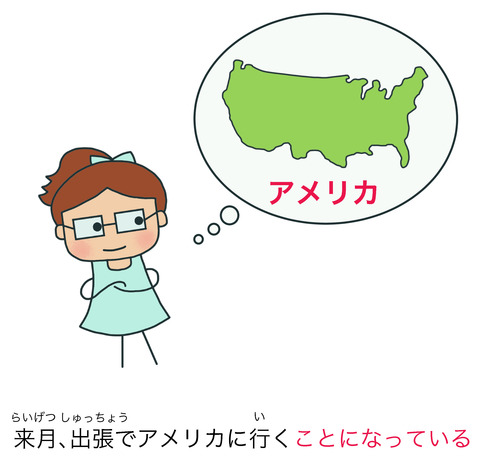
来月、出張でアメリカに行くことになっている
→来月、出張でアメリカに行くと決まっている(会社で決まった予定)I’m scheduled to go to the U.S. on a business trip next month. →It’s been decided that I’ll go to the U.S. on a business trip next month (a schedule decided by the company).
校内ではタバコは吸ってはいけないことになっている
→校内ではタバコは吸ってはいけないと決まっている(学校でのルール)Smoking is prohibited on school grounds. →It’s been decided that smoking is prohibited on school grounds (a school rule).
日本では、車は左側を走ることになっている
→日本では、車は左側を走ると決まっている(国の決定・法律)In Japan, cars drive on the left. →It’s been decided that cars drive on the left in Japan (a national decision / law).
お葬式にはみんな黒い服を着ることになっている
→お葬式にはみんな黒い服を着ると決まっている(社会の慣習)Everyone wears black clothes to funerals. →It’s customary for everyone to wear black clothes to funerals (a social custom).
Read the original source text
Meaning
(会社・学校で決まった規則や予定)〜に決まっている
How to use it
動詞[原形]+ことになっている
動詞[ない形]+ことになっている
Explanation
前回の「〜ことにしている」が「自分の意志で決めたこと」を表すのに対し、「
〜ことになっている」は自分以外の決定「
会社・学校・団体などが決めた規則や予定」を表します。また例文③・④のように「
法律」や「
社会の慣習」を表す場合もあります😊
前回も書いたように、このシリーズはたくさん似ている文型がありますので区別をしてしっかりと覚えられるといいですね😉
【「こと」シリーズ】
〜こと(命令)
〜ことか
〜ことから
〜ことがある
〜ことができる(可能)
〜ことができる(能力)
〜ことこの上ない
〜ことだ・〜ないことだ
〜ことだから
〜ことだし
〜ことで(Nのことで)
〜こととて
〜ことなしに
〜ことなく
〜ことに
〜ことにしている
〜ことにする
〜ことになっている
〜ことになる・〜こととなる
〜ことには
〜ことは〜が①(形容詞・名詞)
〜ことは〜が②(動詞)
〜ことはない
〜ことはならない
〜たことがある(経験)
〜だこと!
(〜は)〜てのこと
〜ても〜すぎることはない
〜ということだ
〜とのことだ
〜ないこともない
〜ないことには
〜なかったことがある
日本語文型辞典
Meaning
Basic information: Nということになっている; V-る(という)ことになっている; V-ない(という)ことになっている. Expresses various arrangements that bind people, ranging from schedules and arrangements in daily life to laws, rules, and customs. It can be understood as the conclusion or result expressed by …ことになる continuing to be in effect.
Examples:
① It is the rule that you must notify the school when you are going to be absent.
② If you lose your ticket, we have to charge you the fare for the longest section.
③ The rules state that anyone who commits fraud is disqualified.
④ The parking lot management is not responsible for thefts or accidents in the parking lot.
⑤ Those attending the party are to meet at the station at six.
⑥ The children are supposed to water the fields during summer vacation.
Read the original source text
Meaning
基本情報NということになっているV-る(という)ことになっているV-ない(という)ことになっている説明予定、日常生活でのとりきめ、法律や規則、慣例のようなものにいたるまで、人を拘束するさまぎまなとりきめを表す。「…ことになる」の結論・結果がつづいている状態と考えてよい。例文① やすむときは学校に連絡しなければならないことになっています。② 乗車券をなくした場合は最長区間の料金をいただくことになっているんですが。③ 規則では、不正をおこなった場合は失格ということになっている。④ 駐車場内での盗難や事故については、一駐車場側は関知しないことになっております。⑤ パーティーに参加する人は、6時に駅で待ち合わせることになっている。⑥ 夏休みのあいだ、畑の水やりは子供たちがすることになっている。
日本語文型辞典 英語版
Meaning
【ことになっている】[Nということになっている][V-る (という)ことになっている][V-ない (という)ことになっている]
Indicates a variety of rules that govern people’s activities, including their plans, agreements in daily life, laws and rules, and even customs. Can be considered to mean that the conclusion or result of ...ことになる continues to have an effect.
In context 6 examples
やすむときは学校に連絡しなければならないことになっています。
There is a rule that you must contact the school when you are absent.
乗車券をなくした場合は最長区間の料金をいただくことになっているんですが。
I'm afraid that, when you’ve lost your train ticket, we have to ask you to pay the fare for the maximum distance.
規則では、不正をおこなった場合は失格ということになっている。
According to the regulations, when you commit an act of wrongdoing, you will be disqualified.
駐車場内での盗難や事故については、駐車場側は関知しないことになっております。
The parking lot management takes no responsibility for theft or accidents that take place inside the parking lot.
パーティーに参加する人は、6時に駅で待ち合わせることになっている。
Those who are going to attend the party are supposed to meet at the station at six o’clock.
夏休みのあいだ、畑の水やりは子供たちがすることになっている。
During summer vacation, it’s the children's job to water the garden.
日本語NET JLPT文法解説まとめ
Meaning
It is a rule that ~ / It has been decided that ~
Means that it has already been decided, as a rule, custom, schedule, etc., that something will or will not be done.
How to use it
V (dictionary form / ない-form) + ことになっている
Explanation
Rules, customs or schedules that has been decided
In context 18 examples
この会社では、毎朝、仕事の前にラジオ体操をすることになっている。
At this company, it is customary to do radio calisthenics before work every morning.
この国では、車は右車線を走ることになっている。
In this country, cars are required to drive in the right lane.
この店には女性しか入れないことになっている。
At this establishment, only women are allowed to enter.
来週の金曜日は東京へ出張へ行くことになっている。
I am scheduled to go on a business trip to Tokyo next Friday.
燃えるゴミは月・水・金に出すことになっている。
Combustible trash is to be put out on Mondays, Wednesdays, and Fridays.
この会社では、毎週水曜日は残業してはいけないことになっている。
At this company, working overtime on Wednesdays is prohibited.
夏の間は、ネクタイをしなくてもいいことになっている。
During the summer, we are allowed not to wear ties.
このマンションではペットを飼ってはいけないことになっている。
Pets are not allowed in this apartment building.
学校を休むときは、事前に連絡しなければいけないことになっている。
When you miss school, you are required to contact them in advance.
この寮では、食事の後、自分でお皿を洗って棚にしまうことになっている。
At this dorm, after meals, you are supposed to wash your own dishes and put them away on the shelf.
シンガポールでは、道にゴミを捨てると罰金を払わなければいけないことになっている。
In Singapore, if you litter in the street, you are required to pay a fine.
私の国では、電車の中で飲食をしてはいけないことになっている。
In my country, eating and drinking on trains is prohibited.
授業中でも単語の意味を調べるのであれば、スマホを使ってもいいことになっている。
Even during class, you are allowed to use your smartphone if you are looking up the meaning of a word.
この店ではDVDは1週間まで借りられることになっている。
At this store, DVDs may be borrowed for up to one week.
ムスリムの人は断食中でも、妊婦さんや子供であれば食事をしても良いことになっている。
Even during the fast, Muslims are allowed to eat if they are pregnant women or children.
今日は午後から取引先と打ち合わせをすることになっている。
I am scheduled to have a meeting with a business partner this afternoon.
寮の門限で、12時までに帰らないといけないことになっているので、そろそろ帰るね。
Because of the dorm curfew, I have to be back by midnight, so I'd better get going.
今日は午後から、取引先の田中社長と会うことになっている。
I am scheduled to meet with President Tanaka of our business partner this afternoon.
Read the original source text
Meaning
~という決まりである / 〜することが決まっている
規則や習慣、予定などでそうすること、そうしないことがすでに決まっているという意味。
How to use it
V(辞書形 / ナイ形)+ ことになっている
Explanation
Rules, customs or schedules that has been decided
毎日のんびり日本語教師
Meaning
~be decided to
How to use it
Verb dictionary form + (という)ことになっている
Verb ない-form + (という)ことになっている
Noun + ということになっている
Explanation
This is used for laws and rules, customs, and conventions that have already been established in social settings such as companies and schools.
In daily life, it can also be used for plans that one has made oneself.
「~ことになっている」 is used when stating something objectively.
It can also be said as 「~こととなっている」, which gives a somewhat formal, stiff impression.
Notes
Nothing in particular.
In context 5 examples
イスラム教徒が行う断食は、日没後に普段と同じように食事をとってもいいことになっている。
Muslims are permitted to eat as usual after sunset during their fast.
鳥獣保護管理法で、野生動物には手出しをせずに見守ることになっている。
Under the Wildlife Protection and Management Act, people are to leave wild animals alone and observe them without interfering.
イギリスは来年3月にEUを脱退することになっている。(英国在明年3月份将脱欧。)
Britain is scheduled to leave the EU next March. (Britain is set to leave the EU next March.)
中国では、車は右側を走行することとなっている。
In China, cars are required to drive on the right.
明日は彼女と遊びに行くことになっている。(明天要跟女朋友去玩。)
I'm supposed to go out with my girlfriend tomorrow. (I'm going to go have fun with my girlfriend tomorrow.)
Read the original source text
Meaning
~と決まっている
How to use it
動詞辞書形+(という)ことになっている
動詞ない形+(という)ことになっている
名詞+ということになっている
Explanation
会社や学校などの社会的な場面で既に決まっている法律や規則、習慣や慣例などに用いられます。
日常生活では自分自身が決めた予定にも使えます。
「~ことになっている」は客観的に述べるときに用いられます。
「~こととなっている」とも言うことができ、この場合やや改まった硬い印象を与える。
Notes
特になし
NINJAL 日本語文型データベース
Meaning
[1] Expresses a plan decided through agreement among several people or due to surrounding circumstances.
[2] Expresses rules, customs, systems, and the like decided through agreement among several people or due to surrounding circumstances.
How to use it
Vることになっている/Vないことになっている
Vることになっている/Vないことになっている
Other forms
Notes
[1] It is not usually used in the negative form.
[2] It is not usually used in the negative form.
In context 13 examples
私は今度の会議で司会をすることになっている。
I am scheduled to chair the upcoming meeting.
14時から16時の間に宅配便が来ることになっているから、その間はうちにいないといけない。
A delivery is scheduled to arrive between 2 and 4 p.m., so I have to stay home during that time.
講演の後で20分の休憩が入ることになっていたが、15分に変更された。
A 20-minute break was scheduled after the lecture, but it was changed to 15 minutes.
その日行われることになっていたラグビーワールドカップの2試合は、台風のため中止になった。
The two Rugby World Cup matches scheduled to be held that day were canceled because of the typhoon.
急病人が出たため、その高速バスは、寄らないことになっていたサービスエリアにも停車した。
Because someone suddenly became ill, the express bus also stopped at a service area where it was not scheduled to stop.
日本のマナーでは、座る場所に「上座」と「下座」の区別があって、上座には客や目上の人が座ることになっている。
According to Japanese etiquette, seating places are divided into the “honored seat” and the “lower seat,” and guests and people senior in rank are supposed to sit in the honored seat.
私の高校では、体育の時間には学年ごとに決まった色のジャージを着ることになっていた。
At my high school, students were supposed to wear tracksuits in a color assigned to each grade during physical education classes.
このジェットコースターには身長130cm以上の人しか乗れないことになっています。
Only people who are at least 130 cm tall are allowed to ride this roller coaster.
500mlのペットボトル入りの飲み物は、国際線の機内には原則として持ち込めないことになっている。
As a rule, drinks in 500 ml plastic bottles cannot be brought onto international flights.
「ここに扉がありますが、非常の場合以外、この扉は使わないことになっています」
“There is a door here, but this door is not to be used except in an emergency.”
この授業の期末試験には教科書、ノートを持ち込んでもよいことになっている。
Students are allowed to bring their textbooks and notebooks into the final exam for this class.
この高校では校則で、アルバイトをしてはいけないことになっている。
The school rules at this high school prohibit students from having part-time jobs.
加工食品に食品アレルギーの原因になりうる「特定原材料」が含まれている場合、表示しなければならないことになっている。
If a processed food contains a “specified ingredient” that could cause a food allergy, it must be labeled.
Read the original source text
Meaning
[1] 複数の人の合意や周囲の事情で決まった予定を表します。
[2] 複数の人の合意や周囲の事情で決まった規則・習慣・仕組みなどを表します。
How to use it
Vることになっている/Vないことになっている
Vることになっている/Vないことになっている
その他
Notes
[1] ふつう否定形にはしません。
[2] ふつう否定形にはしません。
どんなときどう使う 日本語表現文型辞典
Meaning
the case that…; the custom that…
How to use it
Vる・Vない+ことになっている (it is stipulated; it is arranged)
Explanation
~という決まり(予定、習慣など)になっている
1)「さまざまな規則や習慣、予定などにより、そうすること、またはそうしないことが決まりになっている」という意味。
2)改まった言い方として、「こととなっている」とも言う。
3)規則を述べる言い方として、「してもいい・してはいけない・しなければならない」などとよく一緒に使う。
2)Formal version: こととなっている.
3)Often used together with してもいい, してはいけない, しなければならない when describing rules.
1)Something must be certain way because of a variety of rules, customs, or schedules.
In context 4 examples
この会社では社員は1年に1回健康診断を受けることになっています。
At this company, employees are required to have a health checkup once a year.
日本語の敬語では、たとえば自分の父母のすることについてほかの人に話すとき、尊敬語は使わないことになっている。
In Japanese honorific language, for example, when speaking to others about something one's own parents do, it is stipulated that honorific language is not used.
午前の会議はこれで終了いたします。なお、午後の会議は2時からということとなっておりますので、1時50分までにお集まりください。
This concludes the morning meeting. The afternoon meeting is scheduled to begin at 2:00, so please gather by 1:50.
うちの会社ではお客さまに会うとき以外は、スーツを着なくてもいいことになっている。
At our company, it is permitted not to wear a suit except when meeting customers.
Read the original source text
Meaning
the case that…; the custom that…
How to use it
Vる・Vない+ことになっている
Explanation
~という決まり(予定、習慣など)になっている
1)「さまざまな規則や習慣、予定などにより、そうすること、またはそうしないことが決まりになっている」という意味。
2)改まった言い方として、「こととなっている」とも言う。
3)規則を述べる言い方として、「してもいい・してはいけない・しなければならない」などとよく一緒に使う。
2)Formal version: こととなっている.
3)Often used together with してもいい, してはいけない, しなければならない when describing rules.
1)Something must be certain way because of a variety of rules, customs, or schedules.