絵でわかる日本語
Meaning
~, though
~, but
How to use it
Verb/adjective/noun [plain form] + がな
Explanation
“〜がな” means “〜けれどな” and is a sentence pattern used when the speaker is surprised or disappointed because what they did and what actually happened are different.
[Explanation of example ①]
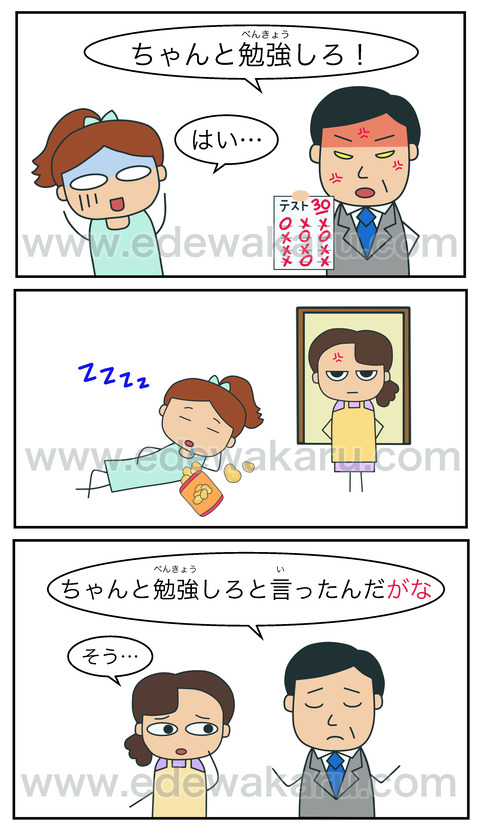
Father: Study properly!
Daughter: Yes…
Father: I told you to study properly, but… (She isn’t doing it… I thought she would study properly…)
The father uses “〜がな” with feelings of [disappointment], [anger], or [doubt], meaning “I thought that because I got angry, my daughter had started studying properly… but she hadn’t.” 😀 (Review: 〜を込めて・〜を込めた)
Also, “〜がな” is used by men in spoken language. 😮 Women should use “〜けれどな” or “〜けどな.” This is an expression used with friends and family, so be careful: it is not used in polite forms. 😨
[Example]
⭕️ I said you mustn’t be late, but…
❌ I said you mustn’t be late, but… (polite form)
[For those who want to learn more]
“〜がな” is also used when you want to ask someone to do something. 😊
[Example]
It would help if you could give me a hand, but…
→ It would help if you could give me a hand, though…
“〜がな” is used especially by someone senior to someone junior.
In most cases it is used by a father to a child, or by a company president or boss to a subordinate. 😊
In context 3 examples
ちゃんと勉強しろと言ったんだがな…
→ちゃんと勉強しろと言ったんだけれどな…I told you to study properly, but… → I told you to study properly, though…
何回も説明したんだがな…
→何回も説明したんだけれどな…I explained it many times, but… → I explained it many times, though…
明日は雨が降らないといいんだがな
→明日は雨が降らないといいんだけれどな…I hope it won’t rain tomorrow, but… → I hope it won’t rain tomorrow, though…
Read the original source text
Meaning
〜けれどな
〜けどな
How to use it
動詞・形容詞・名詞[普通形]+がな
Explanation
「〜がな」は「〜けれどな」という意味で、話者がしたことと、実際に発生したことが違って驚いたり、失望したりする時に使う文型です。
[例文①の説明]
父:もっとちゃんと勉強しろ!
娘:はい…
父:ちゃんと勉強しろと言ったん
だが
…(していない…ちゃんと勉強すると思ったのに…)
父は
「怒ったので、娘はちゃんと勉強するようになったと思っていた…しかし、していなかった」
という【失望】や【怒り】【疑問】の気持ちを込めて「〜がな」を使っています😀(復習:〜を込めて・〜を込めた)
また、
「〜がな」は話し言葉で男性が使います
😮女性は「〜けれどな」「〜けどな」を使いましょう。友達や家族と使う言い方ですので、
丁寧形には使いません
ので気をつけてください😨
[例]
⭕️遅刻をしては
ダメだ
と言ったんだ
がな
❌遅刻をしては
ダメです
と言ったんだ
がな
【余裕のある人へ】
「〜がな」は相手に依頼したい時にも使います😊
[例]
ちょっと手伝ってくれると助かるんだ
がな
→ちょっと手伝ってくれると助かるんだ
けれど
…
「〜がな」は特に、目上の人から目下の人に使われます。
ほとんどの場合は、お父さんから子供、社長や上司から部下などの場合に使用されます😊
日本語文型辞典
Meaning
Basic information: Explanation. This consists of “が,” which expresses contrast, with “な” added. It is used at the end of a sentence to express puzzlement when what one did and what actually happened do not match, or a wish that something that has not yet happened would come true. It may also be used to make a request, as in ⑤. It is not used with the polite form. A masculine spoken expression used in a monologue or with someone close; it may also be pronounced with a lengthened ending as “…がなあ.” It is the same as “…けどな”; women use the latter. Examples: ① Isn't Mr. Yamada here yet? I told him to come without being late, but… ② I failed the exam again. I thought I had studied hard, but… ③ The sports day is tomorrow, right? I hope it doesn't rain. ④ I wish they'd take their work a little more seriously. ⑤ Taguchi, are you free now? I'd appreciate it if you could give me a hand.
Read the original source text
Meaning
基本情報説明逆接を表す「が」に「な」が付いたもので、文末に用い、自分のしたことと実際に起こったことが食違って不思議に思う気持ちや、実際にはまだ起こっていないことを実現させたいと願う気持ちを表す。⑤のように依穎するのに用いることもある。丁寧体にはつかない。ひとりごとや親しい相手に向けて用いる男ことばで、話しことば。「…がなあ」とのばして発音することもある。「…けどな」と同じで、女性はこの方を用いる。例文① 山田さんはまだ来ないの?遅れずに来るように言っておいたんだがな。② 今度の試験も駄目だった。一生懸命勉強したつもりなんだがなあ。③ あした運動会だろう?雨が降らないといいがなあ。④ 彼らももう少し本気で仕事に取り組んでくれるようになるといいんだがなあ。⑤ 田口君、今、暇?ちょっと手伝ってくれるとありがたいんだがな。
日本語文型辞典 英語版
Meaning
Consists of the contradictory conjunction が combined with the particle な. Used at the end of a sentence and indicates either bewilderment at the gap between one’s intention and the actual outcome, or a wish for something that has yet to occur. As in example
(5)
, it can be used to make a request. It cannot be attached to a sentence in polite form. It is a spoken language expression used by men when they are talking to themselves or to someone close. The final sound な is sometimes lengthened so it is pronounced as ...がなあ. A similar expression, ...けどな, is used by women.
In context 5 examples
山田さんはまだ来ないの? 遅れずに来るように言っておいたんだがな。
Yamada-san hasn’t come yet? I told her not to be late!
今度の試験も駄目だった。一生懸命勉強したつもりなんだがなあ。
I did badly on this test, too...and I was sure I had studied so hard for it.
あした運動会だろう? 雨が降らないといいがなあ。
Tomorrow is the sports day, right? I sure hope it doesn’t rain.
彼らももう少し本気で仕事に取り組んでくれるようになるといいんだがなあ。
I wish they would get a little more serious about their work.
田口君、今、暇? ちょっと手伝ってくれるとありがたいんだがな。
Taguchi-kun, are you free right now? It’d be great if you could give me a hand for a second.