くらべてわかる日本語表現文型辞典
Meaning
Meaning 1: A hears or receives information and conveys it to the other person; a hearsay expression.
Meaning 2: From certain information or a state, the speaker concludes that “A is the case.”
Meaning 3: In the form “XとはAということだ” or “XとはAのことだ,” it expresses that X = A and explains the meaning or content of X.
How to use it
Explanation
[Contrast 1]
“Aそうだ”
“Aそうだ” also expresses hearsay, but it cannot take the volitional or imperative form of a verb for A. “Aということだ” can use the wording of the information as is.
○このマンションでは、ゴミは七分別しろということだ。 — In this apartment building, apparently you have to sort the garbage into seven categories.
×このマンションでは、ゴミは七分別しろそうだ。 — In this apartment building, apparently you have to sort the garbage into seven categories. [Using “しろそうだ”]
“AとかB” (Meaning 1, p. 164)
[Contrast 2]
“Aわけだ” (Meaning 1, p. 328)
[Contrast 3]
“Aというものだ” (Meaning 2, p. 155)
Notes
[Note 1]
・“Aという” is a shortened, abbreviated way of saying “Aということだ.”
In context 12 examples
今晩から、寒くなるということだ。
Apparently, it will get cold starting tonight.
気象庁の発表によると、今度の台風は大型だということです。
According to the Meteorological Agency’s announcement, this typhoon is large.
「新しい」という字は昔「あらたしい」と読んでいたということだ。
Apparently, the character “新しい” used to be read as “あらたしい.”
日照り続きで、今年もまた水不足になる可能性が高いという。
With the prolonged dry spell, it is likely that there will be a water shortage again this year.
期末試験を受けなかったということは、落第覚悟ということだな。
Not having taken the final exam means you’re prepared to fail, right?
要するに、この仕事は引き受けられないということですね。
In other words, you’re saying you can’t take on this job.
やきもちを焼くということは、まだ君は彼を愛しているということだ。
Being jealous means you still love him.
価格が高ければ高いほど、品質がいいということだ。
The higher the price, the better the quality, apparently.
この英文の意味は公園に木があるということだ。
The meaning of this English sentence is that there are trees in the park.
禁煙とは、ここでタバコを吸ってはいけないということだ。
“No smoking” means that you must not smoke here.
WHOというのは、世界保健機構のことです。
WHO stands for the World Health Organization.
「カラオケというのはなんですか。」
「空のオーケストラということです。」“What is karaoke?” “It means ‘empty orchestra.’”
Read the original source text
Meaning
意味1:話し手がAという情報を得て、それを相手に伝える伝聞表現。
意味2:ある情報や状態から、話し手が「Aだ」と結論づける。
意味3:「XとはAということだ」「XとはAのことだ」の形で。X=Aということを表し、Xの意味・内容を説明する。
How to use it
Explanation
【対比1】
「Aそうだ」
「Aそうだ」も伝聞を表すがAに動詞の意向形や命令形は使えない。「Aということだ」は情報の表現をそのまま使える。
○このマンションでは、ゴミは七分別しろということだ。
×このマンションでは、ゴミは七分別しろそうだ。
「AとかB」(意味1 P.164)
【対比2】
「Aわけだ」(意味1 P.328)
【対比3】
「Aというものだ」(意味2 P.155)
Notes
【注意1】
・「Aという」は「Aということだ」を短く省略した言い方である。
絵でわかる日本語
Usage 1
Read this source entry ↗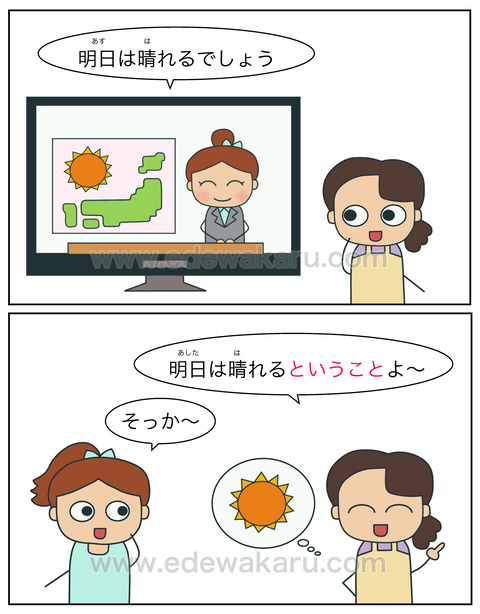
Meaning
(Hearsay / relaying information) Apparently 〜 / I hear that 〜
How to use it
Verb/adjective/noun [plain form] + ということだ
*For the present affirmative form of adjectives and nouns, use 「ーだということだ」
(Examples: きれいだということだ・学生だということだ)
Explanation
“〜ということだ” means “〜そうだ” and is a hearsay expression used when passing on information obtained from somewhere else as is.
It is often used on television news and in newspapers. If you’re taking N3, remember it together with “〜とのことだ” 😉
[Example]
Apparently, it will snow tomorrow.
= I hear that it will snow tomorrow.
“〜ということだ” also has a usage meaning “In other words, it means 〜 (explanatory sentence),” so review that as well 😀
In context 3 examples
明日は晴れるということだ
→明日は晴れるそうだApparently, it’ll be sunny tomorrow. →I hear that it’ll be sunny tomorrow.
新しい先生はやさしいということだ
→新しい先生はやさしいそうだI hear that the new teacher is kind. →Apparently, the new teacher is kind.
黄さんは日本語能力試験に合格したということだ
→黄さんは日本語能力試験に合格したそうだI hear that Mr. Huang passed the Japanese-Language Proficiency Test. →Apparently, Mr. Huang passed the Japanese-Language Proficiency Test.
Read the original source text
Meaning
(伝聞・伝言)〜だそうだ
How to use it
動詞・形容詞・名詞[普通形]+ということだ
*形容詞・名詞の現在肯定形は「ーだということだ」となる
(例:きれいだということだ・学生だということだ)
Explanation
「〜ということだ」は「〜そうだ」という意味で、どこかから得た情報を他の人にそのまま伝える時に使われる伝聞表現です。
テレビのニュースや新聞などでよく使われる表現です。N3を受ける人は「〜とのことだ」と一緒に覚えましょう😉
[例]
明日は雪が降る
ということだ
=明日は雪が降る
とのことだ
「〜ということだ」には「つまり〜という意味だ(説明文)」という意味の用法もありますので、復習をしておきましょう😀
Usage 2
Read this source entry ↗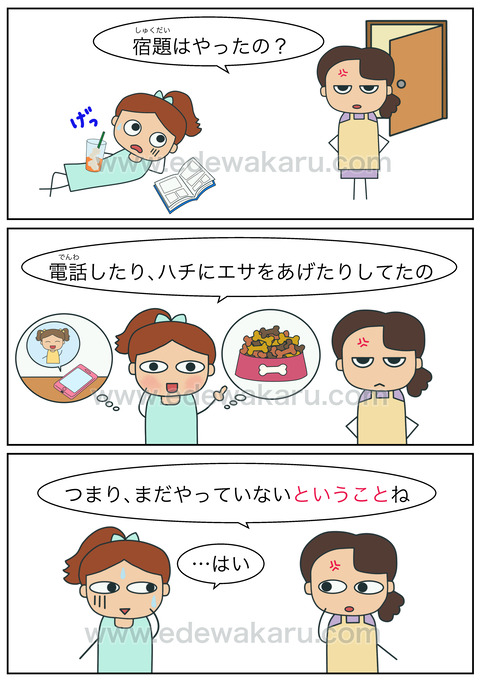
Meaning
In other words, it means that…
How to use it
Verb/adjective/noun [plain form] + ということだ
*For the present affirmative form of adjectives and nouns, use 「ーだということだ」
(Examples: きれいだということだ・学生だということだ)
Explanation
「〜ということだ」 is a sentence pattern that means “in other words, it means that…” It is used to explain the meaning of a word or phrase, or to rephrase what one has understood about a situation. Its colloquial form is 「〜ってことだ」.
[Examples]
You still haven’t done your homework
ということ
ね
= You still haven’t done your homework
ってこと
ね
I’m not young anymore, either
ということだ
な…
= I’m not young anymore, either
ってことだ
な…
「〜ということだ」 also has a hearsay use, so be sure to learn that as well.
[Related articles]
In context 5 examples
母:宿題はやったの?娘:友達に電話したり、ハチにエサをあげたりしてたの母:つまり、まだやってないということね娘:…はい
→つまり、まだやっていないのねMother: Have you done your homework? Daughter: I was calling my friends and feeding Hachi. Mother: So that means you still haven’t done it, right? Daughter: …Yes. →So you still haven’t done it, then.
A:このワインは2本で3000円だったのB:つまり1本1500円ということね
→つまり1本1500円という意味だねA: These two bottles of wine were 3,000 yen. B: So that means one bottle was 1,500 yen, right? →So that means one bottle was 1,500 yen.
A:「立入禁止(たちいりきんし)」って書いてあるね…B:つまり、入ってはいけないということね
→つまり、入っていはいけないという意味ねA: It says “No entry” here… B: So that means we’re not allowed to go in, right? →So that means we’re not allowed to go in.
店長:明日から、もう来なくていいわ!社員:私は首になったということですね…
→つまり、私は首になったという意味ですねManager: Starting tomorrow, you don’t have to come in anymore! Employee: So that means I’ve been fired… →So that means I’ve been fired.
最近オールできなくなった…私ももう若くないということだな…
→私ももう若くないんだな…I can’t stay out all night anymore… That means I’m not young anymore, either… →I’m not young anymore, either…
Read the original source text
Meaning
つまり〜という意味だ
How to use it
動詞・形容詞・名詞[普通形]+ということだ
*形容詞・名詞の現在肯定形は「ーだということだ」となる
(例:きれいだということだ・学生だということだ)
Explanation
「〜ということだ」は「つまり〜という意味だ」という意味を表す文型です。語句の意味を説明したり、状況について理解した内容を言い換えて言う時に使われます。「〜ということだ」の口語形は「〜ってことだ」です。
[例]
まだ宿題をやってない
ということ
ね
=まだ宿題をやってない
ってこと
ね
私も、もう若くない
ということだ
な…
=私も、もう若くない
ってことだ
な…
「〜ということだ」には【伝聞】を表す用法もありますので、一緒に覚えておきましょう。
【関連記事】
毎日のんびり日本語教師
How to use it
Sentence plain form + ということだ
Explanation
There are two meanings.
① Hearsay
Like “~そうだ,” this expresses hearsay.
In addition to “~ということだ,” “~とのことだ” and “~んだって” are used in conversation.
Compared with “~そうだ,” which also expresses hearsay, it is characterized by being closer to the source of the information.
② Stating a conclusion
This usage states a conclusion inferred or drawn from a given situation.
The evidence supporting the conclusion is sufficiently reliable, and the conclusion is unlikely to be overturned.
It often occurs with expressions such as “つまり,” and “ってことだ” is commonly used colloquially.
Notes
Nothing in particular.
In context 8 examples
部長は忙しく、私たちの方でどうにか対処してほしいとのことだ。
The department head is busy and says he wants us to handle things somehow on our end.
天気予報によると、明日は雨が降るということだ。
According to the weather forecast, it will rain tomorrow.
彼は最近新しい彼女ができたんだって。
I hear he’s got a new girlfriend recently.
Aさんは熱があるので、明日は行けないとのことだ。
A says they have a fever, so they can’t come tomorrow.
課長は君に話があるからすぐ来て欲しいとのことだ。
The section chief says he wants you to come right away because he has something to discuss with you.
彼の姿は今日も見えない。つまりまたサボったってことだ。
He still hasn’t shown up today. In other words, he skipped work again.
この2人の答案は全て同じだった。つまりどちらかがカンニングをしたということだ。
These two students’ answer sheets were exactly the same. In other words, one of them cheated.
明日から来なくてもいい。やる気がないなら初めから来るなということだ。
You don’t have to come starting tomorrow. If you’re not motivated, it means you shouldn’t have come in the first place.
Read the original source text
How to use it
文の普通形+ということだ
Explanation
2つの意味があります。
①伝聞
「~そうだ」と同じく伝聞を表します。
「~ということだ」の他に、会話では「~とのことだ」や「~んだって」が用いられます。
同じ伝聞を表す「~そうだ」よりも、根拠となる情報との距離が近いのが特徴です。
②結論を述べる
ある状況より推測される、あるいは得られる結論を述べる用法です。
結論を支える根拠は十分に信頼性があり、覆ることはほぼありません。
「つまり」などと呼応しやすく、「ってことだ」は口語としてよく用いられます。
Notes
特になし
AIUEO JLPT Grammar
Meaning
This sentence pattern is used for conveying information, quoting someone, or explaining the meaning or conclusion of something.
How to use it
Ordinary sentence + と + いうことだ
In context 5 examples
天気予報によると、明日は雨が降るということだ。
According to the weather forecast, it’s going to rain tomorrow.
彼は来月アメリカに転勤するということです。
I heard that he’s being transferred to the U.S. next month.
要するに、彼はその提案に反対しているということでしょう。
In short, he is opposed to the proposal.
つまり、このプロジェクトは来月までに完成しなければならないということだ。
In other words, this project must be completed by next month.
彼女からまだ連絡がないということは、仕事が忙しいということだろう。
The fact that she hasn’t contacted us yet probably means she’s busy with work.
Read the original source text
Meaning
This sentence pattern is used for conveying information, quoting someone, or explaining the meaning or conclusion of something.
How to use it
普通文と+いうことだ
Explanation · 日本語
この文型は、情報を伝えたり、他人の話を引用したり、何かの意味や結論を説明するために使われる表現です。
文法
Usage 1
Meaning
〜そうだ / 〜と言っていました
A hearsay expression that is a little more formal than “〜そうだ” or “〜と言っていました.” It is often used in formal situations.
It can be replaced with “〜とのことだ.”
How to use it
Plain form + ということだ
In context 3 examples
ニュースによると、明日は雨が降るということだ。
According to the news, it will rain tomorrow.
ワンさんは先月受けた試験に合格したということだ。
I hear that Mr. Wang passed the exam he took last month.
新聞によると、先日起きた事件の犯人が捕まったということだ。
According to the newspaper, the culprit in the incident that happened the other day has been caught.
Read the original source text
Meaning
〜そうだ / 〜と言っていました。
伝聞表現で「~そうだ」や「~と言っていました」よりも少し硬い表現。改まった場面で使われることが多い。
「〜とのことだ」で置き換えられる。
How to use it
普通形 + ということだ
Usage 2
Meaning
〜という意味だ / in other words, 〜だ
How to use it
Plain form + ということだ
In context 3 examples
ここは「立入禁止」ということは、つまり、「入ってはいけない」ということだ。
Here, “No Entry” means, in other words, “You must not enter.”
先輩に「明日から来なくてもいいからね」と言われた。つまり首ということかな。
My senior told me, “You don’t have to come in starting tomorrow.” I guess that means I’m fired.
開店は10時の予定だから、あと1時間待たなければいけないということだね。
The store is scheduled to open at 10, so that means we have to wait another hour.
Read the original source text
Meaning
〜という意味だ / つまり〜だ
How to use it
普通形 + ということだ
Bunpro Grammar Reference
Meaning
I heard that, Rumor has it that, It is said that, It means that
How to use it
Phrase + ということ + だ
Phrase + ということ + です
Nuance
A construction that expresses an entire phrase as either hearsay, a rumor, or one's explanation of (A).
Explanation
Like ということ, an expression used for nominalizing a phrase in the fashion of 'the ~ that ~', ということだ makes use of the auxiliary verb だ (or です), and stresses that the nominalized phrase 'is' the case. This phrase is often translated as 'I heard that', or 'it is said that', but literally, it is closer to 'it is that it's ~'. The だ is what gives this expression a high degree of certainty, therefore implying that the speaker has heard the statement elsewhere, and is sure of its validity.
ということだ can be added to the end of any phrase that the speaker wants to highlight as being something that is known.
この井戸水は汚染されているということだ。
It is said that this well water is contaminated.
この魚は全く臭くない。まだ新鮮と言う事だ。
This fish doesn't smell at all. It means that it's fresh.
ということだ is regularly paired with other expressions that show the 'source' of information, such as によると, or によれば.
先生によると、この病気は薬では治せないということだ。
According to the doctor, (it is said that) this sickness cannot be cured with medicine.
大阪府警によれば、犯人はまだ逃げているということだ。
It is said that the criminal is still on the run, according to the Osaka prefectural police.
When ということだ is being used to express hearsay (statements that cannot easily be proven), it can be rephrased as とのことだ. The literal difference between these two phrases is as follows:
ということだ - It can be explained that (A) is ~ (more emphasis on the information).
とのことだ - The statement of (A) has been applied to ~ (more emphasis on the source that 'applied' the information).
地域によってルールが違うとのことだ。
It is said that the rules differ depending on the area.
地域によってルールが違うとのことだ。
It is said that the rules differ depending on the area.
Caution
ということだ is considered to be more formal than そうだ when reporting information that has been heard from another source. This is primarily due to ということだ expressing something that is thought to be a fact, while そうだ retains the nuance of being something that is a speculation/guess.
彼は家族に内緒で旅行に行ったそうだ。
I heard that he went on a trip without telling his family.
彼は家族に内緒で旅行に行ったということだ。
It is said that he went on a trip without telling his family.
In context 20 examples
- 人によって考え方が違うという事だ。
It is said that different people have different ways of thinking.
- 先生によると、この病気は薬では治せないということだ。
According to the doctor, (it is said that) this sickness cannot be cured with medicine.
- 大阪府警によれば、犯人はまだ逃げているということだ。
It is said that the criminal is still on the run, according to the Osaka prefectural police.
- 地域によってルールが違うということだ。
It means that the rules differ depending on the area.
- 地域によってルールが違うとのことだ。
It is said that the rules differ depending on the area.
- この魚は全く臭くない。まだ新鮮と言う事だ。
This fish doesn't smell at all. It means that it's fresh.
- この井戸水は汚染されているということだ。
It is said that this well water is contaminated.
- イルカは動物の中で頭が一番いいという事だ。
It is said that dolphins are the smartest of all animals.
- 田中さんと山田さんは、秘密で付き合っているという事だ。
It is said that Tanaka-san and Yamada-san are dating in secret. (rumor has it)
- それはただ文化が違うという事だ。
That just means that their cultures are different. (it is said)
- 忍耐先生によりますと、ガンの治療方法がとうとう見つかったという事です。
According to professor Nintai, (it is said that) the cure for cancer has been finally discovered.
- それは君がミスをしたという事だから、謝った方がいい。
That means you made a mistake, so you should apologize. (it is said)
- 悪気はないという事だから、許してあげようよ。
It means that there is no ill intent, so let's forgive them. (it is said)
- 忍耐先生によれば、タイムマシンが開発されたという事だ。
According to professor Nintai, (rumor has it that) a time machine has been developed. (it is said)
- 今回は失敗だったけど、新しいことにチャレンジしたという事だ。
I failed this time, however, it means I challenged myself with new things. (it is said)
- 証人によると、記者は怒った忍耐先生に攻撃されたという事だ。
According to the witness, (it is said that) the reporter was attacked by an angry Mr. Nintai.
- 苦しいこともある。でもそれが生きるという事だ。
Sometimes you will go through something difficult, but that's just part of life. (it is said)
- 意見を言ってはいけないという事ではなくて、もっと冷静に話してほしい。
I don't mean you can't give your opinion, but I want you to speak more calmly. (it is said)
- 彼は家族に内緒で旅行に行ったそうだ。
I heard that he went on a trip without telling his family.
- 彼は家族に内緒で旅行に行ったということだ。
It is said that he went on a trip without telling his family.
Read the original source text
Meaning
I heard that, Rumor has it that, It is said that, It means that
How to use it
Phrase + ということ + だ
Phrase + ということ + です
Nuance
A construction that expresses an entire phrase as either hearsay, a rumor, or one's explanation of (A).
Explanation
Like ということ, an expression used for nominalizing a phrase in the fashion of 'the ~ that ~', ということだ makes use of the auxiliary verb だ (or です), and stresses that the nominalized phrase 'is' the case. This phrase is often translated as 'I heard that', or 'it is said that', but literally, it is closer to 'it is that it's ~'. The だ is what gives this expression a high degree of certainty, therefore implying that the speaker has heard the statement elsewhere, and is sure of its validity.
ということだ can be added to the end of any phrase that the speaker wants to highlight as being something that is known.
この井戸水は汚染されているということだ。
It is said that this well water is contaminated.
この魚は全く臭くない。まだ新鮮と言う事だ。
This fish doesn't smell at all. It means that it's fresh.
ということだ is regularly paired with other expressions that show the 'source' of information, such as によると, or によれば.
先生によると、この病気は薬では治せないということだ。
According to the doctor, (it is said that) this sickness cannot be cured with medicine.
大阪府警によれば、犯人はまだ逃げているということだ。
It is said that the criminal is still on the run, according to the Osaka prefectural police.
When ということだ is being used to express hearsay (statements that cannot easily be proven), it can be rephrased as とのことだ. The literal difference between these two phrases is as follows:
ということだ - It can be explained that (A) is ~ (more emphasis on the information).
とのことだ - The statement of (A) has been applied to ~ (more emphasis on the source that 'applied' the information).
地域によってルールが違うとのことだ。
It is said that the rules differ depending on the area.
地域によってルールが違うとのことだ。
It is said that the rules differ depending on the area.
Caution
ということだ is considered to be more formal than そうだ when reporting information that has been heard from another source. This is primarily due to ということだ expressing something that is thought to be a fact, while そうだ retains the nuance of being something that is a speculation/guess.
彼は家族に内緒で旅行に行ったそうだ。
I heard that he went on a trip without telling his family.
彼は家族に内緒で旅行に行ったということだ。
It is said that he went on a trip without telling his family.
Nuance · 日本語
フレーズ全体が誰かから聞いたこと、噂、又は(A)の説明であることを表す時に使われる表現。
Explanation · 日本語
「ということだ」は、「ということ」で前の文を名詞化して、助動詞「だ」(または「です」)で、その内容を断定する表現です。「(A) ということだ」は、「私は (A) だと聞いている」という意味になります。これは、誰かから聞いた情報をほかの人に伝えるときに使われます。この表現には、断定の「だ」が含まれていますが、これは話し手がどこかで聞いたその情報は、確かだろうと思っていることを示しています。
「ということだ」は、話し手が伝えたい内容を含む文の終わりに使われます。
この井戸水は汚染されているということだ。
It is said that this well water is contaminated.
この魚は全く臭くない。まだ新鮮と言う事だ。
This fish doesn't smell at all. It means that it's fresh.
「ということだ」は、主に「によると」や「によれば」など、情報がどこから来たかを示す表現と一緒に使われます。
先生によると、この病気は薬では治せないということだ。
According to the doctor, (it is said that) this sickness cannot be cured with medicine.
大阪府警によれば、犯人はまだ逃げているということだ。
It is said that the criminal is still on the run, according to the Osaka prefectural police.
「ということだ」が、伝聞(それが本当かどうかを証明しにくい話)を表すときは、「とのことだ」という形が使われる場合もあります。この二つの違いを見てみましょう。
「ということだ」- どのような内容かに重点が置かれている。
「とのことだ」- 誰が言ったのかに重点が置かれている。
地域によってルールが違うとのことだ。
It is said that the rules differ depending on the area.
地域によってルールが違うとのことだ。
It is said that the rules differ depending on the area.
注意点
伝聞の「ということだ」は、「そうだ」よりもかたい言い方だと考えられています。これは主に、「ということだ」は事実と考えられる内容に使われますが、「そうだ」はその情報が本当かどうかはわからない中で、想像で言っているニュアンスを含んでいるためです。
彼は家族に内緒で旅行に行ったそうだ。
I heard that he went on a trip without telling his family.
彼は家族に内緒で旅行に行ったということだ。
It is said that he went on a trip without telling his family.
IMABI
Phrasal こと
Read this IMABI lesson ↗Explanation
Phrasal こと: ~ことに・~ことには・~AことはA~・Aことこの上ない・~ということだ
The grammatical patterns involving the nominalizer こと to be discussed in this lesson are as follows:
~ことに
~ことには
AことはA
Aことこの上ない
~ということだ
Solid understanding of the other pieces to these grammatical structures combined with understanding how nominalization works with こと is essentially all you need to master these patterns.
~ことに
Following verbal or adjectival/adjectival noun predicates, ~ことに can indicate a strong emotional response toward a situation that follows. This following main clause should not indicate volition. This grammar is largely limited to phrases of the same vein as those in the chart below.
悲しいことにsadly…不思議なことにstrangely enough…
驚いたことにsurprisingly…ありがたいことにthankfully…
残念なことにunfortunately…面白いことにinterestingly…
悔しいことにto my chagrin…幸いなことにfortunately…
困ったことにawkwardly…嬉しいことにto my delight…
恐ろしいことにhorribly…興味深いことにintriguingly…
Not only is it the case that volition is absent from either clause, the commentary itself ought not to include the listener’s circumstance. Meaning, it is limited to first and third person scenarios.
1. とても残念なことに、あともう少しだったのに、負けちまった。
Very unfortunately for me, I ended up losing despite how close I was.
2. ありがたいことに、全員が無事だった。
Thankfully, everyone was alright.
3. 住民の恐ろしいことに、洪水で数千頭の家畜が溺死し、一部は木のてっぺんにとどまりました。
To the horror of the residents, thousands of livestock drowned in the floodwaters, some remaining lodged in the treetops.
If additional emphasis is warranted for these phrases, you may also see it topicalized via the particle は.
4. 驚いたことには、欠席どころか、一度遅刻したこともなかったそうだ。
What was surprising was that, far from being absent, apparently, (he) had never even been late once.
5. あきれたことには、あんな人が店長に昇進したんだよ。
It’s dumbfounded how someone like that got promoted to store manager.
に is highly adverbial in nature in this pattern. Given the emphatic tone of ~ことに, it is comparable to sentence-final ~ことだ. Meaning, we are looking at the /ni-/ 連用形 of the copula. It is this adverbial property which then limits ~ことに to adjectival/adjectival noun predicates.
Given the adverbially nature of に and how it relates quite nicely with sentence-initial instances of “-ly” in English, it is important NOT to confuse ~ことに when に functions as an object marker, which would be obvious from the clausal structuring of the sentence.
6. 悲しいことにも、うれしいことにも、 起こってしまうどんなことにも、 そんなに驚かないで、慌てないでいられたらいいなって思う。
I hope that I can remain unsurprised and not panicked by anything happens, whether sad or happy.
As longwinded as Ex. 6 might be, in the case of both 悲しいことに and うれしいことに, they are objects of the verb 驚く that does indeed follow. In which case, the appropriate translation of に would be “at/by.”
~ことには
By Condition A being the case, Condition B is sure to follow.
7. その根源を解決しないことには、一時的に課題を解決しても、また同じ課題になやまされることになります。
Unless you address the root cause, even if you solve the problem for the time being, you will end up suffering from the same problem again.
8. 早く出発しないことには、大変なことになる。
By not departing early, it’ll become a huge ordeal.
As suggested by the translation of “by,” the particle に shown in this pattern relates to its cause marking function. When applied to predicates, it is Situation/Condition A, usually not happening that causes Situation/Condition B to happen.
~ないことには~ない
This pattern is the same as ~ことには but with both the dependent clause and main clause rendered in the negative, creating a conditional statement in which “by Condition A not being met, Condition B does not come about.”
9. まず、事実関係を確認しないことには、何とも言えません。
First of all, there is really nothing I can say about it without checking the facts.
10. 何事も経験してみないことには分からないでしょう。
You won’t know until you experience it, and that’s with anything.
11. 失敗の発生要因をきちんと見つけだして解決しないことには再発防止にはならないのである。
Unless the cause of the failure is properly identified and resolved, preventing recurrence will not be feasible.
12. 本物であるかは買ってみないことにはわかりません。
You won’t know if it’s real until you buy it.
言う(こと)には・・・
This pattern is used when the speaker wishes to pass along information they have directly obtained from Source A which may still be . It is possible to find 言う in the non-past or past tense, but oddly enough, こと is not required when this pattern is used in the non-past. In its absence, it is understood that には follows the 連体形1.
As for the nature of the particle に, it is used in its standard marker capacity.
13. 村民が言う(こと)には、腹を空かせた熊が、餌を探しに街に出没しているらしい。
Villagers say that hungry bears have been lurking in the town looking for food.
14. テイラー君が言う(こと)には、明日は開店日だそうだよ。
From what Taylor-kun is saying, tomorrow is opening day.
15. メアリーさんの言う(こと)には、今年のN1はかなり難しかったらしいよ。
From what Mary-san is saying, this year’s N1 seemed pretty difficult.
16. 今菊池さんが言ったことには、もしかしたら参考になるかもしれない。
Given what Kikuike-san just said, perhaps it might be of help (to you).
While it is not a requirement that 言う be used, the verb must still be an equivalent.
17. 「鳩さんが申します2には、このお嬢さんのおとしは十歳だそうです。お嬢さんあたりましたか」
“From what Hato-san is saying, you fine lady here are ten, is that right?”
From 『電気鳩』 by 海野十三.
18. 陛下が仰せになる(こと)には、それでよいとのことでした3。
From what His Majesty is saying, that will be fine.
It is worth noting that this utilization of ~ことには ought not be confused with the sentence structure is actually [~こと]+にはある or similar sentences.
19. 検察官の仰ることにはどう見ても首をかしげるような事実誤認の部分もありました。
No matter how you look at it, there were some factual errors in what the prosecutor(s) said that made me tilt my head.
AことはA…(が・けれど)
Juxtaposing a predicate pertaining to states – nominal, adjectival, or adjectival noun – with ITSELF, the speaker admits the validity of the truth statement made by said predicate, but the commentary (Situation B) that follows downplays the importance of it in some way. In a broad sense, it is one way of qualifying one’s statement, with a meaning similar to “it is the case that… but…”
By juxtaposing a predicate (Situation A) with itself, both iterations on each side of ことは must match either in predicate type and state of affirmation (positive or negative). As for politeness, it may be marked on Situation B or on the second utterance of Situation A4.
Now, because the 連体形 must be used before こと, you will still need to know when to use な・だ・である in relation to to nominal/adjectival noun predicates.
Predicate TypeExample
動詞食べることは食べるが
形容詞美味しいことは美味しいが
形容動詞便利{な・である}ことは便利だが
20. おいしいことはおいしいが、ちょっと高すぎる。
Sure, it’s delicious, but it’s a little too expensive.
21. それ以降もミステリーを書くことは書いたが、一般小説で脚光を浴びるようになって行った。
Although (I) continued to write mystery novels after that, (I) began to gain attention for my general fiction.
22. 先月開通した道は便利なことは便利だが、事故が多い。
The road that opened last month is convenient, sure, but there are a lot of accidents (on it).
23. 自分が学生の頃は授業に出ることは出たがあんまり熱心には受講していなかった。
When I myself was a student, I did attend classes, but I was not all that enthusiastic about taking them.
Tense is not restricted by this pattern aside from “past… ~ことは non-past…” being ungrammatical. Consider the following.
24. 見ての通り、キュワワー以外にもレア度の高いモンスターが出たことは出たが、出現率が高いとは言い難い。
As you can see, there were other super rare mons that spawned besides Comfey, but I can’t say that their spawn rate was high.
25. 全部分かったことは分かったけど、時間がなくなってしまった。
I know I understood it all, but I ran out of time.
26. 書いたことは書いたんだけど、捨てちゃったかも。
I wrote it, I know it, but I guess I threw it away.
27a. きのう、本屋へ行ったことは行ったが、店が閉まっていて買えなかった。
27b. きのう、本屋へ行くことは行ったが、店が閉まっていて買えなかった。
27a. I went to the bookstore yesterday, that I did, but the store was closed and I couldn’t buy (it).
27b. Yesterday, I did in fact go to the bookstore, but the store was closed and I couldn’t buy (it).
In Ex. 27a, the speaker is emphasizing that Situation A is a thing of the past. Meanwhile, in Ex. 27b, the use of the non-past tense first indicates how the speaker’s mind has rewound to that moment in time, placing the focus on [本屋へ行く] as opposed to the time setting of yesterday. With [行ったことは行った], the emphasis is on the action having occurred in a confirmatory tone.
28a. タイに行く前にタイ語を勉強することはしたのですが、たった2週間だけです。
28b. タイに行く前にタイ語を勉強したことはしたのですが、たった2週間だけです。
28a. I did in fact study Thai before going to Thailand, but only for two weeks.
28b. I studied Thai before going to Thailand, yes, but only for two weeks.
Ex. 28 also illustrates how ellipsis can occur for the root element of a する verb when it is repeated.
w/ Nominal Predicates
Due to nominal predicates already being representations of “X being Y,” which in this case, Y=X, using AことはA with such predicates is generally unnatural5 due to grammatical redundancy. The same can be said for the English equivalent.
i. 道路{である・な}ことは道路だ。X
What is being a road is a road. X
ii. 道路は道路だ。〇
A road is a road.
Aことこの上ない
Following all predicate types, ~ことこの上ない, this emphatic pattern indicates that there is no condition/state that better fits that description than what is being stated. This, though, could be used in a literal and sarcastic sense, so whether the statement is a good thing or not will be contextually based.
29. 発音が弱くて聞き取りにくかったのかもしれませんが、やる気満々の私には悔しいことこの上ありません。
Maybe my pronunciation was poor and it was hard for them to catch what I was saying, but it was the most vexing thing for me ever considering how determined I was.
30. 昨日は雪が大したことなくて良かったですね。しかしながら、寒いことこの上ないです。
I’m so glad the snow wasn’t too bad yesterday. Even so, it was still beyond cold.
31. 床には粉々に砕けたステンドグラスが散乱しており、見ていて危なっかしいことこの上なかった。
Shattered stained glass was scattered all over the floor, making for an extremely dangerous sight to see.
32. 食べにくいことこの上ございませんことよ6!
It is beyond difficult to eat!
When this pattern is being used to modify a noun, it manifests as この上ない~.
33. 皆様を弊社にお迎えでき、この上ない喜びです。
It is my greatest pleasure to welcome all of you to our company.
34. 大切な方やペットとの死別は、この上ない悲しみや苦しみに襲われる場合があり、どうしようもない悲嘆の感情にお困りの方もいらっしゃるでしょう。
The death of a loved one or a pet can cause extreme sadness and anguish, and some people may find themselves overwhelmed by grief that they cannot cope with.
This pattern may also be used adverbially as この上なく.
35. この上なくいい天気でした。
The weather couldn’t have been better.
~ということだ(伝聞)
Oftentimes, especially in formal speech such as reporting, indicating the “facts” of the matter as first stated or observed by others is indicated with ~ということだ.
36. ロケットが打ち上げられたということだ。
This means that a rocket was launched.
37. 駆除されたクマと、4年前に町内の70代の女性を死亡させたクマのDNAも一致したということです。
The DNA of the culled bear also matched that of a bear that killed a woman in her 70s who lived in the town four years ago.
From NHK 7/19/25.
38. この岩石の年代について、放射性元素を使った手法で詳しく分析したところ、太陽系誕生直後のおよそ45億6730万年前に形成されていたことがわかったということです。
Detailed analysis of the rock’s age using radioactive isotypes revealed that it was formed approximately 4.5673 billion years ago, shortly after the birth of our solar system.
From NHK 7/19/25.
In casual conversation, in addition to seeing it manifested as ~ってことだ, tonality heavily affects the implication behind the speaker relaying what they have heard as hearsay (伝聞). For instance, in the following examples, the speaker is not all too happy about the situation and is probing for more information.
39. その夜、ご主人はご帰宅なさらなかったということですが、おかしいじゃありませんか。どうしてなのですか。
I understand that your husband didn’t come home last night, but isn’t that strange? Why did he not?
40. うちの子が怪我したってことだが、いったいどうしてくれるんだ?
So, apparently my child got hurt. What are you going to do about it?
When the statement ~ということだ follows is not necessarily hearsay, the implication is that the speaker is trying to make a matter-of-fact statement, which would be corroborated by past experiences, common sense, or actually quoting someone.
41. 社長が朝礼で言ったのは、「心をひとつにして頑張ろう」ということだよ。
As for what the president was talking about in our morning meeting, he talked about “coming together and doing our best.”
In the spoken language, you may also encounter this use of ~ということだ further abbreviated to ~って. Now, as for whether what follows ~って happens to still be an ellipsed ことだ or some other plausible replacement such as 言う would be contextually based. In any event, the statement would still be backed up in some fashion beyond the speaker simply stating what they believe to be the case.
~とのことだ is largely equivalent to ~ということだ, albeit with a far calmer tone, making it inappropriate for Exs. 39-40 from earlier. It also would not fit well in Ex. 41, either, on the basis that ~とのことだ is not used to persuade the listener that the statement is true.
42. 今夜雨が降る{という・との}ことでした。
(They) were saying how it’s going to rain tonight.
In Ex. 42, while both という・との are possible, the use of という implies a degree of positive reinforcement on the part of the speaker to get the listener up to speed, with との thus being technically politer and unassuming.
~とのことだ shifts the focus to where the information is derived, making it clear that it is not derived (solely) from the speaker’s mind, which aids in the establishing its calm tone.
43. お出かけになるとのことでしたが、まだよろしいのですか。
I had heard about you heading out, but are you still fine (to head out)?
~とのことだ is heavily used in letters and writing, especially when congratulating, sending condolences, etc. Notice also how, in sentence-medial position, this pattern manifests as ~とのこと~.
44. ご子息様、合格なさった{とのこと 〇・ということ X}ですね。
I hear your son passed the exam.
45. お祖父様、ご逝去とのこと、心よりご冥福をお祈り申し上げます。
I would like to extend my heartfelt condolences to you on the passing of your grandfather.
参照
『日本語類義表現使い分け辞典』 by 泉原省二
Case particles could regularly attach to the 連体形 of verbs, and this property of the 連体形 is found fossilized in a handful of patterns such as this one. ↩︎
In uber-polite 敬語-style speech, the 連体形 of ~ます does become frequently utilized despite politeness markers generally not being used in such capacity. ↩︎
The use of ~た should be interpreted as being confirmatory in nature and not that the measure “was” alright in the past. ↩︎
Politeness marking cannot occur in 連体形 position under normal circumstances, which is why both sides may not match in this regard. ↩︎
This also coincides with how the scope marker ~のだ is similarly ungrammatical due to grammatical redundancy, as nominal predicates naturally designate “X = Y, ” unambiguously as the “focus” of defining. ↩︎
~ませんことよ is an example of てよ・だわ言葉. ↩︎
In context 47 examples
とても残念なことに、あともう少しだったのに、負けちまった。
Very unfortunately for me, I ended up losing despite how close I was.
ありがたいことに、全員が無事だった。
Thankfully, everyone was alright.
住民の恐ろしいことに、洪水で数千頭の家畜が溺死し、一部は木のてっぺんにとどまりました。
To the horror of the residents, thousands of livestock drowned in the floodwaters, some remaining lodged in the treetops.
驚いたことには、欠席どころか、一度遅刻したこともなかったそうだ。
What was surprising was that, far from being absent, apparently, (he) had never even been late once.
あきれたことには、あんな人が店長に昇進したんだよ。
It’s dumbfounded how someone like that got promoted to store manager.
悲しいことにも、うれしいことにも、 起こってしまうどんなことにも、 そんなに驚かないで、慌てないでいられたらいいなって思う。
I hope that I can remain unsurprised and not panicked by anything happens, whether sad or happy.
その根源を解決しないことには、一時的に課題を解決しても、また同じ課題になやまされることになります。
Unless you address the root cause, even if you solve the problem for the time being, you will end up suffering from the same problem again.
早く出発しないことには、大変なことになる。
By not departing early, it’ll become a huge ordeal.
まず、事実関係を確認しないことには、何とも言えません。
First of all, there is really nothing I can say about it without checking the facts.
何事も経験してみないことには分からないでしょう。
You won’t know until you experience it, and that’s with anything.
失敗の発生要因をきちんと見つけだして解決しないことには再発防止にはならないのである。
Unless the cause of the failure is properly identified and resolved, preventing recurrence will not be feasible.
本物であるかは買ってみないことにはわかりません。
You won’t know if it’s real until you buy it.
村民が言う(こと)には、腹を空かせた熊が、餌を探しに街に出没しているらしい。
Villagers say that hungry bears have been lurking in the town looking for food.
テイラー君が言う(こと)には、明日は開店日だそうだよ。
From what Taylor-kun is saying, tomorrow is opening day.
メアリーさんの言う(こと)には、今年のN1はかなり難しかったらしいよ。
From what Mary-san is saying, this year’s N1 seemed pretty difficult.
今菊池さんが言ったことには、もしかしたら参考になるかもしれない。
Given what Kikuike-san just said, perhaps it might be of help (to you).
「鳩さんが申します2には、このお嬢さんのおとしは十歳だそうです。お嬢さんあたりましたか」
“From what Hato-san is saying, you fine lady here are ten, is that right?”
陛下が仰せになる(こと)には、それでよいとのことでした3。
From what His Majesty is saying, that will be fine.
検察官の仰ることにはどう見ても首をかしげるような事実誤認の部分もありました。
No matter how you look at it, there were some factual errors in what the prosecutor(s) said that made me tilt my head.
おいしいことはおいしいが、ちょっと高すぎる。
Sure, it’s delicious, but it’s a little too expensive.
それ以降もミステリーを書くことは書いたが、一般小説で脚光を浴びるようになって行った。
Although (I) continued to write mystery novels after that, (I) began to gain attention for my general fiction.
先月開通した道は便利なことは便利だが、事故が多い。
The road that opened last month is convenient, sure, but there are a lot of accidents (on it).
自分が学生の頃は授業に出ることは出たがあんまり熱心には受講していなかった。
When I myself was a student, I did attend classes, but I was not all that enthusiastic about taking them.
見ての通り、キュワワー以外にもレア度の高いモンスターが出たことは出たが、出現率が高いとは言い難い。
As you can see, there were other super rare mons that spawned besides Comfey, but I can’t say that their spawn rate was high.
全部分かったことは分かったけど、時間がなくなってしまった。
I know I understood it all, but I ran out of time.
書いたことは書いたんだけど、捨てちゃったかも。
I wrote it, I know it, but I guess I threw it away.
きのう、本屋へ行ったことは行ったが、店が閉まっていて買えなかった。
27a. I went to the bookstore yesterday, that I did, but the store was closed and I couldn’t buy (it).
きのう、本屋へ行くことは行ったが、店が閉まっていて買えなかった。
27a. I went to the bookstore yesterday, that I did, but the store was closed and I couldn’t buy (it).
タイに行く前にタイ語を勉強することはしたのですが、たった2週間だけです。
28a. I did in fact study Thai before going to Thailand, but only for two weeks.
タイに行く前にタイ語を勉強したことはしたのですが、たった2週間だけです。
28a. I did in fact study Thai before going to Thailand, but only for two weeks.
発音が弱くて聞き取りにくかったのかもしれませんが、やる気満々の私には悔しいことこの上ありません。
Maybe my pronunciation was poor and it was hard for them to catch what I was saying, but it was the most vexing thing for me ever considering how determined I was.
昨日は雪が大したことなくて良かったですね。しかしながら、寒いことこの上ないです。
I’m so glad the snow wasn’t too bad yesterday. Even so, it was still beyond cold.
床には粉々に砕けたステンドグラスが散乱しており、見ていて危なっかしいことこの上なかった。
Shattered stained glass was scattered all over the floor, making for an extremely dangerous sight to see.
食べにくいことこの上ございませんことよ6!
It is beyond difficult to eat!
皆様を弊社にお迎えでき、この上ない喜びです。
It is my greatest pleasure to welcome all of you to our company.
大切な方やペットとの死別は、この上ない悲しみや苦しみに襲われる場合があり、どうしようもない悲嘆の感情にお困りの方もいらっしゃるでしょう。
The death of a loved one or a pet can cause extreme sadness and anguish, and some people may find themselves overwhelmed by grief that they cannot cope with.
この上なくいい天気でした。
The weather couldn’t have been better.
ロケットが打ち上げられたということだ。
This means that a rocket was launched.
駆除されたクマと、4年前に町内の70代の女性を死亡させたクマのDNAも一致したということです。
The DNA of the culled bear also matched that of a bear that killed a woman in her 70s who lived in the town four years ago.
この岩石の年代について、放射性元素を使った手法で詳しく分析したところ、太陽系誕生直後のおよそ45億6730万年前に形成されていたことがわかったということです。
Detailed analysis of the rock’s age using radioactive isotypes revealed that it was formed approximately 4.5673 billion years ago, shortly after the birth of our solar system.
その夜、ご主人はご帰宅なさらなかったということですが、おかしいじゃありませんか。どうしてなのですか。
I understand that your husband didn’t come home last night, but isn’t that strange? Why did he not?
うちの子が怪我したってことだが、いったいどうしてくれるんだ?
So, apparently my child got hurt. What are you going to do about it?
社長が朝礼で言ったのは、「心をひとつにして頑張ろう」ということだよ。
As for what the president was talking about in our morning meeting, he talked about “coming together and doing our best.”
今夜雨が降る{という・との}ことでした。
(They) were saying how it’s going to rain tonight.
お出かけになるとのことでしたが、まだよろしいのですか。
I had heard about you heading out, but are you still fine (to head out)?
ご子息様、合格なさった{とのこと 〇・ということ X}ですね。
I hear your son passed the exam.
お祖父様、ご逝去とのこと、心よりご冥福をお祈り申し上げます。
I would like to extend my heartfelt condolences to you on the passing of your grandfather.
どんなときどう使う 日本語表現文型辞典
Usage 1
Meaning
(I) hear that
How to use it
See 2).
Explanation
ということだ〈伝聞〉
~そうだ/~と聞いている
1)伝聞の言い方。
2)伝聞の「そうだ」が普通形だけを受けるのに対し、「ということだ」は、基本的には普通形に続くが、直接的な引用という感じが強いので、命令や、 ❸ のように推量の形なども来る。また、「~ということだった」という過去の形もある。 ❷ ~ ❹ の「とのことだ」も同じ意味、用法である。
3) ❹ のように、「とのこと」は特に手紙文で「~だそうですが」の意味で使う。
2)In contrast with hearsay form そうだ, which takes only plain form, ということだ normally follows plain form, but because of strong sense of direct quotation, can be used with commands or conjecture, as in sentence ❸ . Past tense form: ということだった. In sentences ❷ to ❹ とのことだ has same meaning and usage.
3)とのこと is especially common in letters with meaning だそうですが, as in sentence ❹ .
1)Hearsay.
In context 4 examples
今は田畑しかないが、昔はこの辺りが町の中心だったということだ。
There are only fields here now, but apparently this area used to be the center of town.
新聞によると、あの事件はやっと解決に向かったとのことです。
According to the newspaper, that case has finally moved toward a resolution.
大統領の来日は今月10日ということだったが、来月に延期されたそうだ。また、今回は夫人は同行しないだろうとのことだ。
The president’s visit to Japan was supposed to be on the 10th of this month, but apparently it has been postponed until next month. Also, apparently his wife will not accompany him this time.
お手紙によると、太郎君も来年はいよいよ社会人になられるとのこと、ご活躍を心から祈っています。
According to your letter, Taro will finally become a working member of society next year. I sincerely wish him success.
Read the original source text
Meaning
(I) hear that
How to use it
2)参照
Explanation
ということだ〈伝聞〉
~そうだ/~と聞いている
1)伝聞の言い方。
2)伝聞の「そうだ」が普通形だけを受けるのに対し、「ということだ」は、基本的には普通形に続くが、直接的な引用という感じが強いので、命令や、 ❸ のように推量の形なども来る。また、「~ということだった」という過去の形もある。 ❷ ~ ❹ の「とのことだ」も同じ意味、用法である。
3) ❹ のように、「とのこと」は特に手紙文で「~だそうですが」の意味で使う。
2)In contrast with hearsay form そうだ, which takes only plain form, ということだ normally follows plain form, but because of strong sense of direct quotation, can be used with commands or conjecture, as in sentence ❸ . Past tense form: ということだった. In sentences ❷ to ❹ とのことだ has same meaning and usage.
3)とのこと is especially common in letters with meaning だそうですが, as in sentence ❹ .
1)Hearsay.
Usage 2
Meaning
(conclusion) in other words
How to use it
See 2).
Explanation
ということだ〈結論〉
つまり~だ
客:ということは、つまり車では来るなということですね。
1)ある事実を受けて、そこから「つまり~だ」と結論を引き出したり、それについて解釈を述べたりする言い方。 ❸ は相手の言ったことを受けて、相手に確かめたりする言い方。
2)接続は基本的には普通形につくが、話者がたまたま述べる解釈や結論につくので、さまざまな形に続く。
1)Infers conclusions or gives inter-pretations about events. Also used as in sentence ❸ to confirm what other party has said.
2)Usually appends to plain form, but because speaker occasionally uses with interpretation or conclusions, can be appended to various forms.
In context 3 examples
社長は急に出張したので、今日は会社に来られません。つまり、会議はできないということです。
The company president suddenly went on a business trip, so he can’t come to the office today. In other words, we can’t hold the meeting.
山田さんはまだ来ていませんか。つまり、また遅刻ということですね。
Has Mr. Yamada still not arrived? So he’s late again, then.
係の人:明日は特別の行事のため、この駐車場は臨時に駐車禁止になります。
Staff member: Because of a special event tomorrow, parking will be temporarily prohibited in this lot.
Read the original source text
Meaning
(conclusion) in other words
How to use it
2)参照
Explanation
ということだ〈結論〉
つまり~だ
客:ということは、つまり車では来るなということですね。
1)ある事実を受けて、そこから「つまり~だ」と結論を引き出したり、それについて解釈を述べたりする言い方。 ❸ は相手の言ったことを受けて、相手に確かめたりする言い方。
2)接続は基本的には普通形につくが、話者がたまたま述べる解釈や結論につくので、さまざまな形に続く。
1)Infers conclusions or gives inter-pretations about events. Also used as in sentence ❸ to confirm what other party has said.
2)Usually appends to plain form, but because speaker occasionally uses with interpretation or conclusions, can be appended to various forms.
日本語NET JLPT文法解説まとめ
Meaning
“〜そうだ / 〜と言っていました” (“I hear that 〜 / They said that 〜”)
A hearsay expression that is slightly more formal than “〜そうだ” or “〜と言っていました.” It is often used in formal situations.
It can be replaced with “〜とのことだ.”
How to use it
Plain form + ということだ
Explanation
I hear that
A hearsay expression that is slightly more formal than '~そうだ' or '~と言っていました.' It is often used in more formal situations.
In context 6 examples
ニュースによると、明日は雨が降るということだ。
According to the news, it will rain tomorrow.
ワンさんは先月受けた試験に合格したということだ。
I hear that Mr. Wang passed the exam he took last month.
新聞によると、先日起きた事件の犯人が捕まったということだ。
According to the newspaper, the culprit in the incident that happened the other day has been caught.
ここは「立入禁止」ということは、つまり、「入ってはいけない」ということだ。
Here, “No Entry” means, in other words, “You must not enter.”
先輩に「明日から来なくてもいいからね」と言われた。つまりクビということかな。
My senior told me, “You don't have to come in starting tomorrow.” So I guess that means I'm fired.
開店は10時の予定だから、あと1時間待たなければいけないということだね。
The store is scheduled to open at 10, so that means we have to wait another hour.
Read the original source text
Meaning
〜そうだ / 〜と言っていました。
伝聞表現で「~そうだ」や「~と言っていました」よりも少し硬い表現。改まった場面で使われることが多い。
「〜とのことだ」で置き換えられる。
How to use it
普通形 + ということだ
Explanation
I hear that
A hearsay expression that is slightly more formal than '~そうだ' or '~と言っていました.' It is often used in more formal situations.