くらべてわかる日本語表現文型辞典
Meaning
Meaning 1: B is derived from objective evidence A.
Meaning 2: B states a judgment from the standpoint or perspective of A (without looking at the whole picture).
How to use it
A からみると B (A からみれば B / A からみて B / A からみても B)
[noun with no particle] からみると
Explanation
[Contrast 1]
「A からいうと B」 (Meaning 1, p. 66)
「A からすると B」 (Meaning 1, p. 68)
[Contrast 2]
「A にしてみれば B」 (Meaning 1, p. 235)
Notes
[Note 1]
・It is difficult to use this construction unless the grounds for judgment can be verified by sight.
×この匂いからみると、今晩はカレーだな。 — Judging from this smell, it must be curry tonight.
In context 8 examples
学生時代の成績からみると、彼はとても優秀な人だ。
Judging from his grades during his student days, he is a very talented person.
この記録からみると、間違いなくオリンピックに出場できるだろう。
Judging from this record, he will undoubtedly be able to compete in the Olympics.
企業の成長力からみれば、まだこの株価は安すぎる。
Judging from the company’s growth potential, this stock price is still far too low.
輝きからみても大きさからみてもこのダイヤが一番高そうだ。
Judging both from its brilliance and its size, this diamond seems to be the most expensive.
歌がうまいといっても、プロからみると話にならない。
Even if someone sings well, from a professional’s perspective, it is no good at all.
内気な彼はいじめっ子からみると、格好の獲物だった。
To bullies, the timid boy was easy prey.
世界からみれば、日本の国土は決して狭くないのだ。
From a global perspective, Japan’s land area is by no means small.
株主からみて期待を裏切らない企業とは、配当が安定している企業だ。
From a shareholder’s perspective, a company that does not disappoint expectations is one that pays stable dividends.
Read the original source text
Meaning
意味1:Aという客観的な判断材料からBが導かれる。
意味2:(全体像は見ずに)Aという立場や視点からの判断をBで述べる。
How to use it
AからみるとB(AからみればB/AからみてB/AからみてもB)
[名詞-∅]からみると
Explanation
【対比1】
「AからいうとB」(意味1 P.66)
「AからするとB」(意味1 P.68)
【対比2】
「AにしてみればB」(意味1 P.235)
Notes
【注意1】
・判断の根拠が目で見て確認できるものでなければ成立しにくい。
×この匂いからみると、今晩はカレーだな。
絵でわかる日本語
Meaning
From the point of view of 〜
Judging from 〜
Thinking from 〜’s position
How to use it
Noun [dictionary form] + から見ると
Noun [dictionary form] + から見れば
Explanation
“Aから見ると” is a sentence pattern meaning “thinking from A’s point of view” or “judging from A.” When “A” is a [person], it expresses a judgment or inference from that person’s perspective. When “A” is a [situation] or [state], it expresses a judgment based on that situation. “〜から見ると” can be changed to “〜から見れば.”
[Example]
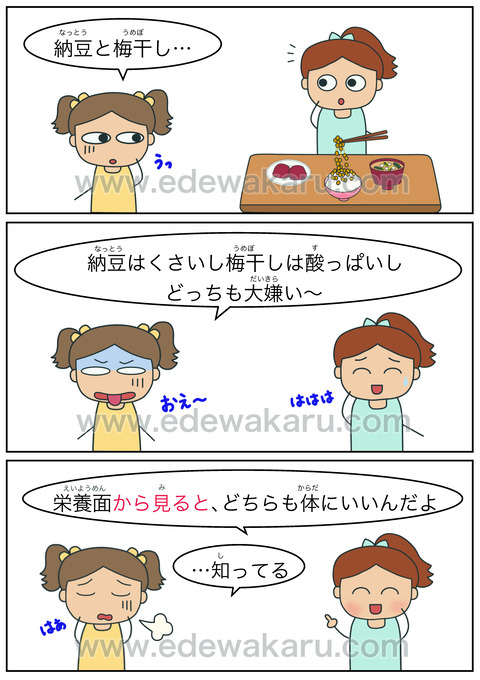
From a nutritional point of view, it’s really good for you.
= Judging from a nutritional point of view, it’s really good for you.
Be sure to review patterns similar to “〜から見ると・〜から見れば” and patterns that use “から” 😊
[“から” series]
[Similar patterns]
In context 5 examples
A:納豆はくさいし梅干しは酸っぱいし、どっちも嫌い〜B:栄養面から見ると、どちらもすごく体にいいんだよ〜
→栄養面から判断すると、すごく体にいいんだよA: Natto smells and pickled plums are sour; I hate both~ B: From a nutritional point of view, they’re both really good for you~ → Judging from a nutritional point of view, they’re really good for you.
あの嬉しそうな様子から見ると、きっとN1に合格したのだろう
→あの嬉しそうな様子から判断すると、きっとN1に合格したのだろうJudging from how happy she looks, she must have passed N1. → Judging from how happy she looks, she must have passed N1.
日本人から見ると、靴をはいたまま家に入るなんて信じられないことだ
→日本人の立場から考えると、靴をはいたまま家に入るなんて信じられないことだFrom a Japanese person’s point of view, it’s unbelievable to enter a house with your shoes on. → Thinking from a Japanese person’s point of view, it’s unbelievable to enter a house with your shoes on.
この状態から見ると、泥棒は窓を割って部屋に入ったのだろう
→この状態から判断すると、泥棒は窓を割って部屋に入ったのだろうJudging from this situation, the thief probably broke the window and entered the room. → Judging from this situation, the thief probably broke the window and entered the room.
この症状から見ると、おそらくインフルエンザだと思います
→この症状から判断すると、おそらくインフルエンザだと思いますJudging from these symptoms, I think it’s probably the flu. → Judging from these symptoms, I think it’s probably the flu.
Read the original source text
Meaning
〜の立場から考えると〜だ
〜から判断すると
How to use it
名詞[辞書形]+から見ると
名詞[辞書形]+から見れば
Explanation
「Aから見ると」は「Aの立場から考えると〜」「Aから判断すると〜」という意味の文型です。「A」に[人]が入る時はその人から見た判断や推量を表します。「A」に[状況][状態]が入る場合は、その状況を基準にした判断を表します。「〜から見ると」は「〜から見れば」にチェンジすることができます。
[例]
栄養面
から見ると、すごく体にいいんだよ
=栄養面
から見れば、すごく体にいいんだよ
「〜から見ると・〜から見れば」に似ている文型と「から」がつく文型を復習しておきましょう😊
【「から」シリーズ】
【類似文型】
毎日のんびり日本語教師
How to use it
Noun + から見ると
Explanation
When it attaches to a word referring to a person, it expresses a judgment from that person's perspective.
When it attaches to a word referring to a situation or condition, it indicates the basis for the judgment stated in the following clause.
A similar pattern is 「【N3文法】~から言うと/から言えば/から言ったら/から言って」, but that pattern cannot attach to words referring to people.
Notes
Similar pattern: 「【N3文法】~から言うと/から言えば/から言ったら/から言って」
In context 8 examples
私から見ると彼は良い人には見えない。
From my perspective, he doesn't seem like a good person.
色んな角度から見ると、物事の見え方も変わる。
Looking at things from various angles changes how they appear.
絵心がない私から見れば、この絵は正に神の領域だ。
To someone like me with no artistic sense, this painting is truly on a divine level.
感染者数から見れば、スペイン風邪が人類史上最悪の感染症である。
Judging by the number of infections, the Spanish flu was the worst infectious disease in human history.
彼はいつもお金の点から見て物事を考えている。
He always thinks about things in terms of money.
私の職場では、誰の目から見ても明らかな不当人事が行われている。
At my workplace, unfair personnel decisions are being made that are obvious to everyone.
Aさんは男性にも人気があるけど、女性から見ても魅力的です。
A is popular with men, but women find A attractive too.
この作品の素晴らしさは素人から見ても分かる。
Even a layperson can see how wonderful this work is.
Read the original source text
How to use it
名詞+から見ると
Explanation
人物を表す語につくと、その人物から見た判断を表します。
状況や状態を表す語につくと、後件で述べられる判断の根拠となるものを表します。
似ている文型に「【N3文法】~から言うと/から言えば/から言ったら/から言って」がありますが、こちらは人物を表す語には接続出来ません。
Notes
似ている文型「【N3文法】~から言うと/から言えば/から言ったら/から言って」