絵でわかる日本語
Meaning
Unable to hold back, naturally end up 〜ing
Unable to hold back, end up doing 〜
Cannot remain without doing 〜
How to use it
Verb [ない-form] + ないではいられない
Verb [ない-form] + ずにはいられない
Explanation
「〜ないではいられない」 is a sentence pattern meaning “unable to hold back, end up doing 〜” or “cannot remain without doing 〜.” It is used when you want to say that you cannot suppress the feeling of wanting to do something by your own effort, and so you naturally end up doing it. 😊 The person who is the subject “can’t hold back and ends up doing 〜,” so it is used with something that has feelings. In most cases, the subject is a person. 😮
[Examples]
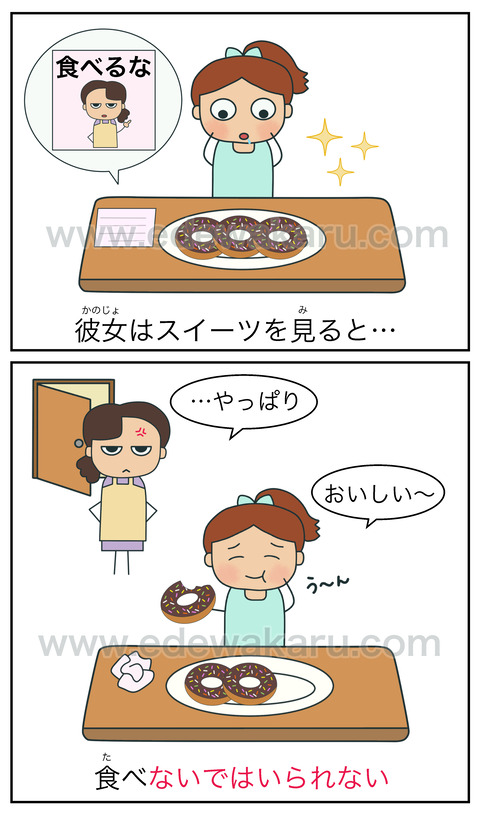
① When she sees sweets, she can’t help eating them.
[Subject]
She
② It was hot today, so I couldn’t help turning on the air conditioner.
[Subject]
I
③ His story was so funny that I couldn’t help laughing.
[Subject]
I
④ Our dog seems unable to help barking when someone comes over.
[Subject]
Our dog
* This can be used for dogs too, since they have feelings. 😊
(Review: 〜ために・〜ためか)
Also, the more literary form of 「〜ないではいられない」 is 「〜ずにはいられない」.
[Example]
When she sees sweets, she can’t help eating them.
= When she sees sweets, she can’t help eating them.
Learn 「〜ないではいられない」 and 「〜ずにはいられない」 together. 😉
In context 5 examples
彼女はスイーツを見ると、食べないではいられない
→彼女はスイーツを見ると、我慢できず食べてしまう(復習:「スイーツ」と「デザート」)When she sees sweets, she can’t help eating them. → When she sees sweets, she can’t hold back and ends up eating them. (Review: “sweets” and “dessert”)
今日は暑かったので、エアコンをつけないではいられなかった
→今日は暑かったので、我慢できずにエアコンをつけてしまった(復習:エアコン)It was hot today, so I couldn’t help turning on the air conditioner. → It was hot today, so I couldn’t hold back and ended up turning on the air conditioner. (Review: air conditioner)
彼の話はおもしろくて、笑わないではいられなかったよ
→彼の話はおもしろくて、我慢できずに笑ってしまったよHis story was so funny that I couldn’t help laughing. → His story was so funny that I couldn’t hold back from laughing.
あの本を読んだら、泣かないではいられない
→あの本を読んだら、泣かないでいることはできないAfter reading that book, you can’t help crying. → After reading that book, you can’t remain without crying.
「口が軽い人」とは、何でも人に話さないではいられない人のことです
→「口が軽い人」とは、我慢できずに何でも人に話してしまう人のことです(復習:〜とは(定義・説明))(復習:口が軽い)A “loose-lipped person” is someone who can’t help telling others everything. → A “loose-lipped person” is someone who can’t hold back and ends up telling others everything. (Review: 〜とは (definition/explanation); 口が軽い)
Read the original source text
Meaning
我慢できず、自然に〜になってしまう
我慢できなくて、〜してしまう
〜しないでいることはできない
How to use it
動詞[ない形]+ないではいられない
動詞[ない形]+ずにはいられない
Explanation
「〜ないではいられない」は「我慢できずに〜してしまう」「〜しないでいることはできない」という意味を表す文型です。
「〜したい」という気持ちを自分の力では抑えることができなくて、自然に〜してしまう
と言いたい時に使います😊 主語になる人が「我慢できずに〜してしまう」という意味ですので、感情を持つものが使われます。
ほとんどの場合、主語には「人」がきます😮
[例]
①彼女はスイーツを見ると、食べ
ないではいられない
【主語】
彼女
②今日は暑かったので、エアコンをつけ
ないではいられなかった
【主語】
私
③彼の話はおもしろくて、笑わ
ないではいられなかった
よ
【主語】
私
④うちの犬は、人が来ると吠え
ないではいられない
ようだ
【主語】
うちの犬
*犬にも感情があるため、使うことができます😊
(復習:〜ために・〜ためか)
また
「〜ないではいられない」の書き言葉的な言い方は「〜ずにはいられない」です。
[例]
彼女はスイーツを見ると、食べ
ないではいられない
=彼女はスイーツを見ると、食べ
ずにはいられない
「〜ないではいられない」「〜ずにはいられない」は一緒に覚えておきましょう😉