AIUEO JLPT Grammar
Meaning
This sentence pattern expresses feelings of relief, satisfaction, or gratitude after something has happened or not happened.
How to use it
Verb て-form + よかった; verb ない-form + なくて + よかった
In context 5 examples
この映画を見てよかった。とても感動した。
I’m glad I watched this movie. It was really moving.
彼に相談してよかったです。
I'm glad I consulted him.
傘を持って行ってよかった。突然の雨に降られずに済んだ。
I’m glad I took my umbrella. I didn’t get caught in the sudden rain.
事故に巻き込まれなくてよかったです。
I'm glad I wasn't involved in an accident.
携帯を家に忘れなくてよかった。仕事の連絡が来ていた。
I’m glad I didn’t forget my phone at home. I received an important work message.
Read the original source text
Meaning
This sentence pattern expresses feelings of relief, satisfaction, or gratitude after something has happened or not happened.
How to use it
動詞て形+よかった動詞ない形+なくて+よかった
Explanation · 日本語
この文型は、ある出来事や行動が起きたことや起きなかったことに対して安心したり、満足したり、感謝したりする気持ちを表します。
Bunpro Grammar Reference
Meaning
I'm glad that
How to use it
Verb[て]+ よかった
[い]Adjective[て] + よかった
[な]Adjective + で + よかった
Noun + で + よかった
Verb[なくて](*) + よかった
Verb[ないで](**) + よかった
[い]Adjective[なくて] + よかった
[な]Adjective+でなくて + で + よかった
Noun+でなくて + よかった
(*) Mostly found in literary/written language
(**) Mostly found in spoken language
Verb[て]+ よかった + です
[い]Adjective[て] + よかった + です
[な]Adjective + で + よかった + です
Noun + で + よかった + です
Verb[なくて](*) + よかった + です
Verb[ないで](**) + よかった + です
[い]Adjective[なくて] + よかった + です
[な]Adjective+でなくて + で + よかった + です
Noun+でなくて + よかった + です
(*) Mostly found in literary/written language
(**) Mostly found in spoken language
Nuance
A phrase that often expresses the speaker's relief or gratitude that (A) either did, or did not happen.
Explanation
When て (or で when following ない) is paired with the past form of the い-Adjective, いい; てよかった, なくてよかった, or ないでよかった will have the meaning of 'I'm glad that (A)' (when positive), or 'I'm glad that I didn't (A)' (when negative).
やっぱり今日来てよかったね。
Actually, I'm glad that we came today, don't you think?
あの携帯を買わなくて良かった。
I'm glad that I didn't buy that cellphone.
あの時にお前と別れないで良かった。
I'm glad that we didn't break up that one time.
The primary difference between なくてよかった and ないでよかった in this expression, is that ないでよかった will be used far more frequently in casual speech. Comparatively, なくてよかった tends to be reserved for books, and may even be considered old-fashioned by some people.
先輩、今日の会議で余計なことを言わなくて良かったですね。
Senpai, aren't you glad that you didn't say anything more at the meeting today? (A bit more formal, focuses on expressing reasons or results)
行った人皆が風邪引いたの?昨日のパーティーへ行かないでよかった!
Everyone that went caught a cold? I'm glad that I didn't go to last night's party! (A bit more casual, focus more on 'not doing' something)
In context 17 examples
- ダイエットを諦めなくてよかった。
I'm glad that I didn't give up on my diet.
- やっぱり今日来てよかったね。
Actually, I'm glad that we came today, don't you think?
- あの携帯を買わなくて良かった。
I'm glad that I didn't buy that cellphone.
- あの時にお前と別れないで良かった。
I'm glad that we didn't break up that one time.
- 先輩、今日の会議で余計なことを言わなくて良かったですね。
Senpai, aren't you glad that you didn't say anything more at the meeting today? (A bit more formal, focuses on expressing reasons or results)
- 行った人皆が風邪引いたの?昨日のパーティーへ行かないでよかった!
Everyone that went caught a cold? I'm glad that I didn't go to last night's party! (A bit more casual, focus more on 'not doing' something)
- このレストランにまた来てよかった。
I'm glad that we came to this restaurant again.
- 勉強をしてよかったです。
I am glad that I studied.
- 今日はデザートを食べなくてよかったです。
I am glad that I didn't eat dessert today.
- このバスに間に合ってよかったです。
I am glad that I made it in time for this bus.
- 今日運動してよかった。
I'm glad that I did exercise today.
- 今日、テストのことを忘れなくてよかった。
I'm glad that I didn't forget about today's test.
- 要らないと思っていたけど、持ってきてよかった。
I didn't think that I needed it, but I'm glad that I brought it.
- スーパーが閉まる前にお砂糖がないって言ってよかった。
I'm glad that I said that we didn't have sugar before the supermarket closed.
- こけた時、ヘルメットを被ってよかったと思った。
When I fell, I thought I'm glad that I wore a helmet.
- 寒いから暖かい服を着てよかった。
It's cold, so I'm glad that I wore warm clothes.
- おばあちゃんが亡くなる前にもう一度会えてよかった。
I'm glad that I was able to see my grandmother once more before she died.
絵でわかる日本語
Meaning
It was a good thing that ~ was done
It was a good thing that ~ was the case
It was lucky that ~ was the case
It was the right thing to do ~
How to use it
Verb [て-form] + よかった
Explanation
“〜てよかった” is a sentence pattern meaning “It was a good thing that ~ was done” or “It was lucky that ~ was the case,” and it expresses a positive evaluation. “よかった” is the [た-form] of “よい,” but this pattern expresses how one feels now.
😮The polite form is “〜てよかったです.”
[Example]
I’m glad it’s sunny today.
“〜てよかった” is taught at the beginner level, but it is a very important pattern that is used frequently. There are several patterns in the “よかった” series, so do your best to distinguish them and use them correctly 😊
In context 4 examples
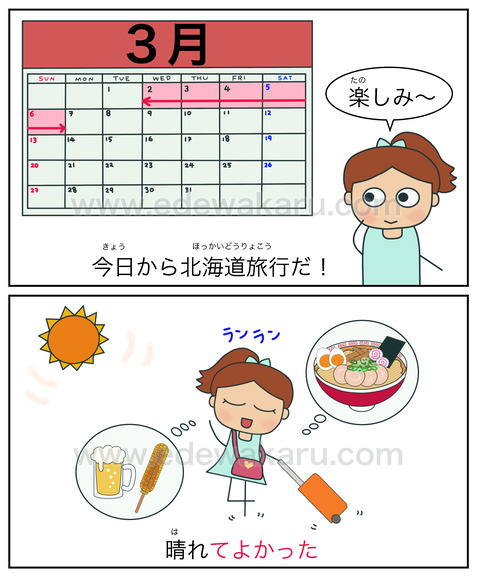
今日から北海道旅行(ほっかいどうりょこう)だ!晴れてよかった
→今日から北海道旅行だ!晴れているのはラッキーだI’m going on a trip to Hokkaido from today! I’m glad it’s sunny. → I’m going on a trip to Hokkaido from today! It’s lucky that the weather is sunny.
雨が降ってきた!傘を持ってきてよかった〜
→雨が降ってきた!傘を持ってきたのは正解だった〜(復習:〜てくる(発生・開始))It’s started raining! I’m glad I brought an umbrella~ → It’s started raining! Bringing an umbrella was the right call~ (Review: 〜てくる (occurrence/beginning))
A:N1に合格してよかったねB:うん、がんばって勉強してきてよかった
→N1に合格したのはすばらしいことだねうん、がんばって勉強してきたのは間違いではなかった(復習:〜ていく(継続))A: I’m glad you passed N1. B: Yeah, I’m glad I kept working hard at my studies. → It’s wonderful that you passed N1. Yeah, it wasn’t a mistake to keep working hard at my studies. (Review: 〜ていく (continuation))
授業に間に合ってよかった
→授業に間に合ったのはラッキーだったI’m glad I made it to class on time. → It was lucky that I made it to class on time.
Read the original source text
Meaning
〜をしたことはいいことだった
〜だったことはいいことだった
〜だったのはラッキーだ
〜をしたことは間違いではなかった
〜をして正解だった
How to use it
動詞[て形]+よかった
Explanation
「〜てよかった」は「〜をしたことはいいことだった」「〜だったのはラッキーだった」という意味で、いい評価を表す文型です。「よかった」は「よい」の【た形】ですが、この文型は
今の気持を表します
😮丁寧形は
「〜てよかったです」
です。
[例]
今日は晴れ
てよかったです
「〜てよかった」は初級で勉強しますが、とてもよく使われる大切な文型です。「よかった」シリーズはいくつかありますので、しっかりと区別をして使えるようにがんばってください😊
毎日のんびり日本語教師
How to use it
Verb te-form + よかった
Verb nai-form + なくてよかった
Noun / な-adjective stem + でよかった
Noun / な-adjective stem + ではなくてよかった / じゃなくてよかった
い-adjective stem + くてよかった
い-adjective stem + くなくてよかった
Explanation
This grammar is used to evaluate something after it has ended.
Notes
Nothing in particular.
In context 8 examples
本当に良い釣り竿だ。買ってよかった。
It’s a really good fishing rod. I’m glad I bought it.
あなたに出会えてよかった。(能遇见你真是太好了。)
I’m glad I met you.
私、男の子じゃなくて本当に良かったと思う。(我觉得自己不是男孩真是太好了。)
I’m really glad I wasn’t a boy.
相談してよかった。いろんな悩みが解決した。(商量一下真是太好了。各种烦恼都解决了。)
I’m glad I talked it over. A lot of my worries were resolved.
怪我がなくてよかったです。
I’m glad there were no injuries.
晴れでよかった。今日は大事な日だから。
I’m glad it’s sunny, because today is an important day.
台風の被害がなくてよかったです。
I’m glad there was no damage from the typhoon.
かくれんぼがとても得意だ。体が小さくてよかったと思う。
I’m really good at hide-and-seek. I think I’m glad I’m small.
Read the original source text
How to use it
動て形+よかった
動ない形+なくてよかった
名詞/ナ形語幹+でよかった
名詞/ナ形語幹+ではなくてよかった/じゃなくてよかった
イ形語幹+くてよかった
イ形語幹+くなくてよかった
Explanation
物事が終わった後に、その物事に対する評価を行う文法です。
Notes
特になし