Bunpro Grammar Reference
Meaning
Things like, And so on, Or something, And whatnot
How to use it
A(1) + だの + B(1) + だの
A(1) + だの + 何だの
(1) Noun, quotation
Nuance
A strong, casual structure emphasizing similar things in a list that are often evaluated negatively. (A) and whatnot (B) and so on.
Explanation
Although originally a combination of the auxiliary verb だ, and the case-marking particle の, だの is considered to be a standalone adverbial particle in modern Japanese that is used in the same way as structures like など and とか in presenting examples. Due to this, it will often be translated as 'and things like (A)', or '(A) and whatnot'.
だの will only be used when at least two examples are given, with each of those examples being followed by だの. Usually, these two things are either opposites of each other, or two things that share the same negative trait.
だの may appear after verbs, い-Adjectives, nouns, or quotations.
彼は仕事はやめるだの家事を手伝わないだの、本当に自分以外のことは何も考えていない。
He does things such as quit work, and not help with chores and so on. He really does not think about anyone other than himself.
この建物は汚いだの危ないだのと近所の人に言われていたので解体されるらしい。
The neighbor has been saying that this building is dirty, dangerous and what not so apparently it is going to get demolished.
揚げ物だのコンビニ弁当だのばかり食べてると、また健康診断の時に先生に怒られるよ。
If you only eat things like fried food, convenience store food and what not, you are going to get told off by your doctor again at the next check-up.
妻は大嫌いだの嫌いだのと毎日言ってくるから悲しくなってきた。
My wife tells me that she hates me and dislikes me and what not everyday so I am starting to feel sad.
彼は「嫌」だの「大変」だの、何かをやる前から弱音を吐くから、一緒にいるとこっちまで仕事をしたくなくなる。
He only says things like 'No' and 'impossible' even before trying anything, so it even makes me not want to work.
Caution
In situations where the words that だの is attached to are opposites, it will be exhibiting a large range to which the same rule applies. However when the words are similar, it is usually expressing things within that specific category as being undesirable. Because of this, regardless of what the words are, the overall statement itself aims to emphasize the speaker's feelings of frustration or boredom in relation to things that fall under that category, or that scope.
そんなに好きだの嫌いだのと言うんだったら明日から自分でご飯作りな。
If you are going to say things like 'I like this', 'I don't like this', and things like that, why don't you start making your own food starting tomorrow? (Opposite ends of a spectrum)
あの新入社員はつらいだの面倒だのの理由で会社を入社して二週間でやめた。
That newbie said things like 'this is too much', and 'this is a pain' and gave a reason similar to that and ended up quitting after 2 weeks of working with us. (Both negative)
In context 19 examples
- ヒナは「臭い」だの「まずい」だのと文句ばかりを言っている。
Hina only complains that 'it smells' or 'it's awful' and so on.
- 彼は仕事はやめるだの家事を手伝わないだの、本当に自分以外のことは何も考えていない。
He does things such as quit work, and not help with chores and so on. He really does not think about anyone other than himself.
- 妻は大嫌いだの嫌いだのと毎日言ってくるから悲しくなってきた。
My wife tells me that she hates me and dislikes me and what not everyday so I am starting to feel sad.
- 揚げ物だのコンビニ弁当だのばかり食べてると、また健康診断の時に先生に怒られるよ。
If you only eat things like fried food, convenience store food and what not, you are going to get told off by your doctor again at the next check-up.
- この建物は汚いだの危ないだのと近所の人に言われていたので解体されるらしい。
The neighbor has been saying that this building is dirty, dangerous and what not so apparently it is going to get demolished.
- 彼は「嫌」だの「大変」だの、何かをやる前から弱音を吐くから、一緒にいるとこっちまで仕事をしたくなくなる。
He only says things like 'No' and 'impossible' even before trying anything, so it even makes me not want to work.
- ラーメンやカレーが嫌いな人:「ラーメンだのカレーだのが好きなやつは味のわからんやつだよ。」
A person that hates ramen and curry: 'People who like things like ramen, curry, and so on are people who don't understand what taste is.'
- 妹にいつもこれが欲しいだのそれが欲しいだのとうるさくせがまれて困る。
I'm annoyed because my persistent younger sister is always badgering me with things like 'I want this' or 'I want that' and so on.
- 彼はゲームに負けるといつも「回線が悪い」だの「敵がチート」だのと言い訳ばかり言う。
Every time he loses a game, he just gives excuses things like 'there's a bad connection' or 'the other players are cheating' and whatnot.
- 娘はお腹が痛いだの頭が痛いだのよく仮病を使うので、あまり信用出来ない。
Since my daughter often feigns illness with a sore stomach or a headache or whatnot, I cannot really trust her.
- 若い頃にタバコだの薬だのを経験したせいで、まだ三十なのに体はボロボロだ。
Due to experiencing things like smoking and drugs and so on when I was younger, despite only being 30, my body is battered.
- 結婚しろだの子供を産めだの叔母は今の時代に相応しくない助言をしてきます。
My auntie often comes with advice that is not appropriate for this generation, such as 'get married', and 'have kids' and whatnot.
- 唐揚げだの菓子パンだの毎日カロリーの高いものを食べているから太るんだよ…。
Because you eat high-calorie food like karaage and sweet pastries and so on every day, you're going to get fat, you know?
- 上司から覇気がないだの愛想が悪いだのと言われて、仕事に対するモチベーションが下がってしまった。
Being told 'you have no ambition', or 'you are unfriendly' and things like that by my boss, my motivation in relation to work has sunk.
- 父は勉強しろだのゲームのし過ぎだのうるさいので、最近は父となるべく顔を合わせないようにしている。
Since my dad is a nuisance with remarks like 'do study', and 'you game too much' and so on, I recently try to avoid him as much as possible.
- 彼はいつも責任を持つだの何だの戯言ばかり言ってるけど、責任を取る時に、真っ先に逃げるのは彼だ。
He always talks nonsense about 'being responsible' and so on, but when it comes time to take responsibility he is the first to run.
- 友達1は友達2に文句を言う:「私たちは最近会話だの何だのばかりしているけど、実際に新製品を開発する人はいないよ。」
Friend1 complains to friend2: 'Recently we are doing nothing but shooting the breeze (chatting) and whatnot, but there is no one that will actually develop a new product.'
- そんなに好きだの嫌いだのと言うんだったら明日から自分でご飯作りな。
If you are going to say things like 'I like this', 'I don't like this', and things like that, why don't you start making your own food starting tomorrow? (Opposite ends of a spectrum)
- あの新入社員はつらいだの面倒だのの理由で会社を入社して二週間でやめた。
That newbie said things like 'this is too much', and 'this is a pain' and gave a reason similar to that and ended up quitting after 2 weeks of working with us. (Both negative)
Read the original source text
Meaning
Things like, And so on, Or something, And whatnot
How to use it
A(1) + だの + B(1) + だの
A(1) + だの + 何だの
(1) Noun、Quotation
Nuance
A strong, casual structure emphasizing similar things in a list that are often evaluated negatively. (A) and whatnot (B) and so on.
Explanation
Although originally a combination of the auxiliary verb だ, and the case-marking particle の, だの is considered to be a standalone adverbial particle in modern Japanese that is used in the same way as structures like など and とか in presenting examples. Due to this, it will often be translated as 'and things like (A)', or '(A) and whatnot'.
だの will only be used when at least two examples are given, with each of those examples being followed by だの. Usually, these two things are either opposites of each other, or two things that share the same negative trait.
だの may appear after verbs, い-Adjectives, nouns, or quotations.
彼は仕事はやめるだの家事を手伝わないだの、本当に自分以外のことは何も考えていない。
He does things such as quit work, and not help with chores and so on. He really does not think about anyone other than himself.
この建物は汚いだの危ないだのと近所の人に言われていたので解体されるらしい。
The neighbor has been saying that this building is dirty, dangerous and what not so apparently it is going to get demolished.
揚げ物だのコンビニ弁当だのばかり食べてると、また健康診断の時に先生に怒られるよ。
If you only eat things like fried food, convenience store food and what not, you are going to get told off by your doctor again at the next check-up.
妻は大嫌いだの嫌いだのと毎日言ってくるから悲しくなってきた。
My wife tells me that she hates me and dislikes me and what not everyday so I am starting to feel sad.
彼は「嫌」だの「大変」だの、何かをやる前から弱音を吐くから、一緒にいるとこっちまで仕事をしたくなくなる。
He only says things like 'No' and 'impossible' even before trying anything, so it even makes me not want to work.
Caution
In situations where the words that だの is attached to are opposites, it will be exhibiting a large range to which the same rule applies. However when the words are similar, it is usually expressing things within that specific category as being undesirable. Because of this, regardless of what the words are, the overall statement itself aims to emphasize the speaker's feelings of frustration or boredom in relation to things that fall under that category, or that scope.
そんなに好きだの嫌いだのと言うんだったら明日から自分でご飯作りな。
If you are going to say things like 'I like this', 'I don't like this', and things like that, why don't you start making your own food starting tomorrow? (Opposite ends of a spectrum)
あの新入社員はつらいだの面倒だのの理由で会社を入社して二週間でやめた。
That newbie said things like 'this is too much', and 'this is a pain' and gave a reason similar to that and ended up quitting after 2 weeks of working with us. (Both negative)
Nuance · 日本語
消極的に評価されが同じリストにある似ている物をカジュアルに強調する表現。(A)やら、(B)やら。
Explanation · 日本語
「だの」は、助動詞「だ」と格助詞「の」の組み合せですが、現代では単独の副助詞として使われています。「など」や「とか」と同じように、例を挙げるときに使われ、「(A)のようなもの」や「(A)やそのほか」といった意味を表します。
「だの」は、少なくとも二つ以上の例があるときに使われ、それぞれの例の後に置かれます。「だの」を使って挙げられる例は、内容が対照的だったり、どちらも否定的だったりすることが多いです。
「だの」は、動詞、イ形容詞、名詞、または引用句の後に置かれます。
彼は仕事はやめるだの家事を手伝わないだの、本当に自分以外のことは何も考えていない。
He does things such as quit work, and not help with chores and so on. He really does not think about anyone other than himself.
この建物は汚いだの危ないだのと近所の人に言われていたので解体されるらしい。
The neighbor has been saying that this building is dirty, dangerous and what not so apparently it is going to get demolished.
揚げ物だのコンビニ弁当だのばかり食べてると、また健康診断の時に先生に怒られるよ。
If you only eat things like fried food, convenience store food and what not, you are going to get told off by your doctor again at the next check-up.
妻は大嫌いだの嫌いだのと毎日言ってくるから悲しくなってきた。
My wife tells me that she hates me and dislikes me and what not everyday so I am starting to feel sad.
彼は「嫌」だの「大変」だの、何かをやる前から弱音を吐くから、一緒にいるとこっちまで仕事をしたくなくなる。
He only says things like 'No' and 'impossible' even before trying anything, so it even makes me not want to work.
注意点
「だの」が対照的な例に使われるときは、その両方を含んだ広い範囲を示しています。一方で、似たような例に使われるときは、その範囲にある物事に対する否定的な気持ちを表していることが多いです。どちらの場合でも、「だの」は、そうしたことに対する話し手の苛立ちや不満、うんざりとした気持ちを強調するために使われます。
そんなに好きだの嫌いだのと言うんだったら明日から自分でご飯作りな。
If you are going to say things like 'I like this', 'I don't like this', and things like that, why don't you start making your own food starting tomorrow? (Opposite ends of a spectrum)
あの新入社員はつらいだの面倒だのの理由で会社を入社して二週間でやめた。
That newbie said things like 'this is too much', and 'this is a pain' and gave a reason similar to that and ended up quitting after 2 weeks of working with us. (Both negative)
DoJG 日本語文法辞典(全集)
Meaning
And (~ and); or (~ or); and things like that
How to use it
(i) Noun1 | だのNoun2だの(Noun3だの) | |
| そばだの、うどんだの、寿司だの | Soba and undon and sushi, and things like that |
(ii) {V/Adjectiveい}1 informal | だの{V/Adjectiveい}2 informalだの | |
| 疲れるだのお腹が空くだのと | Saying that someone gets tired or hungry, and things like that |
| 疲れただのお腹が空いただのと | Saying that someone got tired or hungry, and things like that |
| 暑いだの、雨が多いだのと | Saying that it is hot or it rains too much, and things like that |
| 暑かっただの、雨が多かっただのと | Saying that it was hot or it rained too much, and things like that |
(iii) {Adjective な stem/Noun}{∅/だった} | だの{Adjective な stem/Noun}{∅/だった}だのと | |
| 不健康{∅/だった}だの、非衛生的{∅/だった}だのと | Saying that something is/was unhealthy and unhygienic, and so on |
| バカ者{∅/だった}だの、腑抜け{∅/だった}だのと | Saying that someone is/was a fool or and idiot, among other things |
Explanation
A conjunction that lists nouns/quotes inexhaustively.
In context 8 examples
庭にはすみれだのチューリップだのつつじだの、花がたくさん咲いていた。
In the garden, many flowers such as pansies, tulips, azaleas and others, were in bloom.
学生たちは食堂のご飯がまずいだの、授業がつまらないだのと、いつも不平を言っている。
The students are always complaining that the food at the cafeteria isn't good, or their classes are boring and so on.
僕はそばだの、うどんだの、ラーメンだのといった麺類が大好きだ。
I like noodles such as soba, udon and ramen.
今の高校生は携帯電話だのコンピュータゲームだのにはまっている。
High school students now are addicted to things like cell phones and computer games.
彼は僕が飲みに行こうかと誘っても、いつも頭が痛いだの、約束があるだのと言い訳をする。
Whenever I invite him to go out for a drink, he has an excuse: he's got a headache or another appointment or something.
彼女は仕事が好きだから結婚しても仕事を続けるだの、家庭生活と職業を両立できるだのと主張していた。
She used to claim that she would keep working after she got married because she liked her work and could manage both family life and her career.
彼女は自分がテニスが上手だの、ピアノがうまいだのと自慢ばかりしている。
She's always boasting that she's good at tennis and (also good at) piano, and things like that.
受験生たちは塾だのテストだのと忙しい毎日を送っている。
Students preparing for the examination are spending busy days stuffed with cram school and tests.
絵でわかる日本語
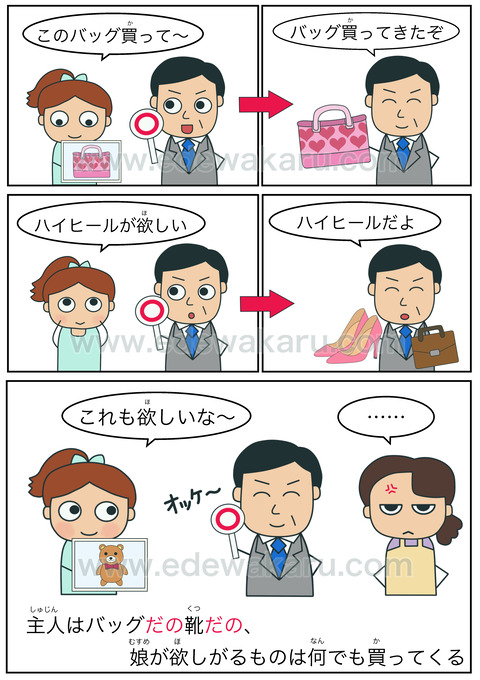
Meaning
〜and 〜, and so on
How to use it
Verb, adjective, or noun [plain form] + だの + verb, adjective, or noun [plain form] + だの
Explanation
“〜だの〜だの” is a pattern meaning “〜 and 〜, and so on” or “〜, 〜, and various other things.” There are several patterns used to give examples, but “〜だの〜だの” conveys the speaker’s [criticism] or [dissatisfaction], among other things. It is often used to say “all this fuss about 〜 and 〜” or “〜 and 〜 are such a nuisance.”
[Examples]
① My husband buys our daughter whatever she wants, bags
だの
shoes
だの…
→He buys her everything, bags and shoes and so on, which is frustrating.
[Criticism and dissatisfaction]
② You’re gaining weight because you eat nothing but sweets like cake
だの
cookies
だの.
→You’re gaining weight because you eat nothing but sweets like cake and cookies.
[Criticism]
③ Mom is always nagging—“study”
だの
“go to bed early”
だの. She’s so annoying.
→She keeps saying “study” and “go to bed early,” and she’s so annoying.
[Dissatisfaction]
④ He does nothing but complain that his salary is low
だの
that work is too busy
だの.
→He does nothing but complain that his salary is low or that work is too busy.
[Criticism]
⑤ She often skips class, saying her stomach hurts
だの, that she caught a cold
だの.
→She often skips class, saying her stomach hurts or that she caught a cold.
[Criticism]
[For those with time to spare]
There is also the set expression “〜だのなんだの,” so let’s learn it too.
[Example]
Mom is always nagging—“study”
だのなんだの. She’s so annoying.
“〜だの〜だの” is often used in spoken language. There are several similar patterns, so let’s review them 😉
[Similar patterns]
In context 5 examples
主人はバッグだの靴だの、娘が欲しがるものは何でも買ってくる…
My husband buys our daughter whatever she wants—bags, shoes, and so on…
ケーキだのクッキーだの甘いものばかり食べているから太るんだよ〜
You’re gaining weight because you eat nothing but sweets like cake and cookies.
お母さんは勉強しろだの早く寝ろだの、本当にうるさい
Mom is always nagging—telling me to study, to go to bed early, and so on. She’s so annoying.
彼は給料が安いだの仕事が忙しすぎるだの、文句ばかり言っている
He does nothing but complain that his salary is low, that work is too busy, and so on.
彼女はお腹が痛いだの、かぜをひいただの、よく授業をサボる
She often skips class, saying her stomach hurts or that she caught a cold.
Read the original source text
Meaning
〜や〜など
How to use it
動詞・形容詞・名詞[普通形]+だの+動詞・形容詞・名詞[普通形]+だの
Explanation
「〜だの〜だの」は「〜や〜など」「〜は〜など、他にもいろいろ」という意味の文型です。例を挙げる文型はいくつかありますが、「〜だの〜だの」は話し手の[非難する気持ち]や[不満]などを表します。「〜や〜など、いろいろうるさい」「〜や〜など、本当に困る」と言いたい時によく使われます。
[例]
①主人はバッグ
だの
靴
だの、娘が欲しがるものは何でも買ってくる…
→バックや靴など、何でも買ってくるので困る
【非難する気持ち・不満】
②ケーキ
だの
クッキー
だの
甘いものばかり食べているから太るんだよ〜
→ケーキやクッキーなど、甘いものばかり食べているから太るんだよ
【非難する気持ち】
③お母さんは勉強しろ
だの
早く寝ろ
だの、本当にうるさい
→勉強しろと言ったり、早く寝ろと言ったり、本当にうるさい
【不満】
④彼は給料が安い
だの
仕事が忙しすぎる
だの、文句ばかり言っている
→給料が安いとか、仕事が忙しすぎるとか、文句ばかり言っている
【非難する気持ち】
⑤彼女はお腹が痛い
だの、かぜをひいた
だの、よく授業をサボる
→お腹が痛いと言ったり、かぜをひいたと言ったりして、よく授業をサボる
【非難する気持ち】
【余裕があるひとへ】
「〜だの〜だの」には「〜だのなんだの」という慣用的表現(かんようてきひょうげん)がありますので、一緒に覚えておきましょう。
[例]
お母さんは勉強しろ
だのなんだの、本当にうるさい
「〜だの〜だの」は、話し言葉としてよく使われます。似ている文型がいくつかありますので、復習しておきましょう😉
【類似文型】
日本語文型辞典
Meaning
Basic information
N / Na だの N / Na だの
A / V だの A / V だの
Explanation
Like やら or とか, this is a way of listing several things, but it is also often used with a negative attitude toward the things being said, as in ④ and ⑤, where the speaker means “they keep saying all sorts of things and it’s annoying.” There is also the set expression …だのなんだの, as in ⑤.
Examples
① When she went to the market, she bought so much meat, vegetables, and the like that she could hardly carry it all.
② The reunion brought together familiar faces we hadn’t seen in 20 years, such as Nakamura and Ikeda.
③ All sorts of things were collected for the charity bazaar, such as clothes donated by celebrities and books with their autographs.
④ He complains a lot, saying things like his salary is low and he doesn’t get enough days off.
⑤ Whenever I see him, he talks about quitting his company to study abroad and other such impossible things.
Read the original source text
Meaning
基本情報N/Na だの N/Na だのA/V だの A/V だの説明「やら」「とか」のようにいくつかのものをあげる言い方だが、④⑤のように発言の内容を「いろいろ言ってうるさい」と否定的にとらえて使うことも多い。また⑤のように「…だのなんだの」という慣用的な表現もある。例文① 彼女は市場に出かけると、肉だの野菜だの持ちきれないほど買ってきた。② 同窓会には中村だの池田だの、20年ぶりのなつかしい顔がそろった。③ チャリティーバザーには有名人の服だのサイン入りの本だのいろいろなものが集まった。④ 彼は、やれ給料が安いだの休みが少ないだのと文句が多い。⑤ 彼はいつ会っても会社をやめて留学するだのなんだのと実現不可能なことばかり言っている。
日本語文型辞典 英語版
Meaning
【だの】[N/Na だの N/Na だの][A/V だの A/V だの]
Like やら and とか, this is a way of listing several items, but as seen in
(4)
and
(5)
, it is often used to indicate a negative evaluation of something another person has said. Means “it’s annoying because he says a lot of things like that.” The expression ...だのなんだの, as in
(5)
, is idiomatic.
In context 5 examples
彼女は市場に出かけると、肉だの野菜だの持ちきれないほど買ってきた。
When she went to the market, she bought such a great quantity of meat and vegetables and whatnot that she could hardly carry it all back.
同窓会には中村だの池田だの20 年ぶりのなつかしい顔がそろった。
Many old familiar faces from twenty years ago, such as Nakamura and Ikeda, appeared together at the reunion.
チャリティーバザーには有名人の服だのサイン入りの本だのいろいろなものが集まった。
Lots of things were collected for the charity bazaar, including a celebrity’s clothing, a signed book, and so forth.
彼は、やれ給料が安いだの休みが少ないだのと文句が多い。
He complains a lot about how low his salary is, how little vacation time he gets, and so on and so forth.
彼はいつ会っても会社をやめて留学するだのなんだのと実現不可能なことばかり言っている。
Whenever I see him, all he talks about are things he will never accomplish, like quitting his job and going abroad to study.
IMABI
だか & だの
Read this IMABI lesson ↗Explanation
だか & だの
In our discussion on だ ellipsis, we learned a little bit about how だ behaves in metalinguistic fashion in the expressions ~だか~だか, ~だの~だの, and to a lesser degree, ~だとか~だとか when juxtaposing factors.
1. 雨だか晴れだか、はっきりしない一日。
Today’s a day with the weather up in the air—rainy or sunny, who knows.
2. 最近、教師の質が悪いだの厳選だの意見が聞こえて来ますが、もうそんな贅沢なこと余裕言ってられなくなってるんじゃないですか。
I’ve come to hear all these opinions about “poor-quality teachers,” talk of “carefully selecting (teachers),” and what not, but we already don’t have the leeway to just be talking about such luxuries, no?
3. 市場づくりというのは、いろいろな合併だとか、なんだとか、それは政策先行でできるんだと思うのですね。
Market development, I believe, can be achieved through policy initiatives such as various merges or what have you.
We also touched on how the copula だ and the question marker か can coexist in sentence-medial position, granted with limitations.
4. それはどうだか、やってみなくてはわからない。
You won’t know until you try it.
This lesson will largely revolve around the innerworkings of ~だか while also investigating how ~だの as well as ~だとか function in a parallel particle capacity.
~だか~だか
The existence of ~だか may come as a huge surprise to even the most advanced learners, and this is with good reason. From the perspective of a learner, exposure to it without proper instruction could lead to glaring mistakes such as Ex. 5a.
5a. 今日は買い物だか何だかしようと思ったのに、何もできなかった。X
5b. 今日は買い物か何かしようと思ったのに、何もできなかった。〇
Intended: Even though I was thinking about shopping or what not today, I wasn’t able to do anything.
What だ adds to the picture is an extra layer of syntax1 that か alone does not, that being that the nouns involved are predicates and not just nouns. Thanks to this property, as we learned very briefly in our discussion on だ ellipsis, when ~だか does function as a parallel particle, this functionality endows it with metalinguistic properties, which allows for sentences such as:
6. [行く]だか[行かない]だか、はっきりしろよ。〇2
You’re going then you’re not going—be clear; which is it?!
Given how Ex. 5a is ungrammatical, it may seem bizarre that Ex. 6 would be grammatical, but it is this metalinguistic approach that makes this sentence possible, representing the predicates involved as individual conceptualizations.
Admittedly, contexts in which ~だか directly attaches to verbal predicates are rare, with many speakers recognizing it as being dialectal.
7. [台風が来る]だか[来ない]だかで、空模様も安定しない。
The sky can’t seem to make up its mind—is the typhoon going to come or not?
With other predicate types, however, ~だか is used quite often, but its exact applications are quite varied, some of which are nearly as dialectal as Ex. 6. Even so, how ~だか functions in respect to modality provides crucial insight into its individual parts.
Modality: “Uncertainty” Means?
Coming at ~だか from a semantic angle, we find that it fits in a continuum of modality on the grounds of uncertainty3. This is a hallmark of placing the affirmation behind だ into question.
To better understand ~だか, we will start with the most nuanced utilization first: when it is combined with ~のだ to produce “~(な)のだか. This will help us tackle how modality works, as it is important to understand that “modality” comes about in as many ways as it is possible to process the world around us. That being said, we will need to keep the following modal dynamics in mind.
Assertive/Declarative Modality: Pertains to the truth/falseness of a statement.
Interrogative Modality (Uncertainty): Questioning an assertion/declaration.
Situation-Oriented Modality (のだ): Grasping the situation at hand as pertinent in the greater context, whether that context has been established prior or the speaker is recognizing said connection in real time.
Interpersonal Modality (のだ): Presenting the situation at hand as pertinent in the greater context to a listener, whether that context has been established prior the speaker is recognizing said connection in real time and feels that the listener ought to know.
We will first tackle these structures within two environments: when only Situation A is present and when two(+) situations are present.
A + ~(な)のだか
Whereas ~のか is not restricted to sentence-medial position, ~のだか very much is restricted to sentence-medial position, even if it does not immediately look like it.
8. 何言ってるんだか。
What the heck are you saying, (because whatever it is you’re trying to say, I can’t figure it out).
In situations in which it appears ~のだか, or ~だか for that matter, is in sentence-final position, ellipsis of the predicate that would otherwise follow—typically on the lines of 知らない・分からない—is undoubtedly to blame. In Exs. 9-10, we see sentences in which such predicates do occur. Then, there are many instances in which ~んだか ends a dependent clause with an implicit “don’t know” built in like in Exs. 12-14.
9. 何のために東京へ出て来たんだか分かりゃしない。
I have not the slightest idea why it is that you’ve come out to Tokyo.
10. でも、どうして米子さんが殺されたのだか分からないわ。あんた、知ってるでしょ?
But, I just don’t understand why Yoneko-san was killed. You know, though, right?
From 『けものみち』by 松本清張.
As indicated by the chart above, ~のだか denotes downright dismissal of Situation A. This “downright dismissal,” though, is also nuanced, as we are dealing with the mood marker ~のだ. That being said, the purpose for why exactly のだ is used will be contextually dependent. Given that ~のだか pertains to uncertainty on the part of the speaker, however, we can largely narrow our focus to the situation-oriented mood marker ~のだ. When the interpersonal mood ~のだ is at play, though, we get sentences like Ex. 11 which pushes the speaker’s downright dismissal onto the listener as a given.
11. どこの人が作ったのだか知れないものを買うやつはいない。
No one is going to buy something if they don’t know who the heck made it.
Now, as for the situation-oriented mood marker ~のだ, it is used to verbalize a recognition on the part of the speaker that the situation at hand ties to some context at large, placing か after it puts all that reasoning into question, and it is that connection which the speaker is downright dismissing. However, this is not necessarily the same as denying that the state/action of Situation A is taking place. It still “could be,” but the speaker is unconvinced to the highest degree.
12. [セールでもしてる]んだか、すごく混んでるな、この店。どうしたんだろう。
This store sure is packed. They couldn’t be having a sale, could they? I wonder what’s going on in there.
In this example, the speaker highly doubts that a sale of some sort is the cause for the store being crowded. Even if there were a sale, it is clear from [どうしたんだろう] that they are very perplexed as to what is going on. Perhaps the store is never packed, maybe there has been a disturbance. Whatever the case may be, they are 100% doubtful that [セールでもしてる] is why.
13. あの子、[おいしい]んだか、よく食べるね、今日は。[腹が減ってるだけな]のかな。
That kid is really eating well today. The food can’t be that good. Maybe they’re just really hungry.
In this example, we get to see what the speaker thinks is more likely the case—[腹が減ってるだけな]—after refuting that the food being [おいしい] is why the kid is sure eating a lot.
14. あいつが犯人だっておっしゃるんですか。[あいつが犯人な]んだか、状況証拠だけじゃ、何とも言えないじゃありませんか。
You’re saying that he‘s the culprit? I mean, you can’t really say anything, that he‘s the culprit (or what have you), based on circumstantial evidence alone.
In this example, the speaker is wholly unconvinced that the person in question is the question, but moreover, stating that at that point in time really amounts to nothing but conjecture.
In the case of nominal predicates, it so happens that ~だか is notably more common than ~なのだか, and this is due to the burden of presenting modality being notably higher. Nominal predicates pertain to “X is Y,” and with the mood marker のだ, the significance of “X is Y” is added to the truth statement behind “X is Y.” If relating Situation A to a greater context is not necessarily intended, or if there is any wavering on the part of the speaker as to what could be the case, then we would need to reevaluate the nature of the uncertainty at hand.
15. あいつが犯人{だか 〇・なんだか X}、このごろ様子が変だよ。
Whether {∅/because} he’s the culprit, (I don’t know), but he’s been strange as of late.
In this context, the wording of the independent clause makes it apparent that the they are still in disbelief that [あいつ] could be the criminal, but the doubt is beginning to creep in. Note that the opposite of this is NOT the case.
16. あいつが犯人{か・なのか}、このごろ様子がちょっと変だな。
Perhaps {∅/because} he’s the culprit, (I don’t know), he’s been a little strange as of late.
In this case, we see that ~か and ~なのか are both possible, but with ~なのか, not only is the speaker significantly more unsure, but the presence of mood のだ directly ties [あいつが犯人] to [このごろ様子がちょっと変だな].
A + ~(な)のだか + B + ~(な)のだか(+ N…)
As evident from the previous chart, when more than one predicate is juxtaposed with ~のだか, the absolute uncertainty of the speaker pertains to the decisiveness of the agent, which is nonexistent. For the majority of the time, the predicates enumerated, usually two though not exclusively so, are opposites of each.
17. 行くんだか、行かないんだか、はっきりしないんだよ。
(They) aren’t clear one bit as to whether they are going to go or not going to go!
Or, one may see 何 stand for Situation B, in which case, the copula embedded in ~のだか is substituting for whatever predicate type would otherwise fill that slot.
18. 有名なんだか、何なのか知らないけど、一体何なんだよ、あの偉そうな態度は?
Whether because (he)’s famous or what have you, I don’t know, but what’s with that arrogant attitude of his?
While most instances of ~(な)のだか~(な)のだか outwardly express the speaker’s frustration at the agent, it is possible to see the statement thrown back at the agent to make a decision in rant-like fashion.
19a. 行くんだか、行かないんだか、はっきりしろよ、もう。
19b. 行くだか行かないだか、はっきりしろよ、もう。
19a. Are you going, or are you not going—which is it, seriously?!
19b. You going or not? Make up your mind, ugh…
Ex. 19a and Ex. 19b are almost identical to each other, but the implications in the moment are, in fact, different.
~んだか indicates that the speaker has zero faith in the agent making a decision, and as for the nature of the mood marker ~のだ, we are still looking at its situation-oriented iteration, at least in Ex. 19, as the speaker is complaining out loud as opposed to directing the agent to make a choice. After all, the speaker has already lost hope that the choices are even legit.
Meanwhile, ~だか implies that the speaker is largely unconvinced that the agent knows what they are going to do. By portraying the agent’s inability to make a choice in such a flippant light, this is a key factor as to what triggers the underlining metalinguistic approach to stating the predicates involved – allowing だ to fill the predicate slot in the dependent clauses present, thus able to follow verbal predicates directly. This syntactic difference also provides insight into how the supposed choices become verbalized thought bubbles by the speaker, amid a sea of doubt no less. Admittedly, examples of ~だか following verbal predicates directly are rare but not impossible.
This time, let’s look at a scenario involving the interpersonal mood ~のだ. Combined with the か, the speaker is demanding that the listener present what is what. Now, as to what exactly that even means, context is everything. Let’s say, though, that for the sake of argument, we only have “is it this or is it that” as our context.
20a. これなんだかあれなんだか、どっちなんだ、早く決めろ!
20b. これだかあれだか、どっちなんだ、早く決めろ!
20c. これなのか、あれなのか、どっちなんだ、早く決めろ!
20d. これかあれか、どっちなんだ、早く決めろ!
20a. Is it this or is it that, c’mon, seriously, which is it?! Decide already!
20b. Is it this or that, huh, which is it?! Decide already!
20c. Is it this or that, which is it?! Decide already.
20d. This or that, which is it?! Decide already.
While that is how Ex. 20a-d would all translate to, let’s step back and think of how these diction options differ from each other. In doing so, we will be directly referring to P (previous context) and Q (situation at hand), which you may recall from our study of the mood marker のだ.
Starting with Ex. 20d., A and B are conjoined with か. Here, there is no uncertainty implied between the two. As such, modality is restricted to [どっちなんだ], in which case whatever Y in “X is Y” ends up being, that is a defining choice to be made for the scenario at hand.
As for Ex. 20c., let’s say that the pivotal role of said choice between X and Y is already known, and with that previous context (P) at the forefront of both the speaker’s mind and, presumably, the listener’s mind, the choice between [これ] and [あれ] truly does feel like a coin toss, one that the speaker really wants the agent=listener to make.
As for Ex. 20b., we strip the sentence of the modality behind [これ] and [あれ], but we know that the presence of だか indicates very high uncertainty. That uncertainty, then, must be directed toward [これ] and [あれ] even being what X and Y are. Thus, on a syntactic level, it is closer to d., with the core difference being that the speaker sounds far more frustrated that the agent has little clue as to which way is up. This is ultimately rooted in how the speaker is choosing to raise these factors as scenarios=predicates as opposed to a choice between two things.
Last but not least, Ex. 20a. expresses zero confidence on the part of the speaker that the agent=listener knows which way is up; nonetheless, that defining of the previous context (P) is still pivotal to their situation. Even so, while A and B are being mentioned, they have already been ruled out by the speaker as being Q (the situation pertaining to P). In this light, we see how d. is closer in meaning and function to c., with the difference being the sheer lack of faith that the agent is going to bring about a resolution.
21. 美談なんだかどうだか、変な噺なんだ。
Whether this is supposed to be some moving tale or what have you, (I don’t know), but it’s a strange tale at that.
In this example, we see how the ~なんだか indicates zero faith on the part of the speaker that the 噺 is of 美談 quality, but then Situation B that could possibly describe it is rendered as どう as a placeholder of sorts.
~だか(わからない・知らない)
The defining difference between ~だか and ~か is that ~だか is used with predicates, situations which the speaker is already more or less refuting as being the case, whereas ~か merely states option(s). The “s” in parentheses is of great significance. Consider the following.
22. 持ち主が誰{だか・か}知らない。
I don’t know who the owner is.
23a. 持ち主が田中さん{だか X・か △・かどうか 〇}知らない。
23b. 持ち主が田中さんだかどうか知らない。
23a. I don’t know whether or not Tanaka-san is the owner.
23b. It don’t know whether or not it’s the case that Tanaka-san is the owner.
Let’s suppose that Ex. 22 is a typical example of an embedded question clause. Back in our discussion of だ ellipsis, we learned that だか is valid provided that an interrogative pronoun is present in the sentence. Now, provided that that is true, it would seem as though we need to reevaluate that claim given the validity of sentences like Ex. 15. from earlier.
15. あいつが犯人{だか 〇・なんだか X}、このごろ様子が変だよ。
Whether {∅/because} he’s the culprit, (I don’t know), but he’s been strange as of late.
Even though only Situation A is mentioned, the high uncertainty that it is even a thing necessitates that the speaker is contemplating other situation(s) that would bring clarity but canceling them out as not being good enough. In this light, the context behind the speaker uttering Ex. 19 is fundamentally different than for Ex. 21, which only pertains to one factor, the owner of the thing in question.
We can then use this insight to understanding other similar instances of ~だか from earlier, too, like how ~かどうか and ~だかどうか differ.
23a. 持ち主が田中さん{だか X・か △・かどうか 〇}知らない。
23b. 持ち主が田中さんだかどうか知らない。
23a. I don’t know whether or not Tanaka-san is the owner.
23b. It don’t know whether or not it’s the case that Tanaka-san is the owner.
~かどうか states the unknown as being whether the owner is “Tanaka-san or not,” whereas ~だかどうか states the unknown as being [持ち主が田中さん], throwing the whole situation up in the air and weighing it against just as unlikely scenario(s) via どう, albeit as a placeholder for said scenario(s) as we have seen.
Singular instances of ~だか without an interrogative pronoun necessitate an open-ended interpretation. With interrogative pronouns in the picture, the indefinite nature of the words themselves already establishes this.
疑問詞+~だか
Now, let’s look at more basic examples of ~だか with interrogative pronouns. These are fairly easy to find in the wild, but in these contexts, ~だか does not indicate extreme doubt. How we can tell is via the modality of the predicate. If the predicate itself does not indicate serious doubt, then the dependent clause marked by か in which だ resides is merely a typical embedded question.
24. どれがどれだか覚えてる?
Do you remember which is which?
25. 「どういう人なの?」「知らないわ。どんな職業の人だか」
“What kind of person is he?” “No clue, don’t know what kind of job he does.”
From 『波の塔』
In Ex. 25, we see what looks like a sentence-final example of ~だか, but in reality, this is simply an example of inversion due to the dependent clause in question being an afterthought.
It may go without saying, that in principle, when ~だか merely indicates an embedded question that だ is interchangeable with である. Interestingly, when the predicate pattern is ~[copula] か言う, whether だ is typical or not can vary wildly among speakers, whereas である is not so problematic.
26a. 何であるか早く言いなさい。〇
26b. 何だか早く言いなさい。△
Go on, tell what it is.
As for Ex. 27, the affirmative nature of だ not being put into any sort of uncertainty with the か would result in a rephrasing of ~だか to ~なのか by many speakers, which would add a layer of pretext as to why and how Shohei knows. Yet, if such pretext is not necessarily at play, ~だか is still grammatical in these sorts of embedded declaratives followed by か.
27. もちろん、昌平には誰のことだかはっきりしている。
Of course, Shohei knows exactly who is being talked about.
~だか~だか
The nature of the main clause, as we have begun to see, ultimately determines the modality of ~だか. If the main clause is indicative of doubt, ~だか denotes uncertainty in dismissive fashion. If the main clause is worded in an affirming manner, the だ in ~だか will likely relate to a preexisting context that is still open as a possibility – uncertain but without sounding dismissive.
At a syntactic level, だか, is not grammaticalized into one word like だの. Yet, in examples like below, it does sure seem to act like a typical parallel particles, with case particles capable of following.
28. 父が、{[脳内出血だ]か[心筋梗塞だ]か}で倒れたらしい。
Supposedly, my father collapsed from either a cerebral hemorrhage or a myocardial infarction.
Syntactically speaking, while か could be viewed normally, だ still has its own affirmative modality, which would make it sound as though [脳内出血だ] and [心筋梗塞だ] were reasons thrown out by others that the speaker is then putting into question via か in a metalinguistic fashion. Semantically speaking, we can infer that the speaker is very skeptical that either event is true, but that there still must be a reason for why their father collapsed. As for the situations stated, they feel more like guesses in the air as opposed to narrowing it down to those two causes.
Also think back to Ex. 7, which features ~だか~だか linking verbal predicates in metalinguistic fashion.
7. [台風が来る]だか[来ない]だかで、空模様も安定しない。
The sky can’t seem to make up its mind—is the typhoon going to come or not?
29. イギリスだかスペインだかイタリアだか知らないけど、どこにでも行ったらいいじゃない?
I don’t know if it’s England, Spain, or Italy that you’re going to, but why not just go anywhere?
At times, だ appears to bear little meaning, but there will still be an inkling of insight as to how the speaker is trying to relate potential scenarios the listener=actual agent into their own thought process. Keep this sentence in mind for when we investigate ~だとか.
~(だ)かどうだか
It is also possible to see だか follow the placeholder どう, but in this scenario, だ lacks modality and is indicative of either older or dialectical favoring of ~だか in dependent clauses overall. Many examples of this, for example, can be found in the writings of 夏目漱石.
30. 「おれが、いつ下宿の女房に足をふかせた?」 「ふかせたかどうだかしらないが、とにかく向こうじゃ、君に困ってるんだ。」
“When did I make the wife of the boarding house wipe my feet?” “I don’t know whether you did make her wipe your feet or not, but at any rate, you’re putting them in a bind.”
From 『坊ちゃん』by 夏目漱石
Parenthetical ~だか
The heavy lifting だ plays by indicating information implied by the predicate it stands for comes into greater practical use when ~だか attaches to interrogative pronouns when said combinations behave as adverbial parenthetical clauses (挿入句). While overall not as commonly encountered as “interrogative pronoun + か,” some examples such as 何だか (for some reason) do happen to be used heavily.
31.{いつか △・いつだか 〇}諒君とその問題について話したことがあるね。
When it was, (I don’t know), but I’ve talked about that problem with you before, Ryo-kun.
32. 誰だか変なおっさんが古代の記憶があると言っていてわけわからなかった。
Some weird old guy, not sure who it was, kept saying he had memories from the ancient past, but it was all Greek to me.
33. 雪か……見ていると、なんだか悲しい気持ちになる。
Snow, huh… For some reason, I end up feeling all sad when I keep looking at it.
34. どうだか疑わしい。
Not sure how, but (that)’s questionable.
In these scenarios, ~だか can still be viewed as marking a dependent clause, but the interpretation of ~だか is rather different. While it does still mark uncertainty, it does so in regard to the exact referent of the interrogative pronoun as opposed to being dismissive of it altogether. In fact, だ helps anchor the expression to a preexisting context, one that the speaker is struggling to remember.
~だか as a Quasi-Nominal?
Building off what we have seen, in some circumstances, instances of ~だか after counter phrases are treated as nominal phrases4, which are then capable of taking case particles. In these phrases, か functions just as it does in phrases like 何か (something), but with the insertion of a parenthetical だ, the affirmative nature of だ and the uncertainty of か are seemingly at odds, forming a quasi-declarative comment inside the resultant nominal phrase.
35. しかし、[九十何階だ]かまで行けると聞いていたぜ。
But, I was hearing how we could make up to the 90th something floor, or something like that.
Translating this application of ~だか shows how “some… or another” is built into the phrasing, but this is notably not the same as going for ~だかわからない.
Dialectal Sentence-Final ~だか
Incidentally, in various areas of East Japan, sentence-final ~だか can be observed. In these dialects, its meaning is identical to that of ~のか, following directly after verbal/adjectival predicates, but directly to nouns and adjectival nouns, making it apparent that the copula だ is at play, albeit bestowed nominalizer-like power, which could be related to its metalinguistic application in standard grammar.
36. 行くだか行かんだか。
Are you goin’ or not goin’?
37. すっだかせんだか、はっきりせえや。
Doin’ it or not doin’ it, make up your mind.
In speaking of dialects, it may come as a surprise that dialectal variants of だ such as や and じゃ do not coexist with the particle か, indicating that ~だか itself is indicative of Eastern Japanese Dialects5.
With ~だか’s dialectal nature now evident, this can help us also rationalize examples of ~だかね, which is completely interchangeable with ~かな・かね.
38. どうだかね。
I wonder.
39. さあ、どこだかね。
Dunno, wonder where.
~だの~だの
The parallel particle だの is the fused combination of the copula だ and the particle の as an interjectory final particle. Basic syntactic and semantic observations that can be made for it are as follows:
Attaches to nouns as well as predicates of all types.
Nouns being enumerated may be a part of a set, but the state of said set is in an unfavorable state for the speaker.
Whether it be nouns or predicates, the things being enumerated are examples that come to mind that point to the issue at hand.
This particle is most often used in the spoken language.
Typically used in contexts in which the speaker is having firsthand experience dealing with the factors raised.
Multiple factors must be enumerated. Even in sentences in which only one だの appears, multiple issues still need to be apparent in context. More often than not, only two issues are raised with more inferred, but it is possible to have 3(+) issues strung together. The second issue may even be omitted and replaced with 何 to make up for the rest not coming to mind spontaneously.
The particle だの directly attaches to nouns, nominal predicates, and adjectival noun predicates, and for adjectival and verbal predicates, it follows the 終止形.
Part of Speech接続Examples
Nouns
Nominal Predicates+∅
+∅書類だの本だの
「私は味方」だの何だの
Adjectival Predicates終止形脚痛いだの腰痛いだの
Adjectival Noun Predicates+∅暇だの何だの
Verbal Predicates終止形
As far as mix-matching goes, nouns may be strung together and predicates of any type can be mixed together, but as for “noun + だの” followed by “predicate + だの,” that does not occur.
In relation to other particles, when だの strings nouns together, the combination functions grammatically as a single nominal phrase, meaning it can take case particles (Exs. 40, 42). When stringing predicates together, the quotative と often follows to better help indicate that other issues are part of the problem, but its presence is not obligatory (Exs. 41, 43-44). Note that if the quotative particle と is immediately followed by a citation verb, the implication of there being more factors involved is not so inherent (Exs. 46-47).
40. 大学に入ると、教科書だの定期券だのを買わなければならない。
When you enter college, you have to buy textbooks, a commuter pass, and so on.
41. 10歳の息子にiPhoneだのパソコンだのとうるさくせがまれて困ってます。
I’m troubled over the fact that I’m being pestered by my ten-year-old son for an iPhone, computer(, and so much more).
42. 書類だの本だのが散乱さんらんしている。
Things such as documents and books are scattered.
43. 目のつけどころが素晴らしいだの文章の構成が優すぐれているだのと、自分でも信じられないような褒ほめ言葉が並んでいるのはわけがわからない。
These accolades lined up that even I myself can’t believe like the focal points being wonderful and the sentence structure being superb are incomprehensible.
44. まずいだのきらいだのと、あんたは文句ばっかり言ってるんだよ。
All you’re ever complaining about is how bad it tastes and how much you hate it.
45. 辛つらいだの面白くないだの、文句ばっか言うのよ!(Feminine)
All you ever complain about is stuff like it being miserable or uninteresting.
46 その国では、神童しんどうだの天才だのと呼ばれる才能ある子供たちは、幼少期ようしょうきから既すでにエリート教育を授さずけられ、成長するに伴いその能力を存分ぞんぶんに開花させていくらしい。
In that country, children with talent that are considered prodigies or geniuses are already given elite education from early childhood, and along with growth, their potential is fully opened to their content.
From 『日本教育121号』 in an article by 鈴木智美.
47. 実施費じっしひが高すぎるだの、非実用的だのといわれますが、それでも私はX議長の政策せいさくを支持しております。
Though it is said that the implementation costs are too high or that it is not practical, I am still in support of Chairman X’s policy.
48. 大学に入ると、教科書だの定期券だの必要なものを買わなければならない。
When you enter college, you have to buy important things such as textbooks and a commuter pass.
~だとか~だとか
While the parallel particle とか has existed in Japanese for centuries, it has maintained a fairly colloquial tone throughout its existence. Grammatically speaking, it is nearly identical to だの.
Attaches to nouns as well as predicates of all types.
Nouns being enumerated may be a part of a set.
Whether it be nouns or predicates, the things being enumerated are examples that happen to come to mind.
This particle is most often used in the spoken language.
Multiple factors must be enumerated but not required. When only one example is given, the context is likely rather vague.
The particle とか directly attaches to nouns and to the 終止形 of predicates, but how nominal predicates and adjectival noun predicates connect with とか is rather complicated as to whether だ appears. This presents a unique problem for the particle, inheriting all the connectivity issues と and か have individually with the copula だ.
When とか directly attaches to adjectival nouns directly, like in the following example, it is evident that とか, just like と, can function as a quotative particle. Under this functionality, direct and indirect quotes are both possible, with both environments exhibiting だ ellipsis.
49.
太郎君:「華子ちゃんは綺麗(で)、幸子ちゃんはブス(だよ)」
華子ちゃん:「綺麗(だ)とかブス(だ)とか言わないでよ」(Direct Quote)
Taro-kun: “Hanako-chan is pretty, (and) Yukiko-chan is ugly!”
Hanako-chan: “Don’t be saying (she’s) pretty or (she’s) ugly!”
50. 初めて会う人に、綺麗{だ・∅ }とか不細工{だ・∅ }とか言うのはおかしいだろう。(Indirect Quote)
It’d be strange to tell someone you’re meeting for the first time that they’re pretty or unattractive.
This quotative function has also evolved to indicate indirect hearsay, much like ~そうだ, in which case だ ellipsis does not occur with nominal or adjectival noun predicates.
51. 転校生が来たらしい。すごくイケメンなんだとか。
Seems like we got a new transfer student. (Everyone’s) saying that he’s super hot…
In this capacity, it is important to separate the notion of “quotative particles” from “parallel particles,” as the latter necessitates juxtaposing at least two elements, usually antonyms. Even if only one element is stated, the other element(s) are readily inferable.
As for when とか does function as parallel particle, distinguishing nouns from nominal predicates is imperative. When nouns are being strung together with とか, the combination functions grammatically as a single nominal phrase, meaning it can take case particles.
52. 服とかバッグとかを買おうと思ってる。
I’m thinking about buying some clothes, bags, and what not.
Meanwhile, when nominal and/or adjectival noun predicates are strung together with ~とか, だ ellipsis is not observed. What makes ~だとか sound so casual, to the point that it sounds like a younger generation colloquialism, are situations in which だ appears to bear little meaning at all.
53. [未来だ]とか[運命だ]とか、そういった大それたものは一旦どこかに置いておく。
Let’s put aside big ideas like the future and destiny for the moment.
In these scenarios, だ anchors the commentary to prior scenes in which []-framed commentary has been in the speaker’s mind. This is similar to how だ behaves in ~だか adverbial parenthetical phrases and when ~だか operates in metalinguistic fashion, hinting at how ~だとか has continued to develop in the dialectal context of Tokyo speech6.
参照
『日本語類義表現 使い分け辞典』 by 泉原省二.
「~だか」という言い方 by 田野村忠温
The semantic weight だ possesses will depend on the exact grammatical environment, of which several are possible in the context of ~だか. ↩︎
The grammaticality of ~だか will vary greatly depending on a speaker’s dialect. Given that dialectal variants of ~だ are not used in the same capacity with か as だ does, this heavily reduces the likelihood of speakers outside of East Japan incorporating uncommon applications of ~だか in their speech, with its metalinguistic extension to following verbal predicates being highly dialectal yet present in Standard Japanese corpuses. As such, this discussion on ~だか predicates that exists and to what extent in the context of Standard Japanese. ↩︎
The modality of ~だか, as well as for its derivative ~のだか, pertains to uncertainty, but the nature of said uncertainty will be main clause-dependent. The opening chart illustrates how ~だか is interpreted when said dependent clause is being dismissed by the speaker and is followed by an independent=main clause that follows up on the speaker’s frustration for not knowing what is what. This is not to be confused when ~だか denotes an embedded question, in which case the affirmative modality of だ is not dampened by the inquisitive (≈uncertain) modality of か. ↩︎
The same could be said for when {~だか~だか} strings connect nouns and are then capable of taking case particles. While the use of ~だか with an inferable わからない・知らない or similar predicate is fairly common, its use as a conjunctive particle outright in this fashion is fairly uncommon and can be viewed as being dialectal despite appearing in literature. ↩︎
~だか has existed in Tokyo speech for centuries, largely mirroring how it is showcased in this discussion. In both antiquity and the modern era, instances in which だ has low modality and is not subsequently ellipsed when combined with か ought to be treated as dialectal. ↩︎
In contrast, the dialectal copulas や・じゃ are not used in metalinguistic or parenthetical fashion, exhibiting zero compatibility in the surface structure of sentences with か in both sentence-medial and sentence-final positions. What prevents だ from being ellipsed, as we have seen, is modality. If a modal function can squeeze itself in between the [COP=copula] and [question.marker] functions in the chain of agglutination, the copula is spared from ellipsis. This also explains why であるか and ですか are not problematic whatsoever, as both represent their own moods [formality] and [politeness] respectively. ↩︎
In context 58 examples
雨だか晴れだか、はっきりしない一日。
Today’s a day with the weather up in the air—rainy or sunny, who knows.
最近、教師の質が悪いだの厳選だの意見が聞こえて来ますが、もうそんな贅沢なこと余裕言ってられなくなってるんじゃないですか。
I’ve come to hear all these opinions about “poor-quality teachers,” talk of “carefully selecting (teachers),” and what not, but we already don’t have the leeway to just be talking about such luxuries, no?
市場づくりというのは、いろいろな合併だとか、なんだとか、それは政策先行でできるんだと思うのですね。
Market development, I believe, can be achieved through policy initiatives such as various merges or what have you.
それはどうだか、やってみなくてはわからない。
You won’t know until you try it.
今日は買い物だか何だかしようと思ったのに、何もできなかった。X
Intended: Even though I was thinking about shopping or what not today, I wasn’t able to do anything.
今日は買い物か何かしようと思ったのに、何もできなかった。〇
Intended: Even though I was thinking about shopping or what not today, I wasn’t able to do anything.
[行く]だか[行かない]だか、はっきりしろよ。〇2
You’re going then you’re not going—be clear; which is it?!
[台風が来る]だか[来ない]だかで、空模様も安定しない。
The sky can’t seem to make up its mind—is the typhoon going to come or not?
何言ってるんだか。
What the heck are you saying, (because whatever it is you’re trying to say, I can’t figure it out).
何のために東京へ出て来たんだか分かりゃしない。
I have not the slightest idea why it is that you’ve come out to Tokyo.
でも、どうして米子さんが殺されたのだか分からないわ。あんた、知ってるでしょ?
But, I just don’t understand why Yoneko-san was killed. You know, though, right?
どこの人が作ったのだか知れないものを買うやつはいない。
No one is going to buy something if they don’t know who the heck made it.
[セールでもしてる]んだか、すごく混んでるな、この店。どうしたんだろう。
This store sure is packed. They couldn’t be having a sale, could they? I wonder what’s going on in there.
あの子、[おいしい]んだか、よく食べるね、今日は。[腹が減ってるだけな]のかな。
That kid is really eating well today. The food can’t be that good. Maybe they’re just really hungry.
あいつが犯人だっておっしゃるんですか。[あいつが犯人な]んだか、状況証拠だけじゃ、何とも言えないじゃありませんか。
You’re saying that he‘s the culprit? I mean, you can’t really say anything, that he‘s the culprit (or what have you), based on circumstantial evidence alone.
あいつが犯人{だか 〇・なんだか X}、このごろ様子が変だよ。
Whether {∅/because} he’s the culprit, (I don’t know), but he’s been strange as of late.
あいつが犯人{か・なのか}、このごろ様子がちょっと変だな。
Perhaps {∅/because} he’s the culprit, (I don’t know), he’s been a little strange as of late.
行くんだか、行かないんだか、はっきりしないんだよ。
(They) aren’t clear one bit as to whether they are going to go or not going to go!
有名なんだか、何なのか知らないけど、一体何なんだよ、あの偉そうな態度は?
Whether because (he)’s famous or what have you, I don’t know, but what’s with that arrogant attitude of his?
行くんだか、行かないんだか、はっきりしろよ、もう。
19a. Are you going, or are you not going—which is it, seriously?!
行くだか行かないだか、はっきりしろよ、もう。
19a. Are you going, or are you not going—which is it, seriously?!
これなんだかあれなんだか、どっちなんだ、早く決めろ!
20a. Is it this or is it that, c’mon, seriously, which is it?! Decide already!
これだかあれだか、どっちなんだ、早く決めろ!
20a. Is it this or is it that, c’mon, seriously, which is it?! Decide already!
これなのか、あれなのか、どっちなんだ、早く決めろ!
20a. Is it this or is it that, c’mon, seriously, which is it?! Decide already!
これかあれか、どっちなんだ、早く決めろ!
20a. Is it this or is it that, c’mon, seriously, which is it?! Decide already!
美談なんだかどうだか、変な噺なんだ。
Whether this is supposed to be some moving tale or what have you, (I don’t know), but it’s a strange tale at that.
持ち主が誰{だか・か}知らない。
I don’t know who the owner is.
持ち主が田中さん{だか X・か △・かどうか 〇}知らない。
23a. I don’t know whether or not Tanaka-san is the owner.
持ち主が田中さんだかどうか知らない。
23a. I don’t know whether or not Tanaka-san is the owner.
どれがどれだか覚えてる?
Do you remember which is which?
「どういう人なの?」「知らないわ。どんな職業の人だか」
“What kind of person is he?” “No clue, don’t know what kind of job he does.”
何であるか早く言いなさい。〇
Go on, tell what it is.
何だか早く言いなさい。△
Go on, tell what it is.
もちろん、昌平には誰のことだかはっきりしている。
Of course, Shohei knows exactly who is being talked about.
父が、{[脳内出血だ]か[心筋梗塞だ]か}で倒れたらしい。
Supposedly, my father collapsed from either a cerebral hemorrhage or a myocardial infarction.
イギリスだかスペインだかイタリアだか知らないけど、どこにでも行ったらいいじゃない?
I don’t know if it’s England, Spain, or Italy that you’re going to, but why not just go anywhere?
「おれが、いつ下宿の女房に足をふかせた?」 「ふかせたかどうだかしらないが、とにかく向こうじゃ、君に困ってるんだ。」
“When did I make the wife of the boarding house wipe my feet?” “I don’t know whether you did make her wipe your feet or not, but at any rate, you’re putting them in a bind.”
{いつか △・いつだか 〇}諒君とその問題について話したことがあるね。
When it was, (I don’t know), but I’ve talked about that problem with you before, Ryo-kun.
誰だか変なおっさんが古代の記憶があると言っていてわけわからなかった。
Some weird old guy, not sure who it was, kept saying he had memories from the ancient past, but it was all Greek to me.
雪か……見ていると、なんだか悲しい気持ちになる。
Snow, huh… For some reason, I end up feeling all sad when I keep looking at it.
どうだか疑わしい。
Not sure how, but (that)’s questionable.
しかし、[九十何階だ]かまで行けると聞いていたぜ。
But, I was hearing how we could make up to the 90th something floor, or something like that.
行くだか行かんだか。
Are you goin’ or not goin’?
すっだかせんだか、はっきりせえや。
Doin’ it or not doin’ it, make up your mind.
どうだかね。
I wonder.
さあ、どこだかね。
Dunno, wonder where.
大学に入ると、教科書だの定期券だのを買わなければならない。
When you enter college, you have to buy textbooks, a commuter pass, and so on.
10歳の息子にiPhoneだのパソコンだのとうるさくせがまれて困ってます。
I’m troubled over the fact that I’m being pestered by my ten-year-old son for an iPhone, computer(, and so much more).
書類だの本だのが散乱さんらんしている。
Things such as documents and books are scattered.
目のつけどころが素晴らしいだの文章の構成が優すぐれているだのと、自分でも信じられないような褒ほめ言葉が並んでいるのはわけがわからない。
These accolades lined up that even I myself can’t believe like the focal points being wonderful and the sentence structure being superb are incomprehensible.
まずいだのきらいだのと、あんたは文句ばっかり言ってるんだよ。
All you’re ever complaining about is how bad it tastes and how much you hate it.
辛つらいだの面白くないだの、文句ばっか言うのよ!(Feminine)
All you ever complain about is stuff like it being miserable or uninteresting.
実施費じっしひが高すぎるだの、非実用的だのといわれますが、それでも私はX議長の政策せいさくを支持しております。
Though it is said that the implementation costs are too high or that it is not practical, I am still in support of Chairman X’s policy.
大学に入ると、教科書だの定期券だの必要なものを買わなければならない。
When you enter college, you have to buy important things such as textbooks and a commuter pass.
初めて会う人に、綺麗{だ・∅ }とか不細工{だ・∅ }とか言うのはおかしいだろう。(Indirect Quote)
It’d be strange to tell someone you’re meeting for the first time that they’re pretty or unattractive.
転校生が来たらしい。すごくイケメンなんだとか。
Seems like we got a new transfer student. (Everyone’s) saying that he’s super hot…
服とかバッグとかを買おうと思ってる。
I’m thinking about buying some clothes, bags, and what not.
[未来だ]とか[運命だ]とか、そういった大それたものは一旦どこかに置いておく。
Let’s put aside big ideas like the future and destiny for the moment.
AIUEO JLPT Grammar
Meaning
This sentence pattern is used to list multiple examples while expressing negative or dissatisfied feelings about them.
How to use it
Verb だの + verb だの; adjective だの + adjective だの; な-adjective だの + な-adjective だの; noun だの + noun だの
In context 5 examples
母はもっと勉強しろだの、遊びすぎだのうるさい。
My mom is always nagging me to study more or that I’m playing too much.
彼は給料が低いだの、仕事がきついだの、文句ばっかり言っている。
He keeps complaining about how low his salary is and how hard his job is.
彼女は部屋が汚いだの、服がダサいだのと、彼氏の悪口ばかり言っている。
She's always badmouthing her boyfriend, saying his room is dirty and his clothes are ugly.
彼女は仕事が忙しいだの、時間がないだの、理由をつけては会おうとしない。
She keeps making excuses like how busy she is at work or how she doesn’t have time and refuses to meet up.
彼は車を買いたいだの、旅行に行きたいだの、贅沢なことばかり言っている。
He keeps talking about wanting to buy a car or go on a trip; all he talks about are luxury things.
Read the original source text
Meaning
This sentence pattern is used to list multiple examples while expressing negative or dissatisfied feelings about them.
How to use it
動詞だの+動詞だの形容詞だの+形容詞だの形容動詞だの+形容動詞だの名詞だの+名詞だの
Explanation · 日本語
この文型は、例を複数挙げて、その内容に対して否定的、または不満の気持ちを表現するときに使われる表現です。
文法
Meaning
~ and ~, among other things
Used when listing multiple examples.
How to use it
V(plain form) + だの
イA(plain form) + だの
ナA+ だの
N+ だの
Notes
① Used in spoken language.
② Conveys the speaker's dissatisfaction or reproach.
In context 11 examples
母はもっと勉強しろだの、遊びすぎだのうるさい。
My mother is always nagging me to study more and saying I play too much.
マークさんは授業がつまらないだの、わからないだの文句ばかりだ。
Mark does nothing but complain that classes are boring or that he doesn’t understand.
仕事が遅いだの、ミスが多いだのサボってばかりいる彼に言われると腹が立つ。
It makes me angry when he, of all people, complains that I work slowly or make too many mistakes, when he’s always slacking off.
ピザだのフライドチキンだの、いつもカロリーの高いものばかり食べているから太るんだよ。
You’re getting fat because you’re always eating high-calorie foods like pizza and fried chicken.
チョコレートだの、アイスクリームだの甘いものばかり食べてるから虫歯になるんだよ。
You’re getting cavities because you eat nothing but sweets like chocolate and ice cream.
学校が始まると、教科書だの筆記用具だのを買わなければならず、お金がかかる。
When school starts, you have to buy things like textbooks and writing supplies, and it costs money.
一生結婚しないだの、海外で暮らすだの、うちの娘は本当に自分勝手だ。
Our daughter is so selfish, saying she’ll never get married or live overseas.
中学生の息子はパソコンが欲しいだの、スマホが欲しいだのうるさい。
My middle-school-aged son keeps pestering me, saying he wants a computer or a smartphone.
父は酒だの、タバコだのが好きで、健康が心配です。
My father likes things like alcohol and cigarettes, so I’m worried about his health.
同僚の木村は給料が安いだの、仕事がつまらないだの、いつも文句ばかり言っている。
My colleague Kimura is always complaining that his pay is low or his job is boring.
アンさんはお腹が痛いだの、風邪を引いただのと言って授業をサボる。
Ann skips class, saying her stomach hurts or that she’s caught a cold.
Read the original source text
Meaning
〜や〜など
例を複数挙げて言う時に使う。
How to use it
V(普通形) + だの
イA(普通形) + だの
ナA+ だの
N+ だの
Notes
① 話し言葉として使われる。
② 話し手の不満や非難の気持ちが含まれる。
日本語NET JLPT文法解説まとめ
Meaning
"~ and ~, among other things"
Used when listing several examples.
How to use it
V(plain form) + だの
イA(plain form) + だの
ナA+ だの
N+ だの
Explanation
"and, and so forth"
Used when giving multiple examples.
① Used in spoken language.
② It conveys the speaker's dissatisfaction or criticism.
① It is used in spoken language.
② It includes the speaker's feelings of dissatisfaction or criticism.
In context 11 examples
母はもっと勉強しろだの、遊びすぎだのうるさい。
My mother is always nagging me to study more and saying I play too much.
マークさんは授業がつまらないだの、わからないだの文句ばかりだ。
Mark does nothing but complain that classes are boring or that he doesn’t understand.
仕事が遅いだの、ミスが多いだのサボってばかりいる彼に言われると腹が立つ。
It makes me angry when he, of all people, complains that I work slowly or make too many mistakes, when he’s always slacking off.
ピザだのフライドチキンだの、いつもカロリーの高いものばかり食べているから太るんだよ。
You’re getting fat because you’re always eating high-calorie foods like pizza and fried chicken.
チョコレートだの、アイスクリームだの甘いものばかり食べてるから虫歯になるんだよ。
You’re getting cavities because you eat nothing but sweets like chocolate and ice cream.
学校が始まると、教科書だの筆記用具だのを買わなければならず、お金がかかる。
When school starts, you have to buy things like textbooks and writing supplies, and it costs money.
一生結婚しないだの、海外で暮らすだの、うちの娘は本当に自分勝手だ。
Our daughter is so selfish, saying she’ll never get married or live overseas.
中学生の息子はパソコンが欲しいだの、スマホが欲しいだのうるさい。
My middle-school-aged son keeps pestering me, saying he wants a computer or a smartphone.
父は酒だの、タバコだのが好きで、健康が心配です。
My father likes things like alcohol and cigarettes, so I’m worried about his health.
同僚の木村は給料が安いだの、仕事がつまらないだの、いつも文句ばかり言っている。
My colleague Kimura is always complaining that his pay is low or his job is boring.
アンさんはお腹が痛いだの、風邪を引いただのと言って授業をサボる。
Ann skips class, saying her stomach hurts or that she’s caught a cold.
Read the original source text
Meaning
"〜や〜など"
例を複数挙げて言う時に使う。
How to use it
V(普通形) + だの
イA(普通形) + だの
ナA+ だの
N+ だの
Explanation
"and, and so forth"
Used when giving multiple examples.
① 話し言葉として使われる。
② 話し手の不満や非難の気持ちが含まれる。
① It is used in spoken language.
② It includes the speaker's feelings of dissatisfaction or criticism.
NINJAL 日本語文型データベース
Meaning
This is a way of listing several examples. It can also be used to quote what someone else has said. It indicates that the matter is undesirable to the speaker, and is often used when the speaker feels dissatisfied or critical.
“〜だのなんだの言って” is an idiomatic expression.
How to use it
V1 plain form + だの V2 plain form + だの・V1 polite form + だの V2 polite form + だの (other parts of speech may also be used)
i-A1 plain form + だの i-A2 plain form + だの・i-A1 polite form + だの i-A2 polite form + だの (other parts of speech may also be used)
na-A1 plain form + だの na-A2 plain form + だの (however, “na-Aだ” becomes “na-A1 + だの na-A2 + だの”)・na-A1 polite form + だの na-A2 polite form + だの (other parts of speech may also be used)
N1 plain form + だの N2 plain form + だの (however, “Nだ” becomes “N1 + だの N2 + だの”)・N1 polite form + だの N2 polite form + だの (other parts of speech may also be used)
In context 19 examples
娘は給料が出たらカバンを買うだの旅行に行くだの、貯金する気は全くないようだ。
My daughter says she’ll buy a bag or go on a trip when she gets paid; she seems to have no intention of saving at all.
同期の岡本さんは、部長に褒められただの家に招待されただの自慢話が多くて嫌になる。
I’m fed up with my coworker Okamoto, who goes on and on boasting about how the department head praised him and invited him to his home.
中学生の息子は、今からやるだの今やろうと思っていただの言うくせに、なかなか宿題に取り掛からない。
My junior-high-school-aged son says he’ll do his homework now or that he was just about to do it, but he never actually gets started.
愛していますだの幸せにしますだの甘い言葉でその気にさせて、結局は結婚詐欺だった。
He won her over with sweet words like “I love you” and “I’ll make you happy,” but in the end it turned out to be marriage fraud.
若すぎるだのなんだの言って、古田さんの実力を認めない人もいる。
Some people refuse to acknowledge Furuta’s ability, saying he’s too young and so on.
息子は忙しいだのめんどくさいだのと言って自分の部屋の掃除をしない。
My son won’t clean his room, saying he’s busy or that it’s a hassle.
進路に迷っている妹にA大学を薦めたが、家から遠いだのなんだの言って私の意見を聞かなかった。
I recommended University A to my younger sister, who was unsure about what to do after graduation, but she wouldn’t listen to me, saying it was too far from home and so on.
グループ旅行の計画は大変だ。海に行きたいだの暑いところには行きたくないだの計画がまとまらない。
Planning a group trip is hard. We can’t settle on a plan, with some wanting to go to the beach and others not wanting to go somewhere hot.
弟が最近一人暮らしを始めたのだが、部屋が狭いだの古いだのと文句ばかりだ。
My younger brother recently started living on his own, but all he does is complain that the room is small or old.
新しく買った服を母に見せたら、安っぽいだのデザインがよくないだの散々に言われてしまった。
When I showed my mother the clothes I’d just bought, she criticized them harshly, saying they looked cheap and the design was bad.
好きだの嫌いだのつべこべ言わないで、とにかく一度やってみたらいい。
Stop going on about whether you like it or dislike it; just try it once.
この絵画は幼稚だの滑稽だの批判されることが多い。
This painting is often criticized as childish or ridiculous.
この店は人気店だが、店主が頑固だの無愛想だのという噂も耳にする。
This shop is popular, but I’ve also heard rumors that the owner is stubborn or unfriendly.
前付き合っていた人のほうが優秀だっただの、真面目だっただの、なにかと比較されてつらい。
It’s painful to be compared in all sorts of ways, with people saying the person I used to date was more capable or more serious.
山田さんの第一印象は、親切じゃなかっただの恐かっただのと言う人がいるが、本当は心優しい人なんです。
Some people say their first impression of Yamada was that he wasn’t kind or that he was scary, but he’s actually a very kind-hearted person.
おにぎりの具と言えば梅干しや鮭が定番だが、最近は唐揚げだのミートボールだの変わった具のおにぎりもある。
Pickled plums and salmon are the standard rice-ball fillings, but lately there are also rice balls with unusual fillings like fried chicken or meatballs.
子どもたちは、クリスマスプレゼントにゲームだの自転車だのを欲しがっています。
The children want things like video games and bicycles for Christmas presents.
彼に電話に出なかった理由を聞くと、運転中だっただの会議中だっただのと言っていた。
When I asked him why he hadn’t answered the phone, he said he’d been driving or in a meeting.
休日、家でダラダラしている夫を映画に誘っても、そんな気分じゃないだのなんだの言っていつも断られる。
On days off, even when I invite my husband, who is lazing around at home, to go to a movie, he always turns me down, saying he’s not in the mood or something.
Read the original source text
Meaning
いくつかの例を挙げる言い方です。他の人の発言の内容を引用して挙げることもあります。話し手にとって好ましくない事柄であることを表し、不満な気持ちがある場合や、非難する気持ちがある場合に使うことが多いです。
「〜だのなんだの言って」は慣用的な言い方です。
How to use it
V1普通形+だのV2普通形+だの・V1丁寧形+だのV2丁寧形+だの(他の品詞になることもある)
i-A1普通形+だのi-A2普通形+だの・i-A1丁寧形+だのi-A2丁寧形+だの(他の品詞になることもある)
na-A1普通形+だのna-A2普通形+だの(ただし、「na-Aだ」→「na-A1+だのna-A2+だの」)・na-A1丁寧形+だのna-A2丁寧形+だの(他の品詞になることもある)
N1普通形+だのN2普通形+だの(ただし、「Nだ」→「N1+だのN2+だの」)・N1丁寧形+だのN2丁寧形+だの(他の品詞になることもある)