絵でわかる日本語
Meaning
... happened because ...
... happened because ... was responsible
... happened because ... was at fault
How to use it
Verb or adjective [plain form] + せいにする
Noun [dictionary form] + のせいにする
Explanation
“Aせいにする” is a grammar pattern meaning “... happened because A was the cause” or “... happened because A was responsible.” It is used to emphasize that A is responsible for an undesirable result. In most cases, it conveys a reproachful feeling of “even though A isn’t really the cause…”
[Examples]
① Daughter: You ate it because you left the cake here!
Mother: Don’t blame me.
→The reason you ate the cake is that Mom was responsible.
This conveys the feeling “even though Mom isn’t responsible…”
② Stop blaming other people for everything.
→Stop saying that everything is someone else’s fault.
This conveys the feeling “even though it isn’t other people’s fault…”
③ Whenever he makes a mistake, he always blames his colleagues.
→He always says his colleagues are at fault.
This conveys the feeling “even though his colleagues aren’t responsible…”
④ A: Sorry I’m late! It was raining so hard~
B: You’re always late even when it isn’t raining… Don’t blame the rain!
→Don’t say you were late because of the rain!
This conveys the feeling “even though the rain wasn’t really the cause…”
⑤ Mother: The electricity bill was high this month…
Daughter: It’s because the air conditioner is old! Let’s buy a new one~
Mother: It’s because you leave it running! Don’t blame the old air conditioner!
→Don’t say it’s because the air conditioner is old!
This conveys the feeling that “the old air conditioner isn’t the cause.”
Learn this together with 〜せいで and 〜せいか 😊
In context 5 examples
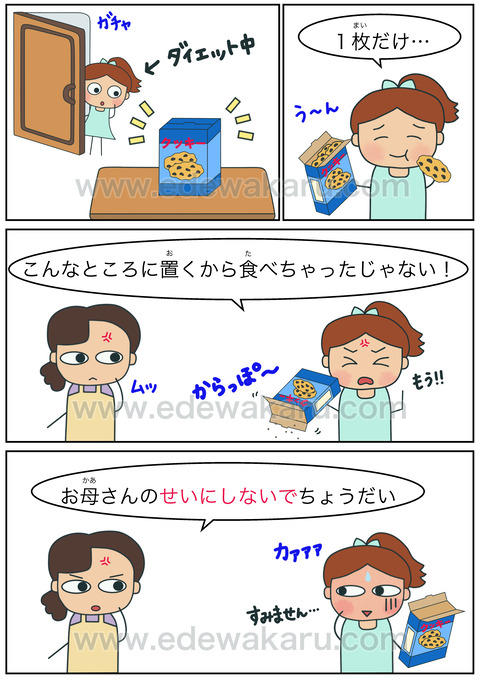
娘:お母さんが、こんなところにクッキーを置くから食べちゃったじゃない!母:お母さんのせいにしないでちょうだい
Daughter: You ate the cookies because Mom left them here! Mother: Don’t blame me!
何でも他人のせいにするのはやめなさい
Stop blaming other people for everything.
彼は失敗をすると、いつも同僚のせいにする
Whenever he makes a mistake, he always blames his colleagues.
A:遅れてごめ〜ん!すごく雨が降ってたからさ〜B:雨が降っていなくても遅れるくせに…雨のせいにしないで!
A: Sorry I’m late! It was raining so hard~ B: You’re always late even when it isn’t raining… Don’t blame the rain!
母:今月の電気代、高かったわ…娘:エアコンが古いからだよ!新しいのを買おうよ〜母:あなたがつけっぱなしにするからよ!エアコンが古いせいにしないの!
Mother: The electricity bill was high this month… Daughter: It’s because the air conditioner is old! Let’s buy a new one~ Mother: It’s because you leave it running! Don’t blame the old air conditioner!
Read the original source text
Meaning
〜になったのは、〜が原因だ
〜になったのは、〜の責任だ
〜になったのは、〜が悪いからだ
How to use it
動詞・形容詞[普通形]+せいにする
名詞[辞書形]+のせいにする
Explanation
「Aせいにする」は「〜になったのは、Aが原因だ」「〜になったのは、Aの責任だ」という意味の文型です。よくない結果が起こったことの責任は「A」だと強調して言う時に使われます。ほとんどの場合、「本当の原因はAではないのに…」という非難の気持ちを込めて使用されます。
[例]
①娘:こんなところにケーキを置くから食べちゃったでしょ!
母:お母さんの
せいにしないで
よ
→ケーキを食べちゃったのは、お母さんの責任だ
「お母さんの責任ではないのに…」という気持ちを表す
②何でも他人の
せいにする
のはやめなさい
→何でも他人が悪いと言うのはやめなさい
「他人が悪いのではないのに…」という気持ちを表す
③彼は失敗をすると、いつも同僚の
せいにする
→いつも同僚が悪いと言う
「同僚の責任ではないのに…」という気持ちを表す
④A:遅れてごめんね!すごく雨が降ってたからさ〜
B:雨が降っていなくても遅れるくせに…雨の
せいにしないで!
→雨が原因で遅れたなんて言わないで!
「本当は雨が原因ではないのに…」という気持ちを表す
⑤母:今月の電気代、高かったわ…
娘:エアコンが古いからだよ!新しいのを買おうよ〜
母:あなたがつけっぱなしにするからよ!エアコンが古い
せいにしない
の!
→エアコンが古いからだと言わないの!
「エアコンが古いのが原因ではない」という気持ちを表す
「〜せいで・〜せいか」と一緒に覚えておきましょう😊