AIUEO JLPT Grammar
Meaning
This sentence pattern is used when comparing two things (nouns), highlighting the differences or characteristics of the comparison.
How to use it
Noun に + 比べ or 比べて; noun と + 比べ or 比べて
In context 5 examples
去年に比べて、今年の夏は涼しい。
Compared to last year, this summer is cooler.
他の都市に比べて、東京は生活費が高い。
Compared to other cities, the cost of living in Tokyo is high.
彼の作品は、前回のものと比べて、かなり進化している。
His work has evolved considerably compared to the previous one.
このスマートフォンは、他のモデルと比べて、バッテリーの持ちがいい。
This smartphone has better battery life compared to other models.
このホテルは、サービスと価格を他と比べても非常にお得です。
This hotel offers great value for money compared to others, in terms of service and price.
Read the original source text
Meaning
This sentence pattern is used when comparing two things (nouns), highlighting the differences or characteristics of the comparison.
How to use it
名詞に+比べor比べて名詞と+比べor比べて
Explanation · 日本語
この文型は、名詞に接続して使われ、二つの事物や状況を比較するときに用いられる表現で、比較対象を提示し、その違いや特徴を強調するために使われます。
文法
Meaning
This can be replaced with the elementary-level comparative expression 「〜より」. There is also the expression 「〜に比べると」.
How to use it
N + に比べて
In context 14 examples
以前に比べて、彼の日本語は上手になった。
Compared with before, his Japanese has improved.
マクドナルドに比べて、モスバーガーはヘルシーだ。
Compared with McDonald’s, MOS Burger is healthier.
昨日に比べて、今日は少し寒いね。
It’s a little colder today than yesterday.
去年の冬に比べて、今年はずいぶん寒い。
This year is much colder than last winter.
兄に比べて、弟はスポーツがよくでき、頭もいい。
Compared with his older brother, his younger brother is better at sports and smarter.
東京に比べると、田舎は物価が安くとても住みやすい。
Compared with Tokyo, prices are lower in the countryside, and it’s much easier to live there.
去年に比べて、今年は雨の日が多い。
There are more rainy days this year than last year.
男性に比べて、女性の方が一般的に寿命が長いそうです。
Women generally seem to live longer than men.
2年前に来たころに比べて、だいぶ街が発展しました。
The city has developed considerably compared with when I came here two years ago.
日本に比べて、私の国は物価が安いです。
Prices are lower in my country than in Japan.
私に比べて、弟は真面目でスポーツもよくできます。
Compared with me, my younger brother is more serious and better at sports.
英語に比べて、日本語は難しいと思う。
I think Japanese is difficult compared with English.
昔に比べて、外で元気に遊ぶ子供の数は減ってきている。
Compared with the past, the number of children playing energetically outside has been decreasing.
去年に比べて、売り上げが30%も増えた。
Sales increased by as much as 30% compared with last year.
Read the original source text
Meaning
〜より初級で勉強する比較表現「〜より」と置き換えが可能。「〜に比べると」という言い方もある。
How to use it
N + に比べて
Bunpro Grammar Reference
Meaning
Compared to, When compared to
How to use it
Noun + に比べ(て)(1)
(1) に比べたら、に比べれば、に比べると
Nuance
A grammar point used to make direct comparisons or contrasts between (A) and (B).
Explanation
に比べて is a set expression in Japanese, used when comparing one thing to another. It is often simply translated as '(A) compared to (B)', or 'when comparing (A) to (B)'. 比べる is a る - Verb that means 'to compare', or 'to contrast'.
に比べて will be attached directly after a noun, before the (B) part of the sentence will explain the comparison that is being made.
東京の冬は北海道の冬に比べて全然寒くない。
Tokyo's winter is not cold at all compared to Hokkaido.
去年に比べて今年の冬は暖かい。
Compared to last year, this year's winter is warm.
Occasionally, the case marking particle と will be used instead of に. に and と are largely interchangeable in this expression, with に focusing slightly more on the changes/differences between similar features of (A) and (B). Alternatively と often mutually contrasts (A) and (B), discussing their individual/unique characteristics.
大阪の人口は東京の人口に比べて小さい。
Osaka's population is smaller compared to Tokyo.
彼も真面目だけど、君は彼に比べるともっと真面目だ。
He is serious too, but you are more serious compared to him.
君は彼と比べて真面目だ。
Compared to him, you are serious. (You are serious, while he has other qualities)
日本はアメリカと比べて小さい。
Compared to America, Japan is small. (Japan is small, compared to America, which is big, among other things)
Caution
The way that 比べる is conjugated is not overly important to the sentence, so long as the meaning of 'if', or 'when' is conveyed. Due to this, に比べたら, に比べれば, and に比べると are all possible combinations.
他の地域に比べたら、この地域は住みやすい。
Compared to other areas, this area is very easy to live in.
去年に比べれば今年は寒いけど、昨日に比べたら今日は暖かい。
If compared to last year, it is colder this year. However if we compare it to yesterday, it is warm today.
新型のパソコンに比べるとこのパソコンは遅く感じるけど、そんなに遅くない。
If we compare this computer to a new model, it feels slow, but it's not that slow.
In context 21 examples
- 野球に比べたら、サッカーの方が好きだ。
When compared with baseball, I like soccer more.
- 東京の冬は北海道の冬に比べて全然寒くない。
Tokyo's winter is not cold at all compared to Hokkaido.
- 大阪の人口は東京の人口に比べて小さい。
Osaka's population is smaller compared to Tokyo.
- 彼も真面目だけど、君は彼に比べるともっと真面目だ。
He is serious too, but you are more serious compared to him.
- 君は彼と比べて真面目だ。
Compared to him, you are serious. (You are serious, while he has other qualities)
- 日本はアメリカと比べて小さい。
Compared to America, Japan is small. (Japan is small, compared to America, which is big, among other things)
- 去年に比べて今年の冬は暖かい。
Compared to last year, this year's winter is warm.
- 一学期に比べて成績がよくなった。
My grades have improved compared to first semester.
- 昨日に比べたら今日は暖かい。
Compared to yesterday, today is warmer.
- 去年に比べて今年は雪が多い。
There is more snow this year compared to last year.
- 昔に比べると、今の人は長生きだ。
People live longer nowadays compared to those in the past.
- 先輩に比べたら、僕はまだまだ日本語が下手だ。
Compared to my superior, I am still poor at Japanese.
- 以前の家に比べたら、今の家は快適だ。
Compared to our last house, the house we have now is more liveable.
- マニュアル車に比べたら、オートマの方が運転が楽だ。
Compared to manuals, automatic cars are easier to drive.
- アメリカに比べたら、日本の方が安全だと思う。
I think that when compared to America, Japan is the safer of the two.
- 他の痛さに比べて、頭痛は一番辛い。
When compared to other types of pain, headaches are the worst.
- 夏に比べて、ずいぶん涼しくなったが、まだまだ暑い。
Compared to summer it is quite cool, but it's still hot.
- 高級肉に比べると少し味は落ちるが、この肉も十分美味しい。
When you compare this meat with expensive meat, it is not as good. However, it is still quite delicious.
- 他の地域に比べたら、この地域は住みやすい。
Compared to other areas, this area is very easy to live in.
- 去年に比べれば今年は寒いけど、昨日に比べたら今日は暖かい。
If compared to last year, it is colder this year. However if we compare it to yesterday, it is warm today.
- 新型のパソコンに比べるとこのパソコンは遅く感じるけど、そんなに遅くない。
If we compare this computer to a new model, it feels slow, but it's not that slow.
Read the original source text
Meaning
Compared to, When compared to
How to use it
Noun + に比べ(て)(1)
(1) に比べたら、に比べれば、に比べると
Nuance
A grammar point used to make direct comparisons or contrasts between (A) and (B).
Explanation
に比べて is a set expression in Japanese, used when comparing one thing to another. It is often simply translated as '(A) compared to (B)', or 'when comparing (A) to (B)'. 比べる is a る - Verb that means 'to compare', or 'to contrast'.
に比べて will be attached directly after a noun, before the (B) part of the sentence will explain the comparison that is being made.
東京の冬は北海道の冬に比べて全然寒くない。
Tokyo's winter is not cold at all compared to Hokkaido.
去年に比べて今年の冬は暖かい。
Compared to last year, this year's winter is warm.
Occasionally, the case marking particle と will be used instead of に. に and と are largely interchangeable in this expression, with に focusing slightly more on the changes/differences between similar features of (A) and (B). Alternatively と often mutually contrasts (A) and (B), discussing their individual/unique characteristics.
大阪の人口は東京の人口に比べて小さい。
Osaka's population is smaller compared to Tokyo.
彼も真面目だけど、君は彼に比べるともっと真面目だ。
He is serious too, but you are more serious compared to him.
君は彼と比べて真面目だ。
Compared to him, you are serious. (You are serious, while he has other qualities)
日本はアメリカと比べて小さい。
Compared to America, Japan is small. (Japan is small, compared to America, which is big, among other things)
Caution
The way that 比べる is conjugated is not overly important to the sentence, so long as the meaning of 'if', or 'when' is conveyed. Due to this, に比べたら, に比べれば, and に比べると are all possible combinations.
他の地域に比べたら、この地域は住みやすい。
Compared to other areas, this area is very easy to live in.
去年に比べれば今年は寒いけど、昨日に比べたら今日は暖かい。
If compared to last year, it is colder this year. However if we compare it to yesterday, it is warm today.
新型のパソコンに比べるとこのパソコンは遅く感じるけど、そんなに遅くない。
If we compare this computer to a new model, it feels slow, but it's not that slow.
Nuance · 日本語
(A)と(B)を直接照らし合わせる時に使われる文法。
Explanation · 日本語
「に比べて」は、「比べる」という一段動詞を含んだ表現で、二つの物事を比べるときに使われます。「(A) は、(B) と並べて見ると、〜だ」のように、二つの違いについて言いたいときに使います。
「に比べて」は、名詞のすぐあとに付けて使います。そして、そのあとの文で、どのように違うかを説明します。
東京の冬は北海道の冬に比べて全然寒くない。
Tokyo's winter is not cold at all compared to Hokkaido.
去年に比べて今年の冬は暖かい。
Compared to last year, this year's winter is warm.
「に」と「と」はだいたい同じように使われます。ただし、「に比べて」は、(A) と (B) が似ているとき、その違いを伝えるために使うことが多いです。「と比べて」は、(A) と (B) の違うところをはっきりと比べたいときに使います。
大阪の人口は東京の人口に比べて小さい。
Osaka's population is smaller compared to Tokyo.
彼も真面目だけど、君は彼に比べるともっと真面目だ。
He is serious too, but you are more serious compared to him.
君は彼と比べて真面目だ。
Compared to him, you are serious. (You are serious, while he has other qualities)
日本はアメリカと比べて小さい。
Compared to America, Japan is small. (Japan is small, compared to America, which is big, among other things)
注意点
「比べる」は、いろいろな形で使うことができます。 「に比べたら」「に比べれば」「に比べると」など、次の文に自然につなぐことができる形であれば、どれを使っても大丈夫です。
他の地域に比べたら、この地域は住みやすい。
Compared to other areas, this area is very easy to live in.
去年に比べれば今年は寒いけど、昨日に比べたら今日は暖かい。
If compared to last year, it is colder this year. However if we compare it to yesterday, it is warm today.
新型のパソコンに比べるとこのパソコンは遅く感じるけど、そんなに遅くない。
If we compare this computer to a new model, it feels slow, but it's not that slow.
絵でわかる日本語
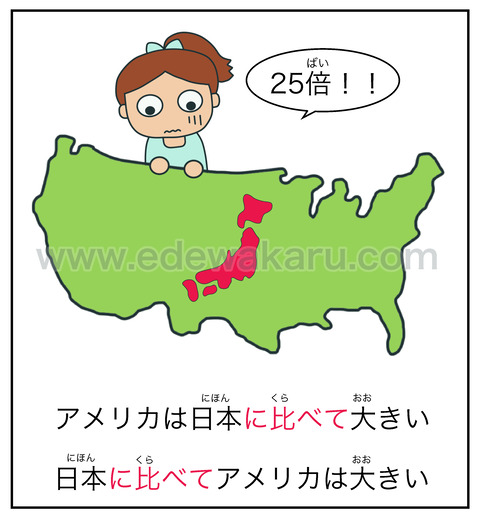
Meaning
(Compared with A, B is)
B is 〜 than A
Compared with A, B is 〜
How to use it
Verb [dictionary form] + の + に比べて
Noun [dictionary form] + に比べて
Explanation
“Aに比べてB” is a sentence pattern meaning “B is 〜 than A” or “compared with A, B is 〜.” It can be switched with “AよりB,” which you learned at the beginner level. 😊 Remember that it says something about “B,” as in “compared with A, B is 〜.”
If you keep in mind that the subject is “B,” you should be able to use it correctly. 😉 It’s a good idea to learn both forms shown in the examples: “Aに比べてBは〜” and “BはAに比べて〜.”
[Examples]
① [A: Japan] [B: America] [Subject: America]
Compared with Japan, America is big.
America is big compared with Japan.
② [A: last year] [B: this year] [Subject: this year]
Compared with last year, this year is hot.
This year is hot compared with last year.
“〜に比べて” is formal-sounding, so use “〜より” in everyday conversation. 😊 This is a simple pattern, but a lot of people use it incorrectly. 😨 Actually, I often got confused about it myself when I was teaching. 😅 When you use it, think about what “B,” the subject, is. 😀 (Review: 〜ところ (Nのところ))
In context 5 examples
アメリカは日本に比べて大きい日本に比べてアメリカは大きい
→アメリカは日本より大きいAmerica is big compared with Japan. Compared with Japan, America is big. → America is bigger than Japan.
今年は去年に比べて暑い去年に比べて今年は暑い
→今年は去年より暑いThis year is hot compared with last year. Compared with last year, this year is hot. → This year is hotter than last year.
弟は兄に比べて頭がいい兄に比べて弟は頭がいい
→弟は兄より頭がいいMy younger brother is smarter than my older brother. Compared with my older brother, my younger brother is smart. → My younger brother is smarter than my older brother.
日本語は英語に比べて簡単だと思うよ英語に比べて日本語は簡単だと思うよ
→英語と比較すると日本語は簡単だと思うI think Japanese is easy compared with English. Compared with English, I think Japanese is easy. → I think Japanese is easy compared with English.
男性に比べて女性はスイーツが好きだと言われている女性は男性に比べてスイーツが好きだと言われている
→男性と比較すると女性はスイーツが好きだと言われている(復習:「スイーツ」と「デザート」)(復習:〜と言われている)It is said that women like sweets more than men. Women are said to like sweets compared with men. → It is said that women like sweets more than men. (Review: “sweets” and “dessert”) (Review: 〜と言われている)
Read the original source text
Meaning
(Aに比べてBは)
AよりBは〜
Aと比較するとBは〜
How to use it
動詞[辞書形]+の+に比べて
名詞[辞書形]+に比べて
Explanation
「Aに比べてB」は「AよりB」「Aと比較するとBは〜」という意味で使われる文型です。初級で勉強した「AよりB」とチェンジすることができます😊この文型は「Aと比較するとBは〜」というように、「B」について言うということを覚えておきましょう。
主語は「B」
ということに気をつければ間違えないと思います😉例文のように
「Aに比べてBは〜」「BはAに比べて〜」
と2つ覚えておくといいと思います。
[例]
①【A:日本】【B:アメリカ】【主語:アメリカ】
日本
に比べて
アメリカは大きい
アメリカは日本
に比べて
大きい
②【A:去年】【B:今年】【主語:今年】
去年
に比べて
今年は暑い
今年は
去年
に比べて
暑い
「〜に比べて」はかたい言い方ですので、日常会話(にちじょうかいわ)では「〜より」を使いましょう😊簡単な文型ですが、間違って使っている人がとても多いです😨実のところ、私も教えている時によく混乱していました😅みなさんも、主語になる「B」は何かを考えながら使いましょう😀(復習:〜ところ(Nのところ))
日本語NET JLPT文法解説まとめ
Meaning
Compared with …
It can be substituted for the comparison expression 「〜より」 learned at the beginner level. The expression 「〜に比べると」 is also used.
How to use it
N + に比べて
Explanation
compared to ~
In context 14 examples
以前に比べて、彼の日本語は上手になった。
Compared with before, his Japanese has improved.
マクドナルドに比べて、モスバーガーはヘルシーだ。
Compared with McDonald’s, MOS Burger is healthier.
昨日に比べて、今日は少し寒いね。
It’s a little colder today than yesterday.
去年の冬に比べて、今年はずいぶん寒い。
This year is much colder than last winter.
兄に比べて、弟はスポーツがよくでき、頭もいい。
Compared with his older brother, his younger brother is better at sports and smarter.
東京に比べると、田舎は物価が安くとても住みやすい。
Compared with Tokyo, prices are lower in the countryside, and it’s much easier to live there.
去年に比べて、今年は雨の日が多い。
There are more rainy days this year than last year.
男性に比べて、女性の方が一般的に寿命が長いそうです。
Women generally seem to live longer than men.
2年前に来たころに比べて、だいぶ街が発展しました。
The city has developed considerably compared with when I came here two years ago.
日本に比べて、私の国は物価が安いです。
Prices are lower in my country than in Japan.
私に比べて、弟は真面目でスポーツもよくできます。
Compared with me, my younger brother is more serious and better at sports.
英語に比べて、日本語は難しいと思う。
I think Japanese is difficult compared with English.
昔に比べて、外で元気に遊ぶ子供の数は減ってきている。
Compared with the past, the number of children playing energetically outside has been decreasing.
去年に比べて、売り上げが30%も増えた。
Sales increased by as much as 30% compared with last year.
Read the original source text
Meaning
〜より
初級で勉強する比較表現「〜より」と置き換えが可能。「〜に比べると」という言い方もある。
How to use it
N + に比べて
Explanation
compared to ~
毎日のんびり日本語教師
Meaning
Compared with ~
How to use it
Noun + に比べて / に比べると / と比べて / と比べると
Verb dictionary form + の + に比べて / に比べると / と比べて / と比べると
Explanation
「Aに比べてB」 is used when contrasting A and B, which stand in opposition to each other.
「Aと比べてB」 is used when comparing A and B with each other.
There is a slight difference in nuance between the two.
Notes
Fixed expression: 「~と比べ物にならない」
In context 8 examples
喫煙者は通常の人に比べ、味覚が鈍くなると言われている。(一般认为吸烟者比普通人味觉迟钝。)
Smokers are said to have a duller sense of taste compared with ordinary people.
今年度の申し込みは前年度に比べ、およそ1.5倍に増えた。
Applications this fiscal year increased to about 1.5 times the previous year’s number.
若い頃に比べると月日の流れが早く感じるようになった。
Compared with when I was young, the days seem to pass more quickly now.
入社時に比べると明らかに仕事の新鮮味が薄れてきている。
Compared with when I joined the company, the freshness of the work has clearly worn off.
この曲は、他の曲に比べ断トツに気に入っている。
I like this song by far the most compared with the others.
あの人は頭が良すぎて、私と比べ物にならない。
That person is so smart that there’s no comparison between us.
英語は文字が26字しかないので、日本語と比べて初級が楽だ。
Since English has only 26 letters, the beginner level is easier than in Japanese.
彼女は周囲と比べ理想が高すぎるから結婚できないのだろう。
She probably can’t get married because her expectations are too high compared with those around her.
Read the original source text
Meaning
~と比較して
How to use it
名詞+に比べて/に比べると/と比べて/と比べると
動辞形+の+に比べて/に比べると/と比べて/と比べると
Explanation
「Aに比べてB」は、対立関係にあるAとBを対比させるときに用います。
「Aと比べてB」は、AとBを相互に比較するときに用います。
この2つのニュアンスはやや異なります。
Notes
慣用句「~と比べ物にならない」
IMABI
Compare/Contrast
Read this IMABI lesson ↗Explanation
Compare & Contrast: ~に比べて, ~に引き換え, ~に反して,~にもまして, & ~ないまでも
The patterns in this lesson deal with compare and contrast. Although not near as similar to each other as topics in other lessons, you still need to pay attention to detail so that you don’t confuse them with each other.
~{に・と}比べて
The verb 比べる means “to compare,” and because it is the quintessential verb for establishing comparisons, it is heavily used with the standard marking function of both the case particle に and the case particle と, and the choice between the two rests in how they differ in directionality.
XをYと比べる compares X and Y on an even playing field regardless of whether the comparison is contrastive, resulting in a more formal tone. As for XをYに比べる, Y is viewed as the standard for which the contrast that follows is based. Imagine with と that X and Y are brought together and compared side by side (X→←Y), while with に, the direction of focus is pointed at Y (X→Y). Consequently, because the focus is pointed at Y with に, it carries an implication about the merits of the comparison, which is not had with と.
Instead of seeing this grammar point rendered in the て form, you may also see it without て in formal speech (連用形中止法), or you may even see 比べると or any other conditional provided that you account for the unique layer of nuancing provided by said conditional grammar pattern – with 比べると being neutral but to the point.
1. 外は暑いが、それに比べて中は寒い。
It’s hot outside, but, moreover, in contrast, it’s cold inside.
2. この本は昨日読んだのと比べると全くつまらない。
This book compared to the one I read yesterday is completely boring.
3. 彼は妹と比べて若く見えました。
He looked younger beside his younger sister.
4. 今年は去年に比べ、雪の量りょうが多い。
In contrast to last year, there has been a lot of snowfall this year.
5. 欧米諸国の薬剤費が全体の一〇~ニ〇%にとどまっているのに較べて異常な数値だ。
(That) is a bizarre figure in comparison to the pharmaceutical costs of Western countries being confined to 10~20% of their total (costs).
Orthography Note: In formal writing, you may also see the verb 比べる spelled as 較べる.
~に引き換え vs ~と引き換えに
The verb 引き換える has two definitions, each which produces two unique grammar structures which hinge on how に and と differ as standard markers.
The pattern ~に引き換え follows nouns or nominalized expressions to indicate a sharp contrast, one that is both subjective and pertaining to a good vs. bad judgment call by the speaker.
When following nominalized expressions, the nominalizer of choice is the particle の, as is to be expected due to the highly subjective nature of this pattern.
6. 健太の住んでいるマンションは新しくて、広い。それに引き換え、僕のところは古くて狭いし、駅からも遠いよ。
The apartment that Kenta is living at is new and wide. By contrast, my place is old, small, and also far from the train station.
7. 同じ年の人に引き換え、彼はとても頭がよくて、たくさんの素晴らしい偉業いぎょうを成し遂とげました。
In sharp contrast to people of his same age, he is very smart and has made a lot of wonderful achievements.
8. 惑星わくせいの大きさに引き換え、冥王星めいおうせいはとても小さい。
In sharp contrast to the size of a planet, Pluto is very small.
When a contrast is not subjectively charged and the contrast being made is neutral in nature, ~に引き換え will not be the natural word choice. Instead, something like ~に対して would need to be used to enforce neutrality.
9. 整備して明るくなった竹林にはタケノコが生えているのに{対して 〇・引き換え X}、まだ整備していないところは竹が密生して暗く、タケノコが生えていない。
In bamboo forest areas that have gotten brighter from (the light fixtures) we set up, bamboo shoots are growing, whereas in areas where we have not set up (light fixtures), with the bamboo so dense and it being so dark, bamboo shoots are not growing.
The pattern ~と引き換えに means “in exchange for,” and from this we can gather how there is always a difference in directionality between に and と. In Exs. 6-8, we can envision a shift from one expectation, which we will call X, to some other reality, which we will call Y. This X → Y directionality is a fundamental property of に. Meanwhile, the directionality of と is X→←Y, and in this context of “exchange,” factors X and Y merely swap places. Similarly to ~に引き換えに, though, ~と引き換えに often remains highly subjective and emotionally charged, especially when Y is a situation (not restricted to nouns) as opposed to a concrete noun.
10. あいつはわずかなお金と引き換えに、自分の友達を裏切った。
That guy betrayed his own friends in exchange for a measly amount of money.
11. 犯人は人質と引き換えに大金を要求してきた。
The criminal came demanding for a large sum of money in exchange for the hostage(s).
~に反して
The verb 反する may be defined as “to be contrary/go against/violate,” and it is often seen in the pattern Xに反してY to indicate that “Y is contrary to/against X.”
12. 予想よそうに反して成功するのはいつもいいことでしょう。
Succeeding against one’s expectations is always a good thing isn’t it?
13. 神の意に反して人間は互たがいに殺害している。
Against the will of God, humans are slaying each other.
14. 2006年に反して、2007年のステンレス鋼スクラップの貿易では、欧州が輸出を増し、東南アジアが輸入を増した。
Contrary to (the expectation set by) 2006, Europe increased its exports and Southeast Asia increased its imports in the 2007 stainless steel scrap market.
15. 大方の期待に反してサービスの展開が遅れている。
the extending of services is delayed contrary to most expectations.
Note that although this verb is often seen in the て form, it is not limited to it. You may see it as the main verb, modifying another noun in the 連体形, or even see て dropped via 連用形中止法.
16. 我々の期待に反していた。
It was contrast to our expectations.
17. これは直感に反しているが、正しい主張だ。
This may be contrary to intuition, but it is the correct assertion.
18. スポーツ精神に反する卑劣な行為であります。
(It) is a contemptible act contrary to sportsmanship.
19. アメリカの4月の耐久財受注は前の月から減少するとの市場予想に反し、0.7%増加しました。
Durable goods manufacture’s orders for America in April increase 0.7% contrary to market expectation which foresaw a decline from the previous month.
Some learners confuse the purpose of the 連用形 and 連体形 with this construction, but it is important to note how the components of the sentence in relation to ~に反する are not the same. In the case of the 連用形, Y is a verbal expression, whereas in the case of the 連体形, Y is another noun.
20. 国防長官こくぼうちょうかんは事実に反する報告をしました。
The Secretary of Defense made a report contradictory to the facts.
21. 予想に反した1結果が出ると「なぜだろう?」という探究心が生まれ、ますます学ぶ意欲が湧いてきます。
The inquisitive mind is borne from the question of “why?” from getting results contrary to one’s expectations, which brings about all the more ambition to study.
~にもまして
~にもまして, which attaches to nouns including interrogatives, indicates that a current extent builds on a previous/aforementioned one. If a comparison does not have it that both reference points share the same quality to start out with, the use of ~にもまして becomes unnatural and would need to be replaced with something else like the particle より.
22. 今年は去年にもまして暑さが厳しい。
The heat is far more severe than even last year.
23. 最近は以前にもまして物覚えが悪くなった。
Recently, my memory has gotten worse than it was even before.
24. テイラー君は病気がちなセス先生{にもまして X・より 〇}体力があります。
Taylor-kun has more stamina than Seth Sensei, who has a tendency of getting sick.
25. 遼平君は何にも増してマルガリータが好きだ。
Ryо̄hei-kun loves margaritas above all else.
26. 今日はいつにも増して暑い。
Today is hotter than it usually is.
As indicated by the Kanji spelling in Ex. 26, the 増して in this expression derives from the verb 増す meaning “to increase.”
~ないまでも
The pattern ~ないまでも indicates that V1, though not exactly reaching the extent the speaker would prefer, it still reaches the threshold with which V2 is carried out.
27. 毎週とはいわないまでも、せめて月に1回は映画館に行きたい。
Not that it’d have to be every week, but I’d like to at least go to the movies once a month.
28. 快晴かいせいとはいかないまでも、雨は降らないでほしい。
Not that I won’t go if it doesn’t turn out to be clear weather, but I’d like it to not rain.
The use of ~た emphasizes that the realization at hand (the results), which is contrary to the expectation that the speaker had, has occurred as such and remains the case. ↩︎
In context 28 examples
外は暑いが、それに比べて中は寒い。
It’s hot outside, but, moreover, in contrast, it’s cold inside.
この本は昨日読んだのと比べると全くつまらない。
This book compared to the one I read yesterday is completely boring.
彼は妹と比べて若く見えました。
He looked younger beside his younger sister.
今年は去年に比べ、雪の量りょうが多い。
In contrast to last year, there has been a lot of snowfall this year.
欧米諸国の薬剤費が全体の一〇~ニ〇%にとどまっているのに較べて異常な数値だ。
(That) is a bizarre figure in comparison to the pharmaceutical costs of Western countries being confined to 10~20% of their total (costs).
健太の住んでいるマンションは新しくて、広い。それに引き換え、僕のところは古くて狭いし、駅からも遠いよ。
The apartment that Kenta is living at is new and wide. By contrast, my place is old, small, and also far from the train station.
同じ年の人に引き換え、彼はとても頭がよくて、たくさんの素晴らしい偉業いぎょうを成し遂とげました。
In sharp contrast to people of his same age, he is very smart and has made a lot of wonderful achievements.
惑星わくせいの大きさに引き換え、冥王星めいおうせいはとても小さい。
In sharp contrast to the size of a planet, Pluto is very small.
整備して明るくなった竹林にはタケノコが生えているのに{対して 〇・引き換え X}、まだ整備していないところは竹が密生して暗く、タケノコが生えていない。
In bamboo forest areas that have gotten brighter from (the light fixtures) we set up, bamboo shoots are growing, whereas in areas where we have not set up (light fixtures), with the bamboo so dense and it being so dark, bamboo shoots are not growing.
あいつはわずかなお金と引き換えに、自分の友達を裏切った。
That guy betrayed his own friends in exchange for a measly amount of money.
犯人は人質と引き換えに大金を要求してきた。
The criminal came demanding for a large sum of money in exchange for the hostage(s).
予想よそうに反して成功するのはいつもいいことでしょう。
Succeeding against one’s expectations is always a good thing isn’t it?
神の意に反して人間は互たがいに殺害している。
Against the will of God, humans are slaying each other.
2006年に反して、2007年のステンレス鋼スクラップの貿易では、欧州が輸出を増し、東南アジアが輸入を増した。
Contrary to (the expectation set by) 2006, Europe increased its exports and Southeast Asia increased its imports in the 2007 stainless steel scrap market.
大方の期待に反してサービスの展開が遅れている。
the extending of services is delayed contrary to most expectations.
我々の期待に反していた。
It was contrast to our expectations.
これは直感に反しているが、正しい主張だ。
This may be contrary to intuition, but it is the correct assertion.
スポーツ精神に反する卑劣な行為であります。
(It) is a contemptible act contrary to sportsmanship.
アメリカの4月の耐久財受注は前の月から減少するとの市場予想に反し、0.7%増加しました。
Durable goods manufacture’s orders for America in April increase 0.7% contrary to market expectation which foresaw a decline from the previous month.
国防長官こくぼうちょうかんは事実に反する報告をしました。
The Secretary of Defense made a report contradictory to the facts.
予想に反した1結果が出ると「なぜだろう?」という探究心が生まれ、ますます学ぶ意欲が湧いてきます。
The inquisitive mind is borne from the question of “why?” from getting results contrary to one’s expectations, which brings about all the more ambition to study.
今年は去年にもまして暑さが厳しい。
The heat is far more severe than even last year.
最近は以前にもまして物覚えが悪くなった。
Recently, my memory has gotten worse than it was even before.
テイラー君は病気がちなセス先生{にもまして X・より 〇}体力があります。
Taylor-kun has more stamina than Seth Sensei, who has a tendency of getting sick.
遼平君は何にも増してマルガリータが好きだ。
Ryо̄hei-kun loves margaritas above all else.
今日はいつにも増して暑い。
Today is hotter than it usually is.
毎週とはいわないまでも、せめて月に1回は映画館に行きたい。
Not that it’d have to be every week, but I’d like to at least go to the movies once a month.
快晴かいせいとはいかないまでも、雨は降らないでほしい。
Not that I won’t go if it doesn’t turn out to be clear weather, but I’d like it to not rain.