絵でわかる日本語
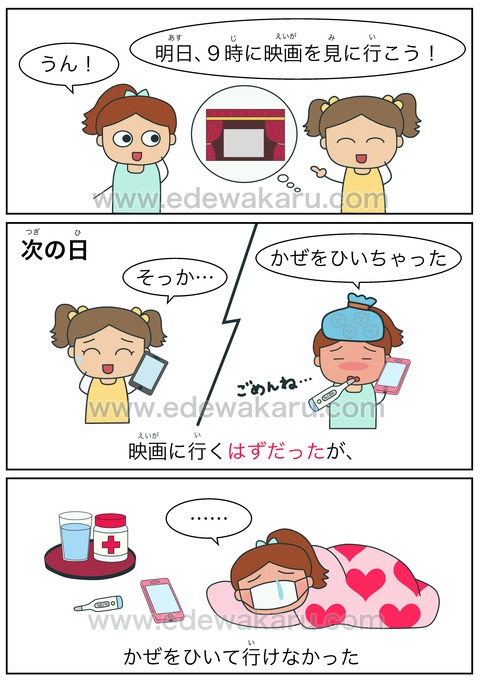
Meaning
I was supposed to …, but I couldn’t.
How to use it
Verb[dictionary form]+はずだった
Explanation
“〜はずだった” is a sentence pattern meaning “I was supposed to …, but I couldn’t.” In many cases, it expresses the speaker’s feelings of “being shocked” or “disappointed.” The forms “〜はずだったが〜,” “〜はずだったのに〜,” and “〜はずだったけれど・けど” are used in most cases. 😊
【For those who have time】
“〜はずだった” also means “I was certain that … would happen, but it turned out differently.” 😮
[Example]
1万円で足りる
はずだった
が、少し足りなかった
→I was absolutely certain that 10,000 yen would be enough, but I was wrong.
There are several sentence patterns with “はず,” so it may be useful to learn them together. 😊
【Sentence patterns with “はず”】
〜たはずなのに
〜はずがない
〜はずだ(judgment)
〜はずだ(plan)
〜はずだった
In context 5 examples
映画に行くはずだったのに、カゼをひいたので行けなかった
→映画に行く予定だったが、カゼをひいたので行けなかったI was supposed to go to the movies, but I couldn’t because I caught a cold. →I had planned to go to the movies, but I couldn’t because I caught a cold.
A:あれ?山田くんは?B:彼も来るはずだったんだけど、来られなくなったんだって
→彼も来る予定だったんだけど、来られなくなったんだって(復習:〜って(伝聞))A: Huh? Where’s Yamada? B: He was supposed to come too, but apparently he can’t make it now. →He had planned to come too, but apparently he can’t make it now. (Review: 〜って (hearsay))
電車は9時に出発するはずだったが、大雪のために1時間も遅れた
→9時に出発する予定だったが、1時間も遅れた(復習:〜ために・〜ためか(原因))(復習:〜も(数量詞+も))The train was supposed to leave at 9, but it was delayed by as much as an hour because of heavy snow. →It was supposed to leave at 9, but it was delayed by as much as an hour. (Review: 〜ために・〜ためか (cause)) (Review: 〜も (quantity word+も))
10時に友達に会うはずだったが、二度寝して遅刻してしまった
→10時に会う予定だったが、遅刻してしまった(復習:二度寝)I was supposed to meet my friend at 10, but I slept through my alarm and ended up being late. →I was supposed to meet them at 10, but I ended up being late. (Review: 二度寝)
明日北海道に行くはずだったが、台風で行けなくなってしまった
→北海道に行く予定だったが、台風で行けなくなってしまったI was supposed to go to Hokkaido tomorrow, but the typhoon made it impossible. →I had planned to go to Hokkaido, but the typhoon made it impossible.
Read the original source text
Meaning
〜予定だったが、〜できなかった
How to use it
動詞[辞書形]+はずだった
Explanation
「〜はずだった」は「〜予定だったが、〜できなかった」という意味を表す文型です。 この文型は多くの場合、話し手の
「ショックだった」「失望した」
という気持ちを表します。ほとんどの場合
「〜はずだったが〜」「〜はずだったのに〜」「〜はずだったけれど・けど」
の形が使われます😊
【余裕のある人へ】
「〜はずだった」には「当然〜になると思っていたが、違っていた」という意味もあります😮
[例]
1万円で足りる
はずだった
が、少し足りなかった
→
絶対に
1万円で足りる
と思っていたが、違っていた
「〜はず」がつく文型はいくつかありますので、まとめて覚えておくといいと思います😊
【「はず」がつく文型】
〜たはずなのに
〜はずがない
〜はずだ(判断)
〜はずだ(予定)
〜はずだった
毎日のんびり日本語教師
How to use it
Noun + はずだった/はずではなかった
い-adjective plain form + はずだった/はずではなかった
な-adjective stem + な/である + はずだった/はずではなかった
Verb plain form + はずだった/はずではなかった
Explanation
Expresses the speaker’s regret that an event they had expected did not occur.
The latter clause is often followed by a concessive expression.
「こんなはずじゃなかったのに」 is a frequently used expression.
Notes
The 「はず」 series
In context 8 examples
来るはずだったアルバイトの子から来れなくなったと連絡が来た。
The part-time worker who was supposed to come contacted me to say they could no longer make it.
17時の飛行機で帰るはずだったのに、大雪の影響でそうはいかなくなった。
I was supposed to return on the 5 p.m. flight, but because of the heavy snow, that became impossible.
早めに帰れるはずだったのに、残業せざるを得なくなった。
I was supposed to be able to leave early, but I ended up having no choice but to work overtime.
病院行くはずだったのに、立ち上がれないほど具合が悪くて結局自宅で寝ていた。
I was supposed to go to the hospital, but I felt so sick I couldn’t stand up, so I ended up sleeping at home.
将来「こんなはずではなかった」と後悔しないため、今からしっかり婚活したい。
I want to pursue marriage seriously now so that I won’t regret it in the future, thinking, “This isn’t how things were supposed to turn out.”
こんな長い時間寝るはずではなかった。疲れてたのかもしれない。
I wasn’t supposed to sleep for such a long time. Maybe I was tired.
髪切ってもらった後、こうなるはずじゃなかったのにと後悔することが多い。
After getting my hair cut, I often regret it, thinking, “This wasn’t how it was supposed to turn out.”
私の人生こんなはずじゃなかった。
My life wasn’t supposed to turn out like this.
Read the original source text
How to use it
名詞+のはずだった/はずではなかった
い形容詞普通形+はずだった/はずではなかった
な形容詞語幹+な/である+はずだった/はずではなかった
動詞普通形+はずだった/はずではなかった
Explanation
話者が想定していた出来事が起きなかったこと対する残念な感情を表します。
後件にはよく逆接の表現がきます。
「こんなはずじゃなかったのに」はよく使われる表現です。
Notes
「はず」シリーズ