くらべてわかる日本語表現文型辞典
Meaning
It is not a big deal, so there is no need to go out of one's way to do A.
How to use it
Aまでもない (AまでもなくB)
[Verb—dictionary form] までもない
Explanation
[Contrast 1]
“Aことはない” (Meaning 2, p. 96)
“Aまでもない” means that the present state is sufficient, so there is no need to go out of one's way to do A. “Aことはない” means that one need not do A; there is no need to do A.
○食べたくなかったら、食べることはない。 — If you don't want to eat it, you don't have to.
×食べたくなかったら、食べるまでもない。 — If you don't want to eat it, there's no need to go out of your way to eat it.
○あの人の作った料理はまずいに決まっている。食べるまでもない。(食べなくてもまずいことはわかる) — The food that person makes is bound to be awful. There's no need to taste it. (You can tell it's awful without tasting it.)
○あの人の作った料理はまずいに決まっている。食べることはない。(まずいから食べなくてもいい) — The food that person makes is bound to be awful. You don't have to eat it. (It's awful, so you don't need to eat it.)
In context 4 examples
大した傷じゃない。薬を塗るまでもないだろう。
It's not a serious wound. I probably don't even need to put medicine on it.
いうまでもなく、彼よりあなたのほうが優秀ですよ。
Needless to say, you are more capable than he is.
この程度の日本語なら、辞書を見るまでもなく読めるはずだ。
If it's Japanese of this level, you should be able to read it without even looking at a dictionary.
合否の結果は彼女の様子から判断できたので、聞くまでもなかった。
I could tell from her expression whether she had passed, so there was no need to ask.
Read the original source text
Meaning
大したことがないので、わざわざAする必要がない。
How to use it
Aまでもない(AまでもなくB)
[動詞-る形]までもない
Explanation
【対比1】
「Aことはない」(意味2 P.96)
「Aまでもない」は、今の状態でも十分だから、わざわざAする必要がないという意味であり、「Aことはない」は、Aをしなくてもいい、Aする必要がないという意味である。
○食べたくなかったら、食べることはない。
×食べたくなかったら、食べるまでもない。
○あの人の作った料理はまずいに決まっている。食べるまでもない。(食べなくてもまずいことはわかる)
○あの人の作った料理はまずいに決まっている。食べることはない。(まずいから食べなくてもいい)
DoJG 日本語文法辞典(全集)
Meaning
Not necessary (to bother) to; do not need (to go as far as) to; do not have to
How to use it
Vinformal nonpast | までもない | |
| 話すまでもない | Not necessary (to bother) to talk |
Explanation
There is no point in going as far as to do something.
In context 8 examples
これは簡単な計算だから計算器を使うまでもない。
This is a simple calculation, so it is not necessary (to bother) to use a calculator.
言うまでもなくジョージ・ワシントンはアメリカの初代大統領だ。
Needless to say, George Washington was the first president of the United States.
彼がみんなに尊敬されたのは言うまでもない。
It goes without saying that he was respected by everybody.
大した用事じゃないからあなたがわざわざ行くまでもないでしょう。
It is not important business, so it is probably not necessary for you to (take the trouble to) get there.
行けば分かることですから電話して聞くまでもありません。
We can find out when we get there, so we don't need to call and about it.
今更申すまでもありませんが、山中先生はこの分野では指導的な立場にあるお方です。
Needless to say (now), Professor Yamanaka is a leading figure in this field.
それは説明するまでもなく明らかなことだ。
It is so obvious that no explanation is necessary.
待つまでもなく妻は買い物から帰ってきた。
My wife came back from shopping without my having to wait for her.
絵でわかる日本語
Usage 1
Read this source entry ↗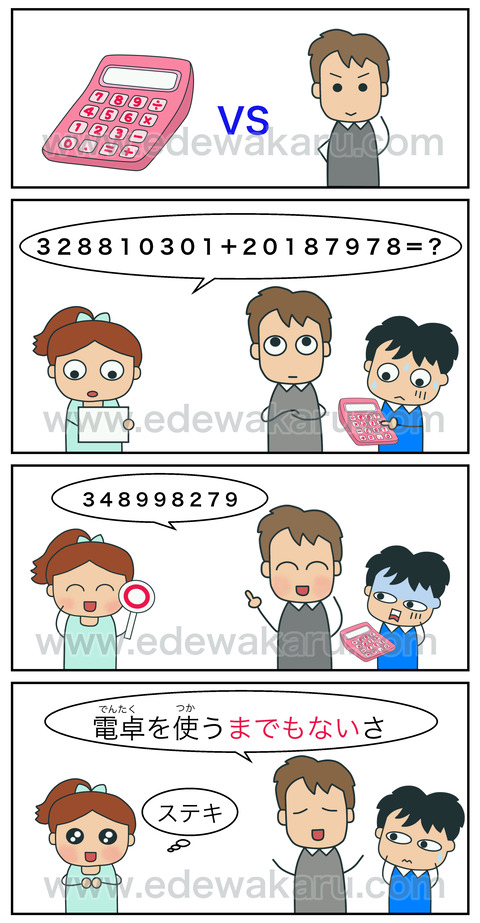
Meaning
there is no need to ~
How to use it
Verb [dictionary form] +までもない
Explanation
「〜までもない」 is a sentence pattern meaning “there is no need to ~.” It is used when you want to say “it’s easy, so there’s no need to ~,” “it’s not serious, so there’s no need to ~,” or “it’s obvious, so there’s no need to ~” 😀
[Examples]
① There’s no need to use a calculator.
→It’s a very simple calculation,
so there’s no need to use a calculator.
② I only have a cold, so there’s no need to go to the hospital.
→It’s not a serious illness,
so there’s no need to go to the hospital.
As in example ⑤, 「言うまでもない」 is used when you want to say “it is so obvious that there is no need to say it” 😀
[Examples]
It goes without saying that you mustn’t be late.
→It is obvious that you mustn’t be late.
It goes without saying, but you mustn’t be late.
→It is obvious, but you mustn’t be late.
「〜までもない」 also has the form 「〜までのことはない」 😮 The usage and meaning are the same as 「〜までもない」 😉
[Examples]
① There’s no need to use a calculator.
=There’s no need to use a calculator.
② There’s no need to go to the hospital.
=There’s no need to go to the hospital.
「〜までもない」 is a commonly used pattern, so be sure to learn it carefully 😊
In context 5 examples
電卓を使うまでもないさ
→電卓を使う必要がないさThere’s no need to use a calculator. →There’s no need to use a calculator.
カゼをひいただけだから、病院に行くまでもないよ
→カゼをひいただけだから、病院に行く必要はないよI only have a cold, so there’s no need to go to the hospital. →I only have a cold, so there’s no need to go to the hospital.
簡単な文法ですから、説明するまでもないですね
→簡単な文法ですから、説明する必要がないですねIt’s simple grammar, so there’s no need to explain it. →It’s simple grammar, so there’s no need to explain it.
そんなに遠くないし、タクシーに乗るまでもない
→そんなに遠くないし、タクシーに乗る必要がないIt isn’t that far, so there’s no need to take a taxi. →It isn’t that far, so there’s no need to take a taxi.
遅刻をしちゃいけないのは言うまでもない
→遅刻をしちゃいけないのは当然のことだ(復習:口語形「〜ちゃ・〜じゃ」)It goes without saying that you mustn’t be late. →It’s obvious that you mustn’t be late (Review: colloquial forms 「〜ちゃ・〜じゃ」)
Read the original source text
Meaning
〜する必要がない
How to use it
動詞[辞書形]+までもない
Explanation
「〜までもない」は「〜する必要がない」という意味で使われる文型です。
「簡単なので〜する必要がない」「程度が低いので〜する必要がない」「当然のことなので〜する必要がない」と言いたい時に使われます
😀
[例]
①電卓を使う
までもない
→
とても簡単な計算なので、
電卓を使う
必要がない
②カゼをひいただけだから、病院に行く
までもない
→カゼは
大変なことではないので、病院に行く
必要がない
例文⑤のように
「言うまでもない」は「言う必要がないくらい当然のことだ」と言いたい時に使われます
😀
[例]
遅刻をしちゃいけないのは
言うまでもない
→遅刻をしてはいけないのは
当然だ
言うまでもないことだが、遅刻をしちゃいけない
→
当然のことだが、遅刻をしてはいけない
また「〜までもない」には「〜までのことはない」という形もあります😮使い方も意味も「〜までもない」と同じです😉
[例]
①電卓を使う
までもない
=電卓を使う
までのことはない
②病院に行く
までもない
=病院に行く
までのことはない
「〜までもない」はよく使われる文型ですので、しっかりと覚えておきましょう😊
Usage 2
Read this source entry ↗Meaning
there is no need to ~
How to use it
Verb [dictionary form] +までもない
Explanation
「〜までもない」 is a sentence pattern meaning “there is no need to ~.” It is used when you want to say “it’s easy, so there’s no need to ~,” “it’s not serious, so there’s no need to ~,” or “it’s obvious, so there’s no need to ~” 😀
[Examples]
① There’s no need to use a calculator.
→It’s a very simple calculation,
so there’s no need to use a calculator.
② I only have a cold, so there’s no need to go to the hospital.
→It’s not a serious illness,
so there’s no need to go to the hospital.
As in example ⑤, 「言うまでもない」 is used when you want to say “it is so obvious that there is no need to say it” 😀
[Examples]
It goes without saying that you mustn’t be late.
→It is obvious that you mustn’t be late.
It goes without saying, but you mustn’t be late.
→It is obvious, but you mustn’t be late.
「〜までもない」 also has the form 「〜までのことはない」 😮 The usage and meaning are the same as 「〜までもない」 😉
[Examples]
① There’s no need to use a calculator.
=There’s no need to use a calculator.
② There’s no need to go to the hospital.
=There’s no need to go to the hospital.
「〜までもない」 is a commonly used pattern, so be sure to learn it carefully 😊
Read the original source text
Meaning
〜する必要がない
How to use it
動詞[辞書形]+までもない
Explanation
「〜までもない」は「〜する必要がない」という意味で使われる文型です。
「簡単なので〜する必要がない」「程度が低いので〜する必要がない」「当然のことなので〜する必要がない」と言いたい時に使われます
😀
[例]
①電卓を使う
までもない
→
とても簡単な計算なので、
電卓を使う
必要がない
②カゼをひいただけだから、病院に行く
までもない
→カゼは
大変なことではないので、病院に行く
必要がない
例文⑤のように
「言うまでもない」は「言う必要がないくらい当然のことだ」と言いたい時に使われます
😀
[例]
遅刻をしちゃいけないのは
言うまでもない
→遅刻をしてはいけないのは
当然だ
言うまでもないことだが、遅刻をしちゃいけない
→
当然のことだが、遅刻をしてはいけない
また「〜までもない」には「〜までのことはない」という形もあります😮使い方も意味も「〜までもない」と同じです😉
[例]
①電卓を使う
までもない
=電卓を使う
までのことはない
②病院に行く
までもない
=病院に行く
までのことはない
「〜までもない」はよく使われる文型ですので、しっかりと覚えておきましょう😊
どんなときどう使う 日本語表現文型辞典
Meaning
no need to
How to use it
Vる + までもない
Explanation
~しなくてもいい
「その程度までする必要ない」と言いたいときの表現。 ❹ のように「までのこともない」という形もある。
No reason to go to such a degree. Can become までのこともない, as in sentence ❹ .
In context 4 examples
あの映画はいいけど、映画館に見に行くまでもないと思う。DVDで見れば十分だよ。
That movie is good, but I don't think it's worth going to the theater to see it. Watching it on DVD is enough.
王さんはけさ退院したそうだ。林さんが家族から直接聞いたのだから、確かめるまでもないだろう。
I hear Wang was discharged from the hospital this morning. Since Lin heard it directly from the family, there's no need to confirm it, is there?
詳しい使い方のビデオがあるんだから、わざわざ説明を聞くまでもないと思う。
Since there's a video explaining in detail how to use it, I don't think there's any need to go out of my way to hear an explanation.
このくらいの小さい切り傷なら、わざわざ病院に行くまでのこともない。消毒して薬を塗っておけば治るだろう。
For a small cut like this, there's no need to go all the way to the hospital. It should heal if you disinfect it and apply some medicine.
Read the original source text
Meaning
no need to
How to use it
Vる+までもない
Explanation
~しなくてもいい
「その程度までする必要ない」と言いたいときの表現。 ❹ のように「までのこともない」という形もある。
No reason to go to such a degree. Can become までのこともない, as in sentence ❹ .
日本語NET JLPT文法解説まとめ
Meaning
There is no need to go out of one's way to ~
How to use it
V (dictionary form) + までもない
V (dictionary form) + までもなく〜
Explanation
"there is no need to do"
It includes the speaker's feeling that this is obvious.
In context 9 examples
簡単な計算だから、電卓を使うまでもない。
It's a simple calculation, so there's no need to use a calculator.
こんな傷、病院に行くまでもありません。
It's just a small cut like this; there's no need to go to the hospital.
彼が犯人であることは、疑うまでもない。
There is no need to doubt that he is the culprit.
スーパーはここから歩いて5分ぐらいです。タクシーを使うまでもないですよ。
The supermarket is about a five-minute walk from here. There's no need to take a taxi.
この前のJLPTはとても簡単だったから、結果を聞くまでもないだろう。
The last JLPT was so easy that the result is probably obvious.
この病気は軽度ですから、手術するまでもありません。
This illness is mild, so there's no need for surgery.
紹介するまでもなく、彼は日本を代表する作家だ。
There's no need to introduce him; he's a writer who represents Japan.
言うまでもないことですが、道にゴミを捨てないでください。
It goes without saying, but please don't litter.
言うまでもなく、喫煙は健康に大きな害を及ぼします。
Needless to say, smoking causes serious harm to your health.
Read the original source text
Meaning
わざわざ〜する必要はない
How to use it
V(辞書形) + までもない
V(辞書形) + までもなく〜
Explanation
"there is no need to do"
It includes the speaker's feeling that this is obvious.
毎日のんびり日本語教師
How to use it
Verb dictionary form + までもない
Verb dictionary form + までもなく
Explanation
For reasons such as it being obvious, trivial, or unimportant, this expresses that there is no need to go out of one’s way to ~.
Notes
Similar grammar: “【N1 Grammar】~には当たらない(あたらない)”
Similar grammar: “【N1 Grammar】~には及ばない(およばない)”
In context 14 examples
ここから家まであと少しなので、傘を差すまでもない。
It’s only a short way home from here, so there’s no need to open an umbrella.
簡単な計算なら計算機を使うまでもない。
There’s no need to use a calculator for simple calculations.
初期段階ですから、手術をするまでもありません。
Since it’s at an early stage, there’s no need to have surgery.
言うまでもないことですが、道にゴミを捨てないでください。
It goes without saying, but please don't litter.
この程度なら医者に診てもらうまでもないだろう。
At this level, there’s probably no need to see a doctor.
これについては既にご存知のはずでしょうから、するまでもないでしょう。
You should already know about this, so there’s probably no need to do it.
この研究が医療の進歩に貢献したことは言うまでもない。
It goes without saying that this research contributed to medical progress.
締め切りを過ぎ、その後叱られてしまったのは言うまでもない。
It goes without saying that the deadline passed and I was scolded afterward.
一人の命と大勢の命、比べるまでもないだろう。
A single life and the lives of many—there’s no need to compare them, is there?
体温36.9度、解熱剤飲むまでもないよね?
A temperature of 36.9°C; no need to take an antipyretic, right?
社会の高齢化が避けられないことは言うまでもない。
It goes without saying that the aging of society is unavoidable.
なぜ差別はいけないか。それは論ずるまでもない。
Why is discrimination wrong? That doesn’t even need to be discussed.
3時間同じ空間にいたのだから、検査するまでもなく陽性だろう。
Since we were in the same space for three hours, it’s obvious they’ll test positive without even needing a test.
もらったケーキは保存するまでもなく、今日中に全部食べてしまうつもりだ。
There’s no need to preserve the cake I was given; I plan to eat all of it today.
Read the original source text
How to use it
動辞形+までもない
動辞形+までもなく
Explanation
当然のことだから、程度が低いから、重要度が低いからなどの理由で「わざわざ~する必要がない」ということを表します。
Notes
似ている文法「【N1文法】~には当たらない(あたらない)」
似ている文法「【N1文法】~には及ばない(およばない)」
文法
Meaning
There is no need to go out of one's way to ~
How to use it
V (dictionary form) + までもない
V (dictionary form) + までもなく〜
In context 9 examples
簡単な計算だから、電卓を使うまでもない。
It's a simple calculation, so there's no need to use a calculator.
こんな傷、病院に行くまでもありません。
It's just a small cut like this; there's no need to go to the hospital.
彼が犯人であることは、疑うまでもない。
There is no need to doubt that he is the culprit.
スーパーはここから歩いて5分ぐらいです。タクシーを使うまでもないですよ。
The supermarket is about a five-minute walk from here. There's no need to take a taxi.
この前のJLPTはとても簡単だったから、結果を聞くまでもないだろう。
The last JLPT was so easy that the result is probably obvious.
この病気は軽度ですから、手術するまでもありません。
This illness is mild, so there's no need for surgery.
紹介するまでもなく、彼は日本を代表する作家だ。
There's no need to introduce him; he's a writer who represents Japan.
言うまでもないことですが、道にゴミを捨てないでください。
It goes without saying, but please don't litter.
言うまでもなく、喫煙は健康に大きな害を及ぼします。
Needless to say, smoking causes serious harm to your health.
Read the original source text
Meaning
わざわざ〜する必要はない
How to use it
V(辞書形) + までもない
V(辞書形) + までもなく〜
Bunpro Grammar Reference
Meaning
There is no need to, Do not have to, It is not necessary to, Needless to
How to use it
More common patterns:
Verb[る]+ までもない
Verb[る]+ までもなく + Phrase
Less common patterns
:Verb[る]+ までもなくて + Phrase
More common patterns:
Verb[る]+ までもありません
Verb[る]+ までもなく + Phrase
Less common patterns:
Verb[る]+ までもなくて + Phrase
Nuance
A construction indicating (A) as unnecessary. There's no need to even go until (A).
Explanation
までもない is a grammar pattern that consists of the particle まで 'until', the adverbial particle も, and ない 'there is not'. This structure will primarily be seen with a translation similar to 'there is no need to (A)', or 'it is not necessary to (A)'. However, a more literal translation of 'it is not so far as to (A)' is also completely acceptable, and still carries the correct nuance.
までもない will be used following verbs in their dictionary form, and may or may not have a part (B) explaining why (A) is not necessary.
痛いけど、指は全部ちゃんと動くから病院に行くまでもないと思う。
Although it hurts, all my fingers move properly so there is no need to go to the hospital.
息子を見て、何か悪いことをしたと分かった。聞くまでもなかった。
I could tell that my son did something bad by just looking at him. It was not necessary for me to ask anything.
あの人ならなんとかしてくれるよ。心配するまでもないよ。
Knowing that person, they would probably do something about it. There is no need to worry.
As can be assumed by the use of まで, the primary nuance of までもない is that while there may be some sort of slight issue or problem, the speaker does not consider it as being something that has reached a point that is worth being concerned about. It may also indicate that because something is obvious, it does not need to be confirmed, etc.
Caution
When coming between an (A) and a (B) phrase, the conjunctive form までもなく will be used, but this is less common.
言うまでもなく、不法投棄で近所の人が迷惑しています。
It goes without saying that illegal disposal of garbage is causing troubles to the people in this neighborhood.
In context 16 examples
- 「今さら訂正するまでもなく、明らかに間違っている。」
'There is no need to correct it, it is clearly wrong.'
- 痛いけど、指は全部ちゃんと動くから病院に行くまでもないと思う。
Although it hurts, all my fingers move properly so there is no need to go to the hospital.
- 息子を見て、何か悪いことをしたと分かった。聞くまでもなかった。
I could tell that my son did something bad by just looking at him. It was not necessary for me to ask anything.
- あの人ならなんとかしてくれるよ。心配するまでもないよ。
Knowing that person, they would probably do something about it. There is no need to worry.
- 先生は、すでに全て解説したので聞くまでもない。
There is no need to ask questions because the teacher has already explained everything.
- これはただの打撲で骨にヒビが入っているわけではないので病院に行くまでもない。
Since this was just a body-blow, and it is not the case that there is a fracture to the bone, there is no need to go to the hospital.
- あのね......そんごくうはクリリンなんかとは比べるまでもなく、それどころかベジータよりもずっと強いんだから。
Hey, there is no need to compare Goku to someone like Krillin, because he is far stronger than Vegeta.
- この試験の難しさから考えると、試験の結果発表は見るまでもなく明らかだ。
Judging from this exam's difficulty, the results are clear without the need to see them.
- ゆきちゃん:「さきちゃん、あれはひどかったよ。」
さきちゃん:「あんな奴なら、優しくするまでもない。」Yuki: 'Saki, that was cruel.' Saki: 'If it's a guy like that, there is no need to be friendly.'
- 私の家はここから徒歩五分圏内なので、わざわざ私を家に送るまでもないよ。
As for my house, since it is within the range of a 5 minute walk by foot from here, there is really no need to go out of your way to escort me home.
- その問題なら私一人で解決できるから、わざわざ他の部署から助っ人を呼ぶまでもない。
If it is just that issue, since I can resolve it by myself, it is not necessary to go out of the way to call for a helper from another department.
- 全身に返り血を浴び、犯行に使われた凶器を持った彼が殺人犯である事は確かめるまでもなく明らかです。
Being that he was completely covered in the blood of his victim, and had the murder weapon, there is no need to confirm that he is the killer. It is plain as day!
- 彼の事なら心配するまでもないよ。だって誰よりも賢くて体力も精神力もあるんだから。
If it is him, then you don't need to worry! You know, because he is more clever, more resilient, and has a stronger will than anybody else!
- 母親が社長で父親が医者である生徒の家庭に金銭的な余裕がある事は言うまでもない。
It is needless to say that a student who has a managing director as a mother and a doctor as a father has a financially abundant household.
- コーラの瓶を開けようとしているとき、A(エー):「待っててよ。栓抜きをすぐ持ってくるよ。」
テーブルの端っこで瓶を開ける、B(ビー):「わざわざ持ってくるまでもないよ。」When trying to open a bottle of coke, A: 'Wait a sec! I'll quickly bring a bottle opener.' *Opens the bottle with the edge of the table* B: 'No need to bother bringing it!' ('You don't need to go to the trouble of getting it!')
- 言うまでもなく、不法投棄で近所の人が迷惑しています。
It goes without saying that illegal disposal of garbage is causing troubles to the people in this neighborhood.
IMABI
The Particle まで II
Read this IMABI lesson ↗Explanation
The Particle まで II
Back in Lesson 63, we learned that the particle まで has four broad usages which all center around the concept of “extent” while differing on the exact grammatical mechanics. In that same spirit, we will be investigating other applications of まで, categorizing by how まで functions from the point of view of part of speech.
Usage 1: Case Particle まで = “Until/Up to”
Usage 2: (Range-Indicating) Case Particle まで = “From… To…”
Usage 3: Adverbial Particle まで = Extremity
Usage 4: Adverbial Noun/Dummy Noun = Severe Degree/Furthest
Usage III: ~てまで
A very important application of Usage III of まで which was not covered in the first lesson is when it follows the て form of verbs. This pattern indicates that the agent goes through the effort despite their reluctance to bring about the following clause. If the following clause fails, it is often followed by the particle のに, which is then followed by the ultimate consequence.
1. 県民大会けんみんたいかいを開いてまで反対を訴うったえたのに、オスプレイは配備はいびされてしまった。
Although we voiced our protest by going as far as to open a meeting of the prefecture citizens, the Ospreys ended up being deployed.
From NHK on January 22, 2012.
2. 体を壊してまで、仕事を続ける。
To continue the/a job to the point of damaging one’s health.
3. 「苦肉の策」は自分の身を傷めてまでも敵を欺くことを指す言葉です。
“Kuniku no saku” is a phrase that refers to deceiving an enemy even at the cost of hurting oneself.
As an application of Usage III, the relationship ~てまで has with the negative is complicated. Consider the following:
4. お金を払ってまでコーラを飲まない。
I don’t drink coke to the point of spending money for it.
One major reason for why the extreme degree (Usage III) iteration of まで is said to not work with the negative is because the extreme degree marked by まで necessitates that something occur because of it. This remains true for Ex. 4 in how it cannot be interpreted. Meaning, Ex. 4 cannot mean “I go so far to spend money to not drink coke.” Here, the negation can be seen negating the premise of the entire sentence. Even so, there are still two potential interpretations of the sentence.
4′. [お金を払ってまでコーラを飲ま]ない。
I don’t [drink coke to the point of spending money for it].
(Agent doesn’t drink coke)
4”. [お金を払って]までコーラを飲まない。
I don’t drink coke to the point of [spending money for it].
(Agent does drink coke but doesn’t pay for it)
5. 10万ドル払はらってまでテキサス大学に入りたくないよ。
I don’t want to go to the University of Texas to the point of paying $100,000.
Usage III: ~までして
Of the same vein as ~てまで but with a distribution, ~までして is seen after nouns (including verbal nouns with する) and adverbial determiners. Intrinsically, this is just the て form of Usage III being used with する, and as such,する is not restricted to being in this form (Ex. 9).
6. そこまでして勝ちたいのか。
You’d go that far just to win?
7. 何故そうまでして嘘をつかなきゃいけないんだよ!
Why would you have to go that far to lie?
8. 徹夜{までして・してまで}とても頑張ったそうです。
I heard that (he) tried so hard that he went so far as to stay up all night.
9. 借金{までして・してまで}物を買う人がいますが、どうしてお金が貯まってから買わないのでしょうか。
There are people who will by things to the point of going into debt, but why is it that they don’t buy (those things) once they’ve saved up the money (for them)?
10. 回収まですることなのでしょうか。
Do (they) really need to go so far as to recall (it)?
Usage IV: ~まで(のこと)だ = The Extent of the Matter at hand
The pattern ~まで(のこと)だ indicates that the intent of the agent does not extent beyond the action in question. This intent to not go beyond the extent declared, however, is borne from a willpower made possible only by there being no perceivable other option. That in and of itself, though, is presented in a light-hearted, unserious manner by the part of the agent.
The inclusion of のこと both emphasizes the structure and re-nominalizes the phrase as a whole. This subtle difference is what prevents this structure from being alternatively interpreted as severe degree, which would otherwise be inherent of the dummy-noun まで when it possesses a far more adverbial role.
11. 誰も協力してくれないんなら、自分でやってみるまでさ。
If no one else will help out, I’ll just have to do it myself.
12. 来月ビザが更新できないのであれば、帰国するまでのことです。
In the case I can’t renew my visa next month, then I’ll be returning to my country, and that’s that.
13. 給料があがらないのなら、転職するまでだ。
If your salary doesn’t go up, then switch jobs: that’s that.
14. ここまでして罪を認めないなら、裁判を起こすまでだ。
If you’ve gone this far yet won’t admit to your wrongdoing, then I am left with no other choice but to file a lawsuit.
Whenever this pattern is used with the past tense, it indicates how the action of the agent was inconsequential, which although in line with what is above, is usually discussed as a separate
15. 考え事をしていたまでです。
I was just thinking (and nothing more).
16. 人として正しいことをしたまでだ。
I did only what was right as a person (and nothing more).
Usage IV: ~までもない
~までもない indicates a lack of need to go so far as to do the act in question, and it is most often translated as “there is no need to…”
17. それをするまでもない。
There’s no need to do that.
18. 手紙に書くまでもないことだから、電話で伝える。
Because it’s not necessary to write a letter, I’ll tell you on the telephone.
19. 確かめるまでもなく明らかだった。
It was clear without even having to check.
20. それは言うまでもないよ。
That goes without saying.
Usage IV: ~ないまでも
The pattern ~ないまでも, while similar in construction to ~までもない, above, differs with how も functions grammatically. Here, も functions as a conjunctive particle indicating a contrastive circumstance (逆接).
The exact nuancing at hand indicates that V1, though not reaching the extent it could, still reaches the threshold with which V2 is true, translating more literally into English as “even though not quite to the point of…” The key to using this structure naturally is making sure that V1 be either an extreme example or ideal (that can never be reached = extreme situation) and that V2 (the actual result) be within the realm of acceptability.
21. セス先生のお父さんは、プロにはなれないまでも、ゴルフをやり続けていくつもりらしい。
Seth Sensei’s father apparently intends on continuing playing golf although he may never quite become a pro.
22. 毎年とは言わないまでも、数年に一度はエアコンフィルターを交換しておいた方がいいですよ。
Although not quite every year, it’d be best to change out your air conditioner’s filter at least once every other several years.
Usage III: ~(ほど)までに
When after the 連体形 of a verb, ~までに1 may indicate how said event is now well within the realm of possibility. In this sense, the severe degree to which this is in line with Usage IV, but given how the adverbial particle ほど may intervene in the structure, the adverbial particle nature of まで indicating an extremity is also strongly felt. This application of まで is best translated as “to the point of.”
23a. わたしは死ぬほど(までに)苦くるしんだ。
23b. わたしは死ぬ(ほど)までに苦しんだ。
I suffered to the point of death.
24. 彼らは生きている人間と見紛うまでに精巧なオートマトンを作り出した。
They produce an automaton so exquisitely to the point it could be confused for a living human being.
The use of the particle に clarifies the intensity as a metaphor as opposed to a literal realization of V1 This can be contrasted with Usage 1 of まで after verbs, which does have V1‘s realization taken literally. Note that, though not discussed in Lesson 63, Usage 1 of まで when after verbs may be preceded by とき (when) as well as くらい・ほど with no change in meaning or function.
25. テイラー君は死ぬ(とき)まで苦しんでいた。
Taylor-kun had suffered until (the moment) he died.
In the case of くらい・ほど being followed by まで, まで would normally not follow given how setting an estimated goal as the furthest extent would limit further development of the situation that might follow.
26. 胃痛になるほど(まで)悩んだ。
I worried by myself (up) to the point of having stomach aches.
27. カラオケで歌えるようになるくらい(まで)練習しなさい。
Please practice to the point (until) you can sing at karaoke.
These examples also indicate how the extent of time Usage I まで establishes blends into the particle’s ability to indicate degree/severity, as an intense situation unfolding described by the situation still requires time to occur, though whether time elapsing is really at the forefront of the speaker’s mind depends on the severity being described. For instance, in Ex. 26, the anxiety the speaker experienced could have onset the stomach pain instantaneously, but there is nothing intrinsic about Usage III まで seen here that indicates a more concrete temporal interpretation.
Meanwhile, in Ex. 27, まで can more safely be interpreted as Usage I > Usage III, as the degree is not severe. The same can be said for Ex. 28.
28. 小さい文字がはっきり読めるまで画面を明るくしました。
I brightened up the screen to the point I could clearly read (the) small print.
29. ミドリを入れるまで、ドリンクは緑色ではなかった。
The drink was not green until I added in the Midori.
However, a key difference between Usage I and Usage III is that severe degree as opposed to extent of time cannot be attributed to a negative outcome2 (Ex. 29), as we also saw with ~てまで. This critical feature of Usage III is what also distinguishes it from other particles which denote extreme situations like さえ3.
Grammatically speaking, the only context in which Usage 1/Usage III and さえ appear, albeit with different meanings, where confusion may consequently occur is when they follow a noun with the potential of an intervening case particle, most notably に. That being said, consider the difference between the following:
30a. 親にまでゲイであることを打ち明けた。
30b. 親にさえゲイであることを打ち明けた。
30c. 親にまでゲイであることを打ち明けなかった。
30d. 親にさえゲイであることを打ち明けなかった。
30e. 親にまではゲイであることを打ち明けなかった。
30f. 親にまでゲイであることを打ち明けたのではない。
30g. 親にもゲイであることを打ち明けなかった。
30h. 親にでもゲイであることを打ち明けなかった。
30a. I went so far as to come out as gay to my parents.
30b. I even came out as gay to my parents.
30c. I didn’t take that final step of coming out as gay to my parents.
30c’. I didn’t come out as gay to the extent of doing so to my parents.
30d. I didn’t even come out as gay to my parents.
30d’. I didn’t come out as gay to my parents on top of (who I did come out to). X
30e. I didn’t come out as gay to my parents (but I did manage to do so to others).
30f. I did not make that final step of coming out as gay to my parents.
30g. I also/even didn’t come out as gay to my parents.
30h. I didn’t come out as gay, even to my parents.
Ex. 30 forces us to consider how まで and さえ differ within the broad distribution – affirmative/negative sentences – where they may both occur.
30a. indicates that agent likely came out to their parents as a last resort, with their parents being the final extent.
30b. indicates that the agent coming out to their parents is a big deal, with さえ heavily emphasizing the sense of “even.” Whether their parents were the last, crucial people to find out is not indicated.
30c. has two interpretations – 30c and 30c’ – based on the consequence of the extent set by まで. In 30c, the agent’s parents are viewed as the highest source of trust between the agent and that the agent did not go to the extent of even coming out to them. This reading rests on the notion that まで is more akin to Usage III, which albeit irregular, is not impossible due to the agent’s situation not changing – the agent is still in the closet. 30c’ is the more likely interpretation, as it applies that while the agent’s parents may still be the furthest extent coming out to may be carried out, the issue is not serious enough to warrant having to go that far; meaning, some people were told, just not to the extent of telling the parents.
30d. The more natural rendering of the first interpretation of 30c, the agent highly emphasizes how they didn’t even come out to their parents; however, the possibility of 30d’, although unlikely, is striking both in how it exists and how it still differs from 30c’, which rests on a far more literal interpretation of さえ4 that has disappeared from negative sentences in modern usage, thus the X grammaticality judgment.
30e. is a non-ambiguous rendering of 30c’.
30f. is a non-ambiguous yet far heavier rendering of 30c, negating a result that the agent is culpable for not doing, which the agent will subsequently explain their reasoning for.
30g. The most no-strings-attached rendition, the use of も does not indicate that the choice of not coming out to their parents is extreme, but it does give the sense that their parents weren’t the only ones not told.
30h. With the use of でも, the negation is heavily stilted towards [親に], but just like with も, the predicate of “coming out” is not being presented as an extreme situation.
The paraphrases 30e-f are most telling as for how まで and さえ differ in negative constructions. While wide-scope interpretations like 30c are possible with まで but more likely to be rephrased with さえ, narrow-scope interpretations like in 30c’, 30e-f are far more likely with まで but also impossible with さえ.
31. テイラー君{まで 〇・さえ X}試験に合格したのではない。(Narrow Scope)
It is not the case (the students) passed the test to the point Taylor-kun did.
Usage I or III: まで + Case Particles
While まで’s relationship with the other particles is fairly predictable in general practice, its dual case/adverbial particle results in rather weird combinations. Excluding ~までに and ~までで which were covered in Lesson 63, consider the following combinations.
~までが
So long as the particle まで is used as a case particle, it may be optionally followed by the case particle が. The effect this has on the sentence is one of grammatical emphasis. This also applies when が is used in conjunction with から (Usage II).
32. 足の下の畳たたみまでが冷ひえて来るので、一人で湯ゆに行こうとすると、 「待って下さい。私も行きます。」と、今度は女が素直すなおについて来た。
While I was about to go bathe alone since even the tatami mat underneath my feet was getting cold, she finally came by this time and meekly said, “Wait for me. I’m going too.”
From 『雪国』 by 川端康成.
33. 緊急時において、経営層から現場の第一線までが適切に行動できるよう、それぞれの役割に応じた訓練を実施しております。
So that (we) can adequately mobilize from our management level to those on the front line, we routinely conduct drills suited to every role.
~までを
So long as the particle まで is used as a case particle, it may be optionally followed by the case particle を. The effect this has on the sentence is one of grammatical emphasis. This also applies when を is used in conjunction with から (Usage II).
34. 円周率は小数点以下2000桁までを暗記している。
I have pi memorized up to 2000 digits past the decimal point.
35. 子供からお年寄りまでを繋げるプロジェクトを開催いたしました。
We opened a project to connect (the community) from children to the elderly.
~をまで
Though excessively rare, the case particle を may appear before まで when it indicates extreme degree. This is highly literary and unlikely to ever be heard in the spoken language. Though, due to the emphatic nature of the combination, it is usually rendered as ~をまでも (see below).
~までへ
Structurally redundant though not impossible, this case particle combination would be used to exaggerate the distance factor behind the extent set by まで.
36. 我々は社員が納得できるビジョンを組織のトップから組織の隅々までへと浸透させていく。
We are aimed to spread a vision that our employees can back from those in the senior management of the organization to those in its every last nook and cranny.
~へまで
The reverse, ~へまで, is very common. Here, へ ought to be viewed as a case particle, while まで should be viewed as an adverbial particle (Usage III) which emphasizes such a great distance as the extent reached.
37. 彼は大破局で得た傷も癒えぬまま、未来へまで飛び込んだ。
With the wounds he had earned from his major collapse unhealed, he jumped into his future (that being the furthest extent he could jump).
~にまで
This combination has about just as many interpretations as に does usages, with the case particle role being established by に and the (extreme) degree being emphasized by まで.
38. この戦いは今日にまで至る。
This fight spans up into the present day.
39. 山の水が湖に流れるのだが、車の走っている道にまで流れているのだ。
Though the mountain water flows into the lake, it is flowing up into streets with cars passing.
40. 寒月君、君の事を譫語(うわがと)にまで言った婦人の名は、当時秘密であったようだが、もう話しても善かろう。
Coldmoon, my dear fellow, I seem to remember at the time the name of that young lady who called your name from the depths of her delirium was to be kept secret, but surely the time has now come when you can speak of her?
From 『吾輩は猫である』by 夏目漱石.
41. 客足が約1割にまで減ったという。
(They) report that customer traffic has dropped to approximately 10% (of what it usually is).
42. 女には逃げられるわ、ヤクザには脅されるわ、終いにゃ売春婦にまで騙された。
Being avoided by women and intimidated by the yakuza, in the end, I was even deceived by a prostitute.
43. 今までは車屋のかみさんでも捕
つらまえて、鼻づらを松の木へこすりつけてやろうくらいにまで怒
おこっていた主人が、突然この反古紙
ほごがみを読んで見たくなるのは不思議のようであるが、こう云う陽性の癇癪持ちには珍らしくない事だ。
The fact that my master, who until but a moment ago was so frenetically incensed that he could happily have grabbed the wife of the rickshawman and ground her snout against some pine tree, now suddenly wishes to read old scraps of paper may seem a little strange, but actually such conduct is not all that unusual in an extrovert so easily entered.
From 『吾輩は猫である』by 夏目漱石.
Usage III~IV: ~までも + {が・を}
While we have established how ~までも exists as an emphatic variant of Usage III, the adverbial nature of both まで and も also have the added effect of canceling out the case particles が・を, yet on seldom occasion, this factor alone fails to delete them. This results in three odd particle combinations:
・までもが
・までをも
・までもを
While ~までもを may be explained due to the combination をも being heavily used in old-fashioned speech – indicating that the ellipsing of を before adverbial particles5 is a recent phenomenon, the grammaticality of までもが and までもを are both contingent on the lexicalization of the particle も within adverbial noun6 phrases, most notably with interrogatives but also with Usage III of まで. If a speaker finds 誰もに acceptable (as opposed to using the established 誰にも), that same speaker will likely find ~までもを acceptable.
44. 日本人までをも魅了みりょうした異文化いぶんかの習慣しゅうかん
A tradition of another culture that has fascinated even Japanese people
45. あの戦争で愛する夫おっとと父をなくし、終戦後しゅうせんごの混乱こんらんの中で母までもをなくし、あわただしい結婚生活の中で子どもをもうけるいとまなく、以来天涯孤独いらいてんがいこどくの身みをかかえて生きて参まいりました。
I lost my beloved husband and father in that war, and I even lost my mother in the turmoil after the end of the war, and with there being no time to bear a child in my busy married life, I have since picked myself up and lived on alone with no relatives.
From 『海辺のカフカ 上』 by 村上春樹.
46. 忠雄名義の銀行預金口座から、ほぼ全額が引き出されていた。御丁寧なことに、定期預金までもが解約されていた。
Nearly all of the funds had been withdrawn from their bank account which was under his name, Tadao. Even the money that had been in his savings account had been thoroughly removed and account closed.
From 『祈りの幕が下りる時』by 東野圭吾.
Provided まで indicates extreme degree and it is already emphasized by を coming first, that means ~をまでも is also possible. Though highly literary, do not be surprised if you encounter this variant.
47. 同時に、一方では、あのおそろしい猛火と混乱との中で、しまいまで、おちついて機敏に手をつくし、または命をまでもなげ出して、多くの人々をすくい上げた、いろいろの人々のとうといはたらきをも忘れてはなりません。
Meanwhile, simultaneously, amid those terrifying flames and the chaos, one mustn’t forget the noble labor of all the people who, composed and with their quick wit left no stone unturned, sacrificing even their lives, rescued so many people.
From 『大震火災記』by 鈴木三重吉.
参照
二種のマデ節について by 小西正人.
とりたて詞「まで」「さえ」についてー否定との関わりからー by 茂木俊伸.
「さえ・まで」の分布についての一考察 by 朱武平.
This iteration of the particle に is its adverbial function, not its temporal function. ↩︎
It is the extreme situation which affirmatively brings about some change which prevents Usage III from being used with a main clause in the negative, as that change brought about such a severe threshold would consequently not occur. If the sentence does not necessarily describe a change in a situation and the speaker is trying to describe a severe lack of extent which something should have gone for emphatic effect, Usage III may appear valid with the negative, but distinguishing it from Usage I would be both impossible and unproductive. ↩︎
Usage III and さえ both describe extreme situations, but they denote opposite ends of what is meant by “extreme” in negative sentences. まで does not agree with negation as an intensifier, thus being rendered as Usage I when used with ~ない, and as such, it still describes a threshold at the furthest (think upward) extent the situation does not attain. さえ, on the other hand, does agree with negation as an intensifier, and it denotes the lowest extent (think downward) that the situation does not go. ↩︎
さえ’s literal interpretation is “in addition to,” in which case the “extent” of the action is expanded to fit the added element. In the context of さえ…ない, this would be a narrow interpretation, which it no longer has in negative sentences in Modern Japanese. ↩︎
In which case, もは has never existed due to conflicting semantics. ↩︎
While まで here still demonstrates an “extremity,” the appearance of both ~までをも and ~までもを indicates how まで is rather fluid when it comes to part of speech. ↩︎
In context 60 examples
県民大会けんみんたいかいを開いてまで反対を訴うったえたのに、オスプレイは配備はいびされてしまった。
Although we voiced our protest by going as far as to open a meeting of the prefecture citizens, the Ospreys ended up being deployed.
体を壊してまで、仕事を続ける。
To continue the/a job to the point of damaging one’s health.
「苦肉の策」は自分の身を傷めてまでも敵を欺くことを指す言葉です。
“Kuniku no saku” is a phrase that refers to deceiving an enemy even at the cost of hurting oneself.
お金を払ってまでコーラを飲まない。
I don’t drink coke to the point of spending money for it.
10万ドル払はらってまでテキサス大学に入りたくないよ。
I don’t want to go to the University of Texas to the point of paying $100,000.
そこまでして勝ちたいのか。
You’d go that far just to win?
何故そうまでして嘘をつかなきゃいけないんだよ!
Why would you have to go that far to lie?
徹夜{までして・してまで}とても頑張ったそうです。
I heard that (he) tried so hard that he went so far as to stay up all night.
借金{までして・してまで}物を買う人がいますが、どうしてお金が貯まってから買わないのでしょうか。
There are people who will by things to the point of going into debt, but why is it that they don’t buy (those things) once they’ve saved up the money (for them)?
回収まですることなのでしょうか。
Do (they) really need to go so far as to recall (it)?
誰も協力してくれないんなら、自分でやってみるまでさ。
If no one else will help out, I’ll just have to do it myself.
来月ビザが更新できないのであれば、帰国するまでのことです。
In the case I can’t renew my visa next month, then I’ll be returning to my country, and that’s that.
給料があがらないのなら、転職するまでだ。
If your salary doesn’t go up, then switch jobs: that’s that.
ここまでして罪を認めないなら、裁判を起こすまでだ。
If you’ve gone this far yet won’t admit to your wrongdoing, then I am left with no other choice but to file a lawsuit.
考え事をしていたまでです。
I was just thinking (and nothing more).
人として正しいことをしたまでだ。
I did only what was right as a person (and nothing more).
それをするまでもない。
There’s no need to do that.
手紙に書くまでもないことだから、電話で伝える。
Because it’s not necessary to write a letter, I’ll tell you on the telephone.
確かめるまでもなく明らかだった。
It was clear without even having to check.
それは言うまでもないよ。
That goes without saying.
セス先生のお父さんは、プロにはなれないまでも、ゴルフをやり続けていくつもりらしい。
Seth Sensei’s father apparently intends on continuing playing golf although he may never quite become a pro.
毎年とは言わないまでも、数年に一度はエアコンフィルターを交換しておいた方がいいですよ。
Although not quite every year, it’d be best to change out your air conditioner’s filter at least once every other several years.
わたしは死ぬほど(までに)苦くるしんだ。
I suffered to the point of death.
わたしは死ぬ(ほど)までに苦しんだ。
I suffered to the point of death.
彼らは生きている人間と見紛うまでに精巧なオートマトンを作り出した。
They produce an automaton so exquisitely to the point it could be confused for a living human being.
テイラー君は死ぬ(とき)まで苦しんでいた。
Taylor-kun had suffered until (the moment) he died.
胃痛になるほど(まで)悩んだ。
I worried by myself (up) to the point of having stomach aches.
カラオケで歌えるようになるくらい(まで)練習しなさい。
Please practice to the point (until) you can sing at karaoke.
小さい文字がはっきり読めるまで画面を明るくしました。
I brightened up the screen to the point I could clearly read (the) small print.
ミドリを入れるまで、ドリンクは緑色ではなかった。
The drink was not green until I added in the Midori.
親にまでゲイであることを打ち明けた。
30a. I went so far as to come out as gay to my parents.
親にさえゲイであることを打ち明けた。
30a. I went so far as to come out as gay to my parents.
親にまでゲイであることを打ち明けなかった。
30a. I went so far as to come out as gay to my parents.
親にさえゲイであることを打ち明けなかった。
30a. I went so far as to come out as gay to my parents.
親にまではゲイであることを打ち明けなかった。
30a. I went so far as to come out as gay to my parents.
親にまでゲイであることを打ち明けたのではない。
30a. I went so far as to come out as gay to my parents.
親にもゲイであることを打ち明けなかった。
30a. I went so far as to come out as gay to my parents.
親にでもゲイであることを打ち明けなかった。
30a. I went so far as to come out as gay to my parents.
indicates that the agent coming out to their parents is a big deal, with さえ heavily emphasizing the sense of “even.” Whether their parents were the last, crucial people to find out is not indicated.
30e. is a non-ambiguous rendering of 30c’.
has two interpretations – 30c and 30c’ – based on the consequence of the extent set by まで. In 30c, the agent’s parents are viewed as the highest source of trust between the agent and that the agent did not go to the extent of even coming out to them. This reading rests on the notion that まで is more akin to Usage III, which albeit irregular, is not impossible due to the agent’s situation not changing – the agent is still in the closet. 30c’ is the more likely interpretation, as it applies that while the agent’s parents may still be the furthest extent coming out to may be carried out, the issue is not serious enough to warrant having to go that far; meaning, some people were told, just not to the extent of telling the parents.
30e. is a non-ambiguous rendering of 30c’.
The more natural rendering of the first interpretation of 30c, the agent highly emphasizes how they didn’t even come out to their parents; however, the possibility of 30d’, although unlikely, is striking both in how it exists and how it still differs from 30c’, which rests on a far more literal interpretation of さえ4 that has disappeared from negative sentences in modern usage, thus the X grammaticality judgment.
30e. is a non-ambiguous rendering of 30c’.
The most no-strings-attached rendition, the use of も does not indicate that the choice of not coming out to their parents is extreme, but it does give the sense that their parents weren’t the only ones not told.
The most no-strings-attached rendering: the use of も does not indicate that choosing not to come out to their parents is extreme, but it does give the sense that their parents were not the only ones who were not told.
With the use of でも, the negation is heavily stilted towards [親に], but just like with も, the predicate of “coming out” is not being presented as an extreme situation.
With the use of でも, the negation is weighted heavily toward [親に], but, just as with も, the predicate “coming out” is not being presented as an extreme situation.
テイラー君{まで 〇・さえ X}試験に合格したのではない。(Narrow Scope)
It is not the case (the students) passed the test to the point Taylor-kun did.
足の下の畳たたみまでが冷ひえて来るので、一人で湯ゆに行こうとすると、 「待って下さい。私も行きます。」と、今度は女が素直すなおについて来た。
While I was about to go bathe alone since even the tatami mat underneath my feet was getting cold, she finally came by this time and meekly said, “Wait for me. I’m going too.”
緊急時において、経営層から現場の第一線までが適切に行動できるよう、それぞれの役割に応じた訓練を実施しております。
So that (we) can adequately mobilize from our management level to those on the front line, we routinely conduct drills suited to every role.
円周率は小数点以下2000桁までを暗記している。
I have pi memorized up to 2000 digits past the decimal point.
子供からお年寄りまでを繋げるプロジェクトを開催いたしました。
We opened a project to connect (the community) from children to the elderly.
我々は社員が納得できるビジョンを組織のトップから組織の隅々までへと浸透させていく。
We are aimed to spread a vision that our employees can back from those in the senior management of the organization to those in its every last nook and cranny.
彼は大破局で得た傷も癒えぬまま、未来へまで飛び込んだ。
With the wounds he had earned from his major collapse unhealed, he jumped into his future (that being the furthest extent he could jump).
この戦いは今日にまで至る。
This fight spans up into the present day.
山の水が湖に流れるのだが、車の走っている道にまで流れているのだ。
Though the mountain water flows into the lake, it is flowing up into streets with cars passing.
寒月君、君の事を譫語(うわがと)にまで言った婦人の名は、当時秘密であったようだが、もう話しても善かろう。
Coldmoon, my dear fellow, I seem to remember at the time the name of that young lady who called your name from the depths of her delirium was to be kept secret, but surely the time has now come when you can speak of her?
客足が約1割にまで減ったという。
(They) report that customer traffic has dropped to approximately 10% (of what it usually is).
女には逃げられるわ、ヤクザには脅されるわ、終いにゃ売春婦にまで騙された。
Being avoided by women and intimidated by the yakuza, in the end, I was even deceived by a prostitute.
今までは車屋のかみさんでも捕
Until now, even the wife of a car dealer would catch…
日本人までをも魅了みりょうした異文化いぶんかの習慣しゅうかん
A tradition of another culture that has fascinated even Japanese people
あの戦争で愛する夫おっとと父をなくし、終戦後しゅうせんごの混乱こんらんの中で母までもをなくし、あわただしい結婚生活の中で子どもをもうけるいとまなく、以来天涯孤独いらいてんがいこどくの身みをかかえて生きて参まいりました。
I lost my beloved husband and father in that war, and I even lost my mother in the turmoil after the end of the war, and with there being no time to bear a child in my busy married life, I have since picked myself up and lived on alone with no relatives.
忠雄名義の銀行預金口座から、ほぼ全額が引き出されていた。御丁寧なことに、定期預金までもが解約されていた。
Nearly all of the funds had been withdrawn from their bank account which was under his name, Tadao. Even the money that had been in his savings account had been thoroughly removed and account closed.
同時に、一方では、あのおそろしい猛火と混乱との中で、しまいまで、おちついて機敏に手をつくし、または命をまでもなげ出して、多くの人々をすくい上げた、いろいろの人々のとうといはたらきをも忘れてはなりません。
Meanwhile, simultaneously, amid those terrifying flames and the chaos, one mustn’t forget the noble labor of all the people who, composed and with their quick wit left no stone unturned, sacrificing even their lives, rescued so many people.
Read the original source text
Explanation
The Particle まで II
Back in Lesson 63, we learned that the particle まで has four broad usages which all center around the concept of “extent” while differing on the exact grammatical mechanics. In that same spirit, we will be investigating other applications of まで, categorizing by how まで functions from the point of view of part of speech.
Usage 1: Case Particle まで = “Until/Up to”
Usage 2: (Range-Indicating) Case Particle まで = “From… To…”
Usage 3: Adverbial Particle まで = Extremity
Usage 4: Adverbial Noun/Dummy Noun = Severe Degree/Furthest
Usage III: ~てまで
A very important application of Usage III of まで which was not covered in the first lesson is when it follows the て form of verbs. This pattern indicates that the agent goes through the effort despite their reluctance to bring about the following clause. If the following clause fails, it is often followed by the particle のに, which is then followed by the ultimate consequence.
1. 県民大会けんみんたいかいを開いてまで反対を訴うったえたのに、オスプレイは配備はいびされてしまった。
Although we voiced our protest by going as far as to open a meeting of the prefecture citizens, the Ospreys ended up being deployed.
From NHK on January 22, 2012.
2. 体を壊してまで、仕事を続ける。
To continue the/a job to the point of damaging one’s health.
3. 「苦肉の策」は自分の身を傷めてまでも敵を欺くことを指す言葉です。
“Kuniku no saku” is a phrase that refers to deceiving an enemy even at the cost of hurting oneself.
As an application of Usage III, the relationship ~てまで has with the negative is complicated. Consider the following:
4. お金を払ってまでコーラを飲まない。
I don’t drink coke to the point of spending money for it.
One major reason for why the extreme degree (Usage III) iteration of まで is said to not work with the negative is because the extreme degree marked by まで necessitates that something occur because of it. This remains true for Ex. 4 in how it cannot be interpreted. Meaning, Ex. 4 cannot mean “I go so far to spend money to not drink coke.” Here, the negation can be seen negating the premise of the entire sentence. Even so, there are still two potential interpretations of the sentence.
4′. [お金を払ってまでコーラを飲ま]ない。
I don’t [drink coke to the point of spending money for it].
(Agent doesn’t drink coke)
4”. [お金を払って]までコーラを飲まない。
I don’t drink coke to the point of [spending money for it].
(Agent does drink coke but doesn’t pay for it)
5. 10万ドル払はらってまでテキサス大学に入りたくないよ。
I don’t want to go to the University of Texas to the point of paying $100,000.
Usage III: ~までして
Of the same vein as ~てまで but with a distribution, ~までして is seen after nouns (including verbal nouns with する) and adverbial determiners. Intrinsically, this is just the て form of Usage III being used with する, and as such,する is not restricted to being in this form (Ex. 9).
6. そこまでして勝ちたいのか。
You’d go that far just to win?
7. 何故そうまでして嘘をつかなきゃいけないんだよ!
Why would you have to go that far to lie?
8. 徹夜{までして・してまで}とても頑張ったそうです。
I heard that (he) tried so hard that he went so far as to stay up all night.
9. 借金{までして・してまで}物を買う人がいますが、どうしてお金が貯まってから買わないのでしょうか。
There are people who will by things to the point of going into debt, but why is it that they don’t buy (those things) once they’ve saved up the money (for them)?
10. 回収まですることなのでしょうか。
Do (they) really need to go so far as to recall (it)?
Usage IV: ~まで(のこと)だ = The Extent of the Matter at hand
The pattern ~まで(のこと)だ indicates that the intent of the agent does not extent beyond the action in question. This intent to not go beyond the extent declared, however, is borne from a willpower made possible only by there being no perceivable other option. That in and of itself, though, is presented in a light-hearted, unserious manner by the part of the agent.
The inclusion of のこと both emphasizes the structure and re-nominalizes the phrase as a whole. This subtle difference is what prevents this structure from being alternatively interpreted as severe degree, which would otherwise be inherent of the dummy-noun まで when it possesses a far more adverbial role.
11. 誰も協力してくれないんなら、自分でやってみるまでさ。
If no one else will help out, I’ll just have to do it myself.
12. 来月ビザが更新できないのであれば、帰国するまでのことです。
In the case I can’t renew my visa next month, then I’ll be returning to my country, and that’s that.
13. 給料があがらないのなら、転職するまでだ。
If your salary doesn’t go up, then switch jobs: that’s that.
14. ここまでして罪を認めないなら、裁判を起こすまでだ。
If you’ve gone this far yet won’t admit to your wrongdoing, then I am left with no other choice but to file a lawsuit.
Whenever this pattern is used with the past tense, it indicates how the action of the agent was inconsequential, which although in line with what is above, is usually discussed as a separate
15. 考え事をしていたまでです。
I was just thinking (and nothing more).
16. 人として正しいことをしたまでだ。
I did only what was right as a person (and nothing more).
Usage IV: ~までもない
~までもない indicates a lack of need to go so far as to do the act in question, and it is most often translated as “there is no need to…”
17. それをするまでもない。
There’s no need to do that.
18. 手紙に書くまでもないことだから、電話で伝える。
Because it’s not necessary to write a letter, I’ll tell you on the telephone.
19. 確かめるまでもなく明らかだった。
It was clear without even having to check.
20. それは言うまでもないよ。
That goes without saying.
Usage IV: ~ないまでも
The pattern ~ないまでも, while similar in construction to ~までもない, above, differs with how も functions grammatically. Here, も functions as a conjunctive particle indicating a contrastive circumstance (逆接).
The exact nuancing at hand indicates that V1, though not reaching the extent it could, still reaches the threshold with which V2 is true, translating more literally into English as “even though not quite to the point of…” The key to using this structure naturally is making sure that V1 be either an extreme example or ideal (that can never be reached = extreme situation) and that V2 (the actual result) be within the realm of acceptability.
21. セス先生のお父さんは、プロにはなれないまでも、ゴルフをやり続けていくつもりらしい。
Seth Sensei’s father apparently intends on continuing playing golf although he may never quite become a pro.
22. 毎年とは言わないまでも、数年に一度はエアコンフィルターを交換しておいた方がいいですよ。
Although not quite every year, it’d be best to change out your air conditioner’s filter at least once every other several years.
Usage III: ~(ほど)までに
When after the 連体形 of a verb, ~までに1 may indicate how said event is now well within the realm of possibility. In this sense, the severe degree to which this is in line with Usage IV, but given how the adverbial particle ほど may intervene in the structure, the adverbial particle nature of まで indicating an extremity is also strongly felt. This application of まで is best translated as “to the point of.”
23a. わたしは死ぬほど(までに)苦くるしんだ。
23b. わたしは死ぬ(ほど)までに苦しんだ。
I suffered to the point of death.
24. 彼らは生きている人間と見紛うまでに精巧なオートマトンを作り出した。
They produce an automaton so exquisitely to the point it could be confused for a living human being.
The use of the particle に clarifies the intensity as a metaphor as opposed to a literal realization of V1 This can be contrasted with Usage 1 of まで after verbs, which does have V1‘s realization taken literally. Note that, though not discussed in Lesson 63, Usage 1 of まで when after verbs may be preceded by とき (when) as well as くらい・ほど with no change in meaning or function.
25. テイラー君は死ぬ(とき)まで苦しんでいた。
Taylor-kun had suffered until (the moment) he died.
In the case of くらい・ほど being followed by まで, まで would normally not follow given how setting an estimated goal as the furthest extent would limit further development of the situation that might follow.
26. 胃痛になるほど(まで)悩んだ。
I worried by myself (up) to the point of having stomach aches.
27. カラオケで歌えるようになるくらい(まで)練習しなさい。
Please practice to the point (until) you can sing at karaoke.
These examples also indicate how the extent of time Usage I まで establishes blends into the particle’s ability to indicate degree/severity, as an intense situation unfolding described by the situation still requires time to occur, though whether time elapsing is really at the forefront of the speaker’s mind depends on the severity being described. For instance, in Ex. 26, the anxiety the speaker experienced could have onset the stomach pain instantaneously, but there is nothing intrinsic about Usage III まで seen here that indicates a more concrete temporal interpretation.
Meanwhile, in Ex. 27, まで can more safely be interpreted as Usage I > Usage III, as the degree is not severe. The same can be said for Ex. 28.
28. 小さい文字がはっきり読めるまで画面を明るくしました。
I brightened up the screen to the point I could clearly read (the) small print.
29. ミドリを入れるまで、ドリンクは緑色ではなかった。
The drink was not green until I added in the Midori.
However, a key difference between Usage I and Usage III is that severe degree as opposed to extent of time cannot be attributed to a negative outcome2 (Ex. 29), as we also saw with ~てまで. This critical feature of Usage III is what also distinguishes it from other particles which denote extreme situations like さえ3.
Grammatically speaking, the only context in which Usage 1/Usage III and さえ appear, albeit with different meanings, where confusion may consequently occur is when they follow a noun with the potential of an intervening case particle, most notably に. That being said, consider the difference between the following:
30a. 親にまでゲイであることを打ち明けた。
30b. 親にさえゲイであることを打ち明けた。
30c. 親にまでゲイであることを打ち明けなかった。
30d. 親にさえゲイであることを打ち明けなかった。
30e. 親にまではゲイであることを打ち明けなかった。
30f. 親にまでゲイであることを打ち明けたのではない。
30g. 親にもゲイであることを打ち明けなかった。
30h. 親にでもゲイであることを打ち明けなかった。
30a. I went so far as to come out as gay to my parents.
30b. I even came out as gay to my parents.
30c. I didn’t take that final step of coming out as gay to my parents.
30c’. I didn’t come out as gay to the extent of doing so to my parents.
30d. I didn’t even come out as gay to my parents.
30d’. I didn’t come out as gay to my parents on top of (who I did come out to). X
30e. I didn’t come out as gay to my parents (but I did manage to do so to others).
30f. I did not make that final step of coming out as gay to my parents.
30g. I also/even didn’t come out as gay to my parents.
30h. I didn’t come out as gay, even to my parents.
Ex. 30 forces us to consider how まで and さえ differ within the broad distribution – affirmative/negative sentences – where they may both occur.
30a. indicates that agent likely came out to their parents as a last resort, with their parents being the final extent.
30b. indicates that the agent coming out to their parents is a big deal, with さえ heavily emphasizing the sense of “even.” Whether their parents were the last, crucial people to find out is not indicated.
30c. has two interpretations – 30c and 30c’ – based on the consequence of the extent set by まで. In 30c, the agent’s parents are viewed as the highest source of trust between the agent and that the agent did not go to the extent of even coming out to them. This reading rests on the notion that まで is more akin to Usage III, which albeit irregular, is not impossible due to the agent’s situation not changing – the agent is still in the closet. 30c’ is the more likely interpretation, as it applies that while the agent’s parents may still be the furthest extent coming out to may be carried out, the issue is not serious enough to warrant having to go that far; meaning, some people were told, just not to the extent of telling the parents.
30d. The more natural rendering of the first interpretation of 30c, the agent highly emphasizes how they didn’t even come out to their parents; however, the possibility of 30d’, although unlikely, is striking both in how it exists and how it still differs from 30c’, which rests on a far more literal interpretation of さえ4 that has disappeared from negative sentences in modern usage, thus the X grammaticality judgment.
30e. is a non-ambiguous rendering of 30c’.
30f. is a non-ambiguous yet far heavier rendering of 30c, negating a result that the agent is culpable for not doing, which the agent will subsequently explain their reasoning for.
30g. The most no-strings-attached rendition, the use of も does not indicate that the choice of not coming out to their parents is extreme, but it does give the sense that their parents weren’t the only ones not told.
30h. With the use of でも, the negation is heavily stilted towards [親に], but just like with も, the predicate of “coming out” is not being presented as an extreme situation.
The paraphrases 30e-f are most telling as for how まで and さえ differ in negative constructions. While wide-scope interpretations like 30c are possible with まで but more likely to be rephrased with さえ, narrow-scope interpretations like in 30c’, 30e-f are far more likely with まで but also impossible with さえ.
31. テイラー君{まで 〇・さえ X}試験に合格したのではない。(Narrow Scope)
It is not the case (the students) passed the test to the point Taylor-kun did.
Usage I or III: まで + Case Particles
While まで’s relationship with the other particles is fairly predictable in general practice, its dual case/adverbial particle results in rather weird combinations. Excluding ~までに and ~までで which were covered in Lesson 63, consider the following combinations.
~までが
So long as the particle まで is used as a case particle, it may be optionally followed by the case particle が. The effect this has on the sentence is one of grammatical emphasis. This also applies when が is used in conjunction with から (Usage II).
32. 足の下の畳たたみまでが冷ひえて来るので、一人で湯ゆに行こうとすると、 「待って下さい。私も行きます。」と、今度は女が素直すなおについて来た。
While I was about to go bathe alone since even the tatami mat underneath my feet was getting cold, she finally came by this time and meekly said, “Wait for me. I’m going too.”
From 『雪国』 by 川端康成.
33. 緊急時において、経営層から現場の第一線までが適切に行動できるよう、それぞれの役割に応じた訓練を実施しております。
So that (we) can adequately mobilize from our management level to those on the front line, we routinely conduct drills suited to every role.
~までを
So long as the particle まで is used as a case particle, it may be optionally followed by the case particle を. The effect this has on the sentence is one of grammatical emphasis. This also applies when を is used in conjunction with から (Usage II).
34. 円周率は小数点以下2000桁までを暗記している。
I have pi memorized up to 2000 digits past the decimal point.
35. 子供からお年寄りまでを繋げるプロジェクトを開催いたしました。
We opened a project to connect (the community) from children to the elderly.
~をまで
Though excessively rare, the case particle を may appear before まで when it indicates extreme degree. This is highly literary and unlikely to ever be heard in the spoken language. Though, due to the emphatic nature of the combination, it is usually rendered as ~をまでも (see below).
~までへ
Structurally redundant though not impossible, this case particle combination would be used to exaggerate the distance factor behind the extent set by まで.
36. 我々は社員が納得できるビジョンを組織のトップから組織の隅々までへと浸透させていく。
We are aimed to spread a vision that our employees can back from those in the senior management of the organization to those in its every last nook and cranny.
~へまで
The reverse, ~へまで, is very common. Here, へ ought to be viewed as a case particle, while まで should be viewed as an adverbial particle (Usage III) which emphasizes such a great distance as the extent reached.
37. 彼は大破局で得た傷も癒えぬまま、未来へまで飛び込んだ。
With the wounds he had earned from his major collapse unhealed, he jumped into his future (that being the furthest extent he could jump).
~にまで
This combination has about just as many interpretations as に does usages, with the case particle role being established by に and the (extreme) degree being emphasized by まで.
38. この戦いは今日にまで至る。
This fight spans up into the present day.
39. 山の水が湖に流れるのだが、車の走っている道にまで流れているのだ。
Though the mountain water flows into the lake, it is flowing up into streets with cars passing.
40. 寒月君、君の事を譫語(うわがと)にまで言った婦人の名は、当時秘密であったようだが、もう話しても善かろう。
Coldmoon, my dear fellow, I seem to remember at the time the name of that young lady who called your name from the depths of her delirium was to be kept secret, but surely the time has now come when you can speak of her?
From 『吾輩は猫である』by 夏目漱石.
41. 客足が約1割にまで減ったという。
(They) report that customer traffic has dropped to approximately 10% (of what it usually is).
42. 女には逃げられるわ、ヤクザには脅されるわ、終いにゃ売春婦にまで騙された。
Being avoided by women and intimidated by the yakuza, in the end, I was even deceived by a prostitute.
43. 今までは車屋のかみさんでも捕
つらまえて、鼻づらを松の木へこすりつけてやろうくらいにまで怒
おこっていた主人が、突然この反古紙
ほごがみを読んで見たくなるのは不思議のようであるが、こう云う陽性の癇癪持ちには珍らしくない事だ。
The fact that my master, who until but a moment ago was so frenetically incensed that he could happily have grabbed the wife of the rickshawman and ground her snout against some pine tree, now suddenly wishes to read old scraps of paper may seem a little strange, but actually such conduct is not all that unusual in an extrovert so easily entered.
From 『吾輩は猫である』by 夏目漱石.
Usage III~IV: ~までも + {が・を}
While we have established how ~までも exists as an emphatic variant of Usage III, the adverbial nature of both まで and も also have the added effect of canceling out the case particles が・を, yet on seldom occasion, this factor alone fails to delete them. This results in three odd particle combinations:
・までもが
・までをも
・までもを
While ~までもを may be explained due to the combination をも being heavily used in old-fashioned speech – indicating that the ellipsing of を before adverbial particles5 is a recent phenomenon, the grammaticality of までもが and までもを are both contingent on the lexicalization of the particle も within adverbial noun6 phrases, most notably with interrogatives but also with Usage III of まで. If a speaker finds 誰もに acceptable (as opposed to using the established 誰にも), that same speaker will likely find ~までもを acceptable.
44. 日本人までをも魅了みりょうした異文化いぶんかの習慣しゅうかん
A tradition of another culture that has fascinated even Japanese people
45. あの戦争で愛する夫おっとと父をなくし、終戦後しゅうせんごの混乱こんらんの中で母までもをなくし、あわただしい結婚生活の中で子どもをもうけるいとまなく、以来天涯孤独いらいてんがいこどくの身みをかかえて生きて参まいりました。
I lost my beloved husband and father in that war, and I even lost my mother in the turmoil after the end of the war, and with there being no time to bear a child in my busy married life, I have since picked myself up and lived on alone with no relatives.
From 『海辺のカフカ 上』 by 村上春樹.
46. 忠雄名義の銀行預金口座から、ほぼ全額が引き出されていた。御丁寧なことに、定期預金までもが解約されていた。
Nearly all of the funds had been withdrawn from their bank account which was under his name, Tadao. Even the money that had been in his savings account had been thoroughly removed and account closed.
From 『祈りの幕が下りる時』by 東野圭吾.
Provided まで indicates extreme degree and it is already emphasized by を coming first, that means ~をまでも is also possible. Though highly literary, do not be surprised if you encounter this variant.
47. 同時に、一方では、あのおそろしい猛火と混乱との中で、しまいまで、おちついて機敏に手をつくし、または命をまでもなげ出して、多くの人々をすくい上げた、いろいろの人々のとうといはたらきをも忘れてはなりません。
Meanwhile, simultaneously, amid those terrifying flames and the chaos, one mustn’t forget the noble labor of all the people who, composed and with their quick wit left no stone unturned, sacrificing even their lives, rescued so many people.
From 『大震火災記』by 鈴木三重吉.
参照
二種のマデ節について by 小西正人.
とりたて詞「まで」「さえ」についてー否定との関わりからー by 茂木俊伸.
「さえ・まで」の分布についての一考察 by 朱武平.
This iteration of the particle に is its adverbial function, not its temporal function. ↩︎
It is the extreme situation which affirmatively brings about some change which prevents Usage III from being used with a main clause in the negative, as that change brought about such a severe threshold would consequently not occur. If the sentence does not necessarily describe a change in a situation and the speaker is trying to describe a severe lack of extent which something should have gone for emphatic effect, Usage III may appear valid with the negative, but distinguishing it from Usage I would be both impossible and unproductive. ↩︎
Usage III and さえ both describe extreme situations, but they denote opposite ends of what is meant by “extreme” in negative sentences. まで does not agree with negation as an intensifier, thus being rendered as Usage I when used with ~ない, and as such, it still describes a threshold at the furthest (think upward) extent the situation does not attain. さえ, on the other hand, does agree with negation as an intensifier, and it denotes the lowest extent (think downward) that the situation does not go. ↩︎
さえ’s literal interpretation is “in addition to,” in which case the “extent” of the action is expanded to fit the added element. In the context of さえ…ない, this would be a narrow interpretation, which it no longer has in negative sentences in Modern Japanese. ↩︎
In which case, もは has never existed due to conflicting semantics. ↩︎
While まで here still demonstrates an “extremity,” the appearance of both ~までをも and ~までもを indicates how まで is rather fluid when it comes to part of speech. ↩︎
AIUEO JLPT Grammar
Meaning
This sentence pattern expresses that certain actions are unnecessary due to the self-evident nature of the matter. It is commonly used for things considered obvious or widely understood.
How to use it
Verb dictionary form + までもなく; verb dictionary form + までもない
In context 5 examples
彼の能力は言うまでもなく、チームに大きな貢献をしている。
Needless to say, his abilities greatly contribute to the team.
これは見るまでもないです。
There's no need to look at this.
この問題は、わざわざ説明するまでもないほど簡単だ。
This problem is so simple that it doesn’t even need an explanation.
試験に合格するには、彼に教えてもらうまでもなく、自分で勉強すればいい。
There’s no need for him to teach you; you can study on your own to pass the exam.
社長は会議に出席するまでもありません。
The president doesn't even have to attend the meeting.
Read the original source text
Meaning
This sentence pattern expresses that certain actions are unnecessary due to the self-evident nature of the matter. It is commonly used for things considered obvious or widely understood.
How to use it
動詞辞書形+までもなく動詞辞書形+までもない
Explanation · 日本語
この文型は、ある事柄が明らかで、わざわざその行動を取る必要がない場合に使われる表現です。多くの場合、常識的で当然のことや、誰もが理解している事柄に対して使われます。