AIUEO JLPT Grammar
Meaning
「〜だらけ」is a sentence pattern used to express that something is covered in or full of a certain thing, usually in a negative context, indicating that something undesirable is present in large quantities.
How to use it
Noun + だらけ
In context 5 examples
この部屋はほこりだらけだ。
This room is full of dust.
彼の答案は間違いだらけだ。
His answers are full of mistakes.
この本は誤字だらけだ。
This book is full of typos.
犬は泥だらけで帰ってきた。
The dog came back covered in mud.
彼のシャツは汗だらけだった。
His shirt was soaked with sweat.
Read the original source text
Meaning
「〜だらけ」is a sentence pattern used to express that something is covered in or full of a certain thing, usually in a negative context, indicating that something undesirable is present in large quantities.
How to use it
名詞+だらけ
Explanation · 日本語
「〜だらけ」は、ある物や状態が一面に広がっていることや、大量に存在していることを表します。主に、望ましくないものや状態について使われます。
Bunpro Grammar Reference
Meaning
Completely covered in, Full of
How to use it
Noun + だらけ
Noun + だらけ + の + Noun
Nuance
A grammar point expressing that (A) is covered in (B), often lots of individual small things.
Explanation
だらけ is a suffix that is used in Japanese to express when one thing is 'covered in', or 'filled with' another thing.
だらけ will be attached to the end of nouns, before (sometimes) being followed by the case marking particle の and a second noun. The second noun is frequently omitted if the place or thing that is 'covered in' something is obvious.
パンケーキの裏側が穴だらけで気持ち悪い。
The underside of this pancake is covered in holes so it is gross.
この公園はゴミだらけだからこどもを連れて来たくない。
This park is covered in garbage, so I don't want to bring my kids here.
傷だらけの車に乗っているのを見られたくないからいつも妻の車に乗ってる。
I don't want someone to see me drive a car covered in scratches, so I always drive my wife's car.
泥だらけの服を洗濯機にいれないで!
Don't put mud-covered shirts in the washing machine!
Fun Fact
だらけ is primarily used to express things that exist in a 'scattered' state (like stars in the sky). Due to this, it will not sound natural when used to describe a thing that is 'covered in' something that is not scattered in some way.
壁をしろだらけに塗ってください。
Please cover my wall with white paint. (Unnatural, unless the speaker specifically wanted paint speckled, rather than covering the wall)
血だらけのシャツをクリーニングに出した。
I took my blood-covered shirt to the dry cleaner. (Natural, as blood drops may be scattered)
In context 18 examples
- 床が泥だらけになった。
The floor became covered in dirt.
- パンケーキの裏側が穴だらけで気持ち悪い。
The underside of this pancake is covered in holes so it is gross.
- この公園はゴミだらけだからこどもを連れて来たくない。
This park is covered in garbage, so I don't want to bring my kids here.
- 泥だらけの服を洗濯機にいれないで!
Don't put mud-covered shirts in the washing machine!
- 傷だらけの車に乗っているのを見られたくないからいつも妻の車に乗ってる。
I don't want someone to see me drive a car covered in scratches, so I always drive my wife's car.
- 汗だらけでもかまわない。
I don't mind being covered in sweat.
- あの壁はいつも落書きだらけだ。
That wall is always covered with graffiti.
- 欠点だらけの人はいない。
No one is completely full of faults.
- あの人の話は矛盾だらけだ。
That person's stories are full of contradictions.
- あの土地、知らないうちに雑草だらけになってしまった。
Before I knew it, that land had been completely overgrown with weeds.
- せっかく海に来たのに、ビーチがゴミだらけだ。
I took the trouble to come to the ocean, and yet I found the beach completely covered in trash.
- 初めての仕事だから、不安だらけですよ。
This is my first job, so I am filled with anxiety.
- 先週、事故があって、血だらけの現場を見てしまった。今も夜、寝付きが悪い。
There was an accident last week where I witnessed a blood-covered scene. Now, I still have difficulties falling asleep.
- 相撲の稽古がきつすぎて、全身傷だらけですよ。
My sumo training is too rough, and I have scars completely covering my body.
- 歯医者に行ったら、「虫歯だらけだ」と言われてしまいました。
I went to the dentist, and I was told that my teeth are 'full of cavities'.
- 君の文章は間違いだらけ。書き直した方がいいよ。
Your passage is full of mistakes. It would be better to rewrite it.
- 壁をしろだらけに塗ってください。
Please cover my wall with white paint. (Unnatural, unless the speaker specifically wanted paint speckled, rather than covering the wall)
- 血だらけのシャツをクリーニングに出した。
I took my blood-covered shirt to the dry cleaner. (Natural, as blood drops may be scattered)
DoJG 日本語文法辞典(全集)
Meaning
Full of; filled with; covered with
How to use it
(i) Noun1 | だらけのNoun2 | |
| ごみだらけの部屋 | A room filled with rubbish |
(ii) Noun1はNoun2 | だらけだ | |
| 部屋はごみだらけだ | The room is full of rubbish |
Explanation
A suffix that indicates that something/someone is covered or filled with something undesirable.
In context 7 examples
スミスさんはいつも泥だらけの靴を履いています。
Mr. Smith is always wearing shoes covered with mud.
この作文は間違いだらけです。
This composition is full of mistakes.
長いこと掃除をしていなかったらしく、床も机の上もほこりだらけだった。
Apparently they have not cleaned the room for a long time and the floor and the tables were covered with dust.
病院に担ぎ込んだ時、その男の顔は血だらけだった。
When we carried him into the hospital, the man's face was covered with blood.
泥だらけの足で入って来ないで。
Don't come in with muddy feet.
借金だらけの生活をしています。
I am living a life with many debts.
この貝は砂だらけで食べにくい。
This seashell contains a lot of sand, so eating is difficult.
どんなときどう使う 日本語表現文型辞典
Meaning
covered in; full of
How to use it
N + だらけ
Explanation
見たところ~がたくさんある/よくない~がたくさんついている
「よくないものがたくさん見える・たくさんついている」という意味。ほかに「ほこりだらけ・ごみだらけ・血だらけ・灰だらけ・穴だらけ」などがある。
Many unpleasant things are visible or on something. Other expressions: ほこりだらけ, ごみだらけ, 血だらけ, 灰だらけ, 穴だらけ, etc.
In context 4 examples
子どもたちは泥だらけになって遊んでいる。
The children are playing, covered in mud.
わたしが英語で書いた間違いだらけの手紙をジムに直してもらった。
I had Jim correct the letter I wrote in English, which was full of mistakes.
けんかでもしたのか、彼は傷だらけになって帰ってきた。
Did he get into a fight or something? He came home covered in cuts.
休暇でわたしが家に帰ると、祖母はしわだらけの顔をくしゃくしゃにして、うれしそうに「よく帰ってきたね。待ってたよ」と言って迎えてくれる。
When I go home for vacation, my grandmother scrunches up her wrinkled face and welcomes me happily, saying, “It's so good you're home. I've been waiting for you.”
Read the original source text
Meaning
covered in; full of
How to use it
N+だらけ
Explanation
見たところ~がたくさんある/よくない~がたくさんついている
「よくないものがたくさん見える・たくさんついている」という意味。ほかに「ほこりだらけ・ごみだらけ・血だらけ・灰だらけ・穴だらけ」などがある。
Many unpleasant things are visible or on something. Other expressions: ほこりだらけ, ごみだらけ, 血だらけ, 灰だらけ, 穴だらけ, etc.
絵でわかる日本語
Meaning
There is a lot of …
There is a lot of … / There are many …
A lot of … is stuck to the surface
How to use it
Noun [dictionary form] + だらけ
Explanation
「〜だらけ」is a sentence pattern used to mean “there is a lot of …” or “there are many ….” Remember that「〜だらけ」is not used for good things; it is used for negative things 😌 It is also used to mean “a lot of … is stuck to [the surface],” as in example ② 😀
[Examples of things stuck all over a surface]
血だらけ
の服 → clothes with blood all over them
ホコリだらけ
の部屋 → a room with lots of dust on the walls and objects
油だらけ
の手 → hands covered in oil
There are several patterns similar to「〜だらけ」, but among them,「〜だらけ」has the widest range of uses and is the easiest to use 😀 It is also common in conversation, so be sure to learn it well 😉
【Related sentence patterns】
In context 4 examples
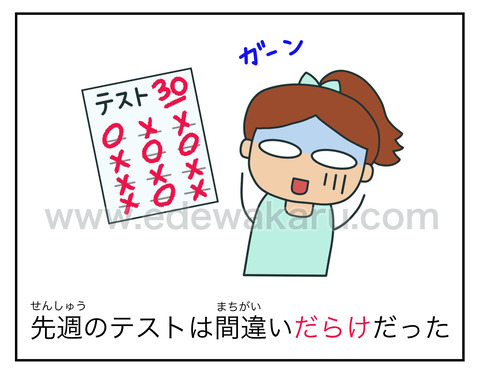
先週のテストは間違いだらけだった
→先週のテストは間違いがいっぱいあったLast week’s test was full of mistakes. →There were a lot of mistakes on last week’s test.
彼女の部屋はゴミだらけだ
→彼女の部屋はゴミがたくさんあるHer room is full of garbage. →There is a lot of garbage in her room.
私のクラスは男だらけだ
→私のクラスは男がいっぱいいるMy class is full of boys. →There are a lot of boys in my class.
子供達が泥だらけで遊んでいる
→子供達が(服に)泥がたくさんついた状態で遊んでいるThe children are playing covered in mud. →The children are playing with lots of mud on their clothes.
Read the original source text
Meaning
〜が多い
〜がいっぱいある・〜がいっぱいいる
〜が表面にたくさんついている
How to use it
名詞[辞書形]+だらけ
Explanation
「〜だらけ」は「〜がいっぱいある・いる」「〜が多い」という意味で使われる文型です。「〜だらけ」はいいことには使われず、
マイナスのことに使用すると覚えておきましょう
😌また、例文②のように
「(表面に)〜がたくさんついている」という意味でも使用されます
😀
[表面にたくさんついているの例]
血だらけ
の服→血が表面にたくさんついている
ホコリだらけ
の部屋→壁や物の上にホコリがたくさんついている部屋
油だらけ
の手→油がたくさんついている手
「〜だらけ」に似ている文型はいくつかありますが、その中で「〜だらけ」は1番使える範囲が広くて使いやすいです😀会話でもよく使いますのでしっかりと覚えておきましょう😉
【関連文型】
日本語文型辞典
Meaning
Basic information: Nだらけだ. Description: Full of it, with lots of only that thing. Unlike “いっぱい” (“full of”), this often expresses the speaker’s negative evaluation. In example ⑤, it suggests not only that there are a great many books in the room, but also that there are too many or that the room feels cluttered.
Examples: ① I got back a test paper full of mistakes. ② The child came into the room with feet covered in mud. ③ He is deep in debt. ④ I watched a movie called “A Youth Covered in Scars.” ⑤ Her room is full of books.
Read the original source text
Meaning
基本情報Nだらけだ説明それでいっぱいで、そればかりがたくさんある様子。「…でいっぱい」と違い、話し手のマイナスの評価を表すことが多い。⑤は部屋に本が非常にたくさんあるというだけでなく、多すぎたり、散らかっている感じがある。例文① 間違いだらけの答案が返ってきた。② 子供は泥だらけの足で部屋に上がってきた。③ 彼は借金だらけだ。④ 「傷だらけの青春」という映画を見た。⑤ 彼女の部屋は本だらけだ。
日本語文型辞典 英語版
Meaning
【だらけ】[Nだらけだ]
Describes a situation where there is a lot of something and only that. Unlike ...でいっぱい, indicates a negative feeling of the speaker about such a situation.
(5)
gives the feeling that there are not just many books in the room, there are too many, and thus the room is messy.
In context 5 examples
間違いだらけの答案が返ってきた。
I got back an answer sheet full of mistakes.
子供は泥だらけの足で部屋に上がってきた。
Children came into the room with mud all over their shoes.
彼は借金だらけだ。
He’s deep in debt. / He has a lot of debt.
「傷だらけの青春」という映画を見た。
I watched a film called Bruised-up Youth (original title: Split Decisions).
彼女の部屋は本だらけだ。
Her room is packed with books.
くらべてわかる日本語表現文型辞典
Meaning
A is present in an excessive amount. The speaker does not consider that a good thing.
How to use it
Aだらけ
[Noun—∅] だらけ
Explanation
【Contrast 1】
“Aまみれ” (Meaning 1, p. 296)
“Aずくめ” (Meaning 1, p. 107)
Notes
【Note 1】
・A is not necessarily a noun with a negative image, but for the speaker, there is too much A, which is unpleasant or frustrating.
○何だ!この花だらけの部屋は。足の踏み場もないぞ。 — What is this room, covered in flowers? There isn’t even room to step!
×あの庭は花だらけで美しい。 — That garden is full of flowers and beautiful.
In context 4 examples
君の答案はまちがいだらけでした。
Your answer sheet was full of mistakes.
どうしたんだ。服が泥だらけじゃないか。
What happened? Your clothes are covered in mud!
失敗だらけの人生でしたが、今は幸せです。
My life was full of failures, but I’m happy now.
問題だらけの法案だと、野党は与党を攻撃した。
The opposition attacked the ruling party, saying the bill was riddled with problems.
Read the original source text
Meaning
Aがあまりにも多くある様子。話し手はそれを良いこととは思っていない。
How to use it
Aだらけ
[名詞-∅]だらけ
Explanation
【対比1】
「Aまみれ」(意味1 P.296)
「Aずくめ」(意味1 P.107)
Notes
【注意1】
・Aは必ずしも悪いイメージの名詞とは限らないが、話し手にとってはAが多くあることが不快・不満である。
○何だ!この花だらけの部屋は。足の踏み場もないぞ。
×あの庭は花だらけで美しい。
日本語NET JLPT文法解説まとめ
Meaning
“There is a lot of ~ / A lot of ~ is attached.”
An undesirable state in which many things of the same kind are present.
How to use it
N + だらけ
Explanation
Indicates that something has a lot of something similar, which is undesirable.
N does not necessarily have to be something that gives a bad or dirty impression.
Example: What is this room, full of paintings?
In context 14 examples
私が翻訳した英語は間違いだらけだったので、友達に直してもらった。
The English I translated was full of mistakes, so I had my friend correct it.
自信があったのに、先週のテストは間違えだらけだった。
Even though I was confident, last week’s test was full of mistakes.
この車はもう傷だらけですが、たくさんの思い出が詰まっているので、まだ買いかえたくないです。
This car is covered in scratches, but it holds so many memories that I still don’t want to replace it.
息子が傷だらけで帰ってきた。友達とケンカしたようだ。
My son came home covered in scratches. It looks like he got into a fight with a friend.
彼の部屋は漫画だらけで、勉強の本は全然なかった。
His room was full of manga, and there weren’t any study books at all.
彼の言うことは矛盾だらけで、全く信用できない。
What he says is full of contradictions, so I can’t trust him at all.
こんな泥だらけの靴ではお店に入れないよ。
I can’t go into the store wearing shoes covered in mud like these.
そんな油だらけの手で、食器を触らないでよ。
Don’t touch the dishes with hands covered in oil like that.
息子が血だらけで帰ってきたので、急いで病院へ連れて行った。
My son came home covered in blood, so I hurriedly took him to the hospital.
借金だらけの生活から、いつになったら、抜け出せるんだろうか。
I wonder when I’ll be able to escape this life full of debt.
部屋がホコリだらけなのに、彼は全然、掃除しない。
Even though the room is covered in dust, he doesn’t clean at all.
一人暮らしの彼氏の家に行ったら、ゴミだらけだった。
When I went to my boyfriend’s place, where he lives alone, it was full of trash.
三年ぶりに歯医者に行ったら、虫歯だらけだった。
When I went to the dentist for the first time in three years, I had cavities everywhere.
私の部署は男だらけで華がない。
My department is full of men, so it has no charm.
Read the original source text
Meaning
"〜がたくさんある / 〜がたくさんついている"
同質のものが多量に存在していてよくない状態。
How to use it
N + だらけ
Explanation
Indicates that something has a lot of something similar, which is undesirable.
Nには必ずしも悪い・汚いイメージの物が来るとは限らない。
例:なんだこの、絵画だらけの部屋は。
毎日のんびり日本語教師
How to use it
Noun + だらけ
Explanation
This grammar expresses that there is a lot of something dirty or unpleasant. It conveys the speaker’s negative impression.
It is often attached to words such as garbage, dust, debt, blood, mistakes, errors, wounds, mud, and wrinkles.
Notes
Nothing in particular.
In context 8 examples
この部屋は掃除していないのか、ゴミだらけだ。
Maybe this room hasn’t been cleaned; it’s covered in garbage.
新築なのに工事の後そのままなのでほこりだらけだった。
Even though it’s a new building, it had been left as it was after construction, so it was covered in dust.
今の日本の財政状況を見ると借金だらけで、税収で支え切れていない。
Looking at Japan’s current fiscal situation, it’s buried in debt and tax revenue can’t support it.
口の中を切って血だらけになった。
I cut the inside of my mouth and it ended up covered in blood.
この答案用紙は間違いだらけであまりにもひどすぎる。
This answer sheet is full of mistakes; it’s just too awful.
子供が傷だらけで帰ってきた。
The child came home covered in cuts.
農道を車で走ると泥だらけになる。
Driving along a farm road leaves you covered in mud.
このしわだらけの手がずっと頑張って働いてきた証拠だ。
These hands, covered in wrinkles, are proof that I’ve kept working hard all this time.
Read the original source text
How to use it
名詞+だらけ
Explanation
汚かったり、不愉快と感じるものがたくさんあることを表す文法です。話者のマイナスの印象を表します。
ゴミ、ほこり、借金、血、ミス、間違い、傷、泥、しわなどによく接続されます。
Notes
特になし
IMABI
Appearance
Read this IMABI lesson ↗Explanation
Appearance: ~だらけ, ~まみれ, ~ずくめ, ~めく, ~げ, ~みどろ, & ~気味
There are several suffixes in Japanese that represent states of appearance.
~だらけ
~だらけ attaches to nouns to describe how something is riddled with something. ~だらけ may be used with both physical and psychological items. There is an extent to how you can use this though. Things like 混乱こんらんだらけ would be wrong. This is because it should be used with things that are either physical or dealing with (emotional) phenomenon and not a “state”. Rather than 混乱だらけ, consider phrases like すごく狼狽ろうばいしている or とても動揺どうようしている.
1. 彼女は(口を開けば){不平・不満}{ばっかり言ってる・だらけだ}な。
She’s full of complaints isn’t she?
2. パソコンは埃ほこり{かぶっていた・だらけだった}。
The desktop was covered in dust.
3. 後悔こうかいだらけ
Covered in regret
4. 傷きずだらけ
Covered in injuries
5. 血だらけになった殺人犯さつじんはんは逃にげ場ばがなくなって自殺じさつしたそうだ。
They say that since the murderer covered in blood didn’t have a place to run away, he committed suicide.
~塗れ
~まみれ comes from 塗まみれる which means “to be covered with”. Similar to ~だらけ ~まみれ shows how something is completely covered in something. Unlike ~だらけ, ~まみれ is solely used with physical objects. However, there is a trend to use ~まみれ with things that have a “physical persona”. This, though, is metaphoric. Creating metaphors in any language causes rules to become more flexible.
6. 遺体いたいは血塗れだったということです。
It is said that the corpse was completely covered in blood.
7. メキシコ湾わんは{辺り一面}重油じゅうゆ{埋め尽くされました・まみれになりました}。
The Gulf of Mexico became completely covered in heavy oil.
8. 彼はただの挫折塗ざせつまみれのやつだけだ。
He’s just completely covered in failure.
~尽くめ
~ずくめ shows that something is “completely…”. It is normally either attached to nouns of colors or こと. There is, though, a condition that whatever it attaches to that the context is in relation to human intent.
A similar ending is ~ずくし. It means “all sorts of”. Here, the human intent condition is non-existent. In writing, using づ instead of ず is OK. This is just a conflict between Old and New orthographies that has just been left to the individual to decide.
9. 人が黒尽くめでした。
The person was completely black.
10. いい事づくしの人
A person full of good luck
11a. 白づくめで抗議してる人は窃盗罪せっとうざいで訴うったえられた人達だ。
11b. 抗議をしている、白づくめの人達は、窃盗罪で訴うったえられた。
The people protesting dressed in white were accused of theft.
~めく
~めく shows what something looks like or what condition something becomes, and it may follow nouns, adverbs, or the stem of adjectives and verbs. The closest translation for ~めく is “to show signs of”. Although all tenses are possible, ~めく is normally only used in the non-past or past tense. Depending on the verb, there are may be more options. For instance, うごめく can be seen in things like the progressive.
To be astir ざわめく To flash 閃く To be mysterious 謎めく
To glimmer 仄めく To color 色めく To be spring-like 春めく
To wriggle うごめく To flourish 時めく To be autumn-like 秋めく
Grammar Note: When attached to verbs, the new verb is often seen contracted and then written differently. ~めく is most often used with nouns and 形容動詞.
12. 教室は興奮こうふんで騒ざわめいた。
The classroom stirred with excitement.
13. 庭の楓かえでが色めくのは本当に美しいですよね。
The changing in colors of the maple trees in the garden is really beautiful, isn’t it?
14. {うわぁ・ああ}、{もぞもぞ動いてる・蠢うごめいてる}虫(がいる)!
Ah, a wriggling worm!
15. 彼は今を時めく歌手・有名人です。
He is one of the most prosperous singers/famous people of the time.
16. 謎なぞめいた様子ようすをしている。
To have an air of mystery.
17. 謎めいた様相ようそうを呈ていする。
To be in a situation covered in mystery.
18. 冬めいてきた。
It became winter-like.
19. 陽光に川面が煌めく。
The river surface glistens in the sunlight.
20. どよめいて、人々が飛びのく。一人の背中が飛鳥にぶつかった。はね飛ばされて、壁に肩をぶつける。さらにはね返ってよろめき、あやうく転びかけたときだった。
Making a stir, people jumped back. A person’s back hit Asuka. Being sent flying, she hit her shoulder on the wall. In addition, it was when she had bounced back, staggered, and dangerously started to tumble.
From 野生の風 by 村山由佳.
~みどろ
~みどろ is a less common alternative to the suffix ~まみれ to show things being covered in something.
21. 血みどろの遺体
A bloody corpse
22. 汗みどろの労働者
A sweat covered laborer
~気
~げ conjugates as a 形容動詞けいようどうし. Used to show a sense of true appearance, it describes something with intense fervor and emotion. Lastly, ~げ may be attached to the stem of adjectives and to nouns.
23. 悲しげに泣く。
Cry while being sad all over.
24. 均衡予算を黙殺するのは大人げない。
Ignoring the balanced budget proposal is childish.
25. 彼は何か言いたげな顔をしていた。
He had the face of wanting to say something.
26. 「今も新しい戦争が僕らを追っかけて来ているのかもしれないし、僕らのなかの前の戦争が、亡霊のように僕らを追っかけているかもしれないんです。」と修一は憎さげに、「お父さまこそ、あの娘がちょっと変わっているから、ひそかに魅力を感じて、妙な考えをくどくどもってまわってらっしゃる。女がほかの女とどこかちょっとちがっているだけで、男はつかまるのですからね。」
“A new word may have come its way to chase after us even now, but the war of the past within ourselves may be chasing after us like a departed spirit”, and Shuichi continued odiously with “And you, of course, Father inwardly feel a mystique since she’s changed a little, and you’re going about stuttering long-winded, strange thoughts. That’s man is just something that it’s caught up with the small differences one woman has with other women.”
From 山の音 by 川端康成.
27. 菊子は不審げに信吾を見て、そして顔を赤らめた。
Kikuko looked strangely at Shingo and then blushed.
From 山の音 by 川端康成.
Grammar Note: ~げ is almost never used with verbs. ~げ is closest to ~そうだ, but ~そうだ lacks the emotional emphasis. As emotional emphasis is very important, it is used with nouns that we aspire to be and adjectives that express our emotions.
The reading け and ぎ also exist, and they confusingly are used similarly to the げ reading. Luckily, the latter reading is not written as 気. The reading け is seen a lot in phrases like 飾り気 (affectation), 色気 (sex appeal), and 寒気 (feeling chilly). 人気 has two readings. When it is read as にんき, it means “popularity”, and when it is read as ひとけ, it is the antonym of deserted, but it is usually used in this sense in the phrase 人気がない.
The reading ぎ of 気 is rather restricted to nouns that can have perceptually suitable characteristics. Words such as 商売気 (mercenary mind), 男気 (chivalry), and 女気 (woman care) come to mind, and the only other examples are all literary words unlikely to be used in conversation, or at the very least appear rarely in literature. Examples of such words include 謀反気 (rebelling spirit), 芝居気 (theatrical spirit), 芸気 (theatrical spirit), and 回り気 (worrying and doubtful spirit).
28. お前さんも余程回り気の人だね。
You’re quite the worry wort too, aren’t you.
From 深川女房 by 小栗風葉.
Interestingly enough, the most common examples of ぎ and け are replaced with っけ. Examples of this include人っ気, 飾りっ気, and 商売っ気. Even words that typically only use け such as 真っ黒け and 真っ白け may have っ insertion in actual conversation. Even more interesting is the fact that the phrases 真っ赤っ赤 (bright red) and 真っ黄っ黄 (bright yellow) exist. The first one shows up dictionaries and is used widely, but the latter is rather dialectical. The interesting point here is how the forms seem to mimic the use of っけ for emphasis.
29. 彼は仕事を事もなげにやってのけた。
He pulled the job off as if nothing happened.
~気味
~気味ぎみ is seen after either a noun or the 連用形れんようけい of a verb. It shows a visible indication or slight feeling and is often used in a negative context. Common translations include “sign of,” “on the…side,” and “slight.”
30. 彼は疲れ気味だ。
He has the signs of fatigue.
30. 彼は太り気味だ。
He’s a little on the heavy side.
31. 今朝はちょっと風邪気味だ。
I have a slight feeling of a cold this morning.
Word Note: ~味 comes from 気味, which means “sensation” or “tendency.”
In context 33 examples
彼女は(口を開けば){不平・不満}{ばっかり言ってる・だらけだ}な。
She’s full of complaints isn’t she?
パソコンは埃ほこり{かぶっていた・だらけだった}。
The desktop was covered in dust.
後悔こうかいだらけ
Covered in regret
傷きずだらけ
Covered in injuries
血だらけになった殺人犯さつじんはんは逃にげ場ばがなくなって自殺じさつしたそうだ。
They say that since the murderer covered in blood didn’t have a place to run away, he committed suicide.
遺体いたいは血塗れだったということです。
It is said that the corpse was completely covered in blood.
メキシコ湾わんは{辺り一面}重油じゅうゆ{埋め尽くされました・まみれになりました}。
The Gulf of Mexico became completely covered in heavy oil.
彼はただの挫折塗ざせつまみれのやつだけだ。
He’s just completely covered in failure.
人が黒尽くめでした。
The person was completely black.
いい事づくしの人
A person full of good luck
白づくめで抗議してる人は窃盗罪せっとうざいで訴うったえられた人達だ。
The people protesting dressed in white were accused of theft.
抗議をしている、白づくめの人達は、窃盗罪で訴うったえられた。
The people protesting dressed in white were accused of theft.
教室は興奮こうふんで騒ざわめいた。
The classroom stirred with excitement.
庭の楓かえでが色めくのは本当に美しいですよね。
The changing in colors of the maple trees in the garden is really beautiful, isn’t it?
{うわぁ・ああ}、{もぞもぞ動いてる・蠢うごめいてる}虫(がいる)!
Ah, a wriggling worm!
彼は今を時めく歌手・有名人です。
He is one of the most prosperous singers/famous people of the time.
謎なぞめいた様子ようすをしている。
To have an air of mystery.
謎めいた様相ようそうを呈ていする。
To be in a situation covered in mystery.
冬めいてきた。
It became winter-like.
陽光に川面が煌めく。
The river surface glistens in the sunlight.
どよめいて、人々が飛びのく。一人の背中が飛鳥にぶつかった。はね飛ばされて、壁に肩をぶつける。さらにはね返ってよろめき、あやうく転びかけたときだった。
Making a stir, people jumped back. A person’s back hit Asuka. Being sent flying, she hit her shoulder on the wall. In addition, it was when she had bounced back, staggered, and dangerously started to tumble.
血みどろの遺体
A bloody corpse
汗みどろの労働者
A sweat covered laborer
悲しげに泣く。
Cry while being sad all over.
均衡予算を黙殺するのは大人げない。
Ignoring the balanced budget proposal is childish.
彼は何か言いたげな顔をしていた。
He had the face of wanting to say something.
「今も新しい戦争が僕らを追っかけて来ているのかもしれないし、僕らのなかの前の戦争が、亡霊のように僕らを追っかけているかもしれないんです。」と修一は憎さげに、「お父さまこそ、あの娘がちょっと変わっているから、ひそかに魅力を感じて、妙な考えをくどくどもってまわってらっしゃる。女がほかの女とどこかちょっとちがっているだけで、男はつかまるのですからね。」
“A new word may have come its way to chase after us even now, but the war of the past within ourselves may be chasing after us like a departed spirit”, and Shuichi continued odiously with “And you, of course, Father inwardly feel a mystique since she’s changed a little, and you’re going about stuttering long-winded, strange thoughts. That’s man is just something that it’s caught up with the small differences one woman has with other women.”
菊子は不審げに信吾を見て、そして顔を赤らめた。
Kikuko looked strangely at Shingo and then blushed.
お前さんも余程回り気の人だね。
You’re quite the worry wort too, aren’t you.
彼は仕事を事もなげにやってのけた。
He pulled the job off as if nothing happened.
彼は疲れ気味だ。
He has the signs of fatigue.
彼は太り気味だ。
He’s a little on the heavy side.
今朝はちょっと風邪気味だ。
I have a slight feeling of a cold this morning.
文法
Meaning
“There is a lot of ~ / A lot of ~ is attached.”
An undesirable state in which many things of the same kind are present.
How to use it
N + だらけ
Notes
The noun N does not necessarily have to refer to something with a bad or dirty image.
Example: What is this room, covered in paintings?
In context 14 examples
私が翻訳した英語は間違いだらけだったので、友達に直してもらった。
The English I translated was full of mistakes, so I had my friend correct it.
自信があったのに、先週のテストは間違えだらけだった。
Even though I was confident, last week’s test was full of mistakes.
この車はもう傷だらけですが、たくさんの思い出が詰まっているので、まだ買いかえたくないです。
This car is covered in scratches, but it holds so many memories that I still don’t want to replace it.
息子が傷だらけで帰ってきた。友達とケンカしたようだ。
My son came home covered in scratches. It looks like he got into a fight with a friend.
彼の部屋は漫画だらけで、勉強の本は全然なかった。
His room was full of manga, and there weren’t any study books at all.
彼の言うことは矛盾だらけで、全く信用できない。
What he says is full of contradictions, so I can’t trust him at all.
こんな泥だらけの靴ではお店に入れないよ。
I can’t go into the store wearing shoes covered in mud like these.
そんな油だらけの手で、食器を触らないでよ。
Don’t touch the dishes with hands covered in oil like that.
息子が血だらけで帰ってきたので、急いで病院へ連れて行った。
My son came home covered in blood, so I hurriedly took him to the hospital.
借金だらけの生活から、いつになったら、抜け出せるんだろうか。
I wonder when I’ll be able to escape this life full of debt.
部屋がホコリだらけなのに、彼は全然、掃除しない。
Even though the room is covered in dust, he doesn’t clean at all.
一人暮らしの彼氏の家に行ったら、ゴミだらけだった。
When I went to my boyfriend’s place, where he lives alone, it was full of trash.
三年ぶりに歯医者に行ったら、虫歯だらけだった。
When I went to the dentist for the first time in three years, I had cavities everywhere.
私の部署は男だらけで華がない。
My department is full of men, so it has no charm.
Read the original source text
Meaning
"〜がたくさんある / 〜がたくさんついている"
同質のものが多量に存在していてよくない状態。
How to use it
N + だらけ
Notes
Nには必ずしも悪い・汚いイメージの物が来るとは限らない。
例:なんだこの、絵画だらけの部屋は。