AIUEO JLPT Grammar
Meaning
This sentence pattern describes transitioning to the next stage after passing through or experiencing something. It emphasizes processes or experiences that lead to the current or next state by connecting to time, place, or stage nouns.
How to use it
Noun を + 経て
In context 5 examples
彼は長年の訓練を経て、一流の選手となった。
After years of training, he became a top athlete.
時間を経て、彼の態度が少しずつ変わってきた。
Over time, his attitude gradually changed.
長い議論を経て、ついに合意に至った。
After long discussions, we finally reached an agreement.
彼はさまざまな仕事を経て、今の職業に就いた。
After going through various jobs, he landed his current profession.
いくつかの段階を経て、製品が完成する。
The product is completed after passing through several stages.
Read the original source text
Meaning
This sentence pattern describes transitioning to the next stage after passing through or experiencing something. It emphasizes processes or experiences that lead to the current or next state by connecting to time, place, or stage nouns.
How to use it
名詞を+経て
Explanation · 日本語
この文型は、何かを経過したり、経験した後で次の段階に進むことを表す表現です。時間や場所、段階を示す名詞に接続し、プロセスや経験を通して現在や次の状態に至ることを強調します。
文法
Meaning
After experiencing 〜 / after a period of time has passed / indicates the route through which one passes, such as time, place, or means.
How to use it
N + を経て
In context 6 examples
アメリカ留学を経て、英語はもちろん、日本とは異なる文化についても学ぶことができた。
After studying abroad in America, I was able to learn not only English but also about cultures different from Japan’s.
色んな失敗を経て、人は成長するものです。
People grow through all kinds of failures.
色々な仕事の経験を経て、一番やりがいのある仕事はやっぱり日本語教師だと思った。
After experiencing various kinds of work, I realized that the most rewarding job is, after all, being a Japanese teacher.
当社では、新入社員は3ヶ月の研修を経て、各部署へ配属となります。
At our company, new employees are assigned to their respective departments after completing three months of training.
10年の歳月を経て、誰も見たこともないような素晴らしい製品が完成した。
After ten years, an amazing product unlike anything anyone had ever seen was completed.
日本からの直行便がないので、イギリスを経てスペインへ行く。
Since there are no direct flights from Japan, I’ll go to Spain via the UK.
Read the original source text
Meaning
〜を経験したあとで / (時間)がたったあとで / 〜を通って時間、場所、手段などの経由を表す。
How to use it
N + を経て
Bunpro Grammar Reference
Meaning
Via, Through, After (experience at job, university, etc.), Pass through
How to use it
Noun + を経て
Nuance
A formal construction, showing that through (A), (B). By passing through the time period of (A), (B).
Explanation
を経て is a fairly formal grammar point used when highlighting a passage of time, or an event that took a certain amount of time. 経る itself is a る-Verb that means 'to elapse' or 'to pass' in terms of time. The difference between it and 過ぎる 'to pass time' is that 過ぎる focuses on having reached the end point, while 経る focuses on what was happening for the whole period leading up to that end point. Because of this, を経て can also be translated as 'having undergone (A)', due to the emphasis being on the preceding action.
を経て will directly follow nouns, and the rest of the sentence usually then goes on to describe the significance of that passage of time or experience, or what happened as a result.
私たちは2019年に出会って、約2年間の交際を経て結婚しました。
We met in 2019, and married after going through two years of dating.
日本への留学を経て、日本の文化などを学ぶことができました。
Through my study in Japan, I was able to learn about Japanese culture and other aspects of the country.
人は色々な経験を経て、成長していく。
People grow through various experiences.
As it is a formal structure, を経て is often seen in biographies, introductions, and similar media.
In context 15 examples
- ベルリンからローマを経てブエノスアイレスに向かいます。
From Berlin, via Rome, to Buenos Aires. (through)
- 私たちは2019年に出会って、約2年間の交際を経て結婚しました。
We met in 2019, and married after going through two years of dating.
- 日本への留学を経て、日本の文化などを学ぶことができました。
Through my study in Japan, I was able to learn about Japanese culture and other aspects of the country.
- 人は色々な経験を経て、成長していく。
People grow through various experiences.
- 数世代を経てもなお争議が続いている。
Even after several generations, the dispute still continues. (through・via・experience)
- ちとげとらくは、約10年の交際を経て結婚した。
Chitoge and Raku finally married after going through about ten years of dating. (through・via・experience)
- 略歴:「早稲田大学理学部卒業後Google(グーグル)勤務を経て202(にー)〇(まる)年独立。」
Short bio: 'Graduated from the department of science, Waseda University. After (having the experience of) working at Google, he started his own business in 202X.' (through・via)
- 新聞:「今後必要な手続きを経て、鉱山買収は完了します。」
Newspaper: 'After going through all of the necessary procedures, the mine acquisition will be complete.' (through・via・experience)
- 私の妹は大学卒業後に三年間に渡るイギリス留学を経て高校の英語教師になった。
After my little sister's graduation, through her experience of studying abroad in England for 3 years, she became a high school English teacher.
- 様々な手続きを経てやっと離婚が成立し、今は清々しい気持ちでいっぱいです。
After a slew of proceedings, our divorce was finally realized, and now I am full of refreshed feelings.
- 一年間の休養を経て仕事に復帰する事になったが不安で押し潰されそうになっている。
After recuperating for one year, I was reinstated at work, but it feels like I will be crushed with anxiety.
- 新入社員として五年間に渡る本社での経験を経て、今月から地方でリーダーとして働く事になった。
Through my experience spanning 5 years at the head office as a new arrival, it has been decided that I will work as a regional leader from this month.
- 流行りの疫病で直行便が減っているため、私たちは日本からシンガポールを経てオーストラリアへ渡りました。
Due to direct flights decreasing with the prevalence of the epidemic, we crossed from Japan, via Singapore, and to Australia.
- 人は多くの失敗を経て成長するのだから、一つや二つ失敗をしたからといって落ち込み過ぎないでね。
Since people will grow after going through many failures, don't get depressed just because of one or two mistakes.
- 教科書の筆者の紹介:「日本語研修所講師を経て現在はJapanese(ジャパニーズ) Institute(インスティチュート) of Language(ランゲージ) &(アンド) History(ヒストリー)代表。」
Introduction of a textbook author: 'After working as a lecturer at a Japanese language training institute, she is now the representative of the Japanese Institute of Language & History.' (through・via・experience)
Read the original source text
Meaning
Via, Through, After (experience at job, university, etc.), Pass through
How to use it
Noun + を経て
Nuance
A formal construction, showing that through (A), (B). By passing through the time period of (A), (B).
Explanation
を経て is a fairly formal grammar point used when highlighting a passage of time, or an event that took a certain amount of time. 経る itself is a る-Verb that means 'to elapse' or 'to pass' in terms of time. The difference between it and 過ぎる 'to pass time' is that 過ぎる focuses on having reached the end point, while 経る focuses on what was happening for the whole period leading up to that end point. Because of this, を経て can also be translated as 'having undergone (A)', due to the emphasis being on the preceding action.
を経て will directly follow nouns, and the rest of the sentence usually then goes on to describe the significance of that passage of time or experience, or what happened as a result.
私たちは2019年に出会って、約2年間の交際を経て結婚しました。
We met in 2019, and married after going through two years of dating.
日本への留学を経て、日本の文化などを学ぶことができました。
Through my study in Japan, I was able to learn about Japanese culture and other aspects of the country.
人は色々な経験を経て、成長していく。
People grow through various experiences.
As it is a formal structure, を経て is often seen in biographies, introductions, and similar media.
Nuance · 日本語
(A)を通して(B)ということを示す丁寧な表現。(A)という時期を通過し、(B)。
Explanation · 日本語
「を経て」は、やや硬めの表現で、時間の経過や、ある出来事に至るまでの過程や経験を強調したいときに使われます。「経る」は「(通過点として)通る」や「時間が経つ」という意味の一段動詞です。この動詞は「過ぎる」とも似ていますが、「過ぎる」が「終わりに達したこと」そのものに焦点を当てるのに対し、「経る」はその終わりに至るまでの期間や段階、過程を通り過ぎることに重きを置いています。そのため、「を経て」は「(A) を通って」や「(A) を経験して」といった意味で、経験や時間、場所などに使われます。
「を経て」は名詞の直後に置かれ、その後には通常、(A) を通り過ぎた上で起こる結果が述べられます。
私たちは2019年に出会って、約2年間の交際を経て結婚しました。
We met in 2019, and married after going through two years of dating.
日本への留学を経て、日本の文化などを学ぶことができました。
Through my study in Japan, I was able to learn about Japanese culture and other aspects of the country.
人は色々な経験を経て、成長していく。
People grow through various experiences.
「を経て」は硬い言い方なので、伝記や経歴の紹介文などでよく使われています。
絵でわかる日本語
Meaning
After time has passed since ~ [time]
Having experienced ~ [experience]
Passing through ~ [place]
Through the state/process of ~ [process]
How to use it
Noun [dictionary form] + を経て
Explanation
“Aを経てB” is a sentence pattern meaning “B by way of A.” A is a word expressing [time], [experience], or [place].
[Time]
→after time has passed since ~
[Experience]
→having experienced ~
[Place]
→passing through ~
[Examples]
① Having studied abroad, I learned many things, including Japanese.
→Having experienced studying abroad, I learned many things, including Japanese.
② Apparently, my mom and dad got married after dating for ten years.
→Apparently, they got married after a period of ten years had passed.
③ We went from Japan to France via South Korea.
→We went to France via South Korea.
④ After a three-month training period, I became a full-time employee.
→After a period of three months had passed, I became a full-time employee.
⑤ People grow through various experiences.
→Having had various experiences, people grow.
Remember that “〜を経て” is often used with [time] and [place] 😀
In context 5 examples
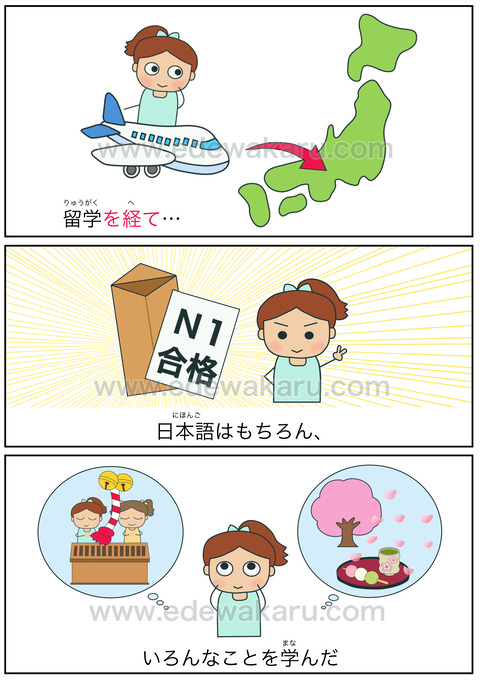
留学を経て日本語はもちろん、いろんなことを学んだ
Having studied abroad, I learned many things, including Japanese.
うちのお父さんとお母さんは、10年間の交際を経て結婚したらしい
Apparently, my mom and dad got married after dating for ten years.
日本から、韓国を経てフランスに行きました
We went from Japan to France via South Korea.
3か月の研修期間(けんしゅうきかん)を経て、正社員になりました
After a three-month training period, I became a full-time employee.
いろんな経験を経て、人は成長していくものだ
People grow through various experiences.
Read the original source text
Meaning
〜の時間が経ったあとで[時間]
〜を経験して[経験]
〜を通って[場所]
〜の状態を通して[過程]
How to use it
名詞[辞書形]+を経て
Explanation
「Aを経てB」は「Aを通ってB」という意味を表す文型です。「A」には[時間][経験][場所]を表す言葉が入ります。
「時間」
→
〜の時間が経ったあとで
「経験」
→
〜を経験して
「場所」
→
〜を通って
[例]
①留学
を経て
日本語はもちろん、いろんなことを学んだ
→留学
を経験して
日本語はもちろん、いろんなことを学んだ
②うちのお父さんとお母さんは、10年間の交際
を経て
結婚したらしい
→10年
の期間が経ったあとで、結婚したらしい
③日本から、韓国
を経て
フランスに行きました
→韓国
を通って
フランスに行きました
④3か月の研修期間
を経て、正社員になりました
→3か月
の期間が経ったあとで、正社員になりました
⑤いろんな経験
を経て、人は成長していくものだ
→いろんな
経験をして、人は成長していくものだ
「〜を経て」は、[時間]や[場所]によく使われると覚えておきましょう😀
日本語NET JLPT文法解説まとめ
Meaning
after experiencing ~ / after (time) has passed / via ~
Indicates passage through time, a place, or a means.
How to use it
N + を経て
Explanation
"after experiencing 〜 / after (time) has passed / through 〜"
Indicates the passage of time, location, or means.
In context 6 examples
アメリカ留学を経て、英語はもちろん、日本とは異なる文化についても学ぶことができた。
After studying abroad in America, I was able to learn not only English but also about cultures different from Japan’s.
色んな失敗を経て、人は成長するものです。
People grow through all kinds of failures.
色々な仕事の経験を経て、一番やりがいのある仕事はやっぱり日本語教師だと思った。
After experiencing various kinds of work, I realized that the most rewarding job is, after all, being a Japanese teacher.
当社では、新入社員は3ヶ月の研修を経て、各部署へ配属となります。
At our company, new employees are assigned to their respective departments after completing three months of training.
10年の歳月を経て、誰も見たこともないような素晴らしい製品が完成した。
After ten years, an amazing product unlike anything anyone had ever seen was completed.
日本からの直行便がないので、イギリスを経てスペインへ行く。
Since there are no direct flights from Japan, I’ll go to Spain via the UK.
Read the original source text
Meaning
"〜を経験したあとで / (時間)がたったあとで / 〜を通って"
時間、場所、手段などの経由を表す。
How to use it
N + を経て
Explanation
"after experiencing 〜 / after (time) has passed / through 〜"
Indicates the passage of time, location, or means.
毎日のんびり日本語教師
How to use it
Noun + を経て
Explanation
Indicates passing through a place (a stopover), time, or means.
Notes
Similar grammar: 「[N2 grammar] ~を通じて(つうじて)/を通して(とおして)」
「~通じて/通して」 cannot be used for a stopover. 「を経て」 can be used to indicate a stopover.
✕
韓国を通じて日本に行く。
◯
韓国を経て日本に行く。
In context 8 examples
韓国を経て日本に行く。
I’m going to Japan via Korea.
2年という長い道のりを経て司法試験にようやく合格することができた。
After the long two-year journey, I was finally able to pass the bar exam.
たくさんの別れと出会いを経て、今の私がある。
The person I am today is the result of many partings and meetings.
彼女とは紆余曲折を経てよりを戻すことになった。
After many twists and turns, she and I got back together.
こうした体験を経て、人は成長していく。
People grow through experiences like these.
わずらわしい手続きや申請を経て、ようやく認可が下りた。
After going through troublesome procedures and applications, approval was finally granted.
数々の失敗を経て気づいた。
I realized it after going through many failures.
国民投票を経て得られた民意を蔑ろにしてはいけない。
The will of the people expressed through a national referendum must not be disregarded.
Read the original source text
How to use it
名詞+を経て
Explanation
場所(経由地)や時間、手段などの経由を表します。
Notes
似ている文法「【N2文法】~を通じて(つうじて)/を通して(とおして)」
「~通じて/通して」は経由地に使うことができません。経由地を表す場合は「を経て」が使えます。
✕
韓国を通じて日本に行く。
◯
韓国を経て日本に行く。