絵でわかる日本語
Meaning
〜without it being a problem
〜become unnecessary
〜without needing to〜
How to use it
Verb [ない-form] + ないですむ
Verb [ない-form] + ずにすむ
Noun [dictionary form] + なしですむ
Explanation
“〜ないですむ,” “〜ずにすむ,” and “〜なしですむ” are sentence patterns meaning “〜without it being a problem,” “〜become unnecessary,” or “〜without needing to〜.”
In most cases, they are used when you want to say that you no longer have to do something bad, unpleasant, or troublesome. 😮
(Review: 〜くさい)
Remember that for verbs, there are two forms: “〜ないですむ” and “〜ずにすむ.”
😀
[Examples]
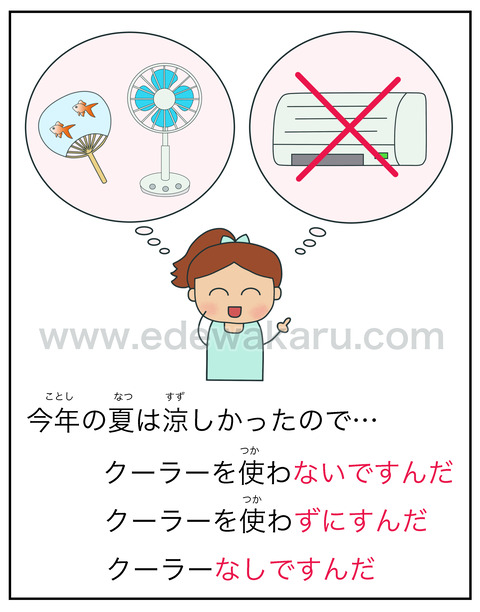
Because this summer was cool, I got by without using the air conditioner.
= Because this summer was cool, I got by without using the air conditioner.
Be careful: when used with a noun, the form is “〜なしですんだ.” 😨
[Examples]
❌ Because this summer was cool, I got by without an air conditioner.
⭕️ Because this summer was cool, I got by without an air conditioner.
Remember that when written in kanji, “〜ないですむ,” “〜ずにすむ,” and “〜なしですむ” are written
“〜ないで済む,” “〜ずに済む,” and “〜なしで済む.”
😀
In context 5 examples
今年の夏は涼しかったので、クーラーを使わないですんだ
→今年の夏は涼しかったので、クーラーを使わなくても問題はなかったBecause this summer was cool, I got by without using the air conditioner. → Because this summer was cool, not using the air conditioner wasn’t a problem.
今年の夏は涼しかったので、クーラーなしですんだ
→今年の夏は涼しかったので、クーラーがなくても問題はなかったBecause this summer was cool, I got by without an air conditioner. → Because this summer was cool, not having an air conditioner wasn’t a problem.
遅刻をしたが、怒られないですんだ
→遅刻をしたが、怒られなかったI was late, but I got away without being scolded. → I was late, but I wasn’t scolded.
すぐに電車が来たので、待たないですんだ
→すぐに電車が来たので、待たなくてもよかったThe train came right away, so I didn’t have to wait. → The train came right away, so I didn’t have to wait.
日本に友達がいるので、ホテルに泊まらないですんだ
→日本に友達がいるので、ホテルに泊まらなくてもOKだったI have a friend in Japan, so I got by without staying at a hotel. → I have a friend in Japan, so staying at a hotel wasn’t necessary.
Read the original source text
Meaning
〜なくても問題はない
〜なくてもよくなる
〜なくてもOKだ
How to use it
動詞[ない形]+ないですむ
動詞[ない形]+ずにすむ
名詞[辞書形]+なしですむ
Explanation
「〜ないですむ」「〜ずにすむ」「〜なしですむ」は「〜なくても問題はない」「〜なくてもよくなる」「〜なくてもOKだ」という意味を表す文型です。
ほとんどの場合、
よくないことや嫌なこと、面倒くさいことをしなくてもよくなったと言いたい時
に使われます😮
(復習:〜くさい)
動詞の場合は
「〜ないですむ」と「〜ずにすむ」
の2つの形があると覚えておきましょう😀
[例]
今年の夏は涼しかったので、クーラーを使わ
ないですんだ
=今年の夏は涼しかったので、クーラーを使わ
ずにすんだ
名詞に使う場合は、「〜なしですんだ」になりますので注意しましょう😨
[例]
❌今年の夏は涼しかったので、クーラー
ないですんだ
⭕️今年の夏は涼しかったので、クーラー
なしですんだ
「〜ないですむ」「〜ずにすむ」「〜なしですむ」は漢字で書くと
「〜ないで済む」「〜ずに済む」「〜なしで済む」
と書くと覚えておきましょう😀
日本語文型辞典
Meaning
Basic information
V-ないですむ
Means “to no longer have to do something that was planned” or “to avoid something that was expected.” It expresses that an undesirable situation has been avoided.
Examples
① The roads were clear, so I managed not to be late.
② We settled things over the phone, so I didn’t have to go.
Read the original source text
Meaning
基本情報V-ないですむ説明「予定していたことをしなくてもよくなる」「予測されることが避けられる」という意味。好ましくない事態が避けられることを表す。例文① 道がすいていたので、遅刻しないですんだ。② 電話で話がついたので、行かないですんだ。
日本語文型辞典 英語版
Meaning
【ないですむ】[V-ないですむ]
Means “it turns out to be all right not to do something that was previously planned,” or “something that was predicted can be avoided.” Used when an unfavorable situation or circumstance can be averted.
In context 2 examples
道がすいていたので遅刻しないですんだ。
I wasn’t late, because there wasn’t much traffic on the road.
電話で話が着いたので行かないですんだ。
I didn’t have to go, because we reached an agreement over the phone.
NINJAL 日本語文型データベース
Meaning
Means that something predictable is avoided. Often used when something undesirable to the speaker is avoided.
How to use it
Vないで済む
In context 5 examples
4月から奨学金をもらえるので、アルバイトをしないで済みます。
Since I’ll be receiving a scholarship starting in April, I won’t have to work part-time.
今日は早く家を出たため、待ち合わせに遅れないで済んだ。
I left home early today, so I didn’t have to be late for our meeting.
自分のことは自分でするように厳しく育てられたおかげで、社会人になってもいろいろなことに困らないで済んでいます。
Thanks to being raised strictly to do things for myself, I can manage all sorts of things without trouble even after becoming a working adult.
新しいシステムを導入して、複雑な作業に時間を使わないで済むようになった。
After introducing a new system, we no longer have to spend time on complicated tasks.
取引先に資料を渡す前にミスを見つけて修正できたので、社長に叱られないですみました。
I found and corrected a mistake before handing the documents to our business partner, so I didn’t have to be scolded by the president.
Read the original source text
Meaning
予測できることが避けられるという意味です。話し手にとって好ましくないことが避けられる場合によく使います。
How to use it
Vないで済む