Bunpro Grammar Reference
Meaning
A is fine...but B is not, If it's ~ then it is ok...but ~ is not, It's different when...but, It's not so bad when...but
How to use it
Phrase (A) + ならまだしも + Phrase (B)
Nuance
A hypothetical expression, stating that even it is still (A), that's fine, but not (B). It's different if it's (B).
Explanation
ならまだしも is a combination of なら 'if', まだ 'still', and the adverbial particle しも, which has the primary purpose of strengthening the word that comes before it. When used, this structure will often be translated as '(A) is fine, but not (B)', or '(A) is fine, but it's different when it's (B)'.
ならまだしも is a phrase that usually separates the first and second half of sentences, so will be attached to the end of the (A) phrase, marking the statement that is acceptable.
暑いだけならまだしも、湿度も高いからどこにも行きたくない。
If it was hot, that would be fine, but because it is also humid, I don't want to go.
二、三日ならまだしも、二週間なんて待てませんよ。
If it was 2 or three days, we could wait, but 2 weeks? We can't wait that long.
一回だけならまだしも、毎日同じことで怒られて何にも思わないの。
If it was only once, okay, but don't you feel any sort of way being scolded for the same thing everyday?
Due to the way that しも alters まだ, a more literal translation of this grammar point can be thought of as 'if it's (A), then of course there's still that, but as for (B)'.
Fun Fact
しも is a classical particle that is not frequently used in modern times outside of set phrases or expressions like ならまだしも, 今しも 'right this moment', and だれしも 'absolutely anybody'. In all cases, it merely strengthens the word directly before it.
今しも家を出ようとしていたところだった。
I was just about to leave the house.
誰しも長年使ってきた釣り竿には愛着がある。
Everyone has an attachment to a fishing rod they have used for many years.
In context 17 examples
- すみませんが、付き合うぐらいならまだしも、結婚は無理な注文です。
I am sorry, if it is just going out then it is ok, but marriage is out of the question. (is not okay)
- 一回だけならまだしも、毎日同じことで怒られて何にも思わないの。
If it was only once, okay, but don't you feel any sort of way being scolded for the same thing everyday?
- 暑いだけならまだしも、湿度も高いからどこにも行きたくない。
If it was hot, that would be fine, but because it is also humid, I don't want to go.
- 二、三日ならまだしも、二週間なんて待てませんよ。
If it was 2 or three days, we could wait, but 2 weeks? We can't wait that long.
- すごく恥ずかしい!お父さん、ビーチでならまだしも、半裸で外に出るのはやめてほしい!
This is so embarrassing! Papa, if it is a beach, it is ok, but going half naked outside? I want you to stop! (it is not okay)
- 「ねぇ、歩いて行こうよ。」
「自転車ならまだしも、そんな遠くまで歩いて行くのは無理だよ。」'C'mon, let's go on foot!' 'If it was on a bicycle, then it would be ok, but it is impossible to go that far on foot!' (is not okay)
- 隣人がうちの駐車区域にたまに車を止めるならまだしも、いつも止めているから、いい加減腹が立つよ。
If my neighbor uses my parking spot from time to time then it's ok, but because he is always parking there, I get pissed. (it is not okay)
- ツイート:「自分が感染するだけならまだしも祖父母や親などが病気になってしまうのがとても恐ろしいです。」
Tweet: 'If it is just me becoming infected, then it is ok, but my grandparents or parents becoming ill is really scary.' (is not okay)
- ただ寒いだけならまだしもこんなに雪が降っているなら外でのピクニックは中止か延期にするべきだ。
It's not so bad if it's just cold, but if there's this much snow falling, you ought to cancel or postpone your picnic outside.
- 一度や二度ならまだしも三日間続けて遅刻をしてきた社員には何かしらの罰を与えよう…。
It's different if it's one or two times, but for an employee that has continued to come in late for three days in a row, let's give them some kind of punishment.
- 待ち合わせに10分遅れてくるくらいならまだしも、2時間も遅刻して謝らないなんてどうかしているよ!
It is not so bad if it is coming around 10 minutes late for a meeting time, but something like being 2 hours late and not apologizing means they are not right in the head!
- ただ風が強いだけならまだしも、台風並みに強いこの風の中で飛行機が飛ぶことはないでしょう。
It's fine if it is merely just a strong wind, but not when a plane is flying through wind that's strength is in line with that of a typhoon, right? (it is not okay)
- 3人や4人ならまだしも、10人も友達を家に呼んでパーティーをするなんて、隣人から文句を言われるに違いない。
If it is 3 or 4 people then it is ok, but something like calling 10 or so friends over to your house for a party, there's no mistake that the neighbors will complain. (it is not okay)
- カロリーが高いだけならまだしも、材料に沢山の添加物まで入っているのならそれを食べるのは遠慮しておくよ。
It's not so bad if it is just high calorie, but if it's something where there are even lots of additives in the ingredients, I will hold back from eating it.
- 友達に出荷遅延について苦情を言う:「1週間とか2週間ならまだしも、出荷まで3ヶ月も待つなんて全く受け入れられない!」
Complaining to a friend about a shipment delay: 'If it was one or two weeks, that would be fine, but waiting something like 3 months until the shipment? That is completely unacceptable!' (not okay)
- 今しも家を出ようとしていたところだった。
I was just about to leave the house.
- 誰しも長年使ってきた釣り竿には愛着がある。
Everyone has an attachment to a fishing rod they have used for many years.
Read the original source text
Meaning
A is fine...but B is not, If it's ~ then it is ok...but ~ is not, It's different when...but, It's not so bad when...but
How to use it
Phrase (A) + ならまだしも + Phrase (B)
Nuance
A hypothetical expression, stating that even it is still (A), that's fine, but not (B). It's different if it's (B).
Explanation
ならまだしも is a combination of なら 'if', まだ 'still', and the adverbial particle しも, which has the primary purpose of strengthening the word that comes before it. When used, this structure will often be translated as '(A) is fine, but not (B)', or '(A) is fine, but it's different when it's (B)'.
ならまだしも is a phrase that usually separates the first and second half of sentences, so will be attached to the end of the (A) phrase, marking the statement that is acceptable.
暑いだけならまだしも、湿度も高いからどこにも行きたくない。
If it was hot, that would be fine, but because it is also humid, I don't want to go.
二、三日ならまだしも、二週間なんて待てませんよ。
If it was 2 or three days, we could wait, but 2 weeks? We can't wait that long.
一回だけならまだしも、毎日同じことで怒られて何にも思わないの。
If it was only once, okay, but don't you feel any sort of way being scolded for the same thing everyday?
Due to the way that しも alters まだ, a more literal translation of this grammar point can be thought of as 'if it's (A), then of course there's still that, but as for (B)'.
Fun Fact
しも is a classical particle that is not frequently used in modern times outside of set phrases or expressions like ならまだしも, 今しも 'right this moment', and だれしも 'absolutely anybody'. In all cases, it merely strengthens the word directly before it.
今しも家を出ようとしていたところだった。
I was just about to leave the house.
誰しも長年使ってきた釣り竿には愛着がある。
Everyone has an attachment to a fishing rod they have used for many years.
Nuance · 日本語
たとえ(A)であっても、(B)でない限り大丈夫だということを表す仮定表現。(B)だったら違う。
Explanation · 日本語
「ならまだしも」は、「なら」と「まだ」、そして直前の語句を強調する副助詞「しも」の組み合わせです。この表現は「(A) はいいが (B) はだめ」といった形で、(A) はなんとか受け入れられるが、(B) は受け入れがたいという意味を表します。
「ならまだしも」は、文の前半 (A) と後半 (B) を区切る表現です。そのため、文の前半 (A) の最後に置かれ、話し手にとって (A) はまだ許容範囲内であることを表します。
暑いだけならまだしも、湿度も高いからどこにも行きたくない。
If it was hot, that would be fine, but because it is also humid, I don't want to go.
二、三日ならまだしも、二週間なんて待てませんよ。
If it was 2 or three days, we could wait, but 2 weeks? We can't wait that long.
一回だけならまだしも、毎日同じことで怒られて何にも思わないの。
If it was only once, okay, but don't you feel any sort of way being scolded for the same thing everyday?
「ならまだしも」の「しも」は直前にある「まだ」を強調することで、(A) と (B) の対比をより際立たせています。
豆知識
「しも」は古語に由来する助詞で、現代では「ならまだしも」「今しも」「誰しも」といった決まった表現の中でしか使われません。どの表現においても、「しも」は直前の語句を強めるためだけに使われています。
今しも家を出ようとしていたところだった。
I was just about to leave the house.
誰しも長年使ってきた釣り竿には愛着がある。
Everyone has an attachment to a fishing rod they have used for many years.
絵でわかる日本語
Meaning
If it were 〜, that would still be okay, but 〜
If it were 〜, that would be somewhat okay, but 〜
If it were 〜, I could still understand, but 〜
If it were 〜, I could still forgive it, but 〜
How to use it
Verb/adjective/noun [plain form] + ならまだしも
Explanation
“AならまだしもB” is a sentence pattern meaning “A would still be okay, but B…” It is used when you want to say that you could forgive or understand A, but could not forgive or understand B. “B” is something worse in degree than “A.”
Remember that “〜ならまだしも” often expresses the speaker’s dissatisfaction or reproach 😊
In context 6 examples
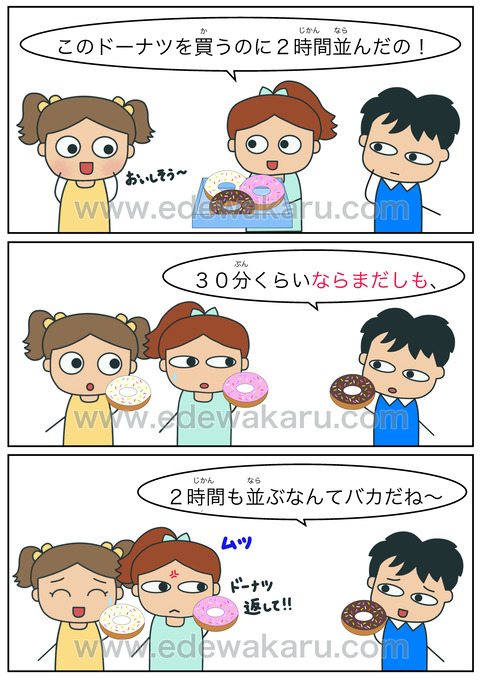
A:このドーナツを買うのに2時間並んだの!B:30分くらいならまだしも、2時間も並ぶなんてバカだね〜
→30分くらいならまだいいけど、2時間も並ぶなんてバカだね〜A: I waited in line for two hours to buy this doughnut! B: Waiting for about 30 minutes would still be okay, but waiting for two whole hours is ridiculous~ → Waiting for about 30 minutes would still be okay, but waiting for two whole hours is ridiculous~
1回ならまだしも、2回も失敗してしまった…
→1回だったらまだいいが、2回も失敗してしまった…If it had been just once, that would still be okay, but I failed twice… → If it had been just once, that would still be okay, but I failed twice…
子供ならまだしも大人なんだから、それくらい自分でやりなさい
→子供ならまだいいが大人なんだから、それくらい自分でやりなさいYou’re an adult, not a child, so do that much yourself.
A:電車の中ではキャンディーくらいならまだしも、ハンバーガーを食べるのはやめてほしいよねB:うん。ハンバーガーはちょっとね…
→キャンディーくらいなら少しはいいが、ハンバーガーを食べるのはやめてほしいA: I wish people wouldn’t eat hamburgers on the train, though candy would still be okay. B: Yeah. Hamburgers are a bit much… → Candy would be somewhat okay, but I wish people wouldn’t eat hamburgers.
1度ならまだしも、2度もドタキャンするなんて許せないわ!
→1度ならまだ許せるが、2度もドタキャンするなんて許せないわ!I could forgive it once, but I can’t forgive you for canceling at the last minute twice!
A:昨日、彼氏に2時間も待たされたの!B:2時間も?大変だったね…A:しかも、謝るならまだしも逆ギレしたんだよ!
→謝るならまだ許せるが、逆ギレしたんだよ!A: My boyfriend kept me waiting for two whole hours yesterday! B: Two hours? That must have been rough… A: And on top of that, he got mad at me instead of apologizing! → I could have forgiven him if he’d apologized, but he got mad at me instead!
Read the original source text
Meaning
〜だったらまだいいが、〜は
〜だったら少しはいいが、〜は
〜ならまだ理解できるが、〜は
〜ならまだ許せるが、〜は
How to use it
動詞・形容詞 ・名詞[普通形]+ならまだしも
Explanation
「AならまだしもB」は「Aだったらまだいいが、Bは〜」という意味の文型です。「Aだったら許したり、理解することができるが、Bだったら許したり理解することができない」と言いたい時に使います。「B」には「A」よりも程度がひどいものが入ります。
「〜ならまだしも」は多くの場合、話者の不満や非難する気持ちを表すと覚えておきましょう😊
IMABI
The Particle しも
Read this IMABI lesson ↗Explanation
The Particle しも
The particle しも is a compound particle formed by the affixation of the bound particle も to the adverbial particle し, with its primary function being to point to a particular item and emphasize it. Traditionally, it may do so after nominals (included nominalized expressions via the 連体形), adverbs, etc., but in Modern Japanese, while what appears with remains quite varied, most instances of the particle can be viewed as set phrases.
The Adverbial Particle しも
As stated in the introduction, the compound particle しも is a combination of the now-moribund adverbial particle し, which was remarkably similar to the particle こそ in meaning as far as how it emphasized elements of a sentence, and the then bound particle も.
The adverbial particle しも inherits three distinct functions from its more productive eras in Classical Japanese:
To single out a nominal phrase in the sense of “X in particular.”
To indicate a limited situation, translating as “only in that situation,” in which case it is followed by a conditional phrase.
When followed by a negation, しも emphasizes said negation.
Even in Modern Japanese, these meanings live odd even with the particle’s overall limited capacity. For instance, 誰しも meaning “anyone” makes it clear that “anyone and everyone” is being singled out. The phrase 折しも meaning “just then” has a very distinct nuance of “only in that instance (despite how there could have been other opportunities), which utilizes the second meaning—made more evident by the phrase’s uncontracted iteration 折しもあれ. As for the third meaning, it is heavily used in several grammar points, one being 必ずしも~とは限らない meaning “not necessarily the case that…”
1. 誰しも地獄じごくへ落おちるのは怖こわい。
Everyone is afraid of going to hell.
2. 勢力はそれ自体では必ずしも幸福をもたらすとは限らない。
Power, in itself, doesn’t necessarily bring happiness.
3. 折しも(あれ)、地震が起きた。
Just at that time, there was an earthquake.
4. 折しも、雪崩が発生し、登山者の二人は行方不明となった。依然として行方不明のままである。
Just then, the avalanche was sparked, and the two mountain climbers went missing. They are still to this moment unaccounted for.
必ずしも~とは限らない
The adverb 必ず means “always/without exception/necessarily,” but when paired with the adverbial particle しも, the resultant 必ずしも must take a negative predicated, thus the translation becomes the opposite as “not necessarily.”
5. 高いものが必ずしも良いものではない。
Expensive items are not always good.
6. 必ずしも楽観はできない。
I/we/one cannot always be so optimistic.
Oftentimes, the predicate is stated as “verb in the affirmative + とは限らない” to make it more evident that the truth statement of the predicate is not limited to the affirmative and that, as made evident by 必ずしも, there are certainly cases in which the situation is not true.
7. 不審者と思われる人が必ずしも犯罪を犯したとは限らないですし、その逆もあり得ます。
It is not always the case that the person who seems suspicious has necessarily committed a crime; in fact, the opposite is just as possible.
8. 日本人の日本語は必ずしも正しいとは限らない。
The Japanese that is spoken by Japanese people is not always correct.
You may also encounter 必ずしも~わけではない, which frames the situation that is “not necessarily” as not necessarily being the plausible reasoning behind what is going on.
9. 毎日日本語を勉強しているからといってうまく使いこなせるようになるわけではない。
Just because you study Japanese every day doesn’t necessarily mean that you will become proficient in using it.
10. アメリカの経済が必ずしも強いわけではない時代を迎えました。
We have entered an era in which the U.S. economy is not always necessarily strong.
11. 女の人は必ずしも必要なものがあるから買い物に行くわけではありません。
Women do not necessarily go shopping because there is something they need.
~ならまだしも
The grammar pattern ~ならまだしも utilizes the hypothetical-marking conjunctive particle なら, only to be followed by まだしも to indicate that “Situation A is one thing, but Situation B is…” In the broadest interpretation of this structure, Situation A is “plausible/acceptable,” but Situation B is “implausible/unacceptable.”
~ならまだしも may occur with all predicate types: nominal, verbal, adjectival, etc., with the particle なら attaching to the 連体形 of verbs/adjectives and to the stem of nouns and adjectival nouns.
12. 1日か2日ならまだしも、10日も無断欠勤だなんて、許されないものだし、非常識だ。
It’s one thing to be 1 or 2 days, but an over ten day unexcused leave is intolerable and against common sense.
13. 新鮮ならまだしも、変色して黒ずんでいる果物を誰が買うものなのか。
Being fresh is one thing, but who would ever by fruit that’s discolored and black?
14. 日本語ならまだしも、英語えいごなんて全く全然分からないよ。
Japanese is one thing, but I absolutely don’t understand English at all!
15. 寒いだけならまだしも、お腹が空いてきた。
If it were just cold, that would be one thing, but I’ve gotten hungry.
16. 事情を説明しに来るならまだしも、顔さえ見せない。
Coming to explain the situation is one thing, but (he) won’t even show his face.
17. 一度ならまだしも、ここまで10回までその言葉を間違えて書いたんですよ。
Once is fine, but you’ve written the word incorrectly ten times now.
18. それならまだしも死んだ方がましだ。
That would be one thing, but I’d rather just be dead.
~なきにしもあらず
A combination of なき(無き) , the classical copula verb にあり, the particle しも inserted within said copula verb, and completed by having the copula be in the negative, ~なきにしもあらず can be more or less translated into Modern Japanese as ないわけではない. As a double negative phrase, it is more less like saying “cannot say never/not at all” in English.
Given all the archaic elements involved, while it is a highly emphatic expression, it is typically only encountered in the written language. When utilized in Modern Japanese, it is often followed by the copula だ, indicating that the expression as a whole has become fossilized (unable to be modified internally).
19. あの子はまだ望のぞみはなきにしもあらずだ。
It’s not to say that the kid doesn’t have (any) hope.
20. 台風が接近しているので、雨が降る事もなきにしもあらずなので、傘をお忘れなく。
The typhoon is approaching, so don’t forget your umbrella because it’s not like it couldn’t rain.
21. 急にカメラが壊れることもなきにしもあらずですよ。
It’s not to say that your camera won’t suddenly break down.
22. 事故などで死ぬ事もなきにしもあらずだからだ。
That’s because it’s not the case that you won’t die in an accident or something.
~をしも
The adverbial particle しも is archaic enough that it breaks one particular norm which can be observed with modern adverbial particles like も, which is that the case particle を does not get ellipsed due to its presence. If it is the case that a nominal phrase + を is the element of the sentence being particularly emphasized by しも, no ellipsis of the object marker occurs.
23. 男たちは縁側で将棋に興じている。街路樹のプラタナスの葉ずれ。ああいうのをしも、人間の文化といわずして、何というのだろう。
The men are amusing themselves with shogi on the veranda while plane trees rustle on the sides of the road. What would you call this if not human culture?
From 『古川柳おちぼひろい』 by 田辺聖子.
In context 23 examples
誰しも地獄じごくへ落おちるのは怖こわい。
Everyone is afraid of going to hell.
勢力はそれ自体では必ずしも幸福をもたらすとは限らない。
Power, in itself, doesn’t necessarily bring happiness.
折しも(あれ)、地震が起きた。
Just at that time, there was an earthquake.
折しも、雪崩が発生し、登山者の二人は行方不明となった。依然として行方不明のままである。
Just then, the avalanche was sparked, and the two mountain climbers went missing. They are still to this moment unaccounted for.
高いものが必ずしも良いものではない。
Expensive items are not always good.
必ずしも楽観はできない。
I/we/one cannot always be so optimistic.
不審者と思われる人が必ずしも犯罪を犯したとは限らないですし、その逆もあり得ます。
It is not always the case that the person who seems suspicious has necessarily committed a crime; in fact, the opposite is just as possible.
日本人の日本語は必ずしも正しいとは限らない。
The Japanese that is spoken by Japanese people is not always correct.
毎日日本語を勉強しているからといってうまく使いこなせるようになるわけではない。
Just because you study Japanese every day doesn’t necessarily mean that you will become proficient in using it.
アメリカの経済が必ずしも強いわけではない時代を迎えました。
We have entered an era in which the U.S. economy is not always necessarily strong.
女の人は必ずしも必要なものがあるから買い物に行くわけではありません。
Women do not necessarily go shopping because there is something they need.
1日か2日ならまだしも、10日も無断欠勤だなんて、許されないものだし、非常識だ。
It’s one thing to be 1 or 2 days, but an over ten day unexcused leave is intolerable and against common sense.
新鮮ならまだしも、変色して黒ずんでいる果物を誰が買うものなのか。
Being fresh is one thing, but who would ever by fruit that’s discolored and black?
日本語ならまだしも、英語えいごなんて全く全然分からないよ。
Japanese is one thing, but I absolutely don’t understand English at all!
寒いだけならまだしも、お腹が空いてきた。
If it were just cold, that would be one thing, but I’ve gotten hungry.
事情を説明しに来るならまだしも、顔さえ見せない。
Coming to explain the situation is one thing, but (he) won’t even show his face.
一度ならまだしも、ここまで10回までその言葉を間違えて書いたんですよ。
Once is fine, but you’ve written the word incorrectly ten times now.
それならまだしも死んだ方がましだ。
That would be one thing, but I’d rather just be dead.
あの子はまだ望のぞみはなきにしもあらずだ。
It’s not to say that the kid doesn’t have (any) hope.
台風が接近しているので、雨が降る事もなきにしもあらずなので、傘をお忘れなく。
The typhoon is approaching, so don’t forget your umbrella because it’s not like it couldn’t rain.
急にカメラが壊れることもなきにしもあらずですよ。
It’s not to say that your camera won’t suddenly break down.
事故などで死ぬ事もなきにしもあらずだからだ。
That’s because it’s not the case that you won’t die in an accident or something.
男たちは縁側で将棋に興じている。街路樹のプラタナスの葉ずれ。ああいうのをしも、人間の文化といわずして、何というのだろう。
The men are amusing themselves with shogi on the veranda while plane trees rustle on the sides of the road. What would you call this if not human culture?
文法
Meaning
~ would be acceptable / ~ would still be within the acceptable range
How to use it
Nは + まだしも
Nなら + まだしも
In context 6 examples
一度や二度ならまだしも、君は何度も同じ間違えをしすぎだぞ!
Once or twice would be one thing, but you've made the same mistake way too many times!
筆記試験だけならまだしも、口頭試験もあるので受かる自信がありません。
If it were only a written exam, that would be one thing, but there's also an oral exam, so I'm not confident I'll pass.
10分ならまだしも、1時間なんて待てませんよ。
I could wait ten minutes, but I can't wait an hour.
小学生ならまだしも、あなたは立派な大人なんだからそれぐらい自分でやりなさい。
If you were an elementary school student, that would be one thing, but you're a grown adult, so do that much yourself.
文句を言うだけならまだしも、女性に暴力を振るうのは絶対にいけません。
Just complaining would be one thing, but using violence against women is absolutely unacceptable.
試験の後ならまだしも、試験前日に映画を見に行くとは随分と余裕があるんですね。
If it were after the exam, that would be one thing, but going to see a movie the day before the exam—you must be feeling pretty confident.
Read the original source text
Meaning
〜なら少しはいいが / 〜はまだ許容範囲であるが
How to use it
Nは + まだしも
Nなら + まだしも
日本語NET JLPT文法解説まとめ
Meaning
~ would be acceptable / ~ would still be within the acceptable range
How to use it
Nは + まだしも
Nなら + まだしも
Explanation
"If it's ~, it's a little okay, but... / It's still within acceptable limits if it's ~, but..."
In context 6 examples
一度や二度ならまだしも、君は何度も同じ間違えをしすぎだぞ!
Once or twice would be one thing, but you've made the same mistake way too many times!
10分ならまだしも、1時間なんて待てませんよ。
I could wait ten minutes, but I can't wait an hour.
小学生ならまだしも、あなたは立派な大人なんだからそれぐらい自分でやりなさい。
If you were an elementary school student, that would be one thing, but you're a grown adult, so do that much yourself.
筆記試験だけならまだしも、口頭試験もあるので受かる自信がありません。
If it were only a written exam, that would be one thing, but there's also an oral exam, so I'm not confident I'll pass.
文句を言うだけならまだしも、女性に暴力を振るうのは絶対にいけません。
Just complaining would be one thing, but using violence against women is absolutely unacceptable.
試験の後ならまだしも、試験前日に映画を見に行くとは随分と余裕があるんですね。
If it were after the exam, that would be one thing, but going to see a movie the day before the exam—you must be feeling pretty confident.
Read the original source text
Meaning
〜なら少しはいいが / 〜はまだ許容範囲であるが
How to use it
Nは + まだしも
Nなら + まだしも
Explanation
"If it's ~, it's a little okay, but... / It's still within acceptable limits if it's ~, but..."