絵でわかる日本語
Usage 1
Read this source entry ↗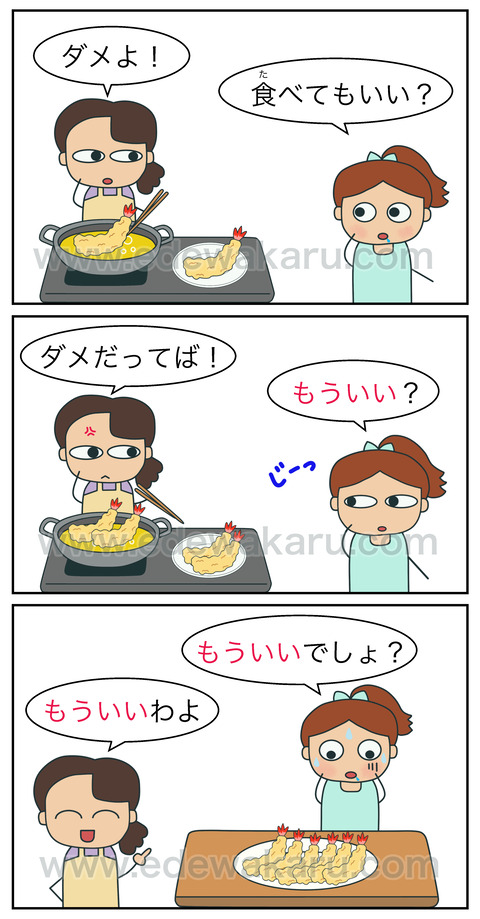
Meaning
It is okay to do ~.
The preparations are complete.
Explanation
“もういい” is an expression meaning “it is okay to do ~” or “the preparations are complete,” and is used affirmatively.
Some of you may have heard this expression used in “hide-and-seek” 😊
(Review: 〜として [as])
[While playing hide-and-seek]
(Review: 〜ている [ongoing action])
A: もういいかい?
Are you ready?
B: もういいよ〜
I’m ready!
→A: Are you ready? (Have you hidden?)
→B: I’m ready (I’m hidden).
(Review: 〜だい・〜かい)
[For those with time to spare]
“もういい” is also often used in the form “もう〜だ” 😮 This expression is used in various situations and means “enough” or “resolved” 😮
(Review: 〜ことがある [there are occasions when])
[Examples]
①A: Is the car repair finished?
B: Yeah. もう大丈夫だよ
→Yeah, it’s all taken care of.
②もうお腹がいっぱいだ
→I’ve eaten enough already, so I’m full.
③Younger sister: Sis, lend me your game!
Older sister: Sure. I’ve already had enough fun with it.
→Sure. I’ve had enough fun with it.
(Review: “貸す” [lend] and “借りる” [borrow])
“もういい” is also often used in conversation, so try using it 😉
Read the original source text
Meaning
〜してもいい状態だ
準備ができた
Explanation
「もういい」は「〜してもいい状態だ」「準備ができた」という意味を表す表現で、肯定的用法(こうていてきようほう)として使われます。
「かくれんぼ」
でもこの表現が使われているのを聞いたことがある人もいると思います😊
(復習:〜として)
[「かくれんぼ」をしている時]
(復習:〜ている(進行中))
A:
もういい
かい?
B:
もういい
よ〜
→A:
準備ができた?(隠れた?)
→B:
準備ができた
よ(隠れたよ)
(復習:〜だい・〜かい)
【余裕のある人へ】
「もういい」は「もう〜だ」の形でもよく使われることもあります
😮この表現は色々な場面で使われ、
「十分だ」「解決した」
という意味で使用されます😮
(復習:〜ことがある)
[例]
①A:車の修理が終わった?
B:うん。
もう
大丈夫
だ
よ
→うん。
解決した
よ
②
もう
お腹がいっぱい
だ
→
もう十分
に食べたから、お腹がいっぱいだ
③妹:お姉ちゃん、ゲームを貸して!
姉:いいよ。私は
もう
十分に楽しん
だ
から〜
→いいよ。私は
十分
楽しんだから〜
(復習:「貸す」「借りる」)
「もういい」は、会話でもよく使われる表現ですので、ぜひ使ってみてくださいね😉
Usage 2
Read this source entry ↗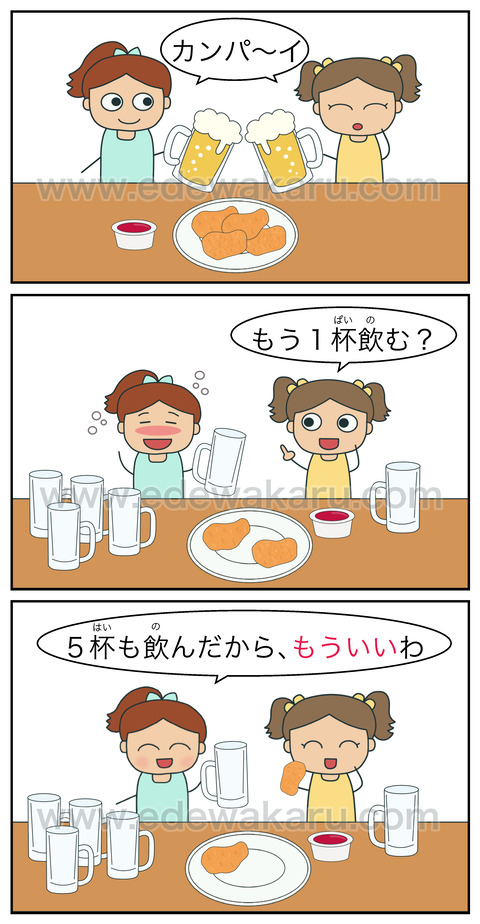
Meaning
There is enough now, so I don’t need any more.
[Example]
A: Would you like another drink?
B: I’ve already had five, so I’m good.
→I’ve already had five, so I don’t need any more.
(Review: もう + quantity word)
(Review: 〜も [as many/much as])
Explanation
“もういい” is an expression used when you want to say “I have enough now, so I don’t need any more.” It can also be used when [turning something down], [giving up], or when you want to say [I can’t put up with this any longer] 😮
(Review: 〜ことがある [there are occasions when])
[When turning something down]
A: Would you like a refill?
B: No, I’m fine.
→No, I don’t need any.
[When giving up]
A: Are you taking the N1 exam again this year?
B: I’m done with N1. It’s too hard for me…
→I’ve given up on N1.
(Review: 〜もの・〜んだもの [because ~])
[When you can’t put up with any more]
Mother: Did you get a zero again?!
Daughter: But English is hard…
Mother: Enough with the excuses!
→I don’t want to hear any more excuses!
(Review: またしても [once again])
(Review: だって〜 [but/because ~])
“もういい” also has an affirmative use, so I think it’s good to learn that together 😉
(Review: もういい [affirmative use])
Read the original source text
Meaning
これで十分なので、これ以上いらない
【例】
A:もう1杯飲む?
B:5杯も飲んだから、
もういい
わ
→5杯も飲んだから、
これ以上いらない
わ
(復習:もう+数量詞)
(復習:〜も(数量詞+も))
Explanation
「もういい」は「(これで十分なので)これ以上いらない」と言いたい時に使う表現です。この表現は、
【断る時】
や
【あきらめた時】、
【これ以上我慢できない】
と言いたい時などにも使われることもあります😮
(復習:〜ことがある)
[断る時]
A:おかわりはどうですか?
B:いいえ、
もういいです
→いいえ、
いりません
[あきらめた時]
A:今年もN1を受けるの?
B:N1は
もういい
わ。私には難しすぎるもの…
→N1は
あきらめた
わ。
(復習:〜もの・〜んだもの)
[これ以上我慢できない]
母:またしても0点を取ったの!?
娘:だって英語は難しいから…
母:言い訳は
もういい
わ!
→言い訳は
もう聞きたくない
わ!
(復習:またしても)
(復習:だって〜)
「もういい」には
肯定的用法(こうていてきようほう)
もありますので、一緒に覚えておくといいと思います😉
(復習:もういい(肯定的用法))