AIUEO JLPT Grammar
Meaning
This sentence pattern sets up a condition or assumption and shows the action or judgment based on that. The first part of the sentence presents a hypothetical situation, while the second part shows the response or proposal.
How to use it
Verb dictionary form or verb nai-form or adjective dictionary form or adjective nai-form or na-adjective + な + ようなら; verb dictionary form or verb nai-form or adjective dictionary form or adjective nai-form or na-adjective + な + ようだったら; verb dictionary form or verb nai-form or adjective dictionary form or adjective nai-form or na-adjective + な + ようであれば
In context 5 examples
もし彼が来ないようなら、先に出発しましょう。
If it seems like he won’t come, let’s leave first.
雨が降るようだったら、ピクニックを中止します。
If it looks like it’s going to rain, we’ll cancel the picnic.
遅れるようでしたら、必ず連絡してください。
If you are going to be late, please make sure to contact us.
このまま痛みが続くようだったら、病院に行ったほうがいいですよ。
If the pain continues like this, you should go to the hospital.
その問題が解決しないようであれば、上司に相談しましょう。
If that issue doesn’t get resolved, let’s consult with the boss.
Read the original source text
Meaning
This sentence pattern sets up a condition or assumption and shows the action or judgment based on that. The first part of the sentence presents a hypothetical situation, while the second part shows the response or proposal.
How to use it
動詞辞書形or動詞ない形or形容詞辞書形or形容詞ない形or形容動詞な+ようなら動詞辞書形or動詞ない形or形容詞辞書形or形容詞ない形or形容動詞な+ようだったら動詞辞書形or動詞ない形or形容詞辞書形or形容詞ない形or形容動詞な+ようであれば
Explanation · 日本語
この文型は、ある状況や条件を仮定して、その状況に応じて行動や判断を示すときに使われる表現です。文の前半では仮定された条件を述べ、後半ではそれに基づく対応や提案を述べる構造になります。
絵でわかる日本語
Usage 1
Read this source entry ↗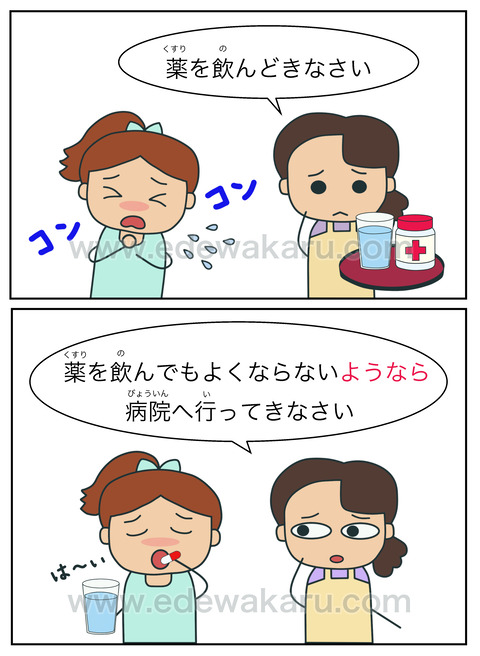
Meaning
If it is a case like…
How to use it
Verb/adjective [plain form] + ようなら
Verb/adjective [plain form] + ようだったら
Explanation
“〜ようなら” is a sentence pattern meaning “if it is a case like…”. It is an expression used when leaving the judgment up to the other person. 😊 You can also express this using “〜ようだったら.” 😉
[Example]
If you don’t get better after taking medicine,
ようなら, go to the hospital.
= If you don’t get better after taking medicine,
ようだったら, go to the hospital.
“〜ようなら” can be used in many different situations. Please give it a try too! 😀
In context 5 examples
薬を飲んでもよくならないようなら、病院へ行ってきなさい
→薬を飲んでもよくならない場合は、病院へ行ってきなさい(復習:〜てくる(継起))If you don’t get better after taking medicine, go to the hospital. (Review: 〜てくる (sequence))
忙しいようなら、手伝うよ
→忙しい場合は、手伝うよIf you’re busy, I’ll help you. → If you’re busy, I’ll help you.
今日中にレポートを書き上げられないようなら、明日でもいいですよ
→今日中にレポートを書き上げられないような場合は、明日でもいいですよ(復習:〜中に)(復習:〜上げる)If you can’t finish writing the report today, tomorrow is fine too. → If you can’t finish writing the report today, tomorrow is fine too. (Review: 〜中に) (Review: 〜上げる)
明日天気がいいようなら、お花見にでも行こうかな…
→明日天気がいい場合は、お花見にでも行こうかな…(復習:〜ようか・〜ようかな・〜ようかしら)(復習:〜でも)If the weather is nice tomorrow, maybe I’ll go cherry-blossom viewing or something… → If the weather is nice tomorrow, maybe I’ll go cherry-blossom viewing or something… (Review: 〜ようか・〜ようかな・〜ようかしら) (Review: 〜でも)
お金がないようなら、貸したげるよ〜
→お金がないという場合は、貸したげるよ〜(復習:貸す・借りる)(復習:〜たげる)If you don’t have money, I’ll lend you some~ → If you don’t have money, I’ll lend you some~ (Review: 貸す・借りる) (Review: 〜たげる)
Read the original source text
Meaning
〜のような場合は
How to use it
動詞・形容詞[普通形]+ようなら
動詞・形容詞[普通形]+ようだったら
Explanation
「〜ようなら」は「〜のような場合は」という意味を表す文型です。相手に判断を任せる時に使う言い方です😊また、
「〜ようだったら」
を使って表すこともできます😉
[例]
薬を飲んでもよくならない
ようなら、病院へ行ってきなさい
=薬を飲んでもよくならない
ようだったら、病院へ行ってきなさい
「〜ようなら」はいろんな場面で使うことができます。みなさんもぜひ使ってみてくださいね😀
Usage 2
Read this source entry ↗Meaning
If it is a case like…
How to use it
Verb/adjective [plain form] + ようなら
Verb/adjective [plain form] + ようだったら
Explanation
“〜ようなら” is a sentence pattern meaning “if it is a case like…”. It is an expression used when leaving the judgment up to the other person. 😊 You can also express this using “〜ようだったら.” 😉
[Example]
If you don’t get better after taking medicine,
ようなら, go to the hospital.
= If you don’t get better after taking medicine,
ようだったら, go to the hospital.
“〜ようなら” can be used in many different situations. Please give it a try too! 😀
Read the original source text
Meaning
〜のような場合は
How to use it
動詞・形容詞[普通形]+ようなら
動詞・形容詞[普通形]+ようだったら
Explanation
「〜ようなら」は「〜のような場合は」という意味を表す文型です。相手に判断を任せる時に使う言い方です😊また、
「〜ようだったら」
を使って表すこともできます😉
[例]
薬を飲んでもよくならない
ようなら、病院へ行ってきなさい
=薬を飲んでもよくならない
ようだったら、病院へ行ってきなさい
「〜ようなら」はいろんな場面で使うことができます。みなさんもぜひ使ってみてくださいね😀
毎日のんびり日本語教師
How to use it
Verb dictionary form + ようなら
Verb ない-form + ないようなら
な-adjective stem + な/である + ようなら
い-adjective (plain form) + ようなら
Explanation
Expresses a hypothetical condition.
「ようであれば」is a somewhat stiff expression.
Notes
The “よう” series
In context 8 examples
このレベルが理解できないようなら、君才能ないよ。
If you can’t understand this level, you have no talent.
一発殴っても分からないようなら、分かるまで殴ってやる。
If you still don’t understand after I punch you once, I’ll keep punching you until you do.
到着が遅れるようなら、あらかじめ連絡をください。
If you’re going to be late, please let me know in advance.
明日も熱が下がらないようだったら病院に行こうと思う。
If I still have a fever tomorrow, I think I’ll go to the hospital.
来られるようだったらぜひ来てください。
If you think you can come, please do come.
この化粧水肌に合うようだったら定期的に購入したい。
If this toner works for my skin, I’d like to buy it regularly.
一人で運べないようなら、私が手伝おうか。
If you can’t carry it alone, shall I help?
人との約束も守れないようなら、誰にも信頼されることもない。
If you can’t even keep promises to other people, no one will trust you.
Read the original source text
How to use it
動辞形+ようなら
動ない形+ないようなら
な形容詞語幹+な/である+ようなら
い形容詞普通形+ようなら
Explanation
仮定条件を表します。
「ようであれば」はやや硬めの表現です。
Notes
「よう」シリーズ