絵でわかる日本語
Meaning
There was ~ and ~ (and it was difficult/a lot to deal with).
There was ~ and ~ (and it was troublesome).
How to use it
Verb/adjective [plain form] + わ + verb/adjective [plain form] + わで
Explanation
“〜わ〜わで” is a sentence pattern used with the meaning “there was ~ and ~.” It is used when bad things happen at the same time and you want to say “it was difficult” or “it was troublesome” 😊 Because “difficult” and “troublesome” are feelings about unpleasant things, this pattern is not used for good things 😨
[Examples]
❌あのレストランの料理は、おいしいわ、安いわで最高だった
The food at that restaurant was delicious, inexpensive, and wonderful.
→“Delicious,” “inexpensive,” and “wonderful” are good things.
❌成績が上がるわ、彼氏ができるわでいいことずくめの1年だった (Review: 〜ずくめ [nothing but ~])
My grades improved and I got a boyfriend, so it was a year full of good things.
→“My grades improved,” “I got a boyfriend,” and “a year full of good things” are good things.
Also, the “で” in “〜わ〜わで” can be omitted 😊
[Examples]
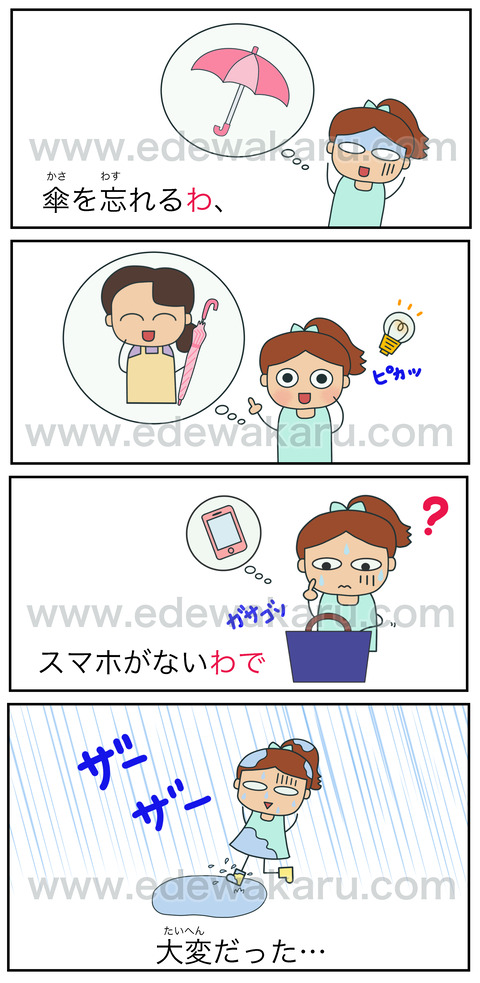
傘を忘れるわ、スマホがないわで大変だった
I forgot my umbrella, and I didn’t have my smartphone, so it was awful.
=傘を忘れるわ、スマホがないわ 大変だった
バイトがあるわ、テストが近いわで忙しい
I have a part-time job, and exams are coming up, so I’m busy.
=バイトがあるわ、テストが近いわ 忙しい
Remember to distinguish “〜わ〜わで” from “〜わ〜わ,” which expresses degree 😀 I’ll cover the degree usage of “〜わ〜わ” next time 😉
In context 4 examples
傘を忘れるわ、スマホがないわで大変だった
→傘を忘れるし、スマホがないし大変だったI forgot my umbrella, and I don’t have my smartphone, so it was awful. →I forgot my umbrella, and I don’t have my smartphone, so it was awful.
バイトがあるわ、テストが近いわで忙しい
→バイトがあるし、テストが近いし忙しいI have a part-time job, and exams are coming up, so I’m busy. →I have a part-time job, and exams are coming up, so I’m busy.
運動はしないわ、お酒は飲むわでやせるはずがない
→運動はしないし、お酒は飲むし、やせるはずがないHe doesn’t exercise and drinks alcohol, so there’s no way he’ll lose weight. →He doesn’t exercise, and he drinks alcohol, so there’s no way he’ll lose weight.
あのレストランの料理は、まずいわ、高いわで最悪だった
→あのレストランの料理は、まずいし、高いし最悪だったThe food at that restaurant was awful and expensive, so it was the worst. →The food at that restaurant was bad and expensive, so it was the worst.
Read the original source text
Meaning
〜し〜し(大変だった)
〜し〜し(困った)
How to use it
動詞・形容詞[普通形]+わ+動詞・形容詞[普通形]+わで
Explanation
「〜わ〜わで」は「〜し〜し」という意味で使われる文型です。悪いことが一度に発生して「大変だ」「困った」と言いたい時に使用します
😊「大変だ」「困った」という気持ちはよくないことに使いますので、この文型はいいことには使いません😨
[例]
❌あのレストランの料理は、おいしい
わ、安い
わ
で最高だった
→「おいしい」「安い」「最高」はいいこと
❌成績が上がるわ、彼氏ができるわでいいことずくめの1年だった(復習:〜ずくめ)
→「成績が上がる」「彼氏ができる」「いいことずくめ」はいいこと
また、「〜わ〜わで」の「で」は省略することができます😊
[例]
傘を忘れるわ、スマホがない
わで
大変だった
=傘を忘れる
わ、スマホがない
わ
大変だった
バイトがある
わ、テストが近い
わで
忙しい
=バイトがある
わ、テストが近い
わ
忙しい
「〜わ〜わで」は程度を表す「〜わ〜わ」と区別して覚えておきましょう😀程度を表す「〜わ〜わ」はまた次回載せます😉
AIUEO JLPT Grammar
Meaning
This sentence pattern lists multiple elements in the same sentence to emphasize difficult or chaotic situations caused by overlapping issues. It is mainly used in negative contexts to describe complex or troublesome scenarios.
How to use it
Verb わ + verb わ + で; adjective わ + adjective わ + で; な-adjective わ + な-adjective わ + で
In context 5 examples
彼は風邪を引くわ、食中毒になるわで、大変な一日だった。
He had a tough day, catching a cold and getting food poisoning.
仕事は溜まるわ、家事は片付かないわで、ストレスがたまっている。
Work is piling up, and I can’t finish the housework, so I’m feeling stressed.
道は混むわ、電車は遅れるわで、会社に遅刻してしまった。
The roads were crowded, and the train was delayed, so I was late for work.
パソコンは壊れるわ、ネットは繋がらないわで、仕事が進まなかった。
My computer broke, and the internet wouldn’t connect, so I couldn’t get any work done.
資料は足りないわ、時間はないわで、プレゼンの準備が全然進まなかった。
I didn’t have enough materials, and I was short on time, so I couldn’t prepare for the presentation.
Read the original source text
Meaning
This sentence pattern lists multiple elements in the same sentence to emphasize difficult or chaotic situations caused by overlapping issues. It is mainly used in negative contexts to describe complex or troublesome scenarios.
How to use it
動詞わ+動詞わ+で形容詞わ+形容詞わ+で形容動詞わ+形容動詞わ+で
Explanation · 日本語
この文型は、同じ文の中で二つ以上の要素を列挙し、それらが重なって大変な状況や混乱した状態を強調する表現です。主にネガティブな場面で使われ、複数の出来事や問題が同時に起こって困っている状況を描写します。
文法
Meaning
〜 and 〜
Means “unpleasant or bad things happened all at once, causing trouble.”
Used to emphasize the speaker’s unpleasant or unhappy feelings.
How to use it
V (plain form) + わ + V (plain form) + わで
い-adjective (plain form) + わ + い-adjective (plain form) + わで
な-adjective (plain form) + わ + な-adjective (plain form) + わで
In context 8 examples
昨日はスマホは壊れるわ、財布は落とすわで、散々な1日だった。
Yesterday was an awful day: my phone broke, and I lost my wallet.
今週はテストはあるわ、レポートの締め切りがあるわで、忙しい1週間になりそうだ。
This week looks like it’s going to be a busy one, with tests and report deadlines.
この会社は給料は安いわ、残業は多いわで、最悪だ。
This company is the worst: the pay is low and there’s a lot of overtime.
このレストランの料理はまずいわ、値段は高いわで、もう二度と来ない。
The food at this restaurant is awful and the prices are high, so I’m never coming back.
最近、彼女にフラれるわ、仕事をクビになるわで、ついてない。
Lately, my girlfriend dumped me and I got fired from my job; I’ve had no luck.
息子は大学を卒業しても、働かないわ、家事も手伝わないわで、今後が心配だ。
Even after graduating from university, my son won’t work or help with the housework, so I’m worried about his future.
飲み会に誘っても、忙しいわ、金欠だわで誰も来てくれない。
Even when I invite people for drinks, nobody comes because they’re either busy or broke.
このホテル、サービスは悪いわ、お湯は出ないわで、止まるんじゃなかった。
This hotel was terrible: the service was bad and there was no hot water. I shouldn’t have stayed here.
Read the original source text
Meaning
〜し、〜し
「良くないこと、悪いことが一度に起こって困った」という意味。
話し手の不快な気持ち、嫌な気持ちを強調して言う時に使う。
How to use it
V(普通形)+わ+V(普通形)+わで
イA(普通形)+わ+イA(普通形)+わで
ナA(普通形)+わ+ナA(普通形)+わで
日本語NET JLPT文法解説まとめ
Meaning
“~ and ~, and it was a mess”
Means that several bad or unpleasant things happened at once, causing trouble.
Used to emphasize the speaker’s unpleasant or irritated feelings.
How to use it
V (plain form) + わ + V (plain form) + わで
い-adjective (plain form) + わ + い-adjective (plain form) + わで
な-adjective (plain form) + わ + な-adjective (plain form) + わで
Explanation
"~ and ~"
It means "bad things or unpleasant events happened all at once, causing trouble."
It is used to emphasize the speaker's feelings of discomfort or displeasure.
In context 8 examples
昨日はスマホは壊れるわ、財布は落とすわで、散々な1日だった。
Yesterday was an awful day: my phone broke, and I lost my wallet.
今週はテストはあるわ、レポートの締め切りがあるわで、忙しい1週間になりそうだ。
This week looks like it’s going to be a busy one, with tests and report deadlines.
この会社は給料は安いわ、残業は多いわで、最悪だ。
This company is the worst: the pay is low and there’s a lot of overtime.
このレストランの料理はまずいわ、値段は高いわで、もう二度と来ない。
The food at this restaurant is awful and the prices are high, so I’m never coming back.
最近、彼女にフラれるわ、仕事をクビになるわで、ついてない。
Lately, my girlfriend dumped me and I got fired from my job; I’ve had no luck.
息子は大学を卒業しても、働かないわ、家事も手伝わないわで、今後が心配だ。
Even after graduating from university, my son won’t work or help with the housework, so I’m worried about his future.
飲み会に誘っても、忙しいわ、金欠だわで誰も来てくれない。
Even when I invite people for drinks, nobody comes because they’re either busy or broke.
このホテル、サービスは悪いわ、お湯は出ないわで、止まるんじゃなかった。
This hotel was terrible: the service was bad and there was no hot water. I shouldn’t have stayed here.
Read the original source text
Meaning
"〜し、〜し"
「良くないこと、悪いことが一度に起こって困った」という意味。
話し手の不快な気持ち、嫌な気持ちを強調して言う時に使う。
How to use it
V(普通形)+わ+V(普通形)+わで
イA(普通形)+わ+イA(普通形)+わで
ナA(普通形)+わ+ナA(普通形)+わで
Explanation
"~ and ~"
It means "bad things or unpleasant events happened all at once, causing trouble."
It is used to emphasize the speaker's feelings of discomfort or displeasure.