AIUEO JLPT Grammar
Meaning
This sentence pattern is used to express gratitude for a positive result brought about by something. It is often used in positive situations, but can also be used ironically in negative contexts.
How to use it
Verb + おかげで or おかげだ; adjective + おかげで or おかげだ; な-adjective + な + おかげで or おかげだ; noun + の + おかげで or おかげだ
In context 5 examples
この本を読んだおかげで、新しい知識を得ることができた。
Thanks to reading this book, I gained new knowledge.
先生の指導のおかげで、試験に合格できた。
Thanks to the teacher’s guidance, I passed the exam.
雨のおかげで、外出できなかった。
Because of the rain, I couldn't go out.
彼のミスのおかげで、計画が遅れてしまった。
Due to his mistake, the plan got delayed.
彼女のアドバイスのおかげです。
It’s thanks to her advice.
Read the original source text
Meaning
This sentence pattern is used to express gratitude for a positive result brought about by something. It is often used in positive situations, but can also be used ironically in negative contexts.
How to use it
動詞+おかげでorおかげだ形容詞+おかげでorおかげだ形容動詞な+おかげでorおかげだ名詞の+おかげでorおかげだ
Explanation · 日本語
この文型は、何かが原因で良い結果がもたらされたことに対して感謝の気持ちを表す表現です。多くの場合、ポジティブな結果に対して使用されますが、時には皮肉を込めて悪い結果にも使われることがあります。
文法
Meaning
~ thanks to / because of
Basically, this is used when describing a cause that led to a good result.
It can also be used for a bad result, but that is sarcastic.
How to use it
V (plain form) + おかげで
い-adjective (plain form) + おかげで
な-adjective な + おかげで
Nの + おかげで
In context 15 examples
薬を飲んだおかげで、すっかり元気になりました。
Thanks to taking the medicine, I’ve completely recovered.
毎日、日本人の友達と話したおかげで、日本語が上手になりました。
Thanks to talking with my Japanese friends every day, my Japanese improved.
一生懸命勉強したおかげで、いい会社に就職することができました。
Thanks to studying hard, I was able to get a job at a good company.
シートベルトをしていたおかげで、一命を取りとめました。
Thanks to wearing a seat belt, I escaped with my life.
友達のおかげで、私は今の彼女と出会うことができました。
Thanks to my friend, I was able to meet my current girlfriend.
歴史のゲームのおかげで、日本の歴史に詳しくなりました。
Thanks to history games, I became knowledgeable about Japanese history.
先生のおかげでJLPT N3に合格できました。
Thanks to my teacher, I was able to pass the JLPT N3.
たばことお酒をやめたおかげで、体調がよくなった。
Thanks to quitting smoking and drinking, I started feeling better.
みんなが手伝ってくれたおかげで早く作業が終わったよ。本当にありがとう。
Thanks to everyone helping, we finished the work early. Thank you so much.
彼女のおかげで、僕は毎日幸せだ。
Thanks to her, I’m happy every day.
毎日、日本のニュースを見たり新聞を読んだおかげで、ビジネスの言葉がわかるようになった。
Thanks to watching Japanese news and reading the newspaper every day, I came to understand business terminology.
タイ旅行はタイ人の友達が案内してくれたおかげで、とても楽しめました。
I really enjoyed my trip to Thailand thanks to my Thai friend showing me around.
君がミスしてくれたおかげで、全部やり直しだよ。
Thanks to your mistake, we have to redo everything.
赤ん坊夜中に泣き出したおかげで、全然寝れなかったよ。
Thanks to the baby starting to cry in the middle of the night, I couldn’t sleep at all.
部長が突然飲み会に参加することになったおかげで、つまらなくなったよ。
Thanks to the department head suddenly joining the drinking party, it became boring.
Read the original source text
Meaning
〜が原因で
基本的に良い結果になった原因を言う時に使う。
悪い結果に使うこともできるが、皮肉となる。
How to use it
V(普通形) + おかげで
イA(普通形)+おかげで
ナAな + おかげで
Nの + おかげで
Bunpro Grammar Reference
Meaning
Thanks to, Because of
How to use it
Verb + おかげで
[い]Adjective + おかげで
[な]Adjective + な + おかげで
Noun + の + おかげで
Nuance
A phrase gives thanks to (A) for causing some particular result, sometimes sarcastically.
Explanation
おかげで (or お陰で in kanji) is an expression that is used to show thanks or appreciation in Japanese. It is usually translated simply as 'thanks to (A)', or 'because of (A)'. おかげで is a combination of the polite prefix お, the noun 陰 'shade', and the case marking particle で.
おかげで can be used after any word in its attributive form.
タケルくんに手伝ってもらったお陰で仕事が早く終わったよ。今日は本当にありがとうね。
We were able to finish work early, thanks to you helping us Takeru. Thank you so much for today.
部屋が汚いお陰でどこに何があるか全く分からない。
Thanks to my room being so dirty, I don't know where anything is. (Sarcasm)
友達が有名なお陰で、どんな高級レストランでも予約なしで入れる。
Thanks to my friend being famous, we can go to any fancy restaurant without a reservation.
あなたのおかげで不自由のない生活ができている。
Thanks to you, we can live a life free of inconvenience.
Literally, お陰で means 'in the shade of (A)'. This implies that (B) was only made possible due to (A) creating the ideal situation for it to occur.
Caution
おかげで may sometimes be used sarcastically, in the same way as 'thanks to (A)' in English. In these sentences, it is usually quite clear from the context/tone of voice that the actual meaning is negative.
お前が変な事言ったおかげで、俺が言いたい事を忘れちゃったじゃん!
Thanks to you saying something weird, I forgot what I wanted to say! (Sarcasm)
あいつのおかげでまた残業だよ。
We have to work overtime again thanks to him. (Sarcasm)
Fun Fact
おかげで is often used at the beginning of a sentence in the same way as 'thankfully' or 'luckily' in English. This just means that whatever comes after おかげで happened, despite negative outcomes also being possible.
おかげで、テストに合格することができました。
Thankfully, I was able to pass my test.
おかげで、いい休暇を過ごせました。
Thanks to you, I was able to enjoy a nice holiday.
In context 20 examples
- 薬のお陰でだいぶよくなりました。
Thanks to the medicine, I got much better.
- 友達が有名なお陰で、どんな高級レストランでも予約なしで入れる。
Thanks to my friend being famous, we can go to any fancy restaurant without a reservation.
- 部屋が汚いお陰でどこに何があるか全く分からない。
Thanks to my room being so dirty, I don't know where anything is. (Sarcasm)
- あなたのおかげで不自由のない生活ができている。
Thanks to you, we can live a life free of inconvenience.
- タケルくんに手伝ってもらったお陰で仕事が早く終わったよ。今日は本当にありがとうね。
We were able to finish work early, thanks to you helping us Takeru. Thank you so much for today.
- 風が強いお陰で、ヨットのスピードが上がった。
Thanks to the strong wind, the yacht gained speed.
- お陰で助かったよ。来てくれてありがとう。
Thanks to you, I was saved. Thank you for coming.
- スマホのお陰で、目的地にスムーズに着きました。
Thanks to my smartphone, I had no trouble arriving at my destination.
- 君のお陰で取引は失敗だったよ。
Thanks to you the deal was a failure!
- 彼がいてくれたお陰で、諦めないで頑張れた。
Because he was there for me, I was able to push through.
- 勉強をしたお陰で、試験に合格した。
I passed the test thanks to studying.
- 文プロのお陰で文法を理解できるようになってきた。
Thanks to Bunpro, I am starting to understand grammar.
- 彼の運転の仕方が上手なお陰で、ちょうど間に合った。
Thanks to his skillful driving, we arrived on time.
- オニヅカ先生に日本語を教えてもらったお陰で、ぺらぺらと話せるようになった。
Thanks to Onizuka-sensei teaching me Japanese, I have come to speak it fluently.
- 誰のお陰でこんなにいい家に住めると思っているんだ!
To whom do you think you should be thankful for being able to live in such a nice house?
- 君のお陰でいい思い出になったよ。また一緒に旅行に行こうね。
Thanks to you, I had a great experience. Let's go on another trip together (someday).
- お前が変な事言ったおかげで、俺が言いたい事を忘れちゃったじゃん!
Thanks to you saying something weird, I forgot what I wanted to say! (Sarcasm)
- あいつのおかげでまた残業だよ。
We have to work overtime again thanks to him. (Sarcasm)
- おかげで、テストに合格することができました。
Thankfully, I was able to pass my test.
- おかげで、いい休暇を過ごせました。
Thanks to you, I was able to enjoy a nice holiday.
どんなときどう使う 日本語表現文型辞典
Meaning
thanks to
How to use it
〔plain form〕(ナAな・ナAである/Nの・Nである)+おかげで
Explanation
~の助けがあったので
B:おかげさまで。ありがとうございます。
「~おかげで…」の形で「~の助けがあったので、…というよい結果になった」と感謝の気持ちで言うときに使う。 ❸ の「おかげか」は、それだけが原因かどうか確信は持てないが、という感じがある。 ❺ の「おかげさまで」はあいさつの言葉としてよく使われる。
Gratitude when a positive result occurs owing to someone's help. In sentence ❸ , it is difficult to discern whether the reason stated is the only possible cause of the positive result. おかげさまで in sentence ❺ is a common greeting.
In context 5 examples
母は最近新しく発売された新薬のおかげで、ずいぶん元気になりました。
Thanks to the new medicine that was recently released, my mother has gotten much better.
あなたが手伝ってくれたおかげで、仕事が早くすみました。ありがとう。
Thanks to your help, I finished the work quickly. Thank you.
夜の道路工事が終わったおかげか、昨夜はいつもよりよく寝られた。
Perhaps because the nighttime roadwork has ended, I slept better than usual last night.
今日、私が指揮者として成功できたのは斉藤先生の厳しいご指導のおかげです。
My success as a conductor today is thanks to the strict guidance of Mr. Saito.
A:就職が決まったそうですね。おめでとう。
A: I hear you've found a job. Congratulations.
Read the original source text
Meaning
thanks to
How to use it
〔普通形〕(ナAな・ナAである/Nの・Nである)+おかげで
Explanation
~の助けがあったので
B:おかげさまで。ありがとうございます。
「~おかげで…」の形で「~の助けがあったので、…というよい結果になった」と感謝の気持ちで言うときに使う。 ❸ の「おかげか」は、それだけが原因かどうか確信は持てないが、という感じがある。 ❺ の「おかげさまで」はあいさつの言葉としてよく使われる。
Gratitude when a positive result occurs owing to someone's help. In sentence ❸ , it is difficult to discern whether the reason stated is the only possible cause of the positive result. おかげさまで in sentence ❺ is a common greeting.
絵でわかる日本語
Meaning
Because … was the cause/reason … (a good result happened)
How to use it
Verb [plain form] + おかげで・おかげか
い-adjective [dictionary form] + おかげで・おかげか
な-adjective [dictionary form] + なおかげで・なおかげか (Examples: きれいなおかげで・便利なおかげで)
Noun [dictionary form] + のおかげで・のおかげか (Examples: あなたのおかげで・薬のおかげで)
Explanation
「〜おかげで」is a sentence pattern that expresses a cause or reason, meaning “... happened because ... was the cause/reason” 😊
It is used mostly when a good result occurs, but at N2 level and above, it may also be used with a feeling of irony or criticism 😮
[Examples used with an ironic feeling]
①The train was delayed because of heavy snow, and I ended up being late.
→The train was delayed and I ended up being late because heavy snow was the cause.
②I made a huge mistake because of you.
→I made a huge mistake because you were the cause.
Also, when a good result occurs because of someone else’s action, the forms 「〜てくれったおかげで」「〜てもらったおかげで」are used 😀
[Examples]
①Thanks to my teacher explaining it to me, I was able to pass.
→I was able to pass because my teacher explained it to me.
②Thanks to Mom waking me up, I made it to class on time.
→I made it to class on time because Mom woke me up.
【Supplementary explanation ①】
「〜おかげで」also has the form 「おかげさまで〜」😮 This is an idiomatic expression and
can only be used at the beginning of a sentence 😨
⭕️Thanks to you, I passed.
❌I passed thanks to my teacher. → ⭕️I passed thanks to my teacher.
❌The reason I passed the N1 was my teacher’s 「おかげさま」. → ⭕️The reason I passed the N1 was my teacher’s help.
【Supplementary explanation ②】
Lastly, the difference between 「〜おかげで」and「〜おかげか」: 「〜おかげで」is used when the cause or reason is clearly known, whereas
「〜おかげか」is used when the cause or reason is not clearly known 😀
薬の
おかげで
頭痛が治った → It is clearly known that taking the medicine was the reason the headache went away.
薬の
おかげか
頭痛が治った → It is not clear whether the headache went away because I took the medicine.
It may help to remember 「〜おかげか」as “probably because …” 😉
In context 3 examples
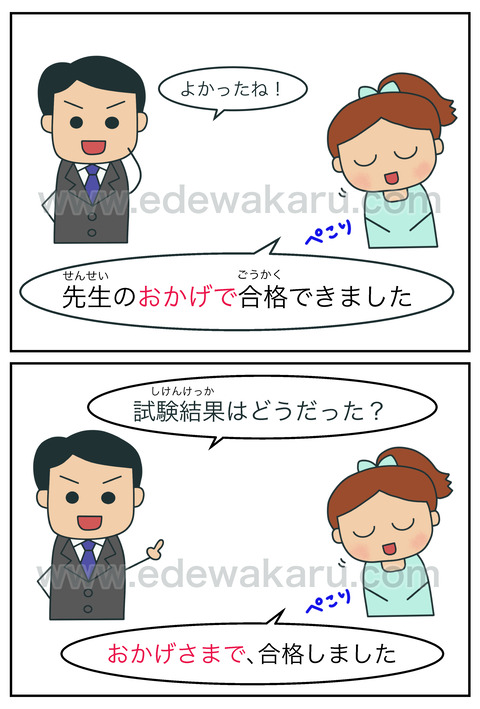
先生のおかげで合格できました
→先生に教えてもらったから合格できましたThanks to my teacher, I was able to pass. →I was able to pass because my teacher taught me.
薬を飲んだおかげで頭痛が治った
→薬を飲んだから頭痛が治ったMy headache went away thanks to taking the medicine. →My headache went away because I took the medicine.
毎日NHKを見ていたおかげで、リスニング力がアップした
→毎日NHKを見ていたから、リスニング力がアップしたMy listening skills improved thanks to watching NHK every day. →My listening skills improved because I watched NHK every day.
Read the original source text
Meaning
〜が原因・理由で…(いい結果が起こった)
How to use it
動詞[普通形]+おかげで・おかげか
い形容詞[辞書形]+おかげで・おかげか
な形容詞[辞書形]+なおかげで・なおかげか (例:きれいなおかげで・便利なおかげで)
名詞[辞書形]+のおかげで・のおかげか (例:あなたのおかげで・薬のおかげで)
Explanation
「〜おかげで」は原因・理由を表す文型で「〜が原因・理由で…が起こった」という意味で使用される文法です
😊
いい結果が発生した場合に使用するのがほとんどです
が、N2以上のレベルになると、皮肉・非難の気持ちを入れて使われることもあります😮
[皮肉の気持ちを入れて使われる場合の例]
①大雪の
おかげで
電車が遅れて遅刻してしまった
→大雪が
原因で、電車が遅れて遅刻してしまった
②あなたの
おかげで
大失敗したよ
→あなたが
原因で、大失敗したよ
また相手の動作でいい結果が発生した場合は
「〜てくれったおかげで」「〜てもらったおかげで」
というようになります😀
[例]
①先生に
教えてもらったおかげで
合格できました
→先生に教えてもらったから合格できました
②お母さんが
起こしてくれたおかげで
授業に間に合った
→お母さんが起こしてくれたから授業に間に合った
【補足説明①】
「〜おかげで」には「おかげさまで〜」という形もあります
😮これは慣用的な表現で、
文の最初にしか使うことができません
😨
⭕️
おかげさまで、合格しました
❌先生のおかげさまで、合格しました→⭕️先生の
おかげで、合格しました
❌N1に合格したのは、先生のおかげさまです→⭕️N1に合格したのは、先生の
おかげです
【補足説明②】
最後に「〜おかげで」と「〜おかげか」の違いについてです。「〜おかげで」は原因理由がはっきりわかっている時に使用するのに対して、
「〜おかげか」は原因理由がはっきりわかっていない時に使います
😀
薬の
おかげで
頭痛が治った→「薬」を飲んだことが治った理由だとはっきりとわかっている
薬の
おかげか
頭痛が治った→「薬」を飲んだから治ったのかはっきりとわからない
「〜おかげか」は「たぶん〜が原因・理由で…」と覚えておくといいですね
😉
日本語文型辞典
Meaning
Basic information: Nのおかげで; Naな/だった おかげで; Aおかげで; V-たおかげで. Explanation: Indicates a cause or reason, and is used when it leads to a good result. For a bad result, use “… せいで.” Examples: ① I was saved thanks to you. ② Thanks to my grandfather's naturally robust health, he has managed to avoid needing a doctor's care even as he has grown older. ③ Thanks to you coming, it was a fun gathering. ④ A: How is your child’s injury?
B: Thankfully, it's much better. ⑤ Honestly, because I asked you, things ended up getting more complicated. ⑥ Thanks to the cool summer this year, we hardly needed to use air conditioning. Examples: (Example) I succeeded thanks to you.
I failed because of you. Explanation: When referring to someone else's action, the form V-てくれた/てもらったおかげで is often used. ④'s おかげさまで is a set greeting expression. It can also be used sarcastically, as in ⑤.
Read the original source text
Meaning
基本情報NのおかげでNa な/だった おかげでAおかげでV-たおかげで説明原因・理由を表すが、それがよい結果を導くものである場合に用いる。悪い結果を導く場合には、「… せいで」となる。例文① あなたのおかげで助かりました。② 祖父は生まれつき体が丈夫なおかげで、年をとっても医者の世話にならずにすんでいる。③ あなたが来てくれたおかげで、楽しい会になりました。④ A:お子さんのけがはどうですか。
B:おかげさまで、だいぶ良くなりました。⑤ まったく、君に頼んだおかげでかえってややこしいことになってしまったじゃないか。⑥ 今年は夏が涼しかったおかげで冷房はほとんど使わずにすんだ。例文(例) あなたのおかげで成功した。
あなたのせいで失敗した。説明相手の動作を表す場合は「V一てくれた/てもらったおかげで」の形になることが多い。④の「おかげさまで」は慣用的なあいさつ表現。また⑤のように皮肉の意味で使うこともある。
日本語文型辞典 英語版
Meaning
【おかげで】[Nのおかげで][Na な/だった おかげで][Aおかげで][V-たおかげで]
B:おかげさまで、だいぶ良くなりました。
Thank you, it is almost healed.
Expresses a reason or cause for a positive outcome. In the case of a negative result, ...せいで is used.
(例)あなたのおかげで成功した。
I succeeded, thanks to you.
(例)あなたのせいで失敗した。
I failed because of you.
When another person’s action is referred to, the forms V-てくれたおかげで or V-てもらったおかげで are often used. おかげさまで in
(4)
is an idiomatic expression of appreciation. V-たおかげで is sometimes used with irony, as in
(5)
.
In context 6 examples
あなたのおかげで助かりました。
Thanks to you, I survived.
祖父は生まれつき体が丈夫なおかげで、年をとっても医者の世話にならずにすんでいる。
Thanks to being born with a strong constitution, my grandfather can get by without a doctor’s care in spite of his old age.
あなたが来てくれたおかげで、楽しい会になりました。
Because you came, the party turned out to be a lot of fun.
A:お子さんのけがはどうですか。
How is your child’s injury?
まったく、君に頼んだおかげでかえってややこしいことになってしまったじゃないか。
Honestly, thanks to your help, things just ended up getting more complicated.
今年は夏が涼しかったおかげで冷房はほとんど使わずにすんだ。
Because of the cool weather this summer, we hardly had to use the air conditioner at all.
くらべてわかる日本語表現文型辞典
Meaning
Meaning 1: A led to the good result B. A is the reason or cause that led to the good result B.
Meaning 2: A led to the bad result B. A is the reason or cause that led to the bad result B. This expression is used with irony or humor.
How to use it
AおかげでB (Aおかげだ)
[Verb] おかげで
[i-adjective—plain form] おかげで
[na-adjective—な / である / だった / ではない] おかげで
[Noun—の] おかげで
Explanation
【Contrast 2】
“AせいでB” (meaning 1, p. 110)
“AせいでB” and “AおかげでB” (meaning 2) have the same meaning, but “AせいでB” carries a feeling of blaming the other party, while “AおかげでB” often carries irony, humor, or the like.
○君のせいで、叱られてしまった。(どうしてくれるんだ) — I got scolded because of you. (What are you going to do about it?)
○君のおかげで叱られてしまった。(全くついていないなあ) — Thanks to you, I got scolded. (Just my luck.)
Whether the speaker sees the same event as “おかげ” or “せい” depends on how they view situation B.
○雨のせいで、授業が中止になった。(残念だ) — Because of the rain, class was canceled. (That’s disappointing.)
○雨のおかげで、授業が中止になった。(うれしい) — Thanks to the rain, class was canceled. (I’m glad.)
Notes
【Note 1】
・Even without the “Aによって” part, the expression “おかげさまで〜” is used as a set greeting.
○おかげさまで元気にしております — Thanks to you, I’m doing well.
○おかげさまで合格しました — Thanks to you, I passed.
In context 8 examples
先生のおかげで、合格することが出来ました。
I was able to pass thanks to my teacher.
親が言葉遣いに厳しかったおかげで、社会人になっても困らない。
Because my parents were strict about how I spoke, I have no trouble even now that I’m working.
交通事故を起こしたが保険に入っていたおかげで経済的には助かった。
I was in a traffic accident, but because I had insurance, I was financially saved.
ガンの早期発見ができたのも、定期検診を受けていたおかげだ。
It was thanks to having regular health checkups that the cancer was detected early.
授業に出なかったおかげで、さっぱりわからない。
Because I didn’t attend class, I don’t understand a thing.
バスに乗り遅れたおかげで、遅刻してしまった。
Because I missed the bus, I ended up being late.
息子が二人とも元気なおかげで、毎日クタクタだ。
Because both my sons are healthy, I’m exhausted every day.
新しいゲームソフトのおかげで、毎日寝不足だ。
Thanks to the new video game, I’m sleep-deprived every day.
Read the original source text
Meaning
意味1:AによってBといういい結果になった。AはBといういい結果になった理由•原因である。
意味2:AによってBという悪い結果になった。 AはBという悪い結果になった理由・原因である。皮肉やユーモアを込めて使う表現である。
How to use it
AおかげでB(Aおかげだ)
[動詞]おかげで
[イ形-普]おかげで
[ナ形-な/である/だった/ではない]おかげで
[名詞-の]おかげで
Explanation
【対比2】
「AせいでB」(意味1 P.110)
「AせいでB」と「AおかげでB」(意味2)は、同じ意味だが、「AせいでB」には相手を責める気持ちが込められており、「AおかげでB」には皮肉・ユーモアなどが込められていることが多い。
○君のせいで、叱られてしまった。(どうしてくれるんだ)
○君のおかげで叱られてしまった。(全くついていないなあ)
同じ事態でも「おかげ」ととるか「せい」ととるかは、話し手がBの事態をどうとらえているかによる。
○雨のせいで、授業が中止になった。(残念だ)
○雨のおかげで、授業が中止になった。(うれしい)
Notes
【注意1】
・「Aによって」の部分がなくても、慣用的なあいさつとして「おかげさまで〜」という表現を使う。
○おかげさまで元気にしております
○おかげさまで合格しました
日本語NET JLPT文法解説まとめ
Meaning
because of ...
Basically used to state the cause of a good result.
It can also be used for a bad result, but then it is sarcastic.
How to use it
V (plain form) + おかげで
い-adjective (plain form) + おかげで
な-adjective な + おかげで
Nの + おかげで
Explanation
"thanks to"
Basically, used to describe the cause of a good outcome.
This can also be used for bad results, but it is ironic.
In context 17 examples
薬を飲んだおかげで、すっかり元気になりました。
Thanks to taking the medicine, I’ve completely recovered.
毎日、日本人の友達と話したおかげで、日本語が上手になりました。
Thanks to talking with my Japanese friends every day, my Japanese improved.
一生懸命勉強したおかげで、いい会社に就職することができました。
Thanks to studying hard, I was able to get a job at a good company.
シートベルトをしていたおかげで、一命を取りとめました。
Thanks to wearing a seat belt, I escaped with my life.
友達のおかげで、私は今の彼女と出会うことができました。
Thanks to my friend, I was able to meet my current girlfriend.
歴史のゲームのおかげで、日本の歴史に詳しくなりました。
Thanks to history games, I became knowledgeable about Japanese history.
先生のおかげでJLPT N3に合格できました。
Thanks to my teacher, I was able to pass the JLPT N3.
たばことお酒をやめたおかげで、体調がよくなった。
Thanks to quitting smoking and drinking, I started feeling better.
みんなが手伝ってくれたおかげで早く作業が終わったよ。本当にありがとう。
Thanks to everyone helping, we finished the work early. Thank you so much.
彼女のおかげで、僕は毎日幸せだ。
Thanks to her, I’m happy every day.
毎日、日本のニュースを見たり新聞を読んだおかげで、ビジネスの言葉がわかるようになった。
Thanks to watching Japanese news and reading the newspaper every day, I came to understand business terminology.
タイ旅行はタイ人の友達が案内してくれたおかげで、とても楽しめました。
I really enjoyed my trip to Thailand thanks to my Thai friend showing me around.
成績がよかったおかげで、奨学金をもらえました。
Thanks to my good grades, I received a scholarship.
早く避難したおかげで、津波に巻き込まれずに済んだ。
Thanks to evacuating early, I avoided being caught in the tsunami.
君がミスしてくれたおかげで、全部やり直しだよ。
Thanks to your mistake, we have to redo everything.
赤ん坊夜中に泣き出したおかげで、全然寝れなかったよ。
Thanks to the baby starting to cry in the middle of the night, I couldn’t sleep at all.
部長が突然飲み会に参加することになったおかげで、つまらなくなったよ。
Thanks to the department head suddenly joining the drinking party, it became boring.
Read the original source text
Meaning
〜が原因で
基本的に良い結果になった原因を言う時に使う。
悪い結果に使うこともできるが、皮肉となる。
How to use it
V(普通形) + おかげで
イA(普通形)+おかげで
ナAな + おかげで
Nの + おかげで
Explanation
"thanks to"
Basically, used to describe the cause of a good outcome.
This can also be used for bad results, but it is ironic.
毎日のんびり日本語教師
How to use it
Noun + の + おかげで/おかげだ
Verb plain form + おかげで/おかげだ
い-adjective plain form + おかげで/おかげだ
な-adjective + な + おかげで/おかげだ
Explanation
Expresses that a good result arose from a certain cause.
「おかげ」 itself is treated as a noun and can also be used sarcastically, as in 「君のおかげでこんなにも損をしたよ」 (“Thanks to you, I lost so much”).
Notes
When used sarcastically, it has the same meaning as 「~せいで」, which emphasizes the cause even more.
Similar grammar: 「~せいで/せいか/せいだ/せいにする」
In context 8 examples
みなさんのおかげで、私たちは結婚することができました。
Thanks to all of you, we were able to get married.
私は今ここにこうやって生きていられるのは間違いなく先生のおかげです。
It is undoubtedly thanks to my teacher that I am alive here like this today.
こんな軽い怪我で済んだのは、あなたのおかげだ。
It's thanks to you that the injury was so minor.
今君が生きていられるのは、誰のおかげだと思ってる?
Who do you think is the reason you're still alive?
病状も薬のおかげで結構楽になってきた。(病情也因为药物变得很轻松。)
Thanks to the medicine, my condition has gotten quite a bit better. (My condition has also become much easier thanks to the medicine.)
私が成功したのも周りのおかげ。(我成功也是多亏了周围的帮助。)
My success was also thanks to the people around me. (My success was also thanks to the support of those around me.)
皆協力してくれたおかげでなんとかなりそう。
Thanks to everyone's cooperation, it looks like things will work out.
解熱剤飲んでずっと寝てたおかげか、平熱まで下がった。
Maybe because I took a fever reducer and slept the whole time, my temperature went back down to normal.
Read the original source text
How to use it
名詞+の+おかげで/おかげだ
動詞普通形+おかげで/おかげだ
い形容詞普通形+おかげで/おかげだ
な形形容詞+な+おかげで/おかげだ
Explanation
ある原因から良い結果が生まれたことを表します。
「おかげ」自体は名詞として扱い、「君のおかげでこんなにも損をしたよ」などと皮肉表現にも使うことができます。
Notes
皮肉として使うときは原因を更に強調した「~せいで」と同じ意味となる。
似ている文法「~せいで/せいか/せいだ/せいにする」
NINJAL 日本語文型データベース
Meaning
Used when you want to say that something has led to a good result. It is often used in situations expressing gratitude, such as when thanking someone.
How to use it
V plain form + おかげで
i-adjective plain form + おかげで
na-adjective plain form + おかげで (however, 「na-Aだ」 changes to 「na-Aな+おかげで・na-Aである+おかげで」)
Nのおかげで・N plain form + おかげで (however, 「Nだ」 changes to 「Nである+おかげで・Nの+おかげで」)
Other
Notes
A negative sentence rarely comes in the “〜” slot.
After 「〜おかげで」, a sentence expressing the speaker’s hopes or intentions, or a sentence urging the other person to do something, cannot follow.
In context 24 examples
両親と同居しているおかげで、仕事が忙しくてもいろいろ手伝ってもらえる。
Thanks to living with my parents, I can get help with various things even when work is busy.
車で通勤している。この道は会社まで遠回りだが、渋滞しないおかげで走りやすい。
I commute by car. This road is a detour to my company, but it’s easy to drive because there’s no traffic.
余計な知識がないおかげで、かえって自由な発想が生まれるということもある。
Sometimes, not having unnecessary knowledge actually leads to free thinking.
みんなが手伝ってくれたおかげで、仕事が早く終わりました。
Thanks to everyone’s help, we finished the work early.
今日一日、すっきりと晴れたおかげで、いい写真がたくさん撮れました。
Thanks to the clear weather all day today, I was able to take lots of good photos.
医療保険に入っていたおかげで、病気になってもお金の心配をしないで済んだ。
Thanks to having health insurance, I didn’t have to worry about money even when I got sick.
今日は宿題がなかったおかげで、いつもよりのんびりできた。
Thanks to not having homework today, I was able to relax more than usual.
名字が珍しいおかげで、みんなによく名前を覚えてもらえる。
Thanks to my unusual surname, people remember my name easily.
気温は高いが、湿度が高くないおかげで、それほど不快ではない。
The temperature is high, but thanks to the low humidity, it isn’t that uncomfortable.
荷物が少なかったおかげで、引っ越し代を安く済ませることができた。
Thanks to having little luggage, I was able to keep the moving costs down.
今回の日本語能力試験では、苦手な聞き取りの問題が難しくなかったおかげで、いい点がとれたと思う。
I think I got a good score on this Japanese Language Proficiency Test thanks to the listening questions, which I’m bad at, not being difficult.
この辺りは土地が肥沃なおかげで、いい作物が取れる。
Thanks to the fertile soil around here, good crops can be harvested.
会社が業務改善に意欲的であるおかげで、残業が減って働きやすくなった。
Thanks to the company’s enthusiasm for improving operations, overtime has decreased and it has become easier to work here.
この温泉地は、それほど有名ではないおかげであまり観光地化されておらず、のどかな雰囲気が残っている。
Thanks to this hot spring town not being very famous, it hasn’t been much developed as a tourist destination, and it has retained its peaceful atmosphere.
皿の入った箱を落としてしまったが、梱包が丁寧だったおかげで、中の皿は割れていなかった。
I dropped the box containing the dishes, but thanks to the careful packing, the dishes inside weren’t broken.
3年前は、仕事があまり大変ではなかったおかげで、趣味に打ち込めていた。
Three years ago, thanks to work not being very demanding, I was able to devote myself to my hobbies.
中山さんのアドバイスのおかげで、ずっと悩んでいたことの解決策が見つかりました。本当にありがとうございました。
Thanks to Mr. Nakayama’s advice, I found a solution to something I’d been worrying about for a long time. Thank you very much.
子どもの頃、両親が仕事で忙しかったので、祖父母が私の面倒を見てくれた。祖父母のおかげで、私は明るく育つことができた。
When I was a child, my parents were busy with work, so my grandparents took care of me. Thanks to them, I was able to grow up cheerful.
家族がデパートの社員であるおかげで、商品が安く買える。
Thanks to a member of my family working at a department store, I can buy products cheaply.
親が国語教師のおかげで、私は作文の宿題を親に見てもらえる。
Because my parent is a Japanese language teacher, I can have them look over my essay homework.
このイベントは、開催日が平日じゃないおかげで、参加できそうだ。
Thanks to this event being held on a weekday, I think I’ll be able to attend.
通っていた英会話学校では、クラスが少人数制だったおかげで、たくさん練習できた。
Thanks to the small class sizes at the English conversation school I attended, I was able to practice a lot.
傘がなかったが、それほど強い雨じゃなかったおかげで、あまり濡れずに帰れた。
I didn’t have an umbrella, but thanks to the rain not being that heavy, I was able to get home without getting very wet.
一人前になるまでの修行は厳しかった。しかし、そのおかげで今、料理人として満足できる仕事ができているのだと思う。
The training I went through to become a full-fledged chef was tough. But I think it’s thanks to that that I can now do work as a chef that I find fulfilling.
Read the original source text
Meaning
〜の恩恵を受けて、いい結果になると言いたいときに使います。お礼など、感謝の気持ちを表す場面で使うことが多いです。
How to use it
V普通形+おかげで
i-A普通形+おかげで
na-A普通形+おかげで(ただし、「na-Aだ」→「na-Aな+おかげで・na-Aである+おかげで」)
Nのおかげで・N普通形+おかげで(ただし、「Nだ」→「Nである+おかげで・Nの+おかげで」)
その他
Notes
「〜」に否定文がくることは少ないです。
「〜おかげで」の後には、話し手の希望・意向を表す文や相手への働きかけの文はきません。
Yokubi — The Common Grammar Guide (https://yoku.bi)
Explanation
のに is related to ので, but it works in the opposite direction. While ので means "because of X, Y", のに means "despite X, Y". Like ので, this is more "objective" than other adversatives. のに also loves being attached to the end of sentences as an emphasis marker of disappointment or discontentment.
Just like ので, のに needs な after nouns and な adjectives
ように essentially means "so as to", as in "walk so as to keep your back hidden". This treads a fine line between "for the purpose of" and "in such a way as".
If it helps, you can think of ように as a noun (よう = "manner") turned into adverb by に. The clause that qualifies よう becomes "adverbial" to the main verb.
ために literally uses the noun ため "purpose" plus に to make a conjunction.
In many situations, ために and ように are interchangeable with the meaning of "for the purpose of", but not always.
ために can also be used to mean "for the sake of" rather than "for the purpose of". The nuance is different in English but in Japanese it is not always obvious. に can also be dropped.
せい is a noun meaning "fault" used to indicate cause/blame/reason. It usually implies that the effect is undesirable.
The opposite of せいで is おかげで, which implies a thankful feeling.
In context 1 examples
俺は、お前のおかげで救われたんだ。
Thanks to you, I was saved.