日本語文型辞典
Usage 1
Meaning
Basic information: Indicates the passage of time or the cost involved. In the case of time it can be rephrased as “たつ”; in the case of cost, as “かかる.”
Used in the forms “…している” and “…したN” to indicate that something has a certain quality or is in a certain state.
Indicates causing something to change by acting on it. While “なる” indicates a natural change in the thing itself, “する” indicates an intentional change brought about by someone acting on it.
⇾ように 35
Attaches to nouns such as smell, fragrance, taste, the past, feeling, a sense, chills, and nausea to express that sensation or perception.
⇾とする 2
Means “decide.” “N + particle” may also be used, as follows.
⇾ものとする
a. N(を)する
Attaches to nouns that express an action or effect to form a verb. Although there are some examples attached to native Japanese words, it is more often attached to Sino-Japanese or loanword nouns to form verbs.
b. Nをする【appearance】
Used in forms such as “Nをしている” and “NをしたN.” An expression for things perceived visually, such as color, shape, appearance, figure, style, and face.
c. Nをする【occupation】
Used in the form “occupation name + をしている,” meaning “to be engaged in that job.”
d. Nをする【wearing accessories】
Used with items such as ties, watches, and rings to indicate wearing them. When describing a state, use the form “している,” as in ②.
Means using something for a different purpose.
⇾お…する
⇾ように 35
How to use it
Numeral + する
Adverb + する
…する
N/Na にする
A-くする
V-ようにする
Nがする
…とする
…にする
Nにする
Vことにする
…ものとする
Nをする
NをNにする
おR-する
V-ようにする
In context 59 examples
バンコクまで往復でいくらぐらいしますか。
About how much is a round trip to Bangkok?
その旅館は一泊5万円もする。
That inn costs as much as 50,000 yen for one night.
30分ほどして戻りますのでお待ちください。
I’ll be back in about 30 minutes, so please wait.
この球根(きゅうこん)は植えて半年したら芽がでます。
This bulb will sprout six months after it is planted.
少ししてから出かけましょう。
Let’s go out after a little while.
こんな建て方では10年しないうちに壊れる。
If it’s built this way, it will collapse in less than ten years.
赤ちゃんの肌はすべすべしている。
A baby’s skin is smooth.
ほこりで机の上がざらざらしている。
The top of the desk is rough with dust.
この料理は味がさっぱりしている。
This dish has a refreshing taste.
息子は体つきががっしりしている。
My son has a sturdy build.
休日はみんなのんびりとしている。
Everyone takes it easy on holidays.
なかなかしっかりしたよい青年だ。
He’s quite a dependable, good young man.
子供を医者にしたがる親が多い。
Many parents want to make their children doctors.
部屋をきれいにしなさい。
Clean your room.
冷たくするともっとおいしいですよ。
It’ll taste even better if you make it cold.
この食品はいそがしい人のためにすぐに食べられるようにしてあります。
This food is prepared so that busy people can eat it right away.
台所からいいにおいがしてきた。
A nice smell came from the kitchen.
このサラダは変な味がする。
This salad tastes strange.
古いピアノはひどい音がして、使い物にならない。
The old piano sounds awful and is no longer usable.
外に出ると冷たい風が吹いていて、寒気がした。
When I went outside, a cold wind was blowing and I felt a chill.
その動物は小さくて柔らかく、まるでぬいぐるみのような感じがした。
The animal was small and soft, and felt just like a stuffed toy.
彼とはうまくやっていけないような気がする。
I feel like I won’t be able to get along with him.
今朝から吐き気がして何も食べられない。
I’ve felt nauseous since this morning and can’t eat anything.
この肉料理にはふしぎな香りがするスパイスが使ってある。
This meat dish is prepared with spices that have a strange fragrance.
来週は休講とする。
There will be no class next week.
一応60点を合格とします。
We will set 60 points as the passing score for now.
A:何になさいますか。
B:コーヒーにします。A: What would you like? B: I’ll have coffee.
今度のキャプテンは西田さんにしよう。
Let’s make Mr. Nishida the next captain.
かぜがよくならないので旅行は止めることにします。
My cold isn’t getting better, so I’ve decided to cancel the trip.
事故がこわいので飛行機には乗らないことにしています。
I’ve made it a rule not to fly because I’m afraid of accidents.
(例) 会議は5時からにします。
(Example) Let’s set the meeting for five o’clock.
午後は買い物をするつもりだ。
I plan to go shopping in the afternoon.
日曜日には妻と散歩をしたり…テニスをしたりする。
On Sundays, I go for walks with my wife, play tennis, and so on.
昔はよくダンスをしたものだ。
I used to dance a lot in the old days.
いたずらをすると叱られるよ。
You’ll get scolded if you play pranks.
ころんで足にけがをした。
I fell and injured my leg.
せきをしているので風邪をひいたのでしょう。
He’s coughing, so he probably caught a cold.
きれいな色をしたネクタイをもらった。
I received a tie with a beautiful color.
その建物は三角形のおもしろい形をしている。
That building has an interesting triangular shape.
見舞いに行ったら、かれはとても苦しそうな様子をしていたのでつらかった。
When I went to visit him, I felt miserable because he looked to be suffering terribly.
それは人間の姿をした神々の物語だ。
It is a story about gods in human form.
みすぽらしい格好をした男が訪ねてきた。
A man dressed shabbily came to visit.
この仏像はとてもやさしそうな顔をしている。
This Buddha statue has a very gentle-looking face.
彼は教師をしている。
He is a teacher.
ベビー・シツターをしてくれる人を探しています。
I’m looking for someone who can babysit.
社長をしているおじの紹介で就職した。
I got a job through an introduction from my uncle, who is a company president.
母は前は主婦だったが今は薬剤師をしている。
My mother used to be a housewife, but now she works as a pharmacist.
あの赤いネクタイをした人が森さんです。
The person wearing that red tie is Mr. Mori.
あの人はいつもイヤリングをしている。
That person always wears earrings.
手袋をしたままで失礼します。
Excuse me for keeping my gloves on.
あっ、今日は時計をしてくるのを忘れた。
Oh, I forgot to put on my watch today.
このごろ風邪をひいてもマスクをする人はいませんね。
These days, no one wears a mask even when they catch a cold, do they?
本をまくらにして昼寝した。
I used a book as a pillow and took a nap.
スカーフをテープルクロスにして使っています。
I use a scarf as a tablecloth.
客間を子どもの勉強部屋にした。
I turned the guest room into a study for the children.
ここでお待ちします。
I’ll wait here.
お荷物お持ちしましょうか。
Shall I carry your luggage?
必ず連絡をとるようにする。
I’ll make sure to get in touch.
朝寝坊しないようにしよう。
Let’s try not to oversleep.
Read the original source text
Meaning
時間の経過、かかる費用を表す。時間の場合は「たつ」、費用の場合は「かかる」と言いかえられる。
「…している」や「…したN」の形で用いて、ある性質をもつことやある様子を示すことを表す。
対象に働きかけて変化させることを表す。「なる」がそのもの自体の自然な変化を表すのに対し、「する」は働きかける人が存在する意図的な変化を表す。
⇾ように35
におい、かおり、味、昔、感じ、気、寒気、吐き気などの名詞に付いて、その感覚、知覚を表す。
⇾とする2
「決める」という意味。次のように「N+助詞」が使われることもある。
⇾ものとする
a. N(を)する
動作や作用を表す名詞に付いて動詞を作るのに使う。和語に付く例も少なくないが、漢語や外来語の名詞に付いて動詞を作る場合が多い。
b. Nをする【外見】
「Nをしている」「NをしたN」のように使う。色、形、様子、姿、かっこう、顔など視覚的にとらえられるものを表す言い方。
c. Nをする【職業】
「職業名+をしている」の形で用いて、「その仕事についている」という意味を表す。
d. Nをする【装身】
ネクタイ、時計、指輪などにつけて、それを身につけていることを表す。状態を言うときは②のように「している」の形で使う。
あるものを別の用途で使うという意味。
⇾お…する
⇾ように35
How to use it
数量詞+する
副詞+する
…する
N/Na にする
A-くする
V-ようにする
Nがする
…とする
…にする
Nにする
Vことにする
…ものとする
Nをする
NをNにする
おR-する
V-ようにする
Usage 2
Meaning
Basic information: おR-する; ごNする. Explanation: Uses a verb's continuative form or a Sino-Japanese noun denoting an action. A humble expression meaning “I perform an action for someone else.” As in ④ and ⑤, when used with a Sino-Japanese noun, the form ごNする is common, but with 電話する, お電話する is used. As in ①, the form おR-します can be used to offer to do something for someone. お…いたす is an even more polite expression. Examples: ① Sensei, I'll carry your luggage. ② I drove the department manager to their home. ③ I delivered the item you ordered. ④ Shall I show you to your room? ⑤ We'll contact you later.
Read the original source text
Meaning
基本情報おR-するごNする説明動詞の連用形や行為を表す漢語名詞を用いる。謙譲表現で「自分が相手のためにある行為をする」という意味。④⑤のように漢語名詞とともに使う場合は「ごNする」の形が多いが、「電話する」の場合は「お電話する」を用いる。①のように「おR-します」の形で、自分が相手のために何かすることを申し出ることができる。「お…いたす」はさらに丁寧な言い方。例文① 先生、お荷物をお持ちします。② 部長をお宅まで車でお送りした。③ ご注文の品をお届けしました。④ お部屋へご案内しましょう。⑤ あとでこちらからご連絡します。
絵でわかる日本語
Usage 1
Read this source entry ↗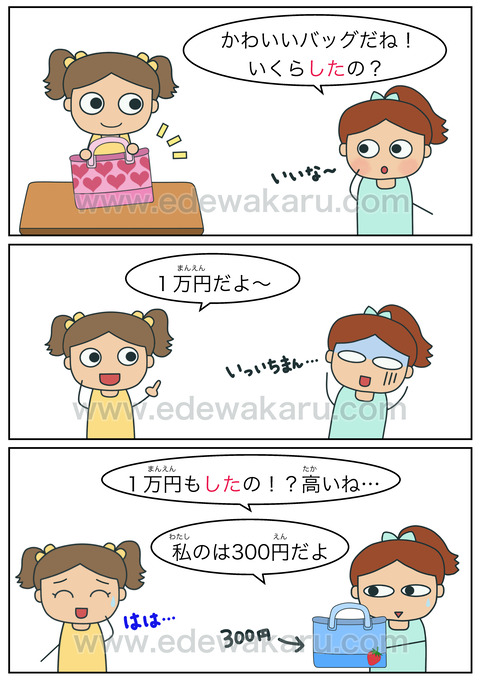
Meaning
Takes (an amount of time)
Costs (an amount of money)
How to use it
Quantity + する
Explanation
“Quantity + する” is a sentence pattern that expresses the passage of time or the cost of money. When expressing the passage of time, it means “〇〇 hours pass”; when expressing an amount of money, it means “it costs 〇〇 yen.”
Beginner-level sentence patterns are often used in everyday conversation and are very important. Review them so you can use them well 😉
In context 5 examples
A:かわいいバッグだね!いくらしたの?B:1万円だよ〜A:え〜!1万円もしたの!?高いね…
→1万円もかかったの!?高いね…A: What a cute bag! How much did it cost? B: 10,000 yen~ A: What~! It cost as much as 10,000 yen!? That’s expensive… → It cost as much as 10,000 yen!? That’s expensive…
東京まで、いくらしますか?
→東京までいくらかかりますか?How much does it cost to get to Tokyo? → How much does it cost to get to Tokyo?
娘:あれ?お母さんは?父:買い物だよ。1時間くらいしたら帰ってくると思うよ
→1時間くらい経ったら帰ってくると思うよDaughter: Huh? Where’s Mom? Father: She went shopping. I think she’ll be back in about an hour. → I think she’ll be back after about an hour has passed.
娘:カップラーメンって何分待てばいいんだっけ?母:3分したら食べてもいいわよ
→3分経ったら食べてもいいわよDaughter: How many minutes am I supposed to wait for cup noodles again? Mother: You can eat them after three minutes. → You can eat them after three minutes have passed.
そんな使い方をしたら、1年しないうちに壊れちゃうよ
→1年経たないうちに壊れちゃうよIf you use it that way, it’ll break in less than a year. → It’ll break before a year has passed.
Read the original source text
Meaning
〜かかる
〜経つ
How to use it
数量詞+する
Explanation
「数量詞+する」は、時間が経過することやお金がかかることを表す文型です。時間の経過を表す場合は「〇〇時間が経つ」、お金がかかることを表す場合は「〇〇円かかる」という意味になります。
初級の文型は日常会話(にちじょうかいわ)でもよく使われ、とても重要です。上手に使えるように復習をしておきましょう😉
Usage 2
Read this source entry ↗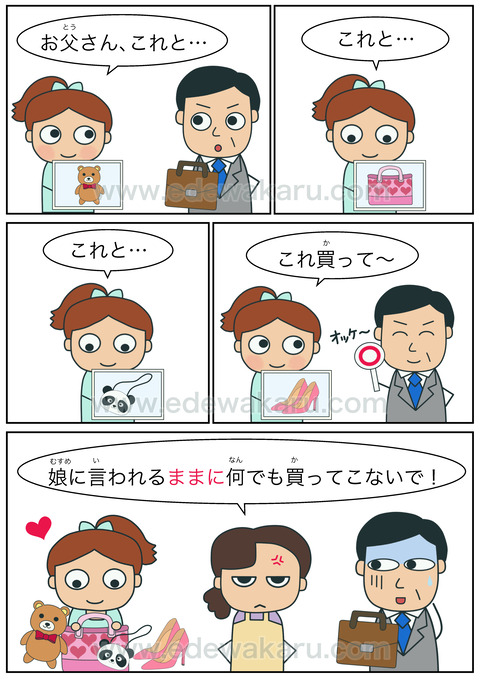
Meaning
Do ~ according to what one is told to do
How to use it
Verb [passive form] + ままに
Explanation
“〜ままに” is used with a verb in the [passive form] and is a sentence pattern meaning “do ~ according to what one is told.” It is used when you want to say, “Do ~ according to someone else’s will, not your own” 😅
[Examples]
① Wife: Don’t buy everything just because our daughter tells you to!
→Don’t buy everything just as our daughter tells you!
② I ended up buying new clothes just as the shop assistant recommended.
→I ended up buying new clothes according to the shop assistant’s recommendation.
③ He works overtime every day as his boss orders him to.
→He works overtime every day according to his boss’s orders.
④ I joined a sports gym just as my friend invited me to.
→I joined a sports gym according to my friend’s invitation.
⑤ I handed over the money just as the criminal instructed me to.
→I handed over the money according to the criminal’s instructions.
[For those with time to spare]
“〜られるままに〜する” can be changed to “〜られるがままに〜する” 😮
[Examples]
① Don’t buy everything just because our daughter tells you to!
=Don’t buy everything just as our daughter tells you to!
② I ended up buying new clothes just as the shop assistant recommended.
=I ended up buying new clothes just as the shop assistant recommended.
There are several sentence patterns that use “〜まま,” so it’s a good idea to remember this pattern as “〜られるままに〜する” 😉
In context 5 examples
妻:娘に言われるままに何でも買ってこないで!夫:すまん…(復習:〜てくる(継起))(復習:〜ん(口語形))
Wife: Don’t buy everything just because our daughter tells you to! Husband: Sorry… (Review: 〜てくる [sequence]) (Review: 〜ん [colloquial form])
店員さんに勧められるままに、新しい服を買ってしまった
I ended up buying new clothes just as the shop assistant recommended.
彼は、上司に命令されるままに毎日残業している
He works overtime every day as his boss orders him to.
友達に誘われるままにスポーツジムに入会した
I joined a sports gym just as my friend invited me to.
犯人に指示されるままにお金を渡してしまった
I handed over the money just as the criminal instructed me to.
Read the original source text
Meaning
〜られたとおりに〜する
How to use it
動詞[受身形]+ままに
Explanation
「〜ままに」は動詞の[受身形]と一緒に使われ「〜られたとおりに〜する」という意味を表す文型です。
「自分の意志ではなく、誰かの意志のとおりに〜する」
と言いたい時に使います😅
[例]
①妻:娘に
言われる
ままに
何でも買ってこないで!
→娘に言われたとおりに何でも買ってこないで!
②店員さんに勧められる
ままに、新しい服を買ってしまった
→店員さんに勧められたとおりに、新しい服を買ってしまった
③彼は、上司に
命令されるままに
毎日残業している
→彼は、上司に命令されたとおりに毎日残業している
④友達に
誘われるままに
スポーツジムに入会した
→友達に誘われたとおりにスポーツジムに入会した
⑤犯人に
指示される
ままに
お金を渡してしまった
→犯人に指示されたとおりにお金を渡してしまった
【余裕がある人へ】
「〜られるままに〜する」は「〜られるがままに〜する」という形にチェンジすることができます😮
[例]
①娘に言われる
ままに
何でも買ってこないで!
=娘に言われる
がままに
何でも買ってこないで!
②店員さんに勧められる
ままに、新しい服を買ってしまった
=店員さんに勧められる
がままに、新しい服を買ってしまった
「〜まま」が使われる文型はいくつかありますので、この文型は
「〜られるままに〜する」
と覚えておくといいと思います😉
Usage 3
Read this source entry ↗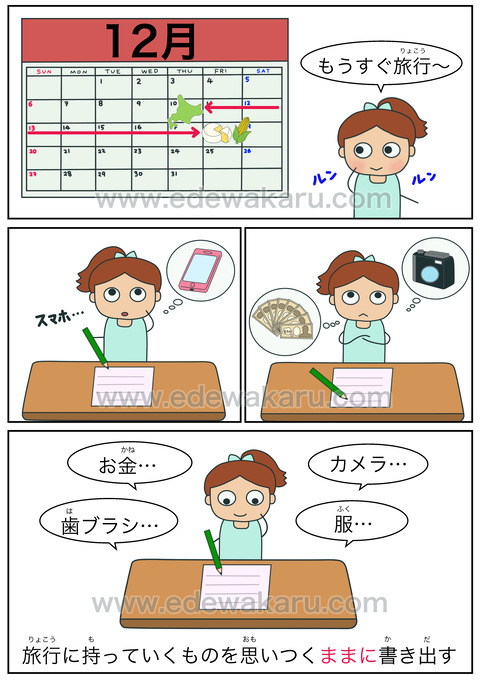
Meaning
Do ~ as you like
Leave it to ~
How to use it
Verb [dictionary form] + ままに
Explanation
“〜ままに〜する” is a sentence pattern meaning “do ~ leaving it to ~” or “do ~ as you like.” It is used with a limited set of verbs and functions like an idiom. There aren’t many verbs used this way, so it’s a good idea to remember a few 😀
[Examples]
思うままに〜
→as you like
足の向くままに〜
→without deciding on a destination, leaving it to your mood at the time
気の向くままに〜
→without deciding on a destination
→without thinking too hard, following the desire to do ~
風の吹くまま気の向くまま [idiomatic expression]
→do ~ without deciding anything, according to the circumstances or mood at the time
Remember “V dictionary form + ままに〜する” together with “Vられるままに〜する” 😀
In context 5 examples
旅行に持っていくものを、思いつくままに書き出す
→思いつくものを紙に書き出すI write down whatever comes to mind about what to take on the trip. →I write down whatever comes to mind on paper.
思うままに絵を描いた
→好きなように、自由に絵を描いたI painted as I pleased. →I painted freely, however I liked.
足の向くままに歩き続けた
→目的地を決めずに、その時の気分にまかせて歩き続けたI kept walking wherever my feet took me. →I kept walking without deciding on a destination, leaving it to my mood at the time.
気の向くままに旅に出た
→目的地を決めずに旅に出たI set off on a trip as the mood took me. →I set off without deciding on a destination.
風の吹くままに洗濯物が揺れている
→風にまかせて洗濯物が揺れているThe laundry is swaying in the wind. →The laundry is swaying at the wind’s mercy.
Read the original source text
Meaning
好きなように〜する
〜にまかせて
How to use it
動詞[辞書形]+ままに
Explanation
「〜ままに〜する」は「〜にまかせて〜する」「自分の好きなように〜する」という意味の文型です。この文型はほとんど決まった動詞に使われ、慣用句のように使われます。使用される動詞は多くありませんので、いくつか覚えておくといいと思います😀
[例]
思うままに〜
→好きなように
足の向くままに〜
→目的地を決めずに、その時の気分にまかせて
気の向くままに〜
→目的地を決めずに〜
→あまり深く考えずに、〜たいという気持ちにまかせて
風の吹くまま気の向くまま【慣用表現(かんようひょうげん)】
→何も決めずに、その時の状況や気分で〜する
「V辞+ままに〜する」は「Vられるままに〜する」と一緒に覚えておきましょう😀
日本語NET JLPT文法解説まとめ
Meaning
A sentence pattern indicating that an object is changed into a certain state.
How to use it
い-adjective (く) + する
な-adjective + に + する
Explanation
"make it 形容詞"
A sentence pattern indicating the transformation of an object into a certain state.
In context 11 examples
このコーヒーは苦すぎるので、砂糖を入れて甘くします。
This coffee is too bitter, so I'll add sugar and make it sweet.
先生、CDの音が聞こえないので、もう少し大きくしてください。
Teacher, I can't hear the CD, so could you turn it up a little?
すみません。このジーンズもう少し短くしてもらえませんか。
Excuse me. Could you make these jeans a little shorter?
部屋が暑いので、エアコンをつけて涼しくします。
The room is hot, so I'll turn on the air conditioner and cool it down.
ビールが冷えていないので、冷蔵庫に入れて冷たくします。
The beer isn't cold, so I'll put it in the refrigerator to make it cold.
あと500円安くしてくれたら、買いますよ。
I'll buy it if you make it 500 yen cheaper.
教室が汚いので、掃除して綺麗にしましょう。
The classroom is dirty, so let's clean it and make it tidy.
君を幸せにするから、僕と結婚してください。
I'll make you happy, so please marry me.
インターネットは私たちの生活を便利にしました。
The internet has made our lives more convenient.
テストは難しかったですか。次はもう少し簡単にしますね。
Was the test difficult? I'll make the next one a little easier.
もう少し、静かにしてください。
Please be a little quieter.
Read the original source text
Meaning
対象をある状態に変化させることを表す文型
How to use it
イAく + する
ナAに + する
Explanation
"make it 形容詞"
A sentence pattern indicating the transformation of an object into a certain state.
日本語文型辞典 英語版
Usage 1
Meaning
Used with regard to the passage of time or to cost. Can be replaced by たつ in the case of time and かかる in the case of cost.
When adverbs are combined with ...している or ...したN, they convey the meaning that someone or something has a certain characteristic or displays a certain condition.
Means “doing something to an object to make it change.” In contrast to なる, which expresses a natural change of the object itself, する expresses an intentional change involving someone who exerts an effect on the object.
→
5
Attaches to nouns that refer to smell, fragrance, flavor, sound, feeling, mood, chilliness, nausea, etc. Expresses a sense or perception.
→
B:コーヒーにします。
I’ll have coffee.
Means “to decide.” Can also be used with a noun + particle, as follows.
(例)会議は5時からにします。
We’ll have the meeting start at five o’clock.
(を)する is attached to nouns that express actions or effects, to create verbs. Although there are many cases in which it is attached to words of Japanese origin, it is more often used to make verbs out of words of Chinese origin and loan words.
b. Nをする〈outward appearance〉
Takes the form Nをしている or NをしたN. Used to describe things that can be grasped visually, such as color, shape, state, form, appearance, facial expression, etc.
c. Nをする〈occupation〉
Used in the form “name of job + をしている” and means “have that occupation.”
d. Nをする〈accessories〉
Attaches to nouns that refer to things like neckties, watches, and rings, to express that they are being worn. しているis used to indicate a state, as in
(2)
above.
Means to use something for a different purpose.
1
→
1
→
【ように3】5
How to use it
1. 数量詞+する
2. 副詞+する
3. ...する[N/Na にする][A-くする][V-ようにする]
4. Nがする
5. ...とする
6. ...にする[Nにする][Vことにする]
7. ...ものとする→
8. Nをするa. N(を)する
9. NをNにする
0. おR-する
1. V-ようにする
In context 58 examples
バンコクまで往復でいくらぐらいしますか。
How much does a round-trip flight to Bangkok cost?
その旅館は一泊5万円もする。
That ryokan (Japanese inn) costs a whopping 50,000 yen a night.
30分ほどして戻りますのでお待ちください。
I’ll be back in about thirty minutes, so please wait.
この球根は植えて半年したら芽がでます。
This bulb will sprout six months after planting it.
少ししてから出かけましょう。
Let’s go out in a little while.
こんな建て方では10年しないうちに壊れる。
It’s built so badly that it’ll collapse within ten years.
赤ちゃんの肌はすべすべしている。
Babies have smooth skin.
ほこりで机の上がざらざらしている。
The desk top is gritty with dust.
この料理は味がさっぱりしている。
The taste of this dish is light and simple.
息子は体つきががっしりしている。
My son has a sturdy build.
休日はみんなのんびりとしている。
We all relax on our days off.
なかなかしっかりしたよい青年だ。
He’s a good, dependable young man.
子供を医者にしたがる親が多い。
Many parents want their children to become doctors.
部屋をきれいにしなさい。
Clean your room.
冷たくするともっとおいしいですよ。
It tastes better if you chill it.
この食品はいそがしい人のためにすぐに食べられるようにしてあります。
This food product is made so that busy people can eat it quickly.
台所からいいにおいがしてきた。
A pleasant aroma came from the kitchen.
このサラダは変な味がする。
This salad tastes strange.
古いピアノはひどい音がして、使い物にならない。
The old piano sounds so terrible that it’s useless.
外に出ると冷たい風が吹いていて、寒気がした。
When I went out, a cold wind was blowing and I felt chilly.
その動物は小さくて柔らかく、まるでぬいぐるみのような感じがした。
The animal was small and soft, and it felt just like a stuffed toy.
彼とはうまくやっていけないような気がする。
I’ve got a feeling I won’t be able to get along with him.
今朝から吐き気がして何も食べられない。
I’ve been feeling queasy since this morning, and I have no appetite.
この肉料理にはふしぎな香りがするスパイスが使ってある。
A spice with an unusual aroma is used for this meat dish.
来週は休講とする。
There will be no class next week.
一応 60 点を合格とします。
The passing mark is set at 60% for now.
A:何になさいますか。
What would you like?
今度のキャプテンは西田さんにしよう。
Let’s make Nishida-san the next captain.
かぜがよくならないので旅行は止めることにします。
My cold isn’t getting any better, so I’m going to cancel the trip.
事故がこわいので飛行機には乗らないことにしています。
I don’t fly because I’m scared of an accident.
午後は買い物をするつもりだ。
I intend to go shopping this afternoon.
日曜日には妻と散歩をしたりテニスをしたりする。
On Sundays my wife and I usually take a walk or play tennis.
昔はよくダンスをしたものだ。
I used to dance a lot.
いたずらをすると叱られるよ。
You’ll be scolded if you make any mischief.
ころんで足にけがをした。
I fell down and injured my leg.
せきをしているので風邪をひいたのでしょう。
Since he’s coughing, he’s probably caught a cold.
きれいな色をしたネクタイをもらった。
I got a beautifully colored necktie.
その建物は三角形のおもしろい形をしている。
That building has an interesting triangular shape.
見舞いに行ったら、かれはとても苦しそうな様子をしていたのでつらかった。
When I went to visit him he seemed to be in pain, so it was hard for me.
それは人間の姿をした神々の物語だ。
This is a story of gods who took on human form.
みすぼらしい格好をした男が訪ねてきた。
A scruffy-looking man came to visit.
この仏像はとてもやさしそうな顔をしている。
This Buddha has a very kind-looking face.
彼は教師をしている。
He’s a teacher.
ベビー・シッターをしてくれる人を探しています。
I’m looking for someone who can work as a baby-sitter for me.
社長をしているおじの紹介で就職した。
I got the job through my uncle, who is the company president.
母は前は主婦だったが今は薬剤師をしている。
My mother used to be a housewife, but now she’s working as a pharmacist.
あの赤いネクタイをした人が森さんです。
The one wearing the red necktie is Mori-san.
あの人はいつもイヤリングをしている。
She’s always wearing earrings.
手袋をしたままで失礼します。
Excuse me for not taking off my gloves.
あっ、今日は時計をしてくるのを忘れた。
Oh, I forgot to wear my watch today.
このごろ風邪をひいてもマスクをする人はいませんね。
These days, people don’t wear face masks even if they have a cold.
本をまくらにして昼寝した。
I took a nap, using a book as a pillow.
スカーフをテーブルクロスにして使っています。
I’m using a scarf as a tablecloth.
客間を子どもの勉強部屋にした。
I made the guest room into a children’s study.
ここでお待ちします。
I’ll wait for you here.
お荷物お持ちしましょうか。
Would you like me to carry your luggage?
必ず連絡をとるようにする。
I’ll be sure to contact (them).
朝寝坊しないようにしよう。
Let’s be sure not to oversleep.
Read the original source text
Meaning
Used with regard to the passage of time or to cost. Can be replaced by たつ in the case of time and かかる in the case of cost.
When adverbs are combined with ...している or ...したN, they convey the meaning that someone or something has a certain characteristic or displays a certain condition.
Means “doing something to an object to make it change.” In contrast to なる, which expresses a natural change of the object itself, する expresses an intentional change involving someone who exerts an effect on the object.
→
5
Attaches to nouns that refer to smell, fragrance, flavor, sound, feeling, mood, chilliness, nausea, etc. Expresses a sense or perception.
→
B:コーヒーにします。
I’ll have coffee.
Means “to decide.” Can also be used with a noun + particle, as follows.
(例)会議は5時からにします。
We’ll have the meeting start at five o’clock.
(を)する is attached to nouns that express actions or effects, to create verbs. Although there are many cases in which it is attached to words of Japanese origin, it is more often used to make verbs out of words of Chinese origin and loan words.
b. Nをする〈outward appearance〉
Takes the form Nをしている or NをしたN. Used to describe things that can be grasped visually, such as color, shape, state, form, appearance, facial expression, etc.
c. Nをする〈occupation〉
Used in the form “name of job + をしている” and means “have that occupation.”
d. Nをする〈accessories〉
Attaches to nouns that refer to things like neckties, watches, and rings, to express that they are being worn. しているis used to indicate a state, as in
(2)
above.
Means to use something for a different purpose.
1
→
1
→
【ように3】5
How to use it
1. 数量詞+する
2. 副詞+する
3. ...する[N/Na にする][A-くする][V-ようにする]
4. Nがする
5. ...とする
6. ...にする[Nにする][Vことにする]
7. ...ものとする→
8. Nをするa. N(を)する
9. NをNにする
0. おR-する
1. V-ようにする
Usage 2
Meaning
【お...する】[おR-する][ごNする]
Used with either verb stems or nouns of Chinese origin that express an action. A humble expression that means “the speaker does something for someone.” With nouns of Chinese origin, as in
(4)
and
(5)
, usually the form ごNする is used. However, in the case of 電話する (to telephone), お電話する is used. Like
(1)
, the form おR-します can be used to offer to do something for someone. お...いたす is a more polite expression.
In context 5 examples
先生、お荷物をお持ちします。
Sir, I’ll bring your baggage.
部長をお宅まで車でお送りした。
I took the department head home in my car.
ご注文の品をお届けしました。
We have delivered the goods you ordered.
お部屋へご案内しましょう。
I’ll show you to your room.
あとでこちらからご連絡します。
We will contact you later.
Bunpro Grammar Reference
Usage 1
Meaning
To do, To make into
How to use it
する
します
Nuance
A verb that has a special class of conjugation rules, and is used for many different actions.
Explanation
する verbs are one of only two main verbs in Japanese that do not follow the standard rules of conjugation for Godan and Ichidan verbs. The other primary verb being 来る. する means to do something, or to make something a certain way.
洗濯をする。
To do laundry.
料理をする。
To cook. (Literally 'to do food')
する will almost always have the particle を attached to the thing that is being done (depending on the form of the verb). The reason that する verbs are called さ-column irregular conjugation verbs in Japanese is because the る in する does not conjugate, but is dropped.
This will leave す to be the part that conjugates. Because of this, する has qualities of both る-Verbs (the る being dropped), and う-Verbs (the remaining す changing, depending on the conjugation). Here are some examples of how する changes.
(さ)せる, (し)ます, (す)る, (せ)よ.
We will learn more about each of these conjugations of する, and their individual meanings at a later stage. For now, let's take a look at the polite します conjugation.
電話をします。
To make a call.
勉強をします。
To study.
In a broader sense, する can be thought of as meaning 'to do something that has an external effect'.
In context 16 examples
- サッカーをする。
To play soccer. (to do)
- 電話をします。
To make a call.
- 洗濯をする。
To do laundry.
- 勉強をします。
To study.
- 料理をする。
To cook. (Literally 'to do food')
- サッカーをします。
To play soccer. (to do)
- 何をしますか。
What will you do?
- 私は勉強をする。
I (will do) study.
- 掃除をする。
To clean. (to do)
- 君は文法を勉強します。
You study grammar. (to do)
- パーティーをする。
To have a party. (to do)
- 私は、それをします。
I will do that.
- 彼がするだろう。
He will do it, right?
- 話をする。
To talk. (to do)
- トムは時計をする。
Tom wears a watch. (to do)
- スポーツをする。
I play sports. (to do)
Read the original source text
Meaning
To do, To make into
How to use it
する
します
Nuance
A verb that has a special class of conjugation rules, and is used for many different actions.
Explanation
する verbs are one of only two main verbs in Japanese that do not follow the standard rules of conjugation for Godan and Ichidan verbs. The other primary verb being 来る. する means to do something, or to make something a certain way.
洗濯をする。
To do laundry.
料理をする。
To cook. (Literally 'to do food')
する will almost always have the particle を attached to the thing that is being done (depending on the form of the verb). The reason that する verbs are called さ-column irregular conjugation verbs in Japanese is because the る in する does not conjugate, but is dropped.
This will leave す to be the part that conjugates. Because of this, する has qualities of both る-Verbs (the る being dropped), and う-Verbs (the remaining す changing, depending on the conjugation). Here are some examples of how する changes.
(さ)せる, (し)ます, (す)る, (せ)よ.
We will learn more about each of these conjugations of する, and their individual meanings at a later stage. For now, let's take a look at the polite します conjugation.
電話をします。
To make a call.
勉強をします。
To study.
In a broader sense, する can be thought of as meaning 'to do something that has an external effect'.
Nuance · 日本語
色々な動作を表すために使われる、特別な活用方法がある動詞。
Usage 2
Meaning
I humbly do, I am obliged to do, Humble speech
How to use it
お + Verb[stem]+ する
ご(1) + する[Verb] + する
(1) お, limited to [する]Verbs like: 電話する、勉強する、散歩する
お + Verb[stem]+ します
ご(1) + する[Verb] + します
(1) お, limited to [する]Verbs like: 電話する、勉強する、散歩する
Nuance
A basic humble expression used to indicate your own actions, or those of your in-group.
Explanation
お〜する comes from a form of polite speech in Japanese called humble speech. This type of speech is used to refer to the speaker and their actions. This is opposed to honorific language, which refers exclusively to the listener and their actions. お〜する is almost exactly the same as お~になる, as in it simply means する.
お〜する is regularly used with words of Japanese origin, while ご~する will be used with words of Chinese origin. The する in this compound will attach directly to the ます stem of almost any verb.
僕がお守りします!
I am going to protect you!
今すぐにご確認します。
I will check right now.
Caution
While the する in this structure will attach directly to the ます stem of verbs, this does not mean that verbs that are already する verbs will become しする. In the case of する verbs, simply change the prefix to ご.
ご登録する方はこちらをクリックしてください。
For those who want to register, please click here.
ご注文する時はこちらのベルを押してください。
When you are going to order, please press this bell.
In rare cases, お may be used instead of ご, when attached to words of Chinese origin. There is no specific rule for this, and they must be memorized on a case by case basis.
先輩にお電話するのがすきです。
I like to call my senpai.
友達とお勉強するのは楽しいです。
It is fun to study with my friends.
Thankfully, the words of Chinese origin that use お instead of ご are extremely common verbs. This means that you will be exposed to almost all of them very quickly. All others may be assumed to use ご.
Fun Fact
In the same way that お~になる is a more common variation of なさる (both honorific language), お〜する is a more common variation of いたす (both humble speech).
5分後にお電話します。
After 5 minutes, I will call you. (I will call you in five minutes)
5分後にお電話いたします。
After 5 minutes, I will call you. (I will call you in five minutes)
In context 20 examples
- ドアをお閉めします。
I (will) humbly close the door.
- 僕がお守りします!
I am going to protect you!
- 今すぐにご確認します。
I will check right now.
- お任せします。
I will humbly leave it up to you.
- 先生の分もお取りします。
I will humbly take the teacher's share.
- あなたの分もお作りします。
I will also humbly make your share.
- これを彼にお渡ししてください。
Please humbly hand over this to him.
- 明日はクラブをお休みします。
I will humbly be absent from tomorrow's club activities.
- 心を込めてお読みしましょう。
Let's humbly and wholeheartedly read.
- 只今コーヒーをお持ちします。
I will humbly bring the coffee right away.
- 明日、サカモト先生にお電話します。
I will humbly call Sakamoto-sensei tomorrow.
- 友達のお母さんにパソコンをお借りしました。
I humbly borrowed a computer from my friend's mother.
- 先生をお呼びしてもよろしいでしょうか?
May I humbly call upon the teacher?
- 彼にお会いしたのは昨日が初めてです。
Yesterday I humbly met him for the first time (and felt obliged).
- ご登録する方はこちらをクリックしてください。
For those who want to register, please click here.
- ご注文する時はこちらのベルを押してください。
When you are going to order, please press this bell.
- 先輩にお電話するのがすきです。
I like to call my senpai.
- 友達とお勉強するのは楽しいです。
It is fun to study with my friends.
- 5分後にお電話します。
After 5 minutes, I will call you. (I will call you in five minutes)
- 5分後にお電話いたします。
After 5 minutes, I will call you. (I will call you in five minutes)
文法
Meaning
A sentence pattern indicating that an object is changed into a certain state.
How to use it
い-adjective (く) + する
な-adjective + に + する
In context 11 examples
このコーヒーは苦すぎるので、砂糖を入れて甘くします。
This coffee is too bitter, so I'll add sugar and make it sweet.
先生、CDの音が聞こえないので、もう少し大きくしてください。
Teacher, I can't hear the CD, so could you turn it up a little?
すみません。このジーンズもう少し短くしてもらえませんか。
Excuse me. Could you make these jeans a little shorter?
部屋が暑いので、エアコンをつけて涼しくします。
The room is hot, so I'll turn on the air conditioner and cool it down.
ビールが冷えていないので、冷蔵庫に入れて冷たくします。
The beer isn't cold, so I'll put it in the refrigerator to make it cold.
あと500円安くしてくれたら、買いますよ。
I'll buy it if you make it 500 yen cheaper.
教室が汚いので、掃除して綺麗にしましょう。
The classroom is dirty, so let's clean it and make it tidy.
君を幸せにするから、僕と結婚してください。
I'll make you happy, so please marry me.
インターネットは私たちの生活を便利にしました。
The internet has made our lives more convenient.
テストは難しかったですか。次はもう少し簡単にしますね。
Was the test difficult? I'll make the next one a little easier.
もう少し、静かにしてください。
Please be a little quieter.
Read the original source text
Meaning
対象をある状態に変化させることを表す文型
How to use it
イAく + する
ナAに + する
Yokubi — The Common Grammar Guide (https://yoku.bi)
Usage 1
Explanation
Now that we've covered the most common verb stems, we can cover the irregular verbs. Japanese only has two major irregular verbs, but they're very common. Their conjugations are completely irregular. Note that there are some other exceptions and corner cases in some other verbs (we've already seen 問うた), but these two are completely different and live in an entire class of their own.
Their conjugations are as such
With する, we can introduce a new class of verbs: the する verbs. In Japanese you can turn a lot of nouns into verbs by simply adding する after them. This is not allowed with all nouns, but a large part of words will show up in the dictionary as "する verb" too. This is especially common between two-kanji words that originate from Chinese.
They mostly mean the same as their non-verb construction, but grammatically the noun becomes for all intents and purposes a real verb.
Consider these sentences
The first treats 勉強 as a verb, and 日本語を as its object. The second considers 勉強 a noun (modified by 日本語) and it is the object of the individual verb する. The third sentence is ungrammatical, because it tries to force two disconnected objects and simply doesn't work.
While we can translate the first and second sentences in two slightly different ways to accentuate the difference between 勉強する and 勉強をする, realistically the meaning is pretty much the same.
In context 5 examples
する
to do
料理する
to cook (lit: "to do cuisine")
日本語を勉強する
to study Japanese
日本語の勉強をする
to study Japanese (lit: "to do the study of Japanese")
*日本語を勉強をする
(ungrammatical nonsense)
Usage 2
Explanation
We have already seen なる in some examples from past lessons. Let's now take a deeper look at how it works.
なる is a verb meaning something like "become" or "ending up being". In addition to just "become", it can be used for all sorts of indirect states, like a team ending up being its members, or a rumor turning out to be true.
に is used as the particle to mark the noun (or thing) that the subject "becomes". As always, the order of particles can change the emphasis, as we can see in the first example sentence above.
In reality, though, なる actually takes an adverb and not just nouns marked with に. It just happens to be that nouns (and な adjectives) can become adverbial when に is used.
We can confirm this when we try to use なる with い adjectives. To do so, we need to turn them into adverbs like this:
Likewise for the negative (ない) forms:
Even verbs can be paired with なる. Verbs in the negative form conjugate like い adjectives, and the same goes for verbs in たい form. Meanwhile, verbs in plain/non-negative form require an extra helper noun like よう which roughly means "in the manner of" (same よう we have already seen in [Lesson 42](../Part3/Lesson42.md)).
It is common for the structure ようになる to have the verb in potential form to mean "become able to do" something.
As a parallel of \<adverb\> + なる, we will now look at \<adverb\> + する.
You can consider する to be the "active" version of なる. While \<adverb\> + なる means "to **become** \<adverb\>", \<adverb\> + する means "to **make** (something) into \<adverb\>".
The sentence structure works exactly the same as なる, except we mark the thing that is being "made" with を.
In context 3 examples
みんなが目を丸くする。
Everyone stared in wonder (lit: "made their eyes a circle")
彼女は笑みを深くする。
She deepened her smile (lit: "made her smile deeper")
美味しいものは人を幸せにする。
Tasty things make people happy (lit: "turn people into happiness")
IMABI
The Verbs する & 来る
Read this IMABI lesson ↗Explanation
The Irregular Verbs する & 来る
Of all the verbs in Modern Japanese, only two are considered irregular. These verbs are する meaning “to do” and 来る meaning “to come.” Their irregularity lies in their unique set of bases. First, we will learn what those bases are, then study how they combine with the endings we know.
In our terminology recap, only terms related to the bases are listed. If a grammar term appears that you are still unsure about, refer to past lessons.
Base: One of the six forms of a verb that is followed by endings like auxiliaries.
Terminal/Predicative Form (終止形): Marks the end of a complete sentence/the predicate.
Attributive Form (連体形): Makes a verb, adjective, etc. into a modifier that goes directly before a noun.
Basic Form (基本形): The basic or “plain speech” form of any given phrase. The basic form encompasses both the predicative and the attributive forms in the context of verbs and adjectives.
Continuative Form (連用形): Used with endings pertaining to actions being carried out.
Irrealis Form (未然形): Used with endings which indicate actions that have yet to occur.
The Bases of する (To Do)
So far, we know about the terminal/predicative form (終止形), the attributive form (連体形), the continuative form (連用形), and the irrealis form (未然形). Although its verb class is only composed of itself, する combines with many words to create more verbs, especially word roots of Sino-Japanese and foreign origin, and with its basic meaning of “to do,” it is arguably the most important verb in Japanese.
Terminology Note: する itself, along with all the verbs it creates, are collectively known as サ行変格活用動詞 (“sa”-column irregular conjugating verbs) or Sahen サ変 verbs for short.
Class ExamplePredicativeAttributivEContinuativeIrrealis
Ichidan見る (to see)MiruMiruMi–Mi–
Godan聞く (to ask)KikuKikuKiki–Kika–
Sahenする (to do)Su(ru)SuruShi–Shi–
※The root of する is s-. What follows this root are the affixes which create the bases themselves. Applying this logic by comparing it to other verb classes reveals just how irregular it truly is.
※The traditional predicative/terminal form is す. Its use in everyday speech is few and far between, but it is fairly common in set phrases, poetry, etc.
※One thing that Ichidan and Sahen verbs share is how the affix ~る marks the attributive form. This does not transfer over to Godan verbs, including those which end in /ru/ because the /r/ is a part of the stem for those verbs.
The Conjugations of する
Now it is time to see how する conjugates for the forms we have learned thus far. Below, you will see how its irrealis form (for the negative auxiliary ~ない) and its continuative form (for most auxiliaries like ~ます for politeness and ~た for past tense) are both し~.
As only the bases of する are different, we will forgo an etymological breakdown of these conjugations (see Lesson 17 or Lesson 18). However, the base of する used for each conjugation will still be listed.
FormConjugationBase of する
Non-Past (Plain)する Terminal/Attribute Form
Non-Past (Polite)しますContinuative Form
Past (Plain)した Continuative Form
Past (Polite)しましたContinuative Form
Negative (Plain)しない Irrealis Form
Negative (Polite Method 1)しませんContinuative Form
Negative (Polite Method 2)しないですIrrealis Form
Negative Past (Plain)しなかった Irrealis Form
Negative Past (Polite Method 1)しませんでしたContinuative Form
Negative Past (Polite Method 2)しなかったですIrrealis Form
When the auxiliary verb ~ます is conjugated into its negative form ~ません, it utilizes its own irrealis form mase- to do so, and this does not change how ~ます attaches to the continuative form of the main verb する.
Speech Level Note: As we learned with Ichidan and Godan verbs, regarding the negative and negative past in polite speech, Method 1 is politer and more appropriate than Method 2 in formal settings.
1. 僕は宿題をしなかった。
I didn’t do my homework.
2. 変なことをする。
To do something weird.
3. 怖い話をしますね。
I’ll talk about something scary, k.
4. 弟は掃除をしました1。
My little brother cleaned.
5. 嫌なことはしないです。
I won’t do anything unpleasant.
6. 皿洗いはしません。
I won’t do the dishes.
7. 料理をしませんでした。
I didn’t cook.
8. 小さい頃は勉強をしなかったです。
I didn’t study when I was little.
9. そんなことはしないよ。
I won’t do anything like that.
10. 掃除をしたよ。
I did the cleaning.
The Meanings of する
する is not only irregular, but it also has several meanings, all of which are very important to grasp.
“To DO” on a Grander Scale
Firstly, する is “to do” in a much larger sense both grammatically and semantically speaking than its English counterpart. In Japanese, words usually cannot be used as another part of speech without a change in word form. For example, the noun for “yawn” is あくび, but “to yawn” is あくびをする. Even if “to do” is not used in this way in English, する helps many nouns behave as verbs. You can alternatively think of it as “to perform the act of…”
11. 息をする。
To breathe.
12. 恋をする。
To be in love.
13. 旅をする。
To go on a journey.
14. 火傷をする。
To burn (oneself).
15. 仕事をする。
To work (a job).
Nouns + する → “する” Verbs
Most importantly, する helps make many words, mostly Sino-Japanese and loanwords, function as verbs. For instance, 運転 means “driving,” but to say “to drive,” you say 運転(を)する. When to include を will be a discussion for another time, but for now, if its inclusion is not necessary, it will be left in parentheses.
注文するTo order翻訳するTo translate
サインインするTo sign-inキャンセルするTo cancel
電話する To call on the phone勉強(を)するTo study
販売するTo sell/market投票する To vote
16. 今夜電話しますね。
I’ll call you tonight, ok?
17. 英文を翻訳しました。
I translated the English sentences.
18. Tシャツを販売します。
(I/we) will sell T-shirts.
19. カレンダーを注文しませんか。
How about ordering a calendar?
20. 今回は投票しませんでした。
I did not vote this time.
21. フィンランド語の勉強をしました。
I did my Finnish studies.
22a. 広東語を勉強しませんか。〇
22b. 広東語を勉強をしませんか。X
Why don’t you study Cantonese?
23. 勉強(を)しませんか。
Why don’t you/we study?
Grammar Note: In Ex. 21, 勉強 is attached to the previous noun with の to create the sense of “studies.” However, simply saying “I study…” involves using 勉強 as a verb with する. Grammatically, を cannot be used twice in the same clause like in 22b. If the object were dropped like in Ex. 23, を is optional with its inclusion most likely used in settings like in Ex. 21.
To Cost
There are several ways to say “to cost” in Japanese, but we will only focus on how する is used in this way. In this meaning, it functions as an intransitive verb with the value phrase functioning as an adverb. The “cost” is the sticker price which the speaker pays for it.
24. レンタルもおおよそ五千円します。
Rental also costs about 5000 yen.
25. LINEスタンプは百円します。
LINE stamps cost 100 yen.
26. このワインは二千円もしませんでした。
This wine didn’t even cost 2000 yen.
To Wear an Accessory
There are many verbs in Japanese meaning “to wear,” but する can specifically express wearing an accessory.
27. マスクをする。
To wear a mask.
28. 手袋をする。
To wear gloves.
29. ネクタイをする。
To wear a tie.
To Sense
する can also be used to mean “to sense” as in the five senses as well as emotions. These are treated as natural phenomena beyond the control of the speaker; thus, this usage is intransitive in nature even though the corresponding English phrases will most likely be transitive. This means that が will mark what would correspond to the object in English.
30. 強い匂いがしました。
There was/it had a strong scent.
31. 甘い味がしますね。
It tastes sweet, doesn’t it?
32. 量が少ない感じがしました。
I felt that the amount was lacking.
33. 変な音がした。
There was a strange sound.
34. 悲しい気持ちがする。
To have sad feelings.
To Be…. (Occupation/Role)
When you want to say your job/role/occupation is, you typically use する. However, to make this an active statement, you need to use the ending ~ている, which indicates an ongoing state.
35. 料理人をしています。
I am a cook.
36. 銀行員をしています。
I am a bank clerk.
To Be/Have
する may translate as “to be/have” as in “to take on” a certain quality. Key phrases of this include the following:
~形をするTo take the form/shape of… ~顔をするTo have a…face
~目付きをするTo have a…expression~目をするTo have… eyes
37. {丸い・四角い}形をした建物を構築する。
To construct a [round/square] shaped building.
38. あの子はかわいい顔をしていますね。
That kid has a cute face, doesn’t he/she?
39. 鋭い目付きをする。
To have a sharp expression.
40. 冷たい目をする。
To have cold eyes.
To Play
The act of playing some specific game or sport is expressed with する. In fact, する also encompasses doing general activities of any sort.
Word Note: In casual contexts, you may also use the verb やる for this meaning.
41. パチンコをしませんか。
Why not play pachinko (Japanese pinball)?
42. 生け花をします。
I will practice flower arrangement.
43. アメフトを{します・やります}。
I’ll play American football.
44. スキーはしません。
I don’t ski.
45. 私は昨日、サッカーをしました。
I played soccer yesterday.
The Bases of 来る (To Come)
来る meaning “to come” has its own unique set of bases, which is the sole reason for why it is viewed as an “irregular” verb.
Terminology Note: The verb class which 来る belongs to is called カ行変格活用動詞 (“ka”-column irregular conjugating verbs) or Kahen カ変 verb for short.
ClassExamplePredicativeAttributiveContinuativeIrrealis
Ichidan食べる (to eat)TaberuTaberuTabe–Tabe–
Godan死ぬ (to die)ShinuShinuShini–Shina–
Sahenする (to do)SuruSuruShi–Shi–
Kahen来る (to come)KuruKuruKi–Ko–
※Similarly to suru する, the stem of kuru 来る is k-. Also just like suru する, its terminal/predicative form was originally just ku 来, but this is no longer used.
The Conjugations of Kuru 来る
Now it is time to see how 来る conjugates for the forms we have learned thus far. Below, you will see how its irrealis form ko– (for the negative auxiliary ~ない) and its continuative form ki- (for most auxiliaries like ~ます for politeness and ~た for past tense) are NOT the same.
As only the bases of 来る are different, we will forego an etymological breakdown of these conjugations (see Lesson 17 or Lesson 18). However, the base of 来る used for each conjugation will still be listed.
FORMCONJUGATIONBASE OF する
Non-Past (Plain)くるTerminal/Attribute Form
Non-Past (Polite)きますContinuative Form
Past (Plain)きたContinuative Form
Past (Polite)きましたContinuative Form
Negative (Plain)こないIrrealis Form
Negative (Polite Method 1)きませんContinuative Form
Negative (Polite Method 2)こないですIrrealis Form
Negative Past (Plain)こなかったIrrealis Form
Negative Past (Polite Method 1)きませんでしたContinuative Form
Negative Past (Polite Method 2)こなかったですIrrealis Form
When the auxiliary verb ~ます is conjugated into its negative form ~ません, it utilizes its own irrealis form mase- to do so, and this does not change how ~ます attaches to the continuative form of the main verb 来る.
The Meaning of 来る
来る means “to come” in both spatial and temporal contexts. The difference it has with its English equivalent is that it means “to come” as in someone/something arriving at Point A (from Point B). In a directional sense, it never describes moving away from where the speaker is at the time of utterance.
46. サンタさんが来なかった。
Santa didn’t come.
47. ついに春が来た!
Spring has finally arrived/come!
48. 電車、来ないよ。
The train hasn’t come!
49. 来る日も来る日も雪だった。
It was snow day after day.
50. 連絡が来ませんでした。
No contact has come in.
51. 手紙が{来なかった・届かなかった}です。
A letter didn’t come.
Synonym Note: In the sense of “to arrive” as in something that is delivered, the verb 届く is preferred but not required.
52. 明日のパーティに来る?
Will you come to [my/the] party tomorrow?
Grammar Note: Even though the speaker of this sentence is not necessarily at Point A (where the party is being held), their state of mind is, and when this is the case, using 来る is still valid.
Previous Lesson
Next Lesson
The translation “to do” does not always have to show up in the English translation, as natural phrasing may differ between English and Japanese. In this instance, 掃除をする does literally translate to “to do cleaning,” but sticking to this wording when naturally translating the sentence is not necessary. The same can be said for Ex. 3, in which 話をする more naturally translates “to talk (about)…” ↩︎
In context 53 examples
僕は宿題をしなかった。
I didn’t do my homework.
変なことをする。
To do something weird.
怖い話をしますね。
I’ll talk about something scary, k.
弟は掃除をしました1。
My little brother cleaned.
嫌なことはしないです。
I won’t do anything unpleasant.
皿洗いはしません。
I won’t do the dishes.
料理をしませんでした。
I didn’t cook.
小さい頃は勉強をしなかったです。
I didn’t study when I was little.
そんなことはしないよ。
I won’t do anything like that.
掃除をしたよ。
I did the cleaning.
息をする。
To breathe.
恋をする。
To be in love.
旅をする。
To go on a journey.
火傷をする。
To burn (oneself).
仕事をする。
To work (a job).
今夜電話しますね。
I’ll call you tonight, ok?
英文を翻訳しました。
I translated the English sentences.
Tシャツを販売します。
(I/we) will sell T-shirts.
カレンダーを注文しませんか。
How about ordering a calendar?
今回は投票しませんでした。
I did not vote this time.
フィンランド語の勉強をしました。
I did my Finnish studies.
広東語を勉強しませんか。〇
Why don’t you study Cantonese?
広東語を勉強をしませんか。X
Why don’t you study Cantonese?
勉強(を)しませんか。
Why don’t you/we study?
レンタルもおおよそ五千円します。
Rental also costs about 5000 yen.
LINEスタンプは百円します。
LINE stamps cost 100 yen.
このワインは二千円もしませんでした。
This wine didn’t even cost 2000 yen.
マスクをする。
To wear a mask.
手袋をする。
To wear gloves.
ネクタイをする。
To wear a tie.
強い匂いがしました。
There was/it had a strong scent.
甘い味がしますね。
It tastes sweet, doesn’t it?
量が少ない感じがしました。
I felt that the amount was lacking.
変な音がした。
There was a strange sound.
悲しい気持ちがする。
To have sad feelings.
料理人をしています。
I am a cook.
銀行員をしています。
I am a bank clerk.
{丸い・四角い}形をした建物を構築する。
To construct a [round/square] shaped building.
あの子はかわいい顔をしていますね。
That kid has a cute face, doesn’t he/she?
鋭い目付きをする。
To have a sharp expression.
冷たい目をする。
To have cold eyes.
パチンコをしませんか。
Why not play pachinko (Japanese pinball)?
生け花をします。
I will practice flower arrangement.
アメフトを{します・やります}。
I’ll play American football.
スキーはしません。
I don’t ski.
私は昨日、サッカーをしました。
I played soccer yesterday.
サンタさんが来なかった。
Santa didn’t come.
ついに春が来た!
Spring has finally arrived/come!
電車、来ないよ。
The train hasn’t come!
来る日も来る日も雪だった。
It was snow day after day.
連絡が来ませんでした。
No contact has come in.
手紙が{来なかった・届かなかった}です。
A letter didn’t come.
明日のパーティに来る?
Will you come to [my/the] party tomorrow?
Suru Verbs
Read this IMABI lesson ↗Explanation
Nouns → Verbs with する
Numerous verbs are made with する attached to nouns. する is primarily seen after 漢語名詞かんごめいし, nouns that are Sino-Japanese (Chinese based) in origin or composition. However, する is not limited to these nouns. It is also seen after native words and recent loanwords.
To study 勉強する To buy and sell 売買する
To eat and drink 飲食する To point out 指図する
To oversleep 寝坊する To exchange (money) 両替する
To love (sexual relation) 恋する To sweat 汗する
To copy コピーする To sign サインする
To design デザインする To cancel キャンセルする
Creating a verb out of a noun with する may simple, but there are a lot of strange semantic restrictions that have to be examined. For instance, even though 供給きょうきゅう (supply) is the opposite of 需要じゅよう (demand), only 供給 can be followed by する. This lesson will investigate what exactly the patterns are to figuring this out.
Particles are also confusing. Some nouns become verbalized by adding ~する, ~をする, ~にする, ~になる, a combination of these. This does not consider the particle to be used before the resultant verb phrase.
Initial Problems
Our first problem is when to use ~をする as opposed to just attaching する directly to the noun in question. From the very beginning of your Japanese studies, you’ve likely encountered very basic vocabulary in which this を is optional: 練習(を)する (to practice ) and 勉強(を)する (to study).
Extending ~をする haphazardly to any する verb isn’t correct, however, as there are situations in which only ~する or ~をする is right. There are even nouns that require completely different means to be turned into a verb.
To play tennis テニス{をする 〇・する △} To play baseball 野球{をする 〇 ・する △}
To mean/imply 意味{する 〇・をする X} To connotate 含意{する 〇・をする X}
To consult 参考{する X・をする X・にする 〇} To be in a daze 夢中{する X ・をする X・になる 〇}
Clarification Notes:
1. 意味をする may be used if you have ~という意味 or ~のような意味. However, the verb 意味する is not quite the same as just to define. Rather, it is more like “to imply.”
2. Particle omission is a common practice in casual speech, but in non-casual speech, expressions like テニスする become improper.
When the particle を is required, する is interpreted literally. This する is sometimes called a 重動詞 (heavy verb) in contrast to when it is just a grammatical item. Notice that the words that only take をする are specific activities: 強盗, テニス, 野球. Are these nouns then made verbs? No, they’re obligatorily marked by を and are thus functioning as direct objects.
For activity nouns that are broad in meaning such as 勉強 and 練習, we see that を is optional. When を is used, these nouns usually have some sort of attribute, making them more specific.
1. 日本語の勉強をする。
To study Japanese.
Literally: To do Japanese studies.
For those that obligatorily only take する, they all represent a state/situation. More examples of these nouns include 刺殺 (stabbing to death), 集中 (concentration), 信用 (trust), 逆転 (reversal).
When する cannot be used at all, the noun lacks a strong verbal aspect. Ignoring set phrases that may break the rules, there are a set of tests to determine whether a noun has a high enough 動詞性 (verbal nature) to take する.
する or not to する
Test 1: Aspect Modifier Test
Time phrases like “until” (までに) in Japanese set aspect limitations on verbs. Aspect is the grammatical concept that denotes how a verb behaves over a duration of time. If a noun in Japanese can take a time parameter setting phrase such as までに, then it is said to have a high 動詞性, which means it should also have a verb form that can take those same time phrases.
2a. 明日までの仕上がり (Noun Phrase) 2b. 明日までに仕上がる (Verb Phrase)
Completion by tomorrow To complete by tomorrow
If you were to replace 仕上がり with 本 or 部屋, which are both Sino-Japanese nouns, you do not get a valid sentence. These physical objects have nothing to do with time. Likewise, even if a noun can be about a state that may occur over a period of time, if a time parameter is not built into its meaning, producing a valid noun phrase like in 2a. will reversely be impossible.
3a. 夜以内の痛み X 3b. 夜の痛み 〇 3c. 夜に痛む
~以内 creates a time parameter in the same way the particle までに does. In this example, we see that 痛む (to hurt/ache) does have a noun form (痛み), but it doesn’t make sense to say “pain within the night” as pain is not recognized as having a definitive end point.
Applying this information to する verbs, when you have a Sino-Japanese noun that can take a time parameter phrase such as までに, する can be used with it. If the noun cannot, you may still have ~をする in which the time phrase agrees with the literal definition of する.
Nominal Phrase Verbal Phrase +する?
完了 (Completion) 完了する (To complete) 〇
完成 (Completion) 完成する (To complete/perfect) 〇
計算 (Calculation) 計算する (To calculate) 〇
算数 (Arithmetic) 算数をする (To do arithmetic) X/△
As you can see, neither language allows “to arithmetic” because math is always a part of our world without a deadline. Although you may still hear 算数する due to casual omission of the particle を, that must be treated as a separate phenomenon.
Test 2: Aspect Ending Test
Nouns that describe a コト (event) and can be followed by time endings such as ~後 (after) ~中 (under/during) should have verb forms.
採用 Adoption (of something) 活動 Activity
研究 Research 募集 Recruitment
建設 Construction 仮眠 Doze
All these nouns can take する, and because they are all examples of activities, attaching をする to these nouns is also valid. When nouns cannot take endings such as ~後 or ~中, then you should expect them not to take する. Such nouns include 感動 (feeling/movement), 緊張 (nervousness), 静止 (stillness), 信用 (trust/faith), 信頼. They express particular states that can’t be viewed as having exact beginnings, midpoints, or ends.
Test 3: State Aspect Test
Nouns that represent states that may change over time are more verb-like. When we use 一時的な (temporary), we can quickly eliminate many nouns that can’t take する.
4. 一時的な{緊張 〇 (Nervousness)・保存 (Preservation) 〇・在庫 (Stock (supply)) 〇/△・健康 (health) X・精神 (spirit/mind) X}
Words like 健康 and 精神 also fail previous aspect tenses. They have no salient relation with time. Although nouns like 緊張, 混乱 (chaos), and 流行 (fashion/trend) may not necessarily have defined time frames, these stages are subject to change, and change takes time.
Note: As for 在庫(を)する, the noun 在庫 means “stock/inventory.” In business, doing inventory is very important, and as it is such an integral part of business, the noun 在庫 has been re-purposed to be used as a noun, even though it is viewed as a physical noun otherwise–one that does happen to change over time. Usually, being a concrete noun like 本 (book), 熱 (fever), 病院 (hospital) would negate this test even if the noun’s state is subject to change.
Test 4: Intent/State of Action with Adjective Modifiers Test
There are still some する verbs not accounted for. For nouns with which intention and state can be expressed with an adjectival modifier, it is more verb-like and should take する. Those that can’t show intention in this way are less verb-like and shouldn’t take する.
For instance, 夢中 literally means “within a daze.” It does describe a state, but it does not take する because there is no intent on the part of the doer. This is also why 需要 doesn’t have a する verb form.
Final Comments
With these four tests, you should be able to correctly assume whether a noun can take する or not. Beware of influence from your native language(s) that may make you accidentally say things like 独立になる, which should be 独立する (to become independent). Independence like marriage presumably lasts for some time. 独立 along with 結婚, 安心, etc. pass Test 3 and thus have する verbs. If a noun fails this test, ~になる, ~にする, or both might be used instead.
As final examples, consider 瀕死 (to become moribund) and 中毒 (intoxication/poisoning). 瀕死する fails all tests. When verbal, you say 瀕死になる, as expected. Both 瀕死 and 中毒 don’t make sense with “temporary”. They describe things that simply happen/come to be. It would be weird to say that something was moribund for several days or someone was intoxicated for two hours.
Word Note: 中毒する does exist in the transitive sense of “to poison”, which then passes Test 4.
Particle Note: The particle used before the する verb is determined by the semantics of the verb phrase itself. This is not the topic of this lesson. The topic of this lesson is what sort of nouns become する verbs and which ones need を.
For instance, を敬礼する is ungrammatical because the する verb 敬礼する means “to salute”, and because you “salute to something”, you use the particle に with it. Though not using “to” is alright in English, this is not English, so you are going to have to consider how 敬礼する is used and not assume it’s like its English equivalents.
Examples
After a long time studying grammar, we will end this section with example sentences with even more する verbs. Though not part of the exercises, try to figure out which tests these verbs passed to be acceptable.
5. 今晩こんばん、予約よやくしたスミスです。
I am Smith with a reservation for tonight.
6. 日本にほんに留学りゅうがくします。
I will study abroad in Japan.
7. 会議かいぎを休止きゅうしする。
To adjourn/pause a meeting.
8. 会あう約束やくそくをキャンセルする。
To cancel an appointment.
Different Kinds of する Verbs
Long time ago, する was す. After certain words, it was voiced as ず, which changed to the interchangeable ~じる・ずる that differ only in speech style and conjugation. The tests taught in this lesson still work for these verbs. Only their conjugations are tricky.
~ずる came before ~じる, but the latter is more common. ~ずる is mainly found in literature, but because they do occasionally show up, you at least need to know that you are looking at a form of する and that it has a more modern equivalent, ~じる.
みぜんけい れんようけい しゅうしけい れんたいけい いぜんけい めいれいけい
~じる じ- じ- じる じる- じれ- じろ・じよ
~ずる ぜ・じ- じ- ず(る) ずる- ずれ- ぜよ
Base Note: Like する, ぜ is used with older endings. So, you don’t need to know it now.
Another sound change with する occurs when it attaches to single character Sino-Japanese nouns that end in つ. This つ, then, subsequently contracts to っ. The chart below illustrates the bases of 発はっする (to emit).
動詞 みぜんけい れんようけい しゅうしけい れんたいけい いぜんけい めいれいけい
発する 発し・発せ・発さ- 発し- 発す(る) 発する- 発すれ- しろ・せよ
Base Note: し- takes ~ない and the volitional as expected, but さ- can also take ~ない aside from being used with the passive and causative. せ-, is of course used with older endings that you should not worry about at this point. It’s just that if you see する verbs in these forms and see that the vowel in the base has changed to an “e”, you at least know what base you’re looking at. This alone can help you know what the ending is being used for.
More Examples
To emit 発する To presume 察する To believe 信{じる・ずる}
To feel; sense 感{じる・ずる} To anticipate 先ん{じる・ずる} To value 重ん{じる・ずる}
To memorize 諳ん{じる・ずる}
Word Note: Notice that じる・ずる do not only follow Sino-Japanese words. When following native words, the native root is followed by ん, which then じる・ずる follows.
In context 10 examples
意味をする may be used if you have ~という意味 or ~のような意味. However, the verb 意味する is not quite the same as just to define. Rather, it is more like “to imply.”
意味をする may be used if you have ~という意味 or ~のような意味. However, the verb 意味する is not quite the same as simply “to define.” Rather, it is closer to “to imply.”
Particle omission is a common practice in casual speech, but in non-casual speech, expressions like テニスする become improper.
Omitting particles is common in casual speech, but in non-casual speech, expressions like テニスする are improper.
日本語の勉強をする。
To study Japanese.
明日までの仕上がり (Noun Phrase) 2b. 明日までに仕上がる (Verb Phrase)
Completion by tomorrow To complete by tomorrow
夜以内の痛み X 3b. 夜の痛み 〇 3c. 夜に痛む
Pain within the night X 3b. Nighttime pain 〇 3c. Hurt at night
一時的な{緊張 〇 (Nervousness)・保存 (Preservation) 〇・在庫 (Stock (supply)) 〇/△・健康 (health) X・精神 (spirit/mind) X}
Temporary {nervousness 〇・preservation 〇・stock (supply) 〇/△・health X・spirit/mind X}
今晩こんばん、予約よやくしたスミスです。
I am Smith with a reservation for tonight.
日本にほんに留学りゅうがくします。
I will study abroad in Japan.
会議かいぎを休止きゅうしする。
To adjourn/pause a meeting.
会あう約束やくそくをキャンセルする。
To cancel an appointment.
Read the original source text
Explanation
Nouns → Verbs with する
Numerous verbs are made with する attached to nouns. する is primarily seen after 漢語名詞かんごめいし, nouns that are Sino-Japanese (Chinese based) in origin or composition. However, する is not limited to these nouns. It is also seen after native words and recent loanwords.
To study 勉強する To buy and sell 売買する
To eat and drink 飲食する To point out 指図する
To oversleep 寝坊する To exchange (money) 両替する
To love (sexual relation) 恋する To sweat 汗する
To copy コピーする To sign サインする
To design デザインする To cancel キャンセルする
Creating a verb out of a noun with する may simple, but there are a lot of strange semantic restrictions that have to be examined. For instance, even though 供給きょうきゅう (supply) is the opposite of 需要じゅよう (demand), only 供給 can be followed by する. This lesson will investigate what exactly the patterns are to figuring this out.
Particles are also confusing. Some nouns become verbalized by adding ~する, ~をする, ~にする, ~になる, a combination of these. This does not consider the particle to be used before the resultant verb phrase.
Initial Problems
Our first problem is when to use ~をする as opposed to just attaching する directly to the noun in question. From the very beginning of your Japanese studies, you’ve likely encountered very basic vocabulary in which this を is optional: 練習(を)する (to practice ) and 勉強(を)する (to study).
Extending ~をする haphazardly to any する verb isn’t correct, however, as there are situations in which only ~する or ~をする is right. There are even nouns that require completely different means to be turned into a verb.
To play tennis テニス{をする 〇・する △} To play baseball 野球{をする 〇 ・する △}
To mean/imply 意味{する 〇・をする X} To connotate 含意{する 〇・をする X}
To consult 参考{する X・をする X・にする 〇} To be in a daze 夢中{する X ・をする X・になる 〇}
Clarification Notes:
1. 意味をする may be used if you have ~という意味 or ~のような意味. However, the verb 意味する is not quite the same as just to define. Rather, it is more like “to imply.”
2. Particle omission is a common practice in casual speech, but in non-casual speech, expressions like テニスする become improper.
When the particle を is required, する is interpreted literally. This する is sometimes called a 重動詞 (heavy verb) in contrast to when it is just a grammatical item. Notice that the words that only take をする are specific activities: 強盗, テニス, 野球. Are these nouns then made verbs? No, they’re obligatorily marked by を and are thus functioning as direct objects.
For activity nouns that are broad in meaning such as 勉強 and 練習, we see that を is optional. When を is used, these nouns usually have some sort of attribute, making them more specific.
1. 日本語の勉強をする。
To study Japanese.
Literally: To do Japanese studies.
For those that obligatorily only take する, they all represent a state/situation. More examples of these nouns include 刺殺 (stabbing to death), 集中 (concentration), 信用 (trust), 逆転 (reversal).
When する cannot be used at all, the noun lacks a strong verbal aspect. Ignoring set phrases that may break the rules, there are a set of tests to determine whether a noun has a high enough 動詞性 (verbal nature) to take する.
する or not to する
Test 1: Aspect Modifier Test
Time phrases like “until” (までに) in Japanese set aspect limitations on verbs. Aspect is the grammatical concept that denotes how a verb behaves over a duration of time. If a noun in Japanese can take a time parameter setting phrase such as までに, then it is said to have a high 動詞性, which means it should also have a verb form that can take those same time phrases.
2a. 明日までの仕上がり (Noun Phrase) 2b. 明日までに仕上がる (Verb Phrase)
Completion by tomorrow To complete by tomorrow
If you were to replace 仕上がり with 本 or 部屋, which are both Sino-Japanese nouns, you do not get a valid sentence. These physical objects have nothing to do with time. Likewise, even if a noun can be about a state that may occur over a period of time, if a time parameter is not built into its meaning, producing a valid noun phrase like in 2a. will reversely be impossible.
3a. 夜以内の痛み X 3b. 夜の痛み 〇 3c. 夜に痛む
~以内 creates a time parameter in the same way the particle までに does. In this example, we see that 痛む (to hurt/ache) does have a noun form (痛み), but it doesn’t make sense to say “pain within the night” as pain is not recognized as having a definitive end point.
Applying this information to する verbs, when you have a Sino-Japanese noun that can take a time parameter phrase such as までに, する can be used with it. If the noun cannot, you may still have ~をする in which the time phrase agrees with the literal definition of する.
Nominal Phrase Verbal Phrase +する?
完了 (Completion) 完了する (To complete) 〇
完成 (Completion) 完成する (To complete/perfect) 〇
計算 (Calculation) 計算する (To calculate) 〇
算数 (Arithmetic) 算数をする (To do arithmetic) X/△
As you can see, neither language allows “to arithmetic” because math is always a part of our world without a deadline. Although you may still hear 算数する due to casual omission of the particle を, that must be treated as a separate phenomenon.
Test 2: Aspect Ending Test
Nouns that describe a コト (event) and can be followed by time endings such as ~後 (after) ~中 (under/during) should have verb forms.
採用 Adoption (of something) 活動 Activity
研究 Research 募集 Recruitment
建設 Construction 仮眠 Doze
All these nouns can take する, and because they are all examples of activities, attaching をする to these nouns is also valid. When nouns cannot take endings such as ~後 or ~中, then you should expect them not to take する. Such nouns include 感動 (feeling/movement), 緊張 (nervousness), 静止 (stillness), 信用 (trust/faith), 信頼. They express particular states that can’t be viewed as having exact beginnings, midpoints, or ends.
Test 3: State Aspect Test
Nouns that represent states that may change over time are more verb-like. When we use 一時的な (temporary), we can quickly eliminate many nouns that can’t take する.
4. 一時的な{緊張 〇 (Nervousness)・保存 (Preservation) 〇・在庫 (Stock (supply)) 〇/△・健康 (health) X・精神 (spirit/mind) X}
Words like 健康 and 精神 also fail previous aspect tenses. They have no salient relation with time. Although nouns like 緊張, 混乱 (chaos), and 流行 (fashion/trend) may not necessarily have defined time frames, these stages are subject to change, and change takes time.
Note: As for 在庫(を)する, the noun 在庫 means “stock/inventory.” In business, doing inventory is very important, and as it is such an integral part of business, the noun 在庫 has been re-purposed to be used as a noun, even though it is viewed as a physical noun otherwise–one that does happen to change over time. Usually, being a concrete noun like 本 (book), 熱 (fever), 病院 (hospital) would negate this test even if the noun’s state is subject to change.
Test 4: Intent/State of Action with Adjective Modifiers Test
There are still some する verbs not accounted for. For nouns with which intention and state can be expressed with an adjectival modifier, it is more verb-like and should take する. Those that can’t show intention in this way are less verb-like and shouldn’t take する.
For instance, 夢中 literally means “within a daze.” It does describe a state, but it does not take する because there is no intent on the part of the doer. This is also why 需要 doesn’t have a する verb form.
Final Comments
With these four tests, you should be able to correctly assume whether a noun can take する or not. Beware of influence from your native language(s) that may make you accidentally say things like 独立になる, which should be 独立する (to become independent). Independence like marriage presumably lasts for some time. 独立 along with 結婚, 安心, etc. pass Test 3 and thus have する verbs. If a noun fails this test, ~になる, ~にする, or both might be used instead.
As final examples, consider 瀕死 (to become moribund) and 中毒 (intoxication/poisoning). 瀕死する fails all tests. When verbal, you say 瀕死になる, as expected. Both 瀕死 and 中毒 don’t make sense with “temporary”. They describe things that simply happen/come to be. It would be weird to say that something was moribund for several days or someone was intoxicated for two hours.
Word Note: 中毒する does exist in the transitive sense of “to poison”, which then passes Test 4.
Particle Note: The particle used before the する verb is determined by the semantics of the verb phrase itself. This is not the topic of this lesson. The topic of this lesson is what sort of nouns become する verbs and which ones need を.
For instance, を敬礼する is ungrammatical because the する verb 敬礼する means “to salute”, and because you “salute to something”, you use the particle に with it. Though not using “to” is alright in English, this is not English, so you are going to have to consider how 敬礼する is used and not assume it’s like its English equivalents.
Examples
After a long time studying grammar, we will end this section with example sentences with even more する verbs. Though not part of the exercises, try to figure out which tests these verbs passed to be acceptable.
5. 今晩こんばん、予約よやくしたスミスです。
I am Smith with a reservation for tonight.
6. 日本にほんに留学りゅうがくします。
I will study abroad in Japan.
7. 会議かいぎを休止きゅうしする。
To adjourn/pause a meeting.
8. 会あう約束やくそくをキャンセルする。
To cancel an appointment.
Different Kinds of する Verbs
Long time ago, する was す. After certain words, it was voiced as ず, which changed to the interchangeable ~じる・ずる that differ only in speech style and conjugation. The tests taught in this lesson still work for these verbs. Only their conjugations are tricky.
~ずる came before ~じる, but the latter is more common. ~ずる is mainly found in literature, but because they do occasionally show up, you at least need to know that you are looking at a form of する and that it has a more modern equivalent, ~じる.
みぜんけい れんようけい しゅうしけい れんたいけい いぜんけい めいれいけい
~じる じ- じ- じる じる- じれ- じろ・じよ
~ずる ぜ・じ- じ- ず(る) ずる- ずれ- ぜよ
Base Note: Like する, ぜ is used with older endings. So, you don’t need to know it now.
Another sound change with する occurs when it attaches to single character Sino-Japanese nouns that end in つ. This つ, then, subsequently contracts to っ. The chart below illustrates the bases of 発はっする (to emit).
動詞 みぜんけい れんようけい しゅうしけい れんたいけい いぜんけい めいれいけい
発する 発し・発せ・発さ- 発し- 発す(る) 発する- 発すれ- しろ・せよ
Base Note: し- takes ~ない and the volitional as expected, but さ- can also take ~ない aside from being used with the passive and causative. せ-, is of course used with older endings that you should not worry about at this point. It’s just that if you see する verbs in these forms and see that the vowel in the base has changed to an “e”, you at least know what base you’re looking at. This alone can help you know what the ending is being used for.
More Examples
To emit 発する To presume 察する To believe 信{じる・ずる}
To feel; sense 感{じる・ずる} To anticipate 先ん{じる・ずる} To value 重ん{じる・ずる}
To memorize 諳ん{じる・ずる}
Word Note: Notice that じる・ずる do not only follow Sino-Japanese words. When following native words, the native root is followed by ん, which then じる・ずる follows.
The Supplementary Verb する
Read this IMABI lesson ↗Explanation
The Supplementary Verb する
Essentially all material in this lesson should be review. What this lesson will try to do is showcase the various usages of the supplementary verb する, which by now you should be accustomed to seeing and using.
With Bound Particles
Bound particles are often placed after a base and followed by the supplementary verb する. For example, the particles は, も, and や may follow the 連用形 and are then followed by する to greatly emphasize the verb.
1. 彼女は褒めこそすれ、非難したことはない。
She does speaks highly (of others), but she never criticizes.
2. 聞きもしないで批評すんな。
Don’t criticize without listening.
3. 彼女は日本語が話せはするが、うまくはないね。
She can speak Japanese, but she’s not good.
4. 責めやしないのはいつまでも最良の決定です。
Not blaming (others) is the best decision no matter what.
5. 彼は顔の前で両手を広げ、それからぱたんとあわせる。「世の中にはいっぱい納屋があって、それらがみんな僕に焼かれるのを待っているような気がするんです。海辺にぽつんと建った納屋やら、たんぼのまん中に建った納屋やら・・・・・・とにかく、いろんな納屋です。十五分もあれば綺麗きれいに燃えつきちゃうんです。まるでそもそもの最初からそんなもの存在もしなかったみたいにね。誰も悲しみやしません。ただ―消えちゃうんです。ぷつん﹅﹅﹅ってね」
He spread out his hands in front of his face, clapped them together with a bang and then said, ”There are a lot of barns in this world, and I feel like waiting for them all to burn. Whether it is the barn standing up all alone on the seashore, the barn built in the middle of a field, just a wide variety of barns. Given fifteen minutes, one can burn down completely quite nicely. It’s as if from the very beginning like those barns had no existence. No one is saddened by this. They just disappear, with a snap.”
From 納屋を焼く by 村上春樹.
Grammar Note: Notice how は may contract in the construction ”連用形+はする”.
In Honorifics
する is a very important verb in humble speech. It is seen after the stems of verbs to show first person action.
6. ご案内します。
I will guide you.
7. ご奉納します。
I will offer (this).
8. お待ちします。
I will wait.
With the Particles たり and など
The auxiliary verb ~たり attaches to the 連用形 to primarily show back and forth action and must always be used with する. In the same fashion, など may also list actions by following the 連体形 of a verb.
9. 休日に雑誌を読むなどして過ごすのは本当につまらない。
To spend the holidays doing stuff like reading magazines is really boring.
10. 彼は泣いたり笑ったりばかりしている男だ。
He’s only a guy that cries and laughs.
11. 遊んだり働いたりしているというのが若さの意味だ。
The meaning of youth is to play and work.
12. 彼女は掃除をするなどして暮らしていた。
She lived on doing things such as cleaning.
With the Volitional Form
With the auxiliary verbs ~う, ~よう, and ~まい + と it shows volition in trying to (not) do something. Of course, the first two auxiliaries are positive and the last is negative.
13. 嘘をつこうとしたが、つけなかった。
I tried to lie, but I couldn’t.
14. 負けるまいとする。
To try not to lose.
15. 彼は歌おうとしたが、うまくなかった。
He tried to sing, but it wasn’t good.
~ようにする
This usage is translated as “to try…”. This is to try to do something for the long run, unlike above. Furthermore, the よう in this pattern is from 様: it’s not the volitional ending. The volitional ending ~よう came from a sound change when the original volitional contracted from む → ん and then → う. With some verb classes, this resulted in the birth of ~よう, most certainly because of pronunciation ease.
16. できるだけ野菜を食べるようにする。
I’ll try to eat vegetables as much as possible.
17. もう二度と会わないようにした。
I tried to not see him a second time.
18. 遅れないようにしてください。
Please try not be late.
~ことにする
In this speech pattern the speaker shows what he or she decided with his or her own will. Remember that this pattern can also be seen as ~こととする, which is deemed to be more punctual and formal.
19. 私は酒を飲むのをやめることとしました。
I have decided to quit drinking liquor.
20. 東京に引っ越すことにした。
I have decided to move to Tokyo.
21. たばこをやめることにしましたよ。
I’ve decided to quit smoking!
~としたことが
Being equivalent to ~ともあろうものが, it shows dismay and regret for someone’s abnormal misbehavior.
22. 彼女としたことが、大変なことを言ってしまった。
Of all people, she accidentally said something that bad!
~と[すると・したら・すれば]
~と[すると・したら・すれば] means “if there were.” The slightly different nuances of the conditional patterns still apply.
23. 十時に出たとすればもう着いているだろう?
If we had left at 10 o’ clock, wouldn’t we already have arrived?
24. 四次元よじげんの世界せかいがあるとすれば、どのようなものだと思いますか。
What do you think of what kind of a world it would be if we assumed that there was a 4 dimensional world?
25. 仮に戦争が起ったとしたら、何千、何百万の人々の命が失われるだろう。
Supposed that war broke out, tens, hundreds of millions of lives would be lost.
26. 温泉に行くとしたら、どこがいいのでしょうか。
If we were to go to a hot spring, where would be good?
27. 雨だとすると、中止だろう。
If there’s rain, it’ll probably be postponed.
28. 大地震が起こるとすると、どうすればいいのか。
If there were to be a big earthquake, what would we do?
29. 大学とすれば、抗議こうぎしないといけない。
Assuming it’s the university, we must protest.
In context 29 examples
彼女は褒めこそすれ、非難したことはない。
She does speaks highly (of others), but she never criticizes.
聞きもしないで批評すんな。
Don’t criticize without listening.
彼女は日本語が話せはするが、うまくはないね。
She can speak Japanese, but she’s not good.
責めやしないのはいつまでも最良の決定です。
Not blaming (others) is the best decision no matter what.
彼は顔の前で両手を広げ、それからぱたんとあわせる。「世の中にはいっぱい納屋があって、それらがみんな僕に焼かれるのを待っているような気がするんです。海辺にぽつんと建った納屋やら、たんぼのまん中に建った納屋やら・・・・・・とにかく、いろんな納屋です。十五分もあれば綺麗きれいに燃えつきちゃうんです。まるでそもそもの最初からそんなもの存在もしなかったみたいにね。誰も悲しみやしません。ただ―消えちゃうんです。ぷつん﹅﹅﹅ってね」
He spread out his hands in front of his face, clapped them together with a bang and then said, ”There are a lot of barns in this world, and I feel like waiting for them all to burn. Whether it is the barn standing up all alone on the seashore, the barn built in the middle of a field, just a wide variety of barns. Given fifteen minutes, one can burn down completely quite nicely. It’s as if from the very beginning like those barns had no existence. No one is saddened by this. They just disappear, with a snap.”
ご案内します。
I will guide you.
ご奉納します。
I will offer (this).
お待ちします。
I will wait.
休日に雑誌を読むなどして過ごすのは本当につまらない。
To spend the holidays doing stuff like reading magazines is really boring.
彼は泣いたり笑ったりばかりしている男だ。
He’s only a guy that cries and laughs.
遊んだり働いたりしているというのが若さの意味だ。
The meaning of youth is to play and work.
彼女は掃除をするなどして暮らしていた。
She lived on doing things such as cleaning.
嘘をつこうとしたが、つけなかった。
I tried to lie, but I couldn’t.
負けるまいとする。
To try not to lose.
彼は歌おうとしたが、うまくなかった。
He tried to sing, but it wasn’t good.
できるだけ野菜を食べるようにする。
I’ll try to eat vegetables as much as possible.
もう二度と会わないようにした。
I tried to not see him a second time.
遅れないようにしてください。
Please try not be late.
私は酒を飲むのをやめることとしました。
I have decided to quit drinking liquor.
東京に引っ越すことにした。
I have decided to move to Tokyo.
たばこをやめることにしましたよ。
I’ve decided to quit smoking!
彼女としたことが、大変なことを言ってしまった。
Of all people, she accidentally said something that bad!
十時に出たとすればもう着いているだろう?
If we had left at 10 o’ clock, wouldn’t we already have arrived?
四次元よじげんの世界せかいがあるとすれば、どのようなものだと思いますか。
What do you think of what kind of a world it would be if we assumed that there was a 4 dimensional world?
仮に戦争が起ったとしたら、何千、何百万の人々の命が失われるだろう。
Supposed that war broke out, tens, hundreds of millions of lives would be lost.
温泉に行くとしたら、どこがいいのでしょうか。
If we were to go to a hot spring, where would be good?
雨だとすると、中止だろう。
If there’s rain, it’ll probably be postponed.
大地震が起こるとすると、どうすればいいのか。
If there were to be a big earthquake, what would we do?
大学とすれば、抗議こうぎしないといけない。
Assuming it’s the university, we must protest.
Intransitive & Transitive: Part 3
Read this IMABI lesson ↗Explanation
Intransitive & Transitive: Part 3
In this third lesson on verbs with both intransitive and transitive usages, we’ll continue to uncover peculiarities in Japanese at the individual word basis.
する, 増す, 働く, 引く
する
する is the most important verb in the Japanese language as we have already learned due to how many usages it has and how important those usages are to the entirety of the language. Unsurprisingly, its usages can be classified as either being intransitive or transitive in nature.
As an intransitive verb, する can demonstrate a sense being sensed, in some state (often with onomatopoeia), show the worth of something (as in price), or the elapse of time (with time phrases).
1. アテモヤは砂糖ざとうで煮詰につめたリンゴのような味あじがします。
The atemoya has a flavor like that of an apple boiled down in sugar.
Spelling Note: Ringo is seldom spelled as 林檎.
2. 目めがぐるぐると回まわるような眩暈めまいがした。
I got dizzy as if my eyes were spinning.
3. 耳鳴みみなりがするとお化ばけが側がわにいるって本当ほんとうですか。
Is it true that a ghost is next to you when your ears ring?
4. 背後はいごに強烈きょうれつな爆発音ばくはつおんがした。
There was the sound of an intense explosion in the background.
5. しばらくしてから行いきましょう。
Let’s go after a little while.
Spelling Note: しばらく is sometimes written as 暫く.
6. このネックレスはいくらしたの?
How much was this necklace?
Spelling Note: いくらis seldom spelled as 幾ら.
7. 狭せまくて息いきが詰つまるような感かんじする。
I feel cramped.
8. 日焼ひやけしちゃった。
I got sunburned.
As a transitive verb, its primary meaning is “to do.” Aside from its complex grammatical usages that happen to be transitive, it can be used to show occupation, mean “to play (a game/sport/etc.),” “to wear (an accessory)”, or even “to be…(shaped)/to have a…(face)/etc.” when describing appearances.
9. 何なにをしたらいいでしょうか。
What should I do?
10. ここは、代々だいだいパン屋やをしている老舗しにせです。
This here is an old bakery past down for generations.
11. 手袋てぶくろをしなさい。
Please wear your cloves.
12. 彼かれは長ながい髪かみをしている。
He has long hair.
13. 買かい物ものでもしようか。
How about we shop or something?
14. 僕ぼくの勤つとめている会社かいしゃにパチンコをする人ひとが数人すうにんいました。
There were several people who play pachinko at the company where I work.
15. 惑星わくせいってどんな形かたちをしているんですか。
What sort of shape do planets have?
16. 変へんな顔かおしないでよ。
Don’t make weird faces.
Spelling Note: 為る may very well be the Kanji for “to do,” but it is no longer used in regular writing. If, though, you feel compelled to know how in its truly transitive sense of “to do” is spelled in Kanji, then this is how.
増す
増す is a literary verb that means “to increase.” In this regard, it is very similar to the intransitive/transitive verb pair 増える and増やす. 増える, unlike 増す, is commonly used in both the written and spoken language. It, though, can have emotion attached to it whereas 増す is only used in an objective sense. However, unlike 増す, it cannot be used to express (dramatic) increase in degree (See Exs. 17, 18, and 21).
17. プミポン国王こくおうの喪失そうしつで、タイの将来しょうらいへの不安ふあんが増ましている。
With the loss of King Bhumibol, suspense over Thailand’s future is massing.
18. 極右政党きょくうせいとうが勢いきおいを増ましている。
The far right political party is gathering strength.
19. 日本にほんでは高齢者こうれいしゃの人口じんこうが増ましている。
In Japan, the elderly population is increasing.
20. 前日ぜんじつの大雨おおあめで川かわの水嵩みずかさが増まして、川かわが氾濫はんらんした。
In the heavy rain the other day, the river’s banks enlarged, causing the river to inundate.
21. 地震波じしんはは、深ふかさと共ともに速度そくどを増ましている。
The seismic waves are increasing in depth as well as speed.
22. 研究人けんきゅうじんの人数にんずうが増ふえた。
The number of researchers has increased.
23. 交通事故こうつうじこの数かずが増ふえているのは何故なぜだろうか。
Why is that the number of traffic accidents is increasing?
24. 強盗ごうとうが増ふえてきているため、宝石店ほうせきてんなどでは厳重げんじゅうな防犯対策ぼうはんたいさくが必要ひつようです。
Because robberies have risen, strong crime prevention measures are necessary at places such as jewelry stores.
増やす is used in the sense of “to increase the number of (resources).” When used in the sense of “to increase (fortune/animals/plants)” as in promulgation, it is often spelled as 殖やす. When this meaning is used in an intransitive sense, 殖える can be used.
25. 相続財産そうぞくざいさんが{増ふえて・殖ふえて}いきます。
Your inheritance will increase.
26. 商品しょうひんの種類しゅるいを増ふやすことで、カナダでの売うり上あげを伸のばしたいと思おもいます。
By increasing the variety of merchandise, I would like to expand sales in Canada.
27. 生物せいぶつの種類しゅるいを殖ふやしていきたいと思おもいます。
I would like to increase the diversity of living things.
28. 不動産ふどうさんを活用かつようして財産ざいさんを殖ふやす。
To increase assets by utilizing real estate.
働く
As an intransitive verb, 働く means “to work” or “to function.” As a transitive verb, it means “to perpetrate.”
29. 中国ちゅうごくでは、出稼でかせぎ労働者ろうどうしゃの多おおくは、工場こうじょうなどで働はたらいているようです。
In China, a lot of migrant workers seem to work at places like factories.
30. 上司じょうしが不正ふせいを働はたらいていることにたまたま気きづいてしまいました。
I’ve incidentally noticed that my boss is committing fraud.
Spelling Note: たまたま is seldom spelled as 偶々.
31. 悪事あくじを働はたらいても何なにも感かんじないという人ひとは少すくない。
There are few people who don’t feel anything from having committed an evil deed.
32. 息子むすこが盗ぬすみを働はたらいているとは考かんがえたくなかった。
I didn’t want to think that my son was committing robberies.
引く
As a transitive verb, ひく can mean a variety of things with just as many ways to spell it. 引く just happens to be the most basic way to spell it. As an intransitive verb, it simply means “to ebb/fade.”
33. くじを引ひいてみました。
I tried drawing a lot.
Spelling Note: くじ may also be spelled as 籤.
34. 参加者さんかしゃの目めを惹ひいていました。
It had been drawing the participants’ attention.
Spelling Note: When used to mean “to attract/captivate,” ひく is usually written as 惹く.
35. 先日せんじつ、風邪かぜを引きました。
I caught a cold the other day.
36. {まっすぐに線せん・直線ちょくせん}を引ひいてください。
Please draw a straight line.
Spelling Note: まっすぐmay alternatively be spelled as 真っ直ぐ.
37. 辞書じしょを引ひいてください。
Please consult a dictionary.
38. 3さんから2にを引ひくと、1いちになります。
When you subtract 2 from 3, you get 1.
39. カードを引ひいてください。
Please draw a card.
40. 熱ねつが引ひいてから2、3みっ日かは外出がいしゅつを控ひかえてください。
Refrain from going out for two to three days after the fever has receded.
41. 潮が引ひいたら歩あるいて渡わたれます。
You can walk across once the tide has ebbed away.
42. 孫氏そんしは長年ながねん、政治せいじの表舞台おもてぶたいを{引退いんたいしている・退しりぞいている/退ひいている}。
Mr. Sun has retired from the center stage of politics for many years.
Spelling Note: When used to mean “to draw back/retire,” ひく is often written as 退く but it becomes indistinguishable from the verb しりぞく, which is far more common and used for the same purpose.
43. 挽ひき肉にくを自分じぶんで挽ひきたいのですが、どんな肉にくを用意よういすればいいでしょうか。
I’d like to mince ground meet by myself, but what sort of meat should I prepare?
Spelling Note: When used to mean “to saw/mince,” ひくis usually written as 挽く.
44. コーヒー豆まめを{挽ひく・碾ひく}と、いい香かおりがします。
Coffee grains have a good scent when you grind them.
Spelling Note: When used to mean “to grind/mill,” ひくis often written as 挽く. It may also be traditionally written as 碾く.
45. 抹茶まっちゃはなぜ石臼いしうすで{挽ひく・碾ひく}んですか。
Why is it that you grind matcha in a stone mortar?
Culture Note: 抹茶 is powdered green tea.
46. 私わたしが自転車じてんしゃに乗のって直進ちょくしんしていたところ、前まえからきた左折させつする車くるまに轢ひかれました。
As I was riding straight ahead on my bicycle, I was knocked down by a car turning left which had come from ahead.
Spelling Note: When used to mean “to run over (with a vehicle)”, ひく is usually spelled as 轢く.
47. ピアノを弾ひけますか。
Can you play the piano?
Spelling Note: When used to mean “to play (a string instrument)”, ひくis spelled as 弾く.
Spelling Notes: ひく may seldom be spelled as 曳く with a nuance of “to tow.” This is especially the case with towing boats, which may be expressed alternatively with the verb 曳航する. When used to mean “to pull/drag ahead,” ひく may seldom be spelled as 牽く. In this sense of “traction/hauling,” the verb 牽引する would be far more common.
In context 47 examples
アテモヤは砂糖ざとうで煮詰につめたリンゴのような味あじがします。
The atemoya has a flavor like that of an apple boiled down in sugar.
目めがぐるぐると回まわるような眩暈めまいがした。
I got dizzy as if my eyes were spinning.
耳鳴みみなりがするとお化ばけが側がわにいるって本当ほんとうですか。
Is it true that a ghost is next to you when your ears ring?
背後はいごに強烈きょうれつな爆発音ばくはつおんがした。
There was the sound of an intense explosion in the background.
しばらくしてから行いきましょう。
Let’s go after a little while.
このネックレスはいくらしたの?
How much was this necklace?
狭せまくて息いきが詰つまるような感かんじする。
I feel cramped.
日焼ひやけしちゃった。
I got sunburned.
何なにをしたらいいでしょうか。
What should I do?
ここは、代々だいだいパン屋やをしている老舗しにせです。
This here is an old bakery past down for generations.
手袋てぶくろをしなさい。
Please wear your cloves.
彼かれは長ながい髪かみをしている。
He has long hair.
買かい物ものでもしようか。
How about we shop or something?
僕ぼくの勤つとめている会社かいしゃにパチンコをする人ひとが数人すうにんいました。
There were several people who play pachinko at the company where I work.
惑星わくせいってどんな形かたちをしているんですか。
What sort of shape do planets have?
変へんな顔かおしないでよ。
Don’t make weird faces.
プミポン国王こくおうの喪失そうしつで、タイの将来しょうらいへの不安ふあんが増ましている。
With the loss of King Bhumibol, suspense over Thailand’s future is massing.
極右政党きょくうせいとうが勢いきおいを増ましている。
The far right political party is gathering strength.
日本にほんでは高齢者こうれいしゃの人口じんこうが増ましている。
In Japan, the elderly population is increasing.
前日ぜんじつの大雨おおあめで川かわの水嵩みずかさが増まして、川かわが氾濫はんらんした。
In the heavy rain the other day, the river’s banks enlarged, causing the river to inundate.
地震波じしんはは、深ふかさと共ともに速度そくどを増ましている。
The seismic waves are increasing in depth as well as speed.
研究人けんきゅうじんの人数にんずうが増ふえた。
The number of researchers has increased.
交通事故こうつうじこの数かずが増ふえているのは何故なぜだろうか。
Why is that the number of traffic accidents is increasing?
強盗ごうとうが増ふえてきているため、宝石店ほうせきてんなどでは厳重げんじゅうな防犯対策ぼうはんたいさくが必要ひつようです。
Because robberies have risen, strong crime prevention measures are necessary at places such as jewelry stores.
相続財産そうぞくざいさんが{増ふえて・殖ふえて}いきます。
Your inheritance will increase.
商品しょうひんの種類しゅるいを増ふやすことで、カナダでの売うり上あげを伸のばしたいと思おもいます。
By increasing the variety of merchandise, I would like to expand sales in Canada.
生物せいぶつの種類しゅるいを殖ふやしていきたいと思おもいます。
I would like to increase the diversity of living things.
不動産ふどうさんを活用かつようして財産ざいさんを殖ふやす。
To increase assets by utilizing real estate.
中国ちゅうごくでは、出稼でかせぎ労働者ろうどうしゃの多おおくは、工場こうじょうなどで働はたらいているようです。
In China, a lot of migrant workers seem to work at places like factories.
上司じょうしが不正ふせいを働はたらいていることにたまたま気きづいてしまいました。
I’ve incidentally noticed that my boss is committing fraud.
悪事あくじを働はたらいても何なにも感かんじないという人ひとは少すくない。
There are few people who don’t feel anything from having committed an evil deed.
息子むすこが盗ぬすみを働はたらいているとは考かんがえたくなかった。
I didn’t want to think that my son was committing robberies.
くじを引ひいてみました。
I tried drawing a lot.
参加者さんかしゃの目めを惹ひいていました。
It had been drawing the participants’ attention.
先日せんじつ、風邪かぜを引きました。
I caught a cold the other day.
{まっすぐに線せん・直線ちょくせん}を引ひいてください。
Please draw a straight line.
辞書じしょを引ひいてください。
Please consult a dictionary.
3さんから2にを引ひくと、1いちになります。
When you subtract 2 from 3, you get 1.
カードを引ひいてください。
Please draw a card.
熱ねつが引ひいてから2、3みっ日かは外出がいしゅつを控ひかえてください。
Refrain from going out for two to three days after the fever has receded.
潮が引ひいたら歩あるいて渡わたれます。
You can walk across once the tide has ebbed away.
孫氏そんしは長年ながねん、政治せいじの表舞台おもてぶたいを{引退いんたいしている・退しりぞいている/退ひいている}。
Mr. Sun has retired from the center stage of politics for many years.
挽ひき肉にくを自分じぶんで挽ひきたいのですが、どんな肉にくを用意よういすればいいでしょうか。
I’d like to mince ground meet by myself, but what sort of meat should I prepare?
コーヒー豆まめを{挽ひく・碾ひく}と、いい香かおりがします。
Coffee grains have a good scent when you grind them.
抹茶まっちゃはなぜ石臼いしうすで{挽ひく・碾ひく}んですか。
Why is it that you grind matcha in a stone mortar?
私わたしが自転車じてんしゃに乗のって直進ちょくしんしていたところ、前まえからきた左折させつする車くるまに轢ひかれました。
As I was riding straight ahead on my bicycle, I was knocked down by a car turning left which had come from ahead.
ピアノを弾ひけますか。
Can you play the piano?